




Abstract
Borage (Borago officinalis) is a plant with nutritional value that is also used in traditional medicine to treat gastrointestinal disease. This study investigated the amoebicidal activity of a methanol extract of borage. The 50% inhibitory concentration (IC50) of the extract for Entamoeba histolytica was 33 μg/mL. The 50% lethal dose of the extract for brine shrimp was greater than 1,000 μg/mL. The IC50 of the extract for Vero cells was 203.9 μg/mL. These results support the use of borage to prevent diseases associated with E. histolytica infection.
Introduction
A
In addition to nutrients, vegetables and fruits may contain substances, such as phytochemicals, that prevent certain diseases. The classic concept of nutrition has been expanded to include functional nutrition or nutraceuticals, which refers to the potential of certain foods to promote health and improve well-being by reducing the risk for disease. 9
Borage (Borago officinalis) is an herbaceous plant that belongs to the Boraginaceae family. It is indigenous to North Africa but is now cultivated throughout Europe and America. It is used as an ingredient for a variety of dishes and salads, particularly in France, Italy, and Spain. 10 Borage seed has a high content of γ-linolenic acid and is used as a dietary supplement. 11 Borage juice and tea are used to treat influenza, colds, injuries, and ulcers. 12 –14 B. officinalis is traditionally used to treat respiratory, cardiovascular, and gastrointestinal diseases. 15
The search for new antimicrobial compounds is an important component of disease-control strategies. 16 Bioactive compounds that have antiamoebic properties and few adverse effects have been isolated from plants that are traditionally used for medicinal purposes. We evaluated the antiamoebic activity of a methanol extract of borage.
Materials and Methods
Vegetal material and preparation of methanol extracts
Borage leaves were collected in Coahuila, Mexico. A specimen plant (herbarium no. 27344) was deposited at the herbarium of the University Antonio Narro. The specimen was dried at room temperature and ground by using a food processor. Forty grams of ground vegetal material was combined with 250 mL of methanol (CTR-Scientific), macerated, and shaken. The methanol extract was filtered and evaporated under reduced pressure at 40°C by using a steam vacuum apparatus (Yamato, model RE200).
Determination of the amoebicidal activity of the methanol borage extract
E. histolytica HM1:IMSS was added to TYI-S-33 17 medium containing 1% penicillin/streptomycin and 10% heat-inactivated bovine serum at a density of 1×10⁴ cells/mL and was incubated in 13×100-mm screw-cap tubes at 37°C for 72 hours. The tubes were placed in iced water for 10 minutes to detach cells adhering to the base of the tube and were inverted 15 times before cell density was determined by using a hemocytometer (Neubauer, Hausser Scientific).
A stock methanol extract was prepared by diluting the original methanol extract to a concentration of 40 mg/mL dissolved in (wt/vol) dimethyl sulfoxide and was sterilized by filtration through a 0.22-mm-pore–size membrane (Millipore). Five concentrations of methanol extract (2, 20, 60, 100, and 200 μg/mL) in 5 mL TYI-S-33 medium containing 10% calf serum and 1% penicillin/streptomycin were prepared in 13×100-mm boron silicate screw-cap tubes. Each tube was inoculated with 1×10⁴ cells/mL and incubated for 6 days at 37°C, after which cell density was determined by using a hemocytometer. The positive controls contained metronidazole. Tests were done in triplicate. Inhibition concentrations were determined by using the Probit test. 18
Test for lethality against brine shrimp
Brine shrimp (Artemia salina) eggs were eclosionated for 48 hours in artificial salt water (Instant Ocean). A stock methanol extract was prepared by diluting the original methanol extract to a concentration of 40 mg/mL with artificial salt water. Five concentrations of methanol extract (0, 100, 300, 500, and 1,000 μg/mL) were tested. The positive controls contained 5% K2Cr2O7. The test was conducted by using 7–10 brine shrimp per 100 μL of salt water in 96-well microtiter plates. Aliquots of the methanol extracts (100 μL) were added to the wells containing the brine shrimp, and the plates were incubated at room temperature for 24 hours. 19 Numbers of dead and live brine shrimp were then recorded to determine viability and 50% lethal dose. The results are expressed as the mean±standard deviation of 3 independent experiments that were conducted in triplicate.
Cytotoxicity assay using Vero cells
The Vero line of African green monkey kidney cells (American Type Culture Collection: CCL-81) was used. The cells were cultivated in M-199 medium (Gibco, cat. 11150-059) containing 4% fetal bovine serum, 100 U/mL penicillin G, and 100 μg/mL streptomycin at 37°C in a humid atmosphere containing 5% CO2. The cytotoxicity test was conducted by using 96-well microtiter plates containing 3,000 cells per well in a volume of 100 μL. The cell suspensions were incubated at 37°C in a humid atmosphere containing 5% CO2 for 24 hours, after which 100 μL of culture medium containing 0, 100, 300, 500, or 1,000 μg/mL methanol extract was added to each well. The positive controls contained 2.5% Triton X-100. The microplates were then incubated for 24 hours under the conditions mentioned earlier, after which 10 μL of Cell Titer-Blue reagent (Promega, cat. G8080) was added to each well. After a further 2 hours of incubation, the absorbance of the suspensions at 550 nm was determined by using a microplate reader (Biotek, Model ELX800). Percentage viability and 50% inhibitory concentration (IC50) were estimated. Three independent experiments were conducted in triplicate.
Phytochemical tests
Conventional chemical tests were used to identify functional groups in the methanol extracts. 20
Statistical analysis
The percentage of cell viability and Artemia organisms was transformed by using arcsine √ p for testing normality (Kolmogorov–Smirnov), and comparisons were made by using a nonparametric analysis of variance (if normal) or Kruskal–Wallis test. 21 SPSS software, version 10.0 (SPSS, Inc.), was used for statistical analysis.
Results and Discussion
The yield of the methanol extraction process was 15.38% wt/wt. The methanol extract had an IC50 of 33 μg/mL for E. histolytica HM1:IMSS (Fig. 1). This finding is consistent with results for Tournefortia densiflora, 22 a plant that belongs to the same family as B. officinalis. The positive control that contained metronidazole had an IC50 of 0.0846 μg/mL for E. histolytica.

Probit graph of the activity of a methanol extract of borage against Entamoeba histolytica HM1:IMSS (50% inhibitory concentration [IC50]=33 μg/mL). Metronidazole had an IC50 of 0.0846 μg/mL. Values are expressed as the mean±standard error (n=9). The probit value is expressed relative to the effect of metronidazole.
The methanol extract had an 50% lethal dose greater than 1,000 μg/mL for brine shrimp (Fig. 2). According to the criterion used, 23 this finding indicates that the methanol extract did not have a toxic effect on brine shrimp at any dose tested compared with the positive control (P>.05).
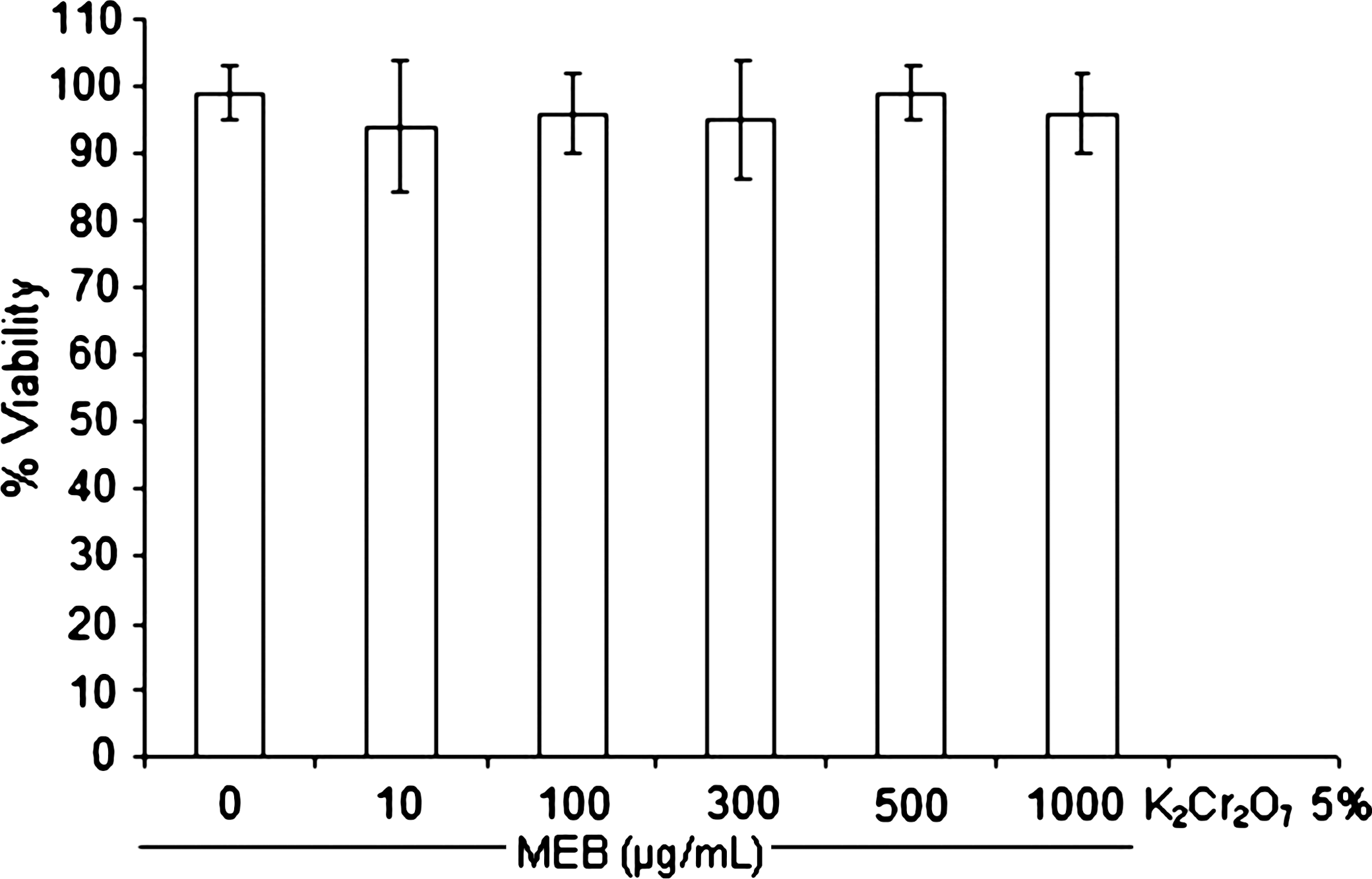
Lethality of a methanol extract of borage (MEB) for brine shrimp. The positive control contained 5% K2Cr2O7. Values are expressed as the mean±standard error (n=9). Viability is expressed relative to positive controls; P>0.05.
The methanol extract had an IC50 of 203.9 μg/mL for Vero cells, 6.2 times greater than the IC50 for E. histolytica (Fig. 3). Therefore, it is recommended 24 that borage should be consumed only for short periods because it contains liver-toxic pyrrolizidine alkaloids.
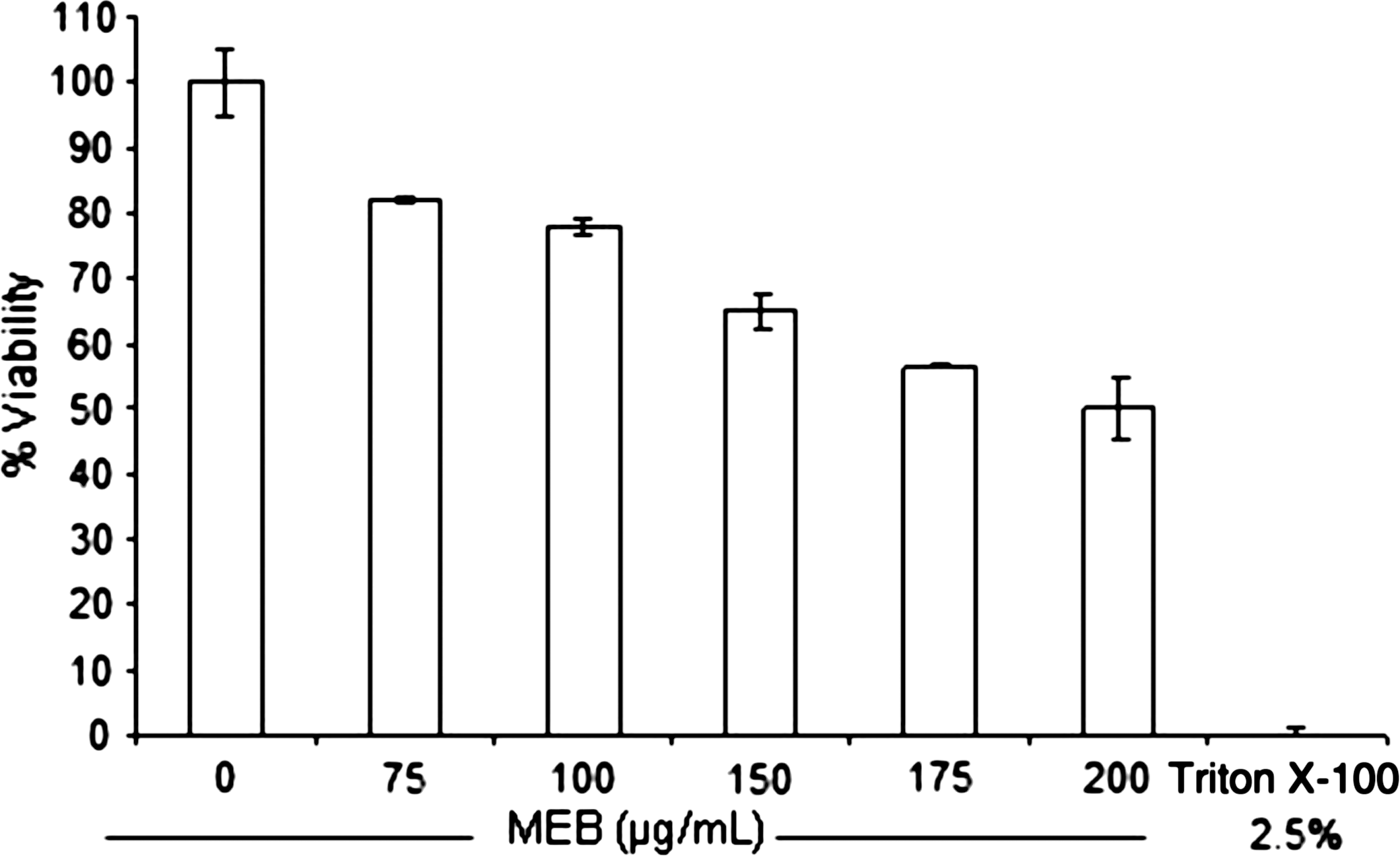
Cytotoxicity of a methanol extract of borage (MEB) for Vero cells. The positive control contained 2.5% Triton X-100. Values are expressed as the mean±standard error (n=9). Viability is expressed relative to positive controls treated with vehicle.
The extract contained lactones, alkaloids, and sugars, a composition consistent with a previous report 15 on the same species. The therapeutic potential of extracts made from plants of the Boraginaceae family, to which borage belongs, has been demonstrated and attributed to polar phytochemical compounds, such as phenolic compounds, quinones, and alkaloids. 25
The methanol extract of borage had considerable antiamoebic activity, low cytotoxicity for Vero cells, and no toxicity for A. salina. These results indicate that borage has potential for preventing gastrointestinal E. histolytica infection. Future research will focus on the isolation and identification of the agent or agents responsible for biological activity on E. histolytica.
Footnotes
Acknowledgments
This work is part of the doctoral thesis of Catalina Leos Rivas, which was supported by CONACYT scholarship no. 204599 and funded by the Universidad Autónoma de Nuevo León (project PAICYT-CA1502–07).
Author Disclosure Statement
The authors have no competing financial interests.