




Abstract
This study investigated the phenolic composition and antioxidant capacity of an ethanolic extract from the peel of the Annurca (Malus domestica var. Annurca), which is widespread in the Campania region of southern Italy. The antimicrobial effect of the extract on different pathogens was also examined. The potential antiquorum sensing activity of the extract was tested by using the microorganism Chromobacterium violaceum. Ultra-performance liquid chromatography revealed that rutin, epicatechin, dicaffeoylquinic acid, and caffeic acid were the most abundant phenolic compounds in the extract; these compounds constituted 27.43%, 24.93%, 16.14%, and 15.3% of the total phenols, respectively. The test for 2,2-diphenyl-1-picryl-hydrazyl free radical–scavenging activity showed that the extract possessed an impressive antioxidant capacity (50% effective concentration of 2.50 μg/g of product). Furthermore, the extract clearly exhibited antimicrobial activity against Bacillus cereus (11- to 14-mm diameter of inhibition halo, depending on the strain) and Escherichia coli serotype O157:H7 (10-mm diameter of inhibition halo). No activity was observed against the probiotic lactobacilli tested or against Staphylococcus aureus. Antiquorum sensing activity was reported for the first time for apple extracts. In conclusion, these results indicate the potential of this extract for treating some microbial infections through cell growth inhibition or quorum sensing antagonism, thereby validating the health benefits of apples.
Introduction
C
Evidence accumulating over the past few years indicates that numerous bacteria use cell-to-cell communication systems that rely on small signal molecules to express some phenotypic traits in a density-dependent manner. This regulatory principle is generally called quorum sensing. 11 Among gram-negative bacteria, the most intensely investigated signaling molecules are N-acyl-homoserine lactones. Given that many pathogens use N-acyl-homoserine lactone–mediated quorum sensing, higher organisms may have evolved strategies to disrupt these signaling pathways. The best example of a eukaryotic organism producing metabolites that specifically interfere with bacterial communication is the macroalga Delisea pulchra, which produces a range of metabolites known as halogenated furanones. 12 Polyphenolic compounds can interfere with bacterial quorum sensing. 13 Apple peel, in particular, is rich in phenolics compared with the apple flesh and core. 14,15 However, during manufacturing, such as in the production of applesauce, apple juice, or canned apples, large amounts of peel are discarded.
Therefore, the objective of our study was to evaluate some of the nutritional and biological qualities of peels obtained from the Annurca apple, a typical variety of apple found in Campania County in Italy, where this variety represents 60% of the region's apple production. Polyphenol content and composition, antioxidant activity, and antimicrobial properties against some probiotics (Lactobacillus) and against some pathogenic gram-positive and gram-negative bacteria were evaluated. Finally, the potential antiquorum sensing activity was tested by using the gram-negative Chromobacterium violaceum tester strain.
Materials and Methods
Extraction of polyphenols
Annurca apples (Malus domestica cv Annurca) were collected from an organic crop in the province of Naples, Italy, during the reddening stage. Three apples were carefully peeled and the peels stored at −26°C. Approximately 2.5 g of peel was incubated at 4°C with 25 mL ethanol for 2 hours. The extraction was carried out on a horizontal shaker. After centrifugation (11,600 g; Biofuge, Beckmann, California, USA), the supernatant was collected, dried, and re-suspended in 3 mL of sterile deionized water.
Polyphenol composition
Ultra-performance liquid chromatography (UPLC) analyses were carried out by using an ACQUITY Ultra Performance LCTM system (Waters) linked simultaneously to a PDA 2996 photodiode array detector (Waters). The ultraviolet-detection wavelength was set at 280 nm. Empower software (Waters) was used for controlling the instruments as well as for data acquisition and processing. The analysis was performed at 30°C by using a reversed-phase column (BEH C18, 1.7-μm, 2.1×100-mm; Waters). The mobile phase consisted of solvent A (7.5 mM acetic acid) and solvent B (acetonitrile) at a flow rate of 250 μL/min (Gruz et al. 16 ). Gradient elution was used starting at 5% solvent B for 0.8 minutes, 5–20% solvent B for 5.2 minutes, isocratic 20% solvent B for 0.5 minute, 20–30% solvent B for 1 minute, isocratic 30% solvent B for 0.2 minute, 30–50% solvent B for 2.3 minutes, 50–100% solvent B for 1 minute, isocratic 100% solvent B for 1 minute, and finally 100–5% solvent B for 0.5 minute. At the end of this sequence, the column was equilibrated under the initial conditions for 2.5 minutes. The pressure ranged from 6,000 to 8,000 psi during the chromatographic run. The effluent was introduced to a liquid chromatography detector (scanning range, 210–400 nm; resolution, 1.2 nm). The injection volume was 5 or 10 μL.
Colorimetric analysis of total phenolic compounds
Total phenolics were determined by following the methods of Singleton and Rossi 17 by using the Folin–Ciocalteu reagent. The absorbance was determined at room temperature at λ=760 nm by using a Cary Uv/Vis spectrophotometer (Varian Cary 50 MPR). Quantification was based on a standard curve generated with gallic acid. The results were expressed as μg gallic acid equivalents/g of a product.
Free radical–scavenging capacity
The free radical–scavenging activity was measured with the stable radical 2,2-diphenyl-1-picrylhydrazyl (DPPH). 18 The analysis was performed in microplates by adding 7.5 μL of extract to 303 μL of a DPPH methanol solution (153 mM). Then, the absorbance was spectrophotometrically measured (Varian) at λ=517 nm. The absorbance of DPPH without antioxidant (control sample) was used as a baseline measurement. The scavenging activity was expressed as the 50% effective concentration (EC50), which was defined as the sample concentration (μg/mL) necessary to inhibit DPPH radical activity by 50% after a 60-minute incubation.
These experiments were performed in triplicate, and the results are expressed as the mean±standard deviation.
Antimicrobial assays
The microorganisms used to determine antimicrobial activity from the ethanolic extract of the Annurca peels included the probiotic Lactobacillus strains L. acidophilus DSM 20079, L. bulgaricus DSM 20081, L. plantarum DSM 20174, and L. rhamnosus DSM 20711. Additionally, gram-positive Bacillus cereus (strains DSM 4313, DSM 4384, and GN105) and Staphylococcus aureus DSM 2592 and gram-negative Escherichia coli (strains HB101 and DSM 8579) were tested.
B. cereus GN105 and E. coli HB 101 were kindly provided by Professor Gino Naclerio of the University of Molise, Italy. The other strains were purchased from Deutsche Sammlung von Mikroorganismen und Zellkulturen GmbH. The lactobacilli were incubated for 18 hours in MRS (de Man, Rogosa, and Sharpe
Antiquorum sensing assay
The C. violaceum quorum sensing system was used for this assay. Quorum sensing in this wild-type strain of bacteria is known 19 to control the production of the purple pigment violacein in response to autoinducer molecules, such as C6-acyl homoserine lactones and C4-acyl homoserine lactones. The disc diffusion method was used to detect the antiquorum sensing activity of the ethanolic extract from Annurca peels. In this test, bacterial growth inhibition would result in a clear halo around the disc, while a positive result of quorum sensing inhibition would cause a turbid halo harboring the pigmentless bacterial cells of C. violaceum DSM 30191. 20 Cultures of C. violaceum were prepared by incubating the bacteria in nutrient broth (Oxoid) for 16–18 hours at 30°C. The cultures were adjusted to the 0.5 McFarland standard (1×10⁸ colony-forming units/mL). The ethanol extract from apple peels was dissolved in sterile deionized water. Different concentrations of the extract were added (from 1 to 100 μg) to C. violaceum–inoculated nutrient agar plates (0.1 mL per plate), and then the plates were incubated at 30°C for 24 hours.
Statistical analysis
All experiments were done in triplicate, and each sample was analyzed in duplicate. The results are expressed as means±standard deviations.
Results and Discussion
Figure 1 shows the profile of an ethanolic extract profile of peels from the Annurca apple. Phenolic acids (caffeic, ferulic, p-coumaric, dicaffeoylquinic, and chlorogenic acid), flavan-3-ols (epicatechin), and the flavonol quercetin and its derivative rutin were identified by comparing the retention times of the compounds to standards. To our knowledge, this is the first analysis of a polyphenol profile from Annurca apple peel extract obtained by UPLC. Overall, hydroxicinnamic acids represented 43.02% of the polyphenols identified by UPLC (Table 1). Rutin (339 μg/g) and epicatechin (309 μg/g) were the most abundant components, representing 27% and 24% of the phenolic composition, respectively, followed by dicaffeoylquinic and caffeic acid, which represented 16.1% and 15.3%, respectively.

Ultra-performance liquid chromatogram of ethanolic extract from peels of Annurca apples. The analytical conditions are described in Materials and Methods. AU, arbitrary units.
The peaks were identified on the basis of the relative standards. For some peaks, it was not possible to calculate the concentration.
ND, not detectable; SD, standard deviation.
Our data agree with results from D'Angelo et al., 21 which identified epicatechin and quercetin derivatives among the main o-diphenols present in the peel of the Annurca apple. However, our results contrast with those of Mari et al., 22 who found higher amounts of chlorogenic acid (3.87% in our extract) but lower levels of rutin. This discrepancy is probably due to diverse growing methods for the apples, as demonstrated by Fratianni et al. 15 Those researchers found different biochemical characteristics and biological properties between 2 organic and conventional crops of Annurca apples. The difference might also have been caused by the different geographic location where the apples were grown (S. Agata dei Goti-Benevento and Naples).
The high levels of rutin and epicatechin affected the total polyphenol content (1,660 gallic acid equivalents μg/g) obtained by spectrophotometric analysis. These molecules can be easily absorbed 21 and reach different tissues, plasma, and the gut, where these molecules not only affect the growth of some pathogens, as demonstrated by an in vitro study by Parkar et al., 23 but also act as potent metal chelators and free radical scavengers, thereby significantly influencing the function of various mammalian cellular systems. 24 The presence of rutin is of particular relevance. Similar to most polyphenols, rutin has strong antioxidant activity and plays a role in inhibiting some cancers. 25 Rutin is capable of reducing the extent of mitochondrial damage and also contributes to improving cardiac mitochondrial structure and function. 26 In addition, rutin can reduce oxidative stress in leukocytes in patients with rheumatoid arthritis. 27
Investigations of the cytotoxic, apoptosis-inducing, genotoxic, and protective effects of flavonoids in hepatic tumor cells suggested that an important biological activity of these compounds can contribute to human health through diet. 28,29 Flavonols, such as epicatechin, constitute an important part of the human diet and possess different biological activities, including antioxidant and anti-inflammatory properties. 30 Flavonols contribute to the beneficial effects of a diet rich in fruits and vegetables, and these compounds have beneficial effects for a wide range of diseases, from cardiovascular abnormalities to cancer and degenerative conditions. The intake of epicatechin was inversely associated with coronary heart disease, and epicatechin may be more bioavailable from apples than the amounts commonly found in teas. 1
The concurrent presence of different polyphenols in the extract and their natural combination were probably responsible for the potent antioxidant activity (EC50, 2.71 μg/mL), a property of relevant interest from a health standpoint. In healthy humans, the ingestion of antioxidant-rich foods induced vasodilatation via activation of the nitric oxide system, thereby providing a plausible mechanism for the protection that flavonol-rich foods provide against coronary events. 31 Furthermore, antioxidant activity has contributed to in vitro as well as in vivo anti-inflammatory, anti-ulcerogenic, anti-hypertensive, and anti-hepatotoxic activities. 5,6
Phenolic compounds are the subject of many anti-infection studies because of their antibacterial, antifungal, and antiviral activity. 32,33 These compounds can affect the growth and metabolism of bacteria by activating or inhibiting microbial growth. Different studies reported antimicrobial activity from the extracts of different apples and described the growth inhibition of specific polyphenols. Slight or no activity was found when extracts from the whole fruit of a Finnish apple variety were used against S. aureus, S. epidermidis, B. subtilis, Micrococcus luteus, and E. coli. 34 In contrast, extracts from Granny Smith and royal gala apples displayed activity against E. coli, Pseudomonas Aeruginosa, and S. aureus. 8
Table 2 lists the inhibition halos (in mm) caused by the phenolic extract from the Annurca peel. The extract did not exhibit any antimicrobial activity against any of the strains of probiotic lactic acid bacteria tested, at the concentrations used in this experiment (from 2 to 20 μg/disk). These results are particularly relevant because they take into account the fate of polyphenols at the gut level and the interactions of these compounds with the resident microflora. 23,25 Phenolic compounds are absorbed to a large extent and metabolized in the digestive tract. Several analyses have identified phenolic metabolism and distinguished between the combined metabolism mediated by the ileum, liver, and colon and the metabolism mediated by microflora in the colon. Phenolics that are not absorbed in the small intestine pass into the colon, where the compounds are hydrolyzed by the gut microflora. These compounds may also undergo further metabolism and degradation.
Results are shown as mean (±standard deviation) of the inhibition zone, in mm (n=3). Blank indicates that the experiment with tetracycline was performed only against pathogen, not against lactobacilli.
On the whole, all phenolic degradation products and metabolites are absorbed. The products can be methylated or conjugated to varying degrees, thereby exhibiting biological activity within the body 35,36 and affecting the intestinal microflora by encouraging the growth of beneficial bacteria. In contrast, the ethanolic extract from Annurca apple peels was capable of inhibiting the pathogenic strains B. cereus DSM 4313, 4384, and GN105, and 2 strains of E. coli (HB1010 and the enterohemorrhagic strain DSM 8579), with inhibition halos ranging from 6 to 14 mm. No inhibition of S. aureus was observed.
The different results for the 2 strains of B. cereus led us to hypothesize that the activity of polyphenols could be strain dependent. This hypothesis, which has also been proposed in previous work, 15 might be supported by the different inhibitory activity of the apple extract against 2 strains of E. coli (HB101 and DSM 8579). The highest amount of extract provoked the formation of an inhibition halo of 13 mm when it was tested against E. coli HB101. Conversely, the same amount of extract caused an inhibition halo of 10 mm against E. coli DSM 8579.
When single phenolic compounds in the apple peel were assayed to evaluate their Antiquorum sensing activity at concentrations that were chromatographically determined from the total extract, no antiquorum sensing activity was detected. Conversely, the whole extract produced antiquorum sensing activity; a pigmentless halo formed after treatment with 20 μg of phenolic extract, and it was still evident after 50-μg treatment (Figure 2). No antiquorum sensing activity was observed with 10 μg of extract. This observation supports the idea of a synergistic or combinatory effect between the molecules in the extract that results in anti-pathogenic antiquorum sensing activity. On the basis of this concept, low concentrations of several bioactive compounds (which naturally occur in food) could be more efficient in preventing diseases than single molecules at higher concentrations. 1,7,21,22
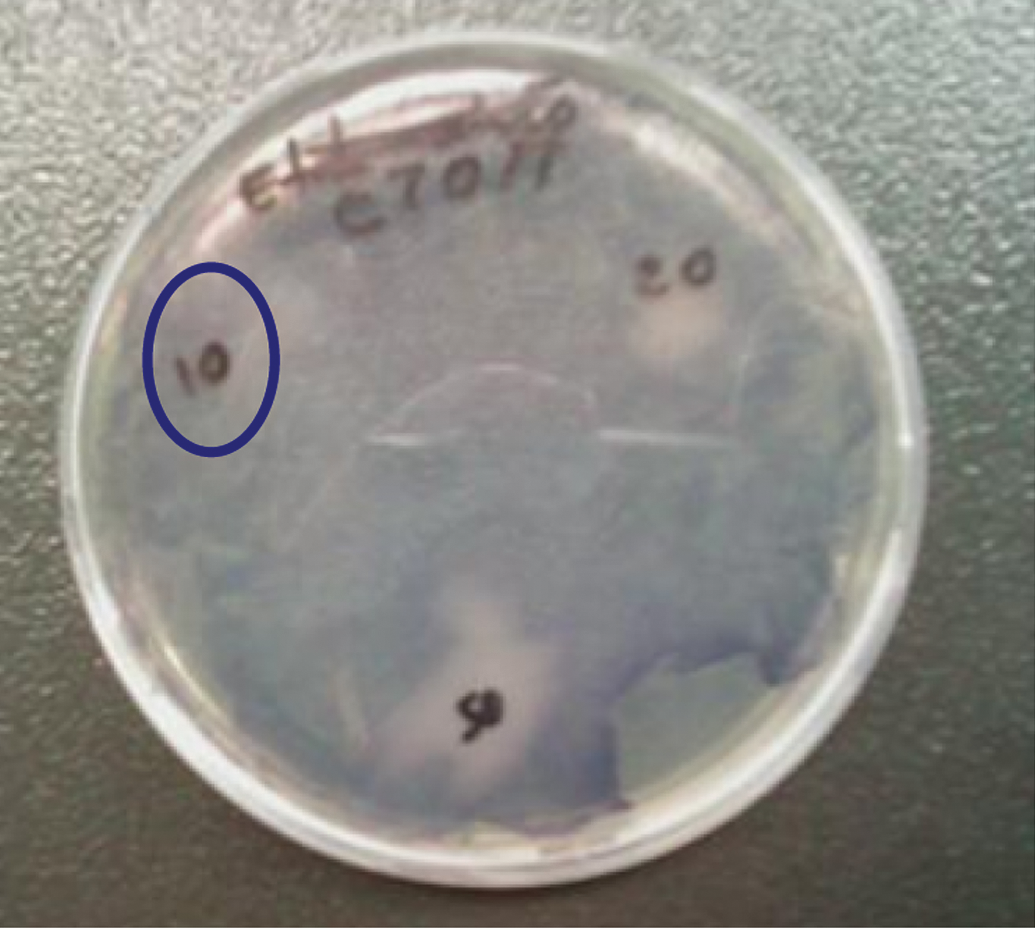
antiquorum activity exhibited by ethanolic extract from peels of Annurca apples at concentrations of 20 and 50 μg, evaluated by using the Chromobacterium tester strain. An amount of 10 μg (indicated by the blue circle) did not result in anti-quorum sensing activity. Color images available online at
Our data agree with previous results that indicated antiquorum sensing activity for various vegetable extracts. 20,37,38 The results clearly indicate that the extract of Annurca peels has substantial antiquorum sensing capacity, and some antibacterial activity, coupled with a high phenolic content and strong antioxidant activity. These results strengthen the concept of the important role for polyphenols. These compounds are not only a potential natural way for controlling microbial pathogenesis in plants but could also be used for medicinal and dietary purposes to limit microbial gene expression related to different human infections and food spoilage. Polyphenols could be used to prevent food spoilage, biofilm formation, and food-borne pathogens, a use that has been demonstrated for other quorum sensing systems; 39,40 polyphenols could also lead to the development of a new category of safe antibacterial drugs and dietary strategies with minimal risk for antibiotic resistance.
Future studies will focus on better identifying the mechanisms associated with phytochemicals and the ability of these compounds to interfere with quorum sensing activity.
Footnotes
Acknowledgment
This work was partially supported by the “SALVE” project for the safeguard of vegetal biodiversity (Fund Rural Development Policy PSR 2007-2013, call 2.14, of the Campania region, Italy).
Author Disclosure Statement
No competing financial interests exist.