




Abstract
In vivo antinociceptive and in vitro radical scavenging and cytotoxic activities of Acanthus hirsutus Boiss. aqueous extract were investigated to give a new insight into plant usage in traditional medicine. The extract showed significant antinociceptive activity in acetic acid–induced writhing test in mice after oral application and did not change the hind-leg retraction period in the hot-plate test for any dose applied. In addition, the extract showed radical-scavenging activity against 2,2-diphenyl-1-picryl-hydrazyl, nitric oxide, and superoxide radicals similar to those of standard compounds 3-t-butyl-4-hydroxyanisole, ascorbic acid (vitamin C), and quercetin. The gallic acid equivalent total phenolic content of the plant was found to be 65.4 mg/g dry extract. Cytotoxic activity of the aqueous extract was tested against 3 different cancer cell lines—Hep-2 (human larynx epidermoid carcinoma), RD (human rhabdomyosarcoma), and L20B (transgenic murine L cells)—and 1 noncancerous cell line (VERO) using the 3-(4,5-dimethylthiazol-2-yl)-2,5-diphenyltetrazolium bromide method. Through the phytochemical studies, the following compounds were isolated: 3 lignan glucosides [(–)-syringaresinol-di-O-β-glucopyranoside, (–)-medioresinol-di-O-β-D-glucopyranoside, (–)-pinoresinol-4′-O-β-glucopyranoside], 2 benzoxazinoids [2-hydroxy-1,4-benzoxazin-3(4H)-one, (2R)-2-O-β-glucopyranosyl-1,4-benzoxazin-3(4H)-one], 4 phenylethanoid glycosides (acteoside, leucosceptoside A, martynoside, hattushoside), and 2 phenylpropanoid glucosides (sinapyl aldehyde-4-O-β-glucopyranoside, sinapyl alcohol-4-O-β-glucopyranoside). Cytotoxic and radical-scavenging activities of the isolated compounds were also determined. 2-hydroxy-1,4-benzoxazin-3(4H)-one and acteoside were the most active compounds in both experiments.
Introduction
A
Bioactivity research on the genus Acanthus concentrates on analgesic, anti-inflammatory, antipyretic, hepatoprotective, and anticarcinogenic properties of aqueous extracts of these plants. 3,8 –10 A. montanus has shown muscle-relaxing effects in addition to centrally and peripherally mediated analgesic effects. 2,10 Teratogenic activity of A. montanus was also tested, and its MeOH/CH2Cl2 extract was found to be nonteratogenic and suitable during pregnancy. 9 Alcoholic extract of A. ilicifolius inhibited the formation of oxygen-derived free radicals in vitro and was found to be hepatoprotective. The same extract was also effective against tumor progression and carcinogen-induced formation of skin papilloma in mice. 2,8 The constituents of the genus were previously investigated and several types of compounds were isolated, particularly benzoxazinoids, phenylethanoids, lignans, flavonoids, aliphatic alcohol glycosides, and polysaccharides. 12,13 Different potent biological activities and rich phytochemical content of the genus Acanthus make the genus interesting from these perspectives.
We sought to test antinociceptive activity of the aqueous extract by using thermal and chemical nociception models. In addition, radical-scavenging activities against nitric oxide (NO), superoxide (SO), and 2,2-diphenyl-1-picryl-hydrazyl (DPPH) radicals and cytotoxic activities against 3 different cancer cell lines (Hep-2 [human larynx epidermoid carcinoma], RD [human rhabdomyosarcoma], and L20B [transgenic murine L-cells]) and noncancerous VERO cells (African green monkey kidney epithelial cells) using the 3-(4,5-dimethylthiazol-2-yl)-2,5-diphenyltetrazolium bromide (MTT) method were also investigated. To identify the chemical content of the plant, total phenolic concentration and phytochemistry of the aqueous extract were determined. Through phytochemical studies, 11 compounds were isolated and their radical scavenging and cytotoxic activities were established. To our knowledge, there are no reported studies of A. hirsutus relating these properties to any biological activity or any chemical composition.
Material and Methods
Plant material
The aerial parts of the plant were collected from the Middle East Technical University Forest in June 2004. A voucher specimen has been deposited in the Herbarium of the Faculty of Pharmacy, Hacettepe University, Ankara, Turkey (HUEF 02047).
Animals
Male Swiss albino mice, age 2–4 months and weighing 25–40 g, were used in the experiments. Animals were obtained from the inbred colony of the Laboratory Animal Husbandry Facility of the Department of Pharmacology, Hacettepe University, Faculty of Medicine. They were maintained in a room where temperature (mean±standard deviation, 24±2°C) and relative humidity (55%±15%) were kept within constant limits, with a light/dark cycle of 12 hours/12 hours (lights came on at 07:00 hours). Rats had ad libitum access to tap water (via a drinking bottle) and consumed standard pellet dairy chow (Korkutelim Feed Industry, Antalya, Turkey). Food was withdrawn 1 day before the experiment; however, water was available throughout the fasting period. Groups of 6 mice were used for each dose of the drugs; during the experiments, mice were housed in individual cages for clear observation. Experiments were always carried out between 12:00 and 18:00 hours.
All procedures involving animals were done in accordance with the guidelines and international rules concerning animal experiments and rights about biodiversity. The Guiding Principles in the Care and Use of Laboratory Animals and the Recommendations from the Declaration of Helsinki were strictly adhered to during the execution of all the procedures described here. This project was approved by the institutional Experimental Animal Care and Use Ethics Committee of Hacettepe University (approval no. 2008/13-1) before the commencement of any intervention.
Reagents and drugs
Acetylsalicylic acid (ASA), MTT, morphine sulfate, and carboxymethyl cellulose (CMC) were purchased from Sigma (St. Louis, Missouri, USA). DPPH, nitro blue tetrazolium, sodium nitroprusside, Folin–Ciocalteu reagent, gallic acid, and ascorbic acid were obtained from the Sigma-Aldrich Chemical Co. 3-t-butyl-4-hydroxyanisole (BHA) was purchased from the Nacalai Tesque Co. (Kyoto, Japan). Sulfanilamide and napthylethylenediamine dihydrochloride were obtained from Merck & Co. (Darmstadt, Germany). The following drugs were used: ASA, 150 mg/kg; morphine sulfate, 5 mg/kg; CMC; aqueous A. hirsutus extracts (obtained from specimens explained earlier) at 50, 100, 200, 400, and 800 mg/kg; and acetic acid (0.6%). The drugs were dissolved in saline and were administered intraperitoneally in a volume of 10 mL/kg of body weight. The control mice received saline, and the standard drug group received ASA or morphine alone.
Cell lines and cell culture media
Fetal bovine serum and a minimal essential medium with Earl's salts with nonessential amino acids and antibiotics (penicillin and streptomycin) were obtained from Biochrom AG (Berlin, Germany). Trypsin (1:250) was purchased from Biochrom KG (Berlin, Germany). Media were supplemented with 10% fetal calf serum, 100 U/mL penicillin, and 100 μg/mL streptomycin. Hep-2, RD, L20B, and VERO cells were provided by the Refik Saydam Hygiene Center and Ankara University Faculty of Veterinary Medicine.
Preparation of herbal extracts
The air-dried aerial parts of the plant (360 g) were extracted with MeOH at 40°C for 12 hours (3×2 L). The MeOH solutions were evaporated under vacuum to yield MeOH extract (43 g). The MeOH extract was dissolved in water and partitioned with petroleum ether to remove chlorophylls. The water fraction was lyophilized to yield 30 g dry weight. The water extract was tested for antinociceptive, cytotoxic, and radical-scavenging activities.
Antinociceptive effect
Application of drugs and extracts
The extracts were given to mice, which had fasted for 1 day, with gastric gavage equipment. ASA (150 mg/kg) was used as a reference drug. ASA and CMC were given orally at 10 mL/kg body weight. Thirty minutes after oral administration of test samples, the mice were intraperitoneally injected with acetic acid and morphine, 10 mL/kg body weight. Control animals received vehicle in appropriate volumes compared with drugs. 14
Thermal nociception model
A hot-plate system with a surface temperature of 52°C and an integrated contact thermometer were used. Each mouse was placed individually on a hot plate, and hind-leg retraction time (in seconds) was used as a reference for the sense of thermal pain. To avoid confusion with the animal's normal behavior, hind-leg retraction was taken as a nociceptive measure. An automatic 30-second cutoff was used to prevent tissue damage. Several hot-plate records of animals were taken as values for the control group before drug or extract application to avoid individual difference in nociception. The control group contained the same animals as before drug injection. 15
Chemical nociception model
Acetic acid (0.6%) was applied intraperitoneally to induce writhing (abdominal constrictions consisting of the contraction of abdominal muscle together with a stretching of the hind limbs). The number of writhes between 5 and 20 minutes of acetic acid injection was counted for each animal. Presented data indicate the average of the total number of writhes observed and the antinociceptive activity is presented as a percentage difference from the control group's writhings. Saline was injected to the control group to prevent any possibility of interference on the results by irritation caused by intraperitoneal injection. 16
Toxicity
Mortality or the development of serious complications was recorded during experiments and the following 7 days. In addition, possible neurotoxic effects of the extract were checked with a Rotarod device (12 rpm).
Antioxidative activity
DPPH radical scavenging activity
The free radical–scavenging effect of Acanthus extracts and isolated compounds 1–11 was assessed by the decoloration of a methanol solution of DPPH spectroscopically; BHA, ascorbic acid, and quercetin were used as standards. Each MeOH solution (100 μL) of compounds 1–11 at various concentrations was added to a DPPH/MeOH (80 μg/mL) solution. The reaction mixture was shaken vigorously and the absorbance of the remaining DPPH was measured at 520 nm after 30 minutes. The radical-scavenging activity was determined by comparing the absorbance with that of a blank (100%) containing only DPPH and solvent. All the analyses were done in triplicate. 17 –20
SO radical–scavenging activity by alkaline dimethyl sulfoxide (DMSO) method
The method of Elizabeth and Rao 21 was used to detect SO radical–scavenging activity of the extract, with slight modification. Briefly, an SO radical was generated in a nonenzymatic system. The reaction mixture containing 10 μL of nitro blue tetrazolium (1 mg/mL solution in DMSO) and 30 μL of the extract or standard compounds was dissolved in DMSO. A total of 100 μL of alkaline DMSO (1 mL DMSO containing 5 mM NaOH in 0.1 mL water) was added, to yield a final volume of 140 μL. The absorbance was measured at 560 nm by using a microplate reader. 21,22
NO- scavenging activity
To determine the NO radical–scavenging activity of A. hirsutus water extract, 60 μL of a serial diluted sample was added to a 96-well flat-bottomed plate. After this, 60 μL of 10 mM sodium nitroprusside, dissolved in phosphate-buffered saline, was added to each well and the plate was incubated under light at room temperature for 150 minute. Finally, an equal volume of the Griess reagent (1% sulfanilamide, 0.1% napthylethylenediamine dihydrochloride, 2.5% H3PO4) was added to each well in order to measure the nitrite content. After chromophore was formed at room temperature in 10 minutes, absorbance at 577 nm was measured on a microplate reader. 18,23,24
Estimation of total phenol content
Antioxidant compounds generally contain phenolic groups, and the amount of phenolic compounds in the extract was estimated by using the Folin–Ciocalteu reagent. Briefly, a 10 μL sample or standard (50–500 mg/L gallic acid) plus 150 μL diluted Folin–Ciocalteu reagent (1:4 reagent:water) were placed in each well of a 96-well plate and incubated at room temperature for 3 minutes. After the addition of 50 μL sodium carbonate (2:3 saturated sodium carbonate:water) and further incubation of 2 hours at room temperature, absorbance was read at 725 nm. The total phenolic content was expressed as gallic acid equivalents in milligrams per gram of extract. All tests were conducted in triplicate. 25,26
Cytotoxic activity
Cell suspensions (0.1 mL) of cancer cells were seeded into 96-multiwell plates at a concentration of 1×10⁵ cells/mL for Hep-2 and 2×10⁵ cells/mL for RD, L20B, and VERO cells and were cultured for 24 hours. Cells were incubated with various concentrations of the test samples in a humidified 5% CO2 incubator at 37°C for 48 hours (0–800 μg/mL for extract, 0–200 μg/mL for compounds). After incubation, the cells were washed and replaced by fresh medium. MTT solution, 10 μL (5 mg/mL in phosphate-buffered saline), was added and incubated for 4 hours. After the incubation, 100 μL of 10% sodium dodecyl sulfate was added to each well to dissolve the formed formazan. The absorbance was measured at 577/655 nm by using a microplate reader. 18,27
Statistical analysis
Data are expressed as arithmetic mean number of experiments±standard error. Differences between the means were analyzed by using the Mann–Whitney U test. The difference was considered statistically significant when the P value was less than .05. Graphics and statistics were prepared at GraphPad Software Prism 3.0 and Microsoft Excel.
Results
Preparation of the aqueous extract and the isolation of compounds
The methanol extract of A. hirsutus was suspended in water and partitioned with petroleum ether. The water fraction of the methanol extract was used for phytochemical and biological studies. Repeated-column chromatography of the aqueous extract (RP, silica gel, and Sephadex LH-20) resulted in the isolation of 11 compounds in pure form. Their structures were identified as follows: 3 lignan glucosides [(–)-syringaresinol-di-O-β-D-glucopyranoside [
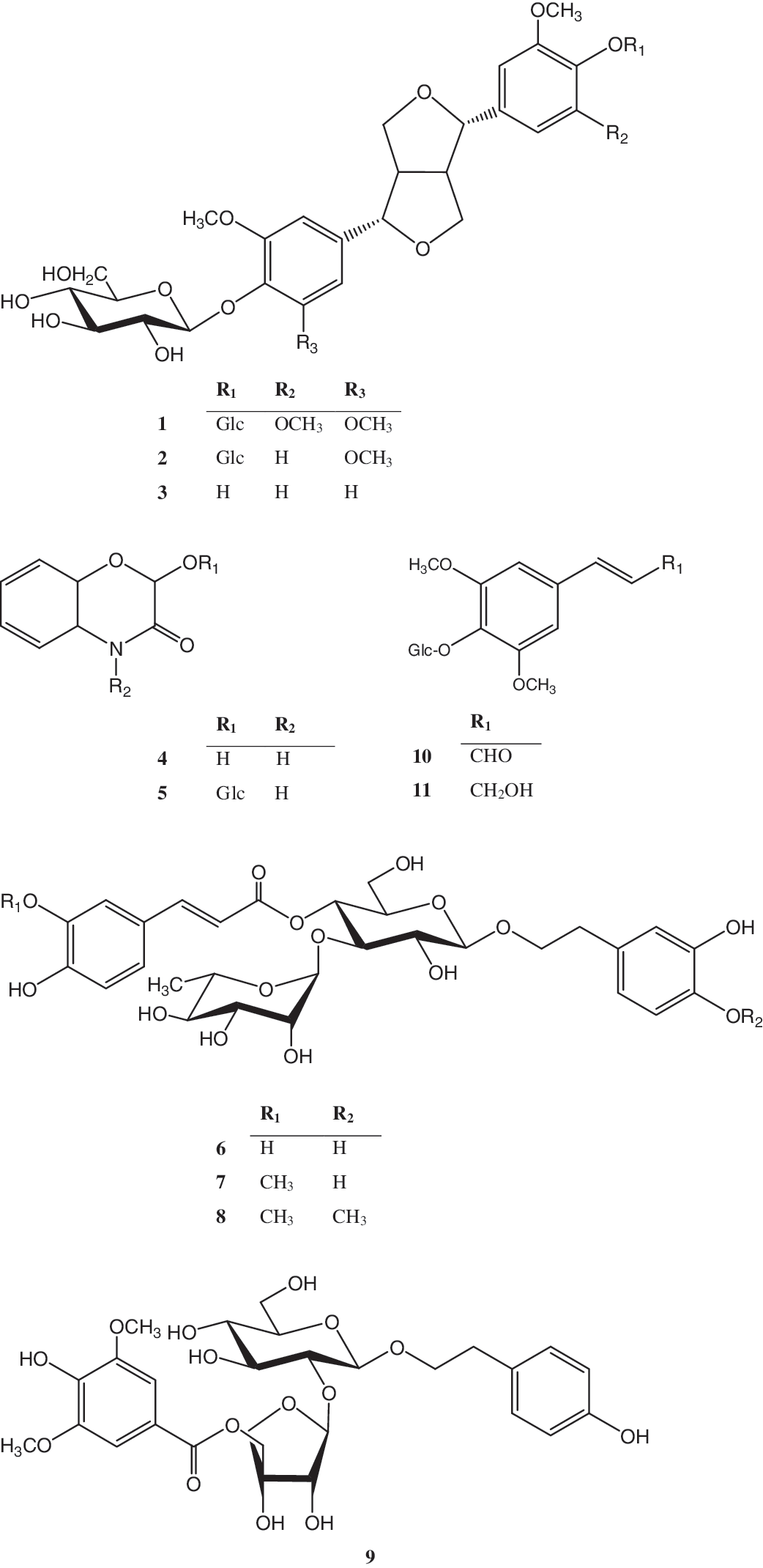
Isolated compounds from Acanthus hirsutus.
Antinociceptive effect
Effects of aqueous A. hirsutus extract on the acetic acid–induced writhing test
Abdominal contractions started immediately after the injection of acetic acid. After 5 minutes of delay, records were counted and maximum activity was observed between 5 and 20 minutes. The number of writhes observed during this period declined gradually. Animals completely recovered without a significant sign of defect after a period of time after the experiment. ASA was highly effective in avoiding the number of writhes and inhibited the number of writhes (44.4%). The methanol extract of A. hirsutus was suspended in water and partitioned with petroleum ether. Water extract showed altered activities in the chemical nociception method. The extract represented a significant reduction in the number of writhes compared with the acetic acid group starting from 200 mg/kg. This reduction (antinociceptive activity) is dose dependent and possesses a maximum activity at 800 mg/kg (55%; P<.05). This was the lowest reduction among all the materials tested in these experiments, including all drugs except morphine, which caused 100% inhibition at a 5-mg/kg dose. Although the number of writhes slightly increased in the 400-mg/kg group compared with the 200-mg/kg group, this increase is within the standard deviation of the latter group and is not statistically significant. The extract showed dose-dependent antinociceptive activity in acetic acid–induced writhes in mice. The most prominent activity was observed at the 800-mg/kg dose, which was found to be more potent than the nonsteroidal anti-inflammatory drug ASA. Analgesic activity was statistically significant (P<.05) when compared with the control and CMC groups (n=6) (Table 1).
P<.05 vs. acetic acid.
ASA, acetylsalicylic acid; CMC, carboxymethyl cellulose; NA, not applicable; SE, standard error.
Effects of aqueous A. hirsutus extract on hot-plate test
In the thermal nociception method, animals react to surface temperature of the hot plate. After the introduction of the different concentrations of the extract, the results of standard drugs and vehicles were recorded. In contrast to the results of the writhing test, there were no significant differences between the extract (100, 200, and 800 mg/kg) and the vehicle. No meaningful trends were observed in the time course of the hot-plate test. The nonsteroidal anti-inflammatory drug ASA also did not change the hind-leg retraction period. Morphine was potent in this test and caused a change in leg reaction time after time (Table 2).
P<.05 vs. control.
ASA, acetylsalicylic acid; CMC, carboxymethyl cellulose; NA, not applicable; SE, standard error.
Toxicity of A. hirsutus
To assess the possible toxic effects of the water extract of A. hirsutus, we observed the animals for 7 days. All animals survived without any noticeable signs of toxicity or complications. These animals did not display any abnormality in their gait and posture and were able to stay on the Rotorod longer than 1 minute at 12 rpm, which indicates the lack of neurotoxicity.
Antioxidant activity
The involvement of free radical–mediated cell damage in inflammatory diseases and high radical contents in cancerous tissue and organs prompted us to determine radical-scavenging activity of A. hirsutus water extract, along with its cytotoxic activity against different cancer cell lines. The radical-scavenging activity of the aqueous extract of A. hirsutus was screened against DPPH, NO, and SO radicals. The aqueous A. hirsutus extract showed dose-dependent radical-scavenging ability against DPPH, NO, and SO radicals similar to those of standard compounds BHA, ascorbic acid, and quercetin (Table 3). Its radical scavenging effect was found relatively high against DPPH radical, with a 50% inhibitory concentration (IC50) value of 86.3 μg/mL, comparing with those of NO (1.25 mg/mL) and SO (221.62 μg/mL) radicals. As seen in Table 3, isolated phenylethanoid glycosides showed potent scavenging activity against the DPPH radical, and this activity decreased with CH3 substitution (Fig. 1). The radical-scavenging activity of acteoside (compound
AA, ascorbic acid; BHA, 3-t-butyl-4-hydroxyanisole; IC50, 50% inhibitory concentration; NA, no activity; NT, not tested because of the limited samples available.
The NO and SO radical–scavenging activities of A. hirsutus were established in comparison with those of ascorbic acid, quercetin, and BHA. NO is a very unstable species under aerobic conditions. It reacts with O2 to produce its stable product nitrate and nitrite through intermediates NO2, N2O4, and N3O4. 21 The NO-scavenging effect of aqueous A. hirsutus extract was determined by using the Griess reagent. It showed dose-dependent NO-scavenging activity that is very close to that of ascorbic acid. The IC50 values were found to be 1256.88 μg/mL for A. hirsutus, 659.1 μg/mL for quercetin, 306.6 μg/mL for BHA, and 1250.03 μg/mL for ascorbic acid. Although high IC50 values indicate moderate NO-scavenging activity for A. hirsutus extract, it is important to note that close IC50 values of the extract and ascorbic acid were found in the tested experiment. On the other hand, nitro blue tetrazolium assay was carried out to test whether extracts of A. hirsutus scavenge SO anions. Alkaline DMSO, used as an SO-generating system, reacts with nitro blue tetrazolium to give colored diformazan. The SO radical–scavenging activity of A. hirsutus was determined from the concentration of 25 μg/mL with 24.09% inhibition. The IC50 values were 221.62 μg/mL for water extract of A. hirsutus, 108.3 μg/mL for ascorbic acid, and 306.64 μg/mL for BHA. Because SO anions are the most common free radicals in vivo, the concentration of SO anions is very important under conditions of oxidative stress.
The preceding investigations indicated the presence of phenolic compounds in the extract, such as flavonoids, phenylethanoids, and lignans. As a result of the isolation studies, 11 compounds were isolated, 9 of which have phenolic structure. These results prompted us to determine total phenolic content of the extract. The total phenol assay by the Folin–Ciocalteu reagent has been extensively used to measure the total phenolics in plant materials for many years. This assay is based on electron-transfer reaction and actually measures a sample's reducing capacity. Therefore, it is accepted as a routine assay for rough estimation of the antioxidant capacity of herbal samples. Here, total phenolic content of the aqueous A. hirsutus extract was 65.4 mg/g dry extract.
Cytotoxic activity of aqueous A. hirsutus extract and isolated compounds on Hep-2, RD, L20B, and VERO cell lines
The aqueous A. hirsutus extract and isolated compounds were tested for their cytotoxic activity against the Hep-2, RD, and L20B cancer cell lines. In addition, the noncancerous VERO epithelial cell line was used to examine the selectivity of the effect. Although aqueous A. hirsutus extract showed moderate cytotoxicity against tested cell lines, acteoside and 2-hydroxy-1,4-benzoxazin-3(4H)-one showed significant cytotoxicity (Table 4). In addition, acteoside and 2-hydroxy-1,4-benzoxazin-3(4H)-one showed cytotoxicity against VERO cells at higher concentrations than of cancer cells (121.2 μg/mL and 105.2 μg/mL, respectively).
Cells were incubated for 48 hours with various concentrations of the extract and compounds. After incubation, viability was determined by the 3-(4,5-dimethylthiazol-2-yl)-2,5-diphenytetrazolium bromide method. IC50 values for other tested compounds higher than 200 μg/mL are not shown in the table. Each value represents the mean of 6 wells.
Discussion
Acanthus hirsutus is a plant endemic to Turkey that is widely used to treat painful disorders. We found that A. hirsutus has antinociceptive activity that is augmented with increasing dosages. Activity was observed starting at 200 mg/kg and was similar to that of the nonsteroidal anti-inflammatory drug ASA. However, the contrasting result observed in the hot-plate experiment emphasizes that this antinociceptive activity is not a central one. Rather, it has a peripheric analgesic character similar to that of nonsteroidal anti-inflammatory drugs. Our results are consistent with a previous study on Acanthus species, which also revealed this peripheric analgesic character. 33 Because no loss of function or balance was recorded on the Rotorod tests, these antinociceptive results can be linked with analgesic properties of the extract.
The radical-scavenging effect of the plant was tested against DPPH, NO, and SO radicals to clarify the biological activity of plant. Previously, the methanolic extract of A. ilicifolius leaves was found to possess significant free radical–scavenging activity against DPPH, 2,2′-azino-bis(3-ethylbenzthiazoline-6)-sulphonic acid, SO, hydroxyl, NO, and lipid peroxide formation.
3,9
In the present study, the aqueous extract of A. hirsutus showed DPPH radical–scavenging ability, with an IC50 of 86.3 μg/mL. The examination of scavenging activity of isolated compounds demonstrated that acteoside (compound
Oxidative stress is characterized by a significantly increased concentration of intracellular oxidizing species, such as reactive oxygen species, and is often accompanied by the simultaneous loss of antioxidant defense capacity. Many diseases and degenerative processes can be associated with the overproduction of reactive oxygen species, including inflammation, brain ischemia, mutagenesis, cancer, dementia, and physiologic aging. Effective antioxidants able to counteract oxidative stress are therefore becoming increasingly important in disease prevention and therapy. 34 Previously, the alcoholic extract of A. ilicifolius was effective against tumor progression and carcinogen-induced skin papilloma formation in mice. 10 This study makes the genus interesting from the viewpoint of anticancer research. Although aqueous extract showed moderate cytotoxicity against tested cell lines, the isolated compounds acteoside and 2-hydroxy-1,4-benzoxazin-3(4H)-one showed significant cytotoxicity against tested cancer cell lines, thereby supporting previous results. 35,36 Their cytotoxic activities on cancer cells were stronger than that of noncancerous cell. This difference is important for the selective effect of compounds between cancer cells and normal cells. Table 3 shows antioxidative effects of the isolated compounds.
The free radical hypothesis supported the fact that the antioxidants can effectively inhibit carcinogenesis, and the observed effect may be attributed to the radical scavenging effect of the acteoside (compound
Footnotes
Acknowledgments
Alper B. Iskit has been supported by the Turkish Academy of Sciences in the framework of the Young Scientist Award Program (Aİ-TUBA-GEBIP/2001-2-11). This study was financially supported by Hacettepe University Research Foundation (no. 0202301007 and no. 0302301010) and the Scientific and Technological Research Council of Turkey (no. 108T518).
Author Disclosure Statement
No competing financial interests exist.