




Abstract
This study evaluated, in vitro, the antimicrobial activity of the hexane extract (JCHE), methanol extract (JCME), and chloroform fraction (JCCF) of bark from Jacaranda cuspidifolia Mart. (Family Bignoniaceae), a Brazilian medicinal plant, traditionally used as anti-syphilis and anti-gonorrhea treatment. The antimicrobial activity was evaluated using the disc diffusion method followed by the determination of minimum inhibitory concentration (MIC) values. JCHE was not active against the bacteria evaluated. JCME presented antibacterial activity against Streptococcus pyogenes, Staphylococcus aureus, and Neisseria gonorrhoeae with MIC values of 16.3 mg/mL, 9.1 mg/mL, and 25.2 mg/mL, respectively. JCCF was active against Staphylococcus epidermidis, S. aureus, Proteus mirabilis, Serratia marcescens, S. pyogenes, Enterobacter aerogenes, and N. gonorrhoeae with MIC values of 18.3 mg/mL, 9.3 mg/mL, 6.3 mg/mL, 6.1 mg/mL, 9.2 mg/mL, 6.2 mg/mL, and 25.2 mg/mL, respectively. Phytochemical analysis of JCME and JCCF gave positive results for saponins, coumarins, flavonoids, tannins, quinones, alkaloids, triterpenes, and steroids. Verbascoside was isolated and identified as a major peak in JCME and JCCF high-performance liquid chromatography fingerprints and might contribute to the observed antimicrobial activity.
Introduction
M
Venereal diseases, also referred to as sexually transmitted diseases, are infections that are usually obtained during sexual intercourse and present a common and serious problem worldwide. The World Health Organization estimates that, globally, more than 340 million new cases of syphilis, gonorrhea, Chlamydia, and trichomoniasis occur every year in men and women between 15 and 49 years old. 3 The largest number of new infections occurs in South and Southeast Asia, followed by sub-Saharan Africa, Latin America, and the Caribbean, and the most reported venereal diseases are gonorrhea and syphilis. 4 Furthermore, there is an increase of opportunistic infections, especially with AIDS patients and individuals on immunosuppressive chemotherapy, and the prescriber should take account that several antibiotic drugs are of limited use because of toxicity.
Jacaranda cuspidifolia Mart. (Family Bignoniceae) is an ornamental tree with attractive foliage and flowers commonly cultivated in gardens, known in Brazil as jacaranda, caroba, or bolacheira. This species is used in Brazilian folk medicine for blenorrhagy, skin ulcers, and anti-syphilis and anti-gonorrhea treatment, as well as pectoral and vulnerary remedies. 5 Some medicinal Bignoniaceae species have been part of the human diet for many years and have dual functions as foods. Leaves and stems of Oroxylum indicum are edible, and the plant presents antioxidant and antimutagenic activities. 6 The fruits of Parmentiera edulis are edible and have a pleasant flavor. The Mexican population uses these fruits as an antidiabetic agent. 7
The Bignoniaceae family possesses 120 genera with around 750 species generally found in tropical regions. 8,9 The genus Jacaranda presents approximately 34 species considered endemic in South America, 10 but there is a lack of knowledge about chemical composition and/or biological activity potential for most of them.
Studies have been shown that extracts of some Jacaranda species present antimicrobial action against several bacterial and fungal strains. 10 –14 Jacaranda mimosaefolia extracts presented antimicrobial activity against Staphylococcus aureus, Staphylococcus epidermidis, Escherichia coli, Saccharomyces cerevisiae, and Bacillus cereus 15,16 and were active against Mycobacterium phlei. 13 Jacaranda mimosoides extracts showed activity against Salmonella typhi and Shigella dysenteriae. 17 Jacaranda acutifolia extract inhibited Xanthomonas campestris growth. 18
Considering that Jacaranda cuspidifolia Mart. occurs in an ecosystem with a high degree of endemism and its ethnomedicinal uses, it is feasible to infer that the plant should be a potential source of bioactive compounds. In the present work, we describe antimicrobial activity of extracts and fractions from this species. Based on the high-performance liquid chromatography (HPLC) fingerprint obtained for J. cuspidifolia, the compounds that might contribute to the observed activity are also discussed.
Materials and Methods
Plant materials
J. cuspidifolia Mart. was collected in the state of Mato Grosso do Sul, Brazil (20°26′S, 55°47′W O), in November 2005. An exsicate was deposited at the herbarium of the Universidade Federal de Mato Grosso do Sul (voucher number UFMS 11923) and identified by Professor Ubirazilda Maria Resende.
Plant material extraction and preliminary fractionation
A powdered dry bark specimen from J. cuspidifolia Mart. (2,000 g) was separately extracted by exhaustive maceration using hexane followed by methanol as solvents. After filtration, the solvents were evaporated under reduced pressure at 40°C, yielding hexane (JCHE) and methanol (JCME) crude extracts. The dry methanol bark extracts (20 g) were suspended in water (20 mL) and sequentially partitioned with CHCl3/H2O (1:1; 100 mL). Solvents were removed in a rotatory evaporator at 40°C. The percentage extraction rates of JCHE, JCME, and chloroform fraction from J. cuspidifolia (JCCF) were 0.16%, 7.65%, and 12.65%, respectively.
HPLC characterization of JCME and JCCF
Analyses were carried out on a Waters Chromatography (Milford, MA, USA) 2995 system composed of a quaternary pump, autosampler (model 2695), photodiode array detector (model 2996), and Empower software for data processing. An ODS C-18 LiChrospher® (125×4.0 mm i.d.; particle size, 5 μm; Merck, Darmstadt, Germany) was used at a temperature of 40°C and flow rate of 1.0 mL/minute. Ultraviolet (UV)-photodiode array detection was performed at λ 210 nm. UV spectra from λ 210 to 400 nm were recorded on-line for peak identification. A linear gradient of H2O and acetonitrile (B) was used: A:B 95:5 (vol/vol) to A:B 40:60 (vol/vol), in 60 minutes, followed by 5 minutes of linear gradient 95% A and 5% B. The solvents were of HPLC grade (Tédia Brazil). The JCME and JCCF of bark specimens from J. cuspidifolia and verbascoside, used as the reference compound, were dissolved in methanol to concentrations of 10 mg/mL (extracts and fractions) and 1 mg/mL, respectively. After filtration through a Millex® (Millipore, Bedford, MA, USA) LCR (pore size, 0.45 μm) polytetrafluoroethylene membrane, 10 μL of the sample was automatically injected onto the apparatus.
Isolation of verbascoside
The verbascoside was isolated, by preparative reversed phase HPLC, from JCCF and characterized by spectromagnetic techniques. The Shimadzu (Kyoto, Japan) HPLC system used was composed of an LC-8A pump, an SPD-GAV UV-Vis detector, an SCL-8A controller system, and a C-R4A integrator. A ZORBAX SB-C18 column (250×9.4 mm i.d.; particle size, 5 μm; Agilent, Palo Alto, CA, USA) was used at room temperature, at a flow rate of 3.0 mL/minute and UV detection at 220 nm. The mobile phase consisted of H2O (A) and acetonitrile (B). The following linear gradient was used: A:B 90:10 (vol/vol) to A:B 70:30 (vol/vol), in 40 minutes. Solvents used were of HPLC grade (Tédia Brazil) and were degassed by sonication before use. Samples (25 mg) were dissolved in methanol (500 μL) in an ultrasonic bath for 10 minutes. After filtration through a membrane syringe filter (pore size, 0.45 μm), the sample solutions (500 μL) were injected onto the apparatus. Nuclear magnetic resonance spectra were obtained in dimethy sulfoxide-d 6 with trimethylsilane as the internal standard and were recorded on a Bruker (Rheinstetten, Germany) Avance DRX-400 instrument.
Phytochemical analysis
The presence of saponins, coumarins, flavonoids, tannins, quinones, alkaloids, triterpenes, and steroids was evaluated in JCHE, JCME, and JCCF, using thin-layer chromatography analysis and specific reagents. 19
Bacterial cultures and growth conditions
The Gram-positive strains S. aureus ATCC 13709, Streptococcus pyogenes (ATCC 19615), S. epidermidis (LTAT 232), and Streptococcus mutans (ATCC 25175) and the Gram-negative strains Salmonella typhimurium (ATCC 19430), Klebsiella pneumoniae (ATCC 13883), Pseudomonas aeruginosa (ATCC 27736), E. coli (ATCC 11229), Enterococcus faecalis (ATCC 29212), Proteus mirabilis (ATCC 25933), Serratia marcescens (LTF 658), Enterobacter aerogenes (ATCC 13048), Enterobacter cloacae (LTKa 159), and Neisseria gonorrhoeae (ATCC 49226) were used as test organisms. The cultures were grown in Mueller–Hinton agar (Vetec Química Fina Ltd., Brazil), at 37°C, for 24 hours.
Antimicrobial assay
The antibacterial activities of JCHE, JCME, and JCCF were evaluated by the disk diffusion method. For the assays, solutions of the extracts and fraction were prepared in methanol to concentrations of 100 mg/mL. Suspensions of microorganisms were prepared in peptone saline solutions to obtain optical density comparable to a MacFarland number 0.5 standard (106 colony-forming units/mL). Each inoculum was spread over plates containing 60 mL of sterile Mueller–Hinton agar (Vetec Química Fina Ltd.). Sterile paper filter discs (6 mm in diameter) were saturated with JCHE, JCME, and JCCF (concentration, 100 mg/mL). After solvent evaporation the discs were placed over the plates and incubated for 24 hours at 37°C. 20 The inhibition zone around the disc was measured and expressed in millimeters. In order to evaluate the sensitivity of the test organisms the following antibiotics (30 μg) were tested: tetracycline, chloramphenicol, penicillin, gentamicin, and cephalothin (CHEMCO Indústria e Comércio Ltda, Campinas, SP, Brazil). Sterile discs impregnated with hexane, methanol, and chloroform were used as negative controls. The experiments were performed in triplicate and repeated twice. The experimental data are expressed as mean±SE values.
Minimum inhibitory concentration bioassay
For all extracts and the fractions the minimum inhibitory concentration (MIC) values were determined by the agar dilution method. 21 Dilutions ranging from 6 to 100 mg/mL were used for each extract and the chloroform fractions. MIC values were taken as the lowest concentration of extract or fraction that completely inhibited bacterial growth after 18 hours of incubation at 37°C.
Results
JCME presented antibacterial activity against S. pyogenes, S. aureus, and N. gonorrhoeae (Table 1). JCCF was active against S. epidermidis, S. aureus, P. mirabilis, S. marcescens, S. pyogenes, E. aerogenes, and N. gonorrhoeae. JCHE was not active against the microrganisms and at the concentrations evaluated (Table 1). The MIC was determined for JCME and JCCF (Table 2).
The hexane extract (JCHE), methanol extract (JCME), and chloroform fraction (JCCF) of J. cuspidifolia were used at 100 mg/mL.
I, inactive.
I, inactive.
The HPLC profile of JCME and JCCF showed four major peaks with close retention times of 21.78 (

High-performance liquid chromatography profiles of (
This compound presents a peak with a retention time of 21.80 minutes and UV spectra with the wavelength maximum of 217.8, 250, 290, and 331.6, close to the constituents of JCME and JCCF (Fig. 2). 22
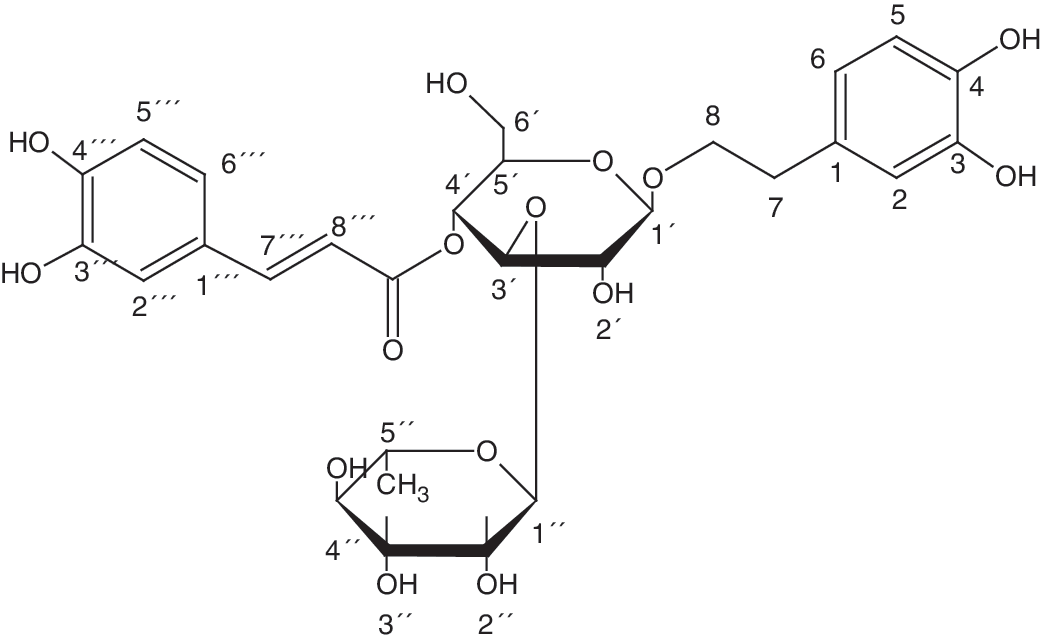
Molecular structure of verbascoside.
The presence of verbascoside in JCCF was also confirmed by a co-injection experiment. Thin-layer chromatography phytochemical screening carried out for JCME and JCCF also indicated the presence of phenols and tannins.
Discussion
In most biological studies performed, Jacaranda extracts were identified as active against many microrganisms. The hexane, ethanol, and water extracts of the leaves of J. mimosaefolia were active against B. cereus, E. coli, and S. aureus. 16
Studies have demonstrated that verbascoside and its derivatives (arilethanoids of cinnamoyl glucosides) are distributed in many medicinal plants of the Bignoniaceae family 23,24 and exhibit a large number of biological activities, including antimicrobial activity. 25,26
The methanol extract from bark specimens of J. cuspidifolia presented antibacterial activity against S. aureus, S. pyogenes, and N. gonorrhoeae, while JCCF was active against S. epidermidis, S. aureus, P. mirabilis, S. marcescens, S. pyogenes, E. aerogenes, and N. gonorrhoeae. Verbascoside isolated from Buddleja cordata showed antimicrobial activity against S. aureus. 27 The mode of action of verbascoside is inhibition of protein synthesis, affecting several important sites of metabolic or structural targets on the bacterial cell. Verbascoside and its derivatives are considered bacteriostatic agents. 27,28
In conclusion, the results here reported corroborate the popular use of J. cuspidifolia Mart. (Family Bignoniaceae) to treat microbial diseases, including gonorrhea, and also demonstrate, by HPLC fingerprinting, that arilethanoids of cinnamoyl glucosides represent a main class of compounds in this species and might contribute to the observed antimicrobial activity.
Footnotes
Acknowledgments
The authors are grateful to the Fundação de Apoio ao Desenvolvimento do Ensino, Ciência e Tecnologia do Estado de Mato Grosso do Sul; Coordenação de Aperfeiçoamento de Pessoal de Nível Superior; Fundação de Amparo à Pesquisa do Estado de Minas Gerais; and the Universidade Católica Dom Bosco and Universidade Federal de Minas Gerais for financial support and fellowships (to D.G.S. and C.J.B.).
Author Disclosure Statement
No competing financial interests exist.