




Abstract
Many health beneficial functions of dietary ingredients, including antimutagenity and anticarcinogenity, have been discussed in relation to their antioxidant properties. In this study, antioxidative mechanisms of whole-apple antioxidants (from seven varieties) were investigated using the 2,2′-azino-bis(3-ethylbenzthiazoline-6-sulfonic acid) (ABTS) radical scavenging capacity assay, the ferric-reducing antioxidant power (FRAP) assay, and the ferrous iron(II) chelating activity assay. Results indicated the ability of primary antioxidants to act as hydrogen or electron donors, with considerable differences depending on variety, with ABTS and FRAP values ranging from 270 to 1,142 mg of vitamin C equivalents/100 g and from 695 to 3,143 μmol of Fe/100 g, respectively. However, varieties did not display measurable chelating activity except for Florina and Graham, exhibiting a weak activity (0.1–0.2 μg of EDTA equivalents/100 g). Correlation analyses showed that polyphenols were major primary antioxidants contributing to antioxidative mechanisms (r>0.99, P<.001), whereas their involvement as secondary antioxidants (i.e., as chelating compounds) was negligible. Our findings further showed that the intake of 100 g of apple fruits can provide antioxidants equivalent to approximately 270–1,140 mg of vitamin C, with highest antioxidant concentrations for the older varieties Grauapfel and Goldparmäne.
Introduction
C
Fruits and vegetables contain a variety of natural compounds having various health-related physiological functions.
8,12
–14
Among them, antioxidant function is among the most studied, as natural nutrients such as vitamins and phytochemicals (e.g., polyphenols) may play a key role in antioxidant compensatory mechanisms in humans and may protect against adverse effects of oxidative stress and related diseases.
8,15
–17
Polyphenols, including phenolic acids and flavonoids, are the most abundant class of antioxidant phytochemicals existing in fruits and vegetables, thereby constituting the major class of antioxidants derived from the diet.
8,14,15
Antioxidants are chemical compounds that can counteract the excessive production of reactive oxygen species and as a result are capable of preventing or slowing down lipid peroxidation and the oxidation of other sensitive biomolecules such as proteins and DNA, thus preventing or delaying oxidative stress-related diseases including cancer and cardiovascular complications.
8,15,16,18
Primary antioxidants (AH) break free radical chain reactions by donating hydrogen atoms (reaction type 1) or electrons (reaction type 2) to radicals (–R·).
8,19
In this regard, polyphenols as well as vitamin E are well-known chain-breaking antioxidants.
8,19
In general, the reactions of primary antioxidants can be described as follows:
Besides these primary antioxidant mechanisms, natural compounds can act in antioxidative processes as secondary antioxidants. In this respect, dietary-originating antioxidants could display multiple secondary antioxidative functions (e.g., by chelating transition metal ion catalysts such as iron and copper, by deactivating singlet oxygen [1O2], or by absorbing ultraviolet radiation). 8,20 –22
The present work aimed at highlighting the antioxidative mechanisms of whole-apple primary antioxidants, including their hydrogen (or electron)-donating ability, resulting in direct reducing activities of free radicals. In addition, chelating effects of whole-apple secondary antioxidants on ferrous iron(II), which, in the presence of peroxides, may catalyze the production of highly toxic hydroxyl radicals via the Fenton reaction, 8,16 were investigated. Amounts of phenolics, flavonoids, and anthocyanins, and also their relation to antioxidant properties of apples, were determined. As a portion of fruits and vegetables can be generally defined as 80–100 g, the results from this study refer to 100 g of fresh apple. This study aims to emphasize the potential contribution of apples to programs targeting the prevention of oxidative stress-related health problems.
Materials and Methods
Chemicals
All products were of analytical grade or superior, and 18 MΩ water (Millipore, Brussels, Belgium) was used throughout. Methanol was obtained from Biosolve (Valkenswaard, The Netherlands). Iron(III) chloride 6-hydrate and iron(II) sulfate 7-hydrate were obtained from Merck (Darmstadt, Germany) and VWR (Leuven, Belgium), respectively. Aluminum chloride (AlCl3), 2,2′-azino-bis(3-ethylbenzothiazoline-6-sulfonic acid) diammonium salt (ABTS), 2,2′-azo-bis(2-methylpropionamidine) dichloride, catechin, gallic acid, EDTA, 3-(2-pyridyl)-5,6-bis(4-phenyl-sulfonic acid)-1,2,4-triazine (ferrozine), Folin–Ciocalteu phenol reagent, iron(II) chloride (FeCl2), phosphate-buffered saline, sodium carbonate (Na2CO3), sodium nitrite (NaNO2), 2,4,6-tri(2-pyridyl)-s-triazine, and vitamin C were purchased from Sigma Aldrich (Bornem, Belgium).
Sample preparation
Seven apple varieties grown in Luxembourg were obtained at commercial maturity from the Fondation Hëllef fir d'Natur (Kockelscheuer, Luxembourg) during September–November 2009: Grauapfel, Roter Trierer Weinapfel, Graham Apfel, Florina, Eifeler Rambour, Topaz, and Goldparmäne. Grauapfel, Goldparmäne, and Eifeler Rambour constituted old varieties, whereas the others represented recent varieties (released within the past 2–4 decades). Six fruits from each cultivar were rapidly cut into thin slices with peel, dipped into liquid nitrogen, and stored in transparent polyethylene bags at −80°C. Prior to analyses, slices were lyophilized, and the dried samples were ground to powder and stored at −80°C until analyzed.
Extraction of phenolic compounds
Three independent extractions for each cultivar were carried out as described previously by Kim et al., 23 using an ultrasound-assisted method. For this purpose, a mixture of approximately 2.5–3 g of freeze-dried powder and 20 mL of 80% aqueous methanol was sonicated for 20 minutes under argon gas to prevent possible oxidative degradation of polyphenolics. The mixture was then filtered through a filter paper (MN615, 70 mm in diameter, Macherey-Nagel, Düren, Germany) using a chilled Buchner funnel and rinsed with 10 mL of 100% methanol. Extraction of the residue was repeated using the same conditions. The two filtrates were combined and transferred into a 200-mL round flask. The solvent was removed using a rotary evaporator (Buchi, Vilvoorde, Belgium) at 40°C to a final volume of approximately 4–6 mL. The remaining phenolic concentrate was first dissolved in 10 mL of 100% methanol and diluted to a final volume of 20 mL with water. The mixture was centrifuged at 4°C at 5,500 g for 20 minutes and stored at −80°C until analysis within the next few days.
Analyses of total phenolics, flavonoids, and total anthocyanins
Determination of total phenolics
Total phenolic content was determined with Folin–Ciocalteu phenol reagent 24 using spectrophotometric analysis (model DU 800 ultraviolet/visible spectrophotometer, Beckman Instruments, Fullerton, CA, USA). In brief, an aliquot (1 mL) of standard solution of gallic acid at different concentrations (0–100 mg/L; external calibration with six different concentrations) in 50% aqueous methanol or appropriately diluted extracts was added to a 25-mL volumetric flask containing 9 mL of water. A reagent blank using water/methanol (1:1, vol/vol) was also prepared. One milliliter of Folin–Ciocalteu phenol reagent was added to the mixture and shaken. After 5 minutes, 10 mL of 7% Na2CO3 solution in water was added. The solution was then immediately diluted to a final volume of 25 mL with water and mixed thoroughly. After incubation for 90 minutes at 23°C, the absorbance versus the prepared blank was read at 750 nm. Total phenolic content in apples was expressed as milligrams of gallic acid equivalents (GAE) per 100 g fresh weight.
Determination of total flavonoids
Total flavonoid content was measured according to a colorimetric assay. 25 A 1-mL aliquot of standard solution of catechin at different concentrations (0–100 mg/L; external calibration with six different concentrations) or appropriately diluted extracts was added to 10-mL volumetric flasks containing 4 mL of water. At zero-time, 0.3 mL of 5% NaNO2 was added to the flask. After 5 minutes, 0.3 mL of 10% AlCl3 was added. At 6 minutes, 2 mL of 1 M NaOH was added to the mixture. Immediately, the solution was diluted to a final volume of 10 mL with water and mixed thoroughly. Absorbance of the mixture was determined at 510 nm versus the prepared blank (50% aqueous methanol). Total flavonoid content in apples was expressed as milligrams of catechin equivalents per 100 g fresh weight.
Determination of total anthocyanins
The quantification of total anthocyanins was evaluated by the pH differential method. 26 Phenolic extracts of apples in both 0.025 M potassium chloride solution (pH 1.0) (1.86 g of KCl in 1 L of water adjusted to pH with concentrated HCl) and 0.4 M sodium acetate buffer (pH 4.5) (54.43 g of NaCH3CO2·3H2O in 1 L of water adjusted to pH 4.5 with concentrated HCl) were measured simultaneously at 510 and 700 nm after 15 minutes of incubation at 23°C. The content of total anthocyanins was expressed as milligrams of cyanidin 3-glucoside equivalents per 100 g of fresh apple. A molar absorption coefficient of 26,900 L mol–1 cm–1 was used to calculate the concentration of cyanidin 3-glucoside in solution.
Methods to estimate antioxidant capacity
ABTS radical scavenging capacity assay
The vitamin C equivalents (VCE) antioxidant capacity test developed by Kim et al. 23 was used in this study. Total antioxidant activity of apples was determined by scavenging blue–green ABTS radicals and was expressed as milligrams of VCE per 100 g fresh weight. Vitamin C was used as a standard to quantify total radical scavenging activity (ABTS test), as this method allows for optimal comprehension of results for both the general public and researchers. 27,28
In brief, 1 mM 2,2′-azo-bis(2-methylpropionamidine), a radical initiator, was mixed with 2.5 mM ABTS in phosphate-buffered saline (pH 7.4). The mixture was heated in a water bath at 68°C for approximately 15 minutes. The resulting blue–green ABTS radical solution was adjusted to an absorbance of 0.650±0.020 at 734 nm with additional phosphate-buffered saline. Twenty microliters of appropriately diluted extracts were then added to 980 μL of the ABTS radical solution. The mixture was incubated in a 37°C water bath under restricted light for 10 minutes. The control consisted of 20 μL of 50% methanol and 980 μL of ABTS radical solution. The decrease of absorbance at 734 nm was measured after 10 minutes. An external standard (vitamin C) calibration curve (range, 0–0.2 mg/mL, n=5 calibration points) was prepared to determine concentrations in solution.
Ferric-reducing antioxidant power assay
The ferric-reducing antioxidant power (FRAP) assay was carried out according to the procedure of Benzie and Strain. 29 In brief, the FRAP reagent was prepared from acetate buffer (pH 3.6), 10 mM 2,4,6-tri(2-pyridyl)-s-triazine solution in 40 mM HCl, and 20 mM iron(III) chloride solution in proportions of 10:1:1 (by volume), respectively. The FRAP reagent was prepared freshly on a daily basis and was warmed to 37°C in a water bath prior to use. Fifty microliters of appropriately diluted extracts were added to 1.5 mL of the FRAP reagent. The absorbance of the reaction mixture was then recorded at 593 nm after 4 minutes. The standard curve was constructed using iron(II) sulfate solution (range, 100–2,000 μM; n=7 concentrations), and the results were expressed as micromoles of Fe(II) per 100 g fresh weight.
Ferrous iron(II) chelating activity assay
The chelating activity of apple extracts toward iron(II) ions was measured using the method of Decker and Welch. 30 In brief, 4.7 mL of extract (or 1 mL of EDTA [0–0.1 mg/mL]+3.7 mL of 50% methanol in water for the standards or 4.7 mL 50% methanol in water for the blank) was allowed to react with 0.1 mL of 2 mM FeCl2 and 0.2 mL of 5 mM ferrozine for 20 minutes. The absorbance was read at 562 nm in a spectrophotometer, with lower absorbance of the reaction mixture indicating higher chelating activity. The chelating activity on inhibition of ferrozine–Fe2+ complex formation was expressed as micrograms of EDTA equivalents per 100 g fresh weight.
Statistical analysis
Data were collected from three independent extractions for each cultivar and reported as mean±SD values. For correlation analyses, Pearson correlation coefficients were calculated, following verification of normality of distribution and equality of variance via Q-Q plots and boxplots. A value of P<.05 (two-tailed) was accepted as being statistically significant. The statistical analyses were carried out using SPSS version 17.0 software (SPSS, Inc., Chicago, IL, USA).
Results and Discussion
As shown in Table 1, 100 g of fresh apples (one portion) contained total phenolics at amounts between 87 and 434 mg of GAE and total flavonoids from 57 to 339 mg of catechin equivalents. The highest concentrations of both total phenolics and total flavonoids were observed in the variety Grauapfel, whereas Topaz ranked lowest. Our results showed that the apple varieties studied were generally poor in anthocyanins, with highest concentration in Florina (2.3±0.1 mg of cyanidin 3-glucoside equivalents/100 g); some varieties such as Grauapfel did not contain these pigments in detectable concentrations. Albeit antioxidant properties of anthocyanins have been stressed in vitro, 31,32 their instability during gastrointestinal digestion 33,34 raises questions on the bioavailability and the actual advantageous contribution to health benefits of anthocyanins in vivo.
Data represent mean±SEM values (n=3).
Total phenolics were expressed as milligrams of gallic acid equivalents/100 g of fresh apples.
Total flavonoids were expressed as milligrams of catechin equivalents/100 g of fresh apples.
Total anthocyanins were expressed as cyanidin 3-glucoside equivalents/100 g of fresh apples.
ND, not detected.
In addition to anthocyanins, four other major groups of polyphenols have already been described in apples, including hydroxycinnamic acids, flavanols, dihydrochalcones, and flavonols. 35,36 It is difficult to compare findings among different research experiments for several reasons, including choices of standards, units, and methods used. Differences between varieties (e.g., from season to season and different sources) could further impede comparisons. Considering reports using the same method of analysis and expression, phenolic concentrations of apples have been reported to range between 16 to 535 mg of GAE/100 g, 36,37 in agreement with our results (87–434 mg/100 g).
It has been proposed that the health beneficial effects of polyphenols could result from either their antioxidant functions and/or independently from these properties (e.g., by acting as modulators of cellular signaling processes). 8,14,38 However, many of the health beneficial functions of polyphenols, including antimutagenity, anticarcinogenity, and anti-aging, among others, have been discussed in relation to their antioxidant properties. 8 In this respect, by using the ABTS and FRAP tests, we found that total antioxidant activities varied greatly among apple varieties. Total VCE antioxidant capacity, reflecting total free radical scavenging capacity quantified as VCE of whole-apple antioxidants following their hydrogen-donating ability to reduce stable ABTS radicals, ranged from 270 to 1,142 mg of VCE/100 g (Table 2). Total reducing power (FRAP values), reflecting the ability of whole-apple antioxidants to act as electron donors reducing ferric iron(III) to ferrous iron(II), varied between 31 and 693 μmol of Fe(II)/100 g. The highest antioxidant capacity as determined by ABTS was observed in Grauapfel and Eifeler Rambour and the lowest in Florina and Topaz (Table 2); the same sequence was observed for the FRAP test. Hence, a good correlation (R 2=0.98, P<.001) was found between the ABTS test and FRAP test for determination of antioxidant activity (Fig. 1), suggesting that free radicals may be scavenged by antioxidants following one of the two direct mechanisms of reduction (hydrogen or electron donation). Similar good correlations, albeit from other food items, have been found between FRAP and other hydrogen donor-based tests, such as the 1,1-diphenyl-2-picrylhydrazyl assay. 39 However, for some antioxidants such as polyphenols, hydrogen atom transfer mechanism might be energetically favored with respect to single electron transfer processes in which higher energies are involved. 40 Our results further indicate linear and significant relationships between both total phenolic or flavonoid contents and total reducing capacities assessed by the ABTS and FRAP tests (Fig. 2). These results suggest that phenolics are major contributing compounds toward the total antioxidant activity of apples. Similar hypotheses have been proposed for other fruits, suggesting that polyphenols were the main participating compounds in total antioxidant capacity, including raspberries 41 and plums. 23,42 The potential scavenging abilities of phenolics mainly depend on the number and the position of hydrogen donating hydroxyl groups on the aromatic cycles of the phenolic molecules. 19

Linear relationship between the ABTS and FRAP tests from seven fresh apple varieties from Luxembourg, suggesting strong correlation between the two tests to measure antioxidant properties. VCE, vitamin C equivalents.
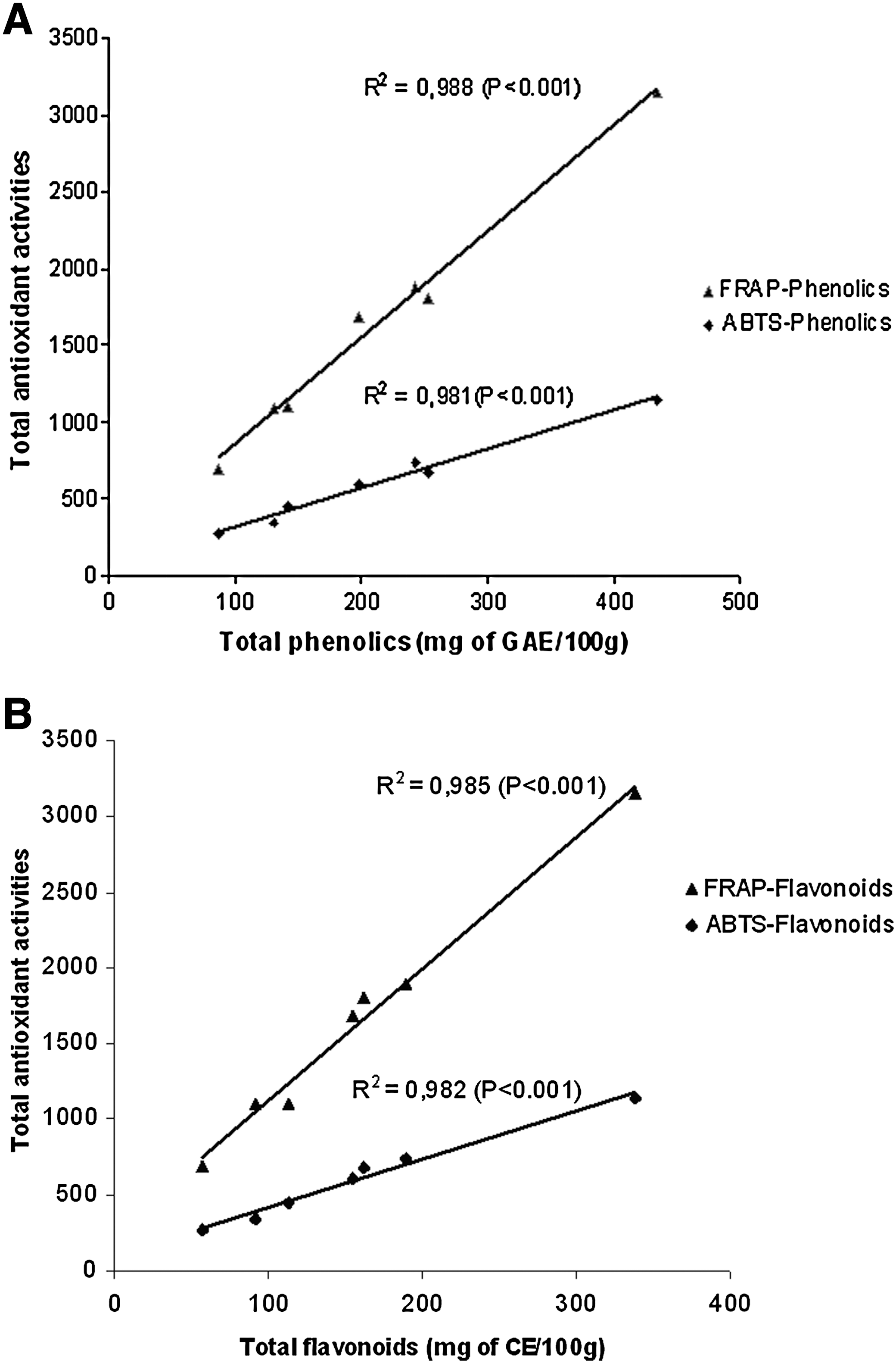
Positive correlations between total antioxidant activities, as assessed by the FRAP and ABTS tests, and levels of both (
Data represent mean±SEM values (n=3).
Total scavenging activity assessed by the 2,2'-azino-bis(3-ethylbenzothiazoline-6-sulfonic acid) (ABTS) test was expressed as vitamin C equivalents per 100 g of fresh apples.
Total reducing capacity assessed by the ferric-reducing antioxidant power (FRAP) test was expressed as micromoles of Fe(II)/100 g of fresh apples.
Chelating activity was expressed as micrograms of EDTA per 100 g of fresh apples.
VCEAC, vitamin C equivalent antioxidant capacity.
It is interesting to note that other compounds such as vitamin C or lipophilic compounds, such as vitamin E or carotenoids, could also contribute to total antioxidant activity; however, even though some of these compounds possess high antioxidant capacity, 8 their concentration in apples is typically low. 43 Antioxidant capacity contribution of vitamin C, however, has been reported to be low compared with polyphenols in apples. 44 Although the main mechanism of antioxidant action in food items is radical scavenging, other mechanisms, such as chelating pro-oxidant transition metal ions, could also play a role and were found to be related to structural properties. 8,19,45 With respect to apples, we investigated the potential chelating effect of polyphenols against ferrous iron(II), which is involved in reactions eliciting free radical production, including hydroxyl radicals (OH·) and alkoxyl radicals (RO·). Our results (Table 2) showed that apple varieties do not possess measurable chelating activity, except for Florina and Graham Apfel, which displayed a weak activity (0.1–0.2 μg of EDTA equivalents/100 g), suggesting that this secondary antioxidant mechanism in apples is dependent on the molecular structure of phenolics rather than the amount of phenolics as investigated in this study.
It has been suggested in literature that the advantageous effects of antioxidants originating from fruits and vegetables on human health occur owing to (1) their presence at physiological concentrations and (2) their combined resulting actions that could be additive or synergistic (reviewed by Bouayed and Bohn 8 ). These recent findings are not in agreement with the theory that isolated compounds (e.g., quercetin) might be major responsible factors associated with proposed health beneficial effects, including cardiovascular complications or certain types of cancer, as previously postulated following retrospective epidemiological studies. 1,2,7 In recent prospective epidemiological studies, consumption of fruits and vegetables in sufficient quantities has been suggested to be advantageous for health because of the combined effects of all ingredients (i.e., nutrients and phytochemicals) present in a complex mixture (reviewed by Bouayed and Bohn 8 ). For example, it has been shown that consumption of five portions per day could help in preventing chronic diseases, including coronary heart disease 6 and stroke. 5 Thus, the availability of apples on the market during the entire year, at least in most Westernized countries, constitutes an additional advantage to promote the consumption of this fruit when aiming to reap general health benefits related to adequate fruit and vegetable consumption. For example, our results suggest that the intake of 100 g of apples (one portion) can provide the consumer with antioxidant VCE of 270–1,142 mg (Table 2), depending on the variety, with Grauapfel displaying an interesting antioxidant potential with more than 1 g of VCE/100 g. Unfortunately, this old variety is among the less marketed varieties in general.
Conclusions
Our results have shown that whole-apple antioxidants might scavenge free radicals following one of the two direct mechanisms of reduction (i.e., by hydrogen or electron donation). Radical scavenging activity is an important property allowing antioxidants to terminate free radical chain reactions, thereby participating in the maintenance or re-establishment of redox homeostasis, an essential state in maintaining healthy biological systems and preventing against diseases related to oxidative stress. The consumption of local apple varieties should be promoted not only because of their potential health beneficial effects, but also because of the positive ecological impact, such as decreased CO2 production, and to maintain biological diversity. Several apple varieties from Luxembourg contained interesting concentrations of phytochemicals and also displayed comparatively high antioxidant properties. In comparison with several rather recent varieties (e.g., Florina and Topaz), old and less frequently marketed varieties such as Grauapfel and Goldparmäne have displayed rich concentrations of polyphenols and related antioxidant activity, suggesting that these varieties could have added values for promoting health beneficial effects. The results of this research emphasize the importance of apples and promote their utilization as potential preventive food items against oxidative stress-related diseases in programs of prevention.
Footnotes
Acknowledgments
The present project is supported by the National Research Fund, Luxembourg, and co-funded under the Marie Curie Actions of the European Commission (FP7-COFUND). We thank Servane Contal, Boris Untereiner, and Daniel Evers for their help and advice in preparing the apples.
Author Disclosure Statement
The authors declare that there are no conflicts of interest.