




Abstract
Bitter melon (BM) was tested in normal and streptozotocin (STZ)-induced diabetic rats. First, normal and diabetic Wistar rats were given four test extracts (EX-1–EX-4) of a wild-genotype BM or metformin by intubation. Second, normal Sprague–Dawley rats were divided into control and three test groups given for 52 days one of three BM preparations in food: Chinese or Indian commercial preparations or EX-4 from experiment I. In experiment I, extracts of BM administered at 50 mg/kg of body weight in normal rats reduced blood sugar for 4 hours without, unlike metformin, inducing hypoglycemia. In STZ-induced diabetic rats, two extracts administered at 250 mg/kg decreased glucose levels to values comparable to metformin at 150 mg/kg. At 4 hours, EX-1 and EX-4 significantly reduced blood glucose 67% and 63%, respectively, compared with metformin's 54%. In experiment II, all test groups had lowered systolic, but not diastolic, blood pressure. The China and EX-4 arms had significantly lowered serum glucose levels compared with the control. In the glucose tolerance test, only EX-4 had significantly lowered glucose levels. Only EX-4 had significantly lowered angiotensin converting enzyme (ACE) activity. All active arms showed significance in the losartan challenge (the renin–angiotensin system [RAS]), with the greatest effect in the EX-4 group. In the N
ω-nitro-
Introduction
B
The present investigation consists of two parts. In the initial experiment, a series of extracts of BM of a wild genotype were tested for antihyperglycemic effects in a normal and streptozotocin (STZ)-induced diabetic rat model (Wistar Albino), and the results were compared with those of metformin, a standard drug used in the treatment of diabetes. In the second experiment, the most successful BM extract in the first experiment, Extract 4 (EX-4), was compared with Chinese- and Indian-origin preparations that are leading extracts manufactured in those countries and sold in East Asia and North America. Extracts in the second experiment were tested in adult normal rats in order to extend the metabolic parameters examined earlier, to compare effects among different BM preparations, and to establish mechanisms of action in blood pressure regulation, especially as these relate to the nitric oxide (NO) system and the renin–angiotensin system (RAS) and to sugar and insulin metabolism. Combining the data on BM under conditions of both disease and normal health in two different rat models potentially extends the heuristic power of the findings.
Materials and Methods
Experiment I
Protocol
Wistar Albino male rats 12 weeks old were obtained from St. John's Pharmacy College Animal House, Bangalore, India and handled according to institutional practices. Rats were divided into eight groups of six rats housed six to a cage with an average weight of 175–225 g per group. All rats were fed a standard rat chow diet (Sai Durga Feed, Bangalore) ad libitum; water also was supplied ad libitum. Following 7 days for acclimatization, half of the rats were fasted for 24 hours and then injected with freshly prepared STZ in citrate buffer (pH 7.4) (45 mg/kg, i.p.). After 1 week, rats with marked hyperglycemia (fasting blood glucose >300 mg/dL) were used as the diabetic rats.
Test materials were four different extracts (Ex-1–Ex-4) (as dry powders) of BM of a wild genotype or metformin. Ex-1–Ex-4 were produced and preserved via different methods, attempting to retain efficacies reported for macerated fresh fruit preparations. EX-1 was a vacuum-dried powder of the macerated extract of fresh fruit (∼25:1). EX-2 was a freeze-dried powder of the macerated extract of fresh fruit (∼25:1). EX-3 was a spray-dried powder of the macerated extract of fresh fruit (∼25:1). EX-4 was a vacuum-dried powder of the macerated extract of fresh fruit adsorbed onto powdered vacuum-dried fresh fruit (∼15:1). Dosages of the extracts were 50 and 250 mg/kg of body weight/day as indicated. After an overnight fast, the extract samples suspended in 5% gum acacia were administered to the animals by gastric intubations with a syringe.
Glucose testing
Glucose was given orally by intubation as a 40% solution (1 g/kg of body weight). Blood samples following the glucose challenge were collected for the measurement of blood glucose from the tail vein at 0, 1, 2, 3, and 4 hours. The blood glucose level was determined by using an electronic glucometer (Accu Chek®, Roche Diagnostics, Basel, Switzerland).
Experiment II
Protocol
This study was approved by the animal welfare board at Georgetown University Medical Center (Washington, DC, USA). A total of 32 male Sprague–Dawley rats (Charles Rivers, Wilmington, MA, USA) were used. The adult Sprague–Dawley rats were divided into four groups of eight rats. Initial body weights ranged between 468 g and 664 g. All rats consumed a regular rat diet of Purina rat chow in crushed form (Purina, Richmond, IN, USA). Sucrose was added to the pulverized rat chow (30%, wt/wt). The four groups consisted of a control eating the described diet and three test groups eating the same diet but with the addition of three BM preparations added to the rat chow at 1% (wt/wt) (1 g of extract to 100 g of ground chow).
The Chinese- and Indian-origin preparations were leading extracts manufactured in these countries and sold in East Asia and North America. The Indian extract, a pale brown powder manufactured by Vidya Herbs Private Ltd., Bangalore, Karnataka, India, was a 10:1 extract soluble in water and listing not less than 10% bitters and no more than 6% loss on drying. The Chinese extract, a yellow–brown powder manufactured by Guilin Layn Natural Ingredients (Guilin, P.R. China), listed extraction by ethanol and water yielding not less than 10% charantin and no more than 5% loss on drying. The material listed as “EX-4” was the extract of a wild-genotype BM used in Experiment I and grown and processed in India. It was manufactured for Glykon Technologies Group, LLC (Santa Monica, CA, USA) and is commercialized as Glycostat®. It was extracted with water with a an herb extraction ratio of >15:1, yielding a pale green powder assayed as not less than 6% total bitters, not less than 5% charantin, and not less than 1.5% undenatured 10,000-Da polypeptide. Loss on drying was listed as not more than 8%. The BM extracts are referred to as “China,” “India,” and “EX-4,” respectively. The second study was subchronic and continued for 52 days.
Body weight
Body weight was estimated by routine scale measurements. Two readings taken at least 10 minutes apart on a given day had to be within 2 g of each other, or the procedure was repeated until the weight measurements were consistently within this range.
Water and food intake
Water and food intakes were estimated by subtracting the volume or weight of the remaining fluid and food from the amounts premeasured 24 hours earlier.
Systolic blood pressure
Systolic blood pressure (SBP) was measured by tail plethysmography using two different instruments. As in many previous studies, an instrument from Narco Biosciences (Houston, TX, USA) was used. 4,5 This allowed the rapid measurement of SBP with a beeper sound system. The second reading was performed on an instrument obtained from Kent Scientific Corp. (Torrington, CT, USA). The latter is a computerized, noninvasive tail cuff acquisition system that uses a specially designed differential pressure transducer to noninvasively measure the blood volume in the tail. This instrument not only records SBP, but also provides measurements of mean blood pressure, diastolic blood pressure, and cardiac rate. Previous experience has shown that the SBP readings were virtually the same by either instrument. 6 Rats were allowed free access to their diet and water until SBP readings were obtained between 13:00 hours and 17:00 hours after a slight warming. Multiple readings on individual rats were taken. To be accepted, SBP measurements on a given rat had to be stable (consistently within 5 mm Hg).
Blood chemistries
Blood for chemical analysis was obtained at the end of the study following removal of food approximately 17 hours earlier. Blood chemistry values were obtained via dry chemistry procedures using a Johnson and Johnson Vitros 250 instrument (Johnson and Johnson, Langhorne, PA, USA).
Intraperitoneal glucose tolerance test
During the intraperitoneal glucose tolearnce test, glucose (2.5 g/kg of body weight) was injected intraperitoneally to challenge the tolerance to glucose. Drops of blood were obtained from the tail at 0, 7.5, 30, 45, and 60 minutes post-injection. Glucose was estimated using commercial glucose strips (One Touch® Ultra, LifeScan, Milpitas, CA, USA).
Insulin challenge testing
Testing was commenced after 17–19 hours of food deprivation. For insulin challenge testing, 0.3 unit of regular insulin/kg of body weight (Eli Lilly Co., Indianapolis, IN, USA) was administered, and blood for glucose determination was obtained from the tail vein at 7.5 minutes after injection. 6 Circulating glucose was estimated using commercial glucose strips (One Touch Ultra).
Losartan challenge
After baseline SBP readings were obtained, spontaneously hypertensive rats from all dietary groups were given 40 mg/kg losartan orally via gastric lavage. 7,8 At 3 and 6 hours after lavage, SBP was remeasured. The decreased SBP after losartan was used to estimate activity of the RAS.
Serum angiotensin converting enzyme activity
Serum angiotensin converting enzyme (ACE) activity was measured by a commercial kit (Sigma, St. Louis, MO, USA). 9 This spectrophotometric method uses the synthetic tripeptide substrate N-[3-(2-furyl)acryloyl]-phenylalanylglycylglycine, which is hydrolyzed by ACE to furylacryloylphenylalanine and glycylglycine. Hydrolysis of N-[3-(2-furyl)acryloyl]-phenylalanylglycylglycine results in a decreased absorbency at 340 nm. Serum ACE activity was determined by comparing the sample reaction rate with that obtained with an appropriate ACE calibrator.
N
ω-nitro-l -arginine-methyl ester challenge
Effects of NO synthase inhibition on SBP were measured.
8
After baseline measurements of SBP, the NO synthase inhibitor N
ω-nitro-
Statistical analyses for both studies
Results are presented as mean±SEM values. SBP and body weight were examined by repeated-measures, two-way analyses of variance (one factor being group and the second factor being time of examination). Where a significant effect of regimen was detected by analysis of variance (P<.05), Dunnett's t test was used to establish which differences between means reached statistical significance. 10 Other measurements were assessed by one-way analyses of variance. Statistical significance was set at P<.05.
Results
Experiment I
Hypoglycemic activity in normal rats (Table 1)
The hypoglycemic activity of BM extracts was studied in normal rats. The drug metformin was used as the positive control (Table 1). The studies revealed that the two extracts examined, EX-1 and EX-2, reduced normal blood sugar levels, but the reduction was less than that with metformin. Significantly, and unlike metformin, the BM extracts did not result in hypoglycemia in normal animals (glucose <70 mg/dL in this model). The large literature on BM mentions rare hypoglycemia in conjunction with a few trials using different species and extraction methods than those used in the current study, but no evidence of hypoglycemia was seen in the tests performed here.
Data are mean±SE values in mg% (n=6 animals in each group). Values in parentheses indicate percentage reduction in blood sugar level compared with initial glucose value (0 hour) in the respective group. Note that metformin at 3 hours and 4 hours resulted in hypoglycemia in normal animals.
P<.01.
Antihyperglycemic activity in hyperglycemic rats (Table 2)
The antihyperglycemic activity of BM extracts was studied in STZ-induced diabetic rats. Metformin was used as the positive control drug (Table 2). The fasting blood glucose level of the diabetic animals was significantly reduced (P<.01) compared with initial levels of blood glucose (0 hour) in the respective groups. The reduction of blood glucose levels by the BM extracts in general was comparable to that with metformin, with the more efficacious extracts (EX-1 and EX-4) being stronger than metformin at the relative dosages administered, especially at 4 hours.
Data are mean±SE values in mg% (n=6 animals in each group). Values in parentheses are percentage reduction of blood sugar level compared with initial level of blood glucose (0 hour) in the respective group.
P<.01.
Overview of findings in Experiment I
In normal rats, wild BM extracts administered at 50 mg/kg of body weight lowered blood sugar for approximately 4 hours without inducing hypoglycemia, in contrast to metformin, which at 50 mg/kg led to hypoglycemia. In diabetic animals, two of the extracts administered at the rate of 250 mg/kg proved comparable to metformin administered at the rate of 150 mg/kg. At 4 hours, all extracts significantly reduced glucose in comparison with initial starting levels. EX-1 and EX-4 reduced blood glucose 66.56% and 63.42% (mg%), respectively, compared with metformin's 53.52% at 4 hours. There was no statistical difference between either EX-1 or EX-4 and metformin.
Experiment II
Body weight (Fig. 1)
Changes in body weight among the four groups were not significantly different over the 52-day course of study.

Body weight of Sprague–Dawley rats in control, China, India, and bitter melon extract EX-4 groups over the course of study. Data are mean±SEM values.
Food and water intake (Table 3)
After 20, 30, and 60 days on the various regimens, average food intakes were similar in all groups consuming the different sources of BM. Consumption of water was different. The EX-4 group showed increased water intake at 30 and 60 days, and the India group showed increased intake at 60 days (Table 3).
Data are average±SEM values.
Statistically significant compared with the control.
SBP (Fig. 2)
At 12 days, the average SBPs of the three test groups (China, India, and EX-4) were similar in response and remained significantly lower than the control throughout the rest of the study (Fig. 2). At 44 days, a more complete evaluation of cardiovascular parameters was performed as shown in Table 4. The average SBP was lower in all the test groups, but the diastolic blood pressure was not statistically significantly lower in any of the test groups. No significant differences in cardiac rates occurred among the four groups.
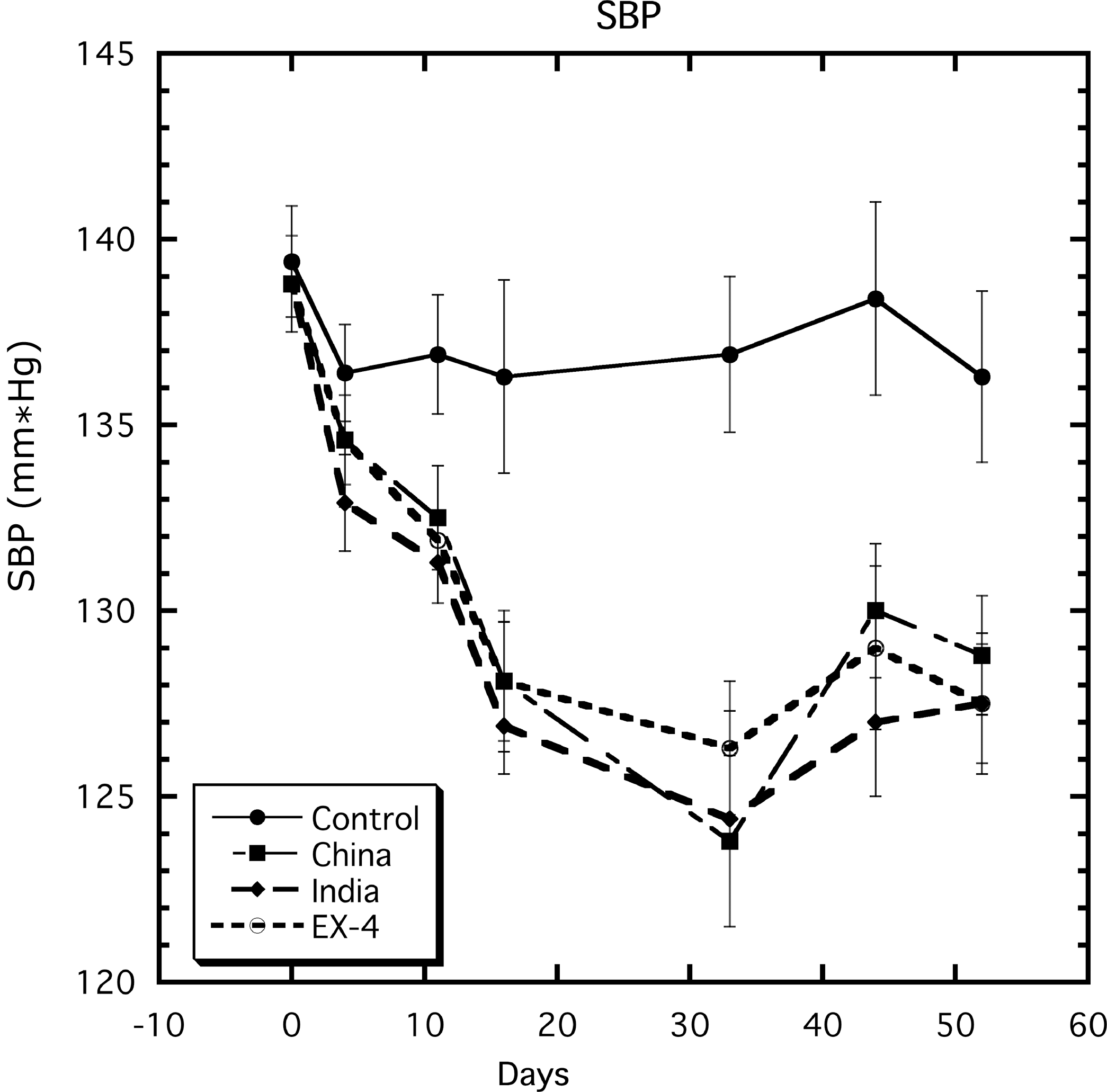
Systolic blood pressure (SBP) of Sprague–Dawley rats in control, China, India, and bitter melon extract EX-4 groups over the course of study. Data are mean±SEM values.
Data are average±SEM values of eight rats.
Statistically significant compared with control.
DBP, diastolic blood pressure; MBP, mean blood pressure.
Glucose tolerance test (Fig. 3)
In these nondiabetic Sprague–Dawley rats, the baseline glucose readings at the initiation of the glucose challenge were not significantly different, although the control group had the highest average (±SEM) values: control, 110±2.2 mg/dL; China, 106±2.7 mg/dL; India, 106±2.3 mg/dL; and EX-4, 105±2.2 mg/dL. In examination of the area under the curve after glucose challenge for the four groups of eight rats (Fig. 3), the Sprague–Dawley rats in the EX-4 group had a statistically significantly lower average (±SEM) reading than the control (3,050±162 units vs. 3,932±236 units). The other two groups showed a trend to be lower than the control (China, 3,250±220 units; India, 3,264±265 units). Baseline (average±SEM) insulin concentrations were as follows: control, 0.92±0.09 ng/mL; China, 0.82±0.06 ng/mL; India, 0.80±0.08 ng/mL; and EX-4, 0.90±0.07 ng/mL. One hour after the glucose challenge, the average (±SEM) insulin concentrations were as follows: control, 2.50±0.22 ng/mL; China, 2.37±0.14 ng/mL; India, 2.15±0.14 ng/mL; and EX-4, 2.23±0.14 ng/mL. The greater glucose clearance in each of the groups thus is unlikely to represent the result of an elevated insulin release.

Glucose tolerance test in control, China, India, and bitter melon extract EX-4 groups. Data are average±SEM values of the area under the curve from baseline. *Statistically significant compared with the control.
Insulin challenge test (Fig. 4)
At 7.5 minutes after intraperitoneal challenge with 0.3 units of regular insulin, the average decrease in circulating glucose of the three test groups showed a statistically significantly greater response than in the control. The lowering among the test groups was virtually the same.
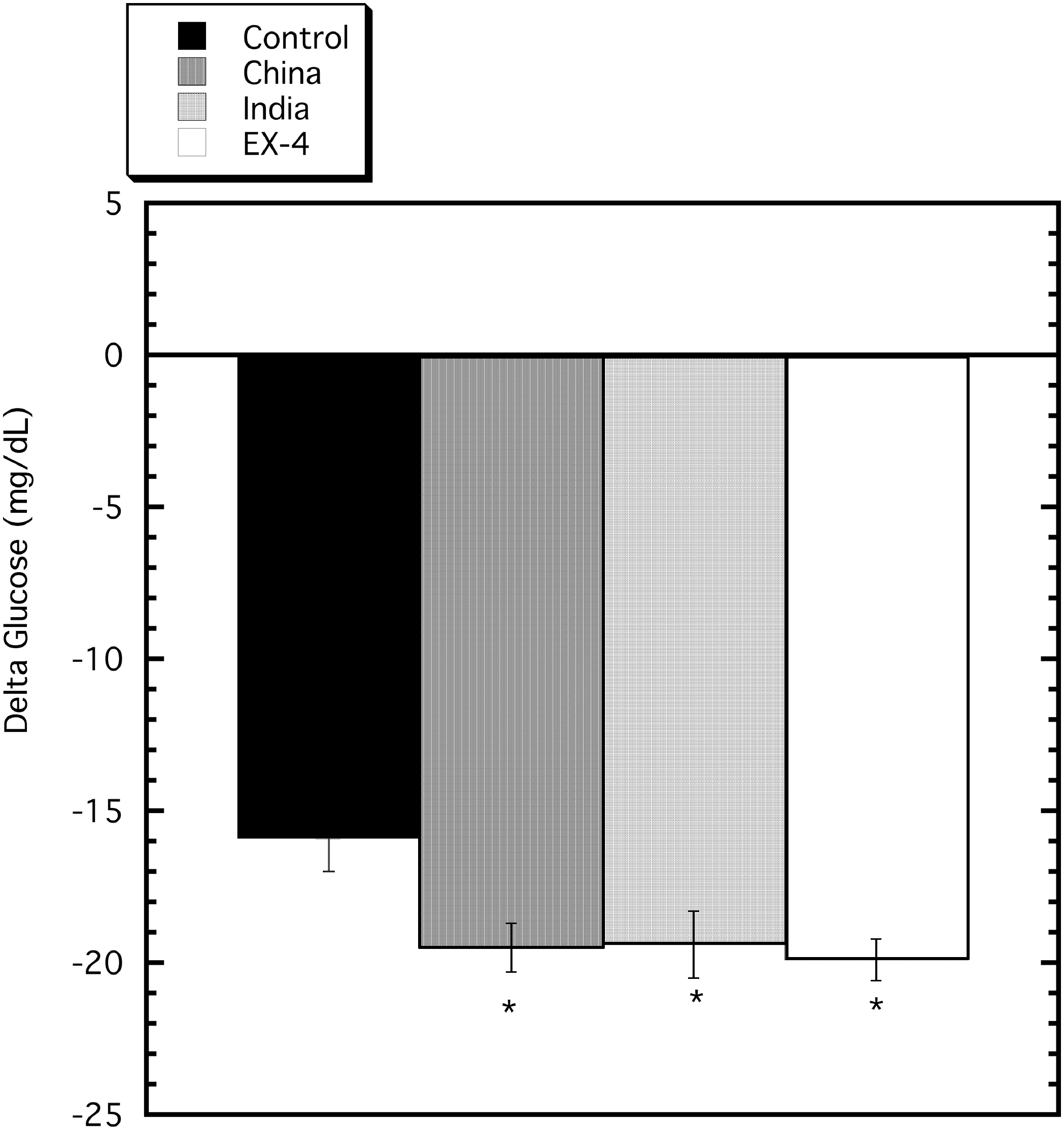
Decrease of circulating glucose level below baseline 7.5 minutes after intraperitoneal injection of regular insulin. Data are average±SEM values (n=8 in each group). *The decrements are significantly greater in the China, India, and bitter melon extract EX-4 groups compared with the control.
Evaluation of RAS (Table 5)
When losartan was given to each group of rats, the decrease in SBP of all three test groups was significantly less than in the control with no statistical differences among the treatment groups.
Data are average±SEM values of eight male rats.
Statistically significant compared with the control (P<.05).
Trend toward statistical significance (.05<P<.10).
ACE, angiotensin converting enzyme.
Examination of serum ACE activity showed significantly lower activity in the EX-4 group compared with the control, whereas the China and India groups each showed only a nonsignificant trend in lower activity compared with the control.
NO system
On day 52,
Blood chemistries (Table 6)
Among the values shown, the only meaningful statistical differences and trends occurred in the three test groups with respect to circulating glucose, which was statistically lower in the China and EX-4 groups and trended lower in the India group (Table 6). With the exception of the potassium levels in the India group, no other reading among the test groups showed statistical differences with the control group.
Data are average±SEM values (n=8 rats per group). Values are mg/dL with the exception of aspartate aminotransferase (AST) and alanine aminotransferase (ALT), which are in units.
Statistically significant compared with the control.
Trend toward statistical significance (.05<P<.10).
ALP, alkaline phosphatase; BUN, blood urea nitrogen; Chol, total cholesterol; Trig, triglycerides.
Overview of findings in Experiment II
There were no significant differences with the control group or between test groups with respect to food intake or body weight gain. Water intake was higher in both the Indian and EX-4 arms. All test groups displayed lower SBPs compared with control, but there was no impact on diastolic blood pressure. There were trends toward lower cholesterol and lower triglycerides with EX-4 in comparison with the other groups. Both the Chinese and EX-4 arms exhibited significantly lower circulating glucose compared with the control. On glucose challenge, EX-4 was significantly more active than the control, whereas neither the Chinese nor the Indian arms reached significance. The EX-4 result was not the product of a greater insulin release in response to the challenge. It is interesting that all three extracts resulted in the same level of response to the insulin challenge test, a finding that suggests a common limit to the rate of glucose clearance in response to insulin, yet activation of glucose clearance as in the glucose challenge test varied in favor of EX-4. EX-4 showed significantly less ACE activity compared with the control, whereas the other arms did not. All active arms showed significance in the losartan challenge, with the greatest effect in the EX-4 group. Hence, EX-4 showed the greatest impact on the RAS. Finally, the
Discussion
The findings of the two experiments described here are novel with regard to the efficacy in a model of diabetes of a wild BM extract and in elucidating mechanisms of action. Such findings are useful, in part, because studies on extracts from cultivars of BM (varieties deliberately selected and cultivated for commercially desired characteristics, usually involving table characteristics and yield) have raised doubts as to their utility in the therapy of glucose–insulin perturbations. Reports of the efficacy of BM extracts in animal models when compared with standard diabetes drugs are uneven. Indeed, the large literature on BM is filled with contradictory results. A recent review describes how the use in an animal model of compounds extracted with alcohol from the fruit demonstrated significant activity when these items were freshly prepared and given at relatively high dosages. Again, freshly decocted fruit has been shown to be efficacious, yet the amount required typically is on the order of reduction from 100 g of fresh fruit per day. 11 The seeds contain a protein similar to bovine insulin, and this vegetable insulin is effective but must be given by injection or subcutaneously. 12 In contrast to findings with the fresh fruit and fresh preparations, dry extracts have not fared well in trials. 2 For instance, in a recent randomized, double-blinded, placebo-controlled clinical trial testing a powder extract with 40 patients, hemoglobin A1c was decreased by an insignificant 0.22%. 2 Similarly, dry extracts usually are concentrated for charantins, yet according to some research, charantins, the saponins commonly called out for “standardized” preparations, may be inactive or only weakly active as antidiabetic agents. 13
Very little work has been performed with wild genotypes of BM, even though there are a great many in India alone. Most information available tends to cover topics such as the suppression of inflammation via modulation of nuclear factor-κB activation. 14 Nevertheless, hints in the literature suggest that the antihypoglycemic effects of some of these wild genotypes could be more potent than those of the cultivars commonly used for extraction. For instance, one laboratory has published that extracts of bitter gourd activated peroxisome proliferator-activated receptors α and γ; in a wild varietal, compounds capable of the activation of peroxisome proliferator-activated receptor α constituted as much as 7.1 g/kg of the dried material. 15
Findings in Experiment I show a significant acute lowering of blood glucose in normal rats ingesting two different extracts of a wild genotype of BM at the rate of 50 mg/kg body. The reduction in glucose was less than that produced by metformin administered at the rate of 50 mg/kg of body weight. Then again, unlike metformin, the BM extracts did not induce hypoglycemia in these nondiabetic animals. At 4 hours, there was a clear return toward baseline with the BM extracts but not with metformin, with which striking hypoglycemia persisted.
With the diabetic animals, the pattern of response to the extraction from the wild genotype of BM was slightly different. At 4 hours, all the extracts exhibited continuing declines in blood glucose, with EX-1 being the most efficacious in this regard followed closely by EX-4. Onset of glucose lowering was not as rapid as with metformin, yet the trajectory was superior, and in the cases of EX-1 and EX-4 the results at 4 hours also were superior. An approximation based on a small animal-to-large animal standard dosage adjustment is that the tested dosages of the extracts (250 mg/kg) would translate to a human of 70 kg of body weight ingesting between 2.5 and 3 g of an extract. 16,17 It should be noted, however, that 50 mg/kg was sufficient in the nondiabetic arms to lower glucose approximately 15% during the initial 2 hours. This suggests that a reasonable threshold dose in humans might be as low as 600–750 mg.
The reduced blood glucose reported here in normal rats is in accord with results from other laboratories in mice. 18,19 Likewise, others have shown that in STZ-induced diabetic mice, BM is able to decrease blood glucose just as shown here in rats. 20 Not all laboratories are in agreement, however, regarding BM's hypoglycemic effects in either normal or STZ-induced diabetic rats. 21 Significantly, although there have been reports—and warnings—of BM extracts resulting in hypoglycemia (the most quoted instance involved children of 3 and 4 years of age who drank a tea made from the vines and leaves), 22 the wild-genotype BM extracts used in the current tests did not excessively reduce the blood sugar levels of the nondiabetic animals (did not lead to hypoglycemia) and similarly gave no indication of leading to hypoglycemia in the diabetic model at the dosages tested. This is in marked contrast with metformin, with which hypoglycemia is a well-established danger.
In the literature, there is disagreement as to how BM extracts compare with standard diabetes drugs. BM exhibited a hypoglycemic effect comparable to glibenclamide in alloxan-induced diabetic rats in one study. 23 In contrast, the hypoglycemic effects of BM were found to be weaker than those of tolbutamide in normal rats or metformin in STZ-induced diabetic rats in another study, suggesting that BM has a stronger effect in alloxan-induced diabetic rats than in STZ-induced diabetic rats. 24 The present study supports a quite powerful impact in STZ-induced diabetic rats and indicates that further research is warranted to determine the differences in efficacy resulting from the use of various genotypes and methods of preparation.
In clinical trials, the fresh fruit juice and the homogenized suspension of BM have led to significant reductions in both fasting and postprandial blood glucose. 25,26 It is noteworthy that the successful trials in the literature as a rule used fresh preparations. Very interesting is the finding that two specialty extracts administered together with half doses of either metformin or glibenclamide led to greater reductions in blood glucose than did the full doses of the drugs, indicating that BM may act synergistically with other oral hypoglycemic agents. 27
Experiment II examined the subchronic effect of an extract from the wild genotype of BM and expanded upon the findings in Experiment I by exploring some possible mechanisms of action. In addition, it demonstrated that the wild genotype tested is apparently more efficacious than the varietals typically used in Chinese and Indian preparations and certainly more consistent in influencing all the parameters tested. The three compounds significantly lowered SBP, although there was no effect on diastolic pressure. The wild BM extract was more active than the others in lowering circulating glucose and in the glucose challenge—significantly, without exhibiting an elevated release of insulin. As noted earlier, all three extracts resulted in the same level of response to the insulin challenge test, a finding that suggests a common limit to the rate of glucose clearance in response to insulin, yet activation of glucose clearance in the glucose challenge test varied in favor of EX-4. Other interesting findings were the wild extract's significant inhibition of ACE, its impact on the RAS, its response in the losartan challenge, and its influence on the NO system. The other two extracts influenced these parameters, but not as consistently. Unfortunately, very little work has been done in these areas with BM, and the superior results with the wild genotype suggest that further research is warranted with this item in venues not previously explored with this herb.
In conclusion, extracts of a wild genotype of BM proved to be quite active in a Wistar rat model of STZ-induced diabetes. Ingestion of 250 mg/kg of body weight led to reductions in blood sugar comparable to those achieved with ingestion of the standard diabetes drug metformin at 150 mg/kg over a 4-hour test period. In normal rats, 50 mg/kg, likewise, reduced blood sugar readings, but unlike ingestion of 50 mg/kg metformin, there was no induction of hypoglycemia. In a model of healthy adult animals of a breed (Sprague–Dawley) not prone to easily elevated blood pressure or blood glucose dysfunction, the wild genotype exhibited effects superior to those of Chinese and Indian commercial preparations on blood glucose regulation, ACE inhibition, the regulation of RAS, and NO generation. The mechanism of action with regard to the superior glucose clearance does not appear to be related to an elevated insulin release.
Footnotes
Acknowledgments
For their roles in the animal handling and data compilation, the authors would like to thank B. Rajkapoor and E.P. Kumar of the Department of Pharmacology & Toxicology, St. John's Pharmacy College, Bangalore, India.
Author Disclosure Statement
D.L.C. is an officer in Glykon Technologies Group, LLC, the developer and commercial source of EX-4 (Glycostat) wild bitter melon. S.N.R. is the owner of Supreem Pharmaceuticals Pvt. Ltd., the manufacturer under license of Glycostat. H.G.P. has no competing financial interests.