




Abstract
A nonvolatile and slightly water-soluble antimicrobial sulfur compound newly isolated from heated garlic extract was characterized. The compound was generated most when heated at 120°C for 30 minutes and completely disappeared after 90 minutes of heating. It has a molecular mass of 225 daltons with an elemental ratio of C6H11N1O2S3, and the interpretation of 1H- and 13C-nuclear magnetic resonance and Fourier transform-infrared data showed that the compound was CH2 = CH-CH2-S-S-S-CH2-CH(NH2)COOH, 3-(allyltrisulfanyl)-2-aminopropanoic acid, a derivative of cysteine, presumably derived from alliin (S-allyl-
Introduction
A
It has been only recently that garlic heated at 120°C was found to be antimicrobial. 3 Garlic heated at this temperature was reported to be antimicrobial because alliin in garlic is thermally degraded to simple antimicrobial compounds without the action of the enzyme alliinase. It was deduced that comparatively mild heating at around 100°C only inactivates alliinase enzyme, while heating garlic at higher temperatures not only inactivated the enzyme but also thermally degraded alliin into compounds with antimicrobial activity. It was observed that molds grow quickly on garlic cloves that have been boiled for 10 minutes, whereas they do not grow well on garlic cloves that have been heated at 120°C for 1 minute (authors' unpublished data).
The principal antimicrobial compounds in garlic heated at 120°C was allyl alcohol (2-propene-1-ol), formed by thermal degradation of alliin. 4 Allyl alcohol (AA) is different from all other known antimicrobial compounds generated from garlic in that it does not contain a sulfur atom(s) in its structure. Other compounds generated in heated garlic are linear diallyl sulfides, including diallyl monosulfide (DAMS), diallyl disulfide (DADS), diallyl trisulfide (DATS), diallyl tetrasulfide, and diallyl pentasufide, and nonlinear heterocyclic sulfur compounds, 4-methyl-1,2,3-trithiolane, 5-methyl-1,2,3,4-tetrathiane, and 6-methyl-1,2,3,4,5-pentathiepane. 5,6
The formation of AA reached a maximum at around 90 minutes of heating in the pH-unadjusted garlic at 120°C, whereas antimicrobial activity reached its maximum value at around 45 minutes of heating, a discrepancy of about 45 minutes. Because the additional antimicrobial sulfur compound(s), including diallyl sulfides, were minimally produced under those conditions, it was assumed that still another unknown antimicrobial compound(s) was generated during heating, reaching maximum levels between 45 minutes and 75 minutes of heating at the temperature. 5 Upon removal of AA and various sulfides by organic solvent and vacuum evaporation, an appreciable antimicrobial activity was observed to be remaining. It was certain that the additional activity must be due to those compound(s) that are nonvolatile and water-soluble. Therefore the task of isolating water-soluble and nonvolatile compounds from heated garlic was performed. There is no prior report of any nonvolatile and water-soluble antimicrobial compound(s) generated in garlic to the best of our knowledge.
Materials and Methods
Materials
Garlic (Allium sativum L.) was purchased from a local market in Seoul, Republic of Korea. AA, hexane, and methylene chloride were purchased from Sigma-Aldrich Co. (St. Louis, MO, USA).
Microbial strains and culture conditions
Staphylococcus aureus B33, Escherichia coli B34, Enterobacter aerogenes B146, Leuconostoc mesenteroides LA10, Pediococcus pentosaceus LA3, Lactobacillus plantarum LA97, Pichia membranefaciens Y20, Saccharomyces cerevisiae ATCC 4126, and Candida utilis ATCC 42416 were gifts from Dr. Henry P. Fleming (Agricultural Research Service, U.S. Department of Agriculture, and North Carolina State University, Raleigh, NC, USA). Candida albicans KCTC 7121 and 7965 were purchased from the Korean Collection for Type Culture (Daejeon, Republic of Korea). Zygosaccharomyces rouxii KCCM50523 was purchased from the Korea Culture Collection of Microorganisms (Seoul). C. albicans (clinical) was a clinical strain isolated from a child with oral candidiasis.
Bacterial and yeast cultures were stored at −64°C in basal medium containing 16% glycerol. Basal medium was MRS broth (Difco Laboratories, Detroit, MI, USA) for lactic acid bacteria, tryptic soy broth (Difco Laboratories) for non–lactic acid bacteria, and YMPG broth (0.3% yeast extract, 0.3% malt extract, 0.5% peptone, and 1% glucose) for yeasts. For resuscitation, frozen cultures were streaked onto agar medium of the same composition used for growth, and an isolated colony was picked and cultivated at least two times in growth medium before using a 24-hour culture for final inoculation for bacteria and yeasts. Yeasts were grown aerobically by shaking at 150 rpm (model KSI-200L shaker, Korea Environmental Control Co., Ltd., Kyunggi-do, Republic of Korea). Ten microliters of a 10 × diluted aliquot of bacterial seed culture was inoculated into 10 mL of the appropriate broth in 16- × 150-mm glass culture tubes and statically incubated. One hundred microliters of a 10 × diluted aliquot of yeast seed culture were inoculated into 20 mL of YMPG broth in Erlenmeyer flasks. All growth studies were performed at 30°C.
Heated garlic extract preparation
Garlic cloves were peeled, trimmed, and blanched by boiling in water for 10 minutes to inactivate alliinase enzyme. The blanched garlic was cooled with flowing tap water, homogenized using a blender (Waring Blender, Dynamics Corp., New Hartford, CT, USA) with an equal amount of distilled water, and centrifuged (HMR-2001V centrifuge, Hanil Industrial Co., Incheon, Republic of Korea) at 17,600 g for 30 minutes to remove insoluble residues. The garlic extract was concentrated to one-half of the original volume by vacuum evaporation (Eyela rotary vacuum evaporator, Tokyo Rikakikai Co., Ltd., Tokyo, Japan) before proteins, nucleic acids, and sugars were removed by adding ethanol to obtain a final concentration of 70% (vol/vol). The supernatant was concentrated again by vacuum evaporation to one-quarter of the volume. The resultant garlic extract was heated at 120°C for different periods of time, and nonpolar antimicrobial compounds were removed by extraction with methylene chloride. The volume was reduced to one-half again before fractionation by using recycling preparative high-performance liquid chromatography (JAI-LC-908 chromatograph, Japan Analytical Industry Co. Ltd., Tokyo).
Screening and isolation of a new nonvolatile and water-soluble antimicrobial compound
Fractions of heated garlic extract were obtained at 2-minute intervals by using recycling preparative high-performance liquid chromatography with a JAI RI-5 RI detector and a gel permeation chromatography column (Jaigel GS-310, 50 cm × 2 cm i.d., Japan Analytical Industry Co.). The injection volume was 20 mL of pretreated garlic extract. Water was used as the eluting solvent at a flow rate of 3 mL/minute. Each fraction was tested for antimicrobial activity using C. utilis ATCC 42516 as an indicator organism. Antimicrobial fractions were concentrated and purified by recycling preparative high-performance liquid chromatography using an additional gel permeation chromatography column (Jaigel W252, Japan Analytical Industry Co.), singly or in combination. Water with 10% methanol was used as the eluting solvent to prevent microbial growth during the repeated recycling, at a flow rate of 3 mL/minute.
Characterization of water-soluble nonvolatile antimicrobial compound
The structure of the water-soluble antimicrobial compound was analyzed by elemental analysis, liquid chromatography-mass spectrometry (LC/MS), 1 H-nuclear magnetic resonance (NMR) and 13C-NMR spectroscopy, and Fourier transform-infrared (FT-IR) spectroscopy. The mass spectrum of the isolated active compound was obtained by LC/MS (1200 series liquid chromatograph and 6130 quadrupole mass spectrometer, Agilent Technologies, Palo Alto, CA, USA). Water was used as the eluting solvent at a flow rate of 0.5 mL/minute. The mass range scanned was 50–1,000 Da. The drying gas temperature was 350°C, and the vaporizer temperature was 325°C. Nebulizer pressure was 60 psi, and corona current was 4.0 μA. Positive chemical ionization mode was used with a fragmentor voltage of 150 V. All fragment patterns were indicated by mass-to-charge ratio (m/z).
The elemental analysis of the isolated compound was performed using an elemental analyzer (Flash EA 1112 series, CE Instruments Ltd., Wigen, UK) with BBOT (C, 72.53%; N, 6.51%; H, 6.09%; S, 7.44%; and O, 7.43%) as a reference material at a combustion temperature of 1,100°C. The analysis was performed by the Korea Basic Science Institute (Daejeon).
The antimicrobial active compound was dissolved in D2O before 1H-NMR analysis and CD3CN-D2O (1:1 containing 2 drops of trifluoroacetic acid) before 13C-NMR analysis (Ultrashield Avance 500, Bruker Corp., Billerica, MA, USA). The presence of amino and carboxyl groups was analyzed by FT-IR spectroscopy (Spectrum 100 FT-IR spectrometer, Perkin Elmer Inc., Boston, MA, USA) at 17°C with a scanning range of 4,000–500 cm−1.
Antimicrobial activity determination
The minimum inhibitory concentration (MIC) values of the water-soluble antimicrobial active compound were determined and compared with the previously reported MIC of AA, DAMS, DADS, and DATS. 4 Media with the desired concentrations of test materials were inoculated with test organisms to yield initial numbers between 1.0 × 10⁴ and 1.0 × 10⁵ cells/mL and incubated at 30°C for 24 hours for bacteria and for 48 hours for yeasts. The sensitivity of the test organisms was expressed as the MIC (in ppm) of each compound. A complete absence of turbidity based on visual observations after the incubation period was regarded as non-growth.
Results and Discussion
Formation of a novel water-soluble antimicrobial material
After all of the volatile antimicrobial materials were removed from the heated garlic extract, a significant portion of the antimicrobial activity remained, indicating the presence of a water-soluble and nonvolatile antimicrobial compound(s). The idea originated from the fact that the antimicrobial activity of garlic heated for 45–75 minutes showed approximately equal potency with that of garlic heated for 90 minutes, which contained a significantly higher concentration of AA. 5
The unknown water-soluble antimicrobial compound was formed as soon as heating started, and its level peaked at 30 minutes of heating (Fig. 1). The level of the compound began to decrease as heating time increased further, and it was not detected after 90 minutes of heating. This compound was not extracted by organic solvents, including hexane and methylene chloride, and was not removed by vacuum concentration. It was certain that the additional antimicrobial activity originated from a nonvolatile and water-soluble polar compound.

Formation of water-soluble antimicrobial compound in heated garlic extract depending on heating time at 120°C.
Identification of the new antimicrobial compound, MW 225
Purified MW 225 was a lightweight white powder remaining after freeze-drying the purified antimicrobial fraction obtained by recycling preparative high-performance liquid chromatography.
Elemental analysis
Elemental analysis of the antibiotic material obtained as a pure crystal exhibited N at 6.33 ± 0.04%, C at 31.99 ± 0.03%, H at 4.95 ± 0.06%, S at 43.16 ± 0.93%, and O at 13.66 ±0.32%, implying the molecular formula of (C6H11N1O2S3) n .
LC/MS analysis
The purified compound was analyzed by LC/MS using the atmospheric pressure chemical ionization method. The mass spectrum of the new compound showed molecular ion peaks at m/z = 226 as [M + H]+ and fragmentation peaks at m/z = 74, 137, and 152. The fragments at 137 and 152 correspond to nonprotonated fragments, [CH2 = CH-CH2-S-S-S]+ and [S-S-CH2-CH(NH2)-COOH]+, respectively. However, the mass spectrometry fragment ion at 74 m/z is protonated as [CH2 = CH-CH2-S + H]+ because of the cleavage of the S-S bond on the propenyl side. 8 Analysis of isotope distribution revealed that the molecular ion contains three sulfur atoms and that peaks at 74, 137, and 152 contain one, three, and two sulfur atoms, respectively (Fig. 2). There was an agreement that the antimicrobial compound with MW 225 was 3-(allyltrisulfinyl)-2-aminopropanoic acid, an analog of allyl cysteine that is naturally present in garlic in minute quantities. There have been no other reports of these compound as far as we know.
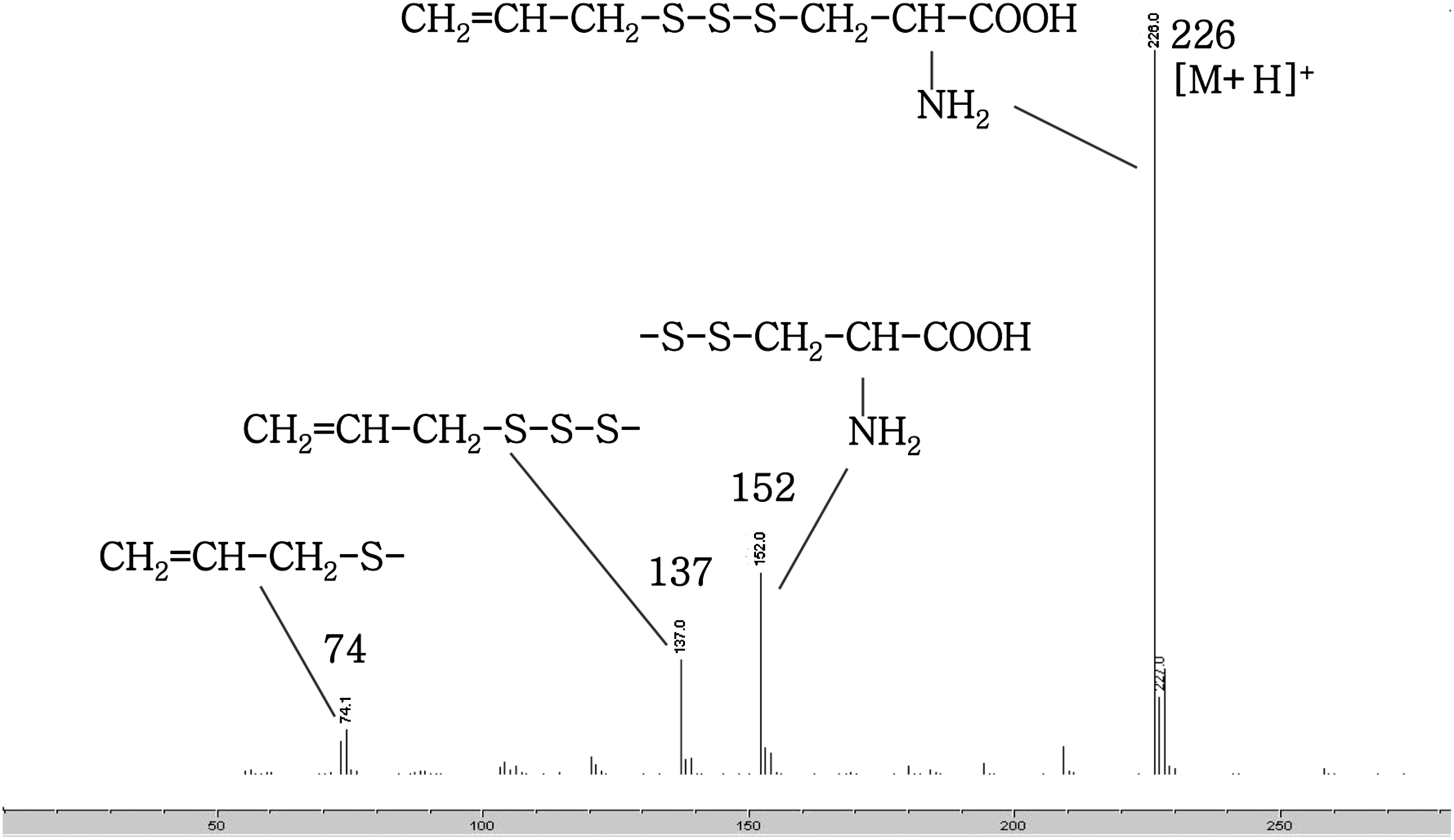
Mass spectrum of MW 225 with positive chemical ion mode.
1H-NMR and 13C-NMR analysis
The new compound was analyzed by 1H-NMR and 13C-NMR spectroscopy. In the 1H-NMR spectrum in D2O, chemical shifts at 5.3 ppm (2H, m), 6.0 ppm (1H, m), and 3.3 ppm (2H, dq) were assigned for the allyl moiety and 3.6 ppm (2H, d) and 4.1 ppm (1H, q) for the cysteine residue. To obtain the 13C-NMR spectrum, a mixture of CD3CN and D2O containing 2 drops of trifluoroacetic acid was used because of the low solubility of the product in D2O. A total of six carbon peaks (132.2, 118.8, and 40.3 for the allyl group and 169.0, 51.0, and 36.8 for the cysteine residue) were observed (Fig. 3).

(Top panel) 1H-nuclear magnetic resonance spectrum of MW 225 (D2O, 500 MHz) and (bottom panel) 13C-nuclear magnetic resonance spectrum of MW 225 (CD3CN-D2O [1:1 vol/vol] containing 2 drops of trifluoroacetic acid, 125.77 MHz).
FT-IR analysis
The FT-IR spectrum of the product revealed two weak N-H stretches between 3,500 and 3,100 cm−1, a broad O-H stretch centered at about 3,000 cm−1, and a strong carbonyl C = O stretch in the region of 1,700–1,600 cm−1 (Fig. 4), implying the presence of amine and carboxylic acid.
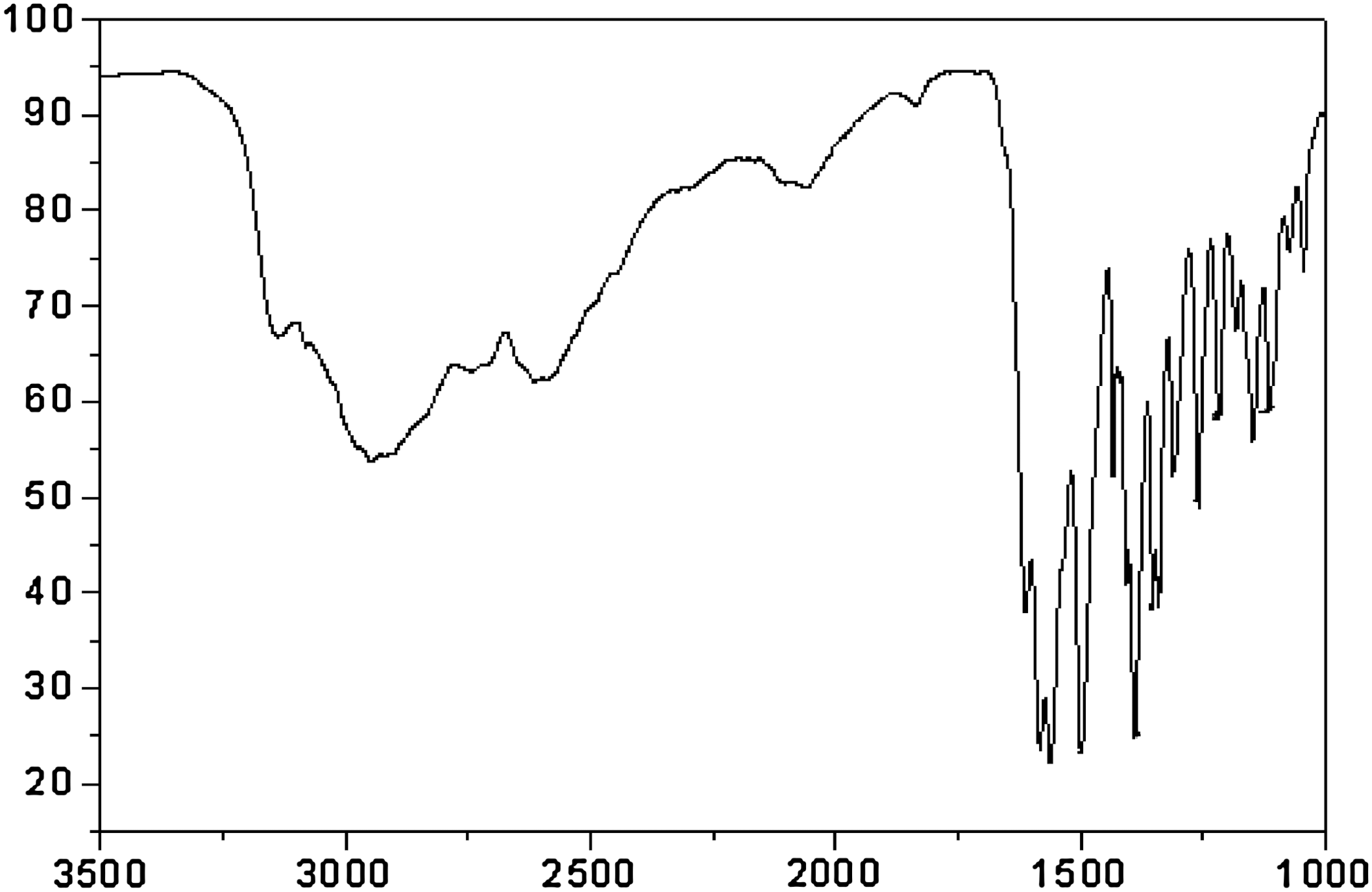
Identification of functional groups in MW 225 with Fourier transform-infrared spectrum.
In summary, overall data from the elemental analysis, LC/MS, NMR spectroscopy, and FT-IR spectroscopy support that the new antimicrobial compound is 3-(allyltrisulfanyl)-2-amino-propanoic acid, which has not previously been reported in the literature. The relevant structures that originated from garlic are S-allylcysteine (SAC) and S-allylmercaptocysteine (SAMC), which have one and two sulfur atoms in allyl-(S) n -cysteine, respectively (Fig. 5). 9 –11,14 –20
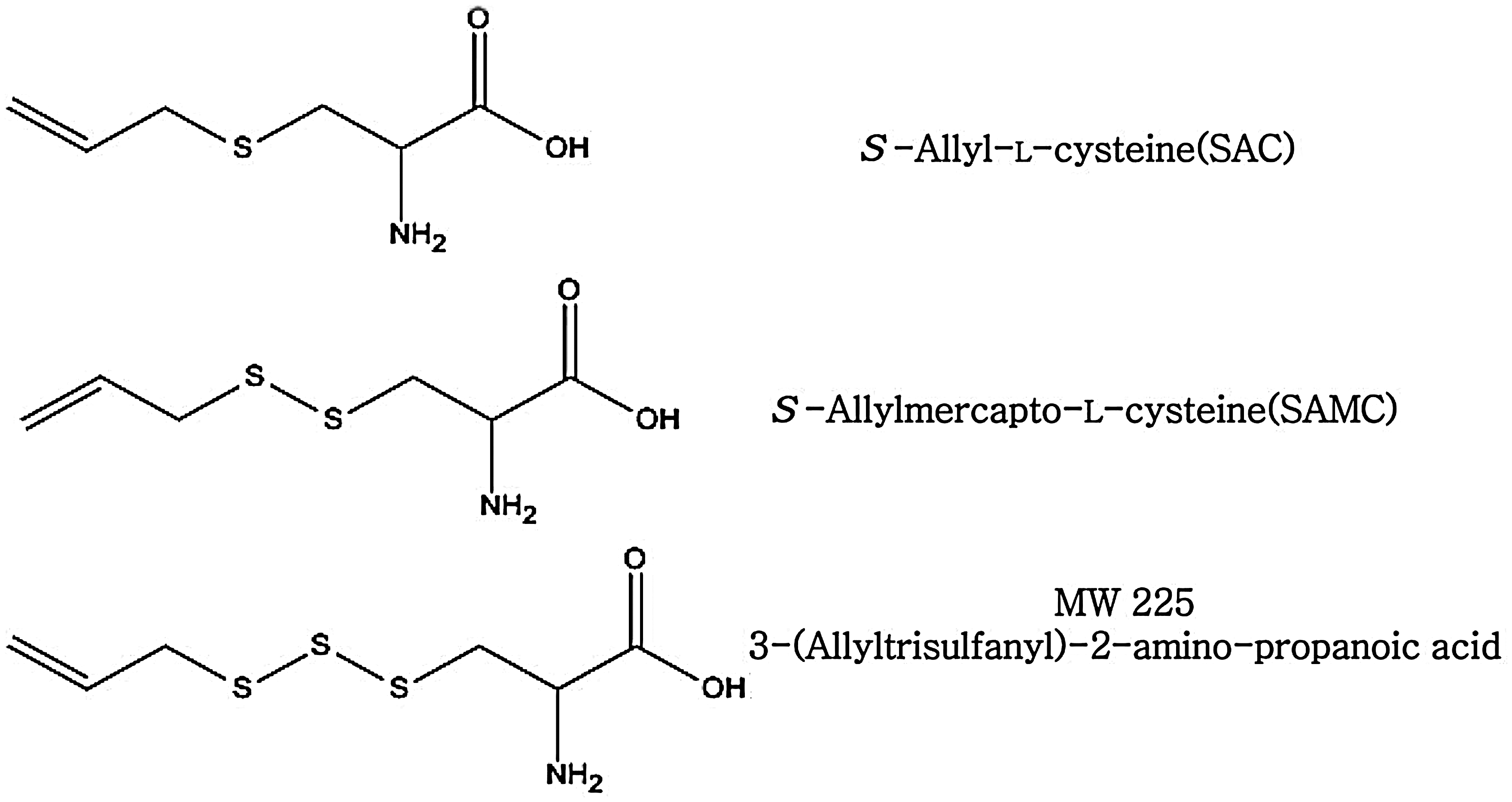
Comparison of molecular structures of MW 225 with other water-soluble sulfur compounds found in fresh and processed garlic.
Antimicrobial activity of the new water-soluble compound
Comparisons of the antimicrobial activity of the purified MW 225 compound with available antimicrobial garlic compounds revealed a comparable antimicrobial activity with AA (Table 1) against yeasts. Judging from the MIC for S. aureus B33 alone, antibacterial activity of MW225 was significantly more potent than that of AA. MW 225 was concluded to be the water-soluble compound that showed additional extra antimicrobial activity in garlic extract heated for 45 and 75 minutes.
The minimum inhibitory concentration (MIC) for bacteria was measured after 24 hours of incubation, whereas the MIC for yeasts was measured after 48 hours of incubation.
Data are from Kim et al. 6
AA, allyl alcohol; DADS, diallyl disulfide; DAMS, diallyl monosulfide; DATS, diallyl trisulfide; DMDS, dimethyl disulfide; DMTS, diallyl trisulfide.
Because the antimicrobial activity of heated garlic was completely abolished with cysteine or glutathione, 3 as was the case with allicin, 21,22 garlic oil, 5 fresh garlic, 23 and cabbage, 24 MW 225 is judged to inhibit microorganisms in the same manner. A generally accepted theory 21 –23 as to how these sulfur compounds, such as thiosulfinates and sulfides, affect cellular activity is that they react with sulfhydryl groups of proteins to make mixed sulfides, interfering with cellular metabolism.
The number of sulfur atoms in antimicrobial sulfides including those in Table 1 is important in conferring potency of anti-yeast activity to dialk(en)yl sulfides. As seen in Table 1, the addition of a sulfur atom increased anti-yeast activity of diallyl sulfides by approximately 10-fold (Table 1). The MICs of DAMS, DADS, and DATS were about 1,000, 100, and 10, respectively. 7 The tendency was very similar in antimicrobial activity of dimethyl sulfides (Table 1). Diallyl trisulfide was approximately 10-fold stronger than dimethyl disulfide. 7 The number of sulfur atoms in SAC, SAMC, and MW 225 may be important in determining antimicrobial activity of these compounds.
In addition to the antimicrobial activity of the new compound, its analogs, including SAC and SAMC (Fig. 5), that were found in fresh and processed garlic were reported to have various health-functional activities, including anticancer, 9 –16 antioxidative, 17 –19 and other beneficial 20,25 activities. The new compound [(3-allyltrisulfinyl)-2-aminopropanoic acid] and the two compounds in Figure 5 belong to a chemical group of allyl-(S) n -cysteine, differing only in the number of sulfur atoms in their molecules. SAMC with two sulfur atoms in the molecule shows anticancer activity 10,11,16 and is reported to be even more effective compared to SAC, which has one sulfur 12,13,15 ; therefore, it should be investigated whether MW 225 possesses any effective health-functional activity comparable to those of SAC and SAMC. It has been a decade since more emphasis has been placed on stable bioavailable compounds like SAC and SAMC, rather than on allicin, which is unstable and disappears during processing. 26 More work has been focused on health-functional characteristics of allyl-(S) n -cysteine than the antimicrobial activities of the compounds.
Footnotes
Acknowledgments
This work was supported by the Sejong University Research Fund (2008). Expert assistance of Mr. I.S. Chung in isolating and purifying the new compound is greatly appreciated.
Author Disclosure Statement
No competing financial interests exist.