The purpose of this study was to investigate the effects of a proprietary blend of soybean peptides, taurine, Pueraria isoflavone, and ginseng saponin complex (STPG capsule) on exercise performance in humans. Fourteen male volunteers were randomly assigned to two crossover treatments in which they consumed either four STPG capsules (STPG treatment) or placebo (P treatment) for 15 days before a 75% maximal oxygen uptake \documentclass{aastex}\usepackage{amsbsy}\usepackage{amsfonts}\usepackage{amssymb}\usepackage{bm}\usepackage{mathrsfs}\usepackage{pifont}\usepackage{stmaryrd}\usepackage{textcomp}\usepackage{portland,xspace}\usepackage{amsmath,amsxtra}\pagestyle{empty}\DeclareMathSizes{10}{9}{7}{6} \begin{document}$$( \dot{V}{ \rm O}_{2 \max} )$$ \end{document} exhaustive cycling test. Blood samples and respiratory gas were collected prior to the exercise (Pre-Ex), at 10 (Ex-10), 15 (Ex-15), 20 (Ex-20), and 25 (Ex-25) minutes during exercise, and immediately after exercise (exhaustion) to assess the blood metabolites, cardiorespiratory responses, and energy substrate utilization. The result showed that exercise time to exhaustion of the 75% \documentclass{aastex}\usepackage{amsbsy}\usepackage{amsfonts}\usepackage{amssymb}\usepackage{bm}\usepackage{mathrsfs}\usepackage{pifont}\usepackage{stmaryrd}\usepackage{textcomp}\usepackage{portland,xspace}\usepackage{amsmath,amsxtra}\pagestyle{empty}\DeclareMathSizes{10}{9}{7}{6} \begin{document}$$\dot{V}{\rm O}_{2 \max}$$ \end{document} exhaustive cycling test of the STPG-treated subjects was significantly greater than with the P treatment (30.99 ± 2.01 vs. 28.05 ± 1.48 minutes). The plasma lactate concentrations at Ex-20 and Ex-25 in the STPG treatment were significantly lower with STPG treatment than with P treatment (10.5 ± 0.7 vs. 11.5 ± 0.8 and 10.7 ± 0.9 vs.12.3 ± 1.0 mmol/L, respectively). Nonesterified fatty acid levels at Ex-15, Ex-20, Ex-25, and exhaustion in the STPG group (0.27 ± 0.03, 0.32 ± 0.04, 0.32 ± 0.06, and 0.37 ± 0.05 mmol/L, respectively) were significantly higher than those in the P treatment (0.21 ± 0.03, 0.23 ± 0.03, 0.24 ± 0.03, and 0.25 ± 0.03 mmol/L, respectively). It was concluded that supplementation of four capsules (2 g) of STPG complex, consisting of soybean peptides, taurine, Pueraria isoflavone, and ginseng saponin, for 15 days was effective in promoting utilization of free fatty acids and improving exhaustive cycling test performance in humans.
Introduction
O
ver the past 10 years, nutritional supplements have become increasingly popular among the general public worldwide, and many supplements are taken as ergogenic aids, a term used for substances that enhance athletic performance and increase stamina and exercise capacity.1,2 There is a growing inclination among athletes to use ergogenic aids to improve exercise performance.3–5
Soybean peptide has been reported to substantially accelerate metabolism6,7 and enhance exercise performance.8 Taurine, a sulfonic amino acid found primarily in skeletal muscle,9,10 was reported to reduce physical fatigue and muscle damage during exercise training in rats.11 Pueraria Radix (the root of kudzu, Pueraria lobata), an herbal medicine with antioxidative effects, can markedly protect against apoptosis of endothelial cells induced by chemical hypoxia–ischemia.12 Ginseng saponin treatment significantly increases levels of the nonesterified fatty acids (NEFAs), maintains the plasma glucose level during exercise, and enhances aerobic exercise performance.13
Although numerous studies have demonstrated the efficacy of diverse nutritional supplements in isolation, few studies have examined the effect of these substances in combination. Studies have suggested that the combinations of various micro- and macronutrients may have a synergistic effect beyond that obtained by ingesting the individual ingredients.14,15 Complex ingredients may strengthen the benefit and reduce the effective dosage. An encapsulated blend of soybean peptides, taurine, Pueraria isoflavone, and ginseng saponin (STPG capsule), is produced by Health Science USA Inc. (Flushing, NY, USA) and claimed to improve endurance exercise performance as substantiated by published studies of the individual ingredients. The coordinated function of metabolically connected nutrients and physiologically active ingredients may be pivotal in enhancing performance. Therefore, the purpose of this study was to investigate whether the STPG capsule can improve the endurance exercise capacity in humans. A 15-day randomized, double-blind, crossover study was conducted.
Materials and Methods
Subjects
Fourteen male collegian volunteers, with a mean age (±SEM) of 21.6 ± 0.7 years, weight of 73.3 ± 3.5 kg, and height of 173.6 ± 1.2 cm, participated in the experiment. Subjects had to successfully complete a health history questionnaire and not be taking any prescription drugs for blood pressure, cardiac problems, or blood glucose control, which might affect the outcome of the study or participant safety. All subjects were fully informed of the purpose of the experiments and of any possible risks before giving their written consent to participate in the study. The study was approved by the Human Research Ethics Committee of National Taiwan Sport University (Taoyuan, Taiwan).
Study design
Each subject participated in two tests, separated by 14 days, in which two STPG capsules (consisting of soybean peptides, taurine, Pueraria isoflavone, and ginseng saponin) (STPG treatment) or placebo (P treatment) was consumed twice per day for 15 days, and then the participant exercised on an ergometer at an intensity of 75% maximal oxygen uptake \documentclass{aastex}\usepackage{amsbsy}\usepackage{amsfonts}\usepackage{amssymb}\usepackage{bm}\usepackage{mathrsfs}\usepackage{pifont}\usepackage{stmaryrd}\usepackage{textcomp}\usepackage{portland,xspace}\usepackage{amsmath,amsxtra}\pagestyle{empty}\DeclareMathSizes{10}{9}{7}{6} \begin{document}$$( \dot{V}{ \rm O}_{2 \max} )$$ \end{document} until exhausted. The tests were administered in a randomized, double-blinded fashion. A blood sample and respiratory gas were collected during the exhaustive cycling test. The exercise performance time, blood metabolites, cardiorespiratory responses, and energy substrate utilization were measured in a 75% \documentclass{aastex}\usepackage{amsbsy}\usepackage{amsfonts}\usepackage{amssymb}\usepackage{bm}\usepackage{mathrsfs}\usepackage{pifont}\usepackage{stmaryrd}\usepackage{textcomp}\usepackage{portland,xspace}\usepackage{amsmath,amsxtra}\pagestyle{empty}\DeclareMathSizes{10}{9}{7}{6} \begin{document}$$\dot{V}{ \rm O}_{2 \max}$$ \end{document} exhaustive cycling test after the 15-day supplementation. Biochemical parameters included activity of creatine kinase (CK) and concentrations of glucose, lactate, and ammonia in plasma and concentrations of NEFAs and glycerol in serum. Energy substrate utilization was calculated from the level of respiratory oxygen consumption \documentclass{aastex}\usepackage{amsbsy}\usepackage{amsfonts}\usepackage{amssymb}\usepackage{bm}\usepackage{mathrsfs}\usepackage{pifont}\usepackage{stmaryrd}\usepackage{textcomp}\usepackage{portland,xspace}\usepackage{amsmath,amsxtra}\pagestyle{empty}\DeclareMathSizes{10}{9}{7}{6} \begin{document}$$( \dot{V}{ \rm O}_2 )$$ \end{document} and carbon dioxide production \documentclass{aastex}\usepackage{amsbsy}\usepackage{amsfonts}\usepackage{amssymb}\usepackage{bm}\usepackage{mathrsfs}\usepackage{pifont}\usepackage{stmaryrd}\usepackage{textcomp}\usepackage{portland,xspace}\usepackage{amsmath,amsxtra}\pagestyle{empty}\DeclareMathSizes{10}{9}{7}{6} \begin{document}$$( \dot{V} { \rm CO}_2 )$$ \end{document}.
Dietary intake and physical activity standardization
All subjects consumed a standardized meal (∼51 kJ/kg of body mass; containing energy as 61.3% carbohydrate, 15.3% protein, and 23.4% fat) in the evening before each test day, thereby minimizing the impact of differences in food intake on blood glucose homeostasis. All volunteers were instructed to refrain from any sort of heavy physical exercise and to keep their diet as constant as possible for 3 days before the 75% \documentclass{aastex}\usepackage{amsbsy}\usepackage{amsfonts}\usepackage{amssymb}\usepackage{bm}\usepackage{mathrsfs}\usepackage{pifont}\usepackage{stmaryrd}\usepackage{textcomp}\usepackage{portland,xspace}\usepackage{amsmath,amsxtra}\pagestyle{empty}\DeclareMathSizes{10}{9}{7}{6} \begin{document}$$\dot{V}{ \rm O}_{2 \max}$$ \end{document} exhaustive cycling tests. In addition, subjects were asked to record their food intake for 48 hours before the start of the first test and to consume the same diet 48 hours before the start of the second test.
Supplementation
Two capsules (500 mg per capsule) of the STPG or placebo were taken after breakfast and two after dinner for 15 days. The STPG capsule consisted of 150 mg of soybean peptides, 50 mg of taurine, 45 mg of Pueraria Radix extract (Pueraria isoflavone), and 30 mg of ginseng saponin (Health Science USA Inc.). The placebo consisted of a starch and lactose filler of the same weight and form as the STPG. Participants' compliance with the study protocol was assessed by checking for any remaining capsules at the end of the 15-day supplementation and verbal questioning.
75% \documentclass{aastex}\usepackage{amsbsy}\usepackage{amsfonts}\usepackage{amssymb}\usepackage{bm}\usepackage{mathrsfs}\usepackage{pifont}\usepackage{stmaryrd}\usepackage{textcomp}\usepackage{portland,xspace}\usepackage{amsmath,amsxtra}\pagestyle{empty}\DeclareMathSizes{10}{9}{7}{6} \begin{document}$$\dot{\rm V}O_{2 \max}$$ \end{document} exhaustive cycling test
The \documentclass{aastex}\usepackage{amsbsy}\usepackage{amsfonts}\usepackage{amssymb}\usepackage{bm}\usepackage{mathrsfs}\usepackage{pifont}\usepackage{stmaryrd}\usepackage{textcomp}\usepackage{portland,xspace}\usepackage{amsmath,amsxtra}\pagestyle{empty}\DeclareMathSizes{10}{9}{7}{6} \begin{document}$$\dot{V}{\rm O}_{2 \max}$$ \end{document} of each subject was determined at least 3 days before the supplementation. \documentclass{aastex}\usepackage{amsbsy}\usepackage{amsfonts}\usepackage{amssymb}\usepackage{bm}\usepackage{mathrsfs}\usepackage{pifont}\usepackage{stmaryrd}\usepackage{textcomp}\usepackage{portland,xspace}\usepackage{amsmath,amsxtra}\pagestyle{empty}\DeclareMathSizes{10}{9}{7}{6} \begin{document}$$\dot{V}{\rm O}_{2 \max}$$ \end{document} was measured with a SensorMedics (Yorba Linda, CA, USA) model 2900 metabolic measurement cart system during continuous and incremental exercise on an ergometer (Monark 839E, Monark Ltd., Varberg, Sweden). The \documentclass{aastex}\usepackage{amsbsy}\usepackage{amsfonts}\usepackage{amssymb}\usepackage{bm}\usepackage{mathrsfs}\usepackage{pifont}\usepackage{stmaryrd}\usepackage{textcomp}\usepackage{portland,xspace}\usepackage{amsmath,amsxtra}\pagestyle{empty}\DeclareMathSizes{10}{9}{7}{6} \begin{document}$$\dot{V}{\rm O}_{2 \max}$$ \end{document} was defined as the attainment of at least two of the three following criteria: (1) no longer maintaining the required speed (70 rpm); (2) heart rate within 10 beats of age-predicted maximum (calculated as 220 – age); and (3) rating of perceived exertion (RPE) greater than 18 using the modified Borg scale.16 Heart rate was measured using a Polar S625X telemetry heart rate monitor (Polar Electro Oy, Kempele, Finland) during the exercise. The average \documentclass{aastex}\usepackage{amsbsy}\usepackage{amsfonts}\usepackage{amssymb}\usepackage{bm}\usepackage{mathrsfs}\usepackage{pifont}\usepackage{stmaryrd}\usepackage{textcomp}\usepackage{portland,xspace}\usepackage{amsmath,amsxtra}\pagestyle{empty}\DeclareMathSizes{10}{9}{7}{6} \begin{document}$$\dot{V}{\rm O}_{2 \max}$$ \end{document} for subjects was 47.6 ± 1.9 mL/kg/minute.
On the day of the 75% \documentclass{aastex}\usepackage{amsbsy}\usepackage{amsfonts}\usepackage{amssymb}\usepackage{bm}\usepackage{mathrsfs}\usepackage{pifont}\usepackage{stmaryrd}\usepackage{textcomp}\usepackage{portland,xspace}\usepackage{amsmath,amsxtra}\pagestyle{empty}\DeclareMathSizes{10}{9}{7}{6} \begin{document}$$\dot{V}{\rm O}_{2 \max}$$ \end{document} exhaustive cycling test, after an overnight fast, the subjects reported to the laboratory by car or public transportation at 07:00–09:00 hours to minimize the effect of physical activity before the test. After the individual rested for 30 minutes, a catheter was inserted into a peripheral arm vein to prepare for blood sampling. The baseline values of respiratory gas and heart rate were measured, and participants performed steady-state cycling exercise on an ergometer at an intensity of 75% \documentclass{aastex}\usepackage{amsbsy}\usepackage{amsfonts}\usepackage{amssymb}\usepackage{bm}\usepackage{mathrsfs}\usepackage{pifont}\usepackage{stmaryrd}\usepackage{textcomp}\usepackage{portland,xspace}\usepackage{amsmath,amsxtra}\pagestyle{empty}\DeclareMathSizes{10}{9}{7}{6} \begin{document}$$\dot{V}{\rm O}_{2 \max}$$ \end{document} until exhausted. The speed of the egometer was kept constant at 70 rpm throughout the exercise. Respiratory gas and blood samples were collected from each subject during the 75% \documentclass{aastex}\usepackage{amsbsy}\usepackage{amsfonts}\usepackage{amssymb}\usepackage{bm}\usepackage{mathrsfs}\usepackage{pifont}\usepackage{stmaryrd}\usepackage{textcomp}\usepackage{portland,xspace}\usepackage{amsmath,amsxtra}\pagestyle{empty}\DeclareMathSizes{10}{9}{7}{6} \begin{document}$$\dot{V}{\rm O}_{2 \max}$$ \end{document} exhaustive cycling test. The heart rate and RPE were recorded throughout. The RPE scale ranges from 6 (no exertion at all) to 13 (somewhat hard) to 20 (maximal exertion). The subjects' degree of exhaustion was assessed based on the above RPE scale. The endurance performance time was recorded at the end of the test for each subject. Following a 14-day washout period, subjects from the P treatment were switched to the STPG treatment, and vice versa. The 75% \documentclass{aastex}\usepackage{amsbsy}\usepackage{amsfonts}\usepackage{amssymb}\usepackage{bm}\usepackage{mathrsfs}\usepackage{pifont}\usepackage{stmaryrd}\usepackage{textcomp}\usepackage{portland,xspace}\usepackage{amsmath,amsxtra}\pagestyle{empty}\DeclareMathSizes{10}{9}{7}{6} \begin{document}$$\dot{V}{\rm O}_{2 \max}$$ \end{document} exhaustive cycling test was then repeated. All tests were conducted under laboratory conditions at 26.9 ± 0.2°C and a relative humidity of 47.9 ± 1.5%.
Blood sampling and analysis
Blood samples were obtained prior to the exercise (Pre-Ex), at 10 (Ex-10), 15 (Ex-15), 20 (Ex-20), and 25 (Ex-25) minutes during exercise, and immediately after exercise (exhaustion). Blood samples for the analysis of plasma CK and ammonia were collected from a brachial vein into a heparin-containing tube and kept on ice until centrifuged at 1,000 g for 10 minutes at 4°C. Blood samples for the analysis of plasma glucose and lactate were collected in fluorosodium-containing tubes and centrifuged at 1,000 g for 10 minutes at 4°C. CK, ammonia, glucose, and lactate in plasma were measured by a DT-60 II analyzer (Orthoclinical Diagnostics, Johnson & Johnson, Rochester, NY, USA) by means of ultraviolet test kits (Orthoclinical Diagnostics). Analyses of serum NEFAs and glycerol were performed on blood that was allowed to coagulate at room temperature, and the serum was obtained by centrifugation as described above and stored at −80°C until analyzed. Serum levels of NEFAs and glycerol were measured with a colorimetric NEFAs kit and glycerol kit (Randox Laboratories, Antrim, United Kingdom).
Cardiorespiratory responses and energy substrate utilization
The respiratory gas was sampled by a SensorMedics model 2900 metabolic measurement cart system and was directed to a laboratory computer for calculation of \documentclass{aastex}\usepackage{amsbsy}\usepackage{amsfonts}\usepackage{amssymb}\usepackage{bm}\usepackage{mathrsfs}\usepackage{pifont}\usepackage{stmaryrd}\usepackage{textcomp}\usepackage{portland,xspace}\usepackage{amsmath,amsxtra}\pagestyle{empty}\DeclareMathSizes{10}{9}{7}{6} \begin{document}$$\dot{V}{\rm O}_{2}$$ \end{document} and \documentclass{aastex}\usepackage{amsbsy}\usepackage{amsfonts}\usepackage{amssymb}\usepackage{bm}\usepackage{mathrsfs}\usepackage{pifont}\usepackage{stmaryrd}\usepackage{textcomp}\usepackage{portland,xspace}\usepackage{amsmath,amsxtra}\pagestyle{empty}\DeclareMathSizes{10}{9}{7}{6} \begin{document}$$\dot{V} { \rm CO}_2$$ \end{document}. At the same time, the heart rate was also recorded with a Polar S625X monitor. Levels of \documentclass{aastex}\usepackage{amsbsy}\usepackage{amsfonts}\usepackage{amssymb}\usepackage{bm}\usepackage{mathrsfs}\usepackage{pifont}\usepackage{stmaryrd}\usepackage{textcomp}\usepackage{portland,xspace}\usepackage{amsmath,amsxtra}\pagestyle{empty}\DeclareMathSizes{10}{9}{7}{6} \begin{document}$$\dot{V}{\rm O}_{2}$$ \end{document} and \documentclass{aastex}\usepackage{amsbsy}\usepackage{amsfonts}\usepackage{amssymb}\usepackage{bm}\usepackage{mathrsfs}\usepackage{pifont}\usepackage{stmaryrd}\usepackage{textcomp}\usepackage{portland,xspace}\usepackage{amsmath,amsxtra}\pagestyle{empty}\DeclareMathSizes{10}{9}{7}{6} \begin{document}$$\dot{V} { \rm CO}_2$$ \end{document} and heart rate were recorded every 5 minutes during the 75% \documentclass{aastex}\usepackage{amsbsy}\usepackage{amsfonts}\usepackage{amssymb}\usepackage{bm}\usepackage{mathrsfs}\usepackage{pifont}\usepackage{stmaryrd}\usepackage{textcomp}\usepackage{portland,xspace}\usepackage{amsmath,amsxtra}\pagestyle{empty}\DeclareMathSizes{10}{9}{7}{6} \begin{document}$$\dot{V}{\rm O}_{2 \max}$$ \end{document} exhaustive cycling test. In addition, the respiratory exchange ratio (RER) and whole-body oxidation rate were calculated from the \documentclass{aastex}\usepackage{amsbsy}\usepackage{amsfonts}\usepackage{amssymb}\usepackage{bm}\usepackage{mathrsfs}\usepackage{pifont}\usepackage{stmaryrd}\usepackage{textcomp}\usepackage{portland,xspace}\usepackage{amsmath,amsxtra}\pagestyle{empty}\DeclareMathSizes{10}{9}{7}{6} \begin{document}$$\dot{V}{\rm O}_{2}$$ \end{document} and \documentclass{aastex}\usepackage{amsbsy}\usepackage{amsfonts}\usepackage{amssymb}\usepackage{bm}\usepackage{mathrsfs}\usepackage{pifont}\usepackage{stmaryrd}\usepackage{textcomp}\usepackage{portland,xspace}\usepackage{amsmath,amsxtra}\pagestyle{empty}\DeclareMathSizes{10}{9}{7}{6} \begin{document}$$\dot{V} { \rm CO}_2$$ \end{document} levels using the following equations:17\documentclass{aastex}\usepackage{amsbsy}\usepackage{amsfonts}\usepackage{amssymb}\usepackage{bm}\usepackage{mathrsfs}\usepackage{pifont}\usepackage{stmaryrd}\usepackage{textcomp}\usepackage{portland,xspace}\usepackage{amsmath,amsxtra}\pagestyle{empty}\DeclareMathSizes{10}{9}{7}{6} \begin{document} \begin{align*}{\rm RER} = \dot{V}{\rm CO}_2 / \dot{V}{\rm O}_2\end{align*} \end{document}\documentclass{aastex}\usepackage{amsbsy}\usepackage{amsfonts}\usepackage{amssymb}\usepackage{bm}\usepackage{mathrsfs}\usepackage{pifont}\usepackage{stmaryrd}\usepackage{textcomp}\usepackage{portland,xspace}\usepackage{amsmath,amsxtra}\pagestyle{empty}\DeclareMathSizes{10}{9}{7}{6} \begin{document} \begin{align*}\hbox{Carbohydrate oxidation} = 4.585 \ {\dot V}{ \rm CO}_2\ {( \rm in\ L / minute) } \\ - 3.226 \ \dot{V}{ \rm O}_2 \, \rm{( in\ L / minute ) }\end{align*} \end{document}\documentclass{aastex}\usepackage{amsbsy}\usepackage{amsfonts}\usepackage{amssymb}\usepackage{bm}\usepackage{mathrsfs}\usepackage{pifont}\usepackage{stmaryrd}\usepackage{textcomp}\usepackage{portland,xspace}\usepackage{amsmath,amsxtra}\pagestyle{empty}\DeclareMathSizes{10}{9}{7}{6} \begin{document} \begin{align*}\hbox{Fat oxdiation} = 1.695 \ \dot{V}{\rm O}_2 \ {\rm ( in \ L / minute) } \\ - 1.701 \ \dot{V}{ \rm CO}_2 \, \rm{( in \ L / minute ) }\end{align*} \end{document}
Statistical analyses
Data are presented as mean ± SEM values. Statistical analysis was performed by SPSS version 14.0 (SPSS, Inc., Chicago, IL, USA). The cycling exercise times of the two treatments (STPG vs. P) were compared by Student's t test for paired data. Differences in other variables were assessed by repeated-measures two-way analysis of variance (time ×treatment). The LSD post hoc test was used to detect the differences at each time point to Pre-Ex in the same treatment and the same time point between treatments. Significance was accepted at the P < .05 level.
Results
Cycling exercise time
The mean exercise time until exhaustion in the 75% \documentclass{aastex}\usepackage{amsbsy}\usepackage{amsfonts}\usepackage{amssymb}\usepackage{bm}\usepackage{mathrsfs}\usepackage{pifont}\usepackage{stmaryrd}\usepackage{textcomp}\usepackage{portland,xspace}\usepackage{amsmath,amsxtra}\pagestyle{empty}\DeclareMathSizes{10}{9}{7}{6} \begin{document}$$\dot{V}{\rm O}_{2 \max}$$ \end{document} exhaustive cycling test was significantly greater for the STPG-treated group (30.99 ± 2.01 minutes) than for the P-treated group (28.05 ± 1.48 minutes).
Blood metabolites
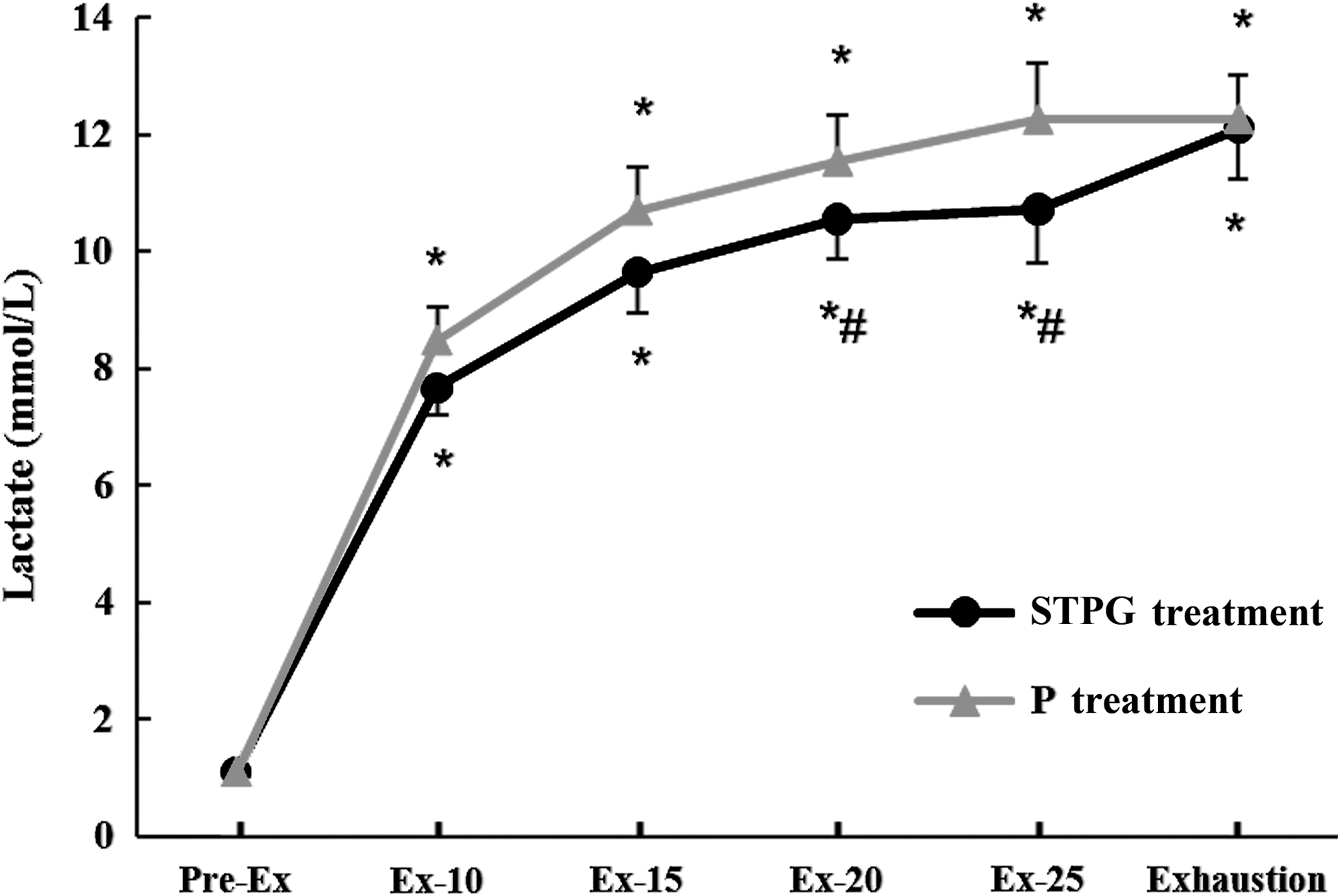
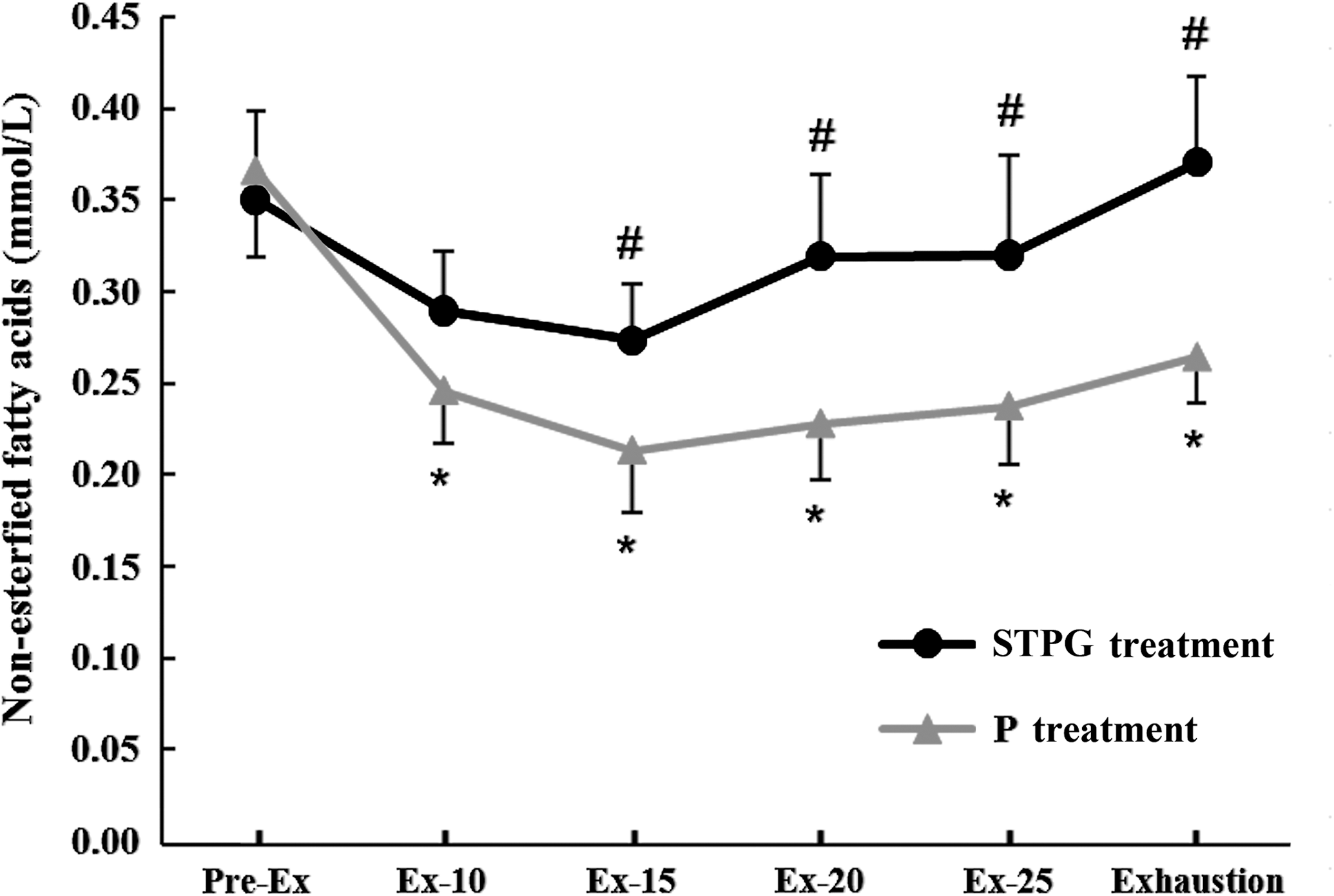
The plasma CK, ammonia, glucose, glycerol, lactate, and NEFAs during the 75% \documentclass{aastex}\usepackage{amsbsy}\usepackage{amsfonts}\usepackage{amssymb}\usepackage{bm}\usepackage{mathrsfs}\usepackage{pifont}\usepackage{stmaryrd}\usepackage{textcomp}\usepackage{portland,xspace}\usepackage{amsmath,amsxtra}\pagestyle{empty}\DeclareMathSizes{10}{9}{7}{6} \begin{document}$$\dot{V}{\rm O}_{2 \max}$$ \end{document} exhaustive cycling test following 15 days of STPG and placebo consumption are presented in Table 1 and Figures 1 and 2. In both the STPG and P treatments, plasma lactate, ammonia, and glycerol significantly increased with the duration of exercise and reached a peak at exhaustion. Plasma lactate concentrations at Ex-20 and Ex-25 in the STPG treatment (10.5 ± 0.7 and 10.7 ± 0.9 mmol/L) were significantly lower than those in the P treatment (11.5 ± 0.8 and 12.3 ± 1.0 mmol/L) (both P < .05) (Fig. 1). Moreover, serum NEFA levels at Ex-15, Ex-20, Ex-25, and exhaustion in the STPG treatment (0.27 ± 0.03, 0.32 ± 0.04, 0.32 ± 0.06, and 0.37 ± 0.05 mmol/L, respectively) were significantly higher than those in the P treatment (0.21 ± 0.03, 0.23 ± 0.03, 0.24 ± 0.03, and 0.25 ± 0.03 mmol/L, respectively) (all P < .05) (Fig. 2). There were no significant differences in plasma CK activities, glucose concentrations, or glutamic oxaloacetic transaminase or glutamic pyruvic transaminase activities (data not shown) between the two treatments for the entire experimental period.
Blood lactate concentrations during the 75% maximal oxygen uptake exhaustive cycling test following 15 days of STPG or placebo consumption (n = 14 per treatment). Data are mean values with the SEM depicted by vertical bars. *Significantly differs (P < .05) from the Pre-Ex value. #Significantly differs (P < .05) from the P group at the same time point.
Concentrations of nonesterified fatty acids during the 75% maximal oxygen uptake exhaustive cycling test following 15 days of STPG or placebo consumption (n = 14 per treatment). Data are mean values with the SEM depicted by vertical bars. *Significantly differs (P < .05) from the Pre-Ex value. #Significantly differs (P < .05) from the P group at the same time point.
Blood Metabolites During the 75% Maximal Oxygen Uptake Exhaustive Cycling Test Following 15 Days of STPG Capsule or Placebo Consumption
Significantly differs (P < .05) from the Pre-Ex value.
CK, creatine kinase; Pre-Ex, pre-exercise; Ex-10, at 10 minutes of exercise; Ex-15, at 15 minutes of exercise; Ex-20, at 20 minutes of exercise; Ex-25, at 25 minutes of exercise; STPG treatment, treatment with a proprietary (Health Science USA Inc.) blend of soybean peptides, taurine, Pueraria isoflavone, and ginseng saponin complex; P treatment, treatment with placebo.
Cardiorespiratory responses and energy substrate utilization
The heart rate, \documentclass{aastex}\usepackage{amsbsy}\usepackage{amsfonts}\usepackage{amssymb}\usepackage{bm}\usepackage{mathrsfs}\usepackage{pifont}\usepackage{stmaryrd}\usepackage{textcomp}\usepackage{portland,xspace}\usepackage{amsmath,amsxtra}\pagestyle{empty}\DeclareMathSizes{10}{9}{7}{6} \begin{document}$$\dot{V}{\rm O}_{2}$$ \end{document}, \documentclass{aastex}\usepackage{amsbsy}\usepackage{amsfonts}\usepackage{amssymb}\usepackage{bm}\usepackage{mathrsfs}\usepackage{pifont}\usepackage{stmaryrd}\usepackage{textcomp}\usepackage{portland,xspace}\usepackage{amsmath,amsxtra}\pagestyle{empty}\DeclareMathSizes{10}{9}{7}{6} \begin{document}$$\dot{V} { \rm CO}_2$$ \end{document}, and RER during the 75% \documentclass{aastex}\usepackage{amsbsy}\usepackage{amsfonts}\usepackage{amssymb}\usepackage{bm}\usepackage{mathrsfs}\usepackage{pifont}\usepackage{stmaryrd}\usepackage{textcomp}\usepackage{portland,xspace}\usepackage{amsmath,amsxtra}\pagestyle{empty}\DeclareMathSizes{10}{9}{7}{6} \begin{document}$$\dot{V}{\rm O}_{2 \max}$$ \end{document} exhaustive cycling test following 15 days of STPG or placebo consumption are presented in Table 2. In both the STPG and P treatment groups, the heart rate significantly increased with the duration of exercise and reached a peak at exhaustion, but there were no differences between the treatments. The \documentclass{aastex}\usepackage{amsbsy}\usepackage{amsfonts}\usepackage{amssymb}\usepackage{bm}\usepackage{mathrsfs}\usepackage{pifont}\usepackage{stmaryrd}\usepackage{textcomp}\usepackage{portland,xspace}\usepackage{amsmath,amsxtra}\pagestyle{empty}\DeclareMathSizes{10}{9}{7}{6} \begin{document}$$\dot{V}{\rm O}_{2}$$ \end{document} levels at Ex-5, Ex-20, and exhaustion in the STPG treatment (2.56 ± 0.07, 2.80 ± 0.12, and 2.90 ± 0.05 L/minute, respectively) were significantly higher than those in the P treatment (2.38 ± 0.06, 2.62 ± 0.09, and 2.74 ± 0.06 L/minute, respectively) (all P < .05). \documentclass{aastex}\usepackage{amsbsy}\usepackage{amsfonts}\usepackage{amssymb}\usepackage{bm}\usepackage{mathrsfs}\usepackage{pifont}\usepackage{stmaryrd}\usepackage{textcomp}\usepackage{portland,xspace}\usepackage{amsmath,amsxtra}\pagestyle{empty}\DeclareMathSizes{10}{9}{7}{6} \begin{document}$$\dot{V} { \rm CO}_2$$ \end{document} levels at Ex-5 and Ex-15 in the STPG treatment (2.58 ± 0.08 and 2.69 ± 0.08 L/minute, respectively) were also significantly higher than those in the P treatment (2.38 ± 0.06 and 2.58 ± 0.09 L/minute, respectively) (both P < .05). Furthermore, RER values at all time points during exercise were greater than that at Pre-Ex and progressively decreased from 5 minutes to exhaustion. However, there were no differences between treatments at the same time point.
Cardiorespiratory Responses During the 75% Maximal Oxygen Uptake Exhaustive Cycling Test Following 15 Days of STPG or Placebo Consumption
Figure 3 illustrates the whole-body carbohydrate and fat oxidation during the exhaustive test after STPG or placebo supplementation. There were no differences between treatments at the same time points.
Whole-body carbohydrate and fat oxidation during the 75% maximal oxygen uptake exhaustive cycling test following 15 days of STPG or placebo consumption (n = 14 per treatment). Data are mean values with the SEM depicted by vertical bars.
Discussion
In the present study, the effects of an ergogenic supplement (STPG capsule) on endurance exercise capacity and blood metabolites in humans were evaluated. The study used 15-day supplementation with four STPG capsules (consisting of 600 mg of soybean peptides, 200 mg of taurine, 180 mg of Pueraria isoflavone, and 120 mg of ginseng saponin) to increase the time to exhaustion in a 75% \documentclass{aastex}\usepackage{amsbsy}\usepackage{amsfonts}\usepackage{amssymb}\usepackage{bm}\usepackage{mathrsfs}\usepackage{pifont}\usepackage{stmaryrd}\usepackage{textcomp}\usepackage{portland,xspace}\usepackage{amsmath,amsxtra}\pagestyle{empty}\DeclareMathSizes{10}{9}{7}{6} \begin{document}$$\dot{V}{\rm O}_{2 \max}$$ \end{document} cycling test. The study also revealed that the STPG capsule supplementation decreased the blood lactate concentration and increased the NEFA concentration during exercise. The observations demonstrate that the STPG capsule can prolong exercise, at least partly, because of a glycogen-sparing effect, which elevates lipid utilization as an energy substrate during exercise.
Increased fatty acid utilization during exercise reduces the glycogen depletion rate and improves the endurance exercise performance.18 Therefore, increased fatty acid utilization is thought to be important for endurance performance. Serum NEFA concentrations at Ex-15, Ex-20, Ex-25, and exhaustion in the STPG treatment were higher than in the P treatment. STPG consumption increased utilization of lipids to a greater extent than glucose as an energy source for performance enhancement. These increases are associated with enhanced lipolysis and sparing of stored glycogen, resulting in a delay in complete glycogen depletion by increasing circulating catecholamines.19 The enhanced availability of NEFAs is thought to cause greater fat metabolism in active muscles, which in turn decreases carbohydrate utilization and leads to increased exercise capacity.20
Data from the respiratory metabolic analysis demonstrated that STPG supplementation increased utilization of lipids as an energy substrate compared with the placebo during the 75% \documentclass{aastex}\usepackage{amsbsy}\usepackage{amsfonts}\usepackage{amssymb}\usepackage{bm}\usepackage{mathrsfs}\usepackage{pifont}\usepackage{stmaryrd}\usepackage{textcomp}\usepackage{portland,xspace}\usepackage{amsmath,amsxtra}\pagestyle{empty}\DeclareMathSizes{10}{9}{7}{6} \begin{document}$$\dot{V}{\rm O}_{2 \max}$$ \end{document} exhaustive cycling test. In addition, the blood lactate concentration at Ex-20 and Ex-25 in the STPG treatment was significantly lower than that in the P treatment during the 75% \documentclass{aastex}\usepackage{amsbsy}\usepackage{amsfonts}\usepackage{amssymb}\usepackage{bm}\usepackage{mathrsfs}\usepackage{pifont}\usepackage{stmaryrd}\usepackage{textcomp}\usepackage{portland,xspace}\usepackage{amsmath,amsxtra}\pagestyle{empty}\DeclareMathSizes{10}{9}{7}{6} \begin{document}$$\dot{V}{\rm O}_{2 \max}$$ \end{document} exhaustive cycling exercise. Lipid utilization as an energy substrate during exercise can facilitate aerobic performance because obtaining energy from carbohydrates leads to lactate production and a decrease in pH that inhibits muscle contractions. Furthermore, the depletion of carbohydrate results in the deposition of glycogen, making it difficult to continue exercise. Therefore, the acceleration of lipid metabolism would lead to improved endurance.
In this study, the STPG capsule contained soybean peptides, taurine, Pueraria isoflavone, and ginseng saponin. Several lines of evidences suggest that soybean peptides may favorably affect lipid absorption,21 insulin resistance,22 and fatty acid metabolism.23 A study by Morifuji et al.24 demonstrated that soy protein feeding in rats decreased hepatic triacylglycerol levels and epididymal adipose tissue weight. These changes were associated with increased activity and mRNA levels of several skeletal muscle enzymes involved in fatty acid oxidation, suggesting that soy protein intake stimulates skeletal muscle fatty acid oxidation.
Oral taurine administrations in rats was reported to prevent the loss of muscle taurine concentration during exercise and even enhanced exercise performance on a treadmill.25 Furthermore, several studies reported the beneficial effects of taurine administration in rats and humans.26–28 Taurine was shown to increase the production of force by skinned muscle fibers in a rodent model.29 This may occur through increased calcium release from the sarcoplasmic reticulum and increased calcium sensitivity for excitation contraction coupling,29 or taurine may act as a free radical scavenger.30
Acute physical activity is generally marked by identifiable oxidative stress in the blood plasma.31 Pueraria Radix (the root of kudzu, P. lobata) is an herbal medicine with antioxidative effects.12 Several studies showed that antioxidants can modify the metabolism of adipose tissue,32–34 but the mechanisms involved are unknown. However, the effects of antioxidants on metabolism of skeletal muscle have received little attention. During exercise, it is important for lipolysis in the body to facilitate lipid utilization by muscles rather than release from adipose tissues. Regulation of fatty acyl-coenzyme A entry into the mitochondria by carnitine palmitoyltransferase I is a rate-limiting step in the oxidation of fatty acids in muscles.35 Recent studies36,37 showed that fatty acid translocase/CD36 is associated with carnitine palmitoyltransferase I on the mitochondrial membrane and elevates its function. The present study showed that serum NEFA concentrations at Ex-15, Ex-20, Ex-25, and exhaustion were higher in the STPG treatment than in the P treatment. The increased lipid metabolism may be partially attributable to the Pueraria.
Ginseng is widely used in Oriental societies as a valuable medicine. The major ingredients of ginseng are ginsenosides, also referred to as steroidal saponins, which make up about 3–6% of ginseng components and contain most of its pharmacological activity.38 Although the mechanisms explaining the ergogenic effects of ginseng saponin are not fully known, plausible theories include interactions with the nuclear receptor peroxisome proliferator-activated receptor α and stimulation of the catabolism of fatty acids, leading to changes in lipid profiles.39 Wang and Lee13 demonstrated that short-term (4-day) treatment with ginseng saponin significantly prolonged the aerobic endurance of non-trained rats. Compared with the control, ginseng saponin treatment significantly increased the plasma free fatty acid level and maintained the plasma glucose level during exercise. Therefore, ginseng saponins may have contributed to the increased exercise endurance realized with the administration of STPG.
In conclusion, this article provides science-based evidence for the potential ergogenic effects of STPG capsule on endurance performance in humans. The result suggested that taking four STPG capsules (2 g) per day for 15 days can increase fatty acid utilization as an energy source by sparing of glycogen during prolonged exercise. Therefore, this study suggests that STPG supplementation can enhance endurance performance. These results have immediate applications for athletes and exercising individuals involved in endurance-type events. Further study is needed to further investigate the benefits of the STPG supplement during training programs.
Footnotes
Acknowledgments
The authors would like to extend their deep appreciation to all participating subjects for their dedication to this study.
Author Disclosure Statement
No competing financial interests exist.
References
1.
LawrenceME, KirbyDF. Nutrition and sports supplements: fact or fiction. J Clin Gastroenterol, 2002; 35:299–306.
2.
KimS, ParkSH, LeeHN, ParkT. Prunus mume extract ameliorates exercise-induced fatigue in trained rats. J Med Food, 2008; 11:460–468.
LoHI, TsiD, TanAC, WangSW, HsuMC. Effects of postexercise supplementation of chicken essence on the elimination of exercise-induced plasma lactate and ammonia. Chin J Physiol, 2005; 48:187–192.
5.
ForbesSC, CandowDG, LittleJP, MagnusC, ChilibeckPD. Effect of Red Bull Energy Drink on repeated Wingate cycle performance and bench press muscle endurance. Int J Sport Nutr Exerc Metab, 2007; 17:433–444.
6.
AoyamaT, FukuiK, TakamatsuK, HashimotoY, YamamotoT. Soy protein isolate and its hydrolysate reduce body fat of dietary obese rats and genetically obese mice (yellow KK)Nutrition, 2000; 16:349–354.
7.
ClaessensM, CalameW, SiemensmaAD, SarisWH, van BaakMA. The thermogenic and metabolic effects of protein hydrolysate with or without a carbohydrate load in healthy male subjects. Metab Clin Exp, 2007; 56:1051–1059.
8.
DraganI, StroescuV, StoianI, GeorgescuE, BaloescuR. Studies regarding the efficiency of Supro isolated soy protein in Olympic athletes. Rev Roum Physiol, 1992; 29:63–70.
9.
HuxtableRJ. Physiological actions of taurine. Physiol Rev, 1992; 72:101–163.
10.
NieminenML, TuomistoL, SolatunturiE, ErikssonL, PaasonenMK. Taurine in the osmoregulation of the Brattleboro rat. Life Sci, 1988; 42:2137–2143.
11.
ManabeS, KurrodaI, OkadaK, MorishimaM, OkamotoM, HaradaN, TakahashiA, SakaiK, NakayaY. Decreased blood levels of lactic acid and urinary excretion of 3-methylhistidine after exercise by chronic taurine treatment in rats. J Nutr Sci Vitaminol, 2003; 49:375–380.
12.
ShiRL, ZhangJJ. Protective effect of puerarin on vascular endothelial cell apoptosis induced by chemical hypoxia in vitro [in Chinese]Yao Xue Xue Bao, 2003; 38:103–107.
13.
WangLC, LeeTF. Effect of ginseng saponins on exercise performance in non-trained rats. Planta Med, 1998; 64:130–133.
14.
EliaD, StadlerK, HorvathV, JakusJ. Effect of soy- and whey protein-isolate supplemented diet on the redox parameters of trained mice. Eur J Nutr, 2006; 45:259–266.
15.
ShaoZH, Vanden HoekTL, LiCQ, SchumackerPT, BeckerLB, ChanKC, QinY, YinJJ, YuanCS. Synergistic effect of Scutellaria baicalensis and grape seed proanthocyanidins on scavenging reactive oxygen species in vitro. Am J Chin Med, 2004; 32:89–95.
16.
BorgG. Psychophysical scaling with applications in physical work and the perception of exertion. Scand J Work Environ Health, 1990; 16:55–58.
17.
PeronnetF, MassicotteD. Table of nonprotein respiratory quotient: an update. Can J Sport Sci, 1991; 16:23–29.
18.
AzevedoJL, LindermanJK, LehmanSL, BrooksGA. Training decreases muscle glycogen turnover during exercise. Eur J Appl Physiol Occup Physiol, 1998; 78:479–486.
19.
IkeuchiM, KoyamaT, TakahashiJ, YazawaK. Effects of astaxanthin supplementation on exercise-induced fatigue in mice. Biol Pharm Bull, 2006; 29:2106–2110.
20.
KleinS, CoyleEF, WolfRR. Fat metabolism during low-intensity exercise in endurance-trained and untrained men. Am J Physiol, 1994; 267:934–940.
21.
TaniguchiM, NagaoK, InoueK, ImaizumiK. Cholesterol lowering effect of sulfur-containing amino acids added to a soybean protein diet in rats. J Nutr Sci Vitaminol, 2008; 54:448–453.
22.
WagnerJD, ZhangL, ShadoanMK, KavanaghK, ChenH, TresnasariK, KaplanJR, AdamsMR. Effects of soy protein and isoflavones on insulin resistance and adiponectin in male monkeys. Metabolism, 2008; 57:24–31.
23.
MochizukiY, MaebuchiM, KohnoM, HirotsukaM, WadahamaH, MoriyamaT, KawadaT, UradeR. Changes in lipid metabolism by soy beta-conglycinin-derived peptides in HepG2 cells. J Agric Food Chem, 2009; 57:1473–1480.
24.
MorifujiM, SanbongiC, SugiuraK. Dietary soya protein intake and exercise training have an additive effect on skeletal muscle fatty acid oxidation enzyme activities and mRNA levels in rats. Br J Nutr, 2006; 96:469–475.
25.
YatabeY, MiyakawaS, OhmoriH, MishimaH, AdachiT. Effects of taurine administration in rat skeletal muscles on exercise. J Orthop Sci, 2009; 643:245–252.
26.
BaumM, WeissM. The influence of a taurine containing drink on cardiac parameters before and after exercise measured by echocardiography. Amino Acids, 2001; 20:75–82.
27.
DawsonRJr, BiasettiM, MessinaS, DominyJ. The cytoprotective role of taurine in exercise-induced muscle injury. Amino Acids, 2002; 22:309–324.
28.
ZhangM, IzumiI, KagamimoriS, SokejimaS, YamagamiT, LiuZ, QiB. Role of taurine supplementation to prevent exercise-induced oxidative stress in healthy young men. Amino Acids, 2004; 26:203–207.
29.
BakkerAJ, BergHM. Effect of taurine on sarcoplasmic reticulum function and force in skinned fast-twitch skeletal muscle fibres of the rat. J Physiol, 2002; 538:185–194.
30.
RedmondHP, StapletonPP, NearyP, Bouchier-HayesD. Immunonutrition: the role of taurine. Nutrition, 1998; 14:599–604.
TsudaT, HorioF, UchidaK, AokiH, OsawaT. Dietary cyanidin 3-O-beta-d-glucoside-rich purple corn color prevents obesity and ameliorates hyperglycemia in mice. J Nutr, 2003; 133:2125–2130.
33.
WolframS, WangY, ThieleckeF. Anti-obesity effects of green tea: from bedside to bench. Mol Nutr Food Res, 2006; 50:176–187.
34.
CampionJ, MilagroFI, FernandezD, MartinezJA. Differential gene expression and adiposity reduction induced by ascorbic acid supplementation in a cafeteria model of obesity. J Physiol Biochem, 2006; 62:71–80.
35.
McGarryJD, BrownNF. The mitochondrial carnitine palmitoyltransferase system. From concept to molecular analysis. Eur J Biochem, 1997; 244:1–14.
36.
CampbellSE, TandonNN, WoldegiorgisG, LuikenJJ, GlatzJF, BonenA. A novel function for fatty acid translocase (FAT)/CD36: involvement in long chain fatty acid transfer into the mitochondria. J Biol Chem, 2004; 279:36235–36241.
37.
HollowayGP, BezaireV, HeigenhauserGJ, TandonNN, GlatzJF, LuikenJJ, BonenA, SprietLL. Mitochondrial long chain fatty acid oxidation, fatty acid translocase/CD36 content and carnitine palmitoyltransferase I activity in human skeletal muscle during aerobic exercise. J Physiol, 2006; 571:201–210.
38.
HuangKC. The Pharmacology of Chinese Herbs. 2nd. CRC Press: Boca Raton, FL, 1999.
39.
YoonM, LeeH, JeongS, KimJJ, NicolCJ, NamKW, KimM, ChoBG, OhGT. Peroxisome proliferator-activated receptor alpha is involved in the regulation of lipid metabolism by ginseng. Br J Pharmacol, 2003; 138:1295–1302.