




Abstract
Arctium lappa L. has been used in folk medicine as a diuretic, depurative, and digestive stimulant and in dermatological conditions. The mechanisms involved in the anti-ulcerogenic activity of the sesquiterpene onopordopicrin (ONP)-enriched fraction (termed the ONP fraction), obtained from A. lappa leaves, were studied. The gastroprotective mechanism of the ONP fraction was evaluated in experimental in vivo models in rodents, mimicking this disease in humans. ONP fraction (50 mg/kg, p.o.) significantly inhibited the mucosal injury induced by ethanol/HCl solution (75%), indomethacin/bethanecol (68.9%), and stress (58.3%). When the ONP fraction was investigated in pylorus ligature, it did not induce alteration in the gastric volume but did modify the pH and total acid concentration of gastric juice. ONP fraction significantly increased serum somatostatin levels (82.1±4.1 vs. control group 12.7±4 pmol/L) and decreased serum gastrin levels (62.6±6.04 vs. control group 361.5±8.2 μU/mL). Mucus production was not significantly altered by the ONP fraction. Gastroprotection by the ONP fraction was completely inhibited by N-ethylmaleimide treatment and did not modify the effect in the animals pretreated with
Introduction
G
In Brazil, Arctium lappa L., popularly known as “bardana,” is used in folk medicine as diuretic, depurative, and digestive stimulant. 8 This plant has already been reported to possess anticancer, 9 anti-inflammatory, 10 and anti-ulcerogenic 8 activities. The present work evaluated the mechanisms of action of a semipurified fraction from the leaves of A. lappa, which contains onopordopicrin (ONP) as its major compound.
Materials and Methods
Animals
Male Wistar rats (weighing 150–250 g) and male Swiss mice (weighing 30–35 g) from the Central Animal House at the State University of Campinas, Campinas, SP, Brazil, were housed on a 12-hour light/dark cycle at 22±1°C and 55% humidity. The animals received a certified Nuvilab CR-a® (Nuvital, Colombo, PR, Brazil) diet and water ad libitum but were fasted prior to all assays because standard drugs or ONP was always administered orally (by gavage; 10 mL/kg) using 12% Tween 80 as vehicle. All the experiments were carried out according to the recommendations of the Canadian Council on Animal Care. 11
Plant material
Leaves of A. lappa were collected in Mogi Mirim, SP, Brazil, and a voucher herbarium specimen (voucher number 131.966) was deposited in the Herbarium of the State University of Campinas.
Sesquiterpene ONP-enriched extract: extraction and characterization by gas chromatography–mass spectrometry
Fresh leaves (171 g) were homogenized three times with a 10-fold excess of aqueous 70% ethanol (volume/fresh weight) at room temperature and immediately filtered under vacuum. The combined aqueous-ethanolic solution was evaporated under reduced pressure at 40°C giving a residue (7 g). This residue was diluted in 500 mL of ethanol:water (2:1 vol/vol) and extracted three times with 500 mL of ether. The ethereal layer was treated with anhydrous Na2SO4, evaporated as above, diluted in 200 mL of ethanol:water (2:1 vol/vol), and extracted three times with 200 mL of hexane. The hexane layer was discharged, and the aqueous-ethanolic layer was extracted three times with 200 mL of CHCl3. The chloroform layer was treated with anhydrous Na2SO4 and evaporated as above, giving a chloroform extract (1.5 g). This extract was analyzed by gas chromatography–mass spectrometry in a Hewlett Packard (Agilent Technologies, Palo Alto, CA, USA) HP 6890 GC system with a fused capillary column (30 m×0.25 mm i.d.×0.25 μm film thickness, HP-5MS, Crossbond 5% phenylpolysiloxane–95% dimethylpolysiloxane) coupled directly to an HP 5973 spectrometer (Agilent) with a selective mass detector. The injection temperature was 250°C with a temperature program of 40–300°C at 4°C/minute, operated in the splitless mode for 1.5 minutes. The carrier gas was He at a constant flow of 1 mL/minute, and the sample volume was 1 μL. The major compound found in the chloroform extract (eluting at 57.686 minutes) agreed with the mass fragmentation of ONP (C19H24O6) (Fig. 1) reported by Barbosa-Filho et al. 12 : m/z (relative abundance) M+ 348 (<1), 281 (8), 207 (29), 147 (43), 119 (88), 91 (52), and 85 (100). The chloroform extract enriched by ONP (hereafter termed the ONP fraction) was used in the anti-ulcerogenic assays.
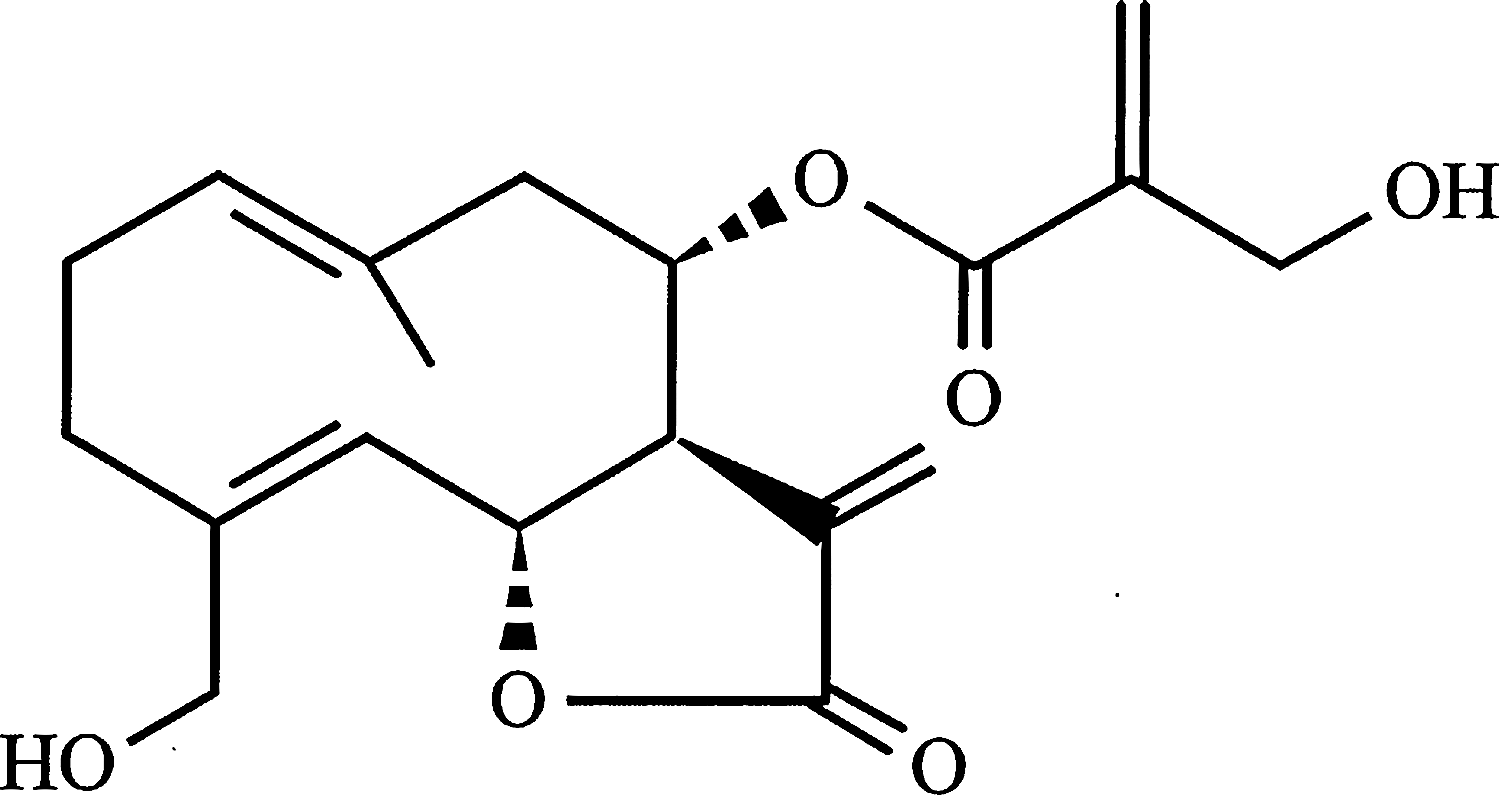
Chemical structure of onopordopicrin.
Gastroprotective effect against different ulcerogenic agents
Ethanol/HCl-induced ulcer (Mizui and Doteuchi 13 )
Mice were divided into five groups (n=7), which were fasted for 24 hours prior to oral administration of 12% Tween (10 mL/kg), lansoprazole (30 mg/kg), or ONP fraction (12.5, 25, 50, 100, 200, or 400 mg/kg). Fifty minutes after the treatments, all animals orally received 0.2 mL of a 0.3 M HCl/60% ethanol solution. Animals were killed by CO2 gas 1 hour after the administration of HCl/ethanol solution. The stomachs were removed, opened along the greater curvature, and fixed between two glass plates. The ulcerative lesion index was calculated according to the methodology described by Szelenyi and Thiemer. 14
Non-steroidal anti-inflammatory drug (Rainsford 15 )
Mice (n=6) were fasted for 24 hours and orally treated with ONP fraction (50–400 mg/kg), cimetidine (100 mg/kg), or 12% Tween 80 30 minutes before the administration of the ulcerogenic agent indomethacin (30 mg/kg subcutaneous [s.c.]). Acetyl-β-methylcholine chloride (bethanechol) (7.5 mg/kg) was administered intraperitoneally 15 minutes before indomethacin. The animals were killed by CO2 gas 4 hours after treatment with indomethacin. The stomachs were removed, and the ulcerative index was calculated as previously described.
Hypothermal-restraint stress (Tabach and Oliveira 16 )
Mice were fasted for 36 hours and then received an oral dose of ONP fraction (50 mg/kg), cimetidine (100 mg/kg), or vehicle (12% Tween 80, 10 mL/kg). Thirty minutes after the treatments, gastric ulceration was induced by immobilizing the mice in a closed cylindrical cage at 4°C. After 3 hours, the mice were killed by cervical dislocation, and the stomachs were removed and examined for ulceration.
Gastroprotective action mechanism
Determination of gastric secretion (Shay et al. 17 )
Male Swiss mice were fasted for 24 hours. The pylorus was ligated, and the mice received 12% Tween 80, cimetidine (100 mg/kg), or ONP fraction (50 mg/kg) intraduodenally. Intraduodenal administration was used to ensure the systemic action of the substances. The mice were sacrificed 4 hours later, the stomachs were removed, and the contents were drained into a graduated centrifuge tube via a small incision. The volume and pH of gastric secretion were determined, and the total acid output was calculated by titrating the pH to 7.0 with 0.05 N NaOH.
Determination of mucus in gastric content (Corne et al. 18 )
After the mice (n=6–7) had fasted for 24 hours, under anesthesia, the abdomen was incised, and the pylorus was ligated. The vehicle (12% Tween), carbenoxolone (200 mg/kg), or ONP fraction (50 mg/kg) was administered intraduodenally after the pylorus ligature. The animals were killed 4 hours after the drug treatments. The stomach content was immersed in 10 mL of 0.02% Alcian blue in 0.16 M sucrose/0.05 M sodium acetate (pH 5.8) and incubated for 24 hours at 20°C. The Alcian blue–binding extract was centrifuged at 2000 g for 10 minutes. The absorbency of supernatant was measured at 615 nm using a light spectrophotometer (model U/2000, Hitachi, Tokyo, Japan). The free mucus in the gastric content was calculated from the amount of Alcian blue bound (in milligrams per wet tissue [in grams]).
Evaluation of involvement of nitric oxide and SH groups in gastroprotection (Sikiric et al. 19 )
Mice were divided in groups of six animals and were fasted for 24 hours. Prior to treatment with ONP fraction or 12% Tween 80, animals were treated with 10 mg/kg (s.c.) of N-ethylmaleimide (NEM), 10 mg/kg
Blood collection (Hofstetter et al. 20 )
Blood samples were collected by puncture of the retroorbital plexus. Immediately after collecting, the blood was centrifuged (1500 g at 6°C for 10 minutes), and the serum was stored at 20°C until used.
Gastrin and somatostatin concentration
The serum levels of somatostatin and gastrin in rats with ethanol-induced ulcers treated with 12% Tween 80 or ONP fraction (50 mg/kg) were measured by radioimmunoassay using commercial kits (RB-306 [Euro-Diagnostica, Malmö, Sweden] and GASK-PR [CIS bio international, Bagnols-sur-Cèze, France]), as described by Arimura et al. 21 and Slingerland et al., 22 respectively.
Statistical analysis
The results are expressed as mean±SD values. Statistical comparisons were done by one-way analysis of variance followed by Tukey's test, with the level of significance set at P<.05. All statistical analyses were done using Statistic version 5.1 software (StatSoft, Inc., Tulsa, OK, USA).
Results
Gastroprotective effect against different agents
To establish a general profile of the anti-ulcerogenic activity of the ONP fraction, this was administered orally at different doses through several gastric ulcer models in mice. On ethanol/HCl-induced ulcers, ONP fraction at 25, 50, 100, 200, or 400 mg/kg reduced, respectively, by 78%, 77%, 83%, 82%, and 80% the total gastric lesion area in comparison with the control group. At 12.5 mg/kg ONP fraction was inactive. Based on the results obtained with ONP fraction, other acute assays were developed only at the dose of 50 mg/kg, which was the lowest dose that represented the best results in the model of gastric lesion induced by ethanol/HCl. The dose of 25 mg/kg was not used in the mechanisms of action because it was demonstrated to have no effect in the indomethacin and stress models. The protective effect of orally administered ONP fraction was significantly greater than that of the control group at a dose of 50 mg/kg (Table 1) in the NSAIDs model. Pretreatment with ONP fraction significantly protected (65.3%) the gastric mucosa against hypothermic-restraint stress-induced ulcers (Table 1).
Data are mean±SD values.
P<.01, *** P<.001 compared with the corresponding control group (by Dunnett's test).
ONP, onopordopicrin; ULI, ulcerative lesion index.
Gastroprotective action mechanism
Determination of gastric secretion
Based on the fact that the gastric ulceration induced by stress is probably mediated by an enhancement in acid secretion, we investigated the influence of ONP fraction on the biochemical parameters of gastric acid (pH, total gastric acid content, and gastric juice volume) using the pylorus ligature method. The intraduodenal administration of ONP fraction (50 mg/kg) or cimetidine (100 mg/kg) resulted in a decrease in the total acid output/4 hours (14±2.9 and 10.2±2.9, respectively) compared with control (23.1±12.6) with a consequent increase in pH (4.2±1.1 and 4.9±0.9, respectively) but no change in gastric juice volume (Table 2).
Dosing was by the intraduodenal route. Data are mean±SEM values.
P<.05, ** P<.01, *** P<.001 compared with the control (Tween 80) group by analysis of variance followed by Tukey's test.
Gastrin and somatostatin concentration
Gastrin and somatostatin are gastrointestinal hormones closely related to the functioning of the gastrointestinal system. Thus, we also evaluated the involvement of somatostatin in the anti-ulcer effect of the ONP fraction (Table 3). We observed that after pretreatment of rats with ONP fraction, a marked increase was observed in the serum somatostatin level (82.1±4.1 pmol/L) compared with the negative control (12.7±4 pmol/L). The increase of somatostatin levels probably contributes to diminishing the secretion of plasma gastrin observed with ONP fraction treatment (62.6±6.04 μU/mL) versus 12% Tween (361.5±8.2 μU/mL) (Table 3).
Data are mean±SEM values.
P<.001 compared with the control (Tween 80) group by analysis of variance followed by Tukey's test.
Determination of mucus in gastric content
The participation of adherent mucus was investigated in animals pretreated with ONP fraction (50 mg/kg). However, no significant change in the mucus production was found (data not shown).
Evaluation of NO and SH groups involvement in gastroprotection
To investigate the mechanisms of defense and repair in the gastric mucosa, NO and endogenous sulfhydryls were evaluated. As shown in Table 4, pretreatment with NEM (10 mg/kg, s.c.) attenuated the gastroprotection of ONP fraction (50 mg/kg). However pretreatment with
P<.05, *** P<.001 compared with the control group by analysis of variance followed by Tukey's test.
Discussion and Conclusions
A. lappa L. (burdock) is a plant brought from Japan and acclimated in Brazil, which is widely used in popular medicine all over the world. 23 This plant has long been cultivated as a vegetable for dietary use and is also used in folk medicine, as a diuretic, antipyretic, digestive stimulant, anti-inflammatory, and antiulcerogenic agent. 8,9,24 A pharmacological screening performed with 30 plants popularly used for their analgesic properties 25 showed that among the extracts that presented more pronounced effects, one was prepared from the leaves of A. lappa. Moreover, the animals showed toxic symptoms characterized by respiratory depression, cyanosis, and high mortality rates. 26 Sesquiterpene lactones constituted the majority of compounds in this extract and probably triggered the toxic action of A. lappa. On the other hand, the pharmacologically active sesquiterpene lactone shows anti-inflammatory effects mediated by the inhibition of prostaglandin synthesis and a stimulation of smooth muscle contractions. 27 Recently, it was also shown that sesquiterpene lactones are potent and specific inhibitors of the anti-inflammatory transcription factor nuclear factor-κB. 27 The transcription factor activation leads to gene activation of several interleukin genes, and its inactivation may explain the anti-inflammatory action by the medicinal plants that have sesquiterpene lactones as constituents. This study is interesting considering that the sesquiterpene lactone ONP could be modified without losing its pharmacological properties. Albino de Almeida et al. 28 reported that a molecule with good anti-ulcerogenic activity accompanied by toxic effects could be modified and, interestingly, still showed similar anti-ulcerogenic activity with lower or no toxicity.
Therefore, the present study shows that an ONP-enriched fraction, obtained from leaves of A. lappa, effectively protects animals from acute experimental gastric lesions. This protection appears to be correlated with the inhibition of gastric secretion. Acute gastric injury induced in mice by the necrotizing agent ethanol was potently decreased by ONP fraction–pretreated animals. Ethanol is one of the ulcerogenic agents that induce intense damage in gastric mucosa by promoting disturbances in mucosal microcirculation, ischemia, and appearance of free radicals, endothelin release, degranulation of mast cells, inhibition of prostaglandins, and decrease in gastric mucus production. 29
The nonselective NSAIDs induce predictable gastric mucosal injury. Initial early injury with agents such as aspirin may occur because of a topical effect. 30 Although direct topical injury may occur, the main mechanism in which NSAIDs cause ulcers and gastrointestinal complications is thought to be systemic due to the inhibition of cyclooxygenase that mediates the prostaglandin synthesis. 30 The present data (Table 1) show that indomethacin in association with bethanechol (a direct-acting muscarinic receptor agonist) increased the ulcerative lesion by producing bleeding and damage in the glandular part of the stomach. Our data show that the ONP fraction exerts significant gastroprotective action compared with the control group. Therefore, this result shows that ONP fraction was able to protect the gastric mucosa despite the inhibition of prostaglandin E2 induced by indomethacin.
Stress ulceration is a diffuse lesion of the mucosal layer of the stomach and sometimes reaches the esophagus and intestine and frequently occurs as a result of major stressful events such as burns, shock, sepsis, surgery, and trauma. 31 Among various animal models of stress, cold immobilization of rats has yielded the most reproducible results and is a commonly used and clinically relevant experimental model for stress ulceration. 31 The major factors implicated in the pathogenesis of stress ulcerations include an increase in aggressive factors, such as acid–pepsin secretion and gastric motility, decreased blood flow to the mucosa, activation of neutrophils, and increased free radical generation, resulting in increased lipid peroxidation. 32 The gastroprotection of ONP against stress-induced gastric mucosal lesions probably is mediated by the antisecretory property. 8
Ligation of the pylorus produced accumulation of gastric juice and lesion in gastric mucosa. 33 Gastric juice obtained from pylorus-ligated mice was used to analyze the gastric biochemical parameters by intraduodenal ONP fraction administration. Animals pretreated with ONP fraction presented a decrease in the total acid output per 4 hours, with a consequent increase in pH. Moreover, it seems that ONP fraction exerts its action mainly through a systemic action. Thus, this result indicated that the antisecretory property is involved in the anti-ulcer activity of the ONP fraction. In this regard, we evaluated the involvement of two gastrointestinal hormones closely related to the functioning of acid secretion in the gastrointestinal system. Somatostatin, the main inhibitor of acid secretion, 3 is closely coupled to target cells (e.g., parietal, enterochromaffin-like, and gastrin cells) either directly via cytoplasmic processes or indirectly via the local circulation. The inhibition of acid secretion occurs by acting directly on parietal cells and indirectly by inhibiting histamine secretion from enterochromaffin-like cells and gastrin secretion from G cells. 3 Pretreatment with ONP fraction increases in serum somatostatin levels but decreases levels of gastrin, a hormone produced in the G cells and the main stimulant of acid secretion during ingestion of a meal. 3 A negative feedback loop exists whereby increased levels of luminal acid stimulate somatostatin secretion, which, in turn, attenuates the release of gastrin and acid. 3 This result suggests that the ONP fraction modulates somatostatin secretion, which attenuates the release of histamine and gastrin.
Gastric mucus is an important protective factor for the gastric mucosa and consists of a viscous, elastic, adherent, and transparent gel formed by water and glycoproteins that covers the entire gastrointestinal mucosa. The protective properties of the mucus barrier depend not only on the gel structure but also on the amount or thickness of the layer covering the mucosal surface. 30 In the present study, we also measured gastric adherent mucus; however, ONP fraction did not increase its production. This result suggests that the gastroprotective effect of ONP fraction is due to the inhibition of acid secretion.
Sulfhydryl compounds are involved in the maintenance of gastric integrity, particularly when reactive oxygen species are implicated in the pathophysiology of tissue damage. 34 Indeed, reduced glutathione participates in many aspects of oxidative metabolism, including the neutralization of hydroperoxides and the maintenance of the physiological sulfhydryl status of proteins. 34 Pretreatment with NEM, a sulfhydryl blocker, reduced the gastroprotection afforded by ONP. This result indicates that endogenous sulfhydryl compounds may be involved in the gastroprotection of this substance.
NO is involved in the modulation of gastric mucosal integrity and is important in the regulation of acid and alkaline secretion, mucus secretion, and gastric mucosal blood flow. 34 The previous administration of L-NAME, an NO synthase inhibitor, did not inhibit the anti-ulcerogenic activity of the ONP fraction, suggesting that NO does not participate in the gastroprotection of this fraction.
In conclusion, the ability of the ONP fraction, obtained from A. lappa, to protect the mucosa against gastric lesions involves an antisecretory effect, stimulation of somatostatin secretion, and inhibition of gastrin release. The gastroprotective mechanism is not based on its ability to strengthen defensive factors such as mucus. Endogenous sulfhydryls play an important role in the gastroprotective mechanism, and endogenous NO does participate in this protection.
Footnotes
Acknowledgments
We are grateful to the Fundacão de Amparo à Pesquisa do Estado de São Paulo and the Conselho Nacional de Desenvolvimento Científico Tecnológico for grants to A.R.M.S.-B. and J.R.T.
Author Disclosure Statement
No competing financial interests exist.