




Abstract
The fruiting bodies of the edible mushroom Gomphus clavatus (Family Gomphaceae) were collected from the wild and extracted with solvents of increasing polarity. Crude extracts were evaluated for their total phenolic content, their antioxidant capacity, and their cytotoxic activity against MCF-7 and PC-3 cancer cell lines. Concerning total phenolics and antioxidant activity, the methanol extract showed the most potent radical scavenging activity with inhibition of 45.5% of 1,1-diphenyl-2-picrylhydrazyl at 3 mg/mL. Further chemical investigation of the methanol extract led to the isolation and identification of nine compounds, among them four ergosterol derivatives. Concerning cytotoxicity, the dichloromethane (DCM) extract showed the most interesting activity, with half-maximal inhibitory concentration (IC50) values of 55.3 and 49.0 μg/mL in the MCF-7 and PC-3 cell lines, respectively. Further investigation of the DCM extract lead to the identification of methyl esters of fatty acids and the isolation of four fatty acids and three ergosterol derivatives. Ergosterol peroxide (compound
Introduction
W
Apart from being recognized as a nutritious food, certain mushrooms are also an important source of biologically active compounds. Those mushrooms have been found to possess antitumor, antimicrobial, antiviral, anti-allergic, immunomodulating, anti-inflammatory, anti-atherogenic, hypoglycemic, hepatoprotective, and central nervous system activities. 3
The antioxidant properties of wild mushrooms have been recently studied, and many antioxidant compounds extracted from these sources have been identified, such as phenolic compounds, tocopherols, ascorbic acid, and carotenoids. 4 Investigations into mushrooms as a source of natural antioxidants have been performed, and mushroom phenolic compounds have been correlated with their in vitro antioxidant properties. 5 These findings suggest that the edible mushrooms might be a potential source of phenolic natural antioxidants. Antioxidants present in the diet assume a major importance as possible protective agents to reduce oxidative damage. However, most research studies for the production of mushroom antioxidants refer to cultivated species, and thus wild and less known edible mushrooms, which are not available in the market, are still to be investigated.
Edible mushrooms have also been reported to have immunomodulating and anticancer activity and have been traditionally used in several countries. Chemical investigation of this vast arsenal of compounds that mushrooms might contain has led to the identification of polysaccharides and terpenoids among other important components. These compounds have attracted significant attention in recent years because of their immunomodulatory activities, resulting in antitumor effects. 6,7 The ergosterol derivatives that are very often present in the fruiting bodies of mushrooms have also been reported to have antitumor activity. 8
Gomphus clavatus (Pers.) Gray [syn. Cantharellus clavatus (Pers.) Fr.] is a Basidiomycete belonging to the Family Gomphaceae (Gomphales, Phallomycetidae, Agaricomycetes). Recently, Giachini 9 and Giachini et al. 10 revised the genus and species concept in Gomphus, based on morphological as well as molecular characters, resulting in a recombination of the species. According to Kirk et al. 11 the genus Gomphus comprises 10 species, and G. clavatus is considered the most widely distributed species in temperate coniferous and deciduous forests of Northern America and Europe and has also been reported from many countries in Asia. 12 It is a widely consumed, tasty edible mushroom, commonly called “pig's ears,” and is considered as one of the chanterelles with significant commercial value. 13 In a recent investigation in the Oaxaca region of Mexico, G. clavatus was the most palatable species among all the other species and was also ranked highest in the multifunctional food index. 14 There are also reports that G. clavatus is used as food from China and Russia to Mexico and the United States. 15
To further elucidate the medicinal properties of the edible mushroom G. clavatus, we report herein the chemical investigation and the evaluation of the antioxidant properties, including scavenging effects on radicals and total phenolic content, as well as the possible cytotoxicity by measuring inhibition of the growth of breast (MCF-7) and prostate (PC-3) cancer cell lines by extracts and isolated secondary metabolites.
Materials and Methods
Collection of samples
The fruiting bodies of the mushroom G. clavatus were collected from an Abies cephalonica forest (Mt. Parnitha, Attiki, Greece) in October 2002 and were identified by Dr. Z. Gonou-Zagou. A voucher specimen (ATHUM 4457) has been deposited in the ATHUM Mycological Herbarium of the University of Athens, Athens, Greece. Fresh mushrooms were directly frozen under liquid nitrogen, lyophilized, and pulverized.
Extraction
Mushroom powder (200 g) was extracted repeatedly with dichloromethane (DCM) (2×2 L) and methanol (2×2 L). The extraction solvents were evaporated under reduced pressure using a rotary evaporator (Rotavapor R-144, Buchi, Flawil, Switzerland), and the residues were collected and stored at 4°C. Two extracts were obtained: 4.7 g of the DCM extract (GOM1) and 6.2 g of the methanol extract (GOM2).
Saponification, fractionation, isolation, and identification of compounds
For the saponification of the DCM extract, 95% ethanol (15 mL) and an aqueous solution of 50% KOH (4 mL) were added in 2.1 g of the crude extract. The mixture was stirred for 1 hour at 100°C and cooled at room temperature; afterward, a mixture of 95% ethanol (5 mL) and water (40 mL) was added, and finally an extraction with cyclohexane (2×50 mL) was carried out. The organic layer was collected, and the solvent was removed under reduced pressure to afford fraction GOM3 (unsaponified constituents). The water phase was acidified with HCl, and the mixture was extracted with ethyl acetate (3×50 mL). Methanol (40 mL) and H2SO4 (0.5 mL) were added, and the mixture was stirred for 1 hour at 100°C. After cooling at room temperature, water (50 mL) was added, and the mixture was extracted with ethyl acetate (3×50 mL). The organic layer was separated, and the solvent was removed to afford the fraction GOM4 (methyl esters of fatty acids).
Fraction GOM3 was subjected to gradient column chromatography over silica gel flash eluting with cyclohexane–ethyl acetate (100:0→30:70) to give 15 fractions. Fractions 4, 6, 7, and 9 contained single compounds characterized as compound
Furthermore, the chemical composition of the fraction GOM4 was analyzed using the gas chromatography–mass spectrometric technique. The instrumentation used for gas chromatography–mass spectrometric analysis (all from Hewlett Packard, Palo Alto, CA, USA) included a mass spectrometer with an HP 5973 mass-selective detector in the electron impact ionization mode (70 eV), Hewlett Packard 6890 gas chromatograph, and capillary columns of HP-5 MS (30 m×0.25 mm; film thickness, 0.25 μm) coated with phenylmethyl siloxane and HP Innowax (30 m×0.25 mm; film thickness, 0.50 μm). The initial temperature of the column was 60°C, and then it was heated up to 280°C at a rate of 3°C/minute. Injector and transfer line temperatures were set at 220°C and 280°C, respectively. Helium was used as the carrier gas at a flow rate of 0.6 mL/minute. The identification of compounds was achieved as described in the previous report. 16
The methanolic extract (GOM2) was chromatographed over a silica gel 60H column and eluted with cyclohexane-CH2Cl2 (100:0→0:100) and CH2Cl2-methanol (100:0→0:100) to give the fractions GOMA–GOMK. Fractions GOMD and GOME, which were eluted with CH2Cl2-methanol (99:1→98:2), were combined and subjected to flash column chromatography over silica gel with CH2Cl2-methanol (100:0→85:15) to give compound
All compounds were identified by means of spectral data (mass spectrometry, 1 H nuclear magnetic resonance [NMR], 13 C NMR, distortionless enhancement by polarization transfer, and two-dimensional NMR) and direct comparison with the respective literature data. 1 H NMR (600 MHz) and 13 C NMR (100 MHz) data were recorded on a Bruker (Bremen, Germany) Avance III 600 and a Bruker DRX400 spectrometer, respectively (using trimethylsilane as an internal standard). Correlation spectroscopy, heteronuclear multiple-quantum correlation spectroscopy, heteronuclear multiple-bond correlation spectroscopy, and nuclear Overhauser effect spectroscopy NMR data were obtained using standard Bruker microprograms.
Determination of total phenolic content
The concentrations of phenolic compounds in the DCM extract, methanol extract, and its fractions, expressed as gallic acid equivalents (GAEs), were determined by the Folin–Ciocalteu method with some modification. 5 One milliliter of sample was mixed with 1 mL of Folin–Ciocalteu phenol reagent. After 3 minutes, 1 mL of saturated Na2CO3 (∼35%) was added to the mixture, and it was made up to 10 mL by adding distilled water. The reaction was kept in the dark for 90 minutes, after which its absorbance (A) was read at 725 nm. A calibration curve was conducted with different concentrations of gallic acid (0.1–1.1 mM) as standard.
Scavenging activity of 1,1-diphenyl-2-picrylhydrazyl radical
The scavenging activity of the extracts and the fractions of the methanol extract against 1,1-diphenyl-2-picrylhydrazyl (DPPH) radicals was measured according to the method described by Cheung et al.
5
with some modifications. An aliquot of 1 mL of 0.3 mM DPPH radical (Sigma) in methanol was added to a test tube with 0.5 mL of sample solution (in a final concentration of 3.0 mg/mL) in methanol. Methanol was used instead of the mushroom sample as a negative control. Butylated hydroxyanisole was used as a positive control. The reaction mixture was vortex-mixed at room temperature, and the A was determined immediately after mixing by measuring at 520 nm with a spectrophotometer. The scavenging activity (%) against DPPH radicals was calculated by the following equation:
Cytotoxicity assay
Human breast adenocarcinoma cells (MCF-7) and human prostate cancer cells (PC-3) were cultured in Dulbecco's modified Eagle's medium supplemented with antibiotics and fetal bovine serum (10% vol/vol) and subcultured using 0.25% trypsin–0.02% EDTA solution. The cytotoxicity assay was performed by a modification of the methyl thiazolyl tetrazolium (MTT) method. 17 In brief, cells were plated at a density of approximately 5,000 cells per well in 96-well microplates, and after 18 hours the samples to be tested were added, appropriately diluted with dimethyl sulfoxide. After a 72-hour incubation, the medium was replaced with MTT (Sigma Chemical Co., St. Louis, MO, USA) dissolved at a final concentration of 1 mg/mL in serum-free, phenol red–free RPMI medium (Biochrom KG, Berlin, Germany), followed by a further 4-hour incubation. Then, the MTT-formazan was solubilized in isopropanol, and the optical density was measured using a microplate analyzer at a wavelength of 550 nm (reference wavelength 690 nm). Results were expressed as the half-maximal inhibitory concentration (IC50) (i.e., the concentration that reduced by 50% the optical density of treated cells with respect to the untreated control). Daunorubicin hydrochloride was used as a positive control.
Statistical analysis
All experiments were performed in triplicate. Data are presented as mean±SD values. Linear regression was performed to indicate the relationship between the total phenolic content and data from the antioxidant assay. Statistical analysis was performed with Statistical Package for Social Science (SPSS) for Windows, version 16.0 (SPSS, Inc., Chicago, IL, USA).
Results and Discussion
The screening for the antioxidant activity of the DCM and methanol crude extracts of the fruiting bodies of G. clavatus, performed by a modification of the DPPH method, revealed that the methanol extract (GOM2) had interesting activity (%ΔA=45.5 at 3 mg/mL) (Table 1). In addition, the total phenolic content of the methanol extract (9.4 mg of GAEs/g of dry extract), as determined by the Folin–Ciocalteu method, was higher than that of the DCM extract. These results were in accordance with previous studies, in which it was reported that higher extraction yields of phenolic compounds were obtained with solvents of increased polarity. 5
A, absorbance; BHA, butylated hydroxyanisole; DPPH, 1,1-diphenyl-2-picrylhydrazyl; GAE, gallic acid equivalents; ND, not detected.
To identify the bioactive compounds, the methanol extract was chromatographed to give fractions GOMA–GOMK. All fractions were evaluated as free radical scavengers, and the concentrations of their phenolic compounds were measured (Table 1). Fractions GOMA and GOMB showed very low total phenolic content (≤10.0 mg of GAEs/g of dry sample) and limited radical scavenger activity (%ΔA=9.4–14.4).
Fractions GOMC, GOMD, and GOME, which showed higher scavenging activity (%ΔA 17.9–27.9), were combined and investigated using chromatographic techniques, and two compounds were isolated. The structures of these pure compounds were elucidated spectroscopically (
1
H,
13
C, and two-dimensional NMR), by mass spectrometry, and by comparison with literature data and were identified as 5α,8α-epidioxy-(22E-24R)-ergosta-6,22-dien-3β-ol (
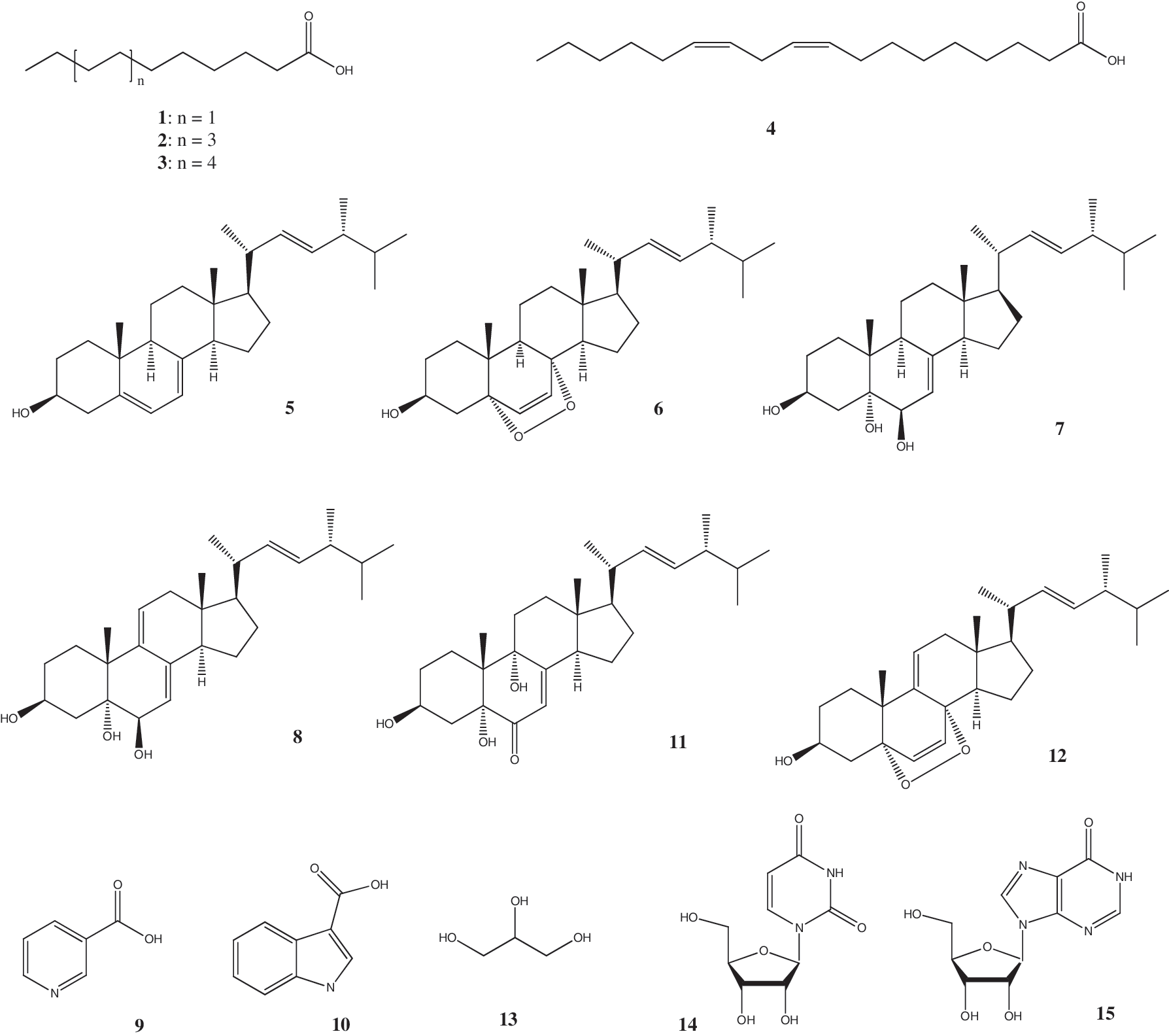
Structures of compounds isolated from G. clavatus.
The more polar fractions (GOMF–GOMK) had significantly higher GAE values (17.5–28.3 mg/g) and higher antioxidant activity (%ΔA=37.9–70.3). The fractionation and investigation of the combined fractions GOMF–GOMK led to the isolation of nicotinic acid (
To investigate the relation between total phenolic content and antioxidant activity, the antioxidant activity of all fraction of the methanol extract was correlated with the content of total phenolics of the corresponding fractions (Fig. 2). The statistical analysis revealed a good correlation (r 2 =0.875). These results are consistent for a positive correlation between total phenolics and antioxidant activity in edible mushrooms. 23
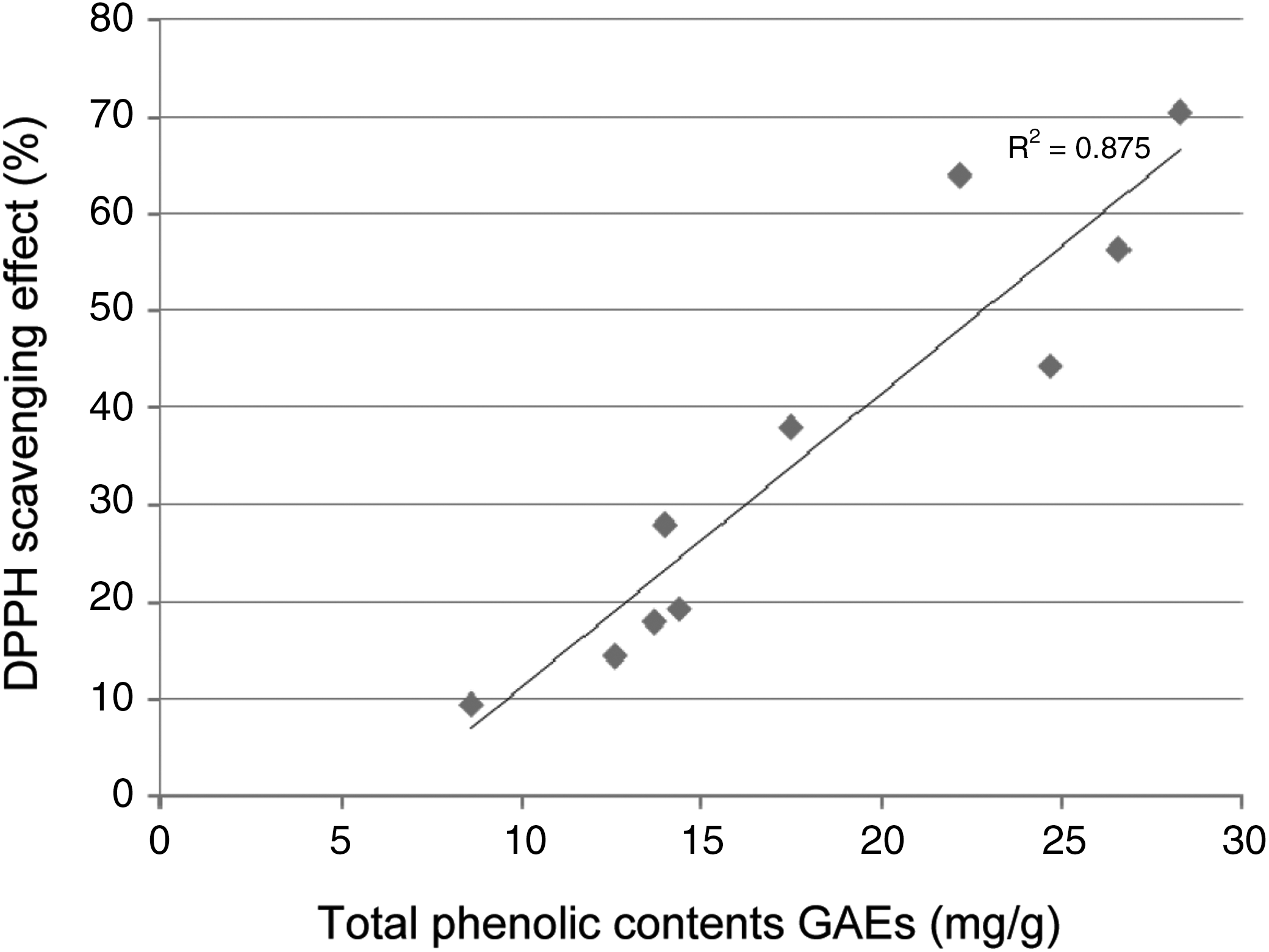
Relationship between antioxidant activity and phenolic contents of the methanol fractions of G. clavatus.
Furthermore, as ergostan-type steroids like ergosterol and its analogs have shown interesting biological activity in MCF-7 (breast cancer) and PC-3 (prostate cancer) cell lines 24 and because such compounds were already isolated from the methanol extract, both total extracts (GOM1 and GOM2) of G. clavatus were evaluated for their activity in the abovementioned two cell lines (Table 2). The sample GOM2 had almost no activity, but the sample GOM1 showed modest cytotoxic activity (IC50=55.3 and 49.0 μg/mL for MCF-7 and PC-3, respectively). Thin-layer chromatography observation of GOM1 revealed that it contained large amounts of fatty acids and ergosterol derivatives. For the separation of the latter compounds, the extract was saponified, and the procedure afforded one fraction (GOM 3) with the unsaponified constituents and one fraction (GOM4) with the methyl esters of fatty acids. The fraction GOM4 was studied by gas chromatography–mass spectrometry, where 64.2% was found to be methyl esters of unsaturated fatty acids and 22.8% those of saturated fatty acids. The major constituents (>1%) identified were two methyl esters of the unsaturated acids linoleic (30.4%) and oleic (33.4%) and two of the saturated fatty acids palmitic (14.3%) and stearic (6.9%).
IC50, half-maximal inhibitory concentration.
Fraction GOM3 showed the most significant activity (IC50=15.1 and 13.6 μg/mL for MCF-7 and PC-3 cell lines, respectively). Further investigation led to the isolation of four fatty acids—capric (
Ergosterol peroxide (
In conclusion, the methanol extract of G. clavatus was more effective than DCM extracts in antioxidant activity using the scavenging ability on DPPH radicals, whereas the DCM extract was more effective against MCF-7 and PC-3 cancer cell lines. In general, a good correlation between higher antioxidant activity and larger amount of total phenolics was found in the fractions of the methanol extract. The investigation of those fractions led to the identification of fatty acids, ergostane derivatives, and phenolic compounds. For applications in food industry, the fractionation of methanolic extracts and the preparation of a fraction rich in phenolic compounds are areas worthy of further investigation. In addition, it was found that some ergosterol derivatives are responsible for the cytotoxic activity of the DCM extract against MCF-7 and PC-3 cancer lines, confirming other studies that have found that ergostan steroids have cytotoxic activity. 21,25 The results presented here, as well as the ability of cultivating G. clavatus in commercial scale, could be explored further for developing novel applications in the food and nutraceutical industries.
Footnotes
Author Disclosure Statement
No competing financial interests exist.