




Abstract
The objective of the present work was to establish the antioxidative ability linked to lipophilic, hydrophilic, and polyphenolic fractions of new tomato hybrids of industrial interest, grown in an outdoor field, named “Medugno”, situated in the Agro-Nocerino Sarnese area (Province of Salerno, Campania Region, Italy). Antioxidant activities of lipophilic, hydrophilic, and polyphenolic extracts of tomato hybrids determined by the 2,2′-azino-bis(3-ethylbenzthiazoline-6-sulfonic acid), N,N-dimethyl-p-phenylenediamine dihydrochloride, and 2,2-diphenyl-1-picrylhydrazyl methods, respectively, showed the best results in hybrids obtained between the pure San Marzano and Black Tomato lines. Antioxidant activity tests, performed also on the San Marzano×Black Tomato hybrid (pulped tomatoes), indicated that the industrial transformation process of this new tomato hybrid did not cause a significant loss of antioxidant activity. The in vitro production of nitrite by lipopolysaccharide-stimulated macrophages J774A.1 performed on lipophilic extracts showed that only two hybrids (San Marzano×Black Tomato and Marmande×Black Tomato) inhibited, in a concentration-related manner, nitric oxide release. Results suggested that genotypic factors could determine the nutritional quality of tomato because of the content of biologically active compounds and their biosynthesis. Moreover, the new tomato hybrid achieved could have a potential for the agri-food industry because of its nutritional quality and because it lends itself in processes of industrial transformation.
Introduction
T
Recently, there has been a great interest in antioxidant compounds because of recent data suggesting the important role of antioxidants in human health as preventive and therapeutic agents. 4 Many fruits and vegetables contain compounds (carotenoids, vitamins, polyphenols) having antioxidant activity, and an increased presence of fruits and vegetables in the diet reduces the risk of cancer and heart disease. 5,6 Among vegetables, tomato is the most important both for its widespread consumption and for its richness in health-related food components. Recent studies have shown that the consumption of tomatoes and related products is associated with a lower risk of developing cancer in the digestive system and prostate. 7,8 The beneficial effects on human health of tomato consumption are generally attributed to carotenoids, in particular lycopene, which is the major carotenoid present at a concentration of about 80%, and β-carotene (about 7–10%). 9,10 The tomato fruit is also a source of other interesting compounds, such as vitamin C and phenolic compounds, 11,12 which also display remarkable antioxidant and free radical scavenging properties. 13 Starting from recent research concerning healthy tomato consumption, the content of antioxidant compounds and the total antioxidant capacity of tomato fruits have been widely investigated also with the aim to produce cultivars having a high antioxidant content. The total antioxidant capacity of tomato derives from genetic factors (kind of cultivar), degree of ripening, and agronomic and environmental conditions during cultivation (sun exposure, watering, soil). 14,15 The development of such tomato cultivars having better nutritional qualities, in term of antioxidant capacity, is a significant trend in plant research, as well as the study of environmental effects, ripening stage of the fruit, and post-harvest storage conditions that could also influence the nutritional profile.
The aim of this work was to investigate the antioxidative ability linked to lipophilic, hydrophilic, and polyphenolic fractions of new tomato hybrids. Moreover, we reported results about antioxidant activity of pulped new tomato hybrids compared with pulped commercial tomatoes. Cytotoxic activity and a potential anti-inflammatory property of different extracts on lipopolysaccharide (LPS)-stimulated J774.A1 macrophages were also reported.
Materials And Methods
Tomato hybrids
Seeds of tomato hybrids were obtained by natural cross-pollination between the pure line of San Marzano tomatoes and the pure line of Black Tomato tomatoes. The new hybrids were named MAR/BT (Marmande Tomato crossed with Black Tomato), SM/BT (San Marzano crossed with Black Tomato), and YSM/BT (Yellow San Marzano crossed with Black Tomato). The achievement and registration of seed were given to the seed selector industry M.F.M. of Torre del Greco (NA), Italy.
Sampling
“Medugno” was a field in the Agro-Nocerino Sarnese area presenting a very good exposure to the sun and watering. Seeds of tomato hybrids were germinated in alveolar boxes at the end of March. Tomato seedlings 45 days old were transplanted in the “Medugno” field and grown following traditional agronomic techniques for plant nutrition and prevention of pathogens. In brief, tomato plants were transplanted 50 cm apart from each other to form a row. All rows were spaced at 180 cm. Plants, supported by bamboo reeds, reached 3.20 m in height. For pathogen prevention treatment, ENOVIT F2 (Sipcam Agro, Milan, Italy) was used, in order to prevent apical putrefaction; PIKAR (Gowan Co., Yuma, AZ, USA) and copper sulfate were used as fungicides. Moreover, sunflowers (Helianthus annuus) and borage (Borago officinalis) were used as repellents for insects. Sampling of fruits was performed in August at the peak ripening stage. All hybrids were in the same degree of growth and ripening. Fruits were a strong red color and without injuries. Samples were taken to the laboratory and kept at −20°C until analysis. The seeding and sampling were carried out for two consecutive years (2008 and 2009). Pulped tomato hybrid was directly supplied from the manufacturer.
Commercial pulped tomatoes were purchased from a local supermarket in Naples, Italy, in 2009.
Chemicals
Analytical-grade solvents were obtained from Carlo Erba (Rodano, Italy). Methanol and dichloromethane (high-performance liquid chromatography [HPLC] grade) from Merck (Darmstadt, Germany) were used. N,N-Dimethyl-p-phenylenediamine dihydrochloride (DMPD), 2,2′-azino-bis(3-ethylbenzthiazoline-6-sulfonic acid) (ABTS) as the crystallized diammonium salt, and 2,2-diphenyl-1-picrylhydrazyl (DPPH) were from Fluka (Buchs, Switzerland). 6-Hydroxy-2,5,7,8-tetramethylchroman-2-carboxylic acid (Trolox) was from Aldrich (Milwaukee, WI, USA), and β-carotene, lycopene, and potassium persulfate (K2S2O8) were purchased from Sigma Chemical Co. (Milan). The murine macrophage cell line J774A.1, the WEHI-164 murine fibrosarcoma cells, and the HEK-293 human embryonic kidney cells were obtained from American Type Culture Collection (Manassas, VA, USA). Unless stated otherwise, all reagents and compounds used were obtained from Sigma Chemical Co.
Spectrophotometric measurements
Absorbances were recorded at controlled room temperature (25°C) with a Varian (Palo Alto, CA, USA) DMS 90 UV-VIS spectrophotometer.
Sample preparation
Samples were homogenized in a blender and centrifuged at 13,848 g for 20 minutes. Supernatants (hydrophilic fractions) and pellets were collected separately and kept for analysis. 2
Pellets were extracted with diethyl ether (1:2 wt/vol) with stirring in the dark overnight. Lipophilic extracts were filtered, concentrated in a rotary evaporator under vacuum (temperature <35°C), and dried under N2.
In separate experiments samples were extracted with acetone/methanol/ethanol (70:15:15 by volume) or with ethyl acetate for 2 hours at 4°C. The extracts were filtered, concentrated in a rotary evaporator in vacuum, and dried under N2, thus obtaining the acetonic and ethyl acetate extracts of tomato hybrids.
All pulped tomatoes were centrifuged to obtain a supernatant (hydrophilic fraction) and a solid part on which diethyl ether extraction was performed to obtain lipophilic fractions. Moreover, on solid parts of pulped tomatoes and on tomato fruits of San Marzano, Black Tomato, and the SM/BT hybrid, extractions with a solution of 60% (vol/vol) ethanol acidified with citric acid at 60°C for 2 hours were also performed. The ethanol extracts were centrifuged at 12,429 g for 10 minutes, and the supernatants were evaporated at 40°C with a rotary evaporator.
DMPD assay for hydrophilic fraction
Antioxidant activity of hydrophilic fractions of all samples was determined by the DMPD method. 16 The reaction mixture contained 1 mM DMPD and 0.1 mM ferric chloride in 0.1 M acetate buffer (pH 5.25) in a total volume of 1 mL. The assay temperature was 25°C. The reaction was monitored at λ=505 nm until absorbance became stable at a value of 0.900±0.100. Then, 5 μL of hydrophilic fraction was added to the reaction mixture, and the decrease in absorbance, which is proportional to the DMPD•+ quenched, was determined after 20 minutes at room temperature. According to the method, the antioxidant activity of the hydrophilic fraction was assayed in triplicate on the supernatant and on its 1:2, 1:5, and 1:10 dilutions. The antioxidant activity was reported both as percentage inhibition of radical cation and as Trolox equivalent antioxidant capacity (TEAC) (in μM) per milligram of fresh product.
ABTS assay for lipophilic fraction
Evaluation of the antioxidant activity of lipophilic fractions of all samples was performed according to the ABTS method. 17 The reaction mixture contained 56 mM ABTS and 24.5 mM K2S2O8 in ethanol (diluted 1:100) in a total volume of 1 mL. The lipophilic fraction (5 μL of organic phase) was added to the reaction mixture, and the decrease in absorbance at λ=734 nm was determined after 5 minutes at room temperature. The total time needed to carry out each assay was approximately 6 minutes. The absorbance decrease was determined from the difference between the values for absorbance at 734 nm before and after addition of sample. According to the ABTS method, the antioxidant activity of the lipophilic fraction was assayed in triplicate on the diethyl ether extract of each sample, dissolved in analytical-grade dichloromethane (20 mg/mL), and on its 1:2; 1:5; and 1:10 dilutions. The antioxidant activity was reported both as percentage inhibition of radicalic cation and as TEAC (in μM) per milligram of fresh product.
Free radical scavenging activity assay by using DPPH radical
Solutions of acetonic extracts in methanol, at a concentration of 20 mg/mL, were prepared and assayed by the DPPH test. 18 Fifty microliters of these solutions was added to 0.7 mL of DPPH in methanol (6 mg/50 mL; 0.1 mM final concentration) and adjusted to a final volume of 2 mL with methanol. The absorbance at λ=517 nm was determined after 30 minutes at room temperature, and the percentage of free radical inhibition was calculated. Trolox, a synthetic antioxidant compound, was used as the standard. The antioxidant activity of samples was estimated both as percentage inhibition of DPPH free radical and as TEAC (in μM).
Determination of polyphenolic content by Folin–Ciocalteau method
The total polyphenol content was measured using the Folin–Ciocalteau colorimetric method. 19 To 800 μL of deionized water, 50 μL of Folin–Ciocalteau phenol reagent and a volume of sample ranging from 10 to 50 μL were added and accurately mixed. After 1 minute, 100 μL of 20% sodium carbonate solution was added and mixed. Deionized water was then added up to a volume of 1 mL. The solution was carefully mixed, and total phenol content was spectrophotometrically estimated at 765 nm (DU spectrophotometer, Beckman Coulter, Brea, CA, USA) after a 2-hour incubation at room temperature. Quantification was based on the standard curve generated with quercetin. All determinations were carried out in triplicates.
Determination of anthocyanin content
The anthocyanin content was determined according to the method reported by Lee et al. 20 In brief, a small amount of acidified ethanol extracts of each sample was dissolved in pH 1.0 buffer and pH 4.5 buffer. Absorbance of samples was measured at 510 and 700 nm using a spectrophotometer. Absorbance was calculated as Absorbance=(Absorbance510nm−Absorbance700nm)pH1.0−(Absorbance510nm−Absorbance700nm)pH 4.5 with a molar extinction coefficient for cyanidin 3-glucoside of 26,900.
The anthocyanin content, by using Eq. 1, was expressed as milligrams of cyanidin 3-glucoside equivalents per 100 g fresh weight of tomato hybrids or solid part of pulped tomatoes:
where Abs is absorbance, e is cyanidin 3-glucoside molar absorbance (26,900), L is the cell path length (1 cm), MW is the molecular weight of anthocyanin (449.2), D is a dilution factor, V is the final volume (in mL), and G is the weight of the tomato hybrid or the solid part of pulped tomatoes (in g).
Qualitative HPLC analysis of lipophilic extracts
The diethyl ether extract from each sample was analyzed in order to determine its qualitative composition by reversed-phase HPLC. The system was a Shimadzu (Kyoto, Japan) LC 6A apparatus with a Kromasil 100A C18 column (particle size, 5 μm; 250×10 i.d. mm) (Phenomenex, Torrance, CA, USA) with an SPD 10A VP UV-VIS detector, CR 3A recorder, SCL 10A VP system controller, and ChemStation (Agilent, Palo Alto) integration software Class–VP 5.0. Immediately before injection, the diethyl ether extracts were dissolved in 2 mL of HPLC-grade dichloromethane and filtered with a polytetrafluorethylene syringe filter (pore size, 0.22 μm). For every HPLC chromatographic run 30 μL was injected.
HPLC analysis was performed by using the following chromatographic conditions: gradient elution, 60:40 to 30:70 (vol/vol) A:B (A was methanol/water [95:5 vol/vol] [0.1% butylated hydroxytoluene and 0.05% triethylamine] and B was dichloromethane [0.1% butylated hydroxytoluene and 0.05% triethylamine]); linear gradient changed over a period of 35 minutes and returned to starting conditions in 5 minutes before the next injection; flow rate, 1.5 mL/minute; wavelength of ultraviolet detector, 450 nm; sensitivity adjusted to 0.04 absorbance units full scale; room temperature.
3-(4,5-Dimethylthiazol-2-yl)-2,5-phenyl-2H-tetrazolium bromide antiproliferative assay
A murine macrophage cell line (J774.A1), murine fibrosarcoma cells (WEHI-164), and human embryonic kidney cells (HEK-293) were used for the evaluation of antiproliferative activity by 3-(4,5-dimethylthiazol-2-yl)-2,5-phenyl-2H-tetrazolium bromide (MTT) assay. J774.A1 cells were grown with adhesion on Petri dishes and maintained with Dulbecco's modified Eagle's medium at 37°C supplemented with 10% fetal calf serum and HEPES (25 mM). WEHI-164 cells were maintained adherent on Petri dishes with Dulbecco's modified Eagle's medium supplemented with 10% heat-inactivated fetal calf serum, HEPES (25 mM), penicillin (100 U/mL), and streptomycin (100 μg/mL). HEK-293 cells were maintained and grown with adhesion on Petri dishes with Dulbeccos' modified Eagle's medium supplemented with fetal calf serum (10%), HEPES (25 mM), penicillin (100 U/mL), and streptomycin (μg/mL).
J774A.1, WEHI-164, and HEK-293 cells (3.5×10⁴ per well) were plated on 96-well microtiter plates and allowed to adhere at 37°C in a 5% CO2 atmosphere for 2 hours. Thereafter, the medium was replaced with fresh medium, a serial dilution of each test compound was added, and then the cells were incubated for 72 hours. In some experiments, serial dilutions of 6-mercaptopurine, used as the reference compound, were added. Mitochondrial respiration, an indicator of cell viability, was assessed by the mitochondrial-dependent reduction of MTT to formazan, and cell viability was assessed accordingly to the method of Mosmann. 21 In brief, 5 μL of MTT (5 mg/mL) was added, and the cells were incubated for an additional 3 hours. Thereafter, cells were lysed, and the dark-blue crystals were solubilized with 100 μL of a solution containing 50% (vol/vol) N,N-dimethylformamide and 20% (wt/vol) sodium dodecyl sulfate with an adjusted pH of 4.5. 22 The optical density (OD) of each well was measured with a microplate spectrophotometer (Titertek [Huntsville, AL, USA] Multiskan MCC/340) equipped with a 620 nm filter. The viability of each cell line in response to treatment with tested compounds and 6-mercaptopurine was calculated as follows: percentage of dead cells=100 – (ODtreated/ODcontrol)×100.
Analysis of nitric oxide production
The J774A.1 murine macrophage cell line was extensively used to investigate the modulation of inducible nitric oxide (NO) synthase (iNOS) by measuring nitrite (NO2
–) release in the cell medium, an index of NO release and thus of iNOS activity. Cells (5.0×10⁵ per well) were plated on 96-well microtiter plates and allowed to adhere at 37°C in a 5% CO2 atmosphere for 2 hours. The compounds examined (1–100 μg/mL) were added 1 hour before and simultaneously with LPS from Escherichia coli (6×10³ U/mL), used to induce iNOS. NO, evaluated as
Data analysis
All measurements were carried out in triplicate, and the results are statistically analyzed using the Systat (Chicago, IL, USA) version 7.0 software program to determine the average value and SEM of at least three experiments.
Data sets regarding analysis of NO2 – production were examined by one-way analysis of variance, and individual group means were then compared with Bonferroni's unpaired t test. A value of P<.05 was considered significant.
Results
Antioxidant compounds play a major role in the determination of the nutritional quality of tomato fruit. 1 In recent years, increasing numbers of researchers have initiated the study of tomato carotenoids, in particular, lycopene and β-carotene, having strong antioxidant activity, with regard to their beneficial effects on human health. 24 –26
The results of the present work showed antioxidant activity in some tomato hybrid extracts and their polyphenolic and anthocyanin contents. All data refer to values calculated with fruit harvested for 2 years (2008 and 2009) of sampling.
Antioxidant activities of hydrophilic, lipophilic, and acetonic fractions are reported in Table 1. We observed that in hydrophilic fractions, all hybrids showed greater antioxidant activity in comparison with San Marzano; in particular, the YSM/BT and SM/BT hybrids presented the best activity (29.3% and 25.0%, respectively). Regarding antioxidant activity of lipophilic fractions, we observed that San Marzano and, among the hybrids, SM/BT showed the best and comparable activity (3.1% and 2.63%, respectively). Also as regards antioxidant activity of acetonic fractions, San Marzano and SM/BT tomato hybrid presented comparable activity (1.5% and 1.3%, respectively).
Data are mean±SD values.
Percentage of the absorbance of the uninhibited radical cation solution expressed per 1 mg of fresh product, obtained by using the N,N-dimethyl-p-phenylenediamine dihydrochloride, 2,2′-azino-bis(3-ethylbenzthiazoline-6-sulfonic acid), and 2,2-diphenyl-1-picrylhydrazyl methods for the hydrophilic, lipophilic, and acetonic fractions, respectively.
Trolox equivalent antioxidant capacity (TEAC) (in μM) per 1 mg of fresh product.
Polyphenolic content (mg) relative to 1 g of fresh product.
MAR/BT, Marmande/Black Tomato hybrid; SM/BT, San Marzano/Black Tomato hybrid; YSM/BT, Yellow San Marzano/Black Tomato hybrid.
As regards polyphenolic compounds, the results, reported in Figure 1, showed the best polyphenolic content was recorded in SM/BT tomato hybrid and in San Marzano tomatoes (0.12 mg/g and 0.2 mg/g of fresh product, respectively). Moreover, anthocyanin contents for San Marzano and Black Tomato fresh tomatoes and for fresh and processed (pulped) SM/BT tomato hybrid, according to the method reported by Lee et al., 20 were also determined. Results indicated that the pure line of San Marzano tomato did not contain anthocyanin compounds, whereas the pure line of Black Tomato tomato and the San Marzano/Black Tomato hybrid contained a low but significant amount of anthocyanin (1.7 μg/100 g and 4.2 μg/100 g of fresh product, respectively) (Fig. 1).
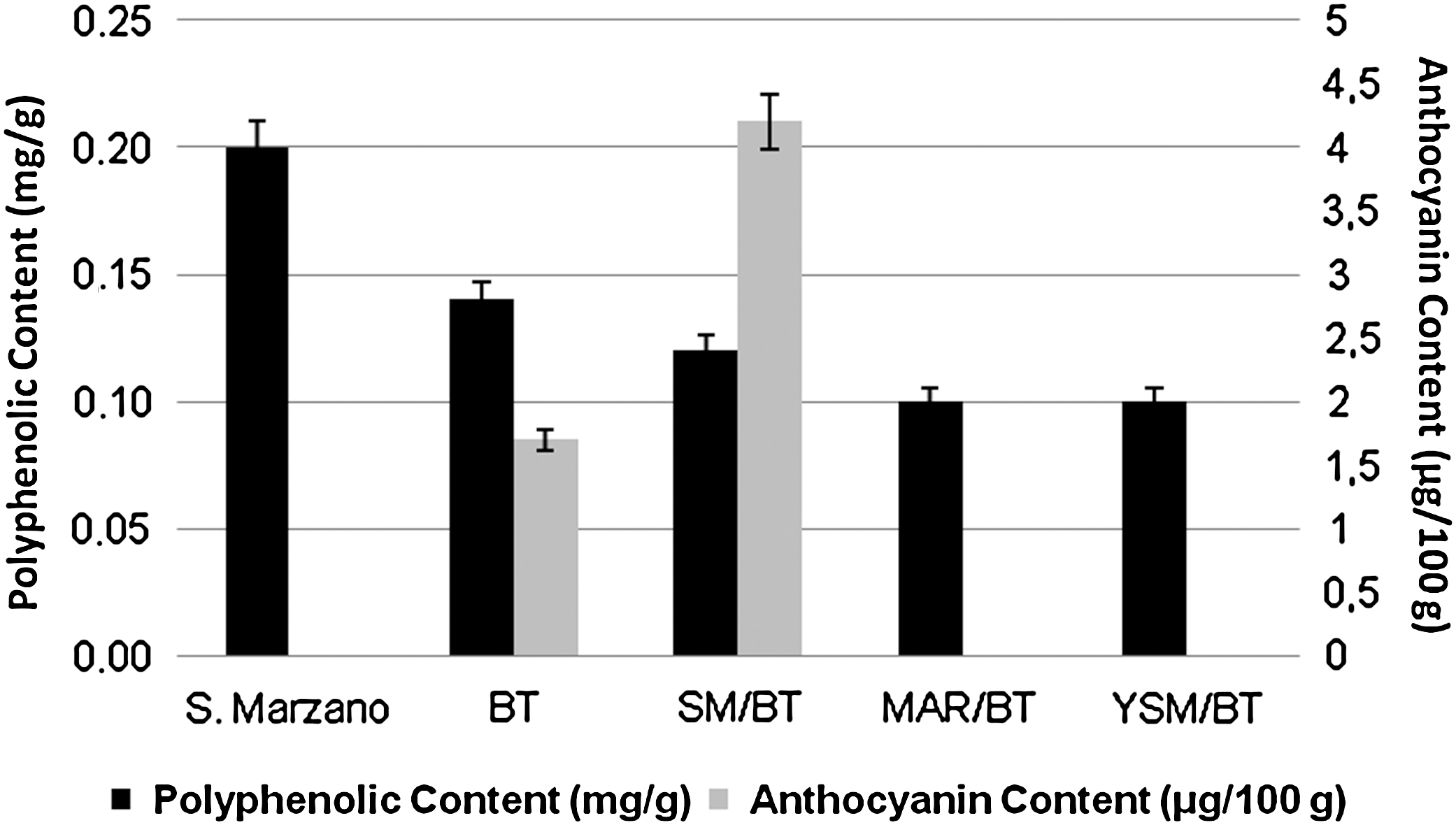
Polyphenolic and anthocyanin contents of different fresh and pulped tomatoes. Polyphenolic content (in mg) is relative to 1 g of fresh product. Anthocyanin content (in μg) is relative to 100 g of fresh product.
The diethyl ether extracts of tomato hybrids were analyzed by HPLC to determine the presence of the main carotenoids, lycopene and β-carotene. All samples exhibited a similar HPLC chromatographic profile showing clearly that the two carotenoids, lycopene and β-carotene, were the main constituent of the lipophilic extracts. The two principal peaks were identified as lycopene and β-carotene by retention time (24.5 minutes for lycopene and 25.7 minutes for β-carotene under the conditions described in Materials and Methods) and by co-injection with purchased authentic standards.
In order to asses the effect of tomato extracts on cell viability, different doses of each lipophilic extract (1–100 μg/mL) were tested in vitro, on a murine macrophage cell line (J774.A1), on murine fibrosarcoma cells (WEHI-164), and on human embryonic kidney cells (HEK-293) using the MTT assay. All tested extracts did not show cytotoxic effect on cells (data not shown).
During host defense mechanisms iNOS is easily induced in many cell types as macrophages. The finding that iNOS was up-regulated during inflammation points toward its pathological impact. In order to evaluate the potential effect of these tomato extracts on iNOS activity we evaluated nitrite production, an index of NO biosynthesis, in the medium of LPS-activated J744.A1 macrophage. Among the hybrids, MAR/BT and SM/BT hybrid lipophilic extracts (1–100 μg/mL), added 1 hour before and simultaneously with LPS, inhibited significantly, at all concentrations and in a concentration-related manner, NO release in the cellular medium of LPS-stimulated J774.A1 macrophages (Table 2).
The effect of MAR/BT and SM/BT lipophilic extracts on nitrite release (as an index of NO production) by J774A.1 macrophages activated with E. coli lipopolysaccharide (LPS) was examined. Data are mean±SEM values for percentage inhibition compared with nitrite release by J774A.1 macrophages treated with LPS alone in at least three experiments.
P<.001 versus LPS alone.
Because the new tomato hybrid SM/BT gave interesting results concerning antioxidant content, we subjected this hybrid to the industrial process of tomato transformation to obtain pulped tomato. We evaluated the antioxidant activity of tomato products and compared them with the commercial tomato pulps. Results showed that pulped products of this new tomato hybrid presented the best antioxidant activity in hydrophilic and lipophilic fractions compared with the commercial ones (Fig. 2). Moreover, this pulped tomato hybrid had also an interesting anthocyanin content (30 μg/100 g of solid part of pulped tomato obtained as reported in Materials and Methods) that was not present in the other tomato products tested (Fig. 1).
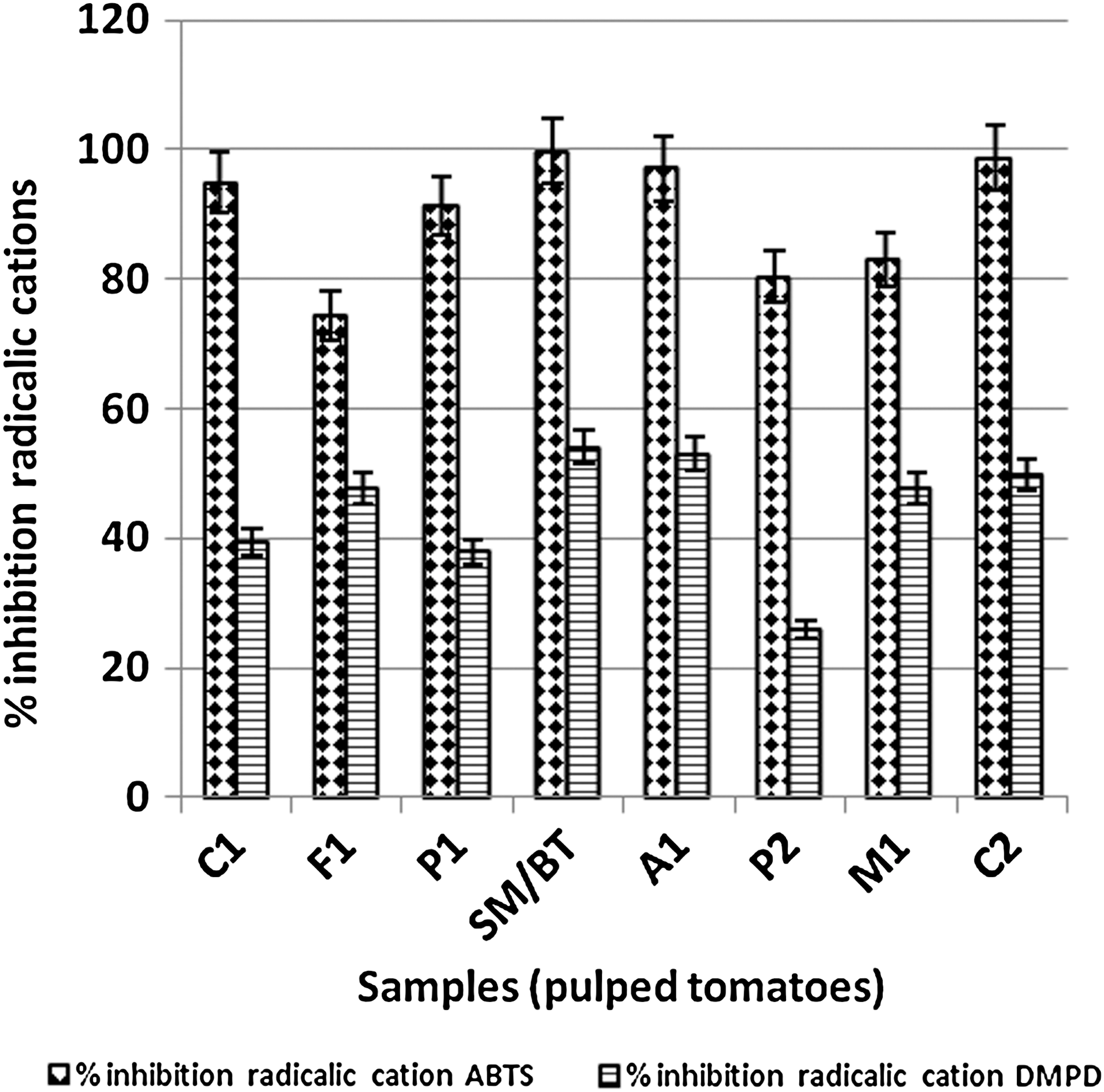
Antioxidant activity of lipophilic and hydrophilic fractions of different pulped tomatoes, by using the 2,2′-azino-bis(3-ethylbenzthiazoline-6-sulfonic acid) (ABTS) and N,N-dimethyl-p-phenylenediamine dihydrochloride (DMPD) methods, respectively. C1, F1, P1, A1, P2, M1, and C2 are commercial pulped tomatoes; SM/BT is the pulped SM/BT hybrid tomato.
Discussion
It is known that the total antioxidant capacity of tomato is due to many factors (i.e., ripening stage, agronomic techniques, and storage conditions). 27 –29 Also, genotypic factors contribute to the nutritional qualities of tomato, in term of antioxidant properties. Several studies have directed attention toward the influence of environmental and genotypic factors on the nutritional value of the tomato, suggesting that the interaction of both variables affects phytonutrient content. 30,31 Moreover, it is clear that single compounds alone cannot be responsible for the healthy effect of tomato, but instead there is a synergistic effect of a pool of compounds belonging to carotenoids, flavonoids, and vitamin C. Therefore, it is important to evaluate the antioxidant properties of the tomato by using different analyses regarding all compounds having antioxidant activity.
In this article we have reported the achievement of new tomato hybrids obtained by using a conventional agronomic technique (natural cross-pollination) and the evaluation of their nutritional factors in comparison with those of a pure line of tomato, San Marzano. We can presume that genotypic factors also could be decisive for the presence in this tomato hybrid of flavonoid compounds (anthocyanins) with known noticeable positive effect on human health, and they could also determine the link of the nutritional quality of the tomato hybrid to content of biologically active compounds and their biosynthesis.
The results obtained regarding the total antioxidant activity of the new tomato hybrid pointed out the enhancement of product quality for its use as both a fresh and a processed agri-food product. Moreover, the significant amount of anthocyanin found in the Black Tomato line and in the San Marzano/Black Tomato hybrid was a very interesting result: these flavonoids usually are not present in tomato fruits, unlike the fruit of other Solanaceae, such as eggplant (Solanum melongena L.) or pepper (Capsicum spp.). 32 Indeed, it is surprising that the anthocyanins were recognized in the fruits of the new tomato hybrid, San Marzano/Black Tomato, with a content greater than that of the pure line of Black Tomato.
Our study evidenced the high capability of MAR/BT and SM/BT tomato hybrids to inhibit release of NO, a biological mediator involved in many physiopathological conditions (e.g., inflammation). 33 Thus further studies will be performed in order to verify the biological activity of the new tomato hybrid juice on inflammatory disease. The achieved tomato hybrid could be used in agri-food industries for its versatility to be converted into tomato juice, pulped tomatoes, or peeled tomatoes, preserving its antioxidant activities. This research could suggest a new product having interesting nutritional qualities, both as fresh product and after processing treatment, and that could satisfy consumers, who are more and more careful to appreciate nutritional qualities of commercial products.
Footnotes
Acknowledgments
The authors thank M.F.M. International s.r.l., which kindly provided seeds of the new tomato hybrids. The authors also thank the farm Scherzi-Medugno of Nocera Inferiore (SA), which carefully supervised the growing of the tomato hybrid plants, and Dr. Gianluca Anzelmo for sampling and assistance. This work was supported by a dedicated grant from the Italian Ministry of Economy and Finance to the National Research Council for the project “Innovazione e Sviluppo del Mezzogiorno, Conoscenze Integrate per Sostenibilità ed Innovazione del Made in Italy Agroalimentare, Legge n. 191/2009.”
Author Disclosure Statement
No competing financial interests exist.