




Abstract
This study sought to characterize the effects of some citrus fruit juices (shaddock [Citrus maxima], grapefruit [Citrus paradisii], lemon [Citrus limoni], orange [Citrus sinensis], and tangerine [Citrus reticulata]) on acetylcholinesterase activity in vitro. The total phenolic content, radical scavenging abilities, and inhibition of Fe2+-induced malondialdehyde (MDA) production in rats brain homogenate in vitro were also assessed. Orange had significantly (P<.05) higher phenolic content than the other juices. The juices scavenged 1,1-diphenyl-2-picrylhydrazyl and hydroxyl radicals in a dose-dependent manner with orange having the highest scavenging ability. Furthermore, the juices inhibited Fe2+-induced MDA production in rat brain homogenate in a dose-dependent manner with shaddock having the highest inhibitory ability. Acetylcholinesterase activity was also inhibited in vitro by the juices in a dose-dependent manner. The inhibition of acetylcholinesterase activity and antioxidant properties of the citrus juices could make them a good dietary means for the management of Alzheimer's disease.
Introduction
M
The link between free radical–induced oxidative damage and Alzheimer's disease has been well established. 5 –7 Free radicals are reactive oxygen species that attack and damage lipids, proteins, and DNA. However, the high oxygen consumption, rich content of easily oxidizable fatty acids, relatively low content of antioxidant enzymes and antioxidants, and the presence of high levels of iron make the central nervous system very susceptible to free radical–induced oxidative damage. 8,9
Citrus fruits are an excellent source of many nutrients and phytochemicals that contribute to a healthy diet, and they are good sources of antioxidants such as phenolics. 10 The Kame Project carried out with Japanese-Americans between 1992 and 2001 found that subjects with a higher intake of fruit and vegetable juices had a substantially reduced incidence of Alzheimer's disease. 11 This study therefore sought to investigate some citrus juices as dietary intervention in the management of Alzheimer's disease.
Materials and Methods
Sample collection
Specimens of five citrus fruits—shaddock (Citrus maxima), grapefruit (Citrus paradisii), lemon (Citrus limon), orange (Citrus sinensis), and tangerine (Citrus reticulate)—were purchased from the Akure Main Market. The citrus fruits were washed, and the juice was extracted.
Reagents
All chemicals used in this study were of analytical grade, and glass-distilled water was used.
Determination of total phenol content
The total phenol content was determined according to the method of Singleton et al. 12 In brief, appropriate dilutions of the extracts were oxidized with 2.5 mL of 10% (vol/vol) Folin–Ciocalteau reagent and neutralized by 2.0 mL of 7.5% sodium carbonate. The reaction mixture was incubated for 40 min at 45°C, and the absorbance was measured at 765 nm in a spectrophotometer. The total phenol content was subsequently calculated as gallic acid equivalents (GAE).
Determination of total flavonoid content
The total flavonoid content was determined using a slightly modified method reported by Meda et al. 13 In brief, 0.5 mL of appropriately diluted sample was mixed with 0.5 mL of methanol, 50 μL of 10% AlCl3, 50 μL of 1 M potassium acetate, and 1.4 mL of water and allowed to incubate at room temperature for 30 min. The absorbance of the reaction mixture was subsequently measured at 415 nm; the total flavonoid content was subsequently calculated. The nonflavonoid polyphenols were taken as the difference between the total phenol and total flavonoid content.
1,1-Diphenyl-2-picrylhydrazyl free radical scavenging ability
The free radical scavenging ability of the extracts against 1,1-diphenyl-2-picrylhydrazyl (DPPH) free radical was evaluated as described by Gyamfi et al. 14 In brief, appropriate dilution of the extracts (1 mL) was mixed with 1 mL of 0.4 mM methanolic solution containing DPPH radicals, the mixture was left in the dark for 30 min, and the absorbance was taken at 516 nm. The DPPH free radical scavenging ability was subsequently calculated.
Fenton reaction (degradation of deoxyribose)
The method of Halliwell and Gutteridge 15 was used to determine the ability of the juice to prevent Fe2+/H2O2-induced decomposition of deoxyribose. The extract (0–100 μL) was added to a reaction mixture containing 120 μL of 20 mM deoxyribose, 400 μL of 0.1 M phosphate buffer, and 40 μL of 500 μM FeSO4. The volume was made up to 800 μL with distilled water. The reaction mixture was incubated at 37°C for 30 min, and the reaction was then stopped by addition of 0.5 mL of 28% trichloroacetic acid. This was followed by addition of 0.4 mL of 0.6% thiobarbituric acid (TBA) solution. The tubes were subsequently incubated in boiling water for 20 min. The absorbance was measured at 532 nm in a spectrophotometer.
Preparation of brain homogenates
The rats were decapitated under mild diethyl ether anesthesia, and the brain was rapidly isolated, placed on ice, and weighed. This tissue was subsequently homogenized in cold saline (1:10 wt/vol) with about 10-up-and-down strokes at approximately 1200 rpm in a Teflon® (DuPont)–glass homogenizer. The homogenate was centrifuged for 10 min at 3000 g to yield a pellet that was discarded, and a low-speed supernatant (S1) was kept for lipid peroxidation assay. 16
Lipid peroxidation and TBA reactions
The lipid peroxidation assay was carried out using the modified method of Ohkawa et al. 17 In brief, 100 μL of S1 fraction was mixed with a reaction mixture containing 30 μL of 0.1 M (pH 7.4) Tris-HCl buffer, extract (0–100 μL), and 30 μL of 250 μM freshly prepared FeSO4. The volume was made up to 300 μL by water before incubation at 37°C for 1 h. The color reaction was developed by adding 300 μL of 8.1% sodium dodecyl sulfate to the reaction mixture containing S1, which was subsequently followed by addition of 600 μL of acetic acid/HCl (pH 3.4) mixture and 600 μL of 0.8% TBA. This mixture was incubated at 100°C for 1 h. TBA-reactive species produced were measured at 532 nm, and the absorbance was compared with that of standard curve using malondialdehyde (MDA).
AChE inhibition assay
Inhibition of AChE was assessed by a modified colorimetric method. 18 The AChE activity was determined in a reaction mixture containing 200 μL of a solution of AChE (0.415 U/mL in 0.1 M phosphate buffer, pH 8.0), 100 μL of a solution of 5,5′-dithio-bis(2-nitrobenzoic) acid (3.3 mM in 0.1 M phosphate-buffered solution, pH 7.0) containing NaHCO3 (6 mM), juice dilutions (0–100 μL), and 500 μL of phosphate buffer, pH 8.0. After incubation for 20 min at 25°C, acetylthiocholine iodide (100 μL of 0.05 mM solution) was added as the substrate, and AChE activity was determined with an ultraviolet spectrophotometer from the absorbance changes at 412 nm for 3.0 min at 25°C.
Data analysis
The results of three replicates were pooled and expressed as mean±SD values. One-way analysis of variance and the least significance difference test were carried out. 19 Significance was accepted at P≤.05.
Results
The results of the total phenol and flavonoid content of the citrus juices are presented in Table 1. The total phenolic content of the juices (reported as GAE) revealed that orange (160.34 mg of GAE/L) had significantly (P<.05) higher total phenolic content than the other juices tested (shaddock, 139.04 mg of GAE/L; grapefruit, 144.73 mg of GAE/L; lemon, 144.18 mg of GAE/L; and tangerine, 147.38 mg of GAE/L). Tangerine had the least total flavonoid content (8.84 mg/L, reported as quercetin equivalents) compared with the others (shaddock, 30.10 mg/L; grapefruit, 30.18 mg/L; and lemon, 30.23 mg/L), whereas orange juice had the highest total flavonoid content (34.52 mg/L).
Data are mean±SD values of triplicate determinations.
Values with the same subscript letter in the same column are not significantly different (P>.05).
GAE, gallic acid equivalents; QE, quercetin equivalents.
The DPPH free radical scavenging abilities of the citrus juices are presented in Figure 1. The juices scavenged the DPPH• radical in a dose-dependent manner. Orange juice had the highest inhibition (95.01%) at the maximum concentration (100 mL/L) tested, whereas tangerine had the least inhibition (3.1–34.76%) at all the concentrations tested.
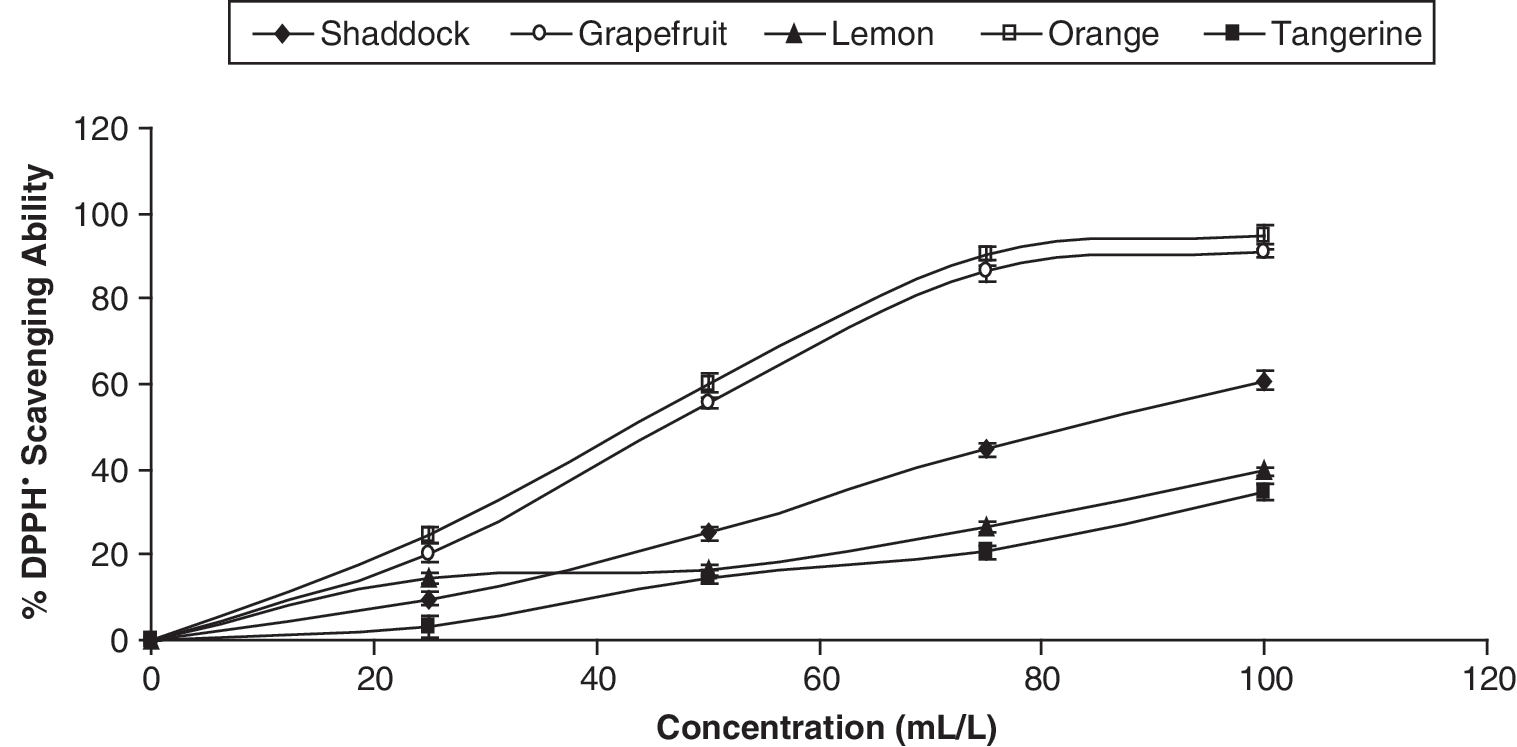
1,1-Diphenyl-2-picrylhydrazyl radical (DPPH•) scavenging ability of some citrus juices.
The hydroxyl radical (OH•) radical scavenging abilities of the juices are presented in Figure 2; the juices scavenged OH• in a dose-dependent manner. Orange juice had the highest scavenging ability of 32.23% at the highest concentration (5.88 mL/L) tested.
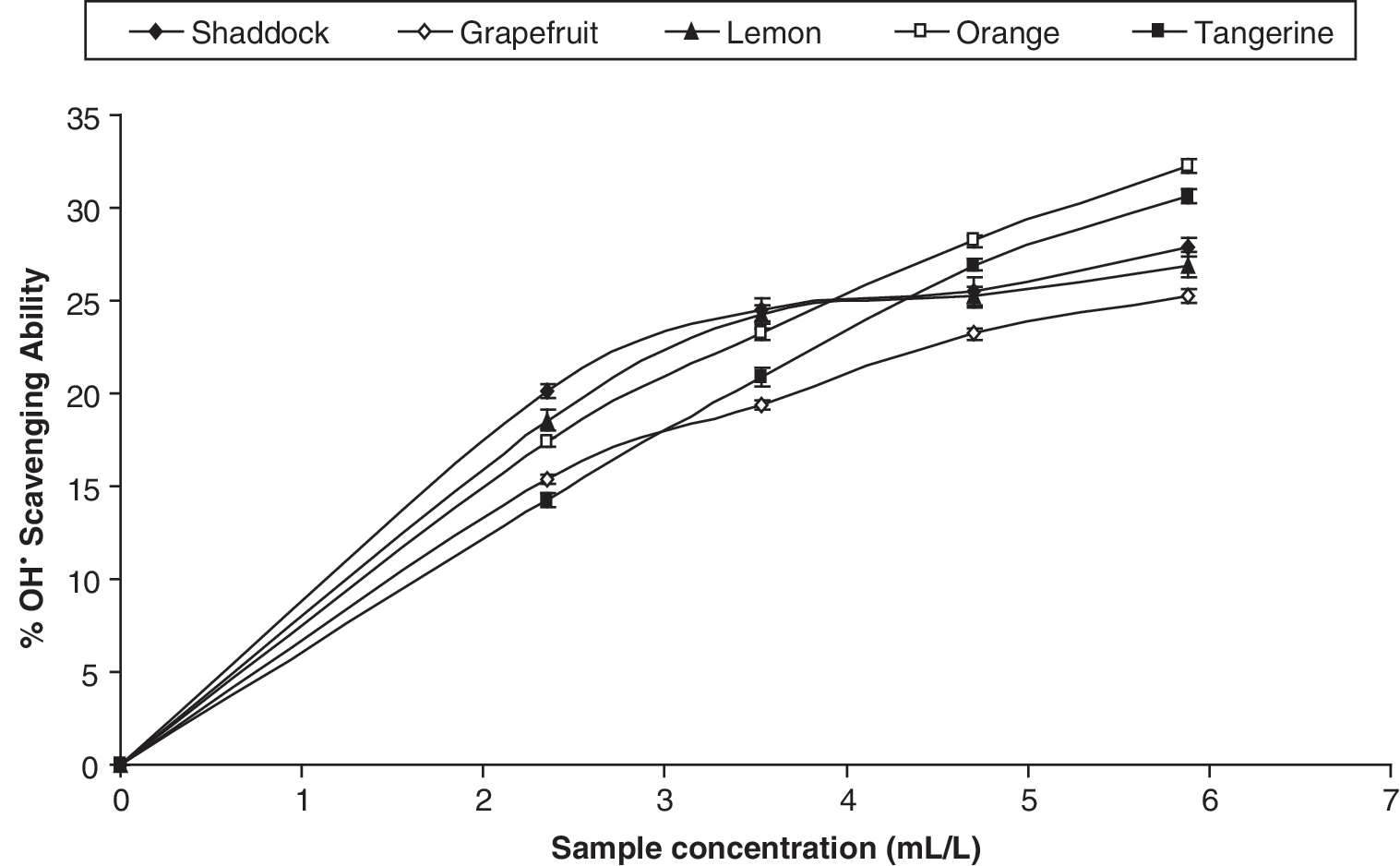
Hydroxyl radical (OH•) scavenging ability of some citrus juices.
Furthermore, incubation of rat brain homogenate in presence of Fe2+ caused a significant increase (P<.05) in the MDA content (Fig. 3); however, the juices inhibited MDA production in the brain homogenate in a dose-dependent manner, with shaddock juice having the highest inhibitory ability, inhibiting MDA production to 44.97% of control values at the highest concentration (6.68 mL/L) tested.
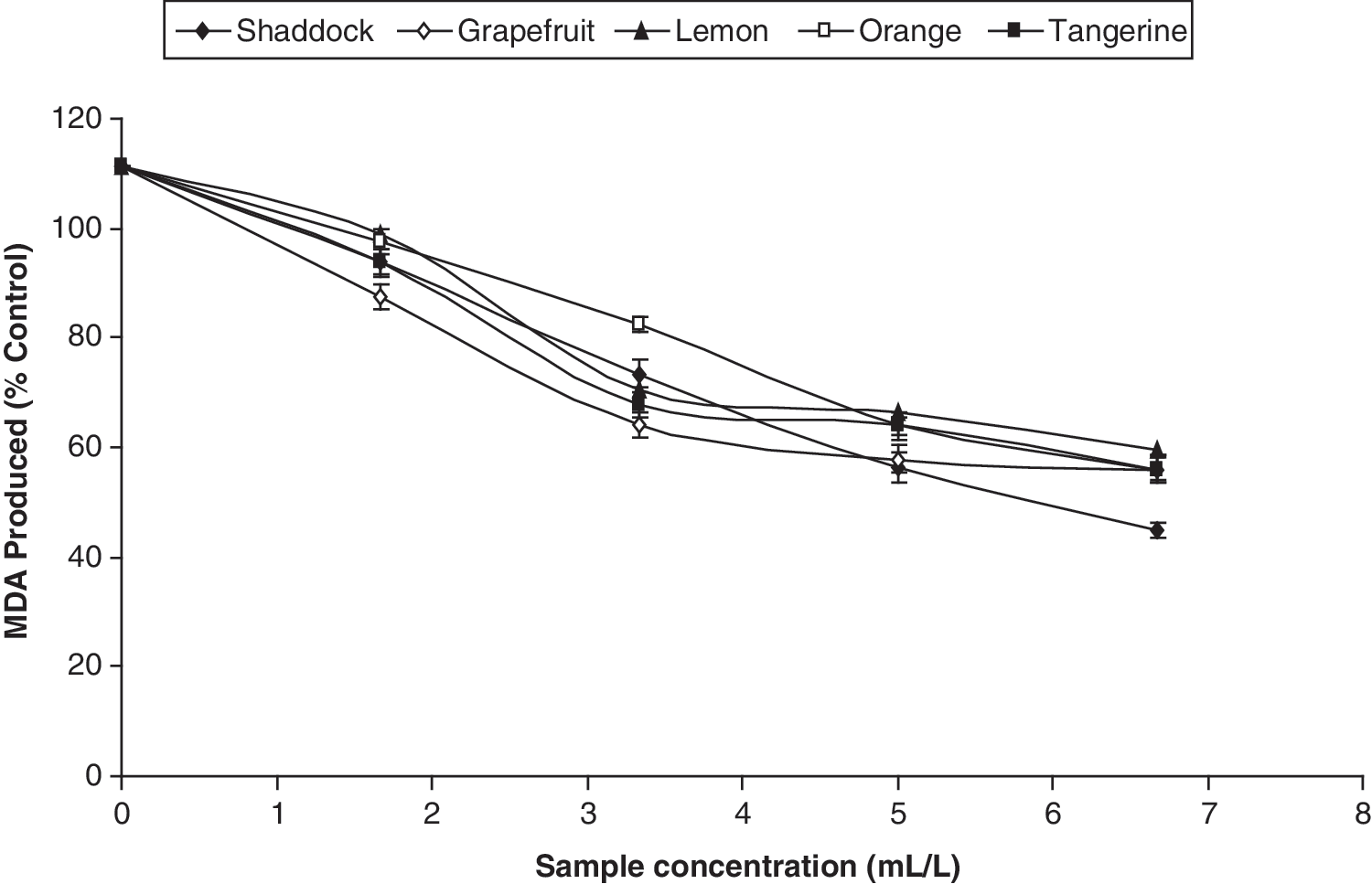
Inhibition of Fe2+-induced malondialdehyde (MDA) production in rat brain homogenate by some citrus juices.
The AChE inhibitory potentials of the juices were assessed and are reported in Figure 4; the results reveal that the extracts inhibited AChE activity in a dose-dependent manner, with orange juice (30.89%) having the highest inhibition at the lowest concentration (16.67 mL/L) tested and shaddock juice having the highest inhibition of 60.39% at the highest concentration tested (66.68 mL/L).
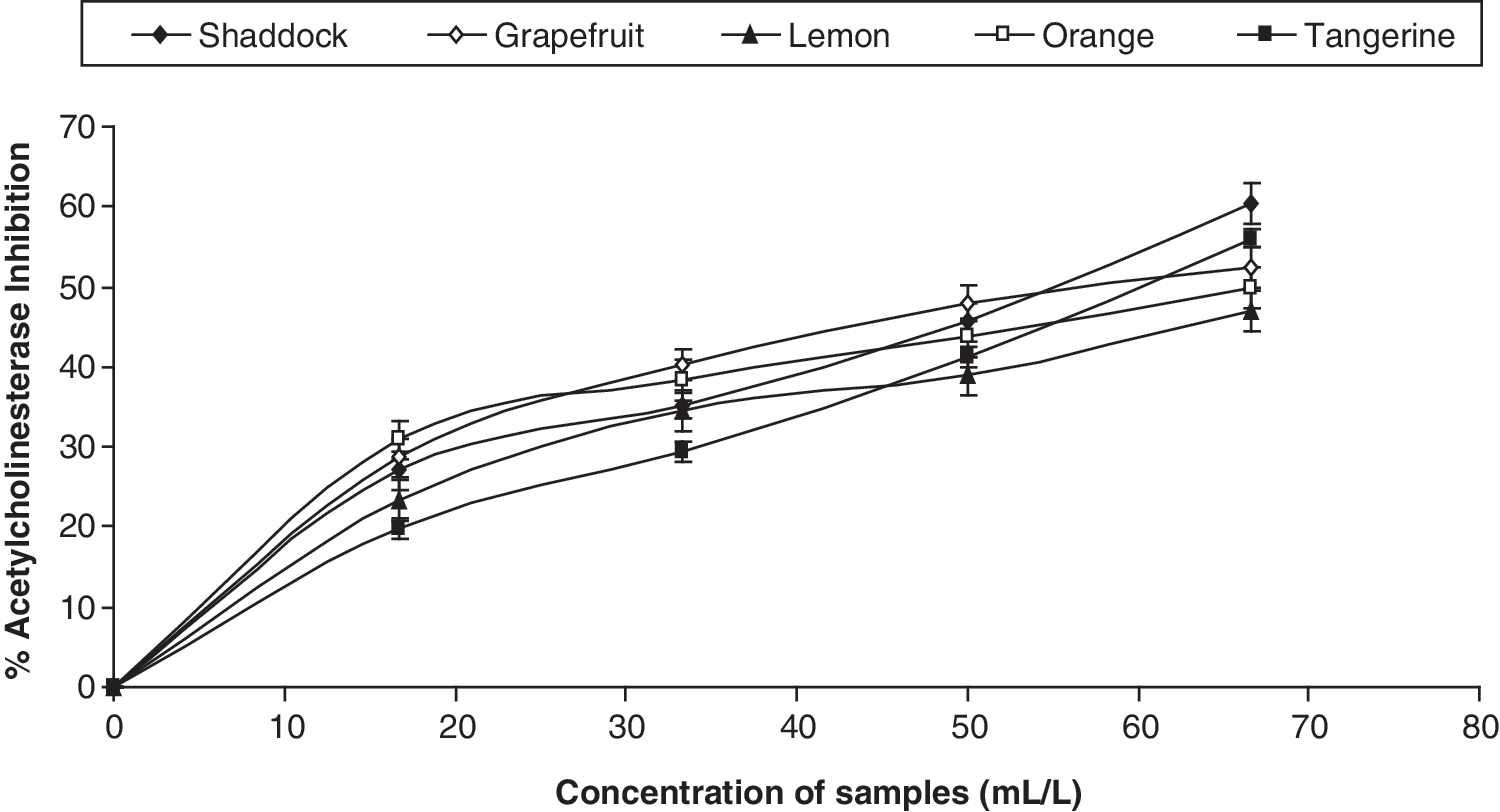
Acetylcholinesterase inhibitory activity of some citrus juices.
Discussion
The correlation between total phenol contents and antioxidant activity has been widely studied in different foodstuffs, such as fruits and vegetables, 20 –25 and the presence of high concentrations of polyphenolic phytochemicals in fruits and vegetables has been shown to increase antioxidant activities. 26 The total phenolic contents and flavonoid contents of the juices varied among the different citrus (shaddock, grapefruit, lemon, orange, and tangerine) species tested and were lower than in previous reports from Rapisarda et al. 27 (total phenol, 523.74–696.43 mg/L) and Tounsi et al. 28 (total phenol, 784.67–106.22 mg/L; total flavonoid, 34.68–85.33 mg/L). These variations could be due to the genetic potential of individual species for biosynthesis of secondary metabolites such as polyphenols. 29
The link between free radical–induced oxidative damage and Alzheimer's disease has been well established. 5,6 The brain is especially sensitive to free radical–induced oxidative damage because of its high use of oxygen, high content of readily oxidized fatty acids, and low antioxidant levels. 30 Further evidence for high oxidative damage in the brain has been obtained from postmortem brain tissue as well as from living patients with Alzheimer's disease. 31
Assessing the ability of substances to scavenge the stable DPPH radical is a widely accepted method for evaluating the free radical scavenging ability of such substances. 32 The DPPH free radical scavenging ability of the citrus juices, as presented in Figure 1, revealed that the juices scavenged DPPH• in a dose-dependent manner, although orange juice had the highest scavenging ability at all the concentrations tested. In addition, the trend in the results agree with the flavonoid distribution in the juices and many earlier research articles, where correlations were reported between flavonoid content and antioxidant capacity of some plant foods. 33
Iron generates oxygen radicals through the Fenton reaction, 34 wherein molecules of iron donate an electron to hydrogen peroxide while converting from the Fe2+ state to Fe3+, resulting in the generation of hydroxyl radicals. Furthermore, iron, ferritin, and transferrin have been found in the senile plaques of patients with Alzheimer's disease. 8,35 The citrus juices, however, scavenged hydroxyl radicals in a dose-dependent manner, with orange having the highest scavenging ability. This result is of immense importance as it has been shown that hydrogen peroxide mediates oxidative damage, which leads to the development of Alzheimer's disease. 36,37 Recent studies have also shown that polyphenols are able to cross the blood–brain barrier 38 –41 and show neuroprotection against Fenton reaction–mediated damage. 42 –44 It is also noteworthy that orange juice had the highest total phenol content, total flavonoid content, and DPPH• and OH• scavenging abilities, thereby leading to a supposition that orange juice has the highest antioxidant capacity among the juices tested.
The membranes of the brain consist of proteins and abundant amount of phospholipids. These phospholipids contain oxidizable polyunsaturated fatty acids, which are vulnerable to attack by free radicals because of the presence of weak double bonds holding the hydrogen ions. The free radical attack on the brain phospholipids results in Alzheimer's disease. 45,46 It has also been shown that peroxidized lipids in the Alzheimer's diseased brain contribute to neuronal death 7 as elevated levels of TBA-reactive substances, a measure of lipid peroxidation, are found in the brains of patients with Alzheimer's disease compared with brain tissues of nondemented subjects. 8,31
The increase of MDA content is used to analyze the free radical damage in the brain. The incubation of rat brain homogenate in the presence of 25 μM Fe2+ caused a significant increase in the MDA content (111.33%) of the brain. The mechanism by which iron causes this deleterious effect is through the decomposition of H2O2 via Fe2+ catalysis to produce hydroxyl radicals. 47,48 Nevertheless, the citrus juices significantly (P<.05) inhibited MDA production in the brain homogenate in a dose-dependent manner, with shaddock juice having the highest inhibitory ability. The possible mechanism through which the extracts protect the brain could be through OH• scavenging ability. 48,49 In contrast to the radical scavenging abilities, shaddock juice had the highest inhibition of Fe2+-induced MDA production in the brain homogenate. The reason for this contrast cannot be categorically stated, but it could be attributed to the different flavonoid structures and compositions among the juices tested. 50
Increased concentrations of acetylcholine in the brain are brought about by the inhibition of AChE activity preventing the breakdown of acetylcholine, leading to increased communication between the nerve cells that use acetylcholine as a chemical messenger. This action has been used to temporarily improve or stabilize the symptoms of Alzheimer's disease. 51 The interaction of the citrus juices with AChE activity reveals that the juices inhibited AChE activity in a dose-dependent manner. Benamar et al. 52 showed that some plant extracts with phenolic content inhibited AChE activity in vitro, and it could therefore be suggested that the AChE inhibition by the citrus juices is due to their phenolics, as isolated ferulic acid was also found to inhibit AChE activity. 53 Furthermore, the Kame Project carried out with Japanese-Americans between 1992 and 2001 found that subjects with a higher intake of fruit and vegetable juices had a substantially reduced incidence of Alzheimer's disease. 11
Conclusions
The inhibition of AChE activity and lipid peroxidation by the citrus juices, as well as other antioxidant activities as typified by DPPH• and OH• scavenging abilities, could be part of the mechanism by which citrus juices manage and/or prevent Alzheimer's disease. However, further in vivo experiments and clinical trials are recommended.
Footnotes
Author Disclosure Statement
No competing financial interests exist.