




Abstract
A chronic subclinical inflammatory status that coexists with immune dysfunction is commonly found in the elderly population. Consumption of foods rich in antioxidants (e.g., cherries) is an attractive strategy to reduce risk from chronic diseases. Based on previous studies showing the antioxidant effect of a Jerte Valley cherry derivative product in humans, the objective of this work was to evaluate the effect of the intake of a Jerte Valley cherry-based beverage on inflammatory load in both young and old ringdoves (Streptopelia risoria). To this purpose, circulating levels of pro-inflammatory and anti-inflammatory cytokines as well as serum levels of different acute-phase proteins were measured before and after a 10-day treatment with the Jerte Valley cherry-based beverage. Thus, the 10-day treatment with the cherry-based beverage modulated the balance of pro- and anti-inflammatory cytokines in both young and old ringdoves by down-regulating the levels of pro-inflammatory cytokines (interleukin [IL]-1β, tumor necrosis factor-α, and interferon-γ) and up-regulating the levels of anti-inflammatory cytokines (IL-4, IL-2, and IL-10). Moreover, the 10-day treatment with the Jerte Valley cherry-based product reduced the levels of several proteins involved in acute-phase responses, such as C-reactive protein, haptoglobin, α2-macroglobulin, and serum amyloid P component. On the other hand, old birds showed imbalanced levels of inflammatory markers toward a pro-inflammatory status, thereby underlining the fact that aging is usually accompanied by systemic inflammation and inflammation-related chronic diseases. To sum up, the data suggest a potential health benefit by consuming the cherry-based beverage, especially in aged populations, through their anti-inflammatory properties.
Introduction
A
Bioactive compounds are extranutritional constituents that typically and naturally occur in different quantities in plant products. Cherries contain bioactive phytochemicals (e.g., phenolics and anthocyanins) that are reported to possess antioxidant, anticancer, antidiabetic, anti-obesity, and anti-inflammatory properties. 5 –7 Thus, cherries have been reported to inhibit the cyclooxygenase enzymes responsible for inflammatory response 8 and reduce the levels of serum C-reactive protein (CRP), 9 a systemic inflammatory marker. The beneficial properties of fruits and vegetables have been proposed to come from the additive and synergistic effects of their phytonutrients. 10 In this regard, sweet cherries from the Jerte Valley (Extremadura, Spain) contain not only high concentrations of anthocyanin pigments and other phenolic compounds, 11 but also substantial amounts of melatonin, serotonin, 12 and tryptophan. 13
Recently, it has been reported that both a Jerte Valley cherry-enriched diet 14 and the intake of a Jerte Valley cherry-based nutraceutical product 15 exhibit sleep-promoting actions and increase urinary 6-sulfatoxymelatonin, a metabolite that is considered to reflect the nocturnal melatonin concentration, as well as antioxidant status in young, middle-aged, and elderly subjects. Taking into account the potential health-promoting actions of Jerte Valley sweet cherries, the purpose of this work was to evaluate the effect of the consumption of a Jerte Valley cherry-based product on inflammatory load in ringdoves (Streptopelia risoria) from two different age groups: young and old. For this purpose, serum levels of several pro-inflammatory and anti-inflammatory cytokines as well as circulating levels of different acute-phase proteins were measured before and after a 10-day treatment with the Jerte Valley cherry-based product.
Materials and Methods
Animals
Both male and female ringdoves (S. risoria) 4–5 years old (young) and 12–14 years old (old) (the average life span of these birds is 15 years) were used in the study (n=8 per age group). Birds were individually housed under controlled environmental conditions (20°C; 70% humidity), maintained under a 12/12-h light/dark photoperiod (darkness from 19:00 to 07:00 h), and fed ad libitum (food and water). All handling during lights-off was done under dim red light (<2 lux).
The study was approved by the Ethical Committee of the University of Extremadura (Badajoz, Spain) in accordance with the National Institutes of Health Guide for the Care and Use of Laboratory Animals and the European Community's Council Directives (86/609/EEC).
Animal treatment
Both young and old birds were watered with a Jerte Valley cherry-based 16 beverage for a 10-day period. The beverage was made of 27.85 g of powdered freeze-dried product mix diluted in 250 mL of water. On the basis of previous studies showing the antioxidant action of a Jerte Valley cherry derivative product in humans, 15 this product mix consisted of 18.85 g of pitted freeze-dried cherries (equivalent to 141 g of fresh cherries) in equal parts of four Jerte Valley cherry cultivars (Bourlat, Navalinda, Pico Negro, and Pico Colorado), plus 7.5 g of maltodextrin and 1.5 g of ascorbic acid. One dose of the cherry-based product provided roughly 690 mg of total antioxidant capacity, expressed as Trolox equivalents.
The cherry-based beverage was freshly prepared every day. Feeding bottles containing the cherry-based beverage were wrapped up in tinfoil to avoid light-sensitive compounds (e.g., melatonin) to be oxidized and/or destroyed. Basal parameters were obtained from animals studied before treatment that had not been watered with the cherry-based beverage but with drinking water. Liquid consumption was monitored, but no significant difference was noted between the liquid consumption of young and old animals.
Serum collection
As cytokine serum levels may vary throughout the day, 17 blood samples were drawn from all birds (n=16) at 08:00 h, 18:00 h, and the time corresponding to each group's acrophase of the melatonin rhythm, allowing at least 1 week between consecutive samplings. Based on previous research, the acrophases of the melatonin rhythm (times at which the variables reach their maximums) in basal conditions were established at 02:00 h and 01:00 h in young and old ringdoves, respectively. 18 The collections (1 mL) were made with a 25-gauge needle and a syringe, taking blood from the brachial vein and then transferring it unheparinized to a previously prepared tube containing serum-separating gel. The samples were centrifuged at room temperature for 30 min at 300 g. The serum was then aliquoted into Eppendorf vials and kept frozen at −30°C until assay. Nocturnal collections were performed under dim red light, which the animals perceive as darkness. The extractions were performed before initiating the treatment (basal values) and at the end of the treatment.
Determination of cytokines and acute-phase proteins in serum
Serum interleukin (IL)-1β, IL-2, IL-4, IL-6, IL-10, interferon-γ (IFN-γ), tumor necrosis factor-α (TNF-α), CRP, haptoglobin, α2-macroglobulin (α2M), and serum amyloid P component (SAP) were analyzed using a multiplex-format enzyme-linked immunosorbent assay (Bio-Rad, Hercules, CA, USA) that allows for the simultaneous detection of multiple cytokines in each serum sample. We should note here that we also attempted to measure other markers of inflammation, including IL-12 and IL-17. However, the assay sensitivity for our particular samples was too low, in that these end points were undetectable, or non-reproducible, for >70% of the samples. As mentioned previously, basal levels of cytokines and acute-phase proteins were blood values from animals studied before treatment.
Statistical analysis
Data are expressed as mean±SEM values of the numbers of determinations carried out in duplicate. To compare the different treatments, statistical significance was calculated by one-way analysis of variance followed by post hoc Tukey's test. P<.05 was considered to indicate a statistically significant difference.
Results
Table 1 shows serum levels of several pro-inflammatory markers measured at three different time points. Thus, in treated young ringdoves, circulating concentrations of pro-inflammatory IL-1β were substantially lowered both at dawn and at 18:00 h compared with young ringdoves in basal conditions, whereas serum levels of TNF-α and IFN-γ were significantly reduced only at dawn. Likewise, in old ringdoves administered the cherry-based beverage, serum IL-1β and TNF-α levels diminished at 18:00 h and in the acrophase of the melatonin rhythm (01:00 h), whereas circulating levels of IFN-γ markedly dropped after the treatment both at dawn and at 18:00 h. Moreover, old birds exhibited greater basal levels of IL-1β and TNF-α at all hours, as well as higher IFN-γ basal levels at 18:00 h and in the acrophase of the melatonin rhythm.
Samples were analyzed at different times, as indicated in Materials and Methods. Data are mean±SEM values (n=8).
P<.05 relative to basal values; b P<.05 relative to its corresponding value in old animals.
IFN-γ, interferon-γ; IL-1β, interleukin-1β; TNF-α, tumor necrosis factor-α; basal, serum level before consumption; treated, serum level after consumption.
On the other hand, serum levels of IL-2, IL-4, and IL-10 were subsequently measured as anti-inflammatory markers (Table 2). It is interesting that in young ringdoves the 10-day treatment with the Jerte Valley cherry-based beverage led to increased IL-2 (02:00 h), IL-4 (all hours tested), and IL-10 (18:00 h and 02:00 h) concentrations. Similarly, in old ringdoves, the consumption of the cherry-based beverage greatly enhanced serum levels of IL-4 at all hours tested, as well as circulating levels of IL-2 and IL-10 (08:00 h and 01:00 h). Additionally, it is noteworthy that old ringdoves showed lower IL-2 and IL-4 basal levels at dawn and in the acrophase of the melatonin rhythm, as well as lower IL-10 basal levels at 18:00 h.
Samples were analyzed at different times, as indicated in Materials and Methods. Data are mean±SEM values (n=8).
P<.05 relative to basal values; b P<.05 relative to its corresponding value in old animals.
IL-2, interleukin-2; IL-4, interleukin-4; IL-10, interleukin-10.
Furthermore, IL-6 serum levels were also measured after the 10-day treatment with the Jerte Valley cherry-based beverage. In this regard, IL-6 basal levels were modified in different ways depending on the time of sampling (Fig. 1). In fact, after the consumption of the cherry-based beverage, IL-6 serum levels were remarkably diminished at dawn in both age groups. However, because IL-6 basal levels dropped at 18:00 h in both groups, the intake of the cherry-based product increased IL-6 serum levels at 18:00 h, whereas such levels remained unmodified in the acrophase of the melatonin rhythm. In addition, old birds exhibited higher basal levels of IL-6 at dawn than young birds (Fig. 1).
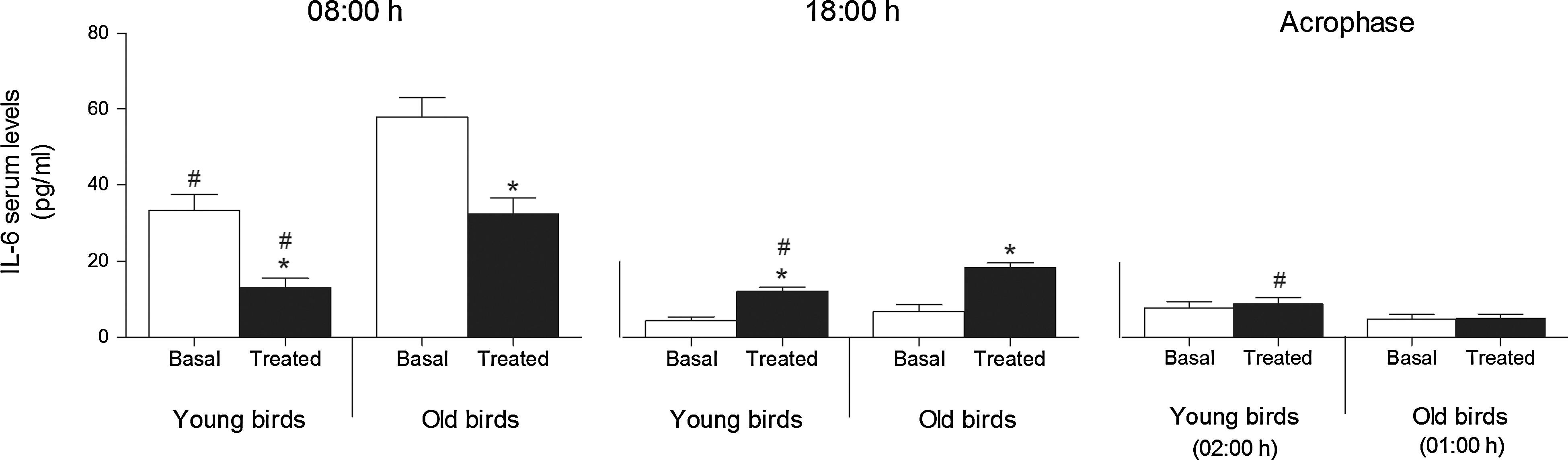
Consuming a Jerte Valle cherry-based beverage modulates circulating concentrations of IL-6 in ringdoves. Serum IL-6 levels were determined in young and old ringdoves before (basal) and after (treated) the consumption of the cherry-based beverage. Samples were analyzed at different times, as indicated in Materials and Methods. Data are mean±SEM values (in pg/mL) (n=8). *P<.05 relative to basal values; # P<.05 relative to its corresponding value in old animals.
Finally, serum concentrations of different acute-phase proteins were analyzed. Despite the fact that serum levels of CRP, haptoglobin, α2M, and SAP were measured at different times, they were only detected at night (i.e., in the acrophase of the melatonin rhythm). Thus, the consumption of the Jerte Valley cherry-based beverage led to reduced levels of CRP, haptoglobin, α2M, and SAP in both young and old ringdoves (Fig. 2). In this case, basal levels of all acute-phase proteins were much higher in old ringdoves than in young ones (Fig. 2).
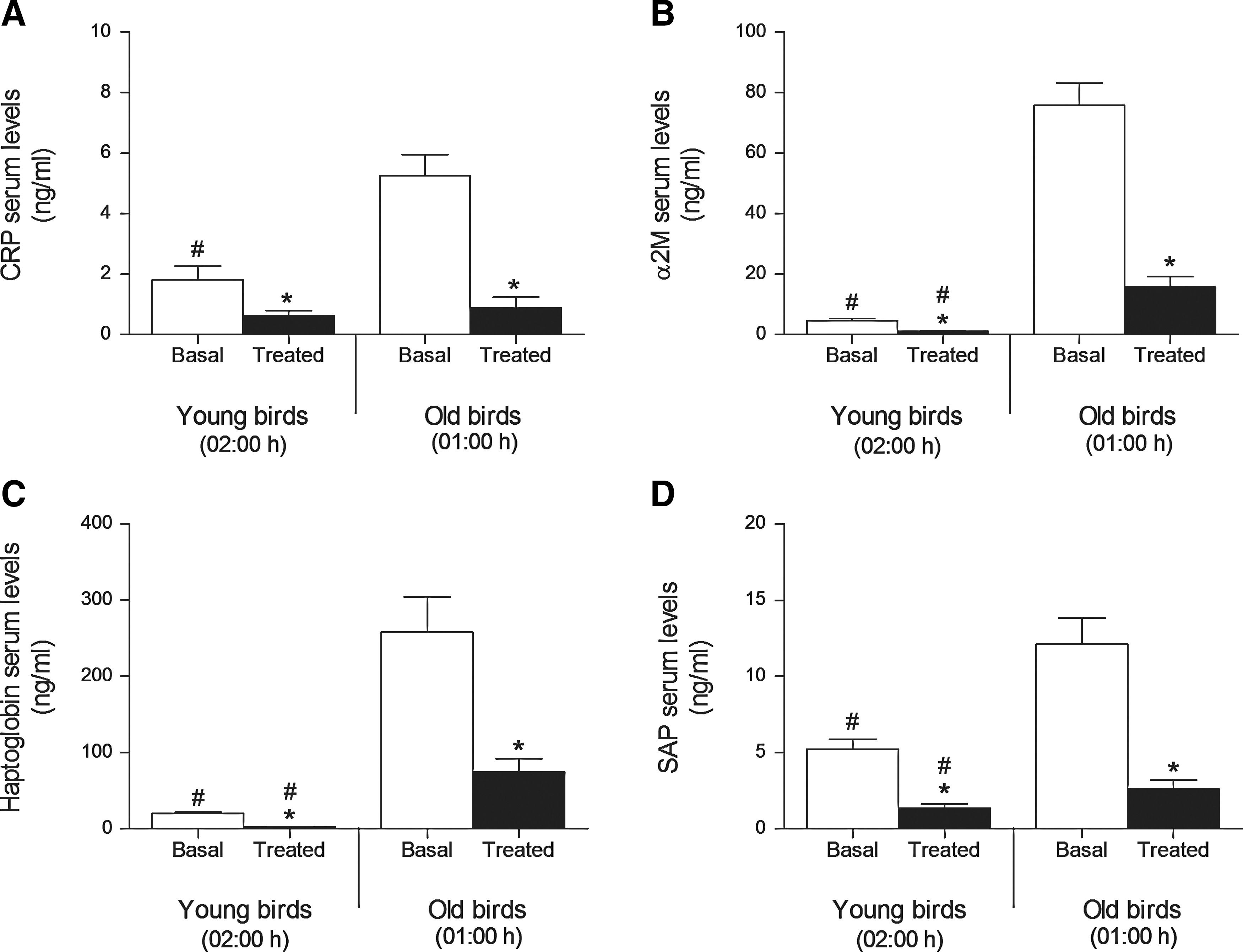
Consumption of a Jerte Valle cherry-based beverage reduces circulating concentrations of different acute-phase proteins in ringdoves. Serum levels of
Discussion
Consumption of fruits and vegetables, foodstuffs rich in antioxidants, is an attractive strategy to reduce risk from chronic diseases. 19,20 In this study, we found that a 10-day treatment with a Jerte Valley cherry-based beverage modulated the balance of pro- and anti-inflammatory cytokines in both young and old ringdoves by down-regulating the levels of pro-inflammatory cytokines (IL-1β, TNF-α, and IFN-γ) and up-regulating the levels of anti-inflammatory cytokines (IL-4, IL-2, and IL-10). These results are consistent with those reported with phenolic compounds in animal models, 21 preliminary human studies with cherries, 22 and in vitro studies with phenolic extracts from cherries. 23 Furthermore, it is noteworthy that the intake of this cherry-based product has been reported not only to induce a substantial increase in the serum antioxidant capacity in young and old ringdoves, 24 but also to cause a significant rise in the urinary antioxidant capacity in humans. 15
On the other hand, IL-6 has traditionally been considered as an inflammatory mediator involved in the pathogenesis of several chronic diseases. 25 Nonetheless, in recent years, Petersen and Pedersen 26 have firmly held that IL-6 may also act as an anti-inflammatory cytokine because IL-6 exerts inhibitory effects on TNF-α and IL-1 production. At this respect, we have found an inhibiting, an enhancing, or no effect on IL-6 expression after the intake of the cherry-based product, depending on the time of sampling. Although these findings seem rather controversial, they agree with most clinical trials, which have reported inhibiting actions 27,28 or no effects 29,30 on circulating IL-6 levels after the consumption of antioxidant-rich foods.
Apart from cytokines, we measured different acute-phase proteins, which are generally regarded as stable biomarkers of systemic inflammatory level. Elevated serum CRP is one of the most important indicators of inflammation, and it is a significant risk factor for cardiovascular disease. 31 Thus, the decrease in plasma CRP (but also in haptoglobin, α2M, and SAP) by the Jerte Valley cherry-based beverage suggests amelioration in inflammation that may positively affect the risk for some chronic diseases. These findings fit into previous studies reporting reduced concentrations of CRP 9 and SAP 32 after consumption of Bing sweet cherries or dried plums, respectively. Nonetheless, other reports showed that the intake of pomegranate seed oil did not alter systemic inflammation, as assessed by CRP and haptoglobin serum levels. 33
A common finding in the elderly population is a chronic subclinical inflammatory status that coexists with immune dysfunction, which could impact health and survival time. 1 Accordingly, the old animals used in this study showed imbalanced levels of inflammatory markers toward a pro-inflammatory status, thereby underlining the fact that aging is usually accompanied by systemic inflammation and inflammation-related chronic illnesses. Therefore, it is worth noting the possibility that nutritional interventions, like the consumption of the cherry-based beverage, could prevent or delay the functional deterioration of the immune system that accompanies aging and, perhaps, return it to that of the “younger” situation, as previously suggested. 34
Immunomodulatory actions exhibited by melatonin are mainly mediated through the modulation of cytokine production. 35 Thus, it is plausible to assume that the anti-inflammatory properties showed herein by the Jerte Valley cherry-based beverage may be attributed to melatonin because Jerte Valley sweet cherries reportedly contain substantial amounts of melatonin. 12 Nevertheless, the involvement of other antioxidants, such as phenolic acids, anthocyanins, and carotenoids, cannot be ruled out.
The significant reduction in pro-inflammatory markers along with the increase in anti-inflammatory markers suggests amelioration or reorganization of immunity to a non-inflamed state, which could be due to a response to nutrients and antioxidants in the cherry-based beverage. Therefore, our findings suggest that the Jerte Valley cherry-based beverage is likely a beneficial addition to the usual diet in support of human health; however, its clinical significance should be addressed in further studies.
Footnotes
Acknowledgments
This research was supported by a UEx grant (Plan de Iniciación a la Investigación, Acción VII 18L202). M.G. is the recipient of a grant from UEx (Plan de Iniciación a la Investigación, Acción II no. 1059). J.E. is the recipient of a grant from the Ministerio de Educación (AP2009-0753). S.D.P. is the recipient of a grant from the Consejería de Economía, Comercio e Innovación–Fondo Social Europeo (Junta de Extremadura, REI09009).
Author Disclosure Statement
No competing financial interests exist.