




Abstract
The present study evaluates the antioxidant activity of two Aronia melanocarpa cultivars—Viking and Aron—and of Aronia prunifolia hybrid in relationship with their phytochemical composition regarding the contents of total phenolics, flavonoids, procyanidins, and monomeric anthocyanins. The antioxidant capacity of the mentioned extracts of chokeberries was evaluated through five complementary assays: 2,2′-azino-bis(3-ethylbenzothiazoline-6-sulfonic acid), H2O2 scavenging potential, oxygen radical absorbance capacity, ferric reducing antioxidant power, and cupric ion reducing antioxidant capacity. A. prunifolia hybrid was found to have the highest antioxidant activity and to be the richest in polyphenols, procyanidins, and anthocyanins compared with the A. melanocarpa cultivars. A good correlation was observed between antioxidant activity and total procyanidin and anthocyanin content. Cyanidin glycosides inhibited HeLa human cervical tumor cell proliferation and increased generation of reactive oxygen species after 48 h of treatment, suggesting that they could be responsible for the antiproliferative activity. These results may be significant for industry concerning food quality and disease prevention.
Introduction
T
The antioxidant activity of these compounds, evaluated until now through different assays classified according to the mechanism of the reaction involved, is due to the presence of ortho-3′,4′-dihydroxy moiety in the B ring and meta-5,7-dihydroxy arrangements in the A ring. 6,7 These berries, because of their high content in anthocyanins, are being studied also for their ability to protect against oral, 8 colon, 9,10 breast, 8 and prostate 11,12 cancer.
The objectives of this study were (1) to determine the contents of total flavonoids, procyanidins, anthocyanins, and polyphenols of chokeberry extracts obtained from three cultivars and to characterize their anthocyanin fraction by high-performance liquid chromatography (HPLC) analysis, (2) to measure and compare the antioxidant activity using three different single electron transfer (SET)-based assays [2,2′-azino-bis(3-ethylbenzothiazoline-6-sulfonic acid) (ABTS), ferric reducing antioxidant power (FRAP), and cupric ion reducing antioxidant capacity (CUPRAC)], one hydrogen atom transfer (HAT)-based method (oxygen radical absorbance capacity [ORAC]), and the H2O2 scavenging potential (HPS) assay, and (3) to evaluate the cytotoxic action and the pro-oxidative effect of the anthocyanin fraction on the HeLa tumor cervical cell line.
Materials and Methods
Reagents
The standard compounds and reagents were obtained from Sigma-Aldrich (Darmstadt, Germany), Polyphenols Laboratories AS (Sandnes, Norway), or local producers. The human cervical tumor HeLa cell line was obtained from The “Prof. Dr. Ion Chiricuţă” Oncology Institute, Cluj-Napoca, Romania.
Extraction and HPLC analysis
The fruits of the two species, A. prunifolia and A. melanocarpa (cultivars Viking [AmV] and Aron [AmA]), were collected in the middle of August at a plantation near Cluj-Napoca and preserved at −20°C, immediately after harvest. Anthocyanin and non-anthocyanin compounds were extracted by homogenization of chokeberries (5 g) in methanol containing HCl (0.3%) using an Ultraturax (model Miccra D-9 KT; Digitronic GmbH, Bergheim, Germany). Extracts were concentrated at 35°C under reduced pressure (Rotavapor® model R-124; Buchi, Flawil, Switzerland). The A. prunifolia anthocyanin fraction was obtained following the procedure described previously. 13 The acidified methanol fraction of anthocyanins was dissolved in deionized water and quantified using HPLC analysis.
HPLC analysis was performed on a Shimadzu (Kyoto, Japan) system equipped with a binary pump delivery system (model LC-20 AT Prominence), a degasser (model DGU-20 A3 Prominence), model SPD-M20 A UV–VISdiode array detector), and a Luna Phenomenex (Torrance, CA, USA) C-18 column (film thickness, 5 μm; 25 cm×4.6 mm). The mobile phase consisted formic acid (4.5%) in double-distilled water (solvent A) and acetonitrile (solvent B). The gradient elution system was as follows: 10% B, 0–9 min; 12% B, 9–17 min; 25% B, 17–30 min; 90% B, 30–50 min; and 10% B, 50–55 min. The flow rate was 0.8 mL/min, and the analyses were performed at 35°C. The chromatogram was monitored at 520 nm. Identification and peak assignments of anthocyanins are based on their retention times and ultraviolet–visible spectra comparing with standards and published data. Anthocyanin quantification was performed using cyanidin 3-O-galactoside.
Measurement of total phenolics, flavonoid, procyanidins, and monomeric anthocyanins
The total phenolic content, expressed as gallic acid equivalents (GAE), was determined by a modified Folin–Ciocalteu method. 14 The absorbance was read at 750 nm by a microplate reader (BioTek Instruments, Winooski, VT, USA).
Total monomeric anthocyanin content, expressed as cyanidin 3-galactoside equivalents, was determined and calculated using the differential pH method. 15
Total proanthocyanidin content, expressed as epicatechin equivalents, was evaluated by a modified vanillin-HCl assay method described by Sun et al. 16 The absorbance was measured at 500 nm using a spectrophotometer (V-630 series, JASCO, Tokyo, Japan), subtracting the anthocyanin absorbance of the extracts.
The existence of other flavonoids in chokeberry cultivars was evaluated by the aluminum chloride colorimetric method as described previously. 17,18 The flavonoid content was expressed as quercetin equivalents.
Antioxidant activity of chokeberry extracts
The scavenging ability of chokeberry extracts against the radical anion ABTS
Cell culture and survival
The human tumor cervical HeLa cell line was maintained in Dulbecco's modified Eagle's medium containing 1 g/L glucose supplemented with 10% fetal bovine serum, 1 mM glutamine, 1% gentamicin, and 1% nonessential amino acids at 37°C in an atmosphere of 5% CO2 and 95% relative humidity. For the cell survival test HeLa cells were plated (5000 cells per well) in 96-well plates for 24 h. The culture medium was then replaced with complete medium containing 0–250 μg/mL anthocyanins. The number of viable cells was determined with the 3-(4,5-dimethylthiazol-2-yl)-2,5-diphenyltetrazolium bromide cell proliferation reagent. Three phosphate-buffered saline washing steps were followed by 1 h of incubation with 3-(4,5-dimethylthiazol-2-yl)-2,5-diphenyltetrazolium bromide solution (0.5 mg/mL) in Dulbecco's modified Eagle's medium without phenol red. The formazan particles were solubilized with dimethyl sulfoxide. The absorbance was read at 550 nm and expressed relative at that 630 nm (for background) with the HT Synergy microplate plate reader. The results were expressed as survival percentage with respect to an untreated control.
Intracellular reactive species assay
The determination of intracellular reactive oxygen species (ROS) uses the fluorescent probe 2′,7′-dichlorodihydrofluorescein diacetate, which is cell membrane permeable and is hydrolyzed by cellular esterases to 2′,7′-dichlorofluorescein, which reacts with intracellular ROS to form fluorescent 2′,7′-dichlorofluorescein, which is measured by a plate reader. Cells cultured in 96-well black-bottom plates were incubated for 1 h with 20 μM 2′,7′-dichlorodihydrofluorescein diacetate in Hanks' balanced salt solution. Fluorescence was monitored at 37°C at excitation wavelengths of 485 nm and emission wavelengths of 528 nm. 25
Statistical analysis
Statistical analyses were performed by an analysis of variance and Duncan's multiple range tests using Microsoft Excel (version 2003; Redmond, WA, USA). The data were expressed as mean±SD values. Differences at P≤.05 were considered to be significant. Correlations among data obtained were done using Pearson's correlation coefficient (r). Each determination was carried out in triplicate.
Results and Discussion
Total phenolic, flavonoid, procyanidin, and anthocyanin contents of chokeberries
The Folin–Ciocalteu method estimates the total content of all phenolics present in the chokeberries, including flavonoids, procyanidins, anthocyanins, and non-flavonoid phenolic compounds. The total phenolic values for chokeberry cultivars ranged from 1586.5 to 2059.5 mg of GAE/100 g FW (Table 1), which are in agreement with values reported previously: 2556 mg of GAE/100 g FW for wild chokeberry 26 and 2010 mg of GAE/100 g FW 3 and 1063.7 mg of GAE/100 g FW 27 for A. melanocarpa. A. prunifolia had the highest total phenolic content of all chokeberry samples investigated.
Data are means±SD.
Means with different letters in the same column have a statistically significant difference at P≤.05.
GAE, gallic acid; FW, fresh weight.
Using a rapid and easy screening method for total monomeric anthocyanin quantification of chokeberry, we estimated for the first time the anthocyanin content of the AmA, AmV, and A. prunifolia cultivars, ranging from 176 to 366 mg/100 g FW (Table 1). The anthocyanin content previously reported, determined with the differential pH method, for A. melanocarpa fruits was 428 mg/100 g FW, 26 460.5 mg/100 g FW, 28 and 434.1 mg/100 g FW. 27
The presence of other flavonoids was evaluated using the aluminum chloride colorimetric method. In chokeberry cultivars the flavonoid content ranged from 47.67 mg/100 g FW (A. prunifolia) to 64.04 mg/100 g FW (AmV) (Table 1). Our results are in agreement with data obtained by HPLC/mass spectrometry analysis, which revealed for A. melanocarpa a flavonoid content of 71 mg/100 g FW, as quercetin glycosides. 5
The remaining difference value between total phenols and anthocyanins relative to flavonoid content corresponds to polymeric procyanidins and to other insoluble phenols. Acoording to the vanillin-HCl assay A. prunifolia had a higher procyanidin content (855.1 mg/100 g) compared with the AmA and AmV cultivars. Literature data report that proanthocyanidins of chokeberries are represented only by polymeric procyanidins. The previously reported procyanidin content for A. melanocarpa berries was about 633 mg/100 g FW. 3
To our knowledge, we report for the first time data regarding the A. prunifolia hybrid, which showed higher statistically significant polyphenols, flavonoid, procyanidin, and anthocyanin contents than either AmA or AmV. The small quantitative differences in content of polyphenolic compounds compared with literature data might be due to different physiological and developmental stage or environmental factors, such as light intensity and nutrient availability 29 (and references therein).
Antioxidant activity
Because different antioxidant assays give very different results, various methods based on different mechanisms must be used in parallel to evaluate the antioxidant capacity of compounds or extracts. Taking into account the pros and cons of each assay and their reaction mechanism (HAT or SET), we chose five antioxidant methods to be used in this study. SET-based assays (ABTS, FRAP, and CUPRAC) measures the capacity of the antioxidants to reduce an oxidant. ORAC, an HAT-based assay, measures the capability of antioxidants to quench peroxyl radicals by hydrogen donation. 30 The ABTS, FRAP, and ORAC assays are the most common methods for measuring in vitro antioxidant capacity. Besides these common methods, we used the HPS and CUPRAC assays, untested on chokeberry extracts, in order to provide comprehensive information regarding their antioxidant activity.
The ABTS assay uses K2S2O8 as an oxidant and measures the antioxidant's ability to scavenge the radical ABTS+∙ compared with Trolox, a vitamin E analog. The chokeberry radical scavenging activity (Table 2) ranged from 95 to 171 μmol of Trolox/g FW, with an elevated value for the AmV extract, but not statistically significant compared with that obtained for A. prunifolia. Our values for scavenging activity toward the ABTS+∙ radical are similar to that reported in a recent study: 37.44 mg of Trolox/g of sample. 31 Considering that the water content of berries is around 85% of the fresh mass, 32 our data are also in the same range of concentration with scavenging effect expressed as dry weight: 439.4 μM Trolox/100 g dry weight. 33
Data are means±SD.
Means with different letters in the same column have a statistically significant difference at P≤.05.
For weighted average (WA) calculation, see Results and Discussion.
ABTS, 2,2′-azino-bis(3-ethylbenzothiazoline-6-sulfonic acid; CUPRAC, cupric ion reducing antioxidant capacity; FRAP, ferric reducing antioxidant potential; HPS, H2O2 scavenging potential; ORAC, oxygen radical absorbance capacity.
FRAP assay values are summarized in Table 2. A. prunifolia extract demonstrated the highest FRAP (300.2±10.6 μmol of Fe2+/g FW), compared with the other two cultivars, AmA and AmV. The reduction of Fe3+ to Fe2+ by polyphenolic-containing extracts, obtained from hybrids of rowanberry with Malus, Pyrus, Aronia, or Mespilus, showed values ranging from 61 to 105 μmol of Fe2+/g FW. 34
Compared with FRAP, the CUPRAC assay is carried out at pH 7.0, close to physiological pH, and the reaction assay involves faster kinetics. 35 The ability of chokeberry extracts to reduce cupric ion (Cu2+) is shown in Table 2. The A. prunifolia cultivar had the highest reducing potential, more than 230 μmol of Trolox equivalents/g FW, a value statistically different from those obtained for the AmA and AmV cultivars: respectively, 158.8 and 177.8 μmol of Trolox equivalents/g FW. CUPRAC values were recently reported to range between 47.1 and 127.9 μmol Trolox equivalents/g FW for some raspberry and blackberry cultivars. 36 To our knowledge, there are no prior literature data about cupric reducing antioxidant capacity of chokeberry extracts.
The ORAC assay measures the scavenging capacity of antioxidants against peroxyl radical. The ORAC values for chokeberry extracts ranged from 35.3 to 42.3 μmol of Trolox/g FW (Table 2), being smaller than those reported previously: 138.2 μmol of Trolox/g FW 26 and 161 μmol of Trolox equivalents/g of FW. 3 These differences could be due to the use of a different fluorescent reagent. Wu et al. 3 used β-phycoerythrin, instead of the fluorescein we used. The disadvantages of using β-phycoerythrin, such as the inconsistent reactivity toward peroxyl radicals, the interaction with polyphenols due to the nonspecific protein binding, and the instability after exposure to excitation light, were the reasons why its replacement by fluorescein was recommended. 37
H2O2 is a strong oxidizing agent, produced in vivo as a by-product of oxygen metabolism. As a main source of hydroxyl radicals it can be toxic for many cell types. 38 AmA, AmV, and A. prunifolia exhibited 53.3, 61.9, and 65.0 μmol/g FW H2O2 scavenging activity, respectively (Table 2). The A. prunifolia cultivar was the most effective scavenger toward H2O2, and the AmV cultivar exhibited the lowest inhibition of H2O2. A black rice anthocyanin-rich extract (100 μg/mL) showed higher H2O2 scavenging activity than butylated hydroxyanisole, butylated hydroxytoluene, and α-tocopherol. 39 As far as we know no study has revealed the H2O2 scavenging ability of chokeberry extracts.
We established a sample ranking calculating the weighted average (in μmol/g) (Table 2) according to a recent study. 40 The ranking order for the antioxidant assay obtained after the weighted average calculation was A. prunifolia > AmV > AmA.
The Pearson's correlation coefficient (r) between chokeberry polyphenolic content and antioxidant activity showed a weak correlation between antioxidant activity and total flavonoid content (r=−0.93 [FRAP], r=−0.23 [ABTS], r=−0.35 [ORAC] and r=−1.0 [CUPRAC], and r=−0.52 [HPS]), a slight correlation between antioxidant activity and total phenolics (r=0.99 [FRAP], r=0.67 [ABTS], r=0.76 [ORAC] and r=0.87 [CUPRAC], and r=0.86 [HPS]), and a high correlation between antioxidant activity versus total anthocyanin and procyanidin contents (for total anthocyanins, r=0.91 [FRAP], r=0.86 [ABTS], r=0.91 [ORAC] and r=0.69 [CUPRAC], and r=0.97 [HPS]; for procyanidins, r=0.91 [FRAP], r=0.87 [ABTS], r=0.92 [ORAC] and r=0.68 (CUPRAC), and r=0.98 [HPS]). The positive correlations between antioxidant assays and the polyphenolic content suggest that the antioxidant capacity of chokeberries would derive more from anthocyanins and procyanidins than from the other phenolic compounds contribution.
The antioxidant capacity evaluated with the SET methods ABTS, FRAP, and CUPRAC showed elevated values for correlation coefficient, whereas for the HAT assay 22 lower values were obtained, so it is possible that the antioxidant mechanism of the chokeberry extracts could be based on SET, a property due to the ability of the aromatic ring of anthocyanins to support an unpaired electron. 41 To the total antiradical activity of chokeberries anthocyanins have the highest contribution (53–56%), but proanthocyanidins and insoluble phenols contribute 35%, followed by phenolic acids and flavonols (9%). 26,42 The antioxidant activity was found to be positively correlated with anthocyanin content also in blackberries, red raspberries, black raspberries, and strawberries. 43,44
Inhibition of HeLa tumor cell survival
In order to prove the antitumor effect of chokeberry anthocyanins, we administered the purified anthocyanin fraction, containing only cyanidin glycosides (67.1% cyanidin 3-galactoside, 2.6% cyanidin 3-glucoside, 24.3% cyanidin 3-arabinoside, and 5.8% cyanidin 3-xyloside), to HeLa tumor cells. The influence of cyanidin glycosides on survival and metabolism was evaluated by measuring the mitochondrial succinate dehydrogenase activity in HeLa cells incubated for 48 h in the absence or in the presence of the extract. The anthocyanin fraction inhibited the survival of HeLa cells by 40% at a concentration of 200 μg/mL after 48 h (Fig. 1). Suppression of survival by 50% of the HT29 cell line by 25 μg of cyanidin 3-glucoside/mL after a 48-h exposure to anthocyanins from chokeberry, with no effect on the growth of normal non-transformed colon epithelial cells (NCM460), was observed. 10 The effects of bilberry extract anthocyanins on cervical cancer HeLa cells showed that the inhibitory rate increased after 48 h of treatment. 45

Cytotoxic effects of chokeberry anthocyanins at different concentrations (μg/mL) on the human cervical cancer HeLa cell line, expressed as the decrease of survival percentage. Cells were exposed to extract treatment for 48 h, and cell survival was measured by the 3-(4,5-dimethylthiazol-2-yl)-2,5-diphenyltetrazolium bromide assay. Data are mean±SD values (n=3). P<.05.
Intracellular ROS
In HeLa tumor cell culture, in contrast to their antioxidant potential in vitro, we observed that cyanidin glycosides induced the accumulation of peroxides. To determine the ROS generation in cyanidin glycoside–treated HeLa cells we used 2′,7′-dichlorodihydrofluorescein, a dye specific for detection of H2O2. Significant increases in dose– and time–response effects of intracellular ROS in chokeberry anthocyanin–treated HeLa cells were observed at 30 min (Fig. 2). An initial reduction of ROS for doses of 25 μg/mL and 50 μg/mL anthocyanins after 4 h was noted. For the 100, 150, and 200 μg/mL concentrations tested, ROS levels were increased above the control value after 30 min, but the accumulated level of ROS was gradually reduced with time. It is possible that the increased oxidative stress, being toxic, was responsible for the cell death. Similar observations were reported in a recent study of cyanidin 3-rutinoside, an anthocyanin extracted and purified from black raspberry, administered to HL-60 leukemic cells, which determined the increase of ROS in human leukemia cells, but the ROS accumulation decreased with time. 46 A dose-dependent increase of intracellular ROS level was observed when the cells were treated with 25–125 μM delphinidin 3-sambubioside obtained from the dried flower of Hibiscus sabdariffa. 47 Also, oxidative stress-induced ROS production was observed in HepG2 cells treated with an anthocyanin-rich extract from Thai black sticky rice. 48
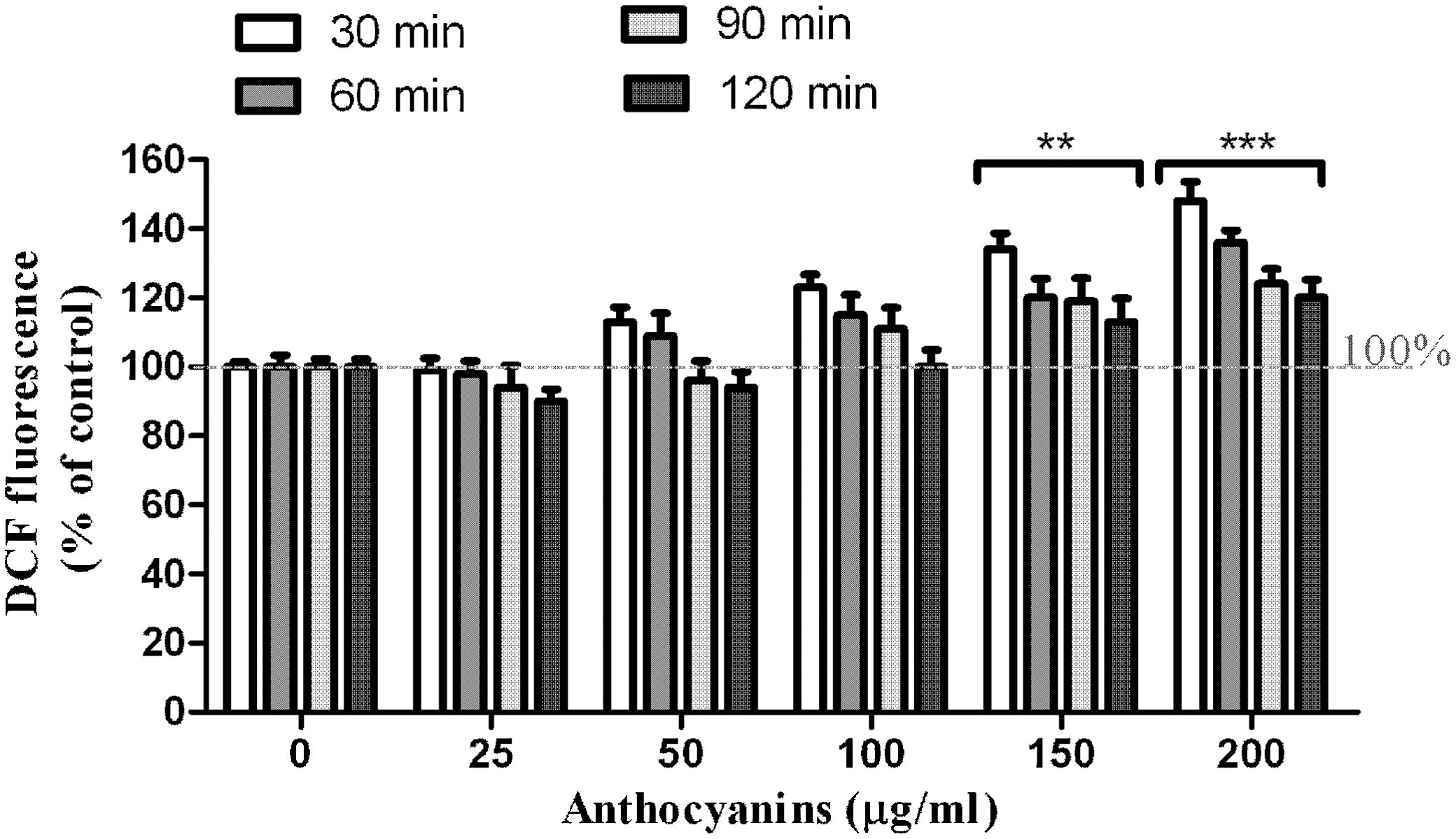
Intracellular reactive oxygen species level in human cervical cancer HeLa cells treated with chokeberry anthocyanins, as determined by the fluorescence test with 2′,7′-dichlorofluorescein (DCF). The cells treated with chokeberry extract showed increased fluorescence compared with untreated cells. Data are mean±SD values (n=3), **P<0.01 (very significant) from corresponding control, ***P<0.001 (extremely significant) from corresponding control.
According to literature data the in vitro antioxidant potential of anthocyanins is related to their highly electron-deficient form of flavylium cation. 44 Crucial for cell–target interaction seems to be the ortho-3′,4′-dihydroxy groups on the B ring. 49 –51 The meta-5,7-dihydroxy arrangements in the A ring and the 3-hydroxyl group (C ring) increase the antioxidant potential of anthocyanins. 6,7 Glycosylation of anthocyanins also modulates their potency, influenced by the orientation, number, and distribution of hydroxyl groups in sugars. 26
Our data seem therefore to support the hypothesis that cyanidin glycosides may be responsible for the ROS accumulation of tumor cells. A possible mechanism for pro-oxidant activity of anthocyanins in tumor cells could be related to their reduced capacity to scavenge ROS, causing its accumulation and finally triggering the mitochondrial apoptotic pathway, 52 through both intrinsic (mitochondrial) and extrinsic pathways. 53,54 This proposed mechanism can interfere with the glutathione antioxidant system. 55 A precise mechanism of death induced by ROS generation after anthocyanin administration in tumor cells still remains unknown and must be further investigated.
Conclusions
The present study provides for the first time information regarding the phytochemical content of A. prunifolia berries, in relation to their antioxidant potentials, being richer in anthocyanins and procyanidins compared with A. melanocarpa cultivars. Two antioxidant methods—the cupric reducing antioxidant capacity and the H2O2 scavenging ability—were tested for the first time on chokeberry extracts. In vitro, cell culture studies showed that the cyanidin glycosides of A. prunifolia inhibited gradually tumor cell proliferation after 48 h of treatment, proving to be cytotoxic for HeLa cells, and the intracellular ROS generation was increased in a dose-dependent manner. The anthocyanins in chokeberries could have a health benefit, acting as antitumor agents, so these fruits can be recommended for daily consumption.
Footnotes
Acknowledgments
Work by D.R. was supported by the European Social Fund Postdoctoral Program grant POSDRU/89/1.5/S/60746. We are also grateful for the financial assistance provided by National Project number PN-II-RU-TE-109-2010.
Author Disclosure Statement
No competing financial interests exist. All the authors report no conflict of interest.