




Abstract
Epidemiological evidence supports inverse associations between fruit and vegetable intake and incidence of cardiovascular disease and neurodegeneration. Dietary botanicals with salient health benefits include berries and leafy vegetables. Molecular pharmacology research has ascribed these benefits primarily to phenolic constituents and antioxidant activity. The current investigation sought to eluicidate pharmacologic activity of two novel preparations of berry and spinach extracts in vitro. Blueberry and cranberry exhibited the greatest antioxidant activity. In a dose-dependent manner, a proprietary mixture of cranberry and blueberry extracts inhibited inhibitor of κB kinase β, a central node in inflammatory signal transduction. A proprietary mixture of blueberry, strawberry, and spinach extracts inhibited prolyl endopeptidase, a regulator of central neuropeptide stability and an emerging therapeutic target in neurology and psychiatry. These results indicate specific molecular targets of blended dietary plants with potential relevance to inflammation and neurological health.
C
Botanical extracts with anti-inflammatory activity often exhibit neuroprotective effects through mechanisms both related to and distinct from NFκB. 13 Prolyl endopeptidase (PEP) is a cytosolic peptidase that degrades central neuropeptides, including oxytocin, bradykinin, and substance P. In clinical studies, PEP inhibitors improve neurocognitive performance. 14 –16 To date, many NFκB studies and nearly all PEP studies have examined phytochemical isolates that directly bind and inhibit IKKβ and PEP. 17 –19 However, fruits and vegetables present arrays of phytochemicals, and functional interactions afforded by chemodiversity may be relevant to their health benefits. 20,21 For example, a whole cranberry extract exhibited greater inhibition of cancer cell proliferation than purified polyphenolic fractions. 20 The current study examines extracts containing naturally low concentrations of phenolics in mixtures more representative of dietary preparations. 18,19,22 This short communication reports NFκB and PEP inhibition in vitro by two mixtures of extracts of widely consumed plant foods.
Aqueous extracts of cranberry (V. macrocarpon) and wild blueberry (V. angustifolium) and ethanol extracts of Orleans strawberry (F. vesca var. Orléans) and spinach (S. oleracea) were obtained from NutraCanada (Champlain, QC, Canada). Various potential combinations of these extracts were assessed, and the final compositions of the two investigated blends are indicated in Table 1. Final extract combinations were cranberry and blueberry (CB) (supplied as PhytoCardio; Pure Encapsulations, Sudbury, MA, USA) and Orléans strawberry, blueberry, and spinach (SBS) (supplied as PhytoMemory; Pure Encapsulations).
Cranberry/blueberry, supplied as PhytoCardio (Pure Encapsulations).
Strawberry/blueberry/spinach, supplied as PhytoMemory (Pure Encapsulations).
NFκB, nuclear factor κB; ORAC, oxygen radical absorbance capacity; PEP, prolyl endopeptidase; TE, Trolox equivalents.
Individual extracts of cranberry, blueberry, strawberry, and spinach were subjected to oxygen radical absorbance capacity (ORAC) assays at Laval University, Sillery, QC, Canada, according to the method of Cao and Prior. 23 Table 1 gives ORAC values of the extracts.
The CB extract combination was subjected to an IKKβ inhibition experiment, conducted with an assay kit from ChromaDex (Irvine, CA, USA). The HTRF® KinEASE™ kit (catalog number 62ST3PEB; Cisbio, Bedford, MA, USA) is a homogeneous time-resolved fluorescence assay based on the proximity of a europium cryptate donor label and an XL665 acceptor label. For each sample, 5 mg was dissolved in 150 μL of methanol and brought to 5 mL with water, from which dilutions were prepared. A total enzymatic reaction mixture of 10 μL contained 2 μL of kinase buffer, 2 μL of test samples or reference inhibitor at various concentrations in vehicle buffer, 2 μL of active IKKβ, 2 μL of substrate, and 2 μL of ATP. Negative and positive controls contained 10 μL of kinase buffer. Mixtures were incubated for 30 min at 37°C. We added 5 μL of XL665 and 5 μL of cryptate to the reaction, and incubation proceeded at 25°C for 1 h. The plate was read using a PHERAstar (BMG Labtech Instruments, Ortenberg, Germany) with an integration delay of 50 μs and an integration time of 400 μs. Results were calculated as follows: % inhibition=([Δf%control – Δf%test]/Δf%control)×100, where Δf is the ratio of absorbance at 665 nm/620 nm. The values for the concentration providing 50% inhibition (IC50) were calculated using log-probit analysis. Each of two samples and standards was tested in triplicate. Statistical significance was determined using the unpaired two-tailed t test.
SBS was subjected to a PEP inhibition assay (ChromaDex) according to the method of Kobayashi et al. 24 PEP was measured as cleavage of the fluorogenic peptide substrate Z-Gly-Pro-AMC at the peptide bond on the carboxyl side of the proline residue. Fluorescence intensity was measured at excitation and emission wavelengths of 360 nm and 460 nm, respectively, at 30°C using a PHERAstar microplate reader. Percentage inhibition (%I) of samples were calculated from the measured relative fluorescence units (RFU) using the following equation: %I=([RFUcontrol – RFUsample]/RFUcontrol)×100. IC50 values were calculated from the mean percentage inhibition values using the Finney software. 25 Each of two samples and standards was tested in triplicate. Statistical significance was determined using the unpaired two-tailed t test.
NFκB is amenable to inhibition by structurally diverse antioxidant phytochemicals through direct IKKβ inhibition and redox-dependent blockade of DNA binding. 12 In the current study, CB exhibited a dose-dependent inhibition of IKKβ with IC50 values of 5.16 and 4.78 μg/mL for each of two samples (Fig. 1). These values indicate much lower affinity than typically reported for pure polyphenolic constituents of berries such as quercetin (IC50=1.35 μg/mL). 17
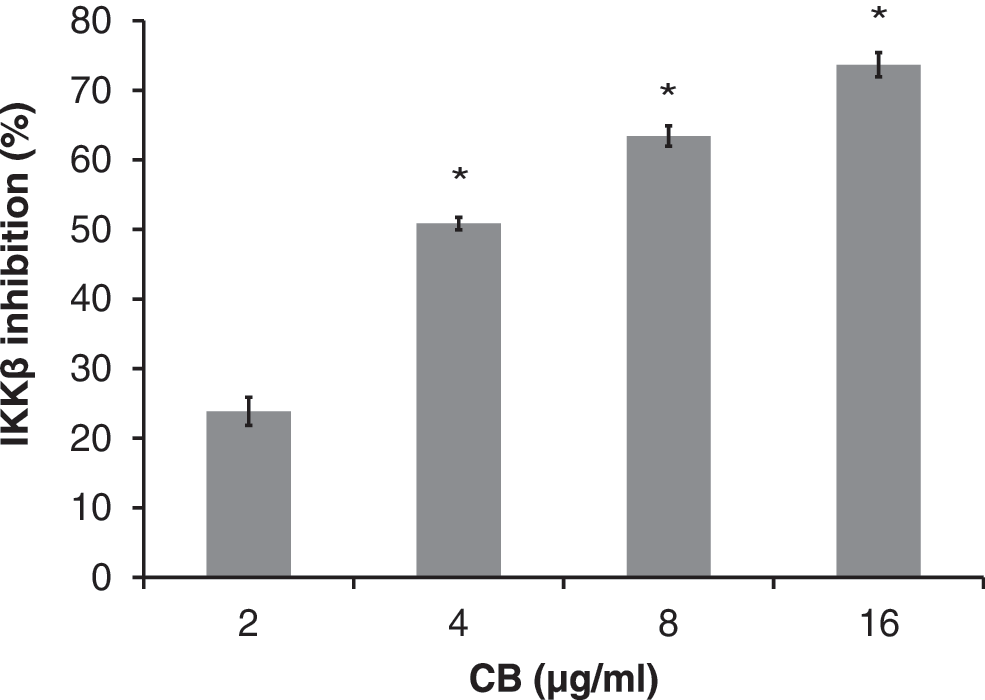
Inhibition of inhibitor of κB kinase β (IKKβ) by CB. Kinase activity was measured using fluorescence resonance energy transfer. Data represent the average of two experiments with triplicate determinations. Error bars represent SEM. *P<.05 compared with all lesser concentrations in both samples.
IKKβ inhibition by quercetin occurs via hydrogen bonding and other interactions with the ATP binding site. 17 Inhibition by piceatannol, a stilbene found in blueberries, is ascribed to modification of the redox state of Cys179 in the activation loop. 26 Because several flavonoid and stilbene compounds exist in Vaccinium berries, it is possible that both types of interactions may be part of the inhibitory mechanism of CB. As CB contains numerous antioxidants, suggested by high ORAC values of blueberry and cranberry (Table 1), it may also modify other redox-sensitive points of NFκB signaling such as DNA binding. Since diverse signals converge on multiple nodes of the NFκB pathway, this partial IKKβ blockade does not necessarily predict attenuation of pro-inflammatory gene expression. Studies in different cell contexts are warranted to faithfully represent the complexities of NFκB signaling.
PEP inhibition has been reported for structurally disparate phytochemicals, suggesting that a chemically diverse extract may present multiple inhibitors at low concentrations. 18,19,22 A dose-dependent inhibition of PEP by SBS was detected with IC50 values of 286.48 and 333.3 μg/mL for the two samples (Fig. 2). These values indicate much lower affinity than that of quercetin (IC50=12 μg/mL). 17 If flavonoids are accountable for inhibition by SBS, a noncompetitive mode is likely. 19 A critical consideration for future work is the capability of the active constituents of SBS to enter the central nervous system at therapeutically relevant concentrations. Contingent on this performance, PEP may constitute one of several mechanisms of previously reported reversal of age-related cognitive decline by supplementation with strawberry, blueberry, and spinach extracts. 27
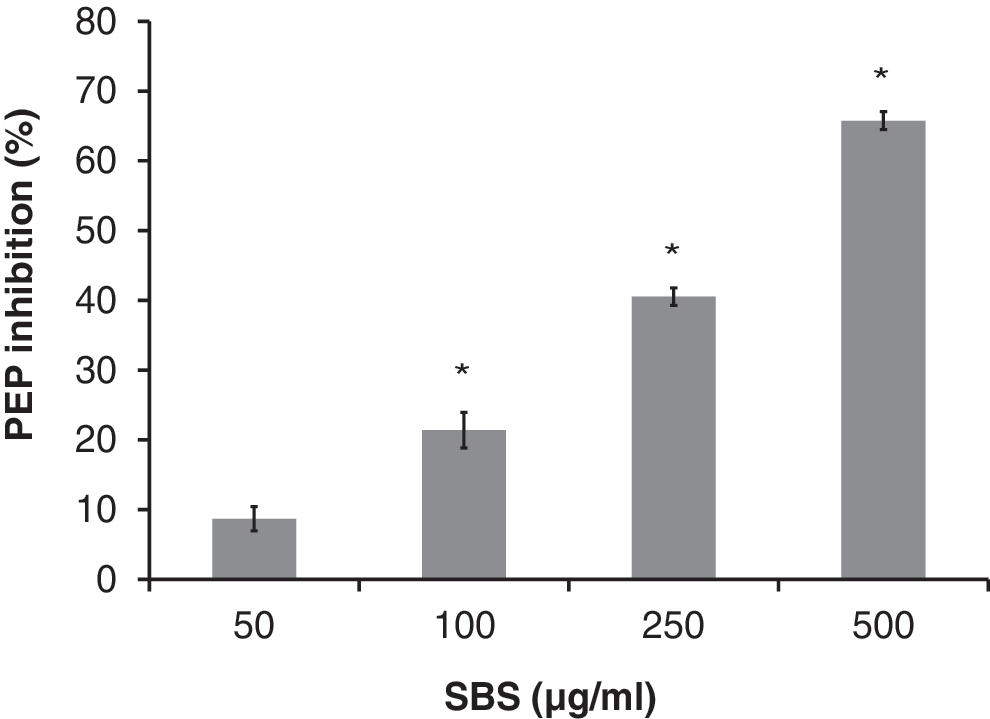
Inhibition of prolyl endopeptidase (PEP) by SBS. PEP was measured as cleavage of a fluorogenic peptide substrate. Data represent the average of two experiments with triplicate determinations. Error bars represent SEM. *P<.05 compared with all lesser concentrations in both samples.
In the last decade, considerable research of dietary plants has focused on singular plant extracts and their phenolic isolates. In pharmacologic models of inflammation and neuroprotection, little attention has been directed toward mixed preparations with low phenolic content. The results of the present study indicate that two recognized molecular targets of isolated phytochemicals are inhibited by mixtures of whole extracts. It is important that this is the first report of PEP inhibition by fruit and vegetable extracts and warrants further interrogation of these foods in neurocognitive models.
Footnotes
Acknowledgments
This work was funded by the Quebec Ministry of Agriculture, Fishery, and Food; NutraCanada; and Atrium Innovations, Inc.
Author Disclosure Statement
S.L. is employed by NutraCanada, which supplied the extracts. K.C.H. is employed by Pure Encapsulations, Inc., the manufacturer of dietary supplements containing CB and SBS. B.W.R. is affiliated with its parent company, Atrium Innovations. P.A. declares no competing financial interests.