




Abstract
Yacon flour has been considered a food with prebiotic potential because of the high levels of fructooligosaccharides, which allows for its use in formulating synbiotic foods. The purpose of this study was to evaluate the effect of yacon flour and probiotic (Bifidobacterium longum) on the modulation of variables related to bone health. Thirty-two Wistar rats were divided into 4 groups: control, yacon flour, diet+B. longum, and yacon flour+B. longum. After euthanasia, the bones were removed for analysis of biomechanical properties (thickness, length, and strength of fracture) and mineral content (Ca, Mg, and P); the cecum was removed for analysis of the microbiota and short-chain fatty acids. Tibia Ca, P, and Mg content was significantly (P<.05) higher in groups fed diet+B. longum, yacon flour+B. longum than in the control group. An increase in fracture strength was observed in the yacon flour (8.1%), diet+B. longum (8.6%), and yacon flour+B. longum (14.6%) in comparison to the control group. Total anaerobe and weight of the cecum were higher (P<.05) in rats consuming the yacon flour diet compared with the other groups. Cecal concentration of propionate was higher in all experimental groups compared with the control (P<.05). Yacon flour in combination with B. longum helped increase the concentration of minerals in bones, an important factor in the prevention of diseases such as osteoporosis.
Introduction
T
Yacon is a tuber belonging to the Asteraceae family. 3,4 It has a high fructan content with a low degree of polymerization (FOS) that ranges from 20% to 67% on a dry basis. FOS are carbohydrates of plant origin indigestible to humans and classified as soluble fibers that act as prebiotics. 5,6 According to the Food and Agriculture Organization (FAO), 7 “prebiotics are nondigestible ingredients that beneficially affect the host by selectively stimulating the growth and/or activity of one or a limited number of bacteria in the colon.”
In addition to studies of prebiotics, researchers have evaluated the effect of probiotics and synbiotics on the bioavailability of minerals and the modulation of intestinal microbiota. 8 –10 Probiotics are “live microorganisms that, when administered in adequate amounts, confer a health benefit to the host.” 11 A synbiotic is an “ingredient and/or food that contains both probiotic and prebiotic components with demonstrated benefits to human health.” 12
In the studies available, the prebiotics evaluated are usually those of commercial origin, extracted from chicory and artichokes of high cost. 8,13,14 However, yacon presents a low production cost and high productivity per hectare. 15 It is known that the predominant dietary fiber fraction in yacon is FOS, and, therefore, it was selected for the present study in order to evaluate the effects of FOS on yacon flour, which is responsible for about two thirds of its prebiotic activity. Until now, this study was the only assessment of yacon flour associated with probiotics. Thus, the objective here was to determine the effect of yacon flour, associated with probiotic (Bifidobacterium longum; American Type Culture Collection [ATCC] 15707), on modulation of the content of minerals in bones by taking into consideration biomechanical properties. The concentrations of triglyceride, total cholesterol and its fractions, short-chain fatty acids (SCFAs), pH cecal, microbiota of cecal content, and parameters of liver toxicity risk in the animals were also assessed.
Materials and Methods
Obtaining the yacon flour
Yacon (115.5 kg) was purchased in the local market (Viçosa, Minas Gerais, Brazil) and after selecting, washing, peeling, and weighing the roots, they were subjected to the flour preparation process according to the methodology of Rodrigues et al. 16 It was dried (48 h at 55°C) in an airflow dryer (Polidryer-DP, Viçosa, Brazil). Chemical composition was determined as indicated by the AOAC 17 method, resulting in the following values per 100 g: 6.9 g of moisture, 2.7 g of proteins, 0.15 g of fat, 5.4 g of ashes, 13.25 g of total fibers, 8.6 g of glucose, 21.1 g of fructose, 16.3 g of sucrose, and 25.7 g of FOS.
Source and concentration of the probiotic culture
The culture of Bifidobacterium longum (ATCC 15707; Rockville, MD, USA) was obtained by transplant of the culture deposited in the Culture Collection of the Federal University of Viçosa (UFVCC, Viçosa, Brazil). After thawing, it was then activated (1%) three consecutive times in MRS-modified broth (De Mann, Ragoso and Sharpe, Difco, Detroit, MI, USA) with 0.075% agar, 0.02% sodium carbonate, 0.01% calcium chloride dihydrate, and 1% solution of 0.05% L-cysteine+HCl. The culture was incubated (18–24 h at 37°C) in anaerobic jars (Gas Pak jar, Franklin Lakes, NJ, USA).
For production of cell concentrate, 2% of the active culture was inoculated in 500 mL of MRS-modified broth under the same incubation conditions as those just described. After cell growth, the material was distributed in sterile polypropylene centrifuge tubes followed by centrifugation at 2750 g for 10 min at 4°C. This was followed by two washes; then, the pellet was resuspended in 100 mL of sterile phosphate buffer, pH 7.2. The final pellet was resuspended in 10 mL of the same buffer (concentrate containing 109 CFU mL−1).
Animals and experimental diets
Thirty-two male Wistar rats (average weight, 109.9±6.27 g) were obtained from the vivarium of the Federal University of Viçosa (UFV). All experimental procedures were approved by the ethics committee of the Veterinary Department of the UFV/MG. Animals were individually housed in stainless-steel wire-bottom cages in an environmentally controlled room (22°C±2°C) with a 12 h light-dark cycle and received demineralized water ad libitum and AIN-93G based experimental diets 18 for 28 days. Diet+B. longum and yacon flour+B. longum groups received 0.1 mL concentrated of B. longum via direct galvage daily containing 109 CFU mL−1, and the other groups received 0.1 mL of demineralized water (Table 1).
Brand/Supplier: aMaximum/ARVE, Viçosa, Minas Gerais, Brazil; bSugar Union/market, Viçosa, Minas Gerais, Brazil; cSOYA/market, Viçosa, Minas Gerais, Brazil; dRhoster, São Paulo, Brazil; eAnchieta/market, Viçosa, Minas Gerais, Brazil; fDepartment of Food Technology, UFV, Minas Gerais, Brazil; gLaboratory of Lactic Cultures of Bioagro, UFV, Minas Gerais, Brazil.
C, control diet AIN93-G; Y, yacon flour contains 4% FOS; B, diet+Bifidobacterium longum ATCC 15707, YB, yacon flour+B. longum; UFV, Federal University of Viçosa.
The contents of protein, dietary fiber, carbohydrates, and lipids provided by the yacon flour were considered as balancing ingredients from the AIN-93G diet, so that all diets were isocaloric. Calcium carbonate was added in order to meet 100% of the recommendations for Ca in growing animals. 18
Experimental design
The animals were divided into 4 groups (n=8) as follows: control AIN-93G diet (C); yacon flour (Y); diet+B. longum (B); and yacon flour+B. longum (YB). Food intake was determined daily, while body weight was determined weekly. The efficiency coefficient of food (CEA) was determined as the weight gain/total food intake. At the end of the study, the animals were euthanized in a CO2 chamber, followed by assessment of liver function variables, bone biomechanical properties, bone mineral content, lipid profile, concentrations of cecum SCFAs, pH, and target groups of intestinal microbiota.
Determination of serum biochemical dosages
After euthanasia, blood was collected from each animal by cardiac puncture. The samples were centrifuged at 2865 g for 15 min (Fanem-204, São Paulo, Brazil) to obtain the serum required for analysis of variables related to liver injury (total protein, albumin, alkaline phosphatase, alanine aminotransferase-ALT, and aspartate aminotransferase-AST) and evaluation of the lipid profile (total cholesterol, high density lipoprotein (HDL)-cholesterol (HDL-c), low density lipoprotein (LDL)-cholesterol (LDL-c), and triglycerides). The ratios of total cholesterol/HDL and LDL-c/HDL-c were also determined, and the analyses were carried out using automated enzymatic and colorimetric “Kits” (Bioclin, Belo Horizonte, Brazil).
Evaluation of biomechanical properties and mineral content
The femur length, distance from the top edge of the head to the bottom edge of the medial condyle, and the thickness, in the midpoint of the length measurement, were determined using a stainless-steel caliper. The bone weight was measured on a digital electronic scale (Marte-AS 2000C, São Paulo, Brazil). For analysis of bone fracture resistance (fracture strength), we used the fracture test by three points on the texturometer TA.HDi Texture Analyzer (Stable Micro System, Godalming, United Kingdom). 19,20
Samples of tibia were prepared according to methodology recommended by AOAC. 17 Minerals (Ca, Mg, and P) were determined by plasma emission spectrophotometry (Perkin-Elmer Optima 3300 DV, Norwalk, CT, USA) with a detection limit of 0.02 μg g−1 for Ca, 0.1 μg g−1 for Mg, and 30 μg g−1 for P.
Evaluation of the microbiota, weight, pH, and concentrations of SCFAs in the cecum
The cecum of 4 animals per group were removed, weighed, and submitted to decimal dilutions using reduced sterile peptone water as the diluent. Samples were submitted for pH determination with a pH meter (Bel Engineering-W3B, Monza, Italy). Bifidobacteria were enumerated in modified MRS agar+5% antibiotic solution and incubated (72 h at 37°C) in anaerobic jars (Gas Pak jar), lactobacilli were enumerated in Rogosa agar (Difco), and total anaerobes were enumerated in Wilkins–Chalgren agar (Difco) and incubated at 37°C for 48 h in anaerobic jars. Mesophile aerobes in PCA (Plate Count Agar; Difco) were incubated at 37°C for 24 h, and enterococci in Enterococcus agar (Difco) were incubated at 37°C for 48 h. The microbiological count was expressed as log10 CFU g−1.
Samples for the analysis of SCFAs (acetic acid, propionic, and butyric) were acidified with 500 μL of meta-phosphoric acid at 25%, maintained at rest for 30 minutes at room temperature, and centrifuged (CT15RE-Hitachi, Tokyo, Japan) at 16.100 g (4°C, 30 min). The supernatant was then transferred to another micro tube. Centrifugation followed for 20 min under the same conditions previously described. This second supernatant was then used to determine the concentration of SCFAs by gas chromatography, 21 in a chromatograph (Shimadzu-17A, Tokyo, Japan). The chromatographic conditions were as follows: column temperature at 100°C for 5 min and at 185°C for 10 min, injector and detector temperatures of 220°C and 250°C, respectively, and column flow of 1.0 mL/min.
Statistical analysis
Data were interpreted by analysis of variance, and treatment means were compared using the Duncan test at 5% probability. All statistical analyses were performed using the Statistical Analysis System (SAS) software 22 version 9.2 licensed for UFV.
Results
Weight gain, food intake, and liver function variables
There was no difference (P>.05) in weight gain (96.9±20.4 g), total food intake (372.9±29.38 g), or feed efficiency (0.2±0.05) between groups after 28 days of the test period. No symptoms of gastrointestinal disorders were observed. Consumption of yacon flour, B. longum, and combination diets did not affect the growth and development of animals. In the B. longum group, the levels of total protein and albumin were higher (P<.05) than in the other treatments. However, the levels of ASL, AST, and alkaline phosphatase did not differ between groups (P>.05) (Table 2).
Average values±standard deviation. n=8.
Significance (P<0.05): Averages followed by the same letter in the row for each variable do not differ by the Duncan test.
Biomechanical properties and bone mineral content
The absolute weight, thickness, length, and strength of fracture of the femur did not differ between experimental groups (P>.05) (Table 3).
Average values±standard deviation. n=8. There was no difference (P>0.05) for the variables by the Duncan test.
N: Newton.
The results of bone mineral content are presented in Table 4. Weight of the tibia did not differ in any of the treatments (P>.05). In the yacon flour group, the contents of Ca, P, and Mg did not differ from those of the control group; however, there was a significant increase in these minerals observed in the animals fed B and YB diets (P<.05). The YB group presented a higher concentration of Ca and Mg than the yacon flour group (P<.05).
Average values±standard deviation. n=8.
Significance (P<.05): Averages followed by the same letter in the row for each variable do not differ by the Duncan test.
Effect on microbiota, weight, pH, and concentration of SCFA in the cecum
Mesophile aerobes and enterococci counts in cecal contents of the animals did not differ among the groups (P>.05). The highest mesophile anaerobic count (P<.05) was attained by the Y group (Fig. 1, left panel), and the lowest lactobacilli count was observed in the YB group (log 4.94 CFU g−1) (Fig. 1, right panel). Although not significant (P>.05), when compared with the control (log 4.58 CFU g−1), the absolute bifidobacteria counts were higher in all the other treatments (log 5.07 CFU g−1 for YB; log 4.95 CFU g−1 for B; and log 4.79 CFU g−1 for Y).
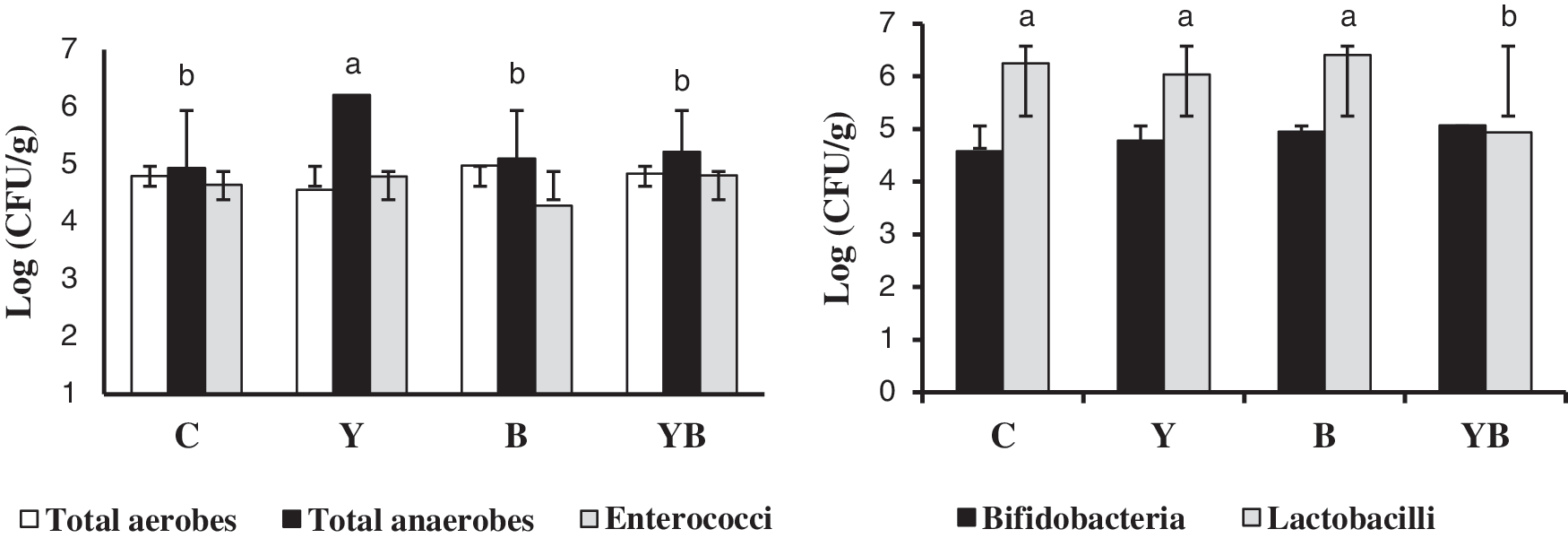
Control AIN-93G diet (C); yacon flour (Y); diet+Bifidobacterium longum (B); yacon flour+B. longum (YB). Average values±standard deviation (vertical bar), n=4. abSignificance (P<.05): treatments with the same letter do not differ by the Duncan test.
When all the groups were compared, the weight of the cecum was greatest (P<.05) in the animals fed the Y diet. Cecum weight from the animals receiving the YB diet was higher (P<.05) than that of the control and B groups. The pH of the cecal contents was not affected by the different test diets (P>.05). The concentration of acetate in the cecum did not differ among groups; however, the levels of propionate were higher in all treatments when compared with the control (P<.05). Similarly, animals of the Y and B groups had a higher concentration of butyrate than those of the control and YB groups (P<.05) (Table 5).
Average values±standard deviation. n=8.
Significance (P<.05): Averages followed by the same letter in the row for each variable do not differ by the Duncan test.
Effect on lipid profile
Table 6 presents the results of the lipid profile. Total cholesterol was lower (P<.05) in rats receiving the Y diet when compared with the other experimental groups; however, in the B group, the concentration of total cholesterol was higher than in the control (P<.05).
Average values±standard deviation. n=8.
Significance (P<.05): Averages followed by the same letter in the row for each variable do not differ by the Duncan test.
The Y group differed from the others in relation to HDL-c, showing the lowest value (P<.05); however, among the B, YB, and control groups, no significant differences were detected. The different diets did not affect the total cholesterol/HDL ratio or triglyceride levels (P>.05). LDL-c levels in the animals that received the Y and YB diets did not differ from the control; however, there was an increase of LDL-c in the B group when compared with the other groups (P<.05). In the Y and B groups, the LDL-c/HDL-c ratio was significantly higher than in the YB, but the B group did not differ from the control (P>.05). The YB group presented the lowest LDL-c/HDL-c ratio that did not differ from the control.
Discussion
Throughout the experimental period, the animals remained healthy and showed no behavioral abnormalities. In the present study, there was no difference in indicators of liver function (AST, ALT, and alkaline phosphatase), indicating that consumption of the experimental diets did not harm the activity of the liver. Although variations were observed in levels of total protein and albumin in animals that received the B. longum diet, the weight gain and CEA of these animals did not differ from the other experimental groups (P>.05), indicating the absence of liver toxicity during the 28 days of experimentation. Similar studies corroborate the absence of toxicity of yacon. Genta et al. 23 evaluated the toxicity of 4-month consumption of yacon flour containing FOS at concentrations about 0.6% and 13.0% and similarly concluded that no significant differences in the concentrations of total proteins, albumin, AST, ALT, and alkaline phosphatase in rats were found when compared with the control group.
With regard to the biomechanical properties, higher percentage fracture strength was observed when compared with the control in the Y (8.1%), B (8.6%), and YB groups (14.6%). From a clinical standpoint, this percentage in increased bone strength plays an important potential role in preventing chronic diseases, such as osteoporosis, as it is characterized by low bone mass and deterioration of bone tissue structure, which then leads to bone fragility, making one more susceptible to fractures. 24 These findings have also been obtained by Lobo et al. 25 The authors, in assessing the prebiotic characteristics of yacon at FOS concentrations of 5% and 7.5% for 27 days, in an animal model, found a higher peak load and stiffness in the experimental animals receiving yacon flour, and concluded that this feature might have contributed to the observed strengthening of the bone structure of the femur.
In the present study, the animals fed B and YB diets had higher concentrations of Ca, Mg, and P in the tibia (P<.05), and, since the Y group did not differ from the control and considered together with the fracture strength data, these results suggest that the probiotic might aggregate value to the yacon flour when these variables are taken into account. In fact, studies have shown that even in the absence of prebiotics, probiotics can positively influence bone growth due to the ability of these bacteria to synthesize enzymes and various vitamins necessary for bone growth and matrix formation, such as the vitamins D, C, K, folate, and B complexes. 26,27 In addition, bifidobacteria are responsible for the production of SCFAs that act to reduce pH, favoring the solubilization of minerals and their absorption by the paracellular pathway. 14,28 In the present study, no observed significant difference between the control group and the probiotic with regard to the retention of minerals might be related to the dose and type of FOS evaluated. Studies published in literature generally use commercial purified FOS, but in this study, 4% FOS was used as present in a food matrix (yacon flour). Using higher doses (7.5%), Lobo et al. 25 found that consumption of FOS increased the concentration of Ca in the femur and tibia of rats. Therefore, to obtain similar results, a higher proportion of consumed yacon flour may be necessary. However, care should be taken, as a high consumption of FOS might lead to flatulence and discomfort to the host. 29 The results obtained here suggest that the addition of B. longum to the yacon flour appears to be more interesting than the yacon flour alone in order to significantly increase the concentration of minerals in the bones. Besides contributing to better bone health, the association of a lower dose of the prebiotic in comparison to the probiotic might also potentially contribute to decreased risk of gastrointestinal disorders due to the presence of beneficial intestinal microorganisms.
In this study, the yacon flour group had a mesophilic anaerobic count higher than the other groups, suggesting a modulation in the composition of the intestinal microbiota. All test diets showed an increase in the concentration of propionate when compared with the control. There was also an increase in butyrate concentration in animals of the B and Y groups. These SCFAs act in maintaining colon health by providing energy to cells and stimulating differentiation and proliferation of the epithelium, which can increase the absorption capacity. 30,31 The cecum weight was higher in animals receiving Y and YB diets, probably due to the increase of biomass as a result of greater fermentation in this site. Such trophic effects, observed in in vivo studies, 14,32 might be a consequence of the increasing production of SCFAs as a result of metabolic activity of intestinal microbiota, which also favors an increase in the absorptive area. Results of a similar study 25 are in agreement with this study, as an increase in cecal contents was observed in rats that consumed 5% and 7.5% of FOS in yacon flour. Recently, Weaver et al. 33 found a positive correlation between cecal weight and Ca content in the femur, suggesting that the osmotic effect, hypertrophy, or permeability increase of enterocytes due to the consumption of prebiotics might have been involved in the increased absorption of minerals. Therefore, the cecum weight seems to be an important variable to be considered in the assessment of bone health when probiotics and prebiotics are being considered.
In the present experiment, when compared with the control, the lipid profile was positively affected by the YB diet, as (i) HDL-C was 6.0% higher, (ii) the ratio of total cholesterol/HDL-C was 5.0% lower, (iii) LDL-C did not significantly differ, and (iv) the LDL-C/HDL-C ratio was significantly lower, by about 7.0%. Therefore, the data obtained here suggest that yacon flour associated with B. longum might contribute to the maintenance of the lipid profile of the host, although conclusive studies can only be considered when performed on specific models. In conclusion, the consumption of B. longum and yacon flour+B. longum had a positive influence on retention of minerals, increasing their concentrations in bones. It is suggested that further studies be performed with yacon flour associated with B. longum using longer test periods in order to verify whether the effects observed in this study actually have a lasting effect through the improvement of mineral metabolism and strengthening of the bone structure.
Footnotes
Acknowledgment
This study was supported by FAPEMIG.
Author Disclosure Statement
No competing financial interests exist.