




Abstract
Periodontal diseases are a group of multifactorial polymicrobial infections characterized by a progressive inflammatory destruction of the periodontium. Flavonoids, including anthocyanins, are receiving increasing attention because of their promising human health benefits. The aim of our study was to investigate the effect of anthocyanins, pure or as part of a standardized black currant extract, on nicotine-induced cytotoxicity and lipopolysaccharide (LPS)-induced inflammatory responses in human cells. Using a colorimetric assay that measures cell viability, it was found that a pretreatment with an anthocyanin-rich black currant extract or cyanidin-3-O-glucoside neutralized the cytotoxic effect of nicotine on epithelial cells and fibroblasts in a dose-dependent manner. The black currant extract and cyanidin-3-O-glucoside also inhibited the LPS-induced secretion of interleukin-6 by human macrophages. The results of the present study suggest that black currant extract and cyanidin-3-O-glucoside may be promising candidates for the development of novel therapies to prevent and/or to treat smoking-related periodontal diseases.
Introduction
P
Many environmental conditions may influence preexisting gingival inflammation, resulting in a modulation of disease severity and susceptibility in individuals. 5 Tobacco use, particularly in the form of cigarette smoking, has been extensively documented in the scientific literature as the most significant environmental risk factor for the development and progression of periodontitis. 6,7 More specifically, smoking is associated with a two- to sevenfold increase in risk for periodontitis, depending on the smoking dose. 6 Data from the Third National Health and Nutrition Examination Survey study, which included 12,329 American adults 18 years and older, concluded that cigarette smoking accounts for more than half of all periodontal diseases among adults in the United States. 8 It is well documented that tobacco smoking impairs various aspects of the innate and immune host responses, including neutrophil function, 9 antibody production, 10 fibroblast activity, 11,12 and inflammatory mediator production. 13,14 Furthermore, tobacco smokers have less favorable responses to nonsurgical and surgical periodontal treatments. 6 There are over 4,000 harmful chemicals in cigarette smoke, of which nicotine is a major component and the most pharmacologically active substance in tobacco. 15
As antioxidants, plant polyphenols are considered beneficial for human health because of their potential protective role in the pathogenesis of multiple diseases associated with oxidative stress that results from an imbalance in the generation of reactive oxygen species and cellular antioxidant defenses. 16 Several thousand different polyphenols have been identified in plant foods and are classified according to their chemical structure, with the largest subclass being flavonoids. Flavonoids have a wide range of biological activities, including antibacterial, anti-inflammatory, and anticarcinogenic properties. 17 –19 An important group of flavonoids is represented by the anthocyanins, which confer the blue, red, violet, and purple colors to fruits and vegetables. 20 Black currant (Ribes nigrum L. Grossulariaceae) fruits are well known to have high levels (250 mg/100 g of fresh fruit) of anthocyanins, including cyanidin-3-O-glucoside, cyanidin-3-O-rutinoside, delphinidin-3-O-glucoside, and delphinidin-3-O-rutinoside. 21 Black currant is a shrubby tree originating from Northern Asia and extensively cultivated in many countries of Europe. Several reports have indicated that black currant extracts offer a variety of beneficial effects, including antimicrobial and anti-inflammatory properties. 22,23
In the present study, considering the strong antioxidant activity of anthocyanins, 24 we hypothesized that these compounds, pure or found in a black currant extract, may have a positive contribution in the reduction of periodontal problems by inhibiting the toxicity of nicotine for epithelial cells and fibroblasts of oral origin as well as the LPS-induced inflammatory response of human macrophages.
Materials and Methods
Chemicals
Nicotine was purchased from Sigma-Aldrich Corp. (St. Louis, MO, USA). The black currant extract (30%) was obtained from Burgundy France (Reyssouze, France). The standardized method developed by Burgundy France to prepare the extract involved extraction of R. nigrum L. berries with ethanol/water and absorption chromatography with ethanol as the elution solvent, in addition to concentration and drying steps. Data provided by the company indicate that the extract contains 36.1% anthocyanins (15.6% delphinidin-3-O-rutinoside, 10.9% cyanidin-3-O-glucoside, 6.8% cyanidin-3-O-rutinoside, and 2.8% delphinidin-3-O-glucoside) as determined by high-performance liquid chromatography. Cyanidin-3-O-glucoside (purity, >96% as determined by high-performance liquid chromatography) was obtained from PlantChem (Sandnes, Norway). Stock solutions of nicotine and black currant extract were prepared in 95% ethanol. A stock solution of cyanidin-3-O-glucoside was prepared in sterile distilled water. All solutions were kept at −20°C in the dark for up to 6 months.
Oral epithelial cell and gingival fibroblast culture conditions
Human oral epithelial cells (GMSM-K) were kindly provided by Dr. Valerie Murrah (University of North Carolina, Chapel Hill, NC, USA), and human primary gingival fibroblasts (HGF-1) were purchased from the American Type Culture Collection (ATCC; Manassas, VA, USA). The immortalized human oral epithelial cell line GMSM-K has an epithelial phenotype based on electron microscopic and immunohistochemical analyses.
25
Both cell lines were cultured in Dulbecco's modified Eagle's medium supplemented with 4 mM
Treatment of oral epithelial cells and gingival fibroblasts and determination of cell viability
Epithelial cells were seeded at a concentration of 4×10⁵ cells/mL and fibroblasts at a concentration of 1×10⁵ cells/mL in 96-well microplates (Sarstedt, Newton, NC, USA). The cells were cultured overnight in Dulbecco's modified Eagle's medium supplemented with 4 mM
LPS preparation
A. actinomycetemcomitans ATCC 29522 (serotype b) was grown at 37°C under anaerobic conditions (80% N2, 10% H2, and 10% CO2) for 24 h in Todd–Hewitt broth (BD Biosciences, Mississauga, ON, Canada) supplemented with 0.001% hemin and 0.0001% vitamin K. LPS was isolated from whole bacterial cells using the procedure described by Darveau and Hancock, 26 which is based on the digestion of whole-cell extracts by proteinase K and successive solubilization and precipitation steps. The LPS preparation was freeze-dried and stored at −20°C until used. The presence of contaminating proteins in the LPS preparation, evaluated using a protein assay kit (Bio-Rad Laboratories, Mississauga) with bovine serum albumin as a control, was less than 0.001%.
Preparation of monocyte-derived macrophages and treatments
U937 cells (ATCC CRL-1593.2), a human monoblastic leukemia cell line, were cultivated at 37°C in a 5% CO2 atmosphere in RPMI-1640 medium (HyClone Laboratories) supplemented with 10% heat-inactivated BS (RPMI-BS) and 100 μg/mL penicillin–streptomycin. Monocytes (2×10⁵ cells/mL) were incubated in RPMI-BS containing 10 ng/mL phorbol myristic acid (Sigma-Aldrich) for 48 h to induce differentiation into adherent macrophage-like cells, as previously reported. 27 Following the phorbol myristic acid treatment, the medium was replaced with fresh medium, and the differentiated cells were incubated for an additional 24 h prior to use. Adherent macrophages were suspended in RPMI-BS and centrifuged at 200 g for 8 min. The cells were washed, suspended at a density of 1×10⁶ cells/mL in RPMI-1640 medium supplemented with 1% heat-inactivated BS, and seeded in six-well plates (2×10⁶ cells per well per 2 mL). The cells were incubated at 37°C in a 5% CO2 atmosphere for 2 h prior to the pretreatments with the black currant extract or cyanidin-3-O-glucoside and were then stimulated with A. actinomycetemcomitans LPS. Various concentrations of the black currant extract (0, 5, and 25 μg/mL) or cyanidin-3-O-glucoside (0, 5, and 25 μg/mL) were added to the monocyte-derived macrophage cultures, which were then incubated at 37°C in a 5% CO2 atmosphere for 2 h prior to adding LPS at a final concentration of 1 μg/mL. After 24 h (37°C in 5% CO2), the culture medium supernatants were collected and stored at −20°C until used. Macrophages incubated with no LPS and black currant extract or cyanidin-3-O-glucoside as well as cells treated with LPS in the absence of black currant extract or cyanidin-3-O-glucoside were used as controls. Assays were performed in triplicate and repeated a minimum of three times.
Determination of cytokine secretion
Commercial enzyme-linked immunosorbent assay kits (R&D Systems, Minneapolis, MN, USA) were used to quantify interleukin (IL)-1β, tumor necrosis factor-α (TNF-α), IL-6, and IL-8 in the samples, according to the manufacturer's protocols. The absorbance at a wavelength of 450 nm was read in a microplate reader with the wavelength correction set at 550 nm. The rated sensitivities of the commercial enzyme-linked immunosorbent assay kits were 31.2 pg/mL for IL-8, 15.6 pg/mL for TNF-α, 9.3 pg/mL for IL-6, and 3.9 pg/mL for IL-1β.
Statistical analysis
Results are expressed as mean±SD values. The differences among the anthocyanin-treated and untreated epithelial cells, fibroblasts, and macrophages were analyzed using Student's t test. A value of P≤.05 was considered statistically significant.
Results
We evaluated the ability of a standardized black currant extract to protect oral epithelial cells and gingival fibroblasts by neutralizing the cytotoxic effect of nicotine. First, we showed that a 24-h treatment of epithelial cells and fibroblasts with 100 μg/mL black currant extract has no obvious toxic effects (data not shown). Nicotine concentrations at levels beginning from 50 μg/mL showed toxicity toward epithelial cells (Fig. 1A). A 2-h pretreatment with the black currant extract (≥25 μg/mL) inhibited dose-dependently the cytoxicity of nicotine (Fig. 1A). At a concentration of 100 μg/mL, nicotine caused a significant (55±2%, P≤.005) loss of epithelial cell viability (Fig. 1A). Pretreating the epithelial cells with 5 μg/mL black currant extract provided no significant (P≤.005) cytoprotective effect. However, pretreating the cells with 25 and 50 μg/mL black currant extract provided a significant (P≤.005) cytoprotective effect, enhancing the viability of the epithelial cells by 29±3% and 43±5%, respectively (Fig. 1A). Nicotine at 25, 50, and 75 μg/mL was found to be toxic for gingival fibroblasts (Fig. 1B). At a concentration of 75 μg/mL, nicotine caused a significant (P≤.005) loss of viability (74±1%) of fibroblasts (Fig. 1B). Pretreating the fibroblasts with 5 μg/mL black currant extract provided no significant (P≤.005) cytoprotective effect; however, pretreating the cells with 25 and 50 μg/mL black currant extract provided a significant (P≤.005) cytoprotective effect, enhancing the viability of the fibroblasts by 31±2% and 48±2%, respectively (Fig. 1B).

Effect of a pretreatment with a standardized black currant extract on the viability of
A major anthocyanin found in black currant, cyanidin-3-O-glucoside, was then tested for its cytoprotective properties. Cyanidin-3-O-glucoside protected both epithelial cells and fibroblasts against toxic concentrations of nicotine (Fig. 2). At a concentration of 100 μg/mL, nicotine caused a significant (P≤.005) loss (57±2%) of epithelial cell viability (Fig. 2A), but pretreating the epithelial cells with 5 μg/mL cyanidin-3-O-glucoside provided a significant (P≤.005) cytoprotective effect, enhancing the viability of the cells by 38±5% (Fig. 2A). At a concentration of 75 μg/mL, nicotine caused a significant (P≤.005) loss (62±2%) of fibroblast viability (Fig. 2B). Pretreating the fibroblasts with 25 μg/mL cyanidin-3-O-glucoside provided a significant (P≤.005) cytoprotective effect, enhancing the viability of the fibroblasts by 41±6% (Fig. 2B).
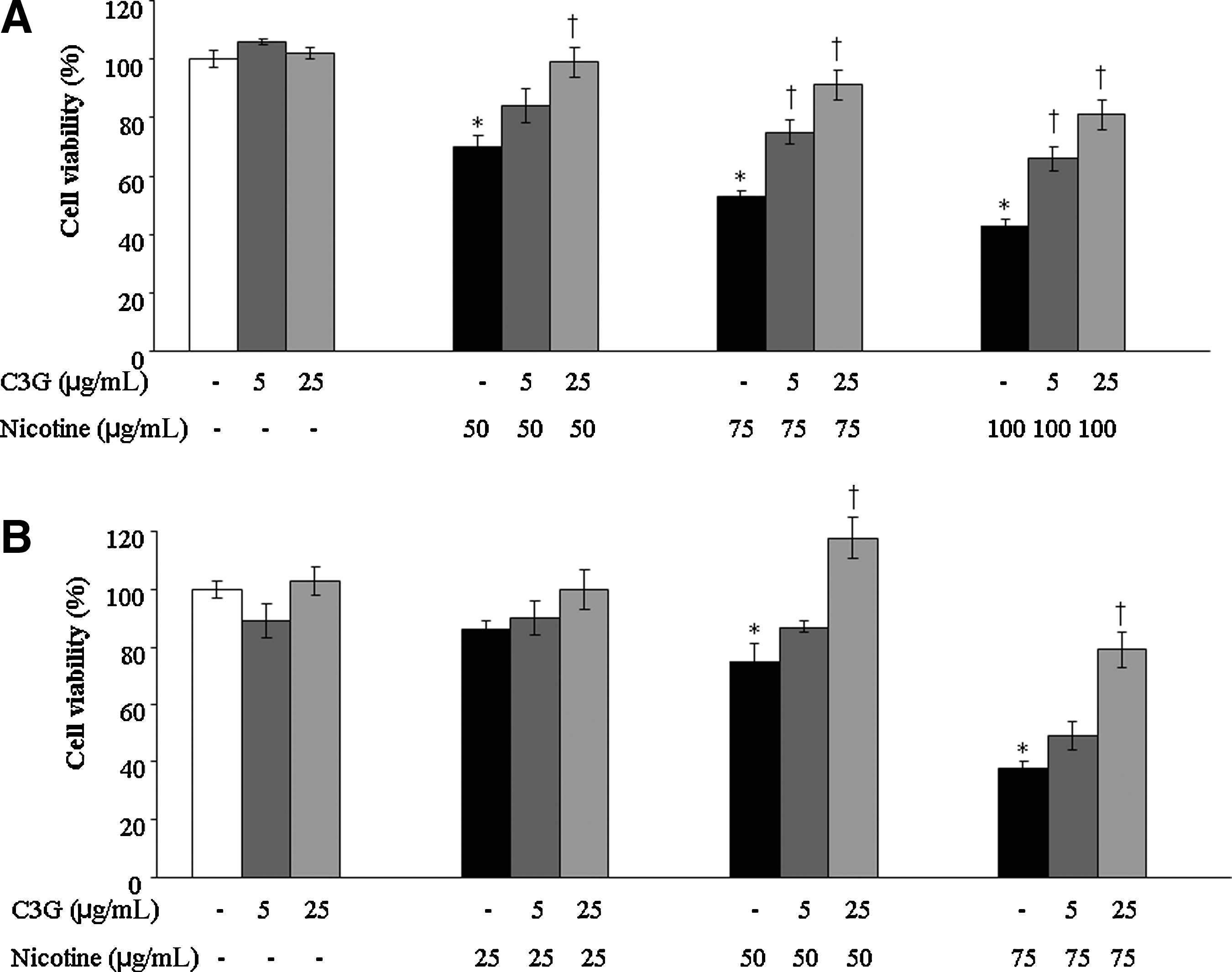
Effect of a pretreatment with cyanidin-3-O-glucoside (C3G) on the viability of
In the second part of the study, the ability of the black currant extract to modulate the LPS-induced inflammatory response in human macrophages was evaluated. The concentrations of IL-1β, IL-6, IL-8, and TNF-α in LPS-stimulated macrophage supernatants were 12-, 67-, 43-, and 170-fold higher, respectively, than in the supernatants of untreated cells (Table 1). To investigate the effect of the black currant extract on the secretion of cytokines by macrophages, cells were treated with the extract 2 h prior to being stimulated with LPS (1 μg/mL). Pretreating the macrophages with 5 and 25 μg/mL black currant extract decreased the secretion of IL-6 by 5% and 37%, respectively (Fig. 3), but had no effect on IL-1β, IL-8, and TNF-α secretion (data not shown). Pretreating the macrophages with 5 and 25 μg/mL cyanidin-3-O-glucoside, an important anthocyanin found in the black currant extract, significantly (P≤.005) neutralized the inflammatory effects of the LPS by reducing the secretion of IL-6 by 22% and 46%, respectively (Fig. 3).
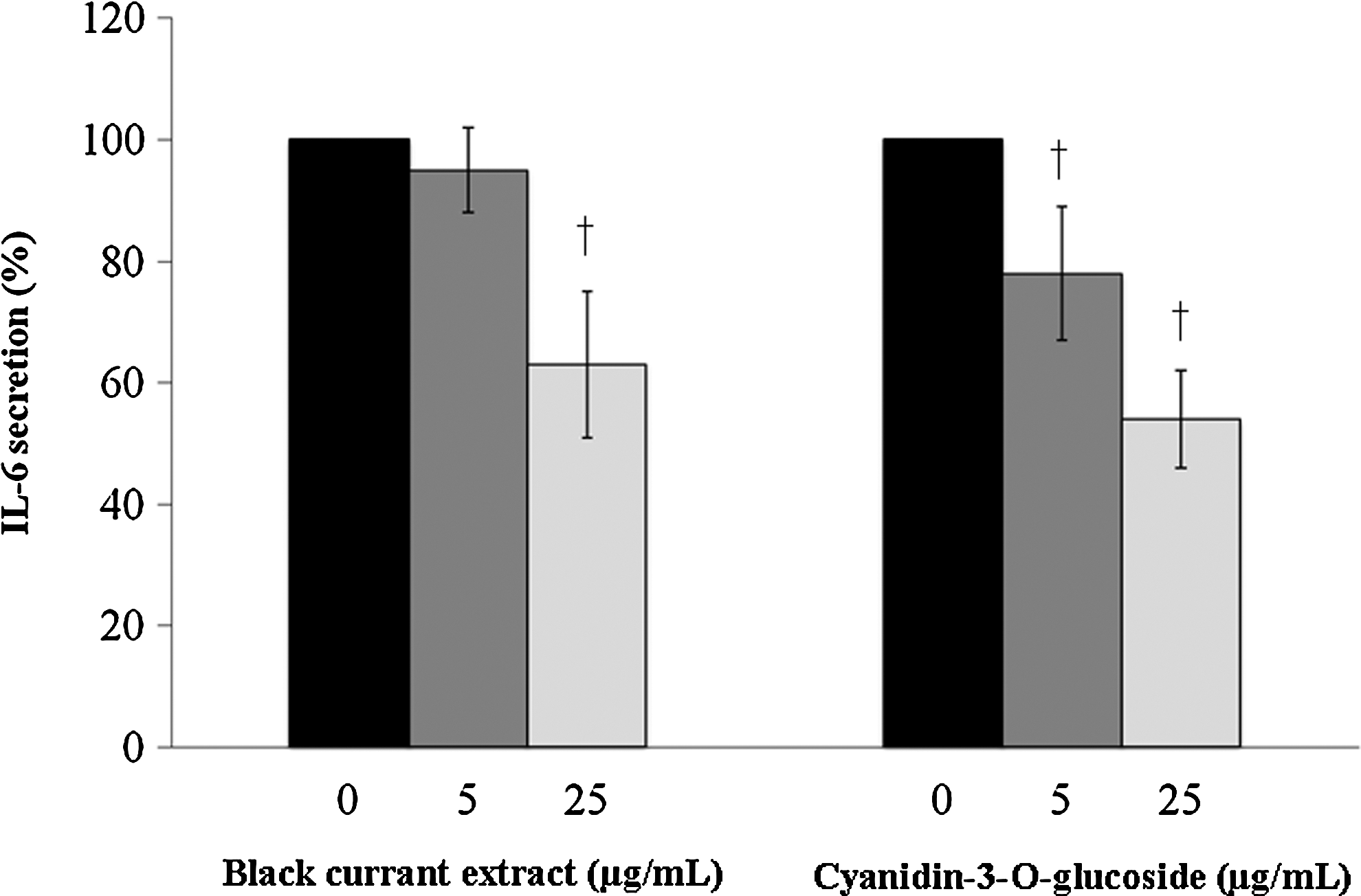
Effect of a standardized black currant extract and C3G on the secretion of IL-6 by macrophages stimulated with A. actinomycetemcomitans LPS (1 μg/mL). Data are mean±SD values of results from triplicate assays with a minimum of three independent experiments. Results were analyzed using Student's t test: † P≤.05 versus control without black currant extract or C3G. C3G, cyanidin-3-O-glucoside.
Data are mean±SD values of triplicate assays with a minimum of three independent experiments.
Results were analyzed using Student's t test: P≤.05 versus control cells.
IL, interleukin; LPS, lipopolysaccharide; TNF-α, tumor necrosis factor-α.
Discussion
Cigarette smoking is generally regarded as the most significant environmental risk factor for the development and severity of inflammatory periodontal diseases. 5 –7 Tobacco smoke contains a complex mixture of toxic substances, including nicotine, the most important acute-acting pharmacologic agent responsible for tobacco smoking addiction and the toxic effects on numerous organs. 15 Nicotine is likely mostly responsible for the impact of cigarette smoke on periodontal status because of its direct contact with the oral epithelial cells and fibroblasts of smokers. Nicotine inhibits gingival and periodontal ligament fibroblast attachment and growth. 11,12,28 According to Chang et al., 28 nicotine toxicity toward periodontal ligament fibroblasts is related to thiol depletion, mainly glutathione. Glutathione plays important roles in the regulation and regeneration of immune cells and systemic detoxification. Glutathione deficiency contributes to oxidative stresses related to aging and to the pathogenesis of many diseases. 29
The antioxidant activity of plant polyphenols has been shown to be beneficial for human health. 30 Indeed, phenolic antioxidants have the ability to neutralize free radicals, thereby protecting against several degenerative and chronic diseases. 30 Anthocyanins, which are members of the flavonoid family, are strong antioxidants. 20 The chemical structure of all anthocyanins is based on a tricyclic aromatic system of 15 carbon atoms with hydroxyl, methoxyl, and/or glycosides attached. 20 The natural electron deficiency of anthocyanins makes them very reactive toward reactive oxygen species because they can accept unpaired electrons from radical molecules. 31 Black currant bushes produce small dark-purple berries possessing a high concentration of anthocyanins. 21,24 Previous studies have reported on the strong antioxidant property of black currants. 32,33
We first showed that a pretreatment with the black currant extract or pure cyanidin-3-O-glucoside, an important black currant anthocyanin, 21 neutralized, in a dose-dependent manner, the cytotoxic effects of nicotine on oral epithelial cells and gingival fibroblasts. It has been reported that nicotine induces the production of free radicals, which contribute to the oxidative stress caused by tobacco use and impair antioxidant defense mechanisms. 34 The mechanism responsible for the protective effect of anthocyanins against nicotine cytotoxicity may be related to a reduction in the production and accumulation of free radicals in the periodontal tissues of smokers. Using a rat model, Balakrishnan and Menon 34 demonstrated that the increase in free radical levels induced by nicotine can be neutralized by hesperidin, a flavanone in citrus fruits. In addition, Russo et al. 35 showed that cyanidin-3-O-glucoside protects against damage caused by ochratoxin A, a mycotoxin with carcinogenic, teratogenic, and nephrotoxic properties. Cyanidin-3-O-glucoside has also been shown to protect human keratinocytes against ultraviolet B radiation damage. 36
We also found that a pretreatment with the black currant extract or pure cyanidin-3-O-glucoside decreased the A. actinomycetemcomitans LPS-induced secretion of IL-6 by macrophages. IL-6 plays a major role in regulating the immune response to periodontal pathogens and is notably involved in osteoclast differentiation. 4 IL-6 levels are higher in the diseased gingiva of patients with periodontitis than in the gingiva of healthy patients. 37 Local inhibition of IL-6 secretion may have a positive effect on the inflammatory and bone-destructive processes associated with periodontitis. The anti-inflammatory property of black currant fractions has been previously reported. 23,38 More specifically, proanthocyanidins isolated from black currant leaves revealed significant anti-inflammatory activity in a model of carrageenan-induced rat paw edema. 23 In addition, LPS-stimulated monocytes from individuals consuming dietary supplements of black currant seed oil secreted significantly less IL-1β, TNF-α, IL-6, and prostaglandin E2. 38
In conclusion, our in vitro study provided evidence that an anthocyanin-rich black currant extract and pure cyanidin-3-O-glucoside have the ability to neutralize the cytotoxic and inflammatory effects of nicotine on two mucosal cell types. This suggests that black currant extract and cyanidin-3-O-glucoside may be promising candidates for the development of novel therapies to prevent and/or to treat smoking-related periodontal diseases.
Footnotes
Acknowledgments
We thank Dr. Valerie Murrah for providing the oral epithelial cell line GMSM-K. This study was supported by a research grant from Tom's of Maine (Kennebunk, ME, USA).
Author Disclosure Statement
C.B. and S.G. are employees of Tom's of Maine. J.D., S.T., and D.G. report no conflicts of interest related to this study.