




Abstract
In Hungary, fairly little is known about Agaricus subrufescens Peck (formerly called Agaricus blazei Murrill), which is cultivated on an industrial scale in the Far East. Nevertheless, this mushroom species exerts a curative influence and might become a new pillar of cancer research and antitumorous therapy. The present study gives a detailed discussion on the compositional differences of the scent components of A. subrufescens and its close relative Agaricus bisporus based on gas chromatography–mass spectrometry measurements, subsequent to Likens–Nickerson simultaneous distillation–extraction.
Introduction
M
In recent years, a number of biological, 4 biochemical, 3,5,6 medical, 2,7 and horticultural 8,9 research studies have focused on a valuable and cultivated Agaricus species, A. subrufescens Peck. Currently, A. subrufescens has several taxonomic identities and also has been known as Agaricus brasiliensis 10 and Agaricus blazei. 5 This mushroom is one of the most comprehensively examined species of the Agaricus genus and is at present the most popular medicinal mushroom in Brazil. 11 William A. Murrill was the first who described it in 1945. He discovered it on the garden lawn of his friend R.W. Blaze in Gainesville, Florida. However, the original provenance of this mushroom is a small mountain town in Brazil called Piedade, located 120 miles southeast of São Paulo. It grows in some other parts of the world as well—for example, in Japan, Korea, Denmark, and in the southeastern United States—although not as prolifically as in South America. 4 A. subrufescens possesses curative traits. Several investigations have proved its cancer-preventing influence, 12 antigenotoxic activity, 13 antioxidant properties, 14 antiviral activity, 7 and other beneficial effects. 6,15 The extract of the mushroom may be useful as an additional prophylactic and probable therapeutic agent against Streptococcus pneumoniae bacteria in mice. It is likely to be useful in humans as well. 16 The variation of the antimutagenic action of the simple water extracts of this mushroom was identified by Guterreza et al. 17 in 2004 too. Many scientists believe that the active ingredients—beta-glucans—in A. subrufescens are more potent than those of the other mushrooms.
The taxonomy of genus Agaricus at section levels has been changing continuously in the past years. The species Agaricus bisporus (J.E. Lange) Imbach was placed first into the group Edulis, 18 and later in the subsection Hortenses. 19 According to the examinations of Cappelli, 20 the mentioned species belongs to the section Bitorques, but five years later, it was placed into the section Duploannulatae 21 by morphological descriptors. This latter was confirmed by internal transcribed spacer segments of the nuclear ribosomal DNA region in samples from Europe and North America, and it was found that A. bisporus belongs to the section Duploannulatae. 22 To our present knowledge, A. subrufescens is in the Arvense section. 23
The aim of this study is to compare the fragrance features of A. bisporus to the scent of A. subrufescens. Although the healing effect is unlikely to be attributed to the volatile organic compounds produced by the msuhrooms, learning why the smells of these mushrooms differ so significantly seems important. In fact, A. bisporus has got a pleasant mushroom-like odor; A. subrufescens possesses a relatively strong fragrance reminiscent of almond with a sweetish nuance. While the main scent compounds of A. bisporus were reported earlier by several authors, 24 –27 no information is available about the components forming the smell of A. subrufescens.
Materials and Methods
Mushroom samples
For analysis, the A. subrufescens strain 11053 was cultivated and compared to the A. bisporus A15 (Sylvan Inc.) variety. The strains were reserved at the Department of Vegetable and Mushroom Growing, Corvinus University of Budapest. The mushrooms were grown and harvested in the university's mushroom unit. Pasteurized mushroom compost was used as a substrate; it was made of wheat straw, chicken manure, gypsum, and water in an industrial mushroom composting farm. The most important parameters of the compost are reported in Table 1. The growing process followed the usual mushroom cultivation technology. 8 For the analysis, all the fungi were picked with closed veil and immature spores in the same physiological state.
Sample preparation
Immediately after harvest, 200 g of the mushroom samples were cut into small slices and put into a 4000-cm3 round-bottomed flask with 180 g of sodium chloride, 900 cm3 of distilled water, and 150 μL of the 0.8 mg/cm3 concentration undecanol-1 internal standard solution. The simultaneous distillation–extraction process (SDE) was performed in a modified Likens–Nickerson (LN) apparatus. Normal pentane of special purity was applied as an organic solvent to extract the volatile fragrance compounds from the samples. Three consecutive distillations were carried out, and the distillation time was one hour (after the boiling started) in every case. Subsequent to the LN-SDE, the extract was frozen to remove the water traces (in the form of ice) and was concentrated to 1 cm3, 3×1 μL of what was injected into the gas chromatography–mass spectrometry (GC-MS) instrument (GC run in triplicate).
Gas chromatography–mass spectrometry
The separation and identification of the mushroom volatiles were accomplished with a Hewlett Packard 5890/II gas chromatograph (Hewlett-Packard) coupled with a 5971A mass selective detector. The instrument was equipped with a 60 m×0.25 mm×0.25 μm AT-WAX fused silica capillary column. The carrier gas was helium of 4.6 grade with the linear speed of 30 cm/s. Temperature program: initial 60°C, and then an increase at a rate of 4°C/min to a final temperature of 280°C, held for 10 min; the injector temperature was 270°C (in a splitless mode with a 100:1 split ratio) and the detector temperature was 280°C in an electron impact mode (70 eV). The detection was performed in the 35–350 mass range at a 390 mass/s scan speed. Data were processed with the aid of the NBS49K, Wiley138, Wiley275, and NIST05 spectrum libraries. The identification was based on the match quality, programmed temperature retention index 28 (PTRI) measurement, and retention-time/reference spectra data of standards if they were available.
Results and Discussion
Two of the gas chromatographic runs of A. bisporus and A. subrufescens samples subsequent to the LN-SDE preparation described above are depicted in Figure 1. Both total ion chromatograms (TICs) recorded under identical measuring conditions exhibit the great separation power of the capillary column of 60 m length, a narrow inside diameter, and a thin film thickness (0.25 mm×0.25 μm).
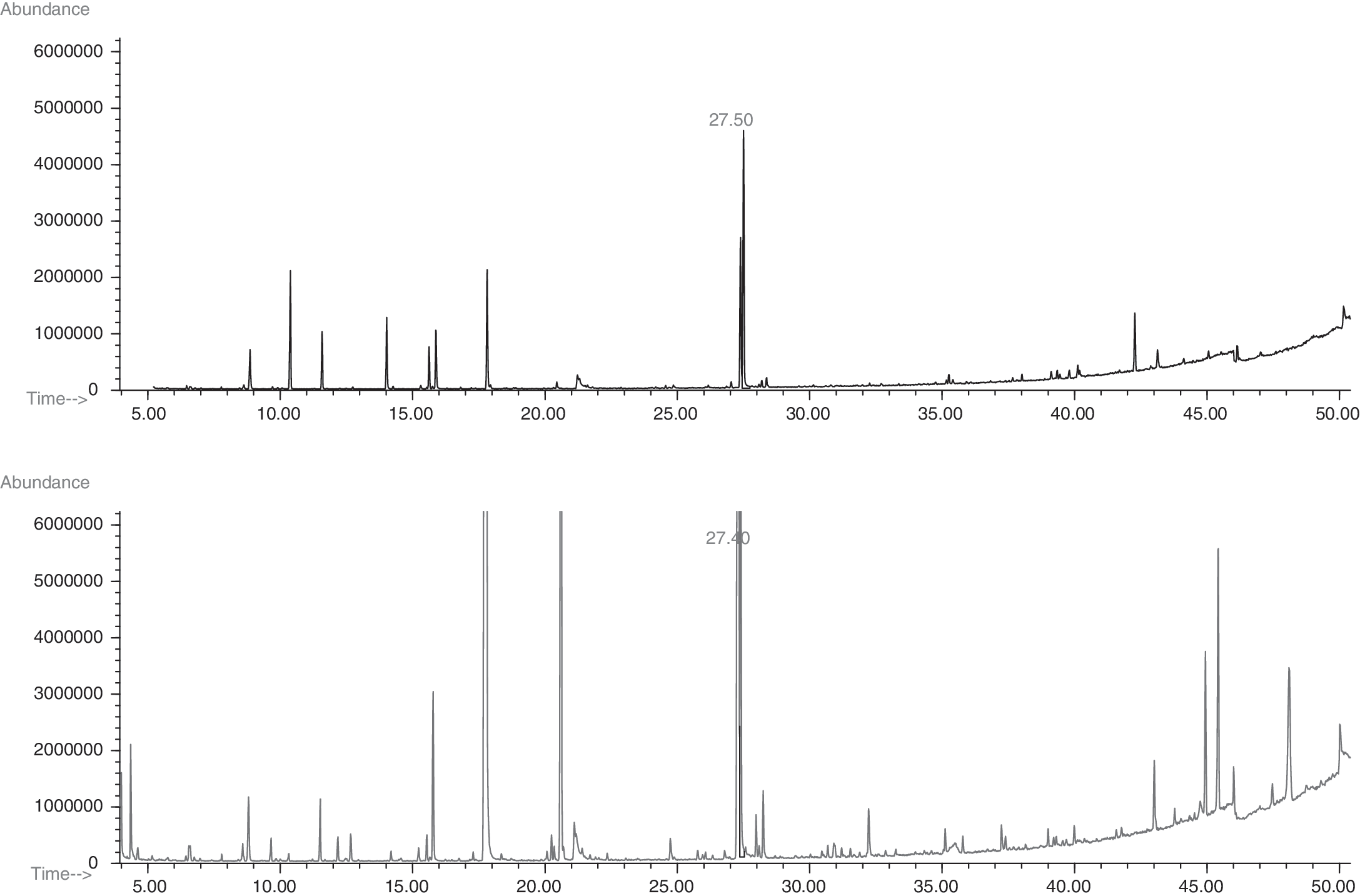
Comparison of the Agaricus bisporus (top) and Agaricus subrufescens (bottom) total ion chromatogram (TIC) records.
The TICs of Figure 1 show A. subrufescens more aromatic than A. bisporus. The former contains 78 detectable compounds, while the latter consists of 65 components. The undecanol-1 internal standard added to the sample in the first step of the analysis eluates at ∼27.5 min. The identified compounds of the two species are listed in Table 2. They are categorized into chemical classes of decreasing smell activity and in the order of elution inside the categories. The table describes only those substances that appeared in all runs with an acceptable intensity and could be identified reliably (with better than 70% match quality).
Chemicals in boldface occur in A. subrufescens only, while those in italic typeface are present only in A. bisporus. The Area%avg values are the means of nine measurements (3 replicates×3 injections per sample). The relative errors of the means are summarized as follows: for small components (<0.1 Area%avg), ±∼10%; for medium compounds (0.1–1.0 Area%avg), ± 5–8%; for main constituents (>1.0 Area%avg), ±<5%.
Asterisks indicate typically open-chain C8 molecules mainly characteristic of mushroom aroma.
PTRI, programmed temperature retention index.
The evaluation and interpretation of the measurements have been carried out by a method called aromaspectra, elaborated by Korány and Amtmann in 2005. 28 The aromaspectra of the two mushroom species are depicted in Figure 2.

The aromaspectra of A. bisporus (top) and A. subrufescens (bottom). The compounds are numbered as follows: 1, 3-methyl-1-butanol; 2, 3-octanone; 3, 1-octen-3-one; 4, 3-octanol; 5, 1-octen-3-ol; 6, 2-furancarboxaldehyde; 7, benzaldehyde (only 16% shown, although 43% was detected in the A. subrufescens sample); 8, benzyl alcohol (only 16% shown, although 24.44% was measured in the A. subrufescens mushroom); 9, drimenol; 10, hexadecanoic acid; 11, methyl-benzoate. PTRI, programmed temperature retention index.
From the data presented in Table 2, two very important lessons can be learned. First, the pleasant, customary, and expected fungus odor of A. bisporus is proven and verified by the wealth of C8 compounds, which are primarily responsible for the mushroom's characteristic aroma. Second, a decisive dominance of bitter almond scent-bearing constituents in the case of A. subrufescens are characteristics of the chemical class of benzene-ringed molecules.
C8 substances
Of the C8 substances, 1-octen-3-ol 25 and 1-octen-3-one are considered typical of the Agaricus note. 27 The enzymatic decay of linoleic acid leads to the formation of 1-octen-3-ol, a part of what oxidizes to ketone in the fresh fungi. The new compound 1-octen-3-one exhibits a mushroom odor in great dilution, but its concentrated form has a metallic smell and is much more intense than the alcohol. This phenomenon is caused by the enormous difference between the sensory thresholds of the two substances: 0.005 ppb for 1-octen-3-one versus 1 ppb for 1-octen-3-ol. 25 The shares of these two substances in A. bisporus and A. subrufescens are 3.39% and 0.24% for 1-octen-3-ol, and 4.94% and 0.58% for 1-octen-3-one, respectively. Within the Open chain alcohols, aldehydes, and ketones class of C8 substances, 3-octanone in A. bisporus has the highest ratio (10.20%), exhibiting an intense, penetrating smell reminiscent of lavender with a slight fruity note. Its detection threshold compared to that of the former two compounds is relatively high, ranging between 21 and 50 ppb, but the only taste characteristics that can be sensed at ∼10 ppm are mushroom-like, ketonic, cheesy, and moldy with a fruity nuance. 24
A. bisporus contains a significant amount (6.12%) of 3-octanol, the saturated variety of 1-octen-3-ol, but this constituent can be sensed in a relatively high concentration (18–250 ppb) only in comparison with the unsaturated form, with an earthy, mushroom, sweety, oily, and grassy note. 24 With regard to the role of C8 alcohols, it has been stated that octanol-1 and octanol-2 have no fungal note at all, which shows that the typical mushroom odor is in close connection with the presence of a double bond and the position of the –OH group on just the third carbon atom. 29
Benzene-ringed substances
The most significant disparity in the scent composition of the two species appears in the amount of benzene-ringed substances. They constitute 33% of the A. bisporus volatiles, while in the case of A. subrufescens, they form 85% of the odorous materials. In both the species, benzaldehyde and benzyl alcohol were the compounds of the highest abundance.
Benzaldehyde
Benzaldehyde is the most important and simplest aromatic aldehyde among the benzene-ringed smell substances; its identification in the first half of the 19th century was one of the milestones of aroma chemistry. 25 The role of benzaldehyde in treating cancerous complaints is extensively investigated and discussed in several works, such as that of Moss. 30 Evidently, this component is the main carrier of the typical bitter almond scent of A. subrufescens, since by itself benzaldehyde constitutes almost half (43%) of the whole aroma (volatile) content. In A. bisporus, its concentration is much lower (11.3%, about one-fourth of the former one); while it is still significant, it unexpectedly causes no almond note at all.
Benzyl alcohol
Both species contain benzyl alcohol of pleasant scent in a relatively high amount, which exerts a somniferous influence on humans. Benzyl alcohol is widespread in the plant kingdom; its nice fruity aroma contributes to the aroma of jasmine, tobacco, tea, neroli, and several berries, for instance. Mixtures of different proportions of benzyl alcohol and benzaldehyde are perceived to have the odor of almond by some people, or to possess that of anise by others. 29,31 Therefore, sensing either of these fragrance types might match reality in describing A. subrufescens.
Methyl benzoate
Besides benzaldehyde and benzyl alcohol, a large amount of methyl benzoate occurs in A. subrufescens. Similarly to benzyl alcohol, it carries a fruity note and is the constituent of several flowers, fruits, and spices. Its taste characteristics at 30 ppm are interesting: phenolic and cherry pit with a camphoraceous nuance. 24
Phenylethyl alcohol
The phenylethyl alcohol detectable in both species (A. bisporus: 2.32%, A. subrufescens: 0.49%) is a fragrant substance; it is one of the most abundant constituents of rose oil. It has a characteristic rose-like odor and an initially slightly bitter taste, and then sweet and reminiscent of a peach. Its odor detection is between 0.015 ppb and 3.5 ppm, and the recognition threshold is 1.2 ppm. The aroma characteristics of phenylethyl alcohol at 1.0% are floral honey, yeasty/bready, musty fresh, and sweet, and its taste characteristics at 20 ppm are mushroom-like, rose floral, sweet, rosy, and bready with honey nuances. 24
Figure 3 introduces some of the most typical benzene ring-containing molecules of A. subrufescens. Many articles are published on the antitumorous influence of A. subrufescens extracts 12,13,15 and about their antioxidant effects, 6,14,32 but the constituents responsible for these features are not definitely identified. The surprising wealth of the aromatic (benzene-related) compounds clearly demonstrates that in A. subrufescens, the biosynthesis of the delocalized π-electron system bearing rings is much more intense than in the majority of other mushrooms, 33,34 including A. bisporus. 35,36 This statement can be easily supported by studying the aromatic particulars of the aroma spectra of the two species in Figure 4, created from the corresponding PTRI and Area% results of Table 2.
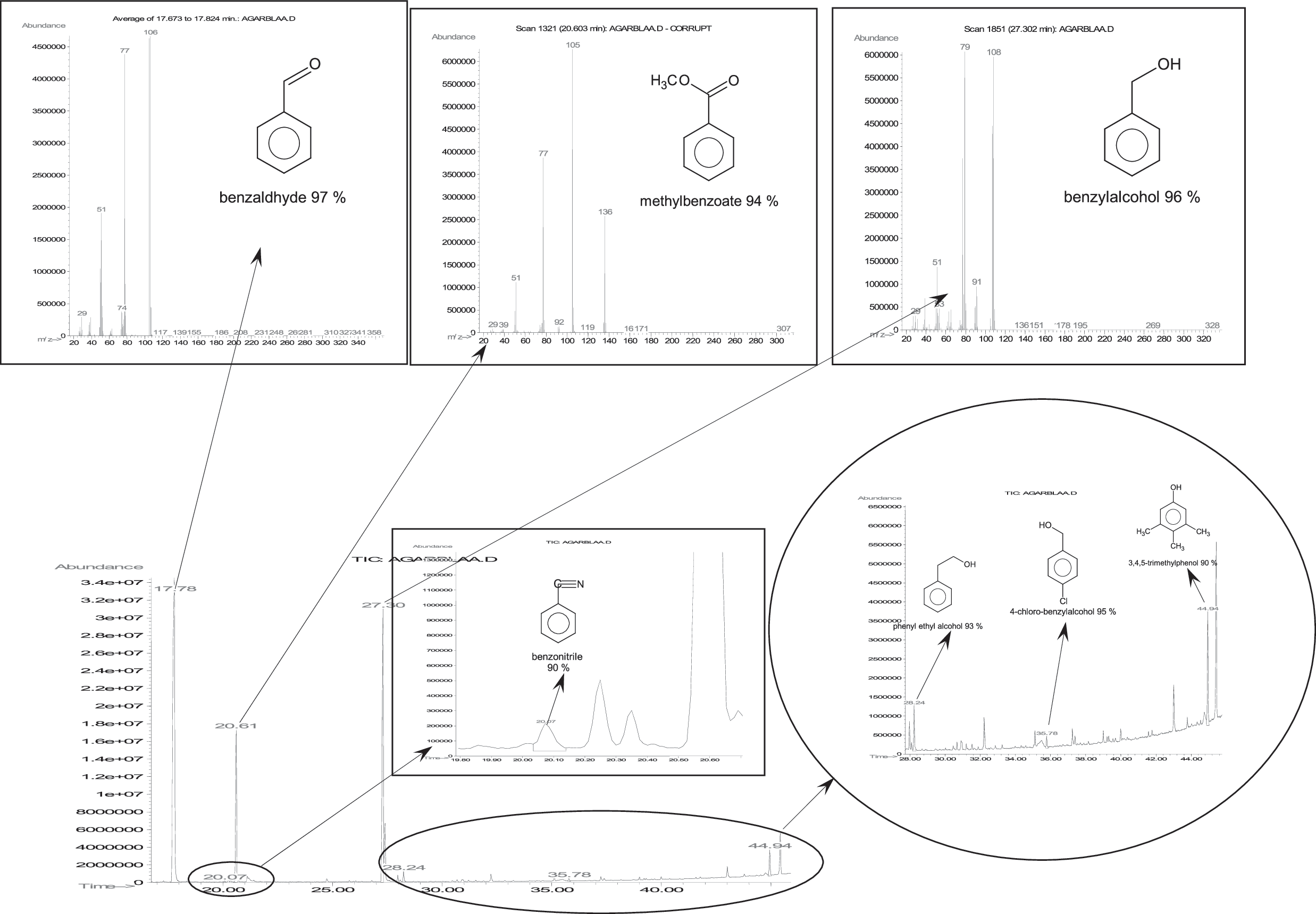
Some of the most typical benzene-ring–containing molecules of A. subrufescens.

The aroma-grams of the benzene-ring–containing compounds of A. bisporus (top) and A. subrufescens (bottom). Composition details are detailed in Table 2 under the chemical class Substances of benzene ring.
The anticancerous effect of A. subrufescens discussed widely by literature might be in close connection to the phenomenon of high benzene compound presence. Obviously, we know that natural antimalignant agents must belong to a molecular size range that exceeds gas chromatographic measurability. However, some of the identified constituents in this work can act as radical-quenchers, repairing the antioxidant status of the human organism, while others may be the starting products or by products of the condensation reactions which result in flavonoids and other polyphenolic molecules. We presume and consider that the wealth of various benzene-type substances observed in our measurements is only the tip of the iceberg—that is, of an intense (poly)phenolic(-glycoside) synthesis—that proceeds deep in the metabolism of A. subrufescens, leading to agents of high physiologic value for humans.
Sulfur-containing substances
Generally, sulfur-containing substances can already be perceived in very small concentrations due to their extremely low odor threshold. The most important S-bearing constituent of A. bisporus is the 4-methylthio-2-butanone of sweet, fruity, and slightly sulfuric nuance. The 3-(methylthio)-propanal (also known as methional) is detectable in both species; in its neat form, it is hot and reminiscent of an onion. 24 This chemical can be found in faultily brewed beer, 37 as well as in wine and honey, 38 and has also been detected in cantaloupe. 39
Terpenes
Terpenes are almost-ubiquitous aroma compounds of the plant kingdom. They consist of isoprene (C5H8) units and can form both open-chain and cyclic molecules. Usually, they are very volatile; therefore, many fragrance compounds recruit from them, and many essential oils belong to this group. The nonvolatile carotenoids and sterols are terpene derivatives as well. The most intense component in A. bisporus (and in the whole class) is drimenol, which occurs only in the champignon mushroom. Consequently, this sesquiterpene can serve as the distinguishing brand between the two species.
Lactones
The observed presence of lactones, such as γ-nonalactone, γ-dodecalactone, and γ-dodecen-6-lactone [shown in Table 2 as (Z)-dihydro-5-(2-octenyl)-2(3H)-furanone], supports the sensory experience perceived intensely in the case of A. subrufescens. That is, they contribute to the mildly sweet (beside bitter almond like) tone of A. subrufescens to a high extent. The first two lactones—appearing only in A. subrufescens—both have very low sensory thresholds of about 7 ppb, with a creamy peach-like, coconut nuance; while the smell activity of γ-dodecen-6-lactone—present in A. bisporus in a higher amount (1.39%)—is much lower (threshold ∼0.5 ppm), with a dairy, creamy, and fatty note. 24
Conclusions
Our efforts aiming to confirm the characteristic disparity between the odor features of A. subrufescens and A. bisporus species by GC-MS measurements revealed that crucial differences exist in some chemical categories of the identified constituents present in the two mushrooms.
At first, the common champignon (A. bisporus) is much richer in those C8 components that are responsible for the typical smell of fungi. That is why A. bisporus, with the greatest rate of consumption in the world, exhibits the expected, customary, and pleasant scent of mushrooms.
Second, the class of benzene-ringed compounds in A. subrufescens represents 84.6%, while in A. bisporus, it is only 33.3% of the total volatiles (expressed in the total area), explaining the almond-odor characteristic of this fungus. At the same time, the role of the highly scent-active lactones in forming the sweet, fruity (peach note), and creamy nuance has to be taken into consideration. The extremely high abundance of benzene-relative constituents (e.g., benzaldehyde) is unlikely to be the sole carrier of the anticancerous activity of A. subrufescens. Although some of the identified structures are effective radical-quenchers, their presence would more likely be the sign of a high-intensity synthesis of substances bearing an antitumorous trait.
The different taxonomical positions of the mushroom species (A. bisporus: Duploannulatae section; A. subrufescens: Arvense section) might have a role in their possessing various aroma spectra. The phylogenetic distances between section Arvense and section Duploannulatae is relatively high, but only at a lower taxonomical level: from a taxonomical point of view, the comparison of aroma spectra of the two major cultivated Agaricus species may add more information to taxonomical reviews as well. The Agaricus genome project, currently in progress, could help in understanding the origin and diversity of taxa within the genus.
In conclusion, our analytical results confirm and explain the sensory features of A. bisporus and A. subrufescens in harmony with sensory perception.
Footnotes
Author Disclosure Statement
No competing financial interests exist.