




Abstract
Moderate wine intake (i.e., 1–2 glasses of wine a day) is associated with a reduced risk of morbidity and mortality from cardiovascular disease. The aim of this study was to evaluate the anti-atherosclerotic effects of a nonalcoholic ethyl acetate fraction (EAF) from a South Brazilian red wine obtained from Vitis labrusca grapes. Experiments were carried out on low-density lipoprotein (LDL) receptor knockout (LDLr −/−) mice, which were subjected to a hypercholesterolemic diet and treated with doses of EAF (3, 10, and 30 mg/kg) for 12 weeks. At the end of the treatment, the level of plasma lipids, the vascular reactivity, and the atherosclerotic lesions were evaluated. Our results demonstrated that the treatment with EAF at 3 mg/kg significantly decreased total cholesterol, triglycerides, and LDL plus very low-density lipoprotein levels compared with control hypercholesterolemic mice. The treatment of mice with EAF at 3 mg/kg also preserved the vasodilatation induced by acetylcholine on isolated thoracic aorta from hypercholesterolemic LDLr −/− mice. This result is in agreement with the degree of lipid deposit on arteries. Taken together, the results show for the first time that the lowest concentration of an EAF obtained from a red wine produced in southern Brazil significantly reduced the progression of atherosclerosis in mice.
Introduction
A
Wine contains an abundant quantity of polyphenolic compounds. The amount and diversity of polyphenols presents in wine contribute to its cardioprotective effects. 4 Besides, the consumption of polyphenol-rich foods, such as fruits, vegetables, and beverages derived from plants, may represent an efficient diet in terms of cardiovascular protection. 5,6 Phenolic substances are found in large amounts in plant foods, and they are important components in the human diet; the daily intake can reach up to 800 mg depending on the consumption of specific foods and beverages. 7
Red wine polyphenols contribute to the prevention of endothelial dysfunction 8 and reduction of oxidized low-density lipoprotein (LDL) 9 –11 and have pro-angiogenic effects in vivo. 12 Polyphenols from red wine also have vasorelaxant 13,14 and anti-atherogenic 15 –18 properties and may contribute to the prevention of platelet aggregation. 19
Many reports have indicated that, in addition to and independently from their antioxidant effects, plant polyphenols enhance the production of vasodilating factors like nitric oxide (·NO), endothelium-derived hyperpolarizing factor, and prostacyclin and inhibit the synthesis of the vasoconstrictor endothelin-1 in endothelial cells. 5,20,21 Indeed, we have previously shown that the crude extract from a South Brazilian red wine from Vitis labrusca and its ethyl acetate fraction (EAF), which is rich in phenolic compounds, relax the rat mesenteric arterial bed through hyperpolarization and the ·NO-cyclic GMP pathway. 22 Taking this into account, the aim of this study was to investigate whether EAF would have some protective effects in vivo. For this purpose, LDL receptor knockout (LDLr −/−) mice were subjected to a hypercholesterolemic diet and treated with different doses of EAF. The parameters evaluated were plasma lipid levels, vascular reactivity of isolated thoracic aorta, and atherosclerotic lesions.
Experimental Procedures
Materials
The standard compounds for the chromatographic analysis (e.g., gallic acid, cinnamic acid, p- and m-coumaric acids, hydroquinone, quercetin, caffeic acid, and trans-resveratrol) were purchased from Sigma Chemical Co. (St. Louis, MO, USA), protocatechuic acid from Aldrich (Steinheim, Germany), and chlorogenic acid from Fluka (Mumbai, India). Ethyl acetate, acetic acid, and n-butanol (high-performance liquid chromatography [HPLC] grade) were purchased from TediaBrazil (Rio de Janeiro, Brazil).
Enzymatic kits for plasma total cholesterol (TC), triglycerides (TGs), and high-density lipoprotein (HDL) were obtained, respectively, from Merck (Darmstadt, Germany), Roche Diagnostics (Mannheim, Germany), and Dade Behring (Newark, NJ, USA). HCl, NaCl, KCl, KH2PO4, and NaHCO3 were purchased from Nuclear (São Paulo, Brazil). Glucose (C6H12O6), MgSO4·7H2O, CaCl2·H2O, MgCl2·6H2O, and hematoxylin were purchased from Merck. Phenylephrine, simvastatin, and acetylcholine were purchased from Sigma Chemical Co.
Extraction, fractionation, and chemical characterization
The EAF was obtained from a red wine (Bordo variety, Vitis labrusca L.) produced in southern Brazil (Vale do Rio do Peixe, Tangara, SC) (vintage 2000), as previously described by Schuldt et al. 22 In brief, for sample preparation 50 mL of red wine was mixed with 150 mL of ethyl acetate (1:3; vol/vol) for 12 h, at 10±1°C in the dark. The organic phase (125 mL) was collected, and the ethyl acetate was removed by evaporation using an N2 stream, affording an EAF percentage yield of about 0.13% (i.e., 1.27 g of EAF/L of wine). The final residue was redissolved in 500 μL of methanol and centrifuged at 5000 rpm for 10 min. The resultant extract was stored (–20±2°C) until use in the chromatographic analysis. HPLC analyses were performed using a Shimadzu (Tokyo, Japan) liquid chromatography modular system consisting of a model LC-10AD pump, a model SPD 10A ultraviolet (UV)-visible detector, and an LC WorkStation Class LC10 system for data processing. The samples (10 μL) were filtered (pore size, 0.22 μm) and introduced using an injection valve fitted with a 20-μL loop (Rheodyne, Rohnert Park, CA, USA). The mobile phase consisted of water:acetic acid:n-butanol (350:1:10, by volume) at a flow rate of 0.8 mL/min. A C-18 reverse-phase column (Shim-pack; 250 mm×4.6 mm×5 μm [particle size]; Shimadzu), fitted with a guard column (C-18; 20 mm×4.6 mm×5 μm [particle size]; Shimadzu) was used at an oven temperature of 35°C. UV detection was performed at 280 nm for phenolic acids, 306 nm for trans-resveratrol, and 360 nm for quercetin. 23
Identification of the analytes was carried out by comparing the retention times, co-chromatography, and the absorption spectra of the peaks of the red wine samples with those of standard compounds. The chromatographic profiles of the standard compounds are shown in Figure 1A. To obtain quantitative data for the components of the EAF, standard curves using commercial gallic acid, trans-resveratrol, and quercetin were obtained. The peak areas were plotted against different known concentrations (1.0–100.0 μg/mL; r 2=0.99; three injections per concentration). For each sample the final concentration of the compounds was determined by calculating the average content after three consecutive injections. The purity of the standard compounds was confirmed by HPLC analysis using the chromatographic conditions described above. Each standard peak was found to be 100% pure according to the criteria of peak purity (UV-visible spectra) measurements plus automatic integration of the chromatogram's peaks using the Shimadzu equipment software.
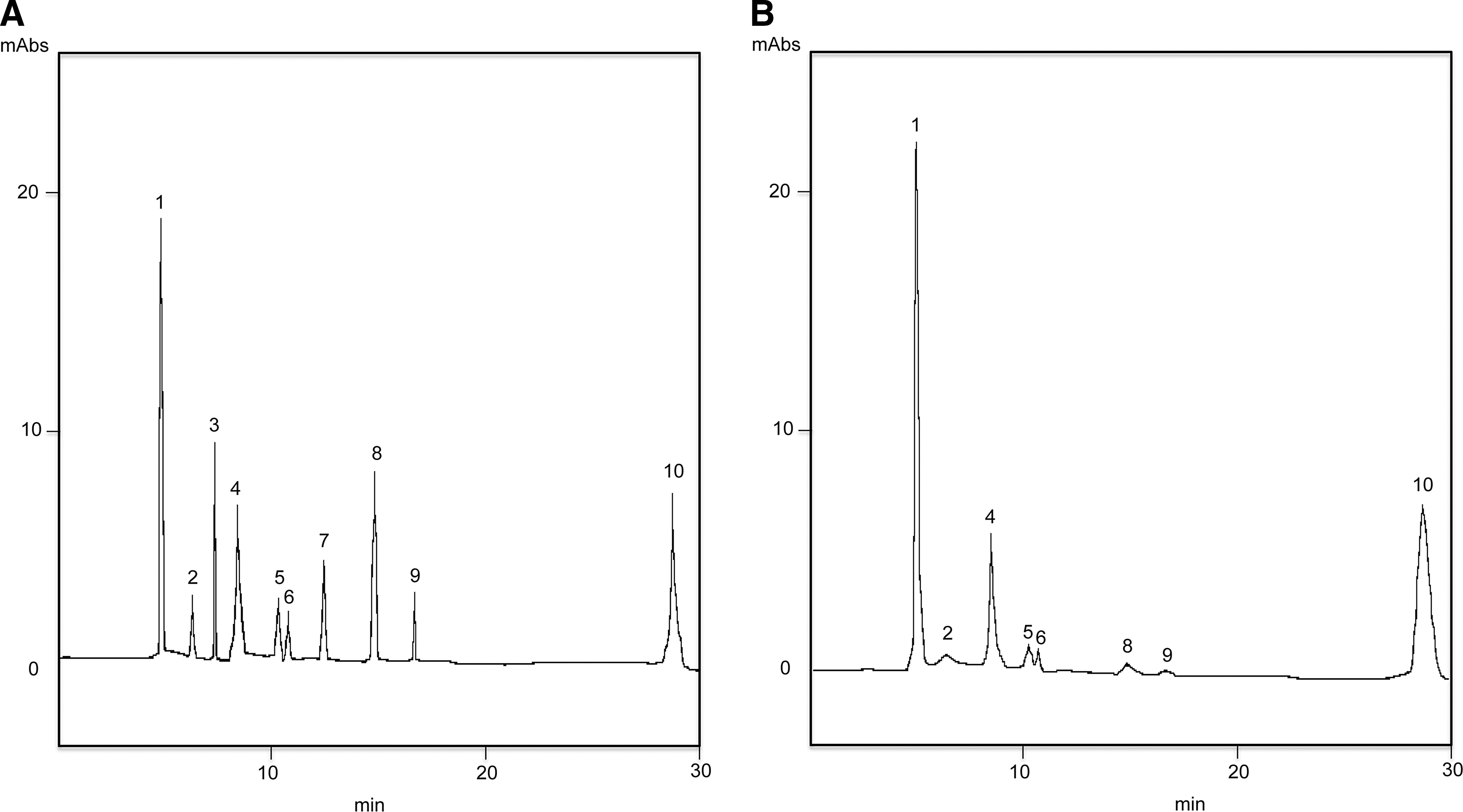
High-performance liquid chromatographic profiles of
Animals and experimental protocols
C57BL6 LDLr −/− mice were obtained from the Laboratory of Clinical Investigation, University of São Paulo, São Paulo. The progenitors were purchased from Jackson Laboratory (Bar Harbor, ME, USA). The animals were kept at 21±2°C under a 12-h light/12-h dark cycle and with free access to food and water. The experimental protocol was approved by the institutional ethics committee of the Federal University of Santa Catarina (protocol number 264/CEUA-23080.003548/2004-04/UFSC), in agreement with the guidelines of the Brazilian College for Animal Experimentation.
Male mice from 8 to 10 weeks of age were randomly assigned to seven groups (n=5–6 animals/group) with a similar mean body weight per group. Mice were fed with either a normal rodent chow diet or a hypercholesterolemic diet (20% fat, 1.25% cholesterol, and 0.5% cholic acid 24 ) for 12 weeks. The vehicle (water), EAF (3, 10, or 30 mg/kg), or simvastatin (1 mg/kg) was given by blunt gavage daily. The food consumption was evaluated daily, and the weight gain was measured weekly. The different experimental groups and their respective treatment are described in Table 1.
C, control (negative); CEAF3, control with 3 mg/kg ethyl acetate fraction; CHD, control hypercholesterolemic; EAF3, EAF10, and EAF30, 3, 10, and 30 mg/kg, respectively, ethyl acetate fraction; PC, positive control.
Plasma lipids
At the end of 3 months of treatment, the mice were anesthetized with a mixture of ketamine (90 mg/kg) and xylazine (15 mg/kg). Total blood was drawn via cava vein puncture, and aliquots of plasma were obtained after centrifugation (3000 g, 37°C, 10 min). TC, HDL, and TGs were measured using enzymatic kits. The concentration of non-HDL cholesterol (LDL, very low-density lipoprotein [VLDL], and intermediate-density lipoprotein [IDL]) was calculated using the following equation: (LDL+VLDL+ IDL)=TC – HDL.
Vascular reactivity
Vascular reactivity in response to the endothelium-dependent vasodilator acetylcholine was assessed in isolated thoracic aorta rings. After excision of the thoracic aorta, the vessel was carefully freed from adhering fat and connective tissue and cut in rings (1.5–2 mm long). The rings were then incubated in 5-mL organ baths with Krebs–Henseleit solution (118 mM KCl, 4.7 mM NaCl, 2.5 mM CaCl2, 1.2 mM MgSO4, 0.9 mM KH2PO4, 25 mM NaHCO3, and 11 mM glucose) and gassed continuously with a mixture of 95% O2 and 5% CO2 at 37°C. Initial tension was set at 0.5 g, and mechanical activity was recorded isometrically by a power transducer connected to an amplifier and chart recorder (model KITCAD8; Soft and Solutions, São Paulo). After an equilibration period of 60 min, phenylephrine (1 μM) was added to the baths. Once the phenylephrine-induced contraction reached a steady state, vasodilating responses to cumulative increments in the concentration of acetylcholine (1 nM–3 μM) were examined. 25
Histological analysis
The aortic arches were carefully dissected and washed with a phosphate-buffered saline. After perfusion of the innominate artery, the left common carotid artery, and the left subclavian artery, the aortic arches were snap-frozen in optimal cutting temperature (tissue freezing medium), using liquid nitrogen. The frozen blocks were cut using a cryostat holder (Leica Instruments GmbH, Wetzlar, Germany). About 10 longitudinal cryostat-cut cross-sections (5 μm each) were serially obtained from each aorta segment. These samples were placed on coverslips and chosen for histological analysis. In order to verify the arterial lipid deposits some sections were separated, counterstained with hematoxylin/eosin, and washed with tap water.
After staining, 30 slices were selected, and the examiners were not told from which experimental group these slices came. The 30 slices (slices from different animals per group) were selected based on the presence of intact aortic arches and the position (distance) based on the serial sectioning (all the slices were in the same distance [in micrometers] from the first longitudinal slice). Arbitrary units were attributed to the atherosclerotic lesions by five blinded examiners. The index of lesions was compiled according to the extension of the lesion, scored from absence of lesion (0) to maximal lesion (4). It is well established at the literature that hypercholesterolemic diet (20% fat, 1.25% cholesterol, and 0.5% cholic acid 24,25 ) induces significant atherosclerotic lesions in LDLr −/− mice. Thus, the lesions found in the control hypercholesterolemic (CHD) group received the maximal score (maximal lesions), and the lesions of the control group (normal chow, no detectable atherosclerotic plaque) received the minimal score.
Statistical analysis
The results were expressed as mean±SEM values. Statistical comparisons among the groups were carried out using one-way analysis of variance followed by post hoc test (Student–Newman–Keuls test). Differences with P values of <.05 were considered statistically significant.
Results
HPLC coupled to UV-visible detection revealed the chromatographic profile of phenolic compounds for the EAF of the Brazilian red wine used in this study (Fig. 1B). Such an analytical approach allowed the identification and quantification of 10 compounds in the EAF, as described in Table 2 and Figure 1B.
ND, not determined (minor compounds).
To investigate the effects of EAF on atherosclerosis, we used LDLr −/− mice as an experimental model. After 12 weeks of treatment no significant difference was observed in food consumption and body weight among the experimental groups (data not shown).
Plasma lipids of LDLr −/− mice are shown in Figure 2. As expected, the high cholesterol intake was associated with a significant increase in plasma TC levels in LDLr −/− mice (P<.001 compared with the control group) (Fig. 2A). Our results demonstrated that EAF at 3 mg/kg significantly decreased TC, TGs, and non-HDL levels compared with the CHD group (Fig. 2A, B, and D). It is interesting that higher doses of EAF (10 and 30 mg/kg) were capable of decreasing only the levels of TGs (Fig. 2D).
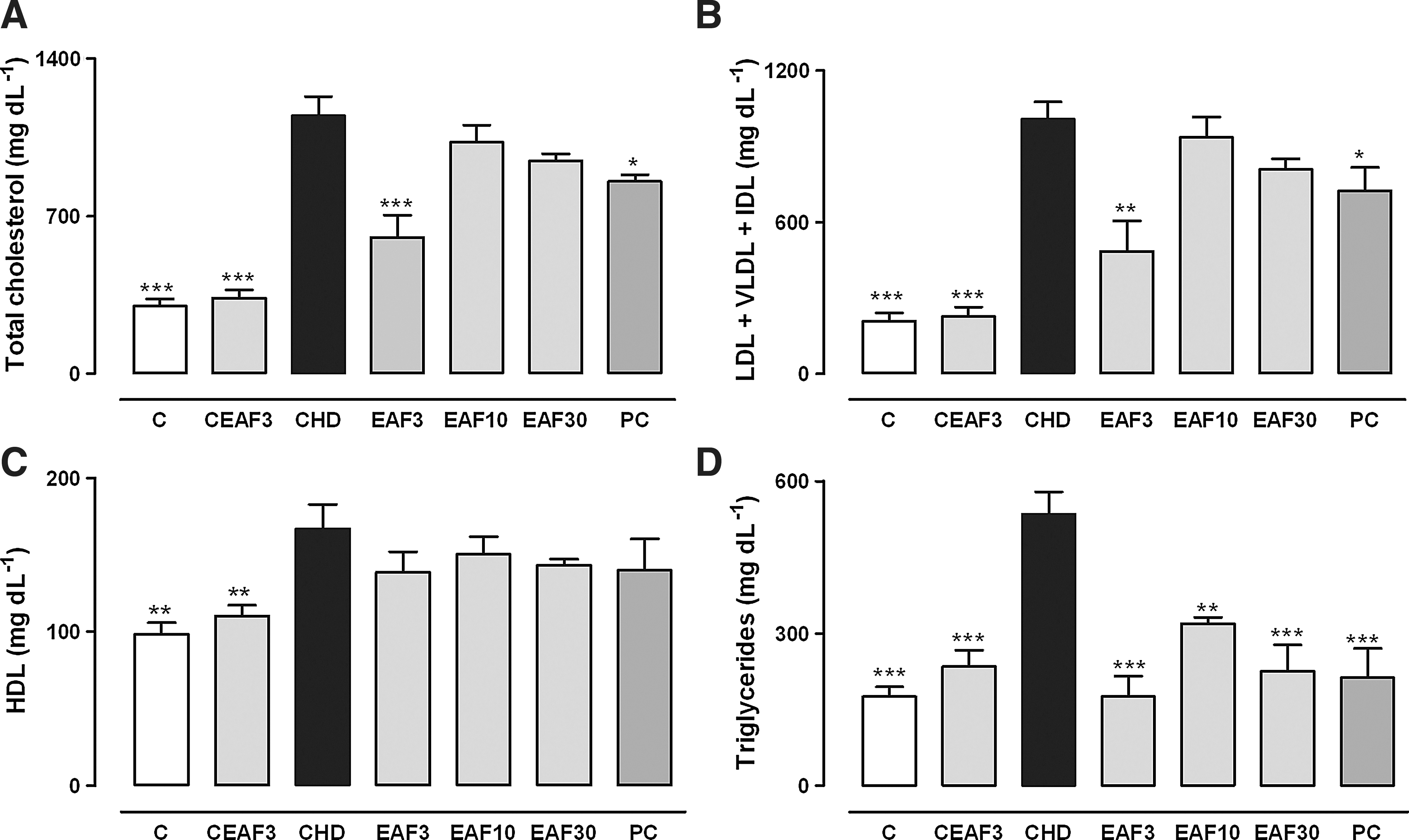
Plasma levels of
Vascular reactivity was examined in thoracic aortic rings (these vessels respond to acetylcholine with vasorelaxation, which is almost entirely endothelium-derived relaxing factor [•NO]-dependent). Acetylcholine-induced vasorelaxation was impaired in the CHD group compared with the control group (P<.001, on maximal relaxation, 3 μM), and this effect was restored by the treatment with EAF at 3 mg/kg in LDLr −/− mice (P<.01) (Fig. 3). However, EAF at 10 and 30 mg/kg was devoid of effect.
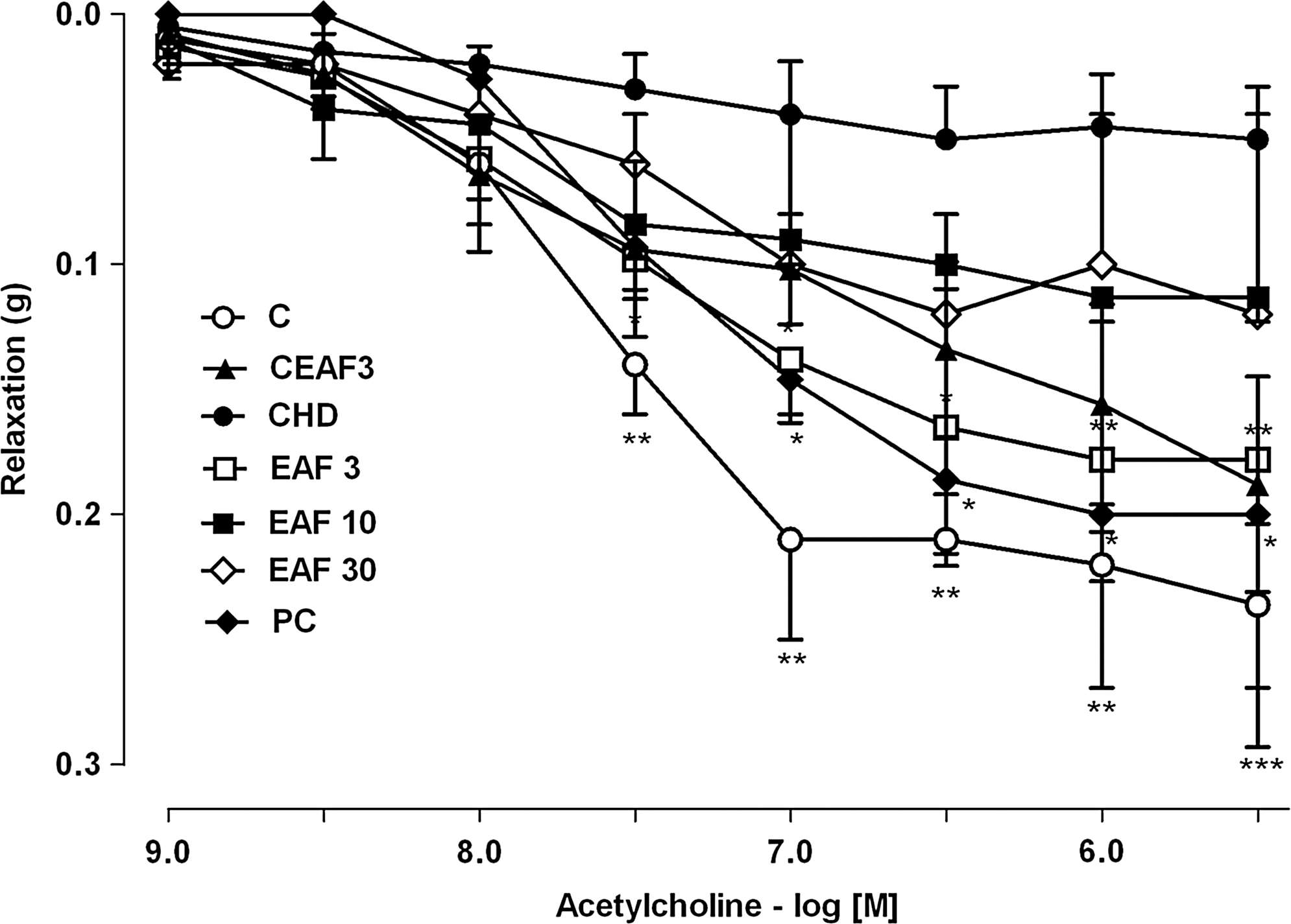
Concentration–response curve of vasodilatation induced by acetylcholine (1 nM–3 μM) in isolated thoracic aorta rings from LDL receptor knockout mice (see Table 1 for group definitions) precontracted with phenylephrine (1 μM). Data are mean±SEM values from five or six experiments. *P<.05, **P<.01, ***P<.001 for difference compared with CHD (by one-way analysis of variance followed by Student–Newman–Keuls test).
The extent of hypercholesterolemic diet-induced atherosclerosis was examined in the arch of the aorta. Control mice showed no detectable atherosclerotic plaque, whereas CHD mice developed significant lesions in the arch of the aorta (Fig. 4). Treatment of mice with EAF significantly reduced the index of atherosclerotic lesions in the arch of the aorta isolated from mice (inhibition of approximately 63% with the dose of 3 mg/kg, 37% with 10 mg/kg, and 31% with 30 mg/kg [P<.001, P<.05, and P<.05 vs. the CHD group, respectively]). Simvastatin (positive control) was not effective in reducing atherosclerotic lesions in hypercholesterolemic LDLr −/− mice (data not shown). Moreover, the treatment of nonhypercholesterolemic LDLr −/− mice with EAF at 3 mg/kg did not modify biochemical and aortic parameters compared with control mice.

Representative longitudinal sections of the arch of the aorta from LDL receptor knockout mice:
Discussion
Atherosclerosis is a progressive disease characterized by the accumulation of lipids and fibrous elements in the large arteries. Advanced lesions are characterized by the accumulation of lipid-rich necrotic debris and smooth muscle cells. Throughout the progression of the disease calcifications, ulcerations at the luminal surface, and hemorrhages from small vessels that grow into the lesion from the media of the blood vessel wall occur. 26 Epidemiological studies have revealed several genetic and environmental risk factors predisposing to atherosclerosis, 27 but it is a consensus that the hypercholesterolemia, hypertriglyceridemia, and low concentration of HDL cholesterol are among the main risk factors that contribute to the premature coronary disease. 28 –31
The events of atherosclerosis have been greatly clarified by studies in animal models, including rabbits, pigs, nonhuman primates, and rodents. Mice deficient in apolipoprotein E or the LDL receptor develop advanced lesions and are the most used experimental models in genetic and physiological studies. 32 LDLr −/− mice were made in 1993 by Ishibashi et al. 33 as an animal model of homozygous familial hypercholesterolemia. These animals develop hypercholesterolemia characterized by moderate levels of LDL and aortic atherosclerosis; however, when fed with an atherogenic diet, they develop significant fatty streak lesions with a lipid-filled necrotic core. This experimental model has been widely used to study the pathogenesis and potential treatment of atherosclerotic lesions. 34 –36
In this study, we used LDLr −/− mice to demonstrate for the first time that low doses of a phenolic-rich fraction obtained from a South Brazilian red wine may have beneficial effects in the progression of atherosclerosis. The study herein reported took into account previous findings by Schuldt et al. 22 where an EAF rich in polyphenols, obtained from a 300-mL sample (i.e., approximately 2 glasses of wine/day) of the red wine under study, activated the inward-rectifying potassium current and the Na+,K+-ATPase pump of the rat mesenteric arterial bed. Besides, that investigation also demonstrated that EAF was able to induce a vasodilator effect on the mesenteric artery that does not involve the opening of ATP current channels and potassium conductance current channels. Such findings in parallel with other systemic beneficial effects of red wine could contribute to the cardiovascular protection enjoyed by moderate drinkers of red wine (i.e., 1 [150 mL]–[300 mL] glasses of wine/day).
The present investigation showed that a 3 mg/kg EAF dose significantly reduced serum levels of TC, TGs, and (LDL+VLDL+IDL) in LDLr −/− mice consuming a hypercholesterolemic diet. In agreement, other reports have already described the beneficial effects of a short-term red wine consumption on atherosclerosis in cholesterol-fed rabbits, 37 cholesterol-fed hamsters, 16 and apolipoprotein E-deficient mice. 38 Vinson et al. 16 found that hyperlipidemic hamsters that received dealcoholized red wine had a reduction in total cholesterol (23.5%) and LDL (13.3%) when compared with control hamsters. The hypolipidemic effect of polyphenols from red wine was related to the fact that these compounds may bind to cholesterol, preventing its absorption. In this situation, the fecal excretion of cholesterol, bile acids, and other dietary lipids is increased. 39 Moreover, several studies have been demonstrated that red wine constituents can reduce TG levels in experimental atherosclerosis models 16,40 by increasing adipocyte lipoprotein lipase. 41,42
Dysfunction of the endothelium is a common feature of all phases of atherosclerosis. The endothelium produces several vasodilator and vasoconstrictor substances that not only regulate vasomotor tone, but also induce the recruitment and activity of inflammatory cells that predispose to thrombosis. The oxidized LDL, which is increased in level in a hypercholesterolemic condition, provokes many aspects of endothelial dysfunction before and during the development of the atheroma. The alterations include an increased adhesiveness of platelets and leukocytes, pro-coagulant properties, and a rise in levels of vasoactive molecules, cytokines, and growth factors. 43 –45 Lifestyle interventions, including diet, have been shown to affect endothelial function. High fat diets impair endothelial function, and diets such as the Mediterranean diet are associated with a better function of the endothelium. 46
Taking this into account, the vasomotor function of the endothelium is a convenient way to assess a long-term risk of cardiovascular disease. 47 It has been established that one of the key parameters characterizing endothelial dysfunction is the impairment of endothelium-dependent vasodilation induced by a dilator such as acetylcholine. 48 Thus, we measured whether the treatment with EAF would improve the vascular reactivity in LDLr −/− mice. Our findings showed that the high cholesterol diet alters relaxation responses in aorta rings. This alteration occurs mainly by a decrease in the bioavailability of ·NO. 29,49,50 Our results showed that the treatment with the lowest dose of EAF preserved the endothelial function in LDLr −/− mice subjected to a hypercholesterolemic diet.
We had already reported that EAF promoted a decrease in the perfusion pressure in the isolated mesenteric arterial bed of rats; this effect was partially dependent on the release of ·NO from the endothelial cells and hyperpolarization of cells through K+ channels. 22 HPLC data revealed that EAF contains some phenolic compounds that are good scavengers of reactive oxygen species. Among others, gallic acid was found as the major compound, and cinnamic acid and chlorogenic acid also occurred in appreciable amounts. Quercetin and trans-resveratrol are well-known reactive oxygen species scavengers but were found in minor amounts in EAF. The antioxidant properties of grape beverages have been shown to protect LDLs from oxidative modifications. 47,51,52 In fact, Napoli et al. 4 demonstrated that administration of antioxidants from wine in experimental models diminished the severity of atherosclerosis by reducing oxidative stress and increasing ·NO production. Thus, the EAF's vasodilator properties and the antioxidant capacity of its polyphenolic compounds could contribute to the vascular protection found in isolated thoracic aorta.
Our in vivo experimental model of atherosclerosis showed that EAF at 3 mg/kg significantly reduced the progression of the disease in LDLr −/− mice. This affirmation is based on the reduction of the index of lesions in histological analysis found in the arch of aorta tissue. This effect could be directly related to the capacity of EAF to decrease lipid levels and increase the vascular response in LDLr −/− mice.
It is interesting that the lowest dose of EAF (3 mg/kg) was more effective at reducing the index of lesions than the higher doses (10 and 30 mg/kg). These data are in agreement with previous studies that showed that only low doses of red wine supplementation increased endothelial nitric oxide synthase expression in atherosclerosis-prone areas of hypercholesterolemic LDLr −/− mice. 4 Recently, Gu et al. 53 demonstrated that trans-resveratrol, only at the lowest concentration (1 μM), enhanced the activity of cell proliferation, migration, and adhesion. Corroborating our results, some studies have demonstrated that high doses of antioxidants, such as phenolic compounds, can act as pro-oxidants and lose their pharmacological properties. 54 –56
In fact, in this study the effects of EAF on cholesterol levels, endothelial dysfunction, and atherosclerotic lesions in LDLr −/− hypercholesterolemic mice were not dose-dependent. Previously, we tested a lower dose of EAF in hypercholesterolemic LDLr −/− mice, but the lipid profile and endothelial function were not modified compared with the CHD group (data not shown). In the same way, we recently demonstrated that a selenium antioxidant compound was anti-atherogenic in hypercholesterolemic LDLr −/− mice independently of the dose. 25 In addition, the EAF is a mixture of different phenolic compounds, and it is not clear which component of EAF is responsible for the anti-atherogenic effect. We speculate that when the dose of EAF was increased, some compounds can mask the properties of EAF. For example, Auger et al. 40 showed that cinnamic and caffeic acid (compounds found in EAF) did not modify lipid levels in hypercholesterolemic hamsters.
Oral administration of simvastatin (positive control) reduced the levels of TC, TGs, and non-HDL lipoprotein. The statins inhibit endogenous cholesterol biosynthesis via 3-hydroxy-3-methylglutaryl-coenzyme A reductase inhibition and enhance cholesterol clearance from the bloodstream by increasing LDL receptor density. Because we used null mice for the LDL receptor, the mechanism of action of statin would be restricted to the inhibition of the cholesterol biosynthesis. 57,58 It would explain the failure of statin to reduce atherosclerotic lesions in our experimental model. Although simvastatin lacked an effect on clearance of lipoproteins, it was still a good control because it improved the vascular reactivity.
In conclusion, we demonstrate here for the first time that in vivo treatment with EAF at 3 mg/kg obtained from a V. labrusca red wine significantly reduced the progression of atherosclerosis in LDLr −/− mice, as shown by the reduction of lipid parameters and by the protection of vascular reactivity. The presence of phenolic compounds in the Brazilian red wine is thought to be responsible for the protective effects and for the additional health benefit compared with other alcoholic beverages. Despite the epidemiological data and the biological effects, experimental research and randomized trials are still required to ensure moderate red wine consumption as a nutritional habit, which will have an effect on old and novel strategies for primary prevention of atherosclerosis-related diseases.
Footnotes
Acknowledgments
This study was supported by the Fundação de Amparo a Pesquisa do Estado de Santa Catarina Coordenação de Aperfeiçoamento de Pessoal de Nível Superior (CAPES) and the Conselho Nacional de Pesquisa e Desenvolvimento (Projeto Milênio: Redoxoma), Brazil.
Author Disclosure Statement
The authors declare no conflict of interest.