




Abstract
This study assessed the antiproliferative effect in vitro of the flower hexane extract obtained from Mentha spicata associated with Mentha rotundifolia against the human breast adenocarcinoma (MCF-7), human mouth epidermal carcinoma (KB), and mouse embryonic fibroblast (NIH 3T3) cell lines, using sulforhodamine B (SRB) assay. A cell density of 2×10⁴/well was seeded in 96-well plates, and samples at different concentrations ranging from 10 to 500 mg/mL were tested. The optical density was determined in an ELISA multiplate reader (Thermo Plate TP-Reader). Results demonstrated that the hexane extract presented antiproliferative activity against both the tumor cell lines KB and MCF-7, presenting a GI50 (MCF-7=13.09 mg/mL), TGI (KB=37.76 mg/mL), and IL50 (KB=291.07 mg/mL). Also, the hexane extract presented antiproliferative activity toward NIH 3T3 cells GI50 (183.65 mg/mL), TGI (280.54 mg/mL), and IL50 (384.59 mg/mL). The results indicate that the flower hexane extract obtained from M. spicata associated with M. rotundifolia presents an antineoplastic activity against KB and MCF-7, although an antiproliferative effect at a high concentration of the extract was observed toward NIH 3T3.
Introduction
T
Plants are a priceless source for the development of new drugs, 7 especially because it has already been determined that plants have been a great source of clinically relevant antitumor substances. 8 –10 Therefore, there is an increasing interest in investigating the therapeutic potential of medicinal herbs. 11,12
Mentha is a genus that belongs to the Labiatae (Lamiaceae) family and has 25–30 species, including Mentha spicata, Mentha rotundifolia, Mentha piperita, and Mentha arvensis, among others. 13,14 M. spicata, commonly known as spearmint or hortelã in Brazil, is used with spices for flavoring chewing gums, toothpaste, confections, and pharmaceutical preparations. 15 This plant grows 30–100 cm high, has strong aroma, and usually grows in wet places like riverbanks and marshy areas. 11,14 An important fact is that this species could be a possible source of therapeutic agents against cancer. 16 It also has been suggested that the extract of M. spicata is an effective chemopreventive agent. 15
M. rotundifolia (L.) Huds., popularly known in Brazil as hortelã-branca and incorporated in Algerian (Africa) traditional medicine, is a hybrid between Mentha longifolia (L.) and Mentha suaveolens Ehrh. This species is a wild-growing, perennial, herbaceous, aromatic plant that is widespread in nature. This species grows in the Brazil region and is a potential source of essential oils. It is very widely distributed around the Mediterranean basin, in America, and in occidental Asia. It has been used for its flavors in cooking, in folk medicine as antiseptic, and as antimicrobial agents. 17 However, little is known about the capacity of M. rotundifolia to serve as an anticancer agent.
To date, there are no scientific data that evaluated the antiproliferative effect of the flower hexane extract obtained from M. spicata associated with M. rotundifolia against tumor cell lineages. Therefore, the objective of this study was to evaluate in vitro the antiproliferative effect of the flower hexane extract obtained from M. spicata associated with M. rotundifolia against the human breast adenocarcinoma (MCF-7), human mouth epidermal carcinoma (KB), and mouse embryonic fibroblast (NIH 3T3) cell lines.
Materials and Methods
Cell lines, chemicals, and biochemical
The MCF-7, KB, and NIH/3T3 cell lines were purchased from the RJCB Collection (Rio de Janeiro Cell Bank, Rio de Janeiro, RJ, Brazil). The KB and NIH/3T3 cell lines were grown in Dulbecco's modified Eagle's medium (DMEM; Gibco, Grand Island, NY, USA), whereas the MCF-7 cell line was grown in RPMI-1640 (Gibco); all cultures contained 10% of fetal bovine serum (FBS; Gibco). Cells were maintained in a humidified atmosphere (RH=95%) of 5% CO2 at 37°C. Before the antiproliferative test (sulforhodamine B [SRB] assay), cells were trypsinized and plated in 96-well round-bottomed tissue culture plates. SRB was purchased from Sigma Aldrich (St. Louis, MO, USA). Trypsin was obtained from Amresco (Detroit, MI, USA) and was prepared as a 0.25% solution. All plastic wares for cell culture were obtained from TTP (Techno Plastic Products AG, Trasadingen, Switzerland).
Plant material
Fresh aerial parts of leaves and flowers were collected in January 2006 from the city of Pelotas, located in southern Brazil. A voucher specimen of M. spicata and M. rotundifolia was deposited at the Federal University of Pelotas Herbarium (Pelotas, RS, Brazil) under the number codes PEL24601 and PEL24064, respectively. They were identified by Dr. M.A.D. da Costa, a botanist from the Catholic University of Pelotas. The plants were collected, rolled up in papers, and packed in cardboard pouches. Then, the plants were cleaned and separated into their respective vegetable parts. Next, they were dried in a stove with air circulation at 40°C for 3 days.
The flowers and leaves were harvested during the phase of flowering, washed, and dried at 40°C for 72 h. They were then ground into powder. The dried flowers and leaves were ground using a variable speed rotor mill Pulverisette 14 (Fritsch GmbH, Oberstein, Germany), with a controlled rotor torque of 17,226 g. One hundred grams of this dry vegetable biomass of M. spicata and M. rotundifolia was macerated with 1000 mL of hexane P.A. (hexane extract) for 3 h at a room temperature. At every 3 h, the extract was filtered, and the residue was re-extracted with another 1000 mL of the fresh hexane solution. Then, the supernatants were concentrated under reduced pressure in a rotary evaporator and stored in a freezer (−20°C) and after in an ultrafreezer (−80°C) until the experiment.
For the experiments, the extract was dissolved in dimethyl sulfoxide (DMSO; Vetec®, Duque de Caxias, RJ, Brazil), and 10 concentrations were made: 500, 400, 300, 200, 150, 100, 75, 50, 25, and 10 mg/mL.
Antiproliferative activity assay
Each cell lineage was seeded at 2×10⁴ cell density, in 200 μL of specific medium, using 96-well plates for cell incubation. Immediately after seeding, samples were placed in an incubator (37°C in 5% CO2) for 24 h. After the period of adhesion, the experiment plates were exposed for 48 h to 2 μL of each increasing concentration of the extract, and then incubated (37°C in 5% CO2). Four repetitions were conducted for each extract concentration.
Cells were then fixed with 50% trichloroacetic acid and incubated for 1 h in a refrigerator at 4°C. Next, plates were washed with distilled water and set to dry. After this procedure, the SRB colorimetric test was conducted. Subsequently, the optical density was determined in an ELISA multiplate reader (Thermo Plate TP-Reader, Thermo Fisher Scientific, Waltham, MA, USA) using a wavelength filter of 492 nm. The results were analyzed with statistical software GraphPad Prism version 4.0 for Windows (GraphPad Software, San Diego, CA, USA; EUA, 2003).
Results
The three cell lines used in this study were capable of attaching and forming a homogeneous monolayer on the plastic substratum of the culture well, which is ideal for the SRB assay. The SRB is used for the primary screening of crude plant extracts and isolation of compounds. The antiproliferative activity of the hexane extract of M. spicata associated with M. rotundifolia toward the KB, MCF-7, and NIH 3T3 cell lines measured by SRB can be observed in Figure 1.
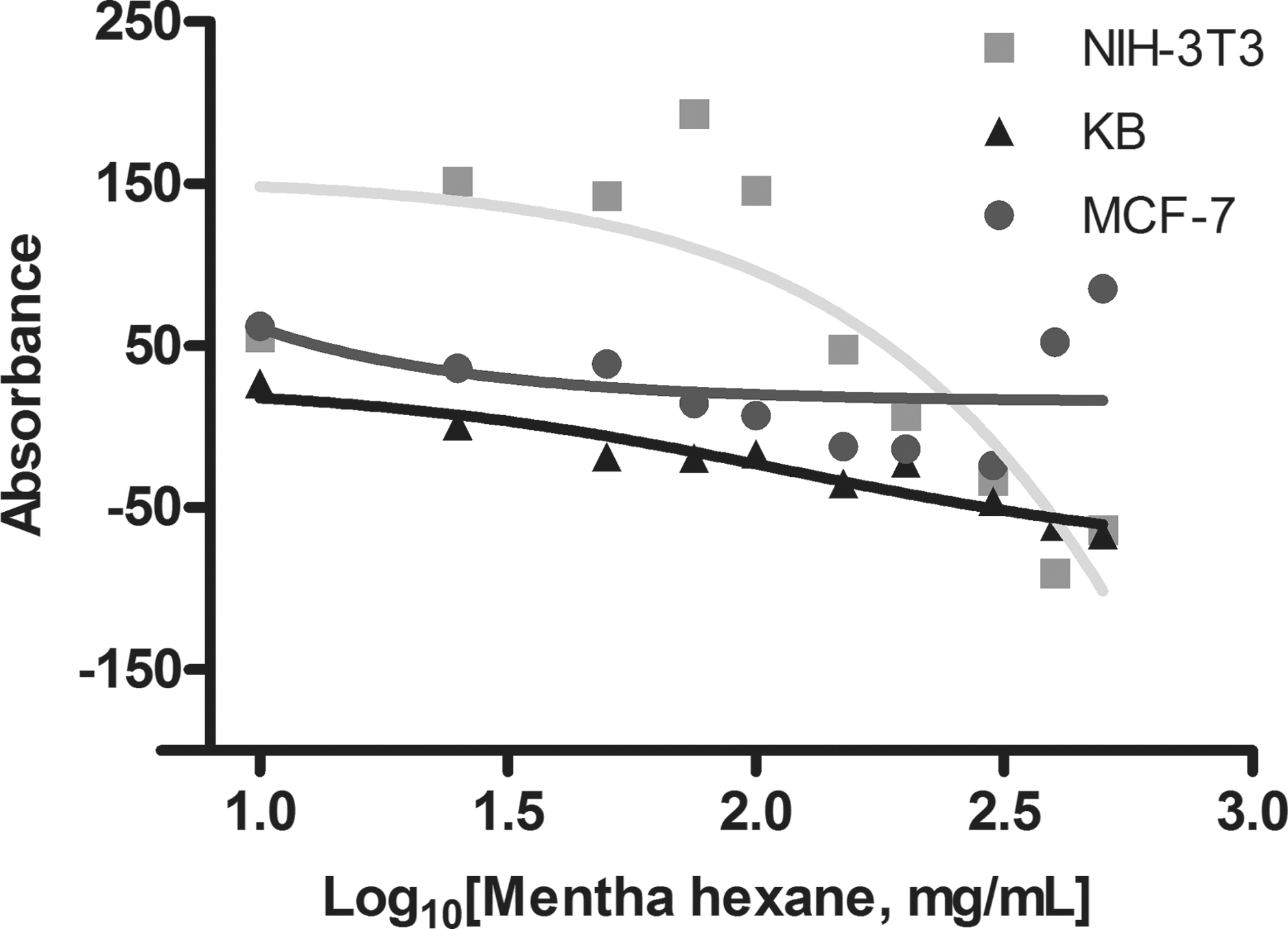
Optical density measurement of KB, MCF-7, and NIH 3T3 cell lines after exposure to hexane extract of Mentha spicata associated with Mentha rotundifolia at different concentrations.
The hexane extract presented an antiproliferative activity against both tumor cell lines presenting a GI50 (MCF-7=13.09 mg/mL), TGI (KB=37.76 mg/mL), and IL50 (KB=291.07 mg/mL). Also, the hexane extract presented an antiproliferative activity toward NIH 3T3 cells GI50 (183.65 mg/mL), TGI (280.54 mg/mL), and IL50 (384.59 mg/mL). Although there was an inhibitor and lethal effect from the hexane extract toward the nontumor cell lineage, the concentration of extract to induce this effect was much higher than that observed in the tumor cell lineages.
Hexane extract showed a more efficient effect in inhibiting tumor cell proliferation (MCF-7 and KB) than in inducing lethality to normal cells. A higher lethality was observed with KB cells, whereas a lower lethality was seen with NIH 3T3. In addition, the highest inhibition was seen against MCF-7 cells, whereas the lowest inhibition was seen against NIH 3T3 cells.
Discussion
Medicinal plants have long been used throughout history. In modern society, the interest is growing due to the increasing knowledge of plants' biological drug significance, as well as the increasing recognition of the origin and function of their diversity. 18,19 In addition, medicinal plants have the advantage of providing a complex of natural compounds and have a more gentle action, as they are better tolerated than synthetic drugs. 19 However, the development of drugs from plants have their challenges, including the legal and logistical problems in obtaining plant material, the delay and costly process of bioassay-guided fractionation and compound isolation, and the difficulty of including natural product research programs in pharmaceutical companies and governmental agencies. 18
In the present study, the choice of using these two species of Mentha is related to their individual properties, their abundance in Brazil, and their popular use as therapeutic medicine. M. spicata is used to alleviate hiccups, flatulence, giddiness, and as medicament for inflammation, bronchitis, and to control vomiting during pregnancy. 3,20,21 Spearmint fights antifungal, antiviral, antimicrobial, insecticide, antioxidant, antiamoebic, antihemolytic, allergenic, and antihelmintic activity. 14,20
On the other hand, the composition of M. rotundifolia oil has been analyzed in a variety of studies, and related chemotypes have been defined. 17 One of these chemotypes proved to be particularly rich in an oxygenated monoterpene. 17 Recently, there has been a great interest in certain monoterpenes due to their chemopreventative and chemotherapeutic properties. 22
In the experiment, DMSO was added as a solubilizing agent at the concentration of 1% and showed no effect on cell proliferation (data not shown). The hexane extract obtained from the association between M. spicata and M. rotundifolia presented antiproliferative activity against the tumor lineages (KB and MCF-7), where a higher lethality was observed with KB cells, and a higher inhibition was seen against MCF-7 cells, which could demonstrate the difference in sensitivity between different cancer cell lines to substances contained in the associated extract. Manosroi et al. 16 tested the oil extract of M. spicata leaf against KB and P388 (murine leukemia) cells and showed that this essential oil sample could be a possible candidate for further development to cancer therapeutic agents. 16
Although it is important to evaluate the antiproliferative capacity of plant extract toward tumor cell lineages, it is also relevant to test the same extract against normal cells, as it is known that most anticancer agents do not greatly differentiate between cancer and normal cells, which could lead to systemic toxicity and adverse effects. In this study, NIH 3T3 cells were used, and the hexane extract presented antiproliferative activity toward these cells as well; however, at low concentrations, the NIH 3T3 cells presented a much higher absorbance than those presented by KB and MCF-7 cells. In addition, it can be observed in Figure 1 that the tumor lineages do not vary greatly in absorbencies as the concentration of the extract increases; the same does not occur with NIH 3T3 cells, which, at higher concentrations, show a drastic decline in absorbance values. This could indicate a promising prospective for this extract in cancer therapy.
Many studies have evaluated M. spicata and M. rotundifolia essential oils, especially with regard to their chemical aspects. 17,23 –27 However, little is known about the composition of hexane extracts. However, M. spicata oils, which have apolar compounds like hexane extracts, contain monoterpenoids such as carvone (29–74%), limonene (4–24%), and cireole (3–18%). 20,21,24,28
Limonene is a monoterpene that has the capacity to act in both cancer prevention and therapy. 29,30 It was able to block and suppress mammary cancer induced in rats by 7.12-dimethylbenz[a] anthracene (DMBA), thus demonstrating the capacity to reduce tumor incidence and multiplicity significantly and increase tumor latency. 31 In addition, limonene could inhibit the metastatic progression of B16F-10 melanoma cells in mouse models, reducing the formation of pulmonary lung tumor nodule by 65%. However, the same results were not observed when carvone was administrated; no significant effect on the metastatic tumor growth was observed. 30 Limonene and other monoterpenes have been studied to determine their mechanism to inhibit tumor growth. The probable method of action is by inhibiting the activity of 3-hydroxy-3-methylglutaril-CoA (HGM-CoA) reductase, which reduces the protein isoprenylation limit in the cell, thus limiting the tumor growth. 32 Therefore, monoterpenes are a potential class of anticancer agents and a promising group of compounds of plant origin. M. rotundifolia also has piperitenone oxide and oxygenated monoterpene as its major constituents. 17,25 These compounds are present in M. spicata and M. rotundifolia and could be directly responsible for the antiproliferative effects of the present extract.
The results of this study indicate that the flower hexane extract obtained from M. spicata associated with M. rotundifolia presents an antineoplastic activity against KB and MCF-7 cell lines, although an antiproliferative effect at high concentration of the extract was observed toward the NIH 3T3 cell line. In this regard, more research is needed to determine the right extracts concentration for reducing the proliferation activity of tumor cells and causing the smallest damage to normal cells.
Footnotes
Acknowledgment
This study was made possible by an undergraduate fellowship provided by the National Council of Scientific and Technology Development of Brazil (CNPq).
Author Disclosure Statement
No competing financial interests exist.