




Abstract
In Jordan, the leaves of Laurus nobilis (Family Lauraceae) have been used in folk medicine for the treatment of diarrhea, among other ailments. However, the ethnopharmacology of this plant needs to be scientifically validated. The present work was carried out to evaluate the scientific basis of the antidiarrheal effect of the aqueous extract of L. nobilis leaf. L. nobilis leaf extract significantly inhibited castor oil–induced diarrhea (effective concentration producing 50% of the maximum response [EC50]=150±6.4 mg/kg) and reduced castor oil–induced enteropooling in rats (EC50=162±5.9 mg/kg). The extract also significantly inhibited intestinal transit of a charcoal meal and exerted a significant dose-dependent relaxation (EC50=71±5.3 mg/mL) on rat ileal smooth muscle. The aqueous extract tested positive for flavonoids, alkaloids, and tannins. These results established the efficacy of L. nobilis leaf aqueous extract as an antidiarrheal agent and are consistent with the popular use of the plant in the treatment of gastrointestinal disorders, particularly diarrhea.
Introduction
D
Several pharmaceutical agents are available for the treatment and management of both adult and infantile diarrhea. In recent years, emphasis has focused on the use of oral rehydration solutions as a replacement therapy to replenish the lost fluid and electrolytes in diarrheic cases. 1 However, there is still a need for continuing search for more effective antidiarrheal agents with minimal side effects. 3
Laurus nobilis belongs to the Lauraceae family and is commonly known as sweet bay but locally known as Al-Ghar. It is an evergreen tree that can reach up to 8 m in height and is native to Mediterranean regions. L. nobilis, a dioecious plant, has been cultivated since ancient times, and the aromatic, dark green, leathery leaves of the laurel tree were used by ancient Greeks and Romans to crown their victors. 4 L. nobilis is a plant of industrial importance because it is used in foods, drugs, and cosmetics. The dried leaves and essential oils are used extensively in the food industry for seasoning of meat products, soups, and fishes. 4 The essential oil is also used as a folk medicine, especially for the treatment of rheumatism and dermatitis. 5
L. nobilis has a long history of folk use in the treatment of many ailments, particularly as an aid to digestion, to treat bronchitis and influenza, 6 and to treat various types of cancer. 7 The leaves were reported to treat upper respiratory tract disorders and to ease arthritic aches and pains. 8 Recent studies have shown that L. nobilis seed and leaf essential oils have gastroprotective, antinociceptive, and anti-inflammatory activities. 9 They also have antidiabetic, cytotoxic, and trypanocidal properties. 10,11 The essential oil and some isolated compounds from L. nobilis have narcotic, antibacterial, and fungicidal properties. 12 –14 Because of its antimicrobial and fungicidal activities, L. nobilis is used in the food industry as a food preservative.
Some phytochemical constituents of L. nobilis have been isolated and identified. These include guaianolides, dehydrocostus lactone, zaluzanin D, p-menthane hydroperoxide, (1R,4S)-1-hydroperoxy-p-menth-2-en-8-ol acetate,
10
alkyl peroxy radical scavenging compounds, sabinene, eugenol,
5
megastigmane glucosides, phenolic glucoside, sesquiterpenes,
7,15
(E)-β-ocimene, 1,8-cineole, α-pinene, β-longipinene, linalool acetate, cadinene, β-pinene, α-terpinyl acetate, α-bulnesene,
16
kaempferol 3-O-α-
In Jordan, L. nobilis is commonly used as a food spice, and the leaf aqueous extract is widely used in the treatment of hypertension, general weakness, arthritis, hair loss, and diarrhea. 17 Despite the relatively wide use of this plant in folk medicine, the scientific basis for its use as an antidiarrheal drug has not been validated. The present study was undertaken to evaluate the antidiarrheal effect of leaf aqueous extract of L. nobilis, using castor oil–induced diarrhea, enteropooling, intestinal transit time, and isometric recording of ileal smooth muscle tone models.
Materials and Methods
Plant material
Fresh leaves of L. nobilis were collected from the Hashemite University campus (Al-Hashemia, Zarka, Jordan) during April 2008. The plant material was identified and authenticated taxonomically at the herbarium of Hashemite University. A voucher specimen has been deposited there for future reference under the number HU-394.
Preparation of aqueous extract
Aqueous extract was obtained by boiling 150 g of the ground air-dried leaves of L. nobilis in 3 L of distilled water for 15 minutes with continuous stirring. The resultant solution was filtered through Whatman (Maidstone, United Kingdom) filter paper. The filtrate was completely evaporated under reduced pressure at 55°C. Solutions were prepared by dissolving the gummy residue in physiological salt solution (PSS).
Phytochemical analysis
The aqueous extract (50 g/L) of the plant was subjected to qualitative chemical screening for the detection of tannins, alkaloids, and flavonoids using standard procedures. 18 In addition to the specific tests noted below, the presence of these constituents was also confirmed by thin-layer chromatography using different solvent systems, detecting reagents, and ultraviolet.
Test for tannins
One milliliter of aqueous extract was mixed with 10 mL of distilled water and filtered. Ferric chloride reagent (3 drops) was added to the filtrate. A blue–black or green precipitate confirmed the presence of gallic tannins or catechol tannins, respectively.
Test for alkaloids
A mixture of 0.2 mL of aqueous extract and 1% aqueous hydrochloric acid (5 mL) was placed on a steam bath and then filtered. One milliliter of the filtrate was treated with Mayer's reagent (3 drops), whereas another portion was similarly treated with Dragedorff's reagent. Turbidity or precipitation with these reagents was considered as evidence for the presence of alkaloids.
Test for flavonoids
Two milliliters of the aqueous extract was heated, and a piece of metallic magnesium followed by concentrated hydrochloric acid (5 drops) was added. A red or orange coloration indicated the presence of flavonoids.
Animals
Adult albino rats of either sex weighing 160–210 g were fed a standard pellet diet and water ad libitum. Food, but not water, was withdrawn 18 hours before the experiments.
Antidiarrheal test
Wistar rats were divided into five groups, each composed of six rats. Rats in the first three groups received aqueous extract of L. nobilis leaf at 3 mL/kg (100, 200, and 400 mg/kg, respectively); the doses were given intraperitoneally, and the largest safe dose was used as determined by preliminary 50% lethal dose experiments. The fourth group received the antidiarrheatic agent diphenoxylate at 3 mL/kg of 5 mg/kg solution as a positive control, and the fifth group received 3 mL/kg PSS and served as a negative control. Rats were then housed singly in cages lined with white blotting paper. One hour after the treatments, each rat was given 1 mL of castor oil orally. Rats were observed for the presence of diarrhea on an hourly basis for the next 5 hours after the castor oil administration. For the purpose of this study, diarrhea was considered as defecation of watery, unformed stool. The number of wet droppings was counted every hour for a period of 5 hours. The total of the wet droppings after 5 hours was counted and averaged.
Anti-enteropooling test
Intraluminal fluid accumulation was determined by the method of Robert et al. 19 Fasting rats were divided into four groups of six animals each. Group 1 received 3 mL of PSS/kg intraperitoneally and served as the control. Groups 2, 3, and 4 were injected intraperitoneally with the plant extract at 100, 200, or 400 mg/kg, respectively, in a total volume of 3 mL/kg. The above treatments were given 1 hour before the administration of 1 mL of castor oil orally. Two hours later the rats were sacrificed, and the small intestine was ligated at both pyloric sphincter and ileocecal junction, dissected out, and weighed. The intestine was reweighed after milking off the contents, and the difference between the weights of loaded and empty intestines was calculated as the weight of the contents.
Gastrointestinal motility
The effect of aqueous extract of L. nobilis on gastrointestinal transit was tested using the charcoal meal method. 20 One-half milliliter of charcoal meal (5 g of activated charcoal suspended in 50 mL of PSS) was given to five groups of six rats each. In the first three groups, the charcoal meal was administered to animals intragastrically 60 minutes after the intraperitoneal injection of aqueous extract of L. nobilis leaf at 3 mL/kg of 100, 200 and 400 mg/kg, respectively. In the fourth group, which served as a positive control, rats were treated with atropine sulfate at 3 mL/kg of 1 mg/kg. The fifth group (control) was treated with 3 mL/kg PSS before receiving the charcoal meal.
Animals were killed 60 minutes after charcoal administration, and the small intestine, from the pylorus to the cecum, was rapidly removed and laid out on white filter paper for inspection. The distance traveled by the front of the charcoal meal was measured and calculated as a percentage of the total length of the intestine.
Ileal preparation
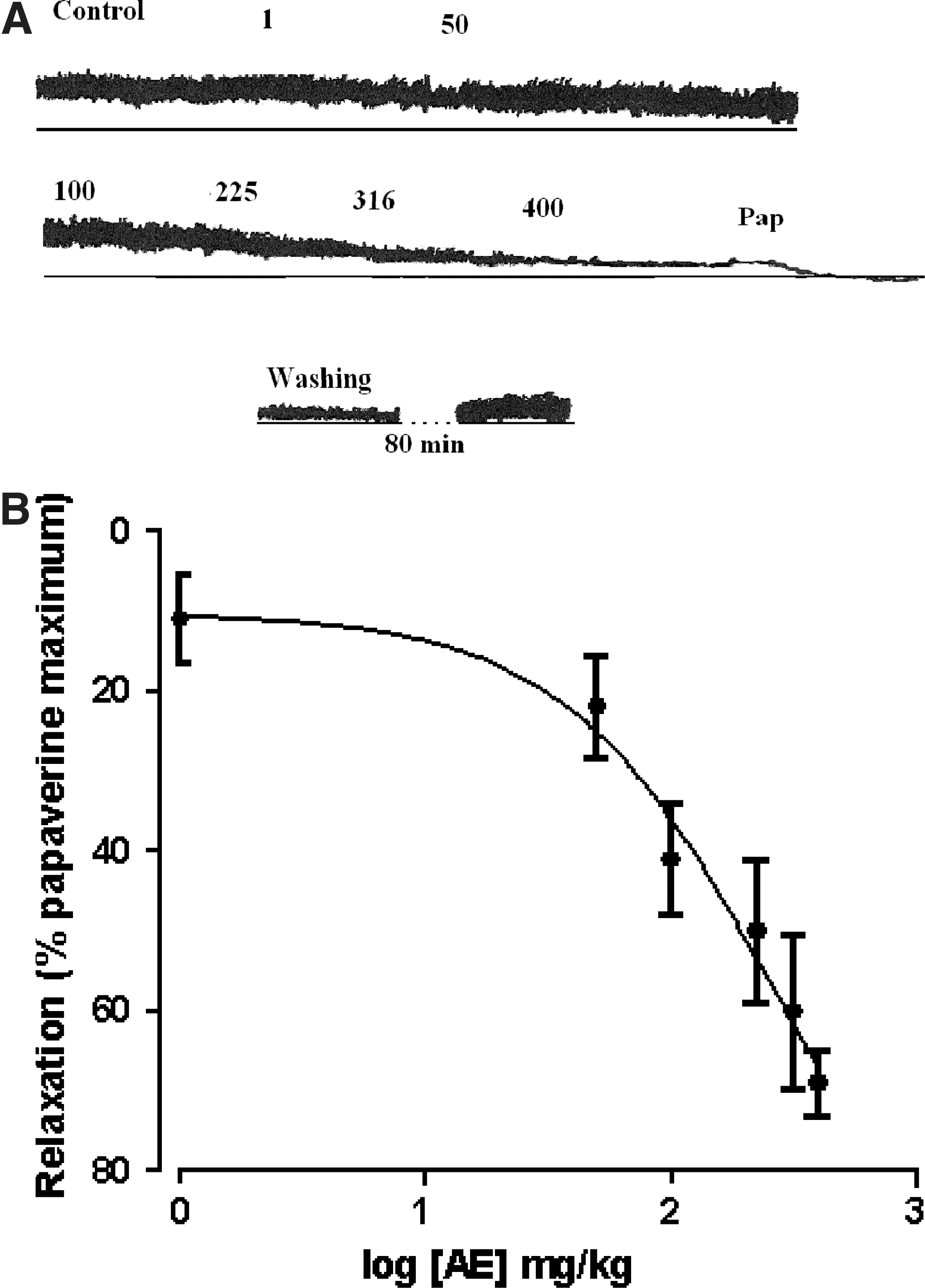
Rats were lightly anesthetized with ether and were sacrificed by a sharp blow to the head, and the abdomen was opened. Segments of the ileum (1–2 cm long) were removed and dissected free of adhering mesentery. The lumen was flushed with PSS to remove any remaining contents. PSS was prepared daily and had the following composition: 118 mM NaCl, 4.7 mM KCl, 2.5 mM CaCl2·2H2O, 1.0 mM MgCl2·6H2O, 0.5 mM NaH2PO4, 25 mM NaHCO3, and 11.1 mM glucose. The preparations were mounted under a tension of 1 g in a 10-mL organ bath containing PSS at 37±1°C and aerated with a gas mixture (95% O2 and 5% CO2). The responses were recorded isometrically on a minigraph (Lafayette Instrument Co., Lafayette, IN, USA). After a 60-minute equilibration period during which the PSS was replaced every 15 minutes, concentration–effect curves for the aqueous extract of L. nobilis leaf (1, 50, 100, 225, 316, and 400 mg/mL) were established. The responses of the ileum to the aqueous extract of L. nobilis leaves were expressed as percentages of the maximum relaxation to a nonspecific relaxant agent (papaverine; 10−3 M), which was added at the end of the experiment.
Statistical analysis
Data were expressed as mean±SEM values. Statistical significance was assessed by Student's t test, and differences were considered significant when P<.05. Experimental data were analyzed by a computer-fitting treatment using GraphPad Prism version 5.0 software (GraphPad Software, San Diego, CA, USA). The effective concentration producing 50% of the maximum response (EC50) was calculated by the best visual fit from the plot of the individual experiments.
Results
Effect of L. nobilis aqueous extract on castor oil–induced diarrhea
One hour after administration of castor oil, diarrhea was apparent in the control group, and it persisted for the next 4 hours (Table 1). This was largely eliminated by the intraperitoneal injection of diphenoxylate in the fourth group. L. nobilis aqueous extract significantly inhibited the diarrheal effect of castor oil in a dose-dependent manner. The EC50 was 150±6.4 mg/kg.
Rats were treated with different concentrations of aqueous extract of L. nobilis leaf, the antidiarrheatic agent diphenoxylate, or physiological salt solution (PSS). Castor oil was given orally to all animals 1 hour after treatment, and the number of wet droppings was counted every hour for 5 hours. The mean±SEM value (n=6) of the wet/loose feces was calculated and averaged for the 5-hour period.
P<.05, significantly different from control by Student's t test.
Effect of L. nobilis aqueous extract on castor oil–induced enteropooling
L. nobilis extract (100, 200, and 400 mg/kg) caused a significant dose-dependent decrease in castor oil-induced enteropooling in rats (Table 2), with an EC50 of 162±5.9 mg/kg.
Rats were treated either with different concentrations of aqueous extract of L. nobilis leaf or with PSS. Castor oil was given orally to all animals 1 hour after treatment. Two hours later, rats were sacrificed, and small intestine was ligated, dissected out, and weighed. The intestine was reweighed after milking off the contents, the difference was calculated and averaged, and the percentage of inhibition of enteropooling relative to the PSS control was calculated. Data are mean±SEM values (n=6).
P<.05, significantly different from control by Student's t test.
Effect of L. nobilis aqueous extract on small intestinal transit
The aqueous extract of L. nobilis (100, 200, and 400 mg/kg) caused a dose-dependent decrease in the propulsion of the charcoal meal through the gastrointestinal tract compared with the control group (Table 3). The EC50 was 139±3.1 mg/kg. The inhibition of intestinal transit produced by the extract was not as prominent as that caused by atropine sulfate.
Rats were treated with different concentrations of aqueous extract of L. nobilis leaf, the anticholinergic agent atropine sulfate, or PSS. One-half milliliter of charcoal meal was given to all animals 1 hour after treatment. One hour later, the small intestine was removed, and the distance traveled by the charcoal was measured, calculated as a percentage of intestine length, and averaged for every group. Data are mean±SEM values from six animals.
P<.05, significantly different from control by Student's t test.
Effect of L. nobilis aqueous extract on the tone of isolated ileum
The aqueous extract (50–400 mg/mL) caused a concentration-dependent decrease in the amplitude of the phasic contractions and relaxed the tone of the longitudinal segments of the ileum (Fig. 1). The EC50 of aqueous extract for relaxation of ileal segments was 71±5.3 mg/mL (n=6). The relaxant effect of aqueous extract was fully reversible after washout of the extract and replacement with PSS.
Discussion
The castor oil test has been extensively used in pharmacology to induce diarrhea and to evaluate antidiarrheal properties of potential drugs in rats, and castor oil–induced diarrhea in rats has been used to reproduce certain aspects of human diarrhea. 21,22 The diarrheal effect of castor oil has been attributed to several possible mechanisms. On the one hand, castor oil liberates the active principle, ricinoleic acid, which results in irritation and inflammation of the intestinal mucosa. This leads to the release of prostaglandins and perhaps other autacoids, 23 which stimulate motility and secretion, two strongly suspected factors that may cause diarrhea. On the other hand, castor oil and its active principle reduce active Na+ and K+ absorption and decrease Na+,K+-ATPase activity in the small intestine and colon. 24 This will lead to decreased absorption, another factor that predisposes to diarrhea. Moreover, nitric oxide has been shown to mediate, in part, the laxative effects of castor oil, although it offers a protective effect against mucosal damage caused by the laxative. 21 Other effects have also been reported. 25
The present experiments demonstrate that the aqueous leaf extract of L. nobilis has an antidiarrheal effect. This has been demonstrated by the following observations: (1) the dose-dependent decrease in the number of wet/loose feces during a period of 5 hours after castor oil administration; (2) the significant reduction of enteropooling; and (3) the significant reduction of charcoal transit in animals treated with the aqueous extract, because decreasing the intestinal motility is considered one of the goals of the antidiarrheal therapy. 26 Many antidiarrheal agents, among them codeine and octreotide, have an antimotility effect. 27 Similarly, opiods, which are effective antidiarrheal agents, also block intestinal propulsion. Presumably, these substances increase the contact time of materials with the intestinal mucosa, an effect that is assumed to enhance the likelihood of absorption. 28 In addition, (4) concentration-dependent relaxation of small intestine is caused by the leaf extract because it has been shown that spasmolytic agents are effective antidiarrheal agents. 29 In support of this, the observed antidiarrheal effect of wood creosote has been partly attributed to inhibition of the amplitude of the spontaneous phasic contractions of longitudinal and circular smooth muscles in guinea pig intestinal segments, as well as contractions induced by spasmogens. 30
Of particular interest is the inhibition of enteropooling by the leaf extract of L. nobilis. Enteropooling caused by castor oil may result from secretory diarrhea, which results in accumulation of water and electrolytes in the intestinal lumen. Some diarrhea-causing agents, like cholera toxin, activate adenylate cyclase in the enterocytes and increase the production of cyclic AMP, which inhibits Na+ absorption and stimulates Cl− secretion, thus leading to massive water secretion into the lumen and to secretory diarrhea. 2,21 Other secretory diarrhea toxins such as Escherichia coli heat-stable enterotoxin may activate a similar mechanism except that the second messenger is cyclic GMP. 30
Castor oil and its metabolite ricinoleic acid are among the list of drugs associated with secretory diarrhea, functioning probably through stimulation of cyclic AMP production. 31 The signal transduction of this second messenger involves phosphorylation of membrane proteins that are involved in ion transport, resulting in active secretion of Cl−, passive efflux of Na+, K+, and water, leading to net fluid secretion. 31 Furthermore, castor oil has been shown to inhibit intestinal Na+,K+-ATPase activity, thus reducing normal fluid absorption. 24 The pump that is located in the basolateral membranes of enterocytes creates electronegativity inside the cell, which serves, in part, as a driving force for sodium and water entry from the intestinal lumen into the cell. Once a cell is inhibited by castor oil or its metabolite, Na+ and water absorption would be compromised, and enteropooling would occur. The observation that the leaf extract of L. nobilis inhibited enteropooling (EC50=162±5.9 mg/kg) suggests that either absorption was enhanced or secretion was inhibited, or both processes occurred. Whether this effect results from inhibition of cyclic AMP production, stimulation of Na+,K+-ATPase, or some other mechanism cannot be resolved from the present experiments.
Many components in the leaf extract could have been responsible for the observed effect. Phytochemical analysis of the aqueous extract of L. nobilis in our laboratory revealed the presence of flavonoids, alkaloids, and tannates. Each of these constituents is a potential candidate to mediate the antidiarrheal properties of L. nobilis extract. For example, tannic acid and tannins are water-soluble polyphenols that are present in many plants and to which the antidiarrheal effect of many plants have been attributed. 32,33 It has been argued that the presence of tannates in the aqueous extract of L. nobilis leaf may make the intestinal mucosa more resistant to secretion and thereby reduces secretion. 34
On the other hand, flavonoids have antidiarrheal properties, and this activity has been attributed to their ability to inhibit intestinal mobility and hydroelectrolytic secretion. 35 Furthermore, flavonoids, such as quercetin, inhibit the intestinal secretory response to prostaglandin E2 both in vitro and in vivo, 36 despite observations to the contrary that showed that dietary quercetin induces Cl− secretion in rat small and large intestine. 37 Also, flavonoids and alkaloids are known to inhibit the release of autacoids and prostaglandins. 38 This effect is interesting because prostaglandins, in particular prostaglandin E2, are known to induce a secretory response in the intestine 36 and to stimulate motility. 39
To stress the potential role of flavonoids in the present observations, phytochemical investigation of L. nobilis leaves and fruits led to the isolation of the flavonoids apigenin, luteolin, kaempferol, myrecitin, and quercitin as well as sesquiterpene lactones, alkaloids, monoterpenes, germacrane alcohols, and glycosylated flavones. 40 The total content of flavonoids was 0.68 mg/g of leaves. This observation is of particular interest because flavones typically have an inhibitory effect on Cl− channels when present in relatively high concentrations. In particular, luteolin and quercitin both were found in the aqueous extract of L. nobilis leaf 40 and showed potent inhibitory effect on Cl− currents across the membrane of a human colonic epithelial cell line. 41 If the aqueous extract in our experiments contains such flavonoids, then it is likely that they inhibit Cl− secretion through the cystic fibrosis transmembrane conductance regulator channel, which is the major Cl− channel in the intestinal epithelium. This would explain the inhibition of enteropooling observed in the present experiments and would explain in part the mechanism of action of L. nobilis leaf extract. In addition, we have demonstrated a direct inhibitory effect of the aqueous leaf extract on intestinal smooth muscle motility, an effect that has been induced consistently by flavonoids. 34 Other indirect effects such as inhibition of the release of autacoids need to be investigated.
The inhibitory effect of the aqueous extract of L. nobilis leaf justifies the use of the plant in folk medicine as a nonspecific antidiarrheal agent. The extract meets some of the criteria for acceptance as an antidiarrheal agent. 42 These criteria include inhibition of the production of wet or unformed feces in animals, as demonstrated in our experiments, and the inhibition of gastrointestinal propulsive action, which was demonstrated using the charcoal meal transit. Also, because decreasing the intestinal motility is one of the goals of the antidiarrheal therapy, 26 the use of the aqueous extract of L. nobilis leaf seems to be consistent with this goal.
In conclusion, the present experiments show that the aqueous extract of L. nobilis leaf has an antidiarrheal effect as demonstrated by a decrease in the number of wet/loose feces, enteropooling, and intestinal charcoal meal transit and by inhibition of ileal smooth muscle tone. The experiments support the traditional medicine use of the aqueous leaf extract of the plant in the treatment of diarrhea. The active constituents responsible for the antidiarrheal activity remain to be identified, although flavonoids, alkaloids, and tannates are likely candidates. Further studies are needed to understand the mechanism of this observed antidiarrheal action.
Footnotes
Acknowledgment
This study was supported by a grant of the Deanship for Scientific Research, Hashemite University.
Author Disclosure Statement
No competing financial interests exist.