




Abstract
Enteromorpha linza, a green alga, has been recognized as a potential source of natural antimicrobial and antifungal compounds. We previously reported that an E. linza extract strongly inhibited the growth of Prevotella intermedia and Porphyromonas gingivalis. The principal objective of this study was to evaluate the clinical effect of a mouth rinse containing the E. linza extract on gingivitis disease, as measured by the plaque index (PI), gingival index (GI), and bleeding on probing (BOP), and on two bacterial strains (P. intermedia and P. gingivalis), in comparison with Listerine® (Listerine-Korea, Seoul, Korea), which was used as a positive control. In total, 55 subjects were recruited into active participation in this clinical study. The PI, GI, BOP, and bacterial strains were then evaluated over a test period of 6 weeks. After 1, 2, 4, and 6 weeks, the same clinical indices were recorded, and the levels of P. intermedia and P. gingivalis were quantified via real-time polymerase chain reaction. At the end of the study, the group using the mouth rinse containing the E. linza extract evidenced significant reductions in the clinical indices (PI, GI, and BOP) and P. gingivalis compared with baseline values. Moreover, E. linza extract containing mouth rinse produced effects similar to those of Listerine. Overall, these results indicate that a mouth rinse containing E. linza extract significantly reduces plaque, improves the condition of gingival tissues, and reduces bleeding. Additionally, E. linza extract mouth rinse significantly inhibits P. gingivalis and P. intermedia. Thus, this clinical study demonstrated that the twice-daily use of an E. linza extract mouth rinse can inhibit and prevent gingivitis.
Introduction
G
The use of several mechanical oral hygiene aids and routine toothbrushing are required for sufficient plaque removal. Toothbrushing is the best-known method for the removal of gingival plaque. However, although toothbrushing is the most frequently used supragingival plaque removal method, this method is not appropriate for the removal of plaques in the embrasure and gingival sulcus of normal dentition. 4 Moreover, plaques induce inflammation of the marginal gingiva, which further complicates the removal of supragingival plaques. As toothbrushing is not always effective in eliminating plaques, additional safety and effectual antiplaque agents must also be used. Additionally, mouse lines have been used extensively in previous studies to demonstrate the ability of mouth rinses to ameliorate gingival disease. The findings of these studies clearly demonstrate that mouth rinses can be excellent preventive agents against dental disease.
In a previous report, chlorhexidine, dextranase, menthol, and triclosan were identified as effective active components of mouth rinses. 5,6 However, the best-known and most widely used constituents of currently available mouth rinses have several undesirable side effects, including staining, tooth discoloration, and specific inhibition. Thus, a clear need exists for the development of new types of mouth rinse agents that can achieve antiparadentitis effects without ancillary negative side effects. This need has resulted in a concerted attempt to locate alternative therapeutic agents in natural compounds, such as green tea and pine needles. 7
Enteromorpha occurs commonly along the North European and Mediterranean shores and is also found distributed broadly throughout the coasts of South Korea and Japan. The alga grows attached to any suitable solid substratum and rapidly colonizes bare surfaces, attaches to boulders too mobile to support other macroalgae, or grows on compacted mud banks or even sandy shores. 8 Enteromorpha linza has been identified as a high-strength natural antimicrobial and antifungal. González et al. 9 previously assessed and described the antibacterial and antifungal activities of a methanol extract of Enteromorpha compressa. Tüney et al. 10 demonstrated the antimicrobial activities of diethyl ether and ethanol extracts of E. linza. Some recent studies have suggested that seaweed extracts, including extracts of E. linza, may exert protective effects against two major microorganisms, Prevotella intermedia and Porphyromonas gingivalis, both of which are associated with gingival disease. 11 –14
The principal objective of the present study was to clinically evaluate the effects of a mouth rinse containing an E. linza extract on plaque and gingivitis, compared with the positive control, Listerine® (McNeil-PPP, Skillman, NJ, USA), a mouth rinse with a long history of use that consists of a hydroalcohol solution of thymol, menthol, eucalyptol, and methyl salicylate. 15
Materials And Methods
E. linza material and mouth rinse product
E. linza powder was purchased from Haecho Food (Il-dong, Jeju, Korea) in April 2009. For the ethanol extractions, 10 L of ethanol was added to 200 g of powder for 24 hours at room temperature (25–30°C). This step was repeated three times, and the combined extracts were filtered through Whatman (Maidstone, UK) filter paper (No. 2), concentrated with a vacuum evaporator, and completely dried with a freeze-drier. The freeze-dried ethanol extract was dissolved in 10 volumes of ethanol. This solution was then filtered (pore size, 0.22 μm) and stored at –20°C until use. This ethanol extract (3.1 g) was loaded on a Sephadex LH-20 (Sigma-Aldrich, St. Louis, MO, USA) gel column (2.2×100 cm) using 95% ethanol as the eluent. Each 10-mL fraction was collected at a flow rate of 1 mL/minute. The active substance was obtained from fractions 10–15 (1.518 g), which were dried and dissolved in 151.8 mL of ethanol. A mouth rinse product was made to a 1.5 mg/mL concentration with purified water.
Determination of total polyphenol content
For the determination of the total phenolic content, phenol reagent, gallic acid (99% purity), and anhydrous sodium carbonate (99% purity) (all from Sigma-Aldrich) were used. The total phenolic content was determined by spectrophotometry, using gallic acid as the standard, according to the method described by Lee et al. 16 In brief, 1.0 mL of the diluted sample extract was transferred in duplicate to separate tubes containing 5.0 mL of a 1:10 dilution of Folin–Ciocalteu reagent in water. Then, 4.0 mL of a sodium carbonate solution (7.5% wt/vol) was added. The tubes were then allowed to stand at room temperature for 60 minutes before absorbance at 765 nm was measured against water. The total phenolic content was expressed as gallic acid equivalents in grams per 100 g of material. The total phenolic content in samples was derived from a standard curve of gallic acid ranging from 25 to 250 μg/mL (Pearson's correlation coefficient r 2 =0.994). 17
Chlorophyll estimation
Measurement of chlorophylls a and b can then be made by direct determination of the absorbance (A) at different wavelengths, using a standard spectrophotometer. Assuming an 80% ethanol extract, the A value should be measured at 663 and 646 nm in 1-cm cells. The concentrations can then be calculated from the following formulas:
17
Determination of total lipid content
To a stoppered glass tube, 100 μL of ethanol (reference tube), 100 μL of the sample, or 100 μL of olive oil (highly refined, low acidity, Sigma-Aldrich) standard dissolved in ethanol was added. To each tube, 2 mL of 18 M sulfuric acid (ACS reagent, 95.0–98.0%, Sigma-Aldrich) was added. The tubes were incubated in a boiling water bath for 10 minutes and cooled for 5 minutes in a water bath at room temperature. Five milliliters of phosphoric acid–vanillin reagent was added to the tubes and incubated at 37°C for 15 minutes. To prepare the phosphoric acid–vanillin reagent, 0.120 g of vanillin was added to 20 mL of water, and the volume was adjusted to 100 mL with 85% phosphoric acid. The tubes were then cooled for 10 minutes in a water bath at room temperature. The optical density at 530 nm was read in a glass cuvette against a reference tube with 100 μL of water. The reference curve is composed of olive oil at concentrations ranging from 100 to 1,000 μg with an increment of 100 μg.
18
Absorbance readings of the standard and unknown (sample) were used to calculate total lipid values as follows:
E. linza extract-containing mouth rinse
In the clinical trial using the mouth rinse test product, 100-mL aliquots of distilled water were distributed into 200-mL plastic bottles. Three milliliters of the E. linza extract (100 mg/mL) and 3 μL of peppermint oil were added, bringing the final volume up to 200 mL. The test products were stored at 4°C until use.
Subjects
In total, 55 subjects were recruited from CHA University (Kyonggi, Korea) to participate in this clinical and microbial study. However, two subjects failed to comply with the study criteria and were therefore excluded. All subjects considered eligible for this study had no clinically significant medical or dental history within the 3 months prior to the study. Subjects who agreed to participate provided signed consent forms prior to participating in the study. The characteristics of subjects are shown in Table 2. This was a randomized and double-blind design study with two treatment groups. Because the subject numbers in this clinical study were insufficient to evaluate three different groups (placebo, E. linza, and Listerine), the population was divided into an experimental group (E. linza extract-containing mouth rinse, n=35 [15 men, 20 women]) and a positive control group (Listerine, n=18 [11 men, seven women]) that is used instead of a placebo group. The E. linza extract used in the clinical trial was a safe food material; this clinical trial was previewed by the Institutional Review Board of the Graduate School, CHA University (protocol number CHA 09-13).
Evaluation parameters
At the beginning of the study, all volunteers were provided with a toothbrush and mouth rinse and instructed in their use. First, the volume of mouth rinse to be used per washing was specified as 10 mL, and the subjects were directed to use the mouth rinse twice a day, 2 hours after brushing. Second, the subjects were instructed not to rinse their mouths for 10 minutes after brushing. At each time, the plaque index (PI), gingival index (GI), and bleeding on probe (BOP) were recorded. In addition, gingival crevicular fluid samples were obtained from the upper first molar in the right quadrant using sterile paper points and were used for quantitative analyses of bacteria within the oral cavity. The PI was measured via the method of Turesky et al., 19 which was a modified version of the Quigley–Hein PI on the buccal surface of the Ramfjord teeth, as follows: 0=no plaque; 1=discontinuous band of plaque at the gingival margin; 2=up to 1 mm continuous band of plaque at the gingival margin; 3=band of plaque wider than 1 mm but less than one-third of the surface; 4=plaque covering one-third or more of the surface, but less than two-thirds of the surface; and 5=plaque covering two-thirds or more of the surface. The gingival index was recorded via the method of Löe and Silness, 20 as follows: 0=absence of inflammation, 1=mild inflammation (either marginal or papillary gingival unit), 3=moderate inflammation, and 4=severe inflammation. Bleeding was assessed according to the coding method developed by Ainamo and Bay, 21 as follows: 0=absence of bleeding; 1=bleeding from gingival margin. The PI, GI, and BOP were measured for each tooth examined. In order to acquire a single index value per volunteer, the total score obtained for each of these clinical measurements was divided by the number of surfaces examined.
DNA isolation and real-time polymerase chain reaction
The gingival crevicular fluid samples were obtained from the deepest periodontal pocket in each dental quadrant using sterile paper points, and the samples were then placed directly in 1 mL of phosphate-buffered saline. Total DNA was extracted from the gingival crevicular fluid with a DNA extraction kit (G-spin for bacteria, catalog number 17121, iNtRon, Seongnam, Korea). The oligonucleotide primer sequence was as follows: P. intermedia, sense (5′-AGGC AGCTTGCCATACTGCG-3′) and antisense (5′-ACTGT TAGCAACTACCGATG-3′); and P. gingivalis, sense (5′-GTTGTGAAATTTAGGTGCTC-3′) and antisense (5′-CAGGGTATCTAATCCTGTTC-3′). Real-time polymerase chain reaction (PCR) with SYBR® Green PCR master mix (Applied Qiagen, Foster City, CA, USA) was performed using the Rotor Gene 3000 sequence detection system (Corbett Research, Sydney, NSW, Australia). The reaction conditions for real-time PCR were as follows: initial denaturation at 95°C for 15 minutes, followed by 45 cycles of denaturation at 95°C for 10 seconds, annealing at 45°C for 15 seconds, and extension at 75°C for 15 seconds, after which the samples were melted by increasing the temperature from 72°C to 95°C.
Statistics
The average index or score was determined for each individual. The indices or scores were then statistically compared between the groups via unpaired t test and nonparametric analysis of variance. All calculations were performed using SAS software (SAS Institute, Cary, NC, USA).
Results
Determination of total phenolic, chlorophylls a and b, and lipid contents of E. linza extract and mouth rinse test product
To evaluate the contribution of bioactive compounds present in the E. linza extract and mouth rinse test product, we determined the total phenolic, chlorophylls a and b, and lipid contents (Table 3). The total phenolic, chlorophylls a and b, and lipid contents of mouth rinse test product were 48.53, 37.89, 46.92, and 16.26 μg/mL, respectively. These results suggest that high levels of phenolics and chlorophylls in mouth rinse product may account for their strong clinical activities on gingival disease.
Data are mean±SD values (n≥3) for polyphenols and averages of three triplicate replications for the other determinations.
Concentration of standard (olive oil) was 600 mg/dL.
Changes in clinical indices (PI, GI, and BOP)
As can be seen in Fig 1A, the mouth rinse containing E. linza extract induced statistically significant reductions in PI compared with baseline values after 1, 2, and 4 weeks. In addition, the difference between the results achieved in the 4–6-week period (not using the mouth rinse containing E. linza) and those of the 4-week period was not statistically significant. Although the difference in data was not statistically significant, the results of the 4–6-week period were not worse than those observed after the 4-week period. The use of Listerine resulted in reductions of approximately 22.4%, 27.6%, and 52.5% at 1, 2, and 4 weeks, respectively, relative to baseline values. Figure 1B shows the mean data for GI. We noted a statistically significant reduction from baseline GI values in the E. linza group at 1, 2, and 4 weeks: on average, lower by 8.6%, 5.5%, and 51.9% relative to baseline, respectively. Moreover, the change in the GI during the 4–6-week period was not statistically significant compared with the change noted at 4 weeks with the group that did not use the E. linza mouth rinse. We also evaluated the effects of the E. linza extract mouth rinse on BOP in volunteers (Fig. 1C). A statistically significant reduction in BOP was noted in the group that used the E. linza mouth rinse relative to baseline at 2 and 4 weeks. The BOP of the group that used the E. linza mouth rinse was reduced by 12.65%, 29.41%, and 54.41% compared with the baseline after 1, 2, and 4 weeks, respectively. Based on these combined results (PI, GI, and BOP), we noted a significant reduction in the clinical indices of the volunteers who used the E. linza mouth rinse. Moreover, the effect of the E. linza extract was similar to that noted in the group that used Listerine, which has been shown previously to induce a significant reduction in PI, GI, and BOP compared with baseline. 15 Therefore, we conducted a correlation analysis between the E. linza extract and Listerine groups using an unpaired t test. Our analysis results indicated no statistical difference in the reduction in clinical indices between the E. linza extract and Listerine groups (data not shown).

Comparison of the (
Effect of E. linza extract mouth rinse on P. gingivalis and P. intermedia
The effects of the E. linza mouth rinse on the levels of P. gingivalis and P. intermedia in each subject were analyzed via real-time PCR. No significant differences were noted in the absorbance level between 1 week and the baseline for P. intermedia (Fig. 2A). However, after 4 weeks the level of P. intermedia was reduced by approximately 19.57% relative to baseline. In particular, the degree of reduction of P. intermedia after 4 weeks in the E. linza extract group was approximately 6.5% greater than that at 4 weeks in the Listerine group. P. gingivalis was not detected at 2, 4, and 6 weeks. P. gingivalis is typically present in patients with periodontal disease. Thus, P. gingivalis expression was observed only after 1 week (Fig. 2B). Moreover, this result indicates that the E. linza extract mouth rinse significantly inhibited the oral growth of P. gingivalis. In addition, the results of our correlation analysis between the E. linza extract and Listerine groups revealed no statistically significant differences between these two treatments (data not shown).
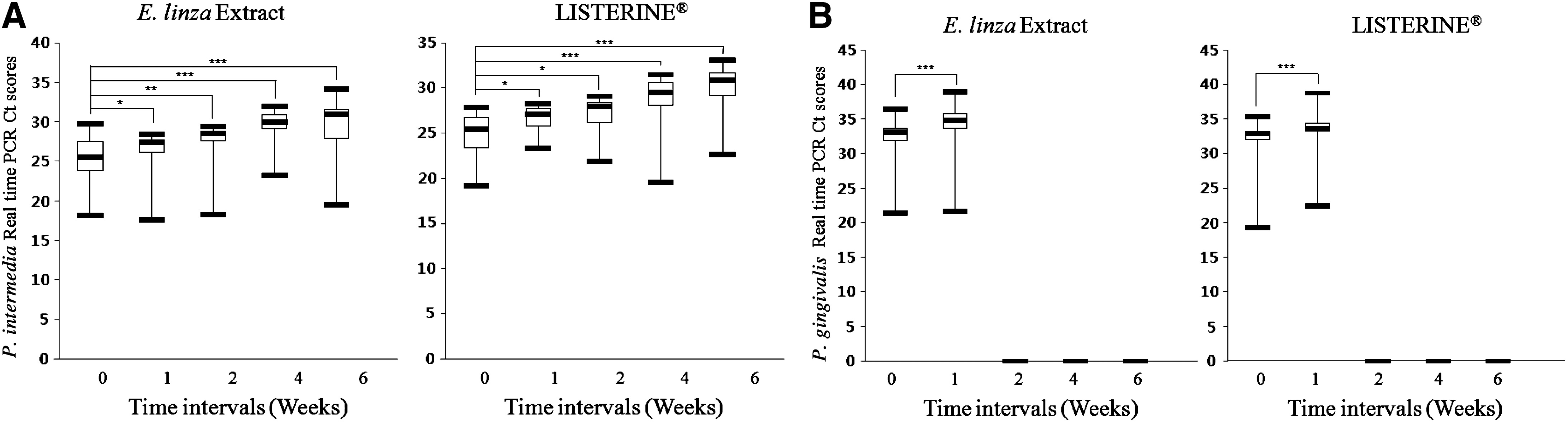
Comparison of the (
Discussion
We reported previously that the E. linza extract exerted a profound antimicrobial activity against P. intermedia and P. gingivalis, which are bacterial strains associated with gingival disease. 14 In this study, we further investigated the clinical and microbial effects on gingivitis disease of a mouth rinse containing E. linza extract, and we evaluated the content of bioactive compounds in the E. linza extract and mouth rinse product. Fifty-five subjects between the ages of 19 to 34 years were recruited for this study, and a 6-week clinical experiment was performed. Among the 55 subjects who participated in this study, 53 subjects completed the 6-week study; two volunteers from the E. linza group were excluded because they did not regularly attend the scheduled appointments (E. linza group, 35 subjects; Listerine, 18 subjects). The mean scores of each clinical assessment were determined for each subject group.
Gingival diseases are complex lesions that are associated with various risk factors. Toothbrushing is the most common method for plaque removal. However, toothbrushing is not an appropriate method for the removal of plaques in the embrasure and gingival sulcus of normal dentition. Recently, mouth rinses have been used as preventive agents against dental disease. E. linza has been identified as having strong natural antimicrobial and antifungal properties. Therefore, we designed a clinical study to evaluate the potential antiperiodontal disease properties of a mouth rinse containing an extract of E. linza.
First, we designed a clinical study to determine the effects of a twice-daily regimen of an E. linza extract mouth rinse on PI, GI and BOP at dental sites. The use of the E. linza extract mouth rinse over a 4-week period resulted in significant reductions in plaque, improved the condition of the gingival tissues, and reduced bleeding. Moreover, in the group that did not use the E. linza extract mouth rinse, no statistically significant differences were observed between the 4–6-week period and the 4-week period. These results indicate that the E. linza extract mouth rinse evidenced significant antigingival effects. Additionally, the E. linza extract mouth rinse was shown to inhibit the growth of the two bacteria tested (4–6-week period; no use of mouth rinse). Moreover, the effects of the E. linza extract mouth rinse were similar to those observed for the group that used Listerine, which has been previously shown to reduce PI, GI, and BOP compared with baseline. 15
Second, the effect of the E. linza extract mouth rinse on the growth of P. gingivalis and P. intermedia in each subject was determined via real-time PCR. The two different bacteria exist in different stages. 13 P. intermedia bacteria exist in the early periodontal or normal stage, whereas P. gingivalis bacteria exist in periodontal disease patients. Our data reveal that P. gingivalis was not present at 2, 4, and 6 weeks in the group using the E. linza mouth rinse, which indicates that this treatment prevented or inhibited the growth of P. gingivalis. The presence of P. intermedia was reduced significantly at 4 weeks, relative to baseline. In particular, the levels of reduced P. intermedia after 4 weeks in the E. linza extract group was approximately 6.5% higher than that seen at 4 weeks in the Listerine group. Moreover, the E. linza extract mouth rinse continued to inhibit P. intermedia throughout the 4–6-week period, relative to the group that did not use the mouth rinse containing the E. linza extract. This result indicates that the E. linza extract mouth rinse significantly inhibited the growth of these two bacteria and that this inhibition was maintained over a prolonged period. Our data indicate that these clinical activities may dependent on the amount of bioactive compounds in the in the mouth rinse containing E. linza.
Additionally, the effects of the E. linza mouth rinse were similar to those of Listerine, a popular high-strength mouth rinse. Axelson and Lindhe 22 previously demonstrated that Listerine reduced PI and GI by approximately 50% in a 6-week study. It is interesting that these results were similar to those observed in this study (effect of Listerine on the clinical index). Thus, the E. linza mouth rinse holds great promise as a powerful agent for the prevention or suppression of gingival disease, and such a product may be commercially valuable.
In summary, the results of this clinical study demonstrated that a mouth rinse containing E. linza extract significantly reduced plaque, improved the condition of gingival tissues, and reduced bleeding. Moreover, our results showed that the E. linza extract mouth rinse significantly inhibited P. gingivalis and P. intermedia. These results indicate that the E. linza extract mouth rinse showed antiplaque efficacy comparable to that of Listerine.
Footnotes
Acknowledgments
This research was a part of the project titled “Development of Lipid Lowering Food and Drug Biomaterials with Korean Seaweed” funded by the Ministry of Food, Agriculture, Forestry and Fisheries, Korea, to B.-.Y.L. and by grant number RTI05-01-02 from the Regional Technology Innovation Program of the Ministry of Knowledge Economy to B.-Y.L. E. linza extract and test product were supported by Park Nam Hee, an engineer at Gijang Mulsan Co., Ltd.
Author Disclosure Statement
No competing financial interests exist.