




Abstract
In this study, a crude polyphenol extract (CPE) from defatted grape seeds was evaluated for antioxidant and cytoprotective effects in PC12 cells. The CPE was then fractionated into a catechin and oligomeric procyanidin fraction (Fcat+olig) and a polymeric procyanidin fraction (Fpol), and the bioactivities of the fractions were evaluated individually. Fpol was the richest in total polyphenol, total flavonoid, and polymeric procyanidin but contained less flavan-3-ol than Fcat+olig. Consistent with these results, Fpol had the highest 2,2-diphenyl-β-picrylhydrazyl radical scavenging activity and reducing power. Both Fcat+olig and Fpol had higher 2,2′-azino-bis(3-ethylbenzthiazoline-6-sulfonic) acid radical scavenging activity than CPE. The resistance of PC12 cells against oxidative stress, after pretreatment with Fpol (200 μg/mL) for 9 h, was 100.7±2.9% of that in the control. Moreover, pretreating these cells with Fcat+olig and Fpol significantly decreased reactive oxygen species generation. These results provide information on a potential new source of antioxidants in the form of a functional food derived from an agricultural by-product.
Introduction
F
Some agricultural and industrial residues are abundant sources of natural antioxidants. Grape seeds are a major by-product of wine and grape juice production. Grape seeds have recently been used for the production of grape seed oil, which is a valuable food product and cosmetic ingredient. However, the oil extraction process generates another by-product: defatted grape seed meal. Defatted grape seed meal is a rich source of monomeric phenolic compounds, such as catechin, epicatechin, epicatechin gallate, and dimeric, oligomeric, and polymeric procyanidins, which are known to have pharmacological and therapeutic potential. 5 The different linkage types, subunits, and chain lengths of these procyanidins produce a variety of structures with different biological activities. 6 Some low-molecular-weight procyanidins from grape seeds, including catechin and several dimeric and trimeric procyanidins, have been studied and appear to have potent antioxidant capacity. 7 However, the biological activities of oligomeric and polymeric procyanidins from defatted grape seed meal are largely unknown. Therefore, the aim of this study was to examine the antioxidant activities and cytoprotective effects of oligomeric and polymeric procyanidin fractions from defatted grape seed in PC12 cells.
Materials and Methods
Sample preparation
Samples from defatted grape seed meal were prepared using open-column chromatography (Fig. 1). 8 In brief, 100 g of defatted grape seed meal was obtained from the Campbell early grape variety, which is widely cultivated in Korea, and extracted with 75% (vol/vol) acetone followed by 80% (vol/vol) methanol. Each solvent extraction was performed by stirring for 12 h at room temperature. The combined supernatants were evaporated to remove organic solvents, subjected to hexane extraction to eliminate fatty materials, and then filtered through a membrane filter (pore size, 0.45 μm). The aqueous polyphenolic solution was stored at −20°C prior to fractionation on C18 open columns or lyophilized to obtain a brownish-yellow powder, referred to as the crude polyphenol extract (CPE). For fractionation, a 50-mL volume of the aqueous polyphenolic solution (13.6 mg of dry matter/mL) was loaded onto an open column (200×25 mm i.d.) packed with Cosmosil® 75C18-OPN (particle size, 75 μm; Nacalai Tesque Inc., Kyoto, Japan). Elution began with 100 mL of distilled water, adjusted to pH 7.0, to eliminate the phenolic acids, followed by 100 mL of ethyl acetate to elute the fraction of catechins and oligomeric procyanidins (Fcat+olig). Finally, the fraction of polymeric procyanidins (Fpol) was eluted with 150 mL of methanol. Each fraction was evaporated to dryness under vacuum, dissolved to a concentration of 100 mg/mL with dimethyl sulfoxide, and stored at −20°C until use.
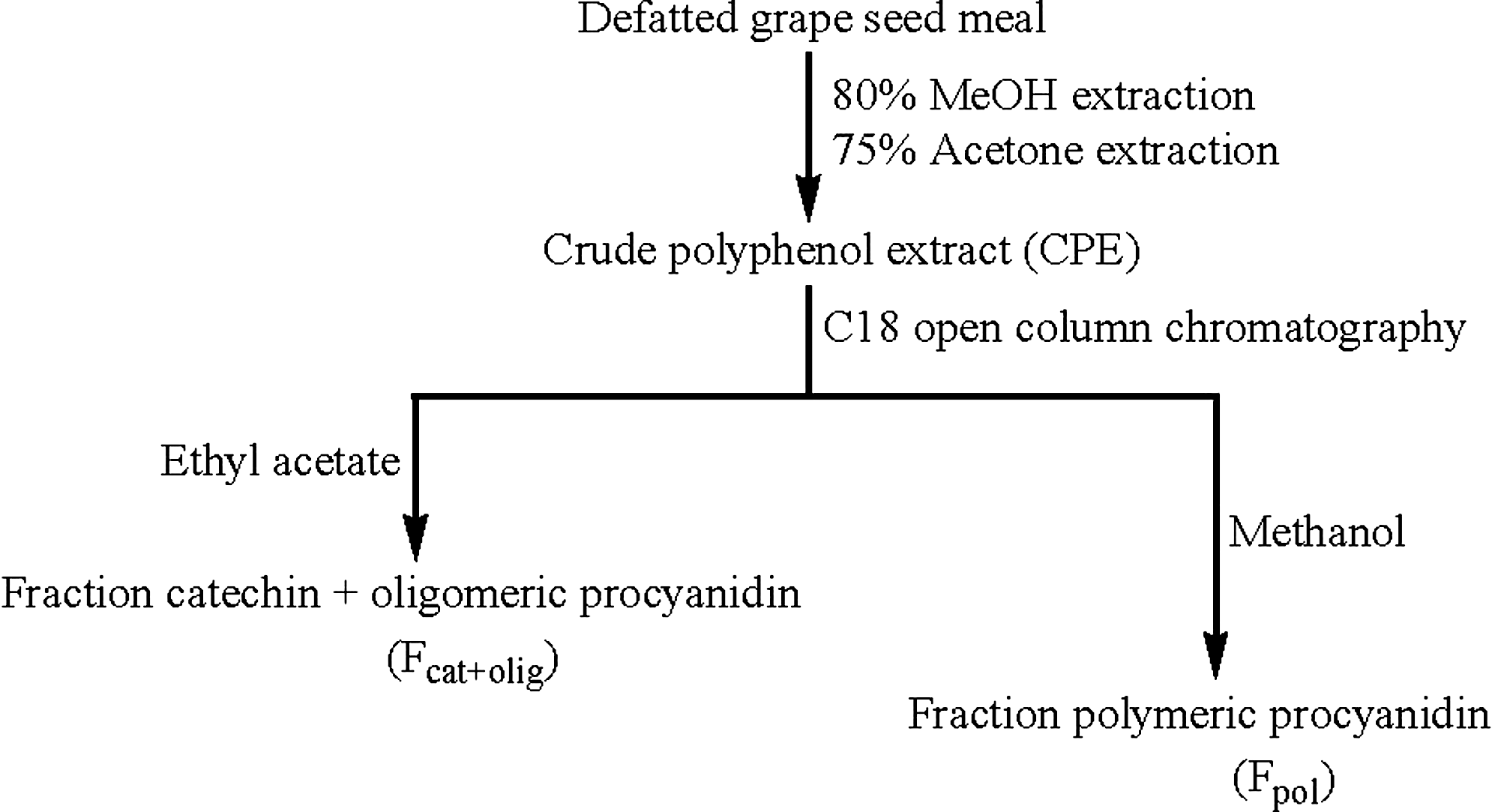
The procyanidin extraction and fractionation process from defatted grape seed meal. MeOH, methanol.
Determination of antioxidant compounds
Total polyphenolic and flavonoid contents were determined according the method of Singleton and Rossi 9 and a previously developed colorimetric method, 10 respectively. Flavan-3-ol content was determined following the 4-dimethylaminocinnamaldehyde-HCl protocol, 11 and total polymeric procyanidins were determined using the butanol-HCl assay. 12
Antioxidant activity
The free radical scavenging activity of the samples was measured in terms of hydrogen donating or radical scavenging ability by using the 2,2-diphenyl-β-picrylhydrazyl (DPPH) stable radical 13 and 2,2′-azino-bis(3-ethylbenzthiazoline-6-sulfonic) acid (ABTS) radical cation. 14 Also, a protocol based on the ferric reducing power assay was used to determine the reducing ability of the samples. 15
Cell culture and cytotoxicity
PC12 cells were obtained from the Korean Cell Line Bank (Seoul, Korea) and grown in Dulbecco's modified Eagle's medium supplemented with 10% heat-inactivated horse serum, 5% heat-inactivated fetal bovine serum, 100 U/mL penicillin, and 100 mg/mL streptomycin in a humidified 5% CO2 atmosphere at 37°C. Cell viability was measured using the 3-(4,5-dimethylthiazol-2-yl)-2,5-diphenyltetrazolium bromide (MTT) assay. PC12 cells were seeded in 96-well plates (2×10⁴ cells per well) and incubated for 36 h. The cells were then treated with different concentrations of the residue samples (0, 25, 50, 100, or 200 μg/mL) for 9 h. After 9 h, 0.5 mg/mL MTT reagent, dissolved in Dulbecco's modified Eagle's medium, was added to each well, and the cells were incubated for 3 h at 37°C. The culture medium was discarded, and dimethyl sulfoxide was added to each well to solubilize the formazan product. The optical density was measured at 550 nm with a spectrophotometer.
Cell-protective effects and intracellular reactive oxygen species analysis
PC12 cells were seeded in 96-well plates at a density of 2×10⁴ cells per well. After 36 h, the culture medium was replaced with serum-free medium containing various concentrations of samples (0, 25, 50, 100, or 200 μg/mL). After 9 h, the culture medium containing the samples was discarded, and the cells were treated for 3 h with H2O2 (500 μM) to induce oxidative stress. Then, cell viability, as an indicator of the cytoprotective effects of the samples, was evaluated using the MTT assay. All experiments were performed in triplicate or more. Reactive oxygen species (ROS) were quantified using the 2′,7′-dichlorofluorescein-diacetate fluorescent probe, as previously described. 16
Statistical analysis
All data are expressed as mean±SD values and are representative of three or more independent experiments. Significant differences were determined by analysis of variance using SAS version 9.0 (SAS Institute Inc., Cary, NC, USA). A P value of < .05 was considered significant.
Results and Discussion
We prepared CPE from defatted grape seed meal, and it was further fractionated into Fcat+olig and Fpol (Fig. 1). Fpol had the highest levels of total polyphenols and flavonoids (Table 1). Fcat+olig was the richest in flavan-3-ols, and the amount was approximately three times higher than that in CPE or Fpol. The level of polymeric procyanidin was highest in Fpol. These results showed that the highest total amounts of polyphenols, flavonoids, and polymeric procyanidins were found in Fpol, whereas the highest total amounts of flavan-3-ols were observed in Fcat+olig, as expected. Extracts from grape seeds may help prevent some degenerative diseases because they contain considerable amounts of powerful antioxidants such as catechins and procyanidins. In particular, procyanidins are known to have a remarkable ability to protect against oxidative cellular damage. 17
Data are mean±SD values.
Means within a column with different subscript letters are significantly different by Tukey's Studentized range test, P<.05.
Mean of triplicate determinations expressed as mg of gallic acid equivalents (GAE)/g of residue using the Folin–Ciocalteu reagent.
Mean of triplicate determinations expressed as mg of (+)-catechin equivalent (CE)/g of residue using the aluminum chloride colorimetric assay.
Mean of triplicate determinations expressed as mg of (+)-CE/g of residue using the 4-dimethylaminocinnamaldehyde-HCl method.
Mean of triplicate determinations expressed as mg of procyanidin B1 equivalent/g of residue using butanol-HCl.
CPE, crude polyphenol extract; Fcat+olig, catechin and oligomeric procyanidin fraction; Fpol, polymeric procyanidin fraction.
It is generally assumed that the antioxidant capacity of a molecule or extract is equivalent to its capacity to react with free radicals. Thus, total antioxidant activity was evaluated by ABTS and DPPH radical scavenging activity and reducing power (Table 2). ABTS radical scavenging activity ranged from 0.959 to 1.299 mg of Trolox® (Hoffmann-La Roche, Basel, Switzerland) equivalent antioxidant capacity/mg of residue. Fcat+olig and Fpol had higher DPPH radical scavenging activity than CPE, and Fpol had significantly higher reducing power than the other fractions. These results showed that Fcat+olig and Fpol have higher antioxidant properties than CPE. These results may be due to their higher procyanidin levels and are consistent with the distribution data for phenolics (Table 1). It is well known that oxidative stress is associated with many forms of neuronal cell damage, resulting in many neurological diseases and disorders. 18 On the basis of these results, we decided to investigate the cytoprotective effects of the oligomeric and polymeric procyanidin fractions, Fcat+olig and Fpol, respectively, from defatted grape seed in PC12 cells.
Data are mean±SD values from triplicate determinations, expressed as mg of Trolox equivalent antioxidant capacity (TEAC)/mg of residue.
Means within a column with different superscript letters are significantly different by Tukey's Studentized range test, P<.05.
ABTS, 2,2′-azino-bis(3-ethylbenzthiazoline-6-sulfonic) acid; DPPH, 2,2-diphenyl-β-picrylhydrazyl.
Neurodegenerative disorders are globally distributed, and oxidative stress is one of the factors responsible for these diseases. 19 As shown in Figure 2A, CPE-, Fcat+olig-, and Fpol-treated cells did not show any cytotoxicity up to 200 μg/mL. The incubation of PC12 cells in the presence of 500 μM H2O2 for 3 h led to a 50% increase in cell death (Fig. 2B). However, pretreatment of the cells with the residue samples at 25–200 μg/mL for 9 h increased cell viability in a dose-dependent manner. The most effective protection against oxidative stress was given by Fpol pretreatment. The viability of PC12 cells in the presence of oxidative stress induced by H2O2 was 100.7±2.9% after exposure to Fpol (200 μg/mL), in comparison with that in the control. In previous studies, it has been reported that flavonoids such as epicatechin and catechin have the potential to protect PC12 cells from cell death. 20 In addition, cocoa procyanidins and procyanidin B2 were shown to protect neurons from H2O2-induced apoptosis through inhibition of the phosphorylation of c-Jun N-terminal protein kinase and p38 mitogen-activated protein kinase. 21 The present study showed that procyanidin fractions from defatted grape seed meal had protective effects on PC12 cells and may have general cytoprotective effects.
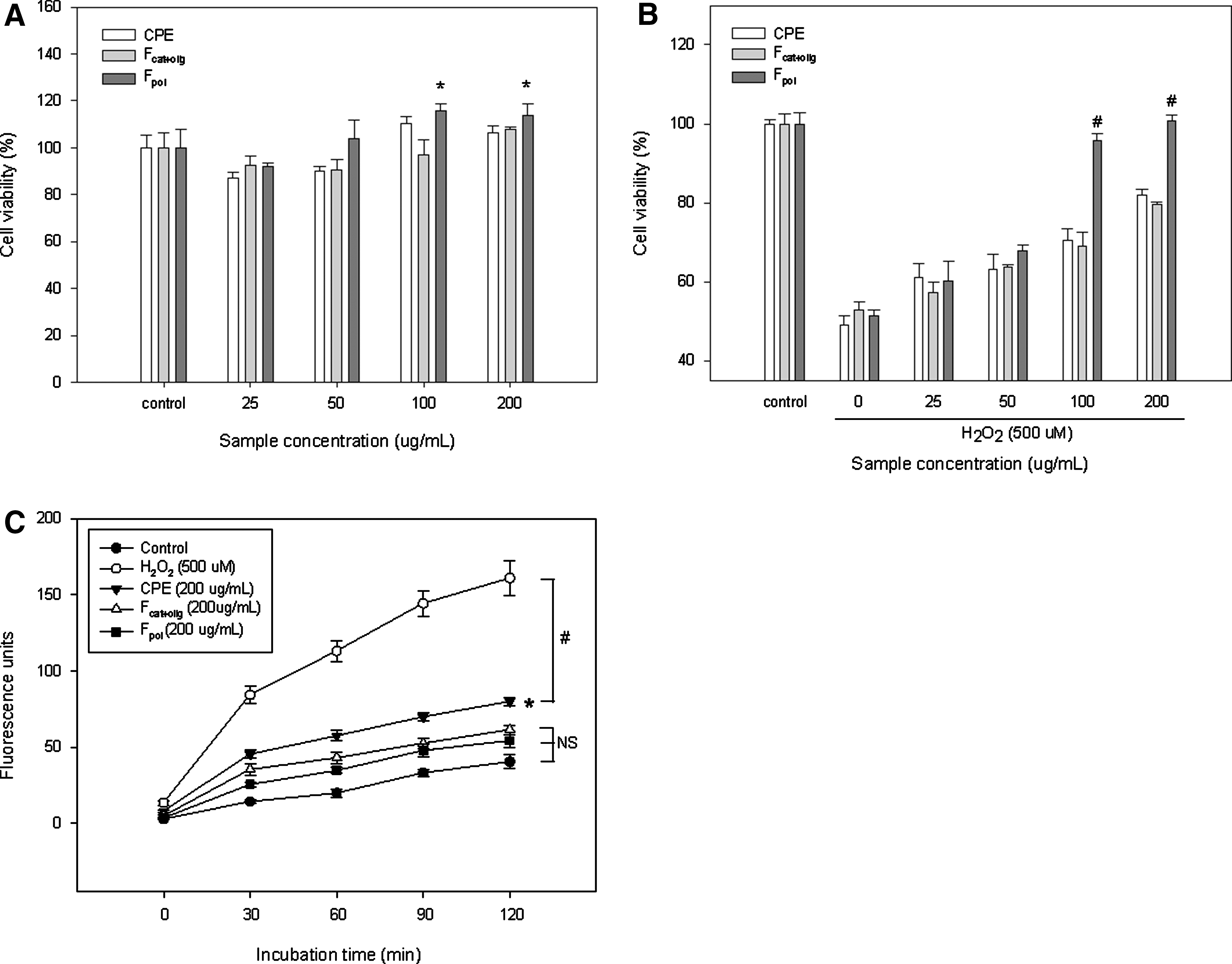
Cell-protective properties and effects on reactive oxygen species generation of CPE and procyanidin fractions in PC12 cells.
Next, we measured intracellular ROS production using 2′,7′-dichlorofluorescein-diacetate staining to evaluate whether procyanidin fractions attenuate H2O2-induced oxidative stress in PC12 cells. PC12 cells were treated for 9 h with the various concentrations of samples (0, 25, 50, 100, or 200 μg/mL) before treatment with 500 μM H2O2. All samples—CPE, Fcat+olig, and Fpol—inhibited ROS generation, in comparison with the findings obtained for H2O2 treatment only (Fig. 2C). However, ROS production was more effectively inhibited by pretreatment with Fcat+olig or Fpol. Accumulation of cellular ROS is a major cause of intracellular damage and can lead to various diseases such as cancer, cardiovascular disease, and diabetes. 22
In conclusion, although further studies are required to fully elucidate the mechanisms behind these antioxidant and cytoprotective effects, these results suggest that oligomeric and polymeric procyanidin fractions from defatted grape seed meal have significant health-promoting properties.
Footnotes
Author Disclosure StaTEment
There are no existing conflicts of interest.