




Abstract
We assessed whether fraction SX derived from maitake mushroom could play a beneficial role in the treatment of a laboratory model of type-1 diabetes by decreasing circulating glucose levels and lowering blood pressure (BP). We injected 50 mg/kg body weight (BW) streptozotocin (STZ) intraperitoneally (i.p.) into 48 male Sprague-Dawley rats (SD) to produce a laboratory model of type-1 diabetes. SD were divided into four groups of 12 SD. A control group ate straight pulverized rat chow. To three treatment groups, we added into the pulverized rat chow: gliclazide (10 mg/kg), pioglitazone (10–30 mg/kg), or maitake SX (2.5 g/kg). In addition to measuring BW, circulating glucose level, and BP, the following procedures were also carried out: insulin challenge (insulin sensitivity), losartan challenge (renin–angiotensin system activity), Nw-nitro-L arginine-methyl ester hydrochloride (LNAME) challenge (nitric oxide [NO] system activity), and evaluation of serum angiotensin converting enzyme (ACE) activity. All treatments compared with control generally decreased circulating glucose levels, but only the maitake SX consistently enhanced measured insulin sensitivity. We found that maitake SX could significantly lower systolic blood pressure (SBP) in diabetic SD. In general, only SD receiving maitake SX, not the two drugs, showed decreased activity of the renin–angiotensin system and increased NO system activity compared with control under the conditions examined. Our results suggest that maitake SX may be useful for treating perturbations in glucose-insulin metabolism and elevated BP in type-1 diabetes.
Introduction
M
Why is this important? In the characteristic form of clinical type-2 diabetes, there is often sufficient circulating insulin; but the target cells do not respond properly and are said to be insulin resistant. 11 –15 Maitake SX is, at least to some extent, an insulin sensitizer making the actions of circulating insulin more effective at the periphery. 8 –10 Therefore, it is not surprising that maitake SX may be useful in treating insulin resistance and maladies associated with it in humans. 16,17
In contrast to benefits in insulin resistant and type-2 diabetes, effectiveness of maitake SX is less certain in type-1 diabetes, an insulin-dependent form of diabetes, where a deficiency of circulating insulin is the principal basis for the glucose perturbations. Fortunately, a laboratory model for this malady does exist. Injection of the antibiotic streptozotocin (STZ) into rodents injures the pancreatic beta cells and induces a well-recognized laboratory model of type-1 diabetes mellitus with low circulating levels of insulin. 18 –20
The primary purpose behind the present research was to study in STZ-induced diabetic Sprague-Dawley rats (SD) the effects of maitake SX fraction and two different antidiabetic drugs with dissimilar major mechanisms of action on circulating glucose levels and BP.
Materials and Methods
Protocol
The Animal Welfare Board at Georgetown University Medical Center approved this protocol. Forty-eight male SD approximately 6 weeks old and weighing between 320 and 380 g were obtained from Taconic Farms (Germantown, NY, USA). The SD were housed, two per cage, in a constant temperature room that had a light–dark phase of 12 hours. All rats ate pulverized rat chow (Purina LabDiet, Brentwood, MO, USA). After 5 days of acclimatization, SD were divided into four groups composed of 12 rats. The four groupings of the SD were such that the systolic blood pressure (SBP) readings and body weight (BW) were virtually the same at the commencement of the study. On the same day as intraperitoneal (i.p.) STZ injection (50 mg/kg BW), the planned diets were assigned to each group. The control group continued to consume straight pulverized rat chow, while the same pulverized diets of the test groups contained either an additional 10 mg/kg pioglitazone or 10 mg/kg gliclazide obtained from Fisher Scientific (Pittsburgh, PA, USA) or 2.5 g/kg of maitake SX obtained from Mushroom Wisdom (East Rutherford NJ, USA). Gliclazide and pioglitazone were examined to allow comparisons (positive controls) to the effects of mushroom extract. After 89 days, the amount of pioglitazone in that diet was increased from 10 to 30 mg/kg.
Materials
The water-soluble fraction of powdered whole maitake mushroom designated maitake SX is a glycoprotein with an average molecular weight of 20,000 Da that is extracted from maitake mushroom through a proprietary process developed by Mushroom Wisdom, Inc., which also provided the extract under investigation (lot# 100625).
Special tests
During the course of study, specialized tests such as insulin challenge testing (ICT), losartan challenge, and Nw-nitro-L arginine-methyl ester hydrochloride (LNAME) challenge were carried out. Details of these procedures follow below.
Food and water intake (24 hours)
Food and water intakes over 24 hours were estimated on days 31, 106, and 126 by subtracting the weight of the remaining food and the volume of remaining water from the measured amounts given the day before. On day 126, the diets of the control and maitake SX groups were switched for a 3-day period, and food and water intakes were measured in these two groups on day 130, the last day of study.
Body weight (grams)
BW was estimated by routine scale measurements. Two readings taken at least 10 minutes apart on the given day had to be within 2 g of each other or the procedure was repeated until the weights were consistently within the 2-g range.
Circulating glucose and insulin levels
Blood was obtained from the rat tail for measurements. Blood glucose measurements were made at frequent intervals, 12 times over 126 days. Glucose was estimated using commercial glucose strips (Lifescan, One Touch Ultra, Melitas, CA, USA). Circulating insulin concentrations were measured at a single time point, day 50. Immunoreactive rat insulin was determined by radioimmunoassay (Diagnostic Products Corporation, Los Angeles, CA, USA).
Insulin challenge testing
ICT was performed on days 18, 38, 89, and 130. Testing was begun after 17–19 hours of food deprivation. For ICT, 0.6 U of regular insulin/kg BW (Eli Lilly Co., Indianapolis, IN, USA) was administered i.p. For the glucose determinations, blood was obtained from the tail vein at 15 minutes after injection. Glucose was estimated using commercial glucose strips (Lifescan, One Touch Ultra). The magnitude of glucose decrease after insulin challenge estimates sensitivity—with greater decrease suggesting higher sensitivity.
Blood pressure (mm Hg)
SBP was measured by tail plethysmography using two different instruments. 21 The primary instrument was obtained from Narco Biosciences (Houston, TX, USA). This machine with a beeper sound system allowed us to rapidly measure SBP over a short period of time. The second instrument was obtained from Kent Scientific Corporation (Torrington, CT, USA). This is a computerized, noninvasive tail cuff acquisition system that utilizes a specially designed differential pressure transducer to noninvasively measure the blood volume in the tail. The latter instrument not only allowed us to read SBP, but also diastolic blood pressure (DBP) and cardiac rate. Previous experienced showed that both instruments produced essentially the same SBP readings. 22
In all studies, rats were allowed free access to their diet and water until SBP readings were obtained between 13.00 and 17.00 hours. Readings on individual rats were taken 0.5–1 minutes apart. To be accepted, SBP measurements on a given rat had to be virtually stable for at least three consecutive readings, that is, within a 5 mm Hg range of each other. Numerous individual readings were recorded over the course of the 130-day study.
Losartan challenge
This test using the angiotensin receptor blocker, losartan, was performed on days 54 and 104. After performing baseline SBP readings, SD from all dietary groups were given 20 mg/kg losartan orally via gastric lavage. 23 Three and six hours after lavage, SBP was remeasured. The decreased SBP after losartan was used to estimate activity of the renin-angiotensin system with a greater decrease in SBP connoting augmented system activity. 22 Previous studies established that the lowest values of BP reached a plateau for a couple of hours after the 6 hours mark.
Serum angiotensin converting enzyme activity
Serum angiotensin converting enzyme (ACE) activity was measured by a commercial kit (Sigma Co. Ltd, St. Louis, MO). This spectrophotometric method utilizes the synthetic tripeptide substrate N-[3-(2-furyl)acryloyl]-phenylalanylglcylglcine (FAPGG). FAPGG is hydrolyzed by ACE to furylacryloylphenylalanine and glycylglycine. A decreased absorbency at 340 nm could result from hydrolysis of FAPGG. Serum ACE activity is compared to a control standard. 24
LNAME challenge
Effects of nitric oxide synthase (NOS) inhibition on SBP were measured. 25 After baseline measurements of SBP, the NOS inhibitor LNAME at a dose of 10 mg/kg was given i.p. Each rat received a single dose of LNAME that increased SBP signifying inhibition of the nitric oxide (NO) system. Measurements of SBP were taken at 7, 15, and 20 minutes postinjection. The area under the curve (AUC) relative to baseline was used to estimate the NO system activity with a greater increase in SBP AUC suggesting higher NO activity.
Statistical analyses
All of the results are presented as mean±standard error of the mean (SEM). SBP and BW were examined by repeated measures, two-way analyses of variance (one factor being group and the second factor being time of examination). Where a significant effect of regimen was detected by analysis of variance (ANOVA; P<.05), the Dunnett t test was used to establish which differences between means reached statistical significance. 26 When the data from two columns were analyzed at a single time point, Student's t test was used. Statistical significance was set at a P<.05. A trend is defined as .05<P<.1.
Results
Body weight
At the beginning, the average BW of the four groups of SD were not significantly different, that is, control=355±6.2 g (SEM), gliclazide=356±8.0 g (SEM), pioglitazone=349±5.7 g (SEM), and maitake SX=344±5.9 g (SEM) (Fig. 1). There was a healthy increase in mean BW in three of the four groups of SD over the 4-month study. After 123 days, the average BW of the control and pioglitazone groups were virtually similar, that is, control=441±28 g (SEM), pioglitazone=445±27 g (SEM). The gliclazide group had the highest average BW gain of the four groups by the end of the study, gliclazide=512±26 g (SEM)—a mean gain of 156 g. Differently, the maitake SX group showed a lesser increase over baseline throughout the course of study. The mean BW of maitake SX group at the end of the experiment was the lowest of the four groups—maitake SX=364±19 g (SEM)—a mean gain of only 20 g over the 4-month period.
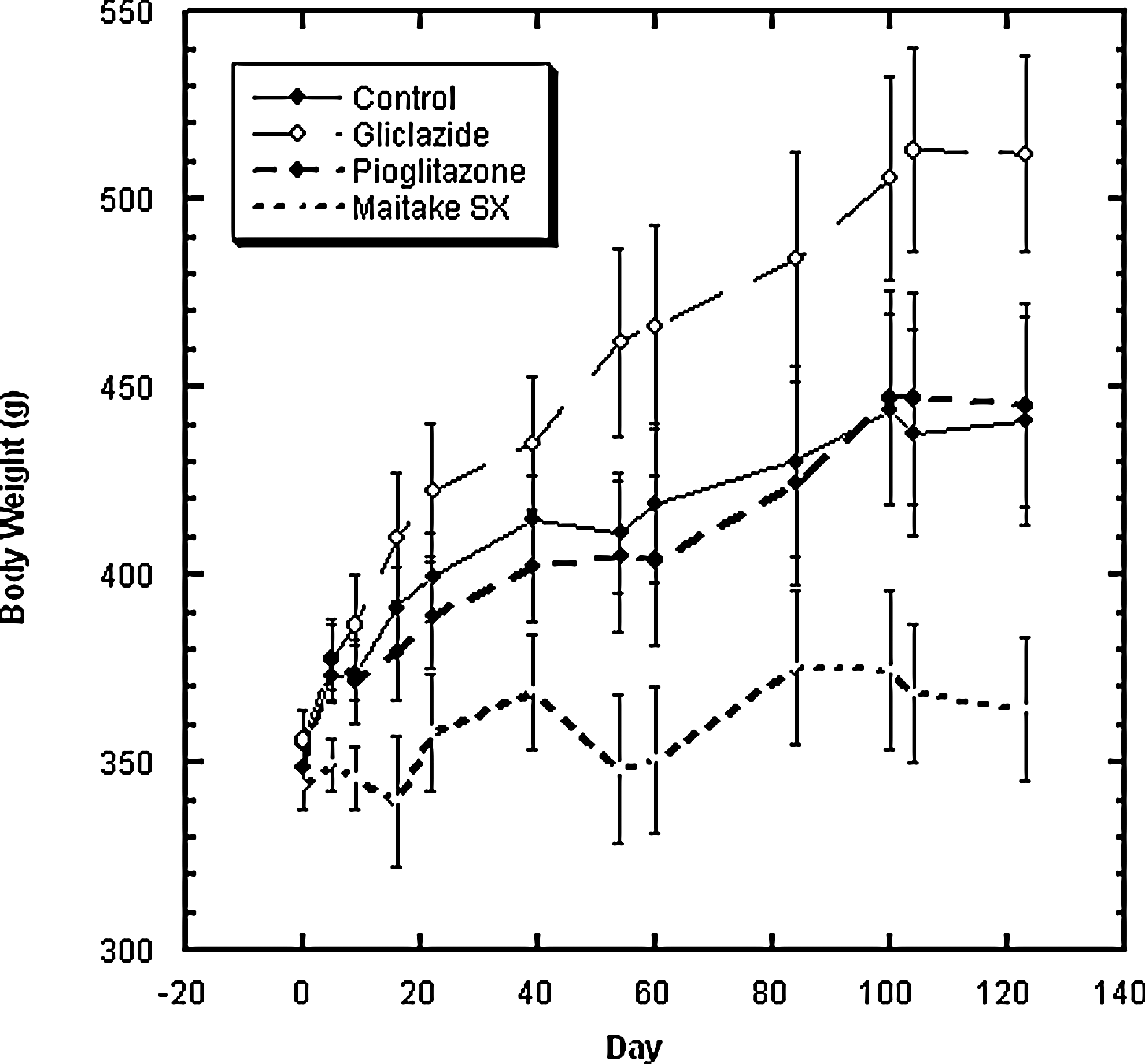
Changes in the body weight of four groups of Sprague-Dawley rats showing mean ± SEM of 12 rats. SEM, standard error of the mean.
Food and water intake
There were no significant differences in 24 hours food intake among the groups with the exception of the maitake SX group at 106 days (Table 1) at which time the data show a statistically significant decrease in food ingestion in the maitake SX group. Repeat examination on day 126 showed the lowest intake of food in the maitake SX group, but this value did not prove to be statistically significantly different from control. On day 130, we switched foods between the control and maitake SX groups. The control group ate the diet with maitake SX and the maitake SX group ate the general control diet. The average food intake of the control group under these changed circumstances was 22.2±0.9 g/24 h (SEM) and for the maitake SX group now eating a control diet was 22.3±1.7 g/24 h (SEM). The latter values are emboldened in Table 1.
Data are mean±SEM (in g/24 h). On day 127 (boldface) the control and maitake SX groups switched diets for 3 days.
Statistically significant, P<.05 vs. control.
SEM, standard error of the mean.
Circulating glucose levels
The control group showed the highest average circulating glucose levels throughout the study. The other three treatment groups for the most part had glucose level statistically lower than the control with similar average values over the 4 months of study (Table 2).
Data are mean±SEM (in mg/dL).
Statistically significant, P<.05 vs. control.
Trend, .05<P<.1 vs. control.
Insulin levels on day 50
On day 50, circulating insulin levels were measured. The average levels of all groups were extremely low, ranging from 0.30 to 0.38 ng/mL. In a separate study being carried out on SD of similar size, we found the level of these supposedly normal control rats (n=12) to be 2.38±0.11 ng/mL (SEM). All these data are shown in Figure 2.
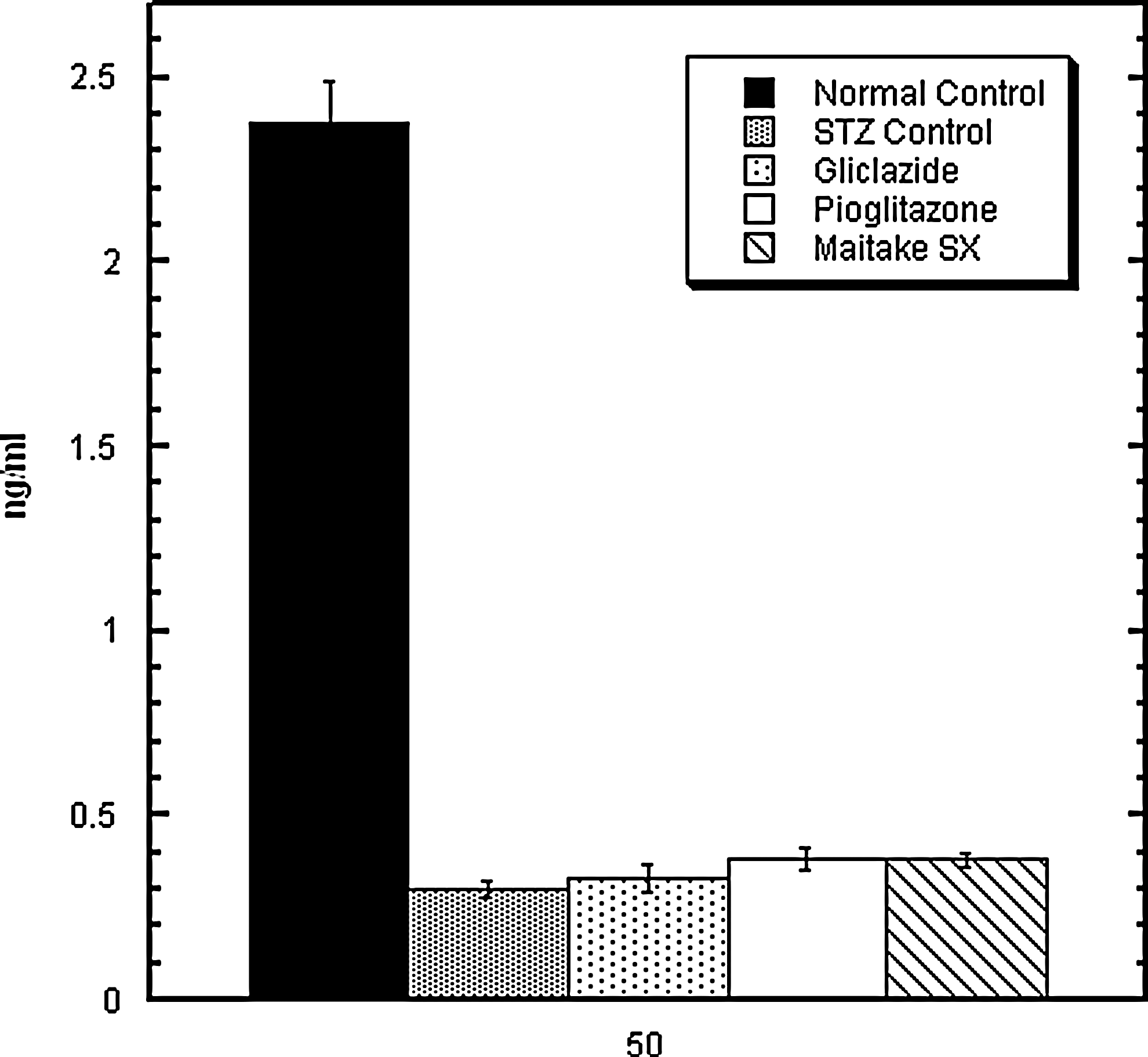
Circulating insulin levels (ng/mL, n=12 in each group). Mean ± SEM shown.
Insulin challenge test
All the groups were challenged with intraperitoneal regular insulin on four occasions (Table 3). As a general trend, 15 minutes after regular insulin challenge, there were no significant differences in decreased glucose levels between the control group and gliclazide groups with the exception of the last study period. The decreased differences in the group tended to be a little greater than the former two groups but only statistically significant on the last day of study, whereas the maitake SX group consistently showed the greatest depression of all four groups and was statistically greater than the control group on three of the test days. On the test day (day 38), the decreased change showed a trend.
Data are mean±SEM of changes in glucose levels (in ng/mL).
Statistically significant, P<.05 vs. control.
Trend, .05<P<.1 vs. control.
SBP readings after STZ in SD
SBP of all four groups steadily increased over the course of the experiment (Table 4). However, the SBP of the gliclazide and maitake SX groups were generally lower at each time point than the control group; but only the maitake SX group showed a consistent statistically significant lowering compared with the control at each reading. Accordingly, the maitake SX group usually had the lowest average SBP in four groups. The average SBP of gliclazide and pioglitazone groups consistently fell between the control and maitake SX readings, with their average SBPs roughly the same.
Data are mean±SEM (in mm Hg).
Statistically significant, P<.05 vs. control.
Trend, .05<P<.1 vs. control.
On day 126, cardiac readings were taken with the Kent apparatus (see Materials and Methods; Table 5). The SBP readings were comparable to those seen with the other apparatus (Table 4). The maitake SX group showed a significant lowering of SBP. While the DBP was lowest in the maitake SX group, this value did not reach statistical significance when compared with the control. Also, no differences in cardiac rate were seen among the four groups.
Data are mean±SEM of 12 rats.
Statistically significant, P<.05 vs. control.
SBP, systolic blood pressure; DBP, diastolic blood pressure.
Losartan challenge
A losartan challenge was given to all groups at two time points (day 54 and 126; Table 6). Six hours after oral losartan, the average decrease from baseline in the control group was respectively 28.8 and 25.0 mm Hg. The gliclazide and pioglitazone groups virtually showed the same decreases. At both time points, the maitake SX group showed significantly lesser decreases in SBP from baseline when compared control.
Data are mean±SEM of delta from baseline (in mm Hg).
Statistically significant, P<.05 vs. control.
ACE activity
We assessed circulating ACE activity twice on days 62 and 106 (Table 7). Only the maitake SX group showed statistically significantly less renin–angiotensin activity on both occasions. On day 106, the pioglitazone group showed a statistical trend for lower serum activity.
Data are mean±SEM (in units of ACE/mL of serum).
Statistically significant, P<.05 vs. control.
Trend, .05<P<.1 vs. control.
Effect of LNAME challenge on SBP
LNAME was injected into SD to estimate NO activity (Table 8). After 15 minutes, there was a significant increase of SBP under the curve (AUC) for all test groups. Compared with elevations in the control, only the maitake SX group showed a greater elevation than the control that appeared on both day 60 and 100.
Data are mean±SEM of delta from baseline (in mm Hg).
Statistically significant, P<.05 vs. control.
Discussion
We previously examined effects of maitake SX on glucose-insulin metabolism and elevated BP using a laboratory model simulating certain aspects of type-2 diabetes. 6 –10 The major pathology behind type-2 diabetes is the inability of peripheral tissues to respond appropriately to what should be adequate levels of circulating insulin—a state often referred to as “insulin resistance”. 11 –15 We created so-called insulin resistance and elevated BP in our laboratory model by feeding rats high amounts of sucrose. 27 –29 With heavy sucrose feeding, we verified that blood levels of insulin rise above normal supposedly in an attempt to overcome insulin resistance. Giving maitake SX in the insulin-resistant state consistently diminishes circulating levels of insulin suggesting strongly that the mushroom extract is lowering blood glucose levels by ameliorating insulin resistance. We also found that maitake SX acts as an ACE inhibitor decreasing circulating levels of angiotensin 2 and augmenting activity of the NO system. 10 The latter two findings no doubt explain, at least in part, the ability of maitake SX to lower of BP.
Considering the above, we were unsure whether maitake SX would significantly influence type-1 diabetes, where, in contrast to type-2 diabetes, low circulating levels of insulin are characteristic. Because the glucose perturbation is brought about largely from a lack of sufficient circulating insulin in type-1, this brings up the question whether so-called insulin sensitizers like maitake SX could be helpful in treating type-1. In this regard, we needed answers to two specific questions in the present study. First, could maitake SX enhance insulin sensitivity enough in the presence of low circulating insulin to successfully lower the elevated glucose levels? Second, would maitake SX lower BP effectively in this state?
STZ-induced diabetes is a well-recognized laboratory model for type-1 diabetes mellitus. 18,19 In the present study, the levels of circulating glucose were abnormally high by day 2 after STZ injection, continued upward on day 5 and essentially reached a level exceeding 500 mg/dL by day 8 (Table 2). The control group readings from day 8 for the 10 subsequent measurements averaged 565±12.3 mg/dL (SEM) with circulating glucose levels remaining between 504 and 629 mg/dL over the entire study. The averages for the 10 readings among the three other groups were in a similar range—but all statistically significantly lower than the control: gliclazide 468±14.3 mg/dL (SEM), pioglitazone 447±17.3 mg/dL (SEM), and maitake SX 463±16.5 mg/dL (SEM). As expected, serum insulin levels were markedly lower than normal and essentially similar among all groups receiving STZ (Fig. 2).
The high circulating glucose levels depicted in Table 2 no doubt contributed to the high consumption of water by these diuresing, diabetic rats (Table 1). The amount of food consumed seemed no different than that seen in other studies with normal rats. Among the groups, food intake in the maitake SX group was significantly lower than the control on day 106, but not lower on the other 2 days examined (days 31 and 126). We believe on the basis of available evidence that differences in food intake could not adequately explain the differences in BW seen over the course of study (Fig. 1).
Compared with the control group BW over the course of study, the pioglitazone group showed virtually no differences, while the gliclazide group displayed a significant increase and the maitake SX group, a significant decrease (Fig. 1). A higher BW or even neutral outcome in the gliclazide and pioglitazone group might be expected according to previous reports, 30 –33 but the markedly lower readings in the maitake SX group were unexpected. We examined our previous studies where we assessed rats with insulin resistance produced by heavy sucrose ingestion. 6 –10 In these previous studies, we saw no consistent changes in BW associated with intake of maitake SX. A report concerning the hypoglycemic effects of maitake mushroom on two type-2 diabetic patients did describe weight loss in both patients. 16 We have no ready explanation for the weight difference seen in the maitake SX group. The changes in food intake mentioned above would not seem to be a major reason for the differences in weight among groups. At the end of study, we reversed the diets between the control and maitake SX groups to make sure that the taste of maitake SX did not affect intake. As seen in Table 1 on day 130, the diet containing the maitake SX (given to the former control) did not decrease the amount of intake 3 days after the dietary switch compared with the group now receiving the control diet (formerly the maitake SX group).
It was interesting to note that all three treatment groups when compared with the control group had significantly lowered circulating glucose concentrations (Table 2). None of the groups showed markedly increased circulating levels of insulin to explain this statistically significant lowering (Fig. 2). In the past, we have reported in insulin-resistant rats the ability of maitake SX to enhance insulin sensitivity. 6 –10 This was also found here in the STZ-induced diabetic rats (Table 3) and probably explains, at least in part, our lowered glucose findings. Also, the increased NO production leading to vasodilation may have contributed to the greater glucose clearing by tissues and resulted in lower circulating glucose concentrations. Oh et al. 34 examined semipurified fractions from the submerged-culture broth of Agaricus blazei Murill mushroom in STZ-induced diabetic rats. Different from our results, they reported an elevated insulin level to go along with suppressed blood glucose levels.
The reasons behind the glucose lowering abilities of gliclazide and pioglitazone are less apparent. A major action of sulfonylureas like gliclazide is via enhanced insulin output from the pancreas. 35 –37 This did not appear to be the case here as depicted in Figure 2. Also, we could not clearly discern with our methodology enhanced insulin sensitivity in the gliclazide group with the single exception of day 130 (Table 3). In the case of pioglitazone, a peroxisomeproliferator-activated receptor gamma agonist, 38,39 we found when compared with the control group a greater average lowering of glucose concentration on each of the four observational study-days even though the differences were not statistically different with the exception of the last examination. A previous study had shown that the thiazolidinediones, AD-4833 and CS-045, improved hepatic insulin resistance in STZ-induced diabetic rats despite minimal levels of insulin. 40 With gliclazide and pioglitazone, we generally used lower doses than other studies, which may account for many of the differences. 41 –46 However, we did triple the dose of pioglitazone toward the end of study without seeing any enhancement of our results.
There were 10 average readings of SBP starting on day 16 (Table 4). Subjecting these 10 averages among groups to repeated measures ANOVA showed statistical significance among groups (P<.0001): control 161.7±1.1 mm Hg (SEM); gliclazide 159.5±1.1 mm Hg (SEM; P=.0085); pioglitazone 159.8±1.6 mm Hg (SEM; P=.0246); and maitake SX 156.4±1.1 mm Hg (SEM; P<.001). When considering individual readings at each time point, seven out of 10 of the maitake SX readings showed a statistical trend or actual significant differences, while only two of 10 readings in the pioglitazone group and none of the 10 in the gliclazide group showed significant decreases. The greater overall lowering in the maitake SX group (average 5.3 mm Hg) compared with the lesser differences in the gliclazide (2.2 mm Hg) and piolitazone (0.9 mm Hg) groups could be due to the dosing. However, at day 89, the pioglitazone dose was tripled, but no obvious changes were seen in this group.
When the renin–angiotensin and NO systems were assessed in vivo, the results suggested that both systems could be involved in the SBP lowering in the maitake SX group (Tables 5 –7). The same could not be said for the results emanating from the gliclazide and pioglitazone groups—perhaps because of the smaller differences in SBP readings depicted in Table 4. Pioglitazone has been reported to lower BP in STZ-injected rats via effects on the NO system. 39,46
In conclusion, the present results suggest that maitake SX may have an important role in the treatment of type-1 diabetes. The extract has the potential to overcome many common perturbations present in diabetes mellitus: (a) lessen insulin resistance and/or hyperglycemia that may be the best means to diminish the risk for future coronary heart disease and atherosclerosis, 47 –50 (b) decrease elevated BP, and (c) lessen endothelial dysfunction via enhanced NO production. 51
Footnotes
Acknowledgment
This work was supported through a grant provided by Mushroom Wisdom, East Rutherford, NJ.
Author Disclosure Statement
M.K. and C.Z. are paid employees of Mushroom Wisdom, East Rutherford, NJ, USA. All other authors have no conflicts of interest.