




Abstract
This study aimed to evaluate the effects of barley flour, crude cinnamon, and their combination on blood glucose, serum insulin, serum lipid profile, and serum adipose tissue hormones in streptozotocin-induced diabetic rats. Male Wistar rats (n=35) were divided into five groups: nondiabetic, diabetic, diabetic group fed 5% cinnamon, diabetic group fed 30% barley, and diabetic group fed 5% cinnamon and 30% barley. Fasting blood glucose, insulin, lipid profile, adiponectin, and leptin were measured after 8 weeks. Blood glucose significantly decreased in all treated diabetic rats compared with the diabetic group. Serum insulin and high-density lipoprotein significantly increased, while cholesterol, triglycerides, and low-density lipoprotein were significantly decreased after 8 weeks. Adiponectin significantly increased, while leptin significantly decreased with administration of either cinnamon, barley, or their combination. No significant differences were observed among the three treated groups on all parameters. A cinnamon and barley combination caused obvious improvement in insulin-positive cells of pancreatic tissue. In conclusion, consuming diets containing either cinnamon, barley, or their combination regulates blood glucose, lipid profile, and adipose tissue hormones in type 2 diabetic rats. The most effective treatment was the cinnamon and barley combination.
Introduction
T
T2DM is associated with obesity, most patients are overweight or obese, and thus have excess adipose tissue. Adipose tissue regulates glucose and lipid metabolism via the secretion of leptin and adiponectin. Plasma leptin levels are elevated T2DM, while adiponectin levels are decreased in both T2DM and insulin resistance. 4
Barley and its various products have been reported to possess therapeutic antidiabetic properties, both in experimental animals and clinical studies. 5,6 A variety of barley components may be responsible for these favorable effects, but barley has recently gained a lot of attention, mainly due to its high levels of soluble fiber β-glucan, which is now regarded as an important functional ingredient to reduce the glycemic response, promote weight management, 7 as well as have lipid-lowering effects. 8
Cinnamon is one of the traditional folk herbs used in Korea, China, and Russia for diabetes mellitus. 9 Cinnamon contains biologically active substances that have demonstrated insulin-mimetic properties. Aqueous extracts of cinnamon have been shown to potentiate the insulin activity more than 20-fold higher than any other compound tested at comparable dilutions, in an in vitro assay of the insulin-dependent utilization of glucose. 10
Limited studies have been done to investigate the effect of either barley or cinnamon on leptin and adiponectin. Also, to our knowledge, no study has demonstrated the effect of administering the combination of barley and cinnamon on glycemia, lipidemia, insulinemia, and adipose tissue hormones. So, the aim of this study was to evaluate the effects of consuming 30% barley flour, 5% crude cinnamon, and their combination on blood glucose, serum insulin, serum lipid profile, and serum adipose tissue hormones in streptozotocin (STZ)-induced diabetic rats.
Materials and Methods
STZ was purchased from Sigma Co. (St. Louis, MO, USA). Kits for estimating the serum lipid profile and insulin were purchased from Human Co. (Wiesbaden, Germany) and Alpco (Salem, NH, USA), respectively. Leptin and adiponectin kits were obtained from Abcam Co. (Cambridge, MA, USA) and B-bridge (Cupertino, CA, USA), respectively. Animal diets that included a high-fat diet (TD.10899), a control normal diet (TD.10895), 5% crude cinnamon diet (Cinnamomum cassia; TD.10896), 30% barley flour diet (Hordeum vulgare L.; TD.10897), and their combination diet (TD.10898) were formulated and ordered from Harlan Laboratories, Inc. (Madison, WI, USA). 11 Barley flour, crude cinnamon, and their combination were added to a normal control diet after slight modification in the energy-yielding nutrients to equalize the kcal/g and macronutrient composition between the experimental diets.
Animals
Thirty-five adult male Wistar rats, weighing between 200–225 g, were purchased from the Faculty of Pharmacy, King Abdulaziz University, Jeddah, KSA. Rats were housed at King Fahd Medical Research Center animal house, Jeddah, in polypropylene cages (seven rats per cage) and kept in a temperature-controlled room at 22°C±1°C and 50–60% humidity with a 12-h light/12-h dark cycle. Care given to the experimental rats was in accordance with the institution guidelines.
Rats were adapted to the experimental environment with a normal control diet for 1 week before the start of the experiment. Food and water were allowed ad libitum to all animals. Rats' body weight and feed intake were recorded twice a week. Body weight gain (BWG) was calculated at the end of the experimental period according to the following equation: BWG (g)=final weight (g)−initial weight (g).
Induction of experimental diabetes mellitus
One group was fed with the normal control diet throughout the experimental period and kept as the nondiabetic group (DM) (negative control). T2DM was induced according to the method described by Zhang et al. 12 by feeding the rest of the rats initially a high-fat diet for 4 weeks followed by intraperitoneal injections of overnight fasting rats with 30 mg/kg STZ solution (in an acetate buffer 0.1 M, pH 4.5) at weekly intervals for 2 weeks.
The high-fat diet initially administered to rats was intended to induce insulin resistance, which is one of the important features of type 2 diabetes. 13 At the same time, multiple low doses of STZ acted to induce a gradual and mild destruction of β-cell of islets of Langerhans leading to high levels of blood glucose in rats. 14 STZ was always freshly prepared for immediate use within 5 min. Rats with fasting blood glucose >140 mg/dL 72 h after the second STZ injection were considered to be diabetic. 12,15 Nondiabetic control rats received only the buffer solution.
Diabetic rats were divided equally according to the type of treatment as follows: group 2 (DM) (positive control) fed a normal diet, group 3 fed a normal diet with 5% cinnamon (CDM), group 4 fed a normal diet with 30% barley (BDM), and group 5 fed a normal diet with both 5% cinnamon and 30% barley (CBDM). All diets were administered for a period of 8 weeks.
Blood sample collection
At the end of the experimental period, rats were fasted for 12 h; blood was collected from the retro-orbital plexus with capillary tubes. Sera were separated by centrifuging the blood samples at 1500 g for 15 min and serum aliquots were stored at −20°C until analysis.
Biochemical analysis
The fasting blood glucose level was measured using a glucometer (Bayer Contour™, New York, USA). 16 Both serum total cholesterol (TC), triglycerides (TG), low-density lipoprotein cholesterol (LDL-C), and high-density lipoprotein cholesterol (HDL-C) were assessed using colorimetric methods. 17 –19 Insulin, leptin, and adiponectin levels were measured using enzyme-linked immunosorbent assay (ELISA) methods. 20 –22
Histopathological studies
Organs (liver and pancreas) were immediately dissected out, cleaned from adhesive tissue, rinsed in a saline solution 0.9%, patted dry, and then weighted. Calculation of the relative weight was done according to the following equation: organ relative weight (%)=(organ weight/final body weight)×100.
The pancreas was immersion fixed in 10% buffered formalin upon removal. They were gradually dehydrated, embedded in paraffin, cut into 5-μm sections, and stained with immune histochemical kits for insulin for histological examination (×400).
Statistical analysis
Results are expressed as the mean±standard deviation (SD). Statistical analysis was done using SPSS, version 16 (SPSS, Chicago, IL, USA). The one-way ANOVA test followed by the least significant difference test were done to determine the variance between all treatments. Differences were considered significant at P<.05.
Results
Body weight gain, food intake, and relative organ weight
There was a statistically significant difference between the NDM and DM groups concerning body weight gain (91.00±27.24 g vs. 39.20±15.28 g). Body weight gain of all treated diabetic groups was not significantly different either with that of the NDM group or with that of the DM group. Food intake of the DM and all treated diabetic groups was significantly higher compared with the NDM group (Table 1).
Values are presented as means±standard deviation.
Values with different superscript letters within a column are significantly different at P<.05.
NDM, nondiabetic; DM, diabetic; CDM, diabetic with 5% cinnamon; BDM, diabetic with 30% barley; CBDM, diabetic with 30% barley and 5% cinnamon.
Regarding relative organ weight of diabetic rats, no significant difference was observed in the liver and pancreas relative weights among the NDM, DM, and all treated diabetic groups at the end of the experimental period.
Fasting blood glucose and serum insulin
The administration of a high-fat diet followed by the injection of STZ, resulted in a significant increase in the fasting blood glucose level and a significant decrease in serum fasting insulin levels in the DM group compared to the NDM group (Table 2). The administration of either cinnamon, barley, or their combination caused a significant reduction in fasting blood glucose, and a significant increment in serum fasting insulin compared to that of the DM group. It is worth to note that both fasting glucose and insulin were retrieved to levels that were not significant with that of the control group after 8 weeks of treatments. No significant differences were observed in both glucose and insulin levels among the intervention groups.
Values are presented as mean±standard deviations.
Values with different superscript letters within a column are significantly different at P<.05.
Serum lipid profile
The initial feeding with a high-fat diet followed by induction of diabetes caused a significant elevation in serum TC and TG of the DM group as compared to the NDM group (Fig. 1). However, after 8 weeks, consuming diets containing either cinnamon, barley, or their combination, resulted in a significant reduction in TC and TG compared to that of the DM group. Values for TC were 167.60±22.78, 118.80±26.57, 114.40±17.10, and 118.10±10.03 mg/dL for DM, CDM, BDM, and CBDM groups respectively. Triglyceride levels were 172.40±26.94, 90.80±20.59, 95.50±15.70, and 90.00±8.74 mg/dL for DM, CDM, BDM, and CBDM groups, respectively.
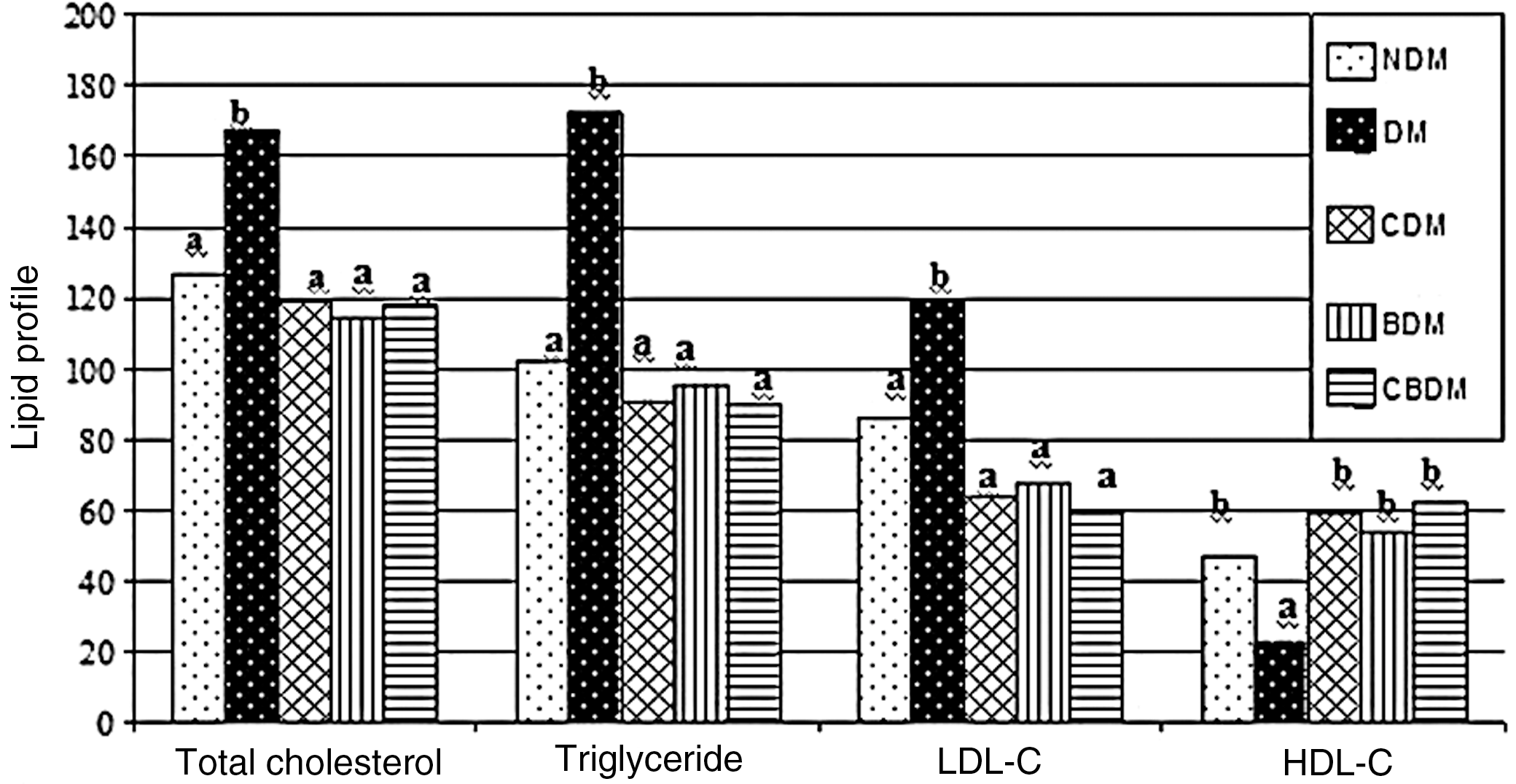
The serum lipid profile of diabetic rats fed cinnamon, barley, and their combination. abColumns with different superscript letters are significantly different at P<.05.
The serum level of the lipoprotein fraction, LDL-C, in the NDM group was significantly lower compared with the DM group (Fig. 1). However, administering cinnamon, barley, or their combination caused a significant decline in all treated diabetic groups compared to the DM group. Values were 118.80±15.77, 63.30±19.56, 67.40±15.66, and 59.20±9.73 mg/dL for DM, CDM, BDM, and CBDM groups, respectively. In contrast, the administration of cinnamon, barley, and their combination, caused a significant increase in HDL-C levels compared to the DM group: 22.60±6.19, 59.10±7.16, 53.60±12.09, and 62.40±11.21 mg/dL for DM, CDM, BDM, and CBDM groups, respectively. No significant differences were observed in the serum lipid profile among the intervention groups.
Adipose tissue hormones
Fasting serum leptin levels of the DM group (Table 2) was significantly higher compared with the NDM group (33.68±4.81 vs. 12.14±2.35 pg/mL). Administering cinnamon, barley, and their combination, significantly reduced fasting serum leptin concentrations (14.38±3.11, 16.26±3.21, and 15.59±3.55 pg/mL, respectively), compared to that of the DM control group (33.68±4.81 pg/mL).
Concentrations of serum adiponectin were significantly lower in the DM group compared to control NDM rats (19.77±3.39 vs. 36.89±7.32 ng/mL; Table 2). However, after intervention, fasting serum adiponectin levels were significantly higher in diabetic groups treated with either cinnamon, barley, or their combination compared with the DM group and reached a level comparable to that of the NDM group (33.50±4.75, 12.01±5.08, 34.14±8.55, 31.80±5.93, and 35.52±6.35 ng/mL) for NDM, DM, CDM, BDM, and CBDM, respectively. No significant differences were observed among the intervention groups.
Histological examination of pancreas
The histological examination of the pancreatic tissue (Fig. 2) revealed that the DM group showed a marked decrease in insulin-positive cells (β-cells) compared to the NDM group, which showed no changes in the pancreatic tissue. On the other hand, treatment with a combination of cinnamon and barley (CBDM) showed obvious improvement in insulin-positive cells and the islets of Langerhans was nearly similar to that of the NDM group. In addition, the CDM group showed a moderate improvement and increase in insulin-positive cells compared to the DM group, while the BDM group showed a slight improvement with a few insulin-positive cells.
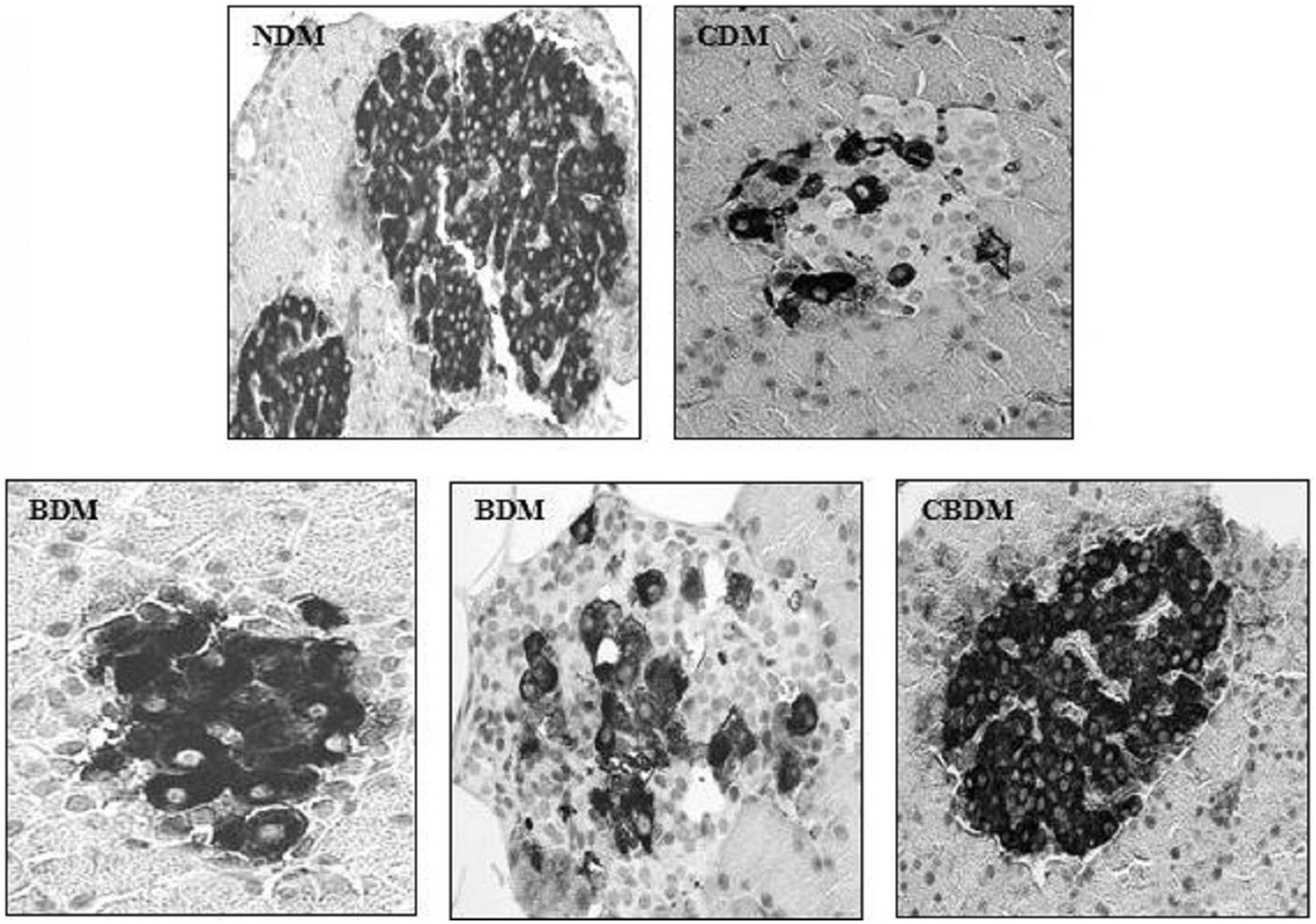
Histopathological changes detected in the pancreas of nondiabetic rats (NDM), diabetic rats (DM), diabetic rats with 5% cinnamon (CDM), diabetic rats with 30% barley (BDM), and diabetic rats with 30% barley and 5% cinnamon (CBDM). Magnification, 400×.
Discussion
The untreated DM group gained weight at a slower, but significantly different rate than the NDM group despite their higher feed intake, as has been reported in another study. 23 In accordance with the present study, a significantly higher feed intake in diabetic rats than the control group was reported. 24 The increment in dietary intake of STZ-induced diabetic rats was explained as a cause of an increase of the neuropeptides YmRNA, and a decreased activity of the leptin receptor of the hypothalamus with insufficient insulin; consequentially, weight gain is reduced even if the feed intake is more in diabetic rats. 25
Treatments with cinnamon, barley, and their combination for 8 weeks restored glucose levels to normal in diabetic rats. This could be due to the hypoglycemic effect of the cinnamon polyphenol type-A polymers, which stimulate autophosphorylation of the insulin receptor through an increased phosphatidylinositol 3-kinase activity. This enzyme causes insulin to bind to cells, and inhibits protein tyrosine phosphatase (PTP-1), an enzyme functioning in dephosphorylation of the insulin receptor and blocks insulin binding to cells. Both mechanisms are associated with increased insulin sensitivity and lead to increased glucose uptake and glycogen synthesis. 26,27 Reduction in the gastric emptying rate might be a second possible factor for glucose reduction after cinnamon consumption through controlling the delivery of carbohydrates to the small intestine. 27,28 Cinnamaldehyde, present in cinnamon oil, may also have a favorable effect on the glucose level of diabetic rats. 29 Similar results have been reported in human subjects given cinnamon. 30
The insulin level significantly improved in the cinnamon-treated group, perhaps due to the role of cinnamon polyphenols in the regeneration of β-cell of islets of Langerhans, which in turn increase the insulin secretion. Similarly, other studies reported a significant increase in serum insulin after the administration of cinnamon. 9,31
The beneficial effect of barley on blood glucose and serum insulin is attributable to the presence of the viscous fiber, β-glucan, which delays stomach emptying, 32 and to the slow absorption of glucose in the small intestine, as it forms a viscous solution when mixed with fluids in the gastrointestinal tract. 33 Colonic fermentation after a meal of indigestible carbohydrates like barley β-glucan may also contribute to subsequent meal improvements in postprandial glycemia. 34 Increased serum short chain fatty acid (SCFA) concentrations as a result of colonic fermentation of soluble fibers may have a favorable effect on glucose metabolism 35 mediated, at least in part, by the inverse association between SCFA and free fatty acid (FFA) levels in circulation. 36 Elevated levels of FFA was found to be associated with insulin resistance as it contributes to the reduction of insulin action in skeletal muscle and the liver. 37 Chromium, another component in barley, is a key component of the glucose tolerance factor 38 that enhances the action of insulin by increasing its binding to cells, the number of insulin receptors, and the phosphorylation of receptors that lead to increased insulin sensitivity. 39 Several studies in humans demonstrated the consumption of foods naturally high in β-glucan, such as barley, improved glucose and insulin responses in subjects with type 2 diabetes. 33,40
Dyslipidemia was shown in the DM group compared to the NDM group. STZ injection not only produced a significant increase in fasting glucose levels that was associated with a decrease in serum insulin levels, but also produced hypercholesterolemia, hypertriglyceredemia, and decrease in HDL-C levels. 41 Defects in insulin action and hyperglycemia could lead to these changes. 42 Treatment with cinnamon, barley, and their combination improved the serum lipid profile. Cinnamon improves lipid metabolism possibly through the upregulation of peroxisome proliferator-activated receptor (PPARα) expressions, which are known to stimulate the mitochondrial oxidation and the cellular uptake of FFAs by modifying the expression of genes, such as the acyl-CoA synthetase gene and fatty acid transport protein gene. 43 Consistent with the present study, a significant improvement in serum lipids in type 2 diabetic animals was observed after cinnamon administration. 9,31
The observed improvement in serum lipid parameters after barley consumption in diabetic rats is possibly a sum of several effects. Soluble fiber increases the excretion of bile acids, increases catabolism of LDL-C, and causes a reduction in the total body pool of cholesterol. 44 Increased viscosity of the gastric and intestinal contents by β-glucan can delay gastric emptying interfering with dietary fat and cholesterol absorption. 45 Furthermore, colon fermentation of soluble fibers gives rise to SCFA, which may inhibit hepatic cholesterol synthesis. In addition, a wide range of phytochemicals, fatty acids, and tocotrienols in barley have been implicated in improving lipid metabolism. 46
The adiponectin level was low after induction of diabetes at baseline. A high-fat diet causes a decrease in adiponectin levels associated with insulin resistance. 47 The observed reduction in blood glucose in diabetic rats treated with cinnamon, barley, and their combination may have been associated, in part, by the improvement in adiponectin levels. It was reported that there is a link between the adiponectin level and T2DM. 48 The glucose-lowering effect of adiponectin has been shown to be due, in part, to its activation of the AMP-activated protein kinase (AMPK) cascade, which stimulates glucose transport. AMPK stimulates both the catabolism of existing intracellular energy stores, such as triglycerides, and an insulin-independent influx of extracellular energy sources, such as glucose. 49 Adiponectin has also been shown to have insulin-sensitizing and anti-inflammatory actions. 50
The anti-diabetic effect of cinnamon may also be related to the upregulation of PPARγ mRNA expression in adipose tissue. PPARγ is highly expressed in adipose tissue and increases insulin sensitivity and the secretion of adipocytokines such as adiponectin. 51 Another study reported a higher adiponectin level in cinnamon-treated T2DM animals. 31 The effect of barley on adiponectin has not been sufficiently studied in animals; however, an increase in the adiponectin level, after healthy subjects consumed a barley meal, was observed. 35
Serum leptin significantly decreased in rats treated with cinnamon, barley, and their combination. This may be related, in part, to the improvement in adiponectin levels and vice versa. There is interplay between the action of adiponectin and leptin, and that leptin treatment corrects plasma adiponectin in obese mice by restoring the adipose tissue adiponectin concentration and secretion, at least in part, via direct stimulation of adiponectin gene expression. 52 A higher leptin level was observed in obese rats fed barley. 53 However, to our knowledge, there is no evident explanation of the mechanism whereby cinnamon and barely improve leptin levels.
STZ injection is responsible for the marked decrease in pancreatic insulin-positive cells (β-cells) in the DM group compared to the NDM group. STZ is widely used to induce diabetes mellitus presently by inducing β-cell death through alkylation of DNA. 54 The observed improvement in insulin-positive cells and the islets of Langerhans in all treated diabetic groups especially in the CBDM group suggested that constituents of both crude cinnamon and barely flour may ameliorate STZ-induced diabetic organ damage and may have cytoprotective effects.
In conclusion, the intake of crude cinnamon and barley flour individually or in combination are useful functional products that may offer an alternate treatment for T2DM. By their unique natural components, they are able to improve significantly the glycemic parameters, lipid profile, and adipose tissue hormones in type 2 diabetic rats. Combinations of crude cinnamon and barley flour showed more positive effects on pancreatic tissue than each one individually. Further studies are still needed.
Footnotes
Author Disclosure Statement
No competing financial interests exist.