




Abstract
Alzheimer's disease (AD) is a progressive neurodegenerative disorder that affects more than five million Americans and is characterized by a progressive loss of memory, loss of cholinergic neurons in the basal forebrain, formation of amyloid plaques and neurofibrillary tangles, and an increase in oxidative stress. Recent studies indicate that dietary supplements of antioxidants and omega-3 and omega-6 fatty acids may reduce the cognitive deficits in AD patients. The current study tested a combinatorial treatment of antioxidants from tart cherry extract and essential fatty acids from Nordic fish and emu oils for reducing cognitive deficits in the mu-p75 saporin (SAP)–induced mouse model of AD. Mice were given daily gavage treatments of Cerise® Total-Body-Rhythm™ (TBR; containing tart cherry extract, Nordic fish oil, and refined emu oil) or vehicle (methylcellulose) for 2 weeks before intracerebroventricular injections of the cholinergic toxin, mu-p75 SAP, or phosphate-buffered saline. The TBR treatments continued for an additional 17 days, when the mice were tested on a battery of cognitive and motor tasks. Results indicate that TBR decreased the SAP-induced cognitive deficits assessed by the object-recognition, place-recognition, and Morris-water-maze tasks. Histological examination of the brain tissue indicated that TBR protected against SAP-induced inflammatory response and loss of cholinergic neurons in the area around the medial septum. These findings indicate that TBR has the potential to serve as an adjunctive treatment which may help reduce the severity of cognitive deficits in disorders involving cholinergic deficits, such as AD.
Introduction
A
The present study tested the efficacy of a new combinatorial therapy, Cerise® Total-Body-Rhythm™ (TBR; Cerise Nutraceuticals, Inc., Traverse City, MI, USA) that is convenient, natural, and readily available. The purity of TBR was validated by Dews Research (Mineral Wells, TX, USA) and is composed of tart cherry extract (100% montmorency cherries, anthocyanidin 426.7 μg/mg); a balanced ratio of omega-3 from mercury-free Nordic fish oil (65%), and omega-6 (26%) and omega-9 (9%) from ultra-refined emu/kalayla oil, as well as zinc and magnesium stearate (18.5 μg/mg), with an oxygen radical absorbance capacity (ORAC) of 2045 per 400 mg. Tart cherry extract is composed of numerous antioxidants, 5 –8 which may be beneficial in decreasing oxidative stress in the aging 9 and AD brain. 10,11 Tart cherries are largely composed of polyphenols, a class of flavanoids, which have been found to be neuroprotective in vitro. 12 The polyphenol, cyanidin, has been shown to possess anti-inflammatory properties which are similar to those of ibuprofen, 5,13 –16 without the risk of harmful side-effects on the liver. Essential fatty acids are necessary for proper brain development, balance, and cognition, 17,18 and are correlated with a lower risk of AD. 19 Furthermore, the omega-3, docosahexaenoic acid (DHA), is decreased in the brains of AD patients compared with unaffected individuals. 17 In rodent models of AD, the level of omega-3 in the diet has been shown to affect the level of DHA in the brain, 20 and treatment with DHA has been found to be beneficial. 21 –25
The goal of the present study was to test the efficacy of TBR in the saporin (SAP) mouse model of AD. SAP has been shown to induce memory deficits, a specific loss in cholinergic neurons, 26 –28 and an increase in activated microglia. 29 In the present study, TBR was given at doses of 30, 60, and 90 mg/kg to mice treated with mu-p75 SAP or phosphate-buffered saline (PBS). The weight, memory, and motor behaviors were assessed, and the effects of TBR on cholinergic loss and inflammation were analyzed.
Materials and Methods
Animals
Nine groups of C57BL/6J mice (Jackson Laboratory, Bar Harbor, ME, USA) received either a sham surgery, or bilateral intraventricular injections of either 0.001 M PBS, or 0.8 μg of SAP followed by oral gavage treatments with TBR at 30, 60, or 90 mg/kg or vehicle (0.5% methylcellulose and H2O). The mice were kept on a 12:12 h dark/light cycle and provided food and water ad libitum. All procedures used followed the guidelines of the National Institute of Health and were approved by the Central Michigan University Institute for Animal Care and Use Committee.
Surgical and treatment procedures
Mice were weighed and dosed daily with TBR (at 1500 h) or vehicle (0.1 mL/g) beginning 2 weeks before SAP administration, when the mice were 7-weeks old, and were continued throughout the experiment. In order to control for the interference of TBR with SAP, one group (n=5) received distilled H2O during the 2 weeks before surgery, followed by TBR at 30 mg/kg, beginning 1 day postsurgery. At 9 weeks of age, surgery was performed as previously described. 30
Rotarod: Because the administration of SAP may lead to motor deficits at high doses, 27 a rotarod test was utilized to assess motor coordination. Before surgery, all mice were trained to balance on a rotating rod (ROTOR-ROD™; San Diego Instruments, San Diego, CA, USA) at 5 rotations/min until they were able to balance for 60 sec for 2 trials or a max of 10 trials, with 5-min intertrial intervals (ITIs). On postsurgery day 18, testing followed previously described procedures. 31
Open Field
On postsurgery day 8, the spontaneous motor activity and exploratory behaviors of the mice were measured using an Open Field test to determine whether the treatment affected overall activity levels. 27 This task also served to habituate the mice to the object/place-recognition tests, which was subsequently conducted in the same apparatus. Distance traveled by the mice was quantified using specialized software connected to an infrared-beam apparatus (Motor Monitor; Kinder Scientific, Poway, CA, USA), which measured interruptions of infrared beams spanning the base of a transparent, 26 cm×46 cm×30 cm Open Field chamber.
Object and place recognition
The object and place recognition tasks allow for the assessment of short-term memory in an environment of minimal stress. 32 On postsurgery day 9, the mice were tested for object recognition by measuring the amount of exploratory gestures spent with a novel object compared with a known object, based on an established protocol. 32 The mice were placed into the center of the Open Field chamber, facing the south wall, and given 10 min to explore 2 identical objects located in the northeast and northwest corners, and after a 5-min ITI, were re-tested for 5 min with one of the original objects replaced by a novel object (Fig. 1). All objects and the chamber were cleaned with LabSan-256Q (Sanitation Strategies, Williamston, MI, USA) and dried with paper towels between all the testing phases and trials. Interactions, as measured by individual instances in which the nose of the mouse was directed within 2 cm of the object, with either the novel or familiar object, were counted, with the percentage of interactions with the novel object serving as the dependent measure.

Percent of interactions with the novel object in the object-recognition task indicated that mice in the Surgery-Control, TBR-Control, and SAP/TBR60 groups which interacted with the novel object were significantly (*P<.05) greater than chance (50%, indicated by the gray line). Note: Surgery-Control includes combined group of mice injected with 0.001 PBS, or given a subcutaneous incision with no injection and treated with vehicle; TBR-Control includes mice injected with 0.001 M PBS and treated with TBR with either 30, 60, or 90 mg/kg; SAP/TBR30, SAP/TBR60, and SAP/TBR90 includes mice injected with SAP and treated with TBR at 30, 60, or 90 mg/kg, respectively; SAP/TBR30post includes mice injected with SAP and treated with TBR at 30 mg/kg, but only after surgery; and SAP-Control includes mice injected with SAP and treated with vehicle. PBS, phosphate-buffered saline; SAP, saporin; TBR, Total-Body-Rhythm™.
Place recognition on postsurgery day 10 followed the same procedures as object recognition, except, instead of using a novel one, one of two identical objects was moved to a novel location. 32 Percentage of interactions, in which the nose of the mouse was directed within 2 cm of the object when the object was placed in the novel location, relative to when the object was placed in a familiar location, served as the dependent measure (Fig. 2).
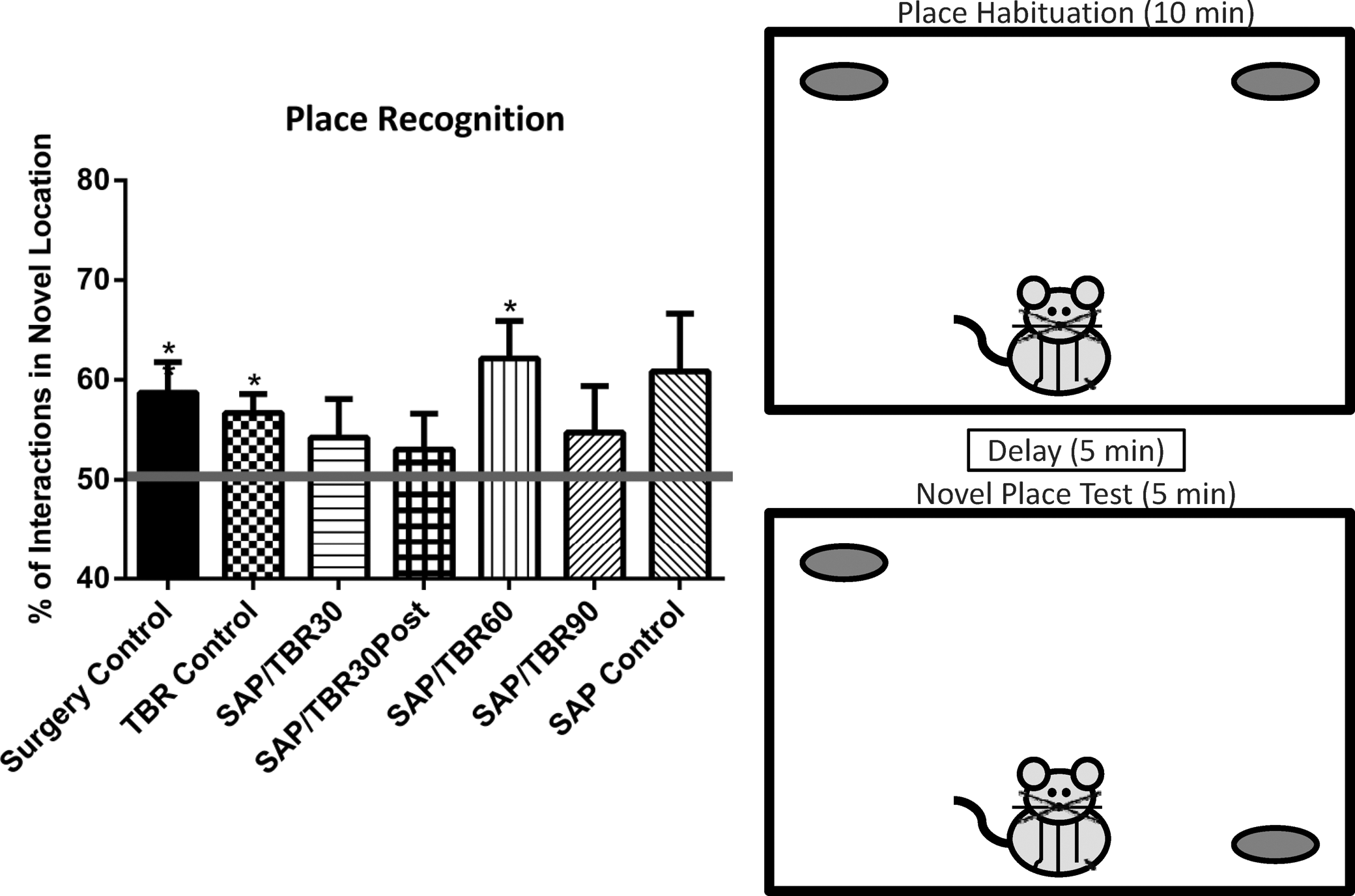
Percent of interactions with the object in the novel position in the place-recognition task revealed that mice in Surgery-Control, TBR-Control, and SAP/TBR60 groups interacted with the moved objects significantly (*P<.05) greater than chance (50%, indicated by the gray line).
Morris water maze
Spatial learning and memory were tested using the Morris water maze (MWM). 33 The apparatus consisted of a 148-cm-diameter water tank, positioned in a room with several visual cues (door, counter, poster, etc.). The MWM was filled with water made opaque with nontoxic white tempera paint. A clear, 12-cm-wide escape platform was placed 1 cm below the water surface.
The MWM testing commenced on postsurgery day 11 and followed an established procedure, 27 with the exception that the acquisition phase was shortened to 4 days. 30 All trials were recorded and tracked using specialized software (Video Track; Otterburn Park, Quebec, Canada) to determine latency and cumulative distance swum to find the platform, as well as average speed.
Immunohistochemistry
After behavioral testing, the mice were injected with a lethal dose of pentobarbital (0.1–0.2 mL) and intracardially perfused with 30 mL of 0.1 M PBS followed by 30 mL of 4% paraformaldehyde. The brains of the mice were then removed and placed in a solution of 4% paraformaldehyde for 12 h, followed by 30% sucrose cryoprotection treatment. The brains were flash frozen in methylbutane on dry ice for 3 min, and then stored at −80°C. Subsequently, the brains were sectioned coronally at 35 μm on a freezing microtome.
Sections at approximately +0.68 mm from bregma were labeled for choline acetyltransferase (ChAT) with an adjusted procedure. 27 Alterations included premounting the tissue onto slides, the use of a primary polyclonal rabbit to ChAT (1:500; Millipore, Billerica, MA, USA), and in the final step, the sections were incubated for 10 min in a diaminobenzidine kit, as per the manufacturer's instructions (Vector, Burlingame, CA, USA). The slides were air dried, and were then further dehydrated for 30 sec in ethanol rinses (at 70%, 95%, and 100% respectively), followed by two rinses for 5 min each in xylenes (Sigma-Aldrich, St. Louis, MO, USA). The tissue was then coverslipped using Depex Mounting Medium (Electron Microscopy Sciences, Hatfield, PA, USA). All ChAT-positive cells in the medial septum (MS) and dorsal band (Fig. 4) at approximately+0.68 mm anterior to bregma were traced and counted using the program Stereologer 2000 (Systems Planning and Analysis, Inc., Alexandria, VA, USA) at 100×with field distance at minimum settings in order to count all cells in the selected region.
The brain sections +0.57 mm from bregma were labeled against CD11b to determine the levels of activated microglia. The procedure followed that was used to label for ChAT with the adjustment of an initial step in 0.3% hydrogen peroxide in order to deactivate endogenous peroxidases followed by 2 rinses in 0.1 M PBS. The antibodies included primary rat monoclonal to CD11b (1:1000; Abcam, Cambridge, MA, USA) and biotinylated goat anti-rat secondary (1:300; Vector). Sections containing CD11b-positive cells were scanned using Nikon Coolscan IV (Nikon, Tokyo, Japan). Average optical density was measured in MS sections approximately +0.57 mm from bregma (Fig. 5) using SigmaScanPro Image Analysis version 5.0 (Jandel Scientific Software, San Rafael, CA, USA).
Design and analysis
One-way analysis of variance was used to determine group differences in dependent variables, including the latency to fall at each speed in the rotarod test; the total distance in the Open Field; the percent change in body weight; the summed latency and distance traveled to find the hidden platform and average speed in the MWM test; the percent of distance traveled in the quadrant that previously contained the platform during the MWM probe test; the counts of ChAT-labeled cells; and the optical density of CD11b labeling. Sample t-tests, with a test value of 50%, were used to determine whether the percentage of interactions with the novel object (in the object-recognition task) or the novel-placed object (in the place-recognition task) differed from chance levels. 34 The alpha level was set at 0.05 for all analysis, and Fisher-protected least-significant-difference (PLSD) post hoc tests were used, when appropriate.
Results
Mice that received an incision without the bilateral injection did not significantly differ from those which received the PBS bilateral injection and were combined into a single surgery-control group. Similarly, mice injected with PBS receiving TBR at 30, 60, or 90 mg/kg did not significantly differ on any of the measures and were combined into a single TBR-control group. Male and female mice did not differ on any of the measures. Thus, the final groups included (1) Surgery-Control (n=15); (2) TBR-Control (n=24); (3) SAP/TBR30 (n=9); (4) SAP/TBR60 (n=8); (5) SAP/TBR90 (n=8); (6) SAP/TBR30Post (n=5); and (7) SAP-Control (n=7; injected with SAP and received vehicle gavage).
Rotarod, Open Field, and weight
Statistics for Rotarod, Open Field, and weight are summarized in Table 1. No significant between-group differences were found in the rotarod task as measured by sum of the latencies to fall in three trials at 5 rotations/min [F(6,69)=1.840, P=.104], 10 rotations/min [F(6,69)=0.382, P=.888], or 15 rotations/min [F(6,69)=0.801, P=.572], or in total distance in the Open Field across 5-min intervals [F(6,69)=1.018, P=.421]. There were also no significant between-group differences in the percent change in body weight [F(6,69)=0.588, P=.739].
Data are reported as mean±SEM. No effects of mu p-76 SAP or TBR (antioxidants and essential fatty acids) treatment were observed in balance on the Rotarod (5, 10, or 15 rotations/min), total distance in the Open Field, or percent change in weight. There were no significant between-group differences on any of these measures.
Surgery-Control includes combined group of mice injected with 0.001 PBS, or given a subcutaneous incision with no injection and treated with vehicle.
TBR Control includes mice injected with 0.001 M PBS and treated with TBR with either 30, 60, or 90 mg/kg.
SAP/TBR30, SAP/TBR60, and SAP/TBR90 include mice injected with SAP and treated with TBR at 30, 60, or 90 mg/kg respectively.
SAP/TBR30post includes mice injected with SAP and treated with TBR at 30 mg/kg, but only after surgery.
SAP-Control includes mice injected with SAP and treated with vehicle.
SAP, saporin; PBS, phosphate-buffered saline; TBR, Total-Body-Rhythm™.
Object and place recognition
Performance on the object-recognition task indicated that Surgery-Control [t(14)=3.394, P=.004], TBR-Control [t(23)=2.221, P=.036], and SAP/TBR60 [t(7)=3.145, P=.016] mice interacted with the novel object significantly more than chance, while the SAP-Control [t(6)=1.521, P=.179], SAP/TBR30 [t(8)=1.080, P=.312, SAP/TBR30post [t(4)=0.829, P=.454], and SAP/TBR90 [t(7)=0.821, P=.439] did not significantly differ from chance on this measure (Fig. 1).
In the place-recognition task, the percent of novel-location interactions by mice in Surgery-Control [t(14)=2.841, P=.013], TBR-Control [t(23)=3.653, P=.001], and SAP/TBR60 [t(7)=3.227, P=.015] groups were found to be significantly greater than chance, while the SAP-Control [t(6)=1.168, P=.111], SAP/TBR30 [t(8)=1.113, P=.298], SAP/TBR30post [t(4)=0.863, P=.437], and SAP/TBR90 [t(7)=1.020, P=.342] were not significantly different from chance (Fig. 2).
Morris water maze
In the MWM, a significant between-group difference [F(6,69)=2.411, P=.036] with PLSD indicated that the SAP-Control demonstrated increased latency to reach the platform compared with all other groups (Fig. 3). However, total distance [F(6,69)=1.101, P=.371] and average speed [F(6,69)=1.762, P=.120], in acquisition, and the percent of time in the target quadrant in the probe [F(6,69)=1.332, P=.255] were not significant.
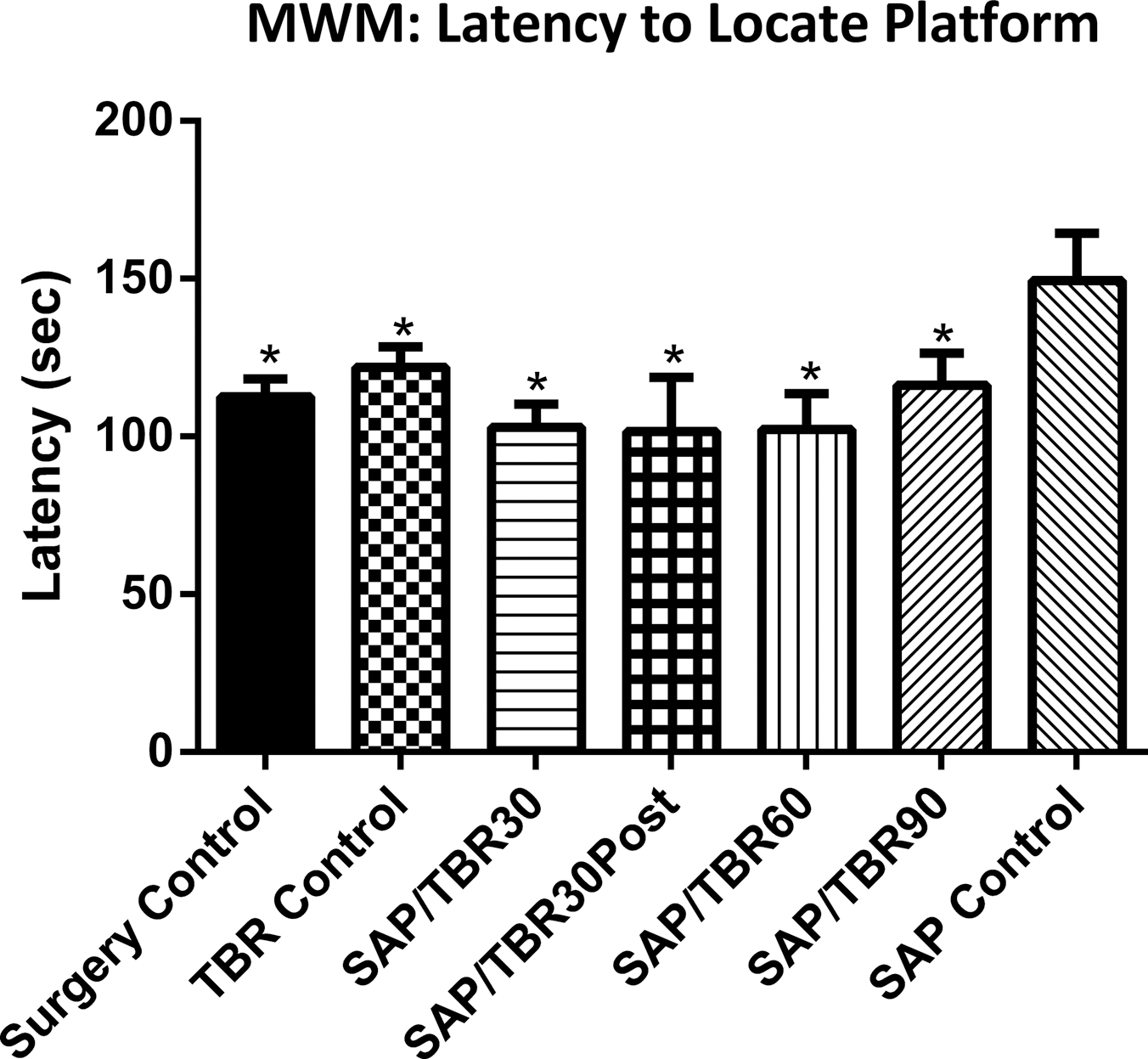
Morris water maze results revealed that TBR treatments reduced spatial memory deficits (*P<.05 from SAP-Control group) as measured by the total latency to locate the platform across 4 days of testing.
Immunohistochemistry
Significant differences were found in the number of ChAT-positive cells counted in the MS at approximately +0.68 mm anterior to bregma [F(6,69)=6.116, P<.001] (Fig. 4). PLSD revealed that SAP-Controls had significantly fewer ChAT-labeled cells compared with Surgery-Controls, TBR-Controls, and SAP/TBR60. SAP/TBR90, SAP/TBR30, and SAP/TBR30post had fewer ChAT-labeled cells compared with Surgery-Controls.
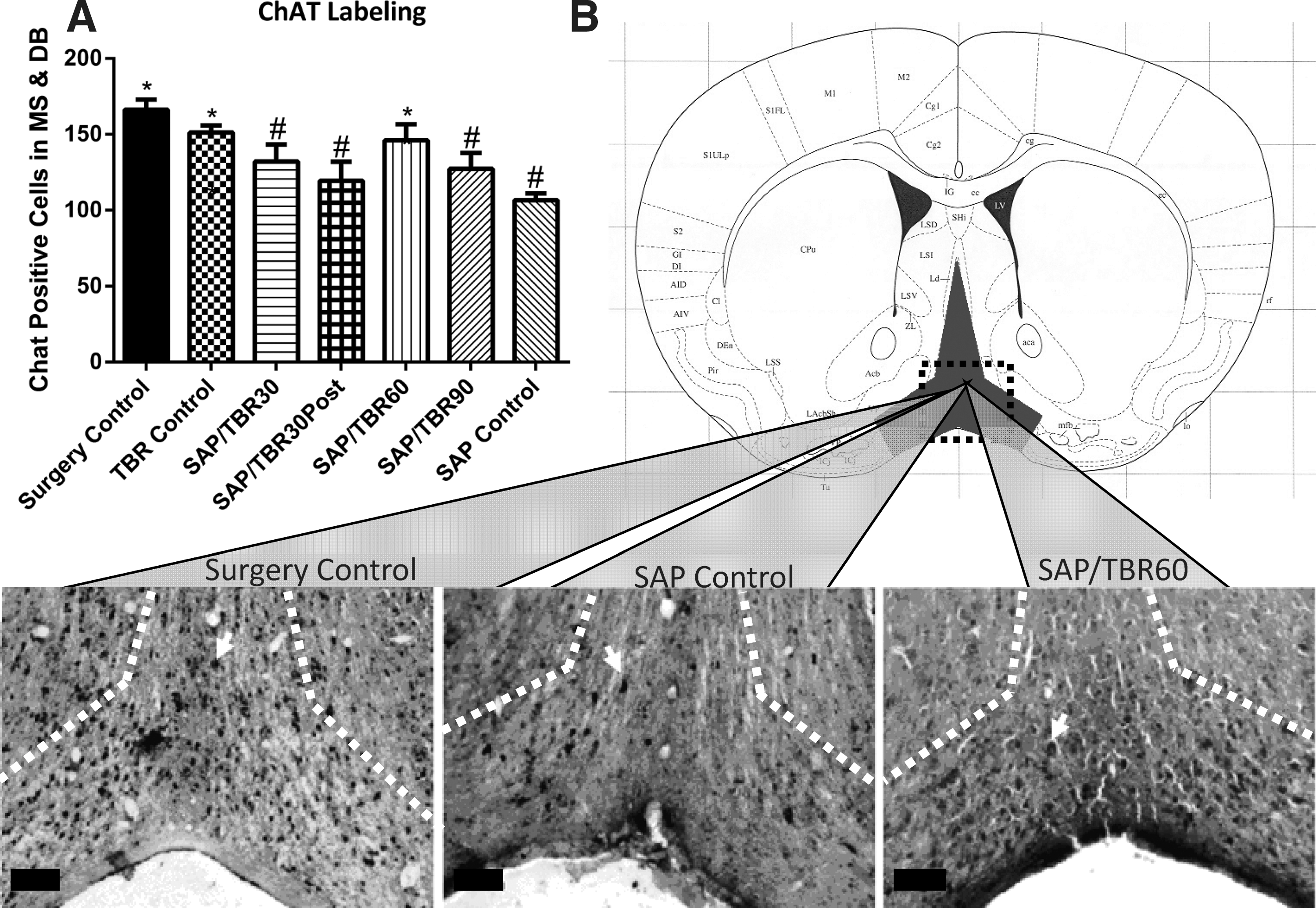
Treatments of 60 mg/kg TBR protected against SAP-induced reduction in the number of ChAT-labeled cells
Optical density of CD11b labeling in the MS approximately +0.57 mm from bregma revealed significant between-group differences [F(6,69)=2.188, P=.045] (Fig. 5). PLSD revealed a significant increase in CD11b labeling in SAP-Control mice, compared with both Surgery-Control and TBR-Control groups. This SAP-induced increase of activated microglia was prevented by TBR at the 60 mg/kg and 90 mg/kg doses.
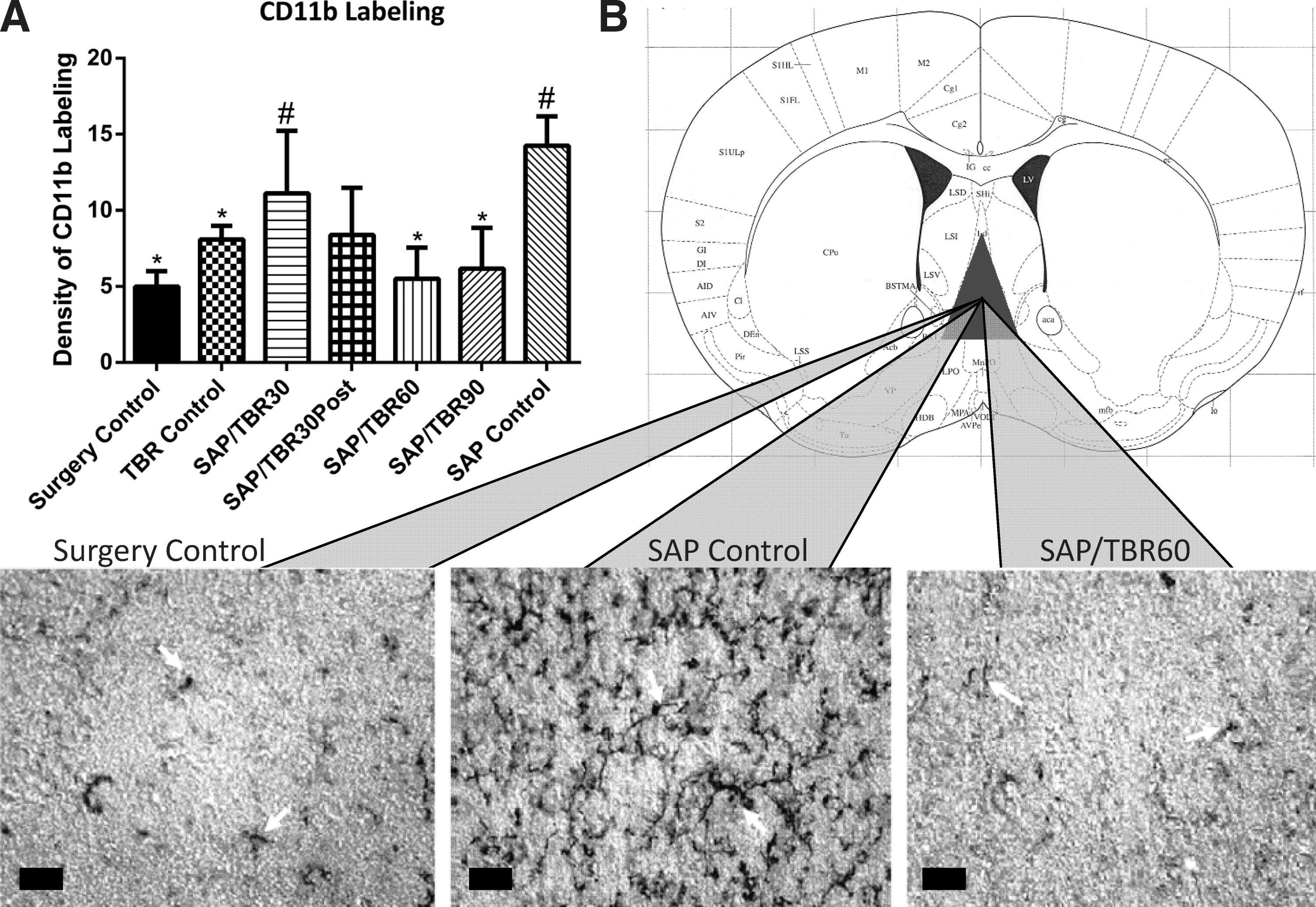
The SAP-induced proliferation of microglia (as indicated by increased CD11b labeling) by SAP that was prevented by 60 mg/kg TBR as revealed by measured optical densitometry
Discussion
The present study indicates that (1) SAP at the 0.8 μg/μL dose caused significant memory deficits without causing motor impairments; (2) SAP caused significant loss of ChAT-labeled neurons and a significant increase in inflammation in the MS; and (3) TBR attenuated these SAP-induced deficits. These findings suggest that the combinatorial treatment of antioxidants from tart cherry extract and essential fatty acids from Nordic fish oil and emu oil, found in TBR, may be capable of slowing down the neuropathologic and memory deficits associated with AD.
The findings that SAP-induced deficits in working memory, as measured by object and place recognition, as well as deficits in spatial memory, as measured by latency to find the hidden platform in the MWM task, provide converging evidence that these cognitive deficits were not task specific and extended to more than one domain of memory. The absence of SAP-induced motor deficits on the rotarod task and in spontaneous motor activity in the Open Field, as well as no differences in swim speed in the MWM, supports the contention that the impaired performance of SAP-treated mice in the MWM, object recognition, and place-recognition tests was due to SAP-induced mnemonic deficits, not by impaired motor ability.
The results of the present study also revealed that intraventricular injections of SAP caused a significant (36%) decrease in the number of cholinergic cells as measured by counts of ChAT-positive cells in the MS. The cholinergic loss was not as severe as that observed in other studies, but this could be due to differences in regions included in the counting or differences in protocol, including the use of different primary antibodies to label ChAT 27 (which may differ in specificity) and differences in secondary antibodies. 28
Intraventricular injections of SAP at 0.8 μg also appear to have increased inflammation, as measured by CD11b. This finding coincides with previous research 29 showing an increase in inflammation, using CD45, which is a leukocyte common antigen, labeling both active and resting microglia. In the present study, it is clear that specifically activated microglia, as labeled by CD11b, are increased in this model.
The findings in the present study also suggest that TBR is effective in attenuating memory deficits produced by intraventricular injections of SAP. Reference memory deficits, as measured by the latency to find the hidden platform in the MWM task, were reduced by all doses of TBR, and working memory deficits, as measured in the object and place-recognition tasks, were attenuated by the 60 mg/kg dose of TBR.
TBR also decreased SAP-induced neuropathological deficits observed in the present study. Treatments of TBR, at the 60 mg/kg dose, attenuated cholinergic cell loss and treatments of TBR, at both 60 and 90 mg/kg doses, were effective in decreasing levels of activated microglia. Our findings coincide with the results of treatment with an anti-inflammatory drug, minocycline, which decreased an activated-microglial response and improved the preservation of cholinergic neurons. 29 Despite the fact that minocycline had positive effects on inflammation, 29 and is presently used to treat acne, rheumatoid arthritis, and infection, there is evidence that it can induce lupus-like symptoms and memory deficits in some patients. 35 It is unlikely that TBR would produce similar symptoms, because it did not appear to produce deleterious effects in the present study or in long-term studies utilizing similar natural treatments. 36 However, very high doses over an extended period of time still need to be assessed to obtain a more comprehensive safety profile for this treatment.
While more information is needed, TBR likely affected the neuropathology of SAP-injected mice through direct effects on the central nervous system. Both main components of TBR, anthocyanins 37 and DHA, 38 have been shown to cross the blood–brain barrier in rodents. However, more information is needed to fully understand the mechanism of TBR in mice.
In conclusion, TBR was shown to decrease both behavioral and pathological deficits observed in the SAP mouse model of AD. Although clinical trials of specific antioxidants 39,40 and essential fatty acids 41,42 have only produced modest attenuation of memory dysfunction in AD patients, the combinatorial treatment provided by TBR offers a concentrated source of antioxidants and essential fatty acid in a natural and easily accessible form, which is well tolerated at relatively high doses. Further research is needed to discern whether or not the ingredients in TBR are working synergistically, or are simply producing a combined therapeutic effect in the SAP model of AD. Collectively, these findings suggest that future research using such a combinatorial approach is warranted and that compounds such as TBR could provide an effective, adjunctive treatment which may help delay the onset or decrease the severity of AD.
Footnotes
Author Disclosure Statement
Cerise® Nutraceuticals donated the Total-Body-Rhythm™ used in the present study, but this company had no other involvement in this study.
Acknowledgments
Funding for this study was provided by Field Neurosciences Institute and the John G. Kulhavi Professorship in Neuroscience. The authors gratefully acknowledge Ray Pleva and Cerise® Nutraceuticals for providing the Total-Body-Rhythm™ used in this study. They also gratefully acknowledge their colleagues at Central Michigan University: Dr. Jim Dews, Dr. Nicholas Dey, Kate Trainor, Nicholas DeKorver, Jeff Delongchamp, and Jaqueline Radwan for their technical assistance.