




Abstract
In this study, the ethanolic extract obtained from piquiá pulp was assessed for genotoxicity and oxidative stress by employing the micronucleus test in bone marrow and peripheral blood cells in addition to comet, thiobarbituric-acid–reactive substances (TBARS), and reduced glutathione assays in the liver, kidney, and heart. Additionally, phytochemical analyses were performed to identify and quantify the chemical constituents of the piquiá extract. Wistar rats were treated by gavage with an ethanolic extract from piquiá pulp (75 mg/kg body weight) for 14 days, and 24 h prior to euthanasia, they received an injection of saline or doxorubicin (15 mg/kg body weight, intraperoneally). The results demonstrated that piquiá extract at the tested dose was genotoxic but not mutagenic, and it increased the TBARS levels in the heart. Further studies are required to fully elucidate how the properties of ethanolic extract of piquiá pulp can affect human health.
C
Piquiá fruits were acquired in Belém, Pará, Brazil. The ethanolic extract, which presented the highest phenolic content, 5 was obtained from freeze-dried ripe piquiá pulp with ethanol/water (1:1, v/v) at room temperature (25°C). High-performance liquid chromatography (HPLC)–diode array detector (DAD) analysis of the carotenoids and phenolic compounds was performed in a Shimadzu HPLC, connected in series to a DAD and a mass spectrometer (Esquire 4000; Bruker Daltonics) with atmospheric pressure chemical ionization (APCI) and electrospray ionization (ESI) sources and an ion-trap analyzer. The identification and quantification of carotenoids (HPLC-DAD-APCI–tandem mass spectrometry [MS/MS]) and phenolic compounds (HPLC-DAD-ESI-MS/MS) were performed as described by Chisté and Mercadante 6 for piquiá pulp. The carotenoid contents and phenolic compounds determined by HPLC-DAD were expressed as μg/g of extract (dry basis, n=3).
The in vivo experimental protocol was approved by the Local Ethics Committee for Animal Use, register no. 09.1.1151.53.3. Twenty-four healthy 4- to 5-week-old male Wistar rats were maintained in cages at a constant temperature (22°C±2°C) with a 12 h light–12 h dark cycle and received a commercial diet (Nuvilab®) and fresh water ad libitum. The ethanolic extract from piquiá (75 mg/kg body weight [b.w.]) was diluted in water and administered by gavage for 14 days; then, animals received intraperitoneal injections of saline (0.9% sodium chloride) or 15 mg/kg b.w. doxorubicin (DXR; Rubidox; Bergamo, CAS 25316-40-9) 24 h before euthanasia. DXR was selected as positive control because it is an effective genotoxic agent in the micronucleus (MN) test and in the evaluated tissues. 7,8 The rats were anesthetized, and peripheral blood from the tail vein was collected for the MN test. Immediately afterward, the animals were decapitated, and the liver, kidneys, and heart were collected for comet assay, thiobarbituric-acid–reactive substances (TBARS), and reduced glutathione (GSH) analyses. The bone marrow cells from the femurs were harvested for the MN test.
The alkaline single-cell comet assay (pH>13) was performed according to Singh et al. 9 and Tice et al. 10 The slides were prepared with suspensions of cells from each organ and then subjected to the following steps: (1) lysis (22 h at 4°C), (2) alkaline electrophoresis (pH 13) for 20 min with an electric field strength of 0.78 V/cm and 300 mA, (3) neutralization for 5 min (pH 7.5), and (4) fixation in ethanol for 2 min. Just prior to analysis, the slides were stained with ethidium bromide (20 μL/mL), and the images were photographed at 400× magnification using a fluorescence microscope (Zeiss) with a 510–560 nm filter, 590 nm barrier, and Axion camera (Zeiss). The %DNA in the tail was measured in 100 nucleoids per animal using TriTek CometScore™ Freeware v1.5 software. The trypan dye (Sigma, CAS 72-57-1) exclusion method was used to determine cell viability immediately before the comet assay, and this parameter was above 75% for all treatments.
The MN tests in the bone marrow and peripheral blood were performed according to Schmid 11 and Holden et al., 12 respectively. The bone marrow cells were collected in fetal bovine serum. The slides were fixed in methanol, stained with Giemsa (Sigma-Aldrich, CAS 51811-82-6), and analyses performed at 1000× magnification. A drop of peripheral blood (5 μL) was deposited on each slide, which were fixed in methanol and stained with Acridine Orange (Sigma-Aldrich, CAS 10127-02-3). Analyses were performed under 1000× magnification using a fluorescence microscope (Zeiss) with a 488 nm excitation filter. A total of 2000 polychromatic erythrocytes (PCEs) from the bone marrow 13 and 1000 PCEs in the peripheral blood 14 were examined in samples from each animal, and the number of micronucleated PCEs (MNPCEs) was recorded and expressed as MNPCEs/1000 PCEs to facilitate the comparison between both tissues. In the bone marrow, the ratio of PCEs to normochromatic erythrocytes (NCEs) was calculated to evaluate the cytotoxicity.
TBARS, a biomarker of lipid peroxidation, were determined as described by Buege and Aust, 15 and the results were reported as nmol TBARS/mg protein using 1,1,3,3-tetramethoxypropane as the standard. The concentrations of GSH were quantified according to Sedlak and Lindsay, 16 and the results were presented as nmol GSH/mg protein using a standard curve of cysteine. Protein was determined by the Hartree method 17 using bovine serum albumin as the standard. Statistical analyses were performed by one-way analysis of variance and Dunnett's test. A value of P<.05 was considered statistically significant.
Considering that the antigenotoxic effects of piquiá pulp have been previously demonstrated 18 and that natural products with functional benefits, including fruits and vegetables, have to be processed, preserved, and extracted 19 for commercialization and application into pharmaceutical and chemical industries, this study aimed to investigate the effects of ethanolic extract from piquiá pulp.
The phytochemical analysis of the ethanolic extract showed that lutein-like (5.24 μg/g extract) and ellagic acid (1838.61 μg/g extract) were the most abundant carotenoid and phenolic compounds, respectively, found in the freeze-dried extract (Table 1). The comet assay results are shown in Figure 1. Although it has been demonstrated that piquiá pulp is not genotoxic, 18 in this study its ethanolic extract significantly increased the %DNA in the tail in all tissues, most likely due to its distinct phytochemical profile. The ethanolic extract from piquiá pulp presents 3-fold less carotenoids and 1.4-fold more phenolic compounds than piquiá pulp. Other studies have also found genotoxic effects for other plant or fruit extracts. 20 –22 Further, phenolic compounds can initiate an autoxidation process and behave as pro-oxidants. 23 A 75 mg/kg dose was used because in another study lower doses did not have any effect on DNA. 22 To investigate whether piquiá extract raises the DXR-induced DNA damage, we performed a simultaneous treatment with piquiá extract+DXR and this effect was observed in the kidney. Moreover, piquiá extract per se induced the highest genotoxicity in the kidney demonstrating that polyphenols exert tissue-specific effect, which was also demonstrated in a previous study. 24 In the MN test, the piquiá extract was not mutagenic in the bone marrow or peripheral blood cells (Table 2). The PCE/NCE ratio was similar among the treatments, demonstrating the absence of cytotoxic effects of piquiá extract.
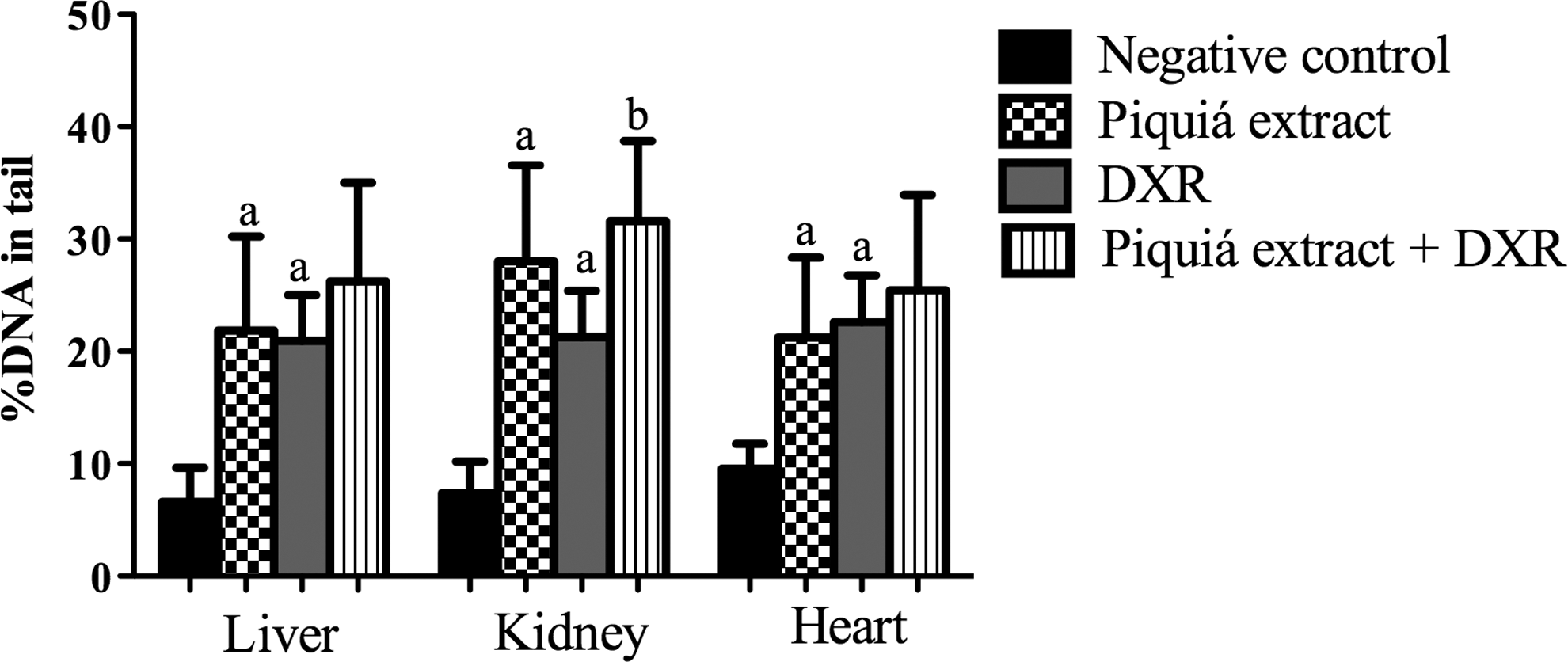
%DNA in tail (mean±standard deviation) in comet assays of liver, kidney, and heart tissues from rats treated with a subacute dose of freeze-dried ethanolic extract from piquiá pulp alone (75 mg/kg body weight per day for 14 days) or combined with DXR (15 mg/kg body weight, one dose). Significantly different from anegative control (P<.05) and bDXR (P<.05) by analysis of variance and Dunnett's test. DXR, doxorubicin.
Data are presented as mean±standard deviation. n=3.
Quantified as equivalent of a9-cis-neoxanthin, bviolaxanthin, clutein, dantheraxanthin, ezeaxanthin, fβ-carotene, ggallic acid, hcoumaric acid, iellagic acid, and jmethyl quercetin.
<LOQ, lower than limit of quantification; HHDP, hexahydroxydiphenoyl.
Data are presented as mean±standard deviation.
Significantly different from negative control (P<.05) by analysis of variance–Dunnett.
Daily dose by gavage of 75 mg/kg body weight for 14 days.
Single intraperitoneal dose of 15 mg/kg body weight.
MNPCEs, micronucleated polychromatic erythrocytes; NCEs, normochromatic erythrocytes; DXR, doxorubicin.
The results of the TBARS and GSH assays are shown in Table 3. The basal TBARS levels in the heart were higher than those in the liver and kidney. The TBARS levels in the heart exhibited a significant increase after treatment with piquiá extract or DXR. Further, the simultaneous treatment with piquiá extract+DXR also resulted in higher cardiac TBARS levels than those in the DXR-alone group. Compared with that of the liver, the antioxidant defense system in the heart is moderate (150-fold less catalase and 4-fold less superoxide dismutase, 25,26 for example). The TBARS and GSH levels in the liver and kidney did not change after DXR treatment, most likely due to the short exposure time. In most studies, the lowest exposure time able to induce oxidative changes was 48 h. 26 –28 We chose the 24 h exposure time based on genotoxicity guidelines. 29
Data are presented as mean±standard deviation.
Significantly different from *negative control (P<.05) and †DXR (P<.05) by analysis of variance and Dunnett's test.
Daily dose by gavage of 75 mg/kg body weight for 14 days.
Single intraperitoneal dose of 15 mg/kg body weight.
TBARS, thiobarbituric-acid-reactive substances; GSH, glutathione.
In conclusion, under the conditions employed in this study, treatment with ethanolic extract from piquiá pulp (75 mg/kg b.w.) was genotoxic but not mutagenic and also induced lipid peroxidation in the heart. Therefore, further studies are required to fully elucidate the mechanisms behind these genotoxic effects and oxidative stress and how the properties of piquiá pulp ethanolic extract can affect human health.
Footnotes
Acknowledgments
The authors thank the Fundação de Amparo à Pesquisa do Estado de São Paulo (FAPESP; nos. 2009/15692-0 and 2005/59552-6) for financial support. We also thank the Conselho Nacional para o Desenvolvimento Científico e Tecnológico (CNPq) and the Coordenação de Aperfeiçoamento de Pessoal de Ensino Superior (CAPES).
Author Disclosure Statement
No competing financial interests exist.