




Abstract
Increased neutrophil activation significantly contributes to the tissue damage in inflammatory illnesses; this phenomenon has motivated the search for new compounds to modulate their effector functions. Coumarins are natural products that are widely consumed in the human diet. We have evaluated the antioxidant and immunomodulator potential of five 4-methylcoumarin derivatives. We found that the 4-methylcoumarin derivatives inhibited the generation of reactive oxygen species by human neutrophils triggered by serum-opsonized zymosan or phorbol-12-myristate-13-acetate; this inhibition occurred in a concentration-dependent manner, as revealed by lucigenin- and luminol-enhanced chemiluminescence assays. Cytotoxicity did not mediate this inhibitory effect. The 7,8-dihydroxy-4-methylcoumarin suppressed the neutrophil oxidative metabolism more effectively than the 6,7- and 5,7-dihydroxy-4-methylcoumarins, but the 5,7- and 7,8-diacetoxy-4-methylcoumarins were less effective than their hydroxylated counterparts. An analysis of the biochemical pathways suggested that the 6,7- and 7,8-dihydroxy-4-methylcoumarins inhibit the protein kinase C-mediated signaling pathway, but 5,7-dihydroxy-4-methylcoumarin, as well as 5,7- and 7,8-diacetoxy-4-methylcoumarins do not significantly interfere in this pathway of the activation of the human neutrophil oxidative metabolism. The 4-methylcoumarin derivatives bearing the catechol group suppressed the elastase and myeloperoxidase activity and reduced the 1,1-diphenyl-2-picrylhydrazyl free radical the most strongly. Interestingly, the 5,7-dihydroxy-4-methylcoumarin scavenged hypochlorous acid more effectively than the o-dihydroxy-substituted 4-methylcoumarin derivatives, and the diacetoxylated 4-methylcoumarin derivatives scavenged hypochlorous acid as effectively as the 7,8-dihydroxy-4-methylcoumarin. The significant influence of small structural modifications in the inhibitory potential of 4-methylcoumarin derivatives on the effector functions of neutrophil makes them interesting candidates to develop new drugs for the treatment of inflammatory diseases mediated by increased neutrophil activation.
Introduction
N
However, increased neutrophil recruitment and activation are involved in the pathogenesis of a number of autoimmune and inflammatory human diseases, such as systemic lupus erythematosus, rheumatoid arthritis, Graves' disease, Crohn's disease, Behçet's disease, and chronic obstructive pulmonary disease. 1,2,4,5 Our research group has investigated the antioxidant and immunomodulatory activities of plant extracts 6 –8 and isolated secondary metabolites like coumarins, 9 –11 flavonoids, 7,12 –14 and sesquiterpene lactones. 15 We aim to discover prototypes of compounds that can modulate the effector functions of neutrophils and supplement the endogenous antioxidant defense system.
Coumarins comprise a very large class of compounds that occur in higher plants; they exist in high concentrations in the Rutaceae and Umbelliferae. 16 The human exposure to coumarins from dietary sources is quite significant, since these compounds occur in many grasses and papilionaceous plants (Papilionaceae) like tonka bean, woodruff, dates, and certain types of cinnamon. They also occur in green tea, chicory, bilberry, cloudberry, and the essential oils of cinnamon bark, cassia leaf, and lavender. Some coumarins find application in the manufacture of foods, beverages, caramel confectionery, and chewing gum. 16 –18
Natural and synthetic coumarins and coumarin-related compounds exhibit a variety of biological effects, such as antioxidant, antimicrobial, antitumoral, anticoagulant, antiviral, and anti-inflammatory action. 16,19 In contrast to many other coumarins, the 4-methylcoumarins are not metabolized to toxic epoxide intermediates. 17,20 The 4-methylumbelliferone, 4-methyldaphnetin, and 4-methylesculetin are naturally occurring derivatives that scavenge free radicals and inhibit the activity of leukocyte 5-lipoxygenase and lipid peroxidation, 19 –24 revealing the potential anti-inflammatory action of the 4-methylcoumarin derivatives.
Considering the important contribution of neutrophil-derived ROS and enzymes to the inflammatory process, we have evaluated the inhibitory effect of five 4-methylcoumarins on the human neutrophil oxidative metabolism triggered by different signaling pathways, as well as their inhibitory activity toward neutrophil enzymes and their free radical scavenging activity.
Materials and Methods
Chemicals
Luminol (5-amino-2,3-dihydro-1,4-phthalazinedione), lucigenin (N,N′-dimethyl-9,9′-biacridinium dinitrate), 2,6,di-tert-butyl-4-methylphenol (BHT), cytochalasin B (CB), 1,1-diphenyl-2-picrylhydrazyl radical (DPPH), 4-(2-hydroxyethyl)-1-piperazineethanesulfonic acid (HEPES), N,N-dimethylformamide (DMF), phorbol-12-myristate-13-acetate (PMA), quercetin, 3,3′,5,5′-tetramethylbenzidine (TMB), gallic acid, taurine, triton X-100, trypan blue, and zymosan A were purchased from Sigma-Aldrich (St. Louis, MO, USA). Dimethyl sulfoxide (DMSO), ethanol, hydrogen peroxide, n-formyl-methionyl-leucyl-phenylalanine (n-fMLP), N-succinyl-Ala-Ala-Val-p-nitroanilide (SAAVNA), methoxy-succinyl-Ala-Ala-Pro-Val-chloromethylketone, human leukocyte MPO (EC 1.7.1.11), and 4-aminobenzoic acid hydrazide were obtained from Calbiochem (Merck KGaA, Darmstadt, Germany). Gelatin (microbiological grade) was acquired from Difco Laboratories (Detroit, MN, USA) and lactate dehydrogenase (LDH) Liquiform™ was provided by Labtest Diagnostica (Lagoa Santa, MG, Brazil). All the other chemicals and solvents used in this work were of analytical grade and purchased from commercial sources.
Coumarins
Coumarin (

Chemical structures of coumarins.
Human neutrophil isolation
Twenty adult volunteers who met the criteria described by Paula et al. 8 were recruited for this study. The experimental procedures were approved by the local Research Ethics Committee on Human Experimentation (CEP/FCFRP-USP, protocol 96), according to the rules of the 196/96 Resolution of the Brazilian National Health Council and the Helsinki Declaration of 1975 (revised in 2008).
Blood was collected by venous puncture and diluted 1:2 in the Alsever solution (anticoagulant). Neutrophils were isolated using sterile and lypopolysaccharide-free solutions, as previously described. 8 The cell pellets were suspended in the Hanks balanced saline solution (HBSS) containing 1 mg/mL gelatin (HBSS-gel). The cell preparations contained 90–95% neutrophils with viability higher than 95%, as established by exclusion with Trypan Blue.
Preparation of the stimuli
Zymosan particles were prepared and opsonized with normal human serum as previously described. 12 Serum-opsonized zymosan (SOZ) was suspended in HBSS for use (10 mg/mL). A 10 mM PMA stock solution was prepared in DMSO, stored at −70°C, and diluted 1:1000 in HBSS before use. 8
Neutrophil chemiluminescence assay
A 90 mM luminol stock solution was prepared in 0.1 M NaOH and diluted 1:100 in HBSS containing 5 mM HEPES before use. 26 Lucigenin was dissolved in HBSS-HEPES. Both probes were prepared daily.
Reaction mixtures containing neutrophils (1×10⁶ cells/mL), the chemiluminescent probe (100 μM luminol or 100 μM lucigenin), and a coumarin (0.01–100 μM) or DMSO (0.1% v/v, control), were preincubated for 3 min, at 37°C. The reaction was initiated by adding SOZ (1 mg/mL) or PMA (0.1 μM) and the luminol- or lucigenin-enhanced chemiluminescence (CL-lum and CL-luc, respectively), was measured for 15 min, at 37°C, in a luminometer (Auto Lumat LB953; EG&G Berthold, Bad Wildbad, Germany). The light emission was recorded in c.p.m. (photon counts per minute). Background CL produced by nonstimulated cells was subtracted from all the samples. The percentage of CL inhibition by each sample was calculated using the formula [1−(AUCsample/AUCcontrol)]×100. AUC is the area under the time–course curve, and it is used to determine IC50 values (concentration that inhibits 50% of the neutrophil CL) by nonlinear regression.
Cytotoxicity evaluation
The cytotoxic effect of coumarins on neutrophils was evaluated as previously described. 26 Briefly, aliquots of neutrophils (1×10⁶ cells/mL) were incubated with a coumarin (200 μM), DMSO (0.1% v/v, vehicle), HBSS (nontreated cells), or Triton X-100 (0.2% v/v, positive control) for 20 min, at 37°C. The cell pellets were immediately suspended in HBSS gel after centrifugation (755 g, 10 min, 4°C) and cellular viability was determined by the Trypan Blue exclusion test, by counting a total of 200 cells for each sample. The activity of LDH released into the supernatant was measured on the basis of absorbance changes at 340 nm for 2 min, at 37°C (Beckman DU-70 spectrophotometer, Fullerton, CA, USA). The LDH Liquiform test kit was used in this assay.
Elastase activity
The elastase-rich supernatant was obtained from human neutrophils treated with CB and n-fMLP, as described by Kanashiro et al. 13 Aliquots of the supernatant were mixed with a coumarin (100 μM) or DMSO (0.1% v/v, control) and incubated for 10 min, at 37°C. The substrate SAAVNA (330 μM) was added to all samples, and the absorbance of the product p-nitroaniline was recorded at 405 nm in a plate reader (EIA Multi-well Reader II, Sigma Diagnostics, St. Louis, MO, USA), after 30 min of incubation at 37°C. Appropriate blanks without the substrate were subtracted from all the samples.
MPO activity
The effect of coumarins on the MPO activity was evaluated using the method of Kitagawa et al., 27 with modifications. The enzyme activity in the MPO stock solution was determined as described by Marquez et al. 28
Reaction mixtures containing PBS (10 mM phosphate buffer pH 7.4, 140 mM NaCl, 10 mM KCl), luminol (20 μM), MPO (20 mU/mL), and a coumarin (0.01–10 μM) or DMSO (0.01% v/v, control) were incubated for 2 min, at 37°C. The reaction was initiated with H2O2 (50 μM), and the CL was measured in a luminometer for 20 min, at 37°C. The IC50 values were calculated as described in the neutrophil CL assay.
Hypochlorous acid scavenging assay
The HOCl scavenging potential of coumarins was assessed by the method of Dypbukt et al. 29 with modifications. Domestic NaOCl was neutralized by dilution in PBS immediately before use. Stock solutions of coumarins were prepared in DMF and diluted in PBS for use. The working solution of a coumarin (0.1–30 μM) or DMF (0.03% v/v, control) was added to HOCl (50 μM) and allowed to react for 10 min. Taurine (5 mM) was added to the reaction medium and taurine chloramine was detected after 5 min by rapidly mixing the developing reagent (2 mM TMB in 400 mM acetate buffer pH 5.4 containing 10% DMF and 100 μM KI). The absorbance was recorded at 650 nm in a plate reader after 5 min of incubation. All the reaction steps were conducted in the dark at 25°C.
DPPH scavenging activity
The DPPH free radical scavenging potential of coumarins was examined by the method of Blois 30 with modifications. 31 The DPPH stock solution was prepared in ethanol and diluted 6:4 in a 40 mM acetate buffer pH 5.5 for use.
The DPPH working solution (100 μM) was incubated with a coumarin (0.1–100 μM) or DMSO (0.1% v/v, control) for 5 min, at 25°C, and the absorbance was recorded at 517 nm. The difference between absorbance readings before and after sample addition was considered to calculate the percentage of DPPH reduction by each sample.
Data analysis
Experimental data were processed and analyzed with the aid of the GraphPad Prism Software (version 3.00 for Windows; GraphPad Software, Inc., San Diego, CA, USA). Statistical analysis was performed by Analysis of Variance followed by the Tukey's test. P<.05 was considered significant.
Results
Cellular CL inhibition
We used the lucigenin (CL-luc)- and luminol (CL-lum)-enhanced CL assays to evaluate the inhibitory effect of the six coumarins (
Coumarins
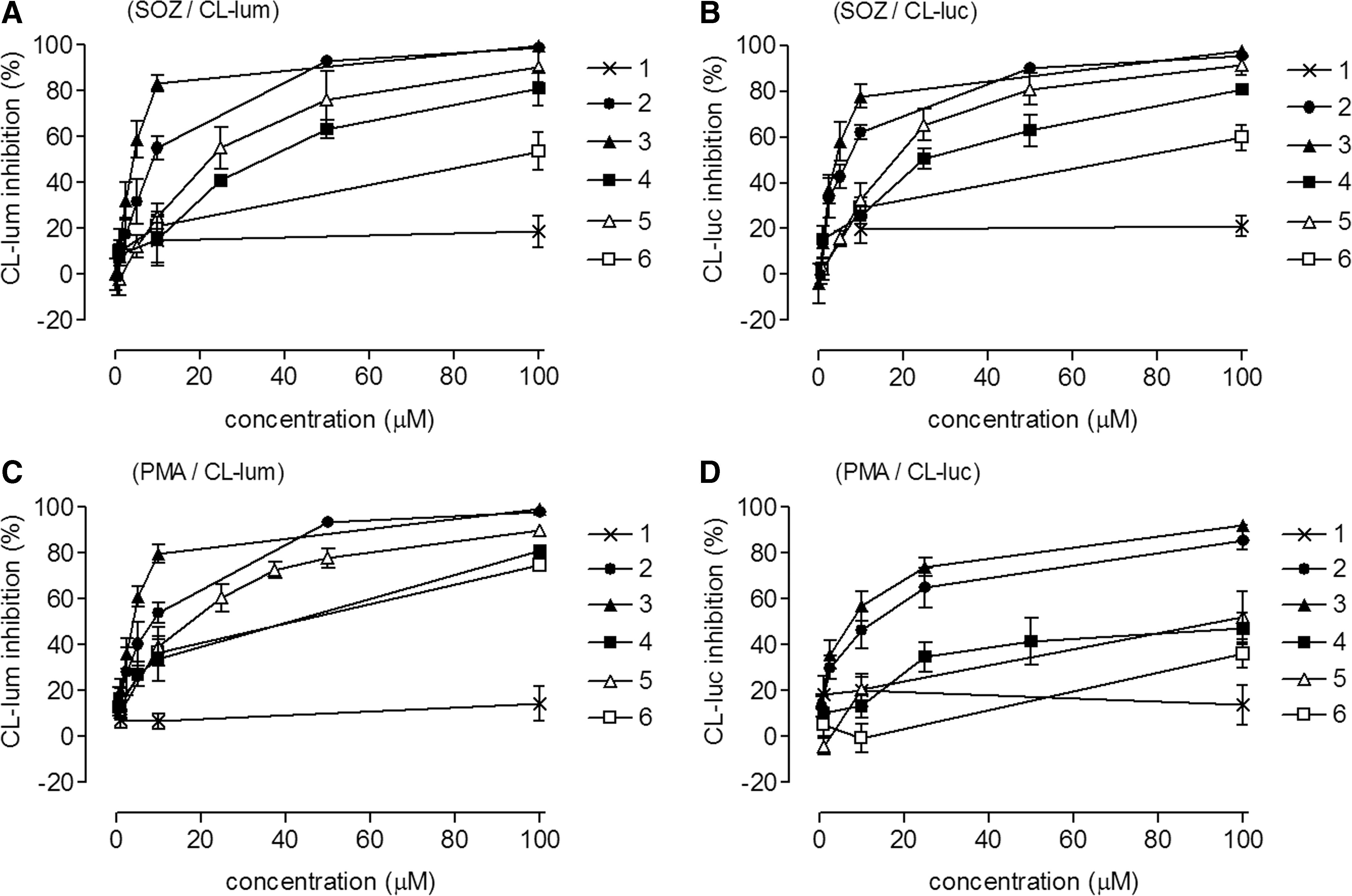
Concentration-dependent inhibitory effect of 4-methylcoumarins on the human neutrophil oxidative metabolism. The cells (1×10⁶ cells/mL) were stimulated with serum-opsonized zymosan
Neutrophils (1 × 10⁶ cells/mL) were stimulated with SOZ (1 mg/mL) or PMA (0.1 μM), and the luminol- or lucigenin-enhanced chemiluminescence (CL-lum and CL-luc, respectively) was measured for 15 min at 37°C. IC50 values are expressed as mean ± SD of at least four independent experiments, assayed in duplicate.
Cytotoxicity data represent the mean ± SD of three independent experiments assayed in duplicate. Samples
Determined by the Trypan Blue exclusion test.
LDH release by the samples was compared with neutrophils completely lysed by Triton X-100.
Values in a column(abcd) or in a row(ABCD) not sharing the same letter are significantly different from each other (ANOVA and Tukey's post hoc test, P < .05).
SOZ, serum-opsonized zymosan; PMA, phorbol-12-myristate-13-acetate; SD, standard deviation; IC50, concentration inhibiting CL-lum or CL-luc by 50%; HBSS, Hank's balanced salt solution (untreated cells); DMSO, dimethyl sulfoxide (0.1% v/v; vehicle control); ANOVA, analysis of variance.
Coumarins
Coumarins
Cytotoxicity
Compared with the control, the six coumarins did not induce significant LDH release or decrease neutrophil viability under the assessed conditions (Table 1). Thus, cytotoxicity does not underlie the inhibition of neutrophil ROS generation by the tested coumarins.
Inhibition of elastase and MPO activity
The o-dihydroxylated coumarins
Data expressed as mean ± SD of three independent experiments assayed in duplicate.
Coumarins tested at 100 μM.
AAPV (a specific inhibitor of elastase activity) tested at 1 μM.
ABAH is a specific inhibitor of MPO activity.
Values in a column not sharing the same letter are significantly different from each other (P < .05; ANOVA and Tukey's post hoc test).
MPO, myeloperoxidase; AAPV, methoxy-succinyl-Ala-Ala-Pro-Val-chloromethylketone; ABAH, 4-aminobenzoic acid hydrazide; n.t., not tested.
HOCl and DPPH radical scavenging ability
The o-dihydroxylated coumarins
Data expressed as mean±SD of three independent experiments assayed in duplicate.
Values in a column not sharing the same letter are significantly different from each other (P<.001; ANOVA and Tukey's post hoc test).
DPPH, 1,1-diphenyl-2-piorylhydrazyl; BHT, 2,6-di-tert-butyl-4-methylphenol.
Coumarins
Discussion
The results reported here are part of a continuous study of the pharmacological activities of plant extracts and isolated compounds on the effector functions of neutrophils. 6 –15 In the present study, we assessed whether six coumarin derivatives inhibit the human neutrophil oxidative metabolism and elastase activity, and investigated some of the underlying mechanisms of action of these compounds.
To gain an initial insight into the action of the tested coumarins in the neutrophil oxidative metabolism, we used two stimuli—PMA and SOZ. The former activates protein kinase C (PKC) directly; 32 the last is a model phagocytic stimulus that binds to the complement, IgG, and mannose membrane receptors of neutrophils. 33 SOZ triggers complex intracellular signaling pathways involving phospholipases and kinases, due to engagement of multiple receptors, but PKC translocation and activation is an important early event of the NADPH oxidase assembly triggered by SOZ. 33 The experimental strategy also involves the use of the chemiluminescent probes lucigenin (CL-luc) and luminol (CL-lum) to study how the coumarins affect different steps of the neutrophil ROS generation process. Lucigenin specifically detects O2 •−, the first ROS produced via the NADPH oxidase complex; luminol measures the overall ROS generation, with higher sensitivity for the ROS produced via the MPO–H2O2–halide system in subsequent steps. 34
We found that the hydroxylated and acetylated 4-methylcoumarins (
Coumarins
Coumarins
Modulating the activity of protein kinases can be effective for the treatment of many diseases. In recent years, there are many protein kinase inhibitors being tested in clinical trials for cancer, cardiovascular diseases, prevention of transplant rejection, and autoimmune diseases such as rheumatoid arthritis, psoriasis, and inflammatory bowel diseases. 36 –38 However, these compounds must be highly specific and selective toward the target protein kinase to minimize adverse effects, because there are a large number of kinases in the human genome and many of them play important roles in pathways that regulate the normal cellular processes. 36,37 The effect of the 4-methylcoumarin derivatives on the subclasses of protein kinases remains to be investigated.
The presence of free dihydroxyl groups determines the ability of 4-methylcoumarins to inhibit the neutrophil oxidative metabolism and the MPO and elastase activity, as well as scavenge free radicals. For instance, the o-dihydroxy-substituted 4-methylcoumarins suppressed the neutrophil oxidative metabolism more than the m-dihydroxy-substituted 4-methylcoumarins. The 7,8-dihydroxyl group contributed two times more than the 6,7-dihydroxyl group to the inhibitory effect. Hoult et al. 19 reported that the O2 •− scavenging effect of the 7,8-, 6,7-, and 5,7-dihydroxy-4-methylcoumarins follows the same ranking order. The o-dihydroxyl group is important for other pharmacological effects of coumarins. Daphnetin (7,8-dihydroxycoumarin) and esculetin (6,7-dihydroxycoumarin), isolated from medicinal plants used to treat allergic and inflammatory diseases, and their 4-methyl analogues, inhibit the rat leukocyte lipoxygenase activity. 19,24 Esculetin suppresses the tyrosine kinase and PI3-K activity of MCF-7 cells. 19 The 4-methyl-5,7-dihydroxycoumarin strongly inhibits the leukocyte cyclooxygenase activity. 19 Moreover, flavonoids bearing a catechol group inhibit the human neutrophil degranulation. 13
Esterification of hydroxyl groups can improve the pharmacological properties of phenolic compounds in cell-mediated oxidative and inflammatory processes. This structural modification of flavonoids and coumarins enhances inhibition of prostaglandin synthesis and nitric oxide production by macrophages and prevents intercellular adhesion molecule-1 expression by endothelial cells.
39,40
Acetylation of quercetin
39
and fluorescent probes
41
increases their lipophilicity and intracellular bioavailability. The ester form of these compounds readily crosses the plasma membrane, intracellular esterases cleave the ester bond, and the hydroxylated products accumulate in the cytoplasm. Interestingly, acetylation of free hydroxyl groups of coumarin derivatives can have a positive or negative impact on their ability to inhibit the neutrophil ROS generation, depending on the number and position of the substituents. The diacetylated 4-methylcoumarins
Regarding the structure activity analysis of MPO activity inhibition by the 4-methylcoumarins, (i) the most active coumarin (
The 6,7- and 7,8-dihydroxyl groups (
Interestingly, the acetylated 4-methylcoumarins do not display remarkable DPPH reducing ability, but they are as good as the 7,8-dihydroxy-4-methylcoumarin to scavenge HOCl. Our results agree with reports of strong free radical scavenger activity of o-diacetoxy-4-methylcoumarins, which can be similar to the corresponding dihydroxy parent structures. 20 –22 The concentration of phenolic compounds in the samples of the acetylated 4-methylcoumarins is not significant, so the antioxidant effect of these compounds does not stem from contamination by hydroxylated compounds. However, the mechanism underlying the antioxidant effect of acetylated compounds remains unexplained.
Dietary exposure to coumarins is significant. It is estimated that the average Western diet contains ∼1 g/day of mixed benzopyrones, which includes coumarins and flavonoids. 18 Coumarins exist at high levels in some essential oils, particularly the cinnamon bark (7000 ppm) and cassia leaf (up to 87,300 ppm) oil. 17 The human plasma concentration of total polyphenol metabolites ranges from 0.1 to 4 μM with an intake of 50 mg of aglycone equivalents 42 and can reach 10 μM after a polyphenol-rich meal. 43 Some coumarinic drugs are rapidly absorbed from the gastrointestinal tract and distributed throughout the body after oral administration; the absorption rate of coumarin can reach up to 83%. 17,18 Interestingly, most of the biological effects of the 4-methylcoumarin derivatives tested herein occurred in a range of concentrations considered relevant for therapeutic purposes (1–10 μM). 20 Therefore, it is possible that the 4-methylcoumarin derivatives achieve significant pharmacological effects in vivo, but further studies are needed to establish the best dosage form to attain therapeutic levels of these compounds. Recently, Witaicenis et al. 44 reported that 4-methylesculetin administered orally displayed antioxidant and intestinal anti-inflammatory effect in rats with acute colitis. These authors suggested that absorption of 4-methylesculetin in the small intestine determined its therapeutic effects, and that the presence of the 4-methyl group improved these effects, in comparison to esculetin.
In summary, the results of the present study contribute to understanding how the 4-methylcoumarins inhibit the human neutrophil oxidative metabolism triggered by different signaling pathways. The structure–activity relationships regarding inhibition of the neutrophil ROS generation process and MPO and elastase activity, as well as the HOCl scavenging action, may contribute to developing more selective compounds. Because 4-methylcoumarins are not metabolized to toxic intermediates, they are interesting therapeutic adjuvants in the treatment of inflammatory diseases involving neutrophils. Further investigation is required to elucidate the molecular mechanisms underlying the pharmacological effect of 4-methylcoumarin derivatives and determine the potential clinical usefulness of these compounds in the adjunctive therapy of inflammatory diseases.
Footnotes
Acknowledgments
The authors thank Mr. Alcides Silva Pereira and Mrs. Nadir Mazzucato (Faculdade de Ciências Farmacêuticas de Ribeirão Preto, Universidade de São Paulo) for technical assistance and the Brazilian agencies Fundação de Amparo à Pesquisa do Estado de São Paulo (FAPESP, grants 2007/02487-3, 2007/00840-8), Coordenação de Aperfeiçoamento de Pessoal de Nível Superior (CAPES), Conselho Nacional de Desenvolvimento Científico e Tecnológico (CNPq, grants 131780/2010-7, 150302/2007-0), and Instituto do Milênio Inovação e Desenvolvimento de Novos Fármacos e Medicamentos (IM-INOFAR) for fellowships and financial support.
Author Disclosure Statement
No competing financial interests exist.