




Abstract
We studied the polyphenol composition and antioxidant activity of the ethanolic and ethyl acetate extracts of Hypericum connatum (Guttiferae), in addition to their antimicrobial and antiquorum-sensing (AQS) properties. The extracts exhibited a similar polyphenol content and a notable antioxidant activity, which was stronger in the ethanolic extract (EC50=3.2 μg/mL). Ultrahigh-performance liquid chromatography analyses revealed different polyphenol profiles, with rutin and apigen being the main components of the ethanolic extract and caffeic acid, (–)-epicatechin and p-coumaric acid being abundant in the ethyl acetate extract. The ethyl acetate extract exhibited a more effective antimicrobial activity than the ethanolic extract against the pathogens Staphylococcus aureus, Bacillus cereus, Escherichia coli, and Pseudomonas aeruginosa. For the first time, AQS activity was detected in H. connatum: the ethanolic extract inhibited the production of violacein, a quorum-sensing–regulated pigment, in a Chromobacterium violaceum tester strain, without interfering with its growth.
Introduction
T
Guttiferae is a large plant family comprising >1000 species; the best-known genus is Hypericum Linnaeus, with ∼484 species. 4 These species are widely distributed worldwide, avoiding only zones of extreme aridity, temperature, and/or salinity. Some Hypericum species are well known for their uses in traditional medicine, and antifungal, antibacterial, antiviral, and anticancer compounds have been isolated from different species of Hypericum. The presence of such compounds could justify the popular use of some of these species as wound-healing agents and in the treatment of some microbiological diseases. 5 Different species of Hypericum have been studied for their phenolic compounds. In general, the occurrence of such metabolites is linked to the biological activities exhibited by some crude extracts, fractions, or isolated compounds, such as antimicrobial, 5 antiviral, 6 and antioxidant properties. 7
Hypericum connatum Lam. is found in different countries of South America and is used in traditional medicine as a tonic, an astringent, and in the treatment of oral lesions, which are frequently caused by Herpes viruses. 6 Previous investigations of the extracts of H. connatum showed antiviral activity against the feline immunodeficiency virus, a widespread lentivirus of domestic cats that shares numerous biological and pathogenic features with the human immunodeficiency virus. 6 With regard to chemical ecology, many plants demonstrate the production of antimicrobial compounds that limit the ability of microbes to produce the factors required for virulence and successful colonization. Bacteria are capable of controlling gene expression in response to their population density via a mechanism known as QS. QS controls a large array of phenotypes in bacteria, ranging from simple bacterial cell motility to more complex behaviors, such as the formation of biofilm and the production of virulence factors and toxins. The system is often linked to the relay of small signal molecules, such as N-acyl-homoserine lactones (AHLs) in Gram-negative bacteria and γ-butyrolactones in Gram-positive bacteria, which cross the cell membrane and between cells and control important functions, including pathogenicity and growth promotion. 8 The inhibition of QS is, therefore, considered a new essential target for antimicrobial purposes. In fact, by disrupting the communication system of bacteria, it might be possible to inhibit the expression of QS-regulated phenotypes and aid in the treatment of bacterial infections, particularly those caused by antibiotic-resistant strains, with natural antibiotics. Polyphenols can inhibit QS-related processes and can interfere in the autoinducer–receptor binding process. 9 Bacterial cell–cell signaling and the population density–dependent regulation of behavior, QS, involve the synthesis and perception of small, diffusible signal molecules, such as the AHL-signaling system in Gram-negative bacteria. Among plants of the genus Hypericum, anti-QS (AQS) activity has been studied only for an ethanolic extract of H. perforatum, an extract that is able to limit the capability of methicillin-resistant Staphylococcus aureus to produce the factors required for virulence and ensuing colonization. 10
Considering these medicinal properties of Hypericum species, the aim of our work was to study the polyphenol content and composition of two extracts, an ethanolic extract and an ethyl acetate extract, of H. connatum and to evaluate their antioxidant, antimicrobial, and AQS activities.
Materials and Methods
Plant material
The plant material was collected in San Luis (Argentina) in October 2010 and identified by one author (M.R.F.). A voucher specimen of the plant was maintained in the Herbarium of the National University of San Luis.
Extraction
The aerial parts of the plant (5 kg) were air-dried and then extracted with methanol for 2 days at room temperature, yielding 840 g of residue. This extract was divided into the fraction soluble in ethyl acetate and the fraction soluble in ethanol, generating 235 and 350 g of residue, respectively. A 500 mg sample of the ethanolic residue was resuspended in 5 mL of H2O and 1 mL of ethanol; 500 mg of the ethyl acetate residue was resuspended in 5 mL of H2O, 2 mL of ethyl acetate, and 1 mL of ethanol. The two mixtures were concentrated and resuspended in dimethyl sulfoxide (DMSO) to produce the same final concentration of 100 mg/mL of the extract and then subjected to biochemical and biological analyses.
Colorimetric analysis of total phenolic compounds
The total phenolics were determined by following the methods in Singleton and Rossi 11 using the Folin–Ciocalteu reagent. The absorbance was determined at room temperature at λ=760 nm using a Cary UV/Vis spectrophotometer (Varian Cary 50 MPR). The quantification was based on a standard curve generated with gallic acid; the results were expressed as μg gallic acid equivalents (GAE)/g of extract.
Polyphenol composition
An ACQUITY Ultra Performance LCTM system (Waters, Milford, MA, USA) linked to a PDA 2996 photodiode array detector (Waters) was used for ultrahigh-performance liquid chromatography (UPLC) analyses. Empower software was used to control the instruments and for data acquisition and processing. The analysis was performed at 30°C using a reverse-phase column (BEH C18, 1.7 μm, 2.1 mm×100 mm; Waters). The mobile phase consisted of Solvent A (7.5 mM acetic acid) and Solvent B (acetonitrile) at a flow rate of 250 μL/min. 12 Gradient elution was employed, starting at 5% B for 0.8 min, 5–20% B for 5.2 min, isocratic 20% B for 0.5 min, 20–30% B for 1 min, isocratic 30% B for 0.2 min, 30–50% B for 2.3 min, 50–100% B for 1 min, isocratic 100% B for 1 min, and decreasing from 100% to 5% B for 0.5 min. At the end of this sequence, the column was equilibrated under the initial conditions for 2.5 min. The pressure ranged from 6000 to 8000 psi (41.37–55.16 MPa) during the chromatographic run. The effluent was introduced to an LC detector (scanning range 210–400 nm; resolution 1.2 nm). The injection volume was 5 μL, and the peaks were monitored at 280 nm. The phenolic compounds were identified by qualitatively and quantitatively comparing the peak areas on the chromatograms of samples with those of diluted standard solutions. 13 –15
Free radical-scavenging capacity
The free radical-scavenging activity was measured using the stable radical 2,2-diphenyl-1-picrylhydrazyl (DPPH). 16 The analysis was performed in microplates by adding 7.5 μL of extract to 303 μL of a DPPH–methanol solution (153 mM). The absorbance was then spectrophotometrically measured (Varian) at λ=517 nm. The absorbance of DPPH without the antioxidant (control sample) was used as the baseline measurement. The scavenging activity was expressed as the half-maximal effective concentration (EC50) of the sample, in terms of μg/mL, necessary to inhibit the DPPH radical activity by 50% after a 60-min incubation. These experiments were performed in triplicate, and the results are expressed as the mean±standard deviation (SD).
Antimicrobial assays
To screen the activity of the H. connatum extracts against microorganisms, a filter paper disc method was used. 17 The bacteria used in this study included Gram-positive Bacillus cereus (strains DSM 4313 and DSM 4384) and S. aureus DSM 25923 and Gram-negative Escherichia coli DSM 8579 and Pseudomonas aeruginosa ATCC 50071 strains. All strains were purchased from the Deutsche Sammlung von Mikroorganismen und Zellkulturen GmbH (DSMZ). The strains were incubated in a nutrient broth (Oxoid) at 37°C for 18 h. The optical densities of all cultures were adjusted to match a 0.5 McFarland standard of 1×10⁸ colony-forming units (CFU)/mL. Sterile filter paper discs (5 mm) were impregnated with 10, 25, 50, and 100 μg of the extracts and placed in Petri dishes. A disc treated with DMSO alone served as the negative control. The plates were left for 30 min at room temperature under sterile conditions and then incubated at 37°C for 24 h, and the inhibition halo around the disc was measured. Tetracycline (7 μg/disc; Sigma) was used as a reference. The experiments were performed in triplicate and averaged.
AQS assay
The Chromobacterium violaceum QS-sensing system was used for this assay. QS in this wild-type strain of bacteria is known 18 to control the production of the purple pigment violacein in response to such autoinducer molecules as C6-AHLs and C4-AHLs. The disc-diffusion method was employed to detect the AQS activity of the extracts from H. connatum. In this test, bacterial growth inhibition would result in a clear halo around the disc, whereas a positive result of QS inhibition would result in a turbid halo harboring the pigmentless bacterial cells of C. violaceum DSM 30191 used as the tester strain. Cultures of C. violaceum were prepared by incubating the bacteria in a nutrient broth (Oxoid) for 16–18 h at 30°C. The cultures were adjusted to the 0.5 McFarland standard (1×10⁸ CFU/mL). The extracts from H. connatum, previously dissolved in sterile DMSO, were added at different concentrations (from 1 to 100 μg) to C. violaceum-inoculated nutrient agar plates (0.1 mL/plate). The inoculated plates were kept under a laminar flow hood for 10 min and then incubated at 30°C for 24 h.
Statistical analysis
All of the experiments were performed in triplicate. The results are expressed as the means±SD. The data were ordered in homogeneous sets, and the Student's t-test of independence was applied. 19
Results and Discussion
Polyphenol composition and antioxidant activity
In our experiments, the ethanolic and ethyl acetate extracts showed a similar amount of polyphenols (134.11 and 119.14 mg of GAE/g of extract, respectively). Evaluation of the polyphenol profile by UPLC, starting from the same amount of polyphenols in terms of milligrams of GAE, revealed the presence in both extracts of some common metabolites, such as gallic, chlorogenic, and ferulic acids and luteolin and hyperoside (Table 1). The most abundant compounds present in the two extracts were hyperoside (82.28 and 76.17 mg GAE/g of extract, respectively) and chlorogenic acid (18.92 and 14.52 mg GAE/g of extract, respectively). The ethanolic fraction contained more gallic and chlorogenic acids than the ethyl acetate fraction and contained rutin and apigenin, which were not detected in the other fraction (Table 1). In contrast, the use of ethyl acetate allowed the extraction of such metabolites as caffeic acid, (−)-epicatechin, p-coumaric acid, and naringenin. The presence of the flavonoid rutin, found in the ethanolic extract, agrees with the literature that reported this flavonoid in Hypericum brasiliense and in the flowers of H. perforatum. 7 However, this compound was not detected in a methanol extract of H. connatum from South Brazil. 7 Rutin can be easily absorbed and is found in different tissues, the plasma, and the gut, where it affects the growth of some pathogens as demonstrated by the in vitro study of Parkar et al., 20 and also acts as a potent metal chelator and a free radical scavenger. In this manner, rutin significantly influences the function of various mammalian cellular systems. Like most polyphenols, rutin has a strong antioxidant activity, plays a role in inhibiting some cancers, and is also capable of reducing the extent of mitochondrial damage and reducing oxidative stress in leukocytes in patients with rheumatoid arthritis. 21 Flavonols, such as (–)-epicatechin, constitute an important part of the human diet and possess different biological activities, including antioxidant and anti-inflammatory properties. 22 Cinnamic acid derivatives, such as chlorogenic, caffeic, and p-coumaric acids, have been shown to be active antioxidants 23 that are capable of inhibiting LDL oxidation in vitro. 24 The two extracts in the present study demonstrated strong antioxidant activities. Despite the similar amount of polyphenols, the ethanolic fraction was twice as strong as the ethyl acetate fraction in inhibiting DPPH free radical activity (Fig. 1), with an EC50 value of 3.2 with respect to 6.6 μg of extract. It is likely that such activity in both extracts could be influenced by the high amount of hyperoside and reinforced, in the ethanolic fraction, mainly by the presence of rutin, as previously described with regard to its antioxidant properties. 25
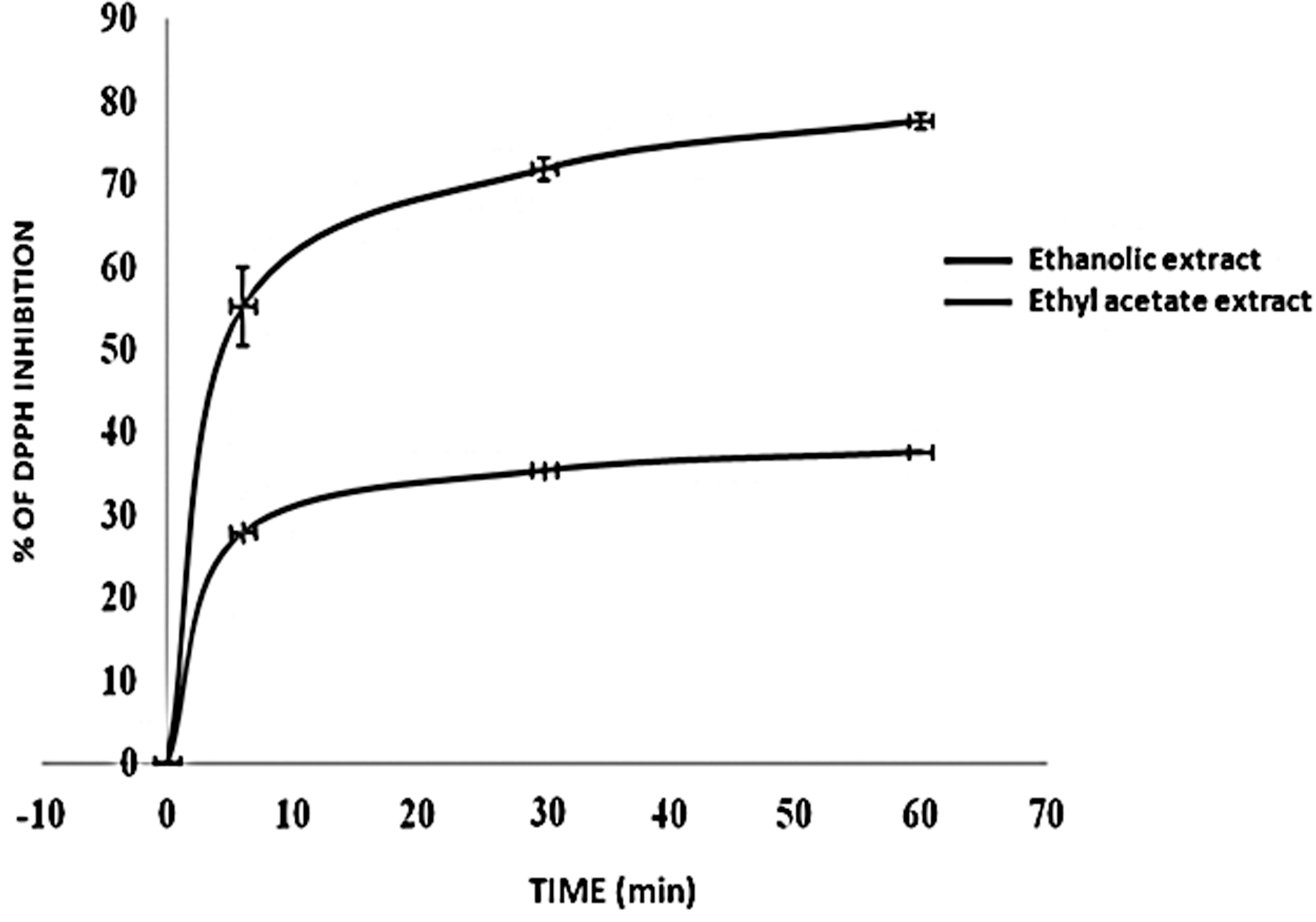
Percentage of inhibition of the 2,2-diphenyl-1-picrylhydrazyl (DPPH) exhibited by the ethanol and ethyl acetate extracts of Hypericum connatum. The vertical bars represent the standard deviation.
The molecules were identified based on the retention times of the relative standards, run in the same conditions. Results are shown as mean±SD (n=3).
Evaluated by spectrophotometric assay.
GAE, gallic acid equivalents; SD, standard deviation.
Antimicrobial activity
Using the inhibition halo technique, we evaluated the antimicrobial activity of the ethanolic and ethyl acetate extracts of H. connatum against a range of Gram-positive and Gram-negative microorganisms responsible for food-borne diseases and/or for the spoilage of contaminated products. In particular, the test was performed against the following: two strains of B. cereus (DSM 4313 and DSM 4384), an aerobic spore-former commonly found in raw and processed foods that causes several cases of foodborne illnesses; an enterotoxigenic strain E. coli, capable of causing serious cases of food poisoning; S. aureus, a pyogenic bacterium that plays a significant role in invasive skin disease; and the opportunistic pathogen P. aeruginosa, which may cause pulmonary, skin, urinary, eye, and ear infections. We found that the ethyl acetate extract was more active compared to the ethanolic extract. All strains tested were sensitive to 25 μg of the ethyl acetate extract (Table 2): the ethanolic extract showed an antimicrobial effect against almost all strains only at the highest dose (100 μg) used in the test, with inhibition halos ranging from 8.7 mm (vs. B. cereus DSM 4313) to 9.3 mm (vs. S. aureus). Both extracts were effective against the toxigenic E. coli DSM 8579, with halos up to 10 mm, but their behavior was different as regard as P. aeruginosa that resulted sensitive to the action of the ethyl acetate extract, but was resistant to all doses of the ethanolic extract used in the experimentation. These results corroborated the work of Dall'Agnol et al., 5 who found antimicrobial activity of the methanol extract from H. connatum against S. aureus and E. coli, and confirmed previous studies reporting the different susceptibility of B. cereus to plant phenolic extracts. 17 With regard to the components responsible for the antimicrobial activity shown, different compounds of distinct natures in these extracts can be considered as acting as antimicrobial agents. This is not surprising, because a variety of active principles present in the majority of the previously studied Hypericum species have a demonstrated antimicrobial activity. 26 However, the activity of the ethyl acetate extract against the tested pathogens could be ascribed to the presence of caffeic acid, which augments the action of (–)-epicatechin and p-coumaric acid. Caffeic acid, present at a concentration of 11.07 mg GAE/g in this fraction, is one of the most common polyphenols in plants and is well recognized as an antimicrobial agent. 27 Caffeic acid acts as an enzyme inhibitor, possibly through a reaction with sulfhydryl groups or through more nonspecific interactions with proteins. 28 p-Coumaric acid has dual mechanisms of bactericidal activity: it disrupts the bacterial cell membranes and binds to the bacterial genomic DNA to inhibit cellular functions, ultimately leading to cell death. 29 (–)-Epicatechin also acts mainly to disrupt the cell membrane of several bacteria. 30
Data are expressed in mm and do not include the diameter of paper disc (5 mm). Tetracycline (7 μg) and dimethyl sulfoxide (DMSO) were used as positive and negative control, respectively. Results are shown as mean±SD (n=3).
P<.05, ** P<.01, *** P<.001 vs. DMSO.
EE, ethanolic extract; EAE, ethyl acetate extract.
AQS activity
Many studies have emphasized that various eukaryotic specimens, including plants, fungi, and even animals, produce compounds, such as polyphenols, capable of interfering with the bacterial QS system. 3,15
In this investigation, we assayed the potential of the ethanolic and ethyl acetate extracts of H. connatum to exhibit the QS inhibitory properties. To this end, we used the C. violaceum DSM 30191 indicator strain in the disk-diffusion assay. 18 The obtained data revealed that 25 μg of the ethanol extract inhibited QS-regulated violacein pigment production in the strain without interfering with its growth; at a lower concentration, the presence of the yellow culture was undetectable, and a higher concentration inhibited the growth of the strain, with inhibition halos of 7.3 mm and 9.3 mm using 50 and 100 μg of the ethanolic extract, respectively. In contrast, neither antiquorum-sensing (AQS) nor antimicrobial activity was observed for any amount (from 10 to 100 μg) of the ethyl acetate extract (Table 3). Although the ethanolic extract exhibited a less antimicrobial activity than the ethyl acetate extract, it exhibits an AQS activity. This behavior is most likely attributable to the presence of rutin, which might synergistically reinforce the AQS activity of apigenin, whereas the presence of other flavonoids in the ethyl acetate extract, such as naringenin, is not likely to strengthen such a property. The available literature reports that flavonoids, such as naringenin, apigenin, quercetin, and rutin, have a demonstrated AQS activity. 9
Tetracycline (7 μg) and DMSO were used as positive and negative control, respectively. Results are shown as mean±SD of three independent experiments.
P<.001 vs. DMSO.
AQS, anti–quorum-sensing.
Summary
Our data indicate that H. connatum extracts present antioxidant and antimicrobial activities, justifying the use of this plant in traditional medicine. The AQS activity exhibited by one of the two extracts led us to identify the compounds involved in the capability of H. connatum to interfere with microbial QS signals and to discovery of new bioactive substances for clinical and agrofood purposes.
Footnotes
Author Disclosure Statement
No competing financial interests exist.