




Abstract
The antioxidant and cytotoxic activities and the polyphenolic and anthocyanin contents of tomato hybrid powders were studied. Tomato powders were obtained, starting from the fresh fruits that had undergone an industrial process of drying and pulverization at two different temperatures. Antioxidant activities were evaluated in different extracts by using spectrophotometric assays: 2,2′-azino-bis-(3-ethylbenzthiazoline-6-sulfonic acid and N,N-dimethyl-p-phenylenediamine dihydrochloride cation radical inhibition for lipophilic and hydrophilic extracts, respectively, and 2,2-diphenyl-1-picrylhydrazyl radical scavenging assay for polyphenolic extracts. Moreover, polyphenolic and anthocyanin contents were also carried out to detect the presence of these bioactive compounds. The effect of cytotoxic activity in vitro of tomato hybrid powder extracts on T47D (human breast carcinoma) cells was also evaluated. Results showed good antioxidant activities in lipophilic, polyphenolic, and hydrophilic extracts of samples that were obtained at a lower temperature. Extracts of the sample obtained at a higher temperature presented moderate antioxidant activity, lower than the extracts of other samples, which was probably due to the loss of labile antioxidant compounds during the industrial process. Very interesting was the presence of anthocyanins in both samples, even if in traces, and also a moderate cytotoxicity of a lipophilic extract on T47D cells. Therefore, tomato hybrid powders, on the basis of their multifunctional properties, could have a biotechnological application in agri-food or cosmetic industries as an additive for improving nutritional and/or bioactive qualities of commercial products used in daily nutrition and cosmetics.
Introduction
R
Many healthy foods are processed before their consumption; thus, it is important to study the effects of the industrial process (high temperature, light exposure, microwaving, etc.) on the quality and content of bioactive compounds in the foods just mentioned. Tomato carotenoids have been found to be stable under severe processing conditions of industrial manufacturing. Tomato-based food products, such as tomato paste, tomato sauce, and tomato soups, are rich in carotenoids; in particular, lycopene is the most abundant carotenoid, ranging in concentration from 0.3 mg/100 g in vegetable beef soup to 55 mg/100 g in tomato paste. 10 Fresh tomato and tomato products are also excellent source of vitamins (A, C, and E), other carotenoids (α-, β-, and γ-carotene), and flavonoids. These nutrients, in combination with lycopene, contribute to the protection against peroxidation, both in case of fresh tomato and in industrially processed tomato. Tomato powder (TP) showed more protection against peroxidation and exerted beneficial effects on serum and hepatic lipids in rat fed with TP and with lycopene–beadlet. 11 Tomato consumption is also associated with decreased prostate cancer incidence by means of the modulation process of lycopene on androgen activation. It has been described that castrated or sham-operated old male rats provided with daily oral supplementation of phytofluene or lycopene, or fed a 10% TP for 4 days, had about 40%–50% lower serum testosterone concentrations. These results showed that the intake of tomato carotenoids alters androgen status, which may be a mechanism by which tomato intake reduces prostate cancer risk. 12 Moreover, the effect of TP supplementation on the development of leiomyomas in the oviduct of Japanese quail has been reported. Results indicated that dietary supplementation with TP reduced the incidence and size of spontaneously occurring leiomyoma of the oviduct in the Japanese quail. 13
The purpose of this work was to evaluate the antioxidant properties of different extracts (lipophilic, hydrophilic, and methanolic) of two samples of hybrid TPs. Further, polyphenolic and anthocyanin content was estimated by means of spectrophotometric methods, and cytotoxic activity on cancer cell T47D (breast carcinoma) of all extracts was also evaluated by 3-(4,5-dimethylthiazol-2-yl)-2,5-phenyl-2H-tetrazolium bromide (MTT) assay.
Materials and Methods
Chemicals
Analytical grade solvents were obtained from Carlo Erba. N,N-Dimethyl-p-phenylenediamine dihydrochloride (DMPD), 2,2′-azino-bis-(3-ethylbenzthiazoline-6-sulfonic acid) (ABTS) as the crystallized diammonium salt, and 2,2-diphenyl-1-picrylhydrazyl (DPPH) were from Fluka; 6-hydroxy-2,5,7,8-tetramethylchroman-2-carboxylic acid (Trolox) was from Aldrich. The T47D (human breast carcinoma) cells were obtained from American Type Culture Collection. Unless stated otherwise, all reagents and compounds used were obtained from Sigma Chemical Company.
Tomato hybrid powders
Tomato hybrid was achieved as previously described. 14 Both samples of tomato hybrid powders were achieved by means of a similar procedure, which is described as follows. Fresh tomatoes were cut into small pieces and were subjected to the drying that took place in two different steps:
1. The dehumidification allowed to eliminate most of the water present in the inside part of the pieces. This step occurred through the cooling air by using a refrigerator apparatus from which the heat necessary to treat the product at a temperature of 60°C in case of Sample 1, and not higher than 45°C in case of Sample 2, is recovered. The air distribution was uniform and on individual trays and on the trolleys; the duration of the drying cycle while using this technique was short, because it occurred in the presence of dehumidified and continuously renewed air. The dried samples were directed at the pulverization step.
2. The pulverization takes place in an apparatus called “Hammer Mill” that is formed by a cylindrical chamber in which a rotor rotates with stainless steel articulated hammers. At the bottom of the mill, there is an interchangeable grid that brings out the ground material (TP).
Extraction
Four different extractions were performed on four aliquots (1 g each) of both samples: (1) 100 mL of diethyl ether under stirring in dark overnight. Lipophilic extracts were filtered and concentrated in a rotary evaporator in vacuum (T<35°C) and dried under N2; (2) 100 mL of water under stirring for 2 h. Hydrophilic extracts were filtered and used for assay; (3) 100 mL of a solution of acetone/methanol/ethanol (70:15:15 by volume) for 2 h at 4°C. The extracts were filtered and concentrated in a rotary evaporator in vacuum and dried under N2; and (4) 100 mL of a solution of 60% (v/v) ethanol acidified with citric acid at 60°C for 120 min. The ethanol extracts were centrifuged at 15,344 g for 30 min, and the supernatant was evaporated at 40°C with a rotary evaporator.
DMPD assay
Antioxidant activity of hydrophilic fraction of all samples was determined by DMPD method. 15 The reaction mixture contained 1 mM DMPD, 0.1 mM ferric chloride in acetate buffer 0.1 M (pH 5.25) in a total volume of 1 mL. The assay temperature was 25°C. The reaction was monitored at 505 nm until absorbance became stable at a value of 0.900±0.100. Then, 5 μL of hydrophilic fraction was added to the reaction mixture, and the decrease in absorbance, which is proportional to the DMPD+ quenched, was determined after 20 min at room temperature. According to the method, the antioxidant activity of hydrophilic fraction was carried out in triplicate on the supernatant (main solution; m.s.) and on its diluted solutions 1:2, 1:5, and 1:10. The antioxidant activity was reported as % inhibition of radical cation DMPD+.
ABTS assay
Evaluation of antioxidant activity of lipophilic fraction of all samples was performed according the ABTS method.
16
The reaction mixture contained 56 mM ABTS and 24.5 mM potassium persulfate in ethanol (dilution 1:100) in a total volume of 1 mL. In this case, 5 μL of the lipophilic fraction (organic phase) was added to the reaction mixture, and the decrease in absorbance at 734 nm was determined after 5 min at room temperature. The total time needed to carry out each assay was ∼6 min. The absorbance decrease was determined from the difference between the Abs734 values before and after the addition of the sample. According to the ABTS method, the antioxidant activity of the lipophilic fraction was carried out in triplicate on the diethyl ether extract of each sample, dissolved in dichloromethane analytical grade (20 mg/mL, m.s.), and on its dilutions 1:2; 1:5; and 1:10. The antioxidant activity was reported as % inhibition of cation radical ABTS
Free-radical-scavenging activity assay
Solutions of acetone/methanol/ethanol extracts in MeOH, at a concentration of 20 mg/mL, were prepared and assayed for DPPH test. 17 Next, 5, 10, 20, and 50 μL of these solutions were added to 0.7 mL of DPPH in MeOH (6 mg/50 mL; 0.1 mM final concentration) and adjusted to 2 mL final volume with MeOH. The absorbance at 517 nm was determined after 30 min at room temperature, and the percent of free radical inhibition was calculated. Trolox, a synthetic antioxidant compound, was used as a standard. The antioxidant activity of samples was estimated as % inhibition of free-radical DPPH.
Polyphenolic content: Folin Ciocalteau method
The total polyphenol content was measured using the Folin Ciocalteau colorimetric method. 18 To 800 μL of deionized water, 50 μL of Folin Ciocalteau's phenol reagent and a volume of sample ranging from 5 to 50 μL were added and accurately mixed. After 1 min, 100 μL of 20% sodium carbonate solution was added and mixed. Deionized water was then added up to a volume of 1 mL. The solution was carefully mixed, and total phenol content was spectrophotometrically estimated at 765 nm (DU-Beckman) after a 2-h incubation at room temperature. Quantification was based on the standard curve generated with quercetin. All determinations were carried out in triplicate.
Anthocyanin content
The anthocyanin content was determined according to the method reported by Lee et al. (2005). 19 Briefly, small amounts of acidified ethanol extracts of samples were dissolved with pH 1.0 buffer and pH 4.5 buffer. Absorbance of samples was measured at 510 and 700 nm using a spectrophotometer. Absorbance was calculated as Abs=(A510nm−A700nm)pH1.0 – (A510nm−A700nm)pH4.5 with a molar extinction coefficient for cyanidin 3-glucoside of 26900.
The anthocyanin content, by using the following equation (1), was expressed as milligrams of cyanidin 3-glucoside equivalents per 100 g of tomato hybrid powder.
where AB is absorbance, e is cyanidin 3-glucoside molar absorbance (26900), L is the cell path length (1 cm), MW is the molecular weight of anthocyanin (449.2 Da), D is a dilution factor, V is the final volume (mL), and G is the weight of tomato hybrid powder (g).
Cell lines and culture conditions
T47D (human breast carcinoma) cells were cultured in Dulbecco's modified Eagle's medium (DMEM) containing 10% fetal calf serum, 1 mM pyruvate and 10 mM HEPES, 100 U/mL penicillin G sodium, and 100 mg/mL streptomycin sulfate at 37°C under 5% CO2. All media and supplements for cell culture were purchased from Gibco–Invitrogen. Cells (3×10⁵) were seeded in 24-well plates and grown for 24 h before treatment with tomato hybrid powder extracts for the indicated period.
MTT viability assay
The cells were plated in 96 culture wells at a density of 250,000 cells/mL and allowed to adhere for 2 h. Next, the medium was replaced with fresh medium, and cells were incubated with tomato hybrid powder extracts at concentrations of 100, 10, and 1 μg/mL. After 24 h, mitochondrial respiration, an indicator of cell viability, was assessed by the mitochondrial-dependent reduction of MTT to formazan, and cell viability was assessed according to the method of Mosmann (Mosmann, 1983). 20 Briefly, 25 μL of MTT (5 mg/mL in complete DMEM) was added to the cells and incubated for an additional 3 h. After this time point, the cells were lysed, and the dark blue crystals were solubilized with 100 μL of a solution containing 50% (v:v) N,N-dymethylformamide, 20% (w:v) sodium dodecyl sulfate with an adjusted pH of 4.5. The optical density (OD) of each well was measured with a microplate spectrophotometer (TECAN GENiOS PRO) that was equipped with a 620-nm filter. The cell mortality in response to treatment with test compounds was calculated as % cell mortality=100−[(OD treated/OD control)×100] and expressed as 50% inhibitory concentration (IC50; μg/mL).
Spectrophotometric measurements
Absorbances were recorded at a controlled room temperature (25°C) with a Varian DMS 90 UV-VIS spectrophotometer.
Data analysis
All measurements were carried out in triplicate, and the results were statistically analyzed using the Systat 7.0 software program to determine the average value and standard error of the mean of at least three experiments.
Results
In a previous article, we reported the achievement of a new tomato hybrid that was obtained by using the conventional agronomic technique (natural cross-pollination) between pure lines of San Marzano and Black Tomato (SM/BT), and the evaluation of its nutritional factors in comparison with a pure line of tomato, San Marzano. Results showed good antioxidant activity in both fresh and processed agri-food products (pulped tomato) of the tomato hybrid just mentioned. 14
The objective of this work has been to evaluate the antioxidant activity, polyphenolic and anthocyanin contents, and cytotoxic activity on cancer human cell of different extracts of two samples of powder obtained by processing fresh tomato hybrid SM/BT.
Results about antioxidant activity linked to lipohilic and hydrophilic extracts are reported in Figures 1 and 2, respectively. With regard to lipophilic extract of Sample 1, the antioxidant activity presented a linear response linked to the concentrations. The maximum activity (93.19%) was observed at the highest concentration (m.s.), and at next dilutions (1:2; 1:5; and 1:10), the inhibition of radical cation ABTS

Antioxidant activity of lipophilic extracts of tomato hybrid powders was measured using the ABTS method. The extracts were tested at a concentration of 20 mg/mL (m.s.) and serial dilution (1:2; 1:5; 1:10). Results are expressed as % inhibition of radical cation ABTS
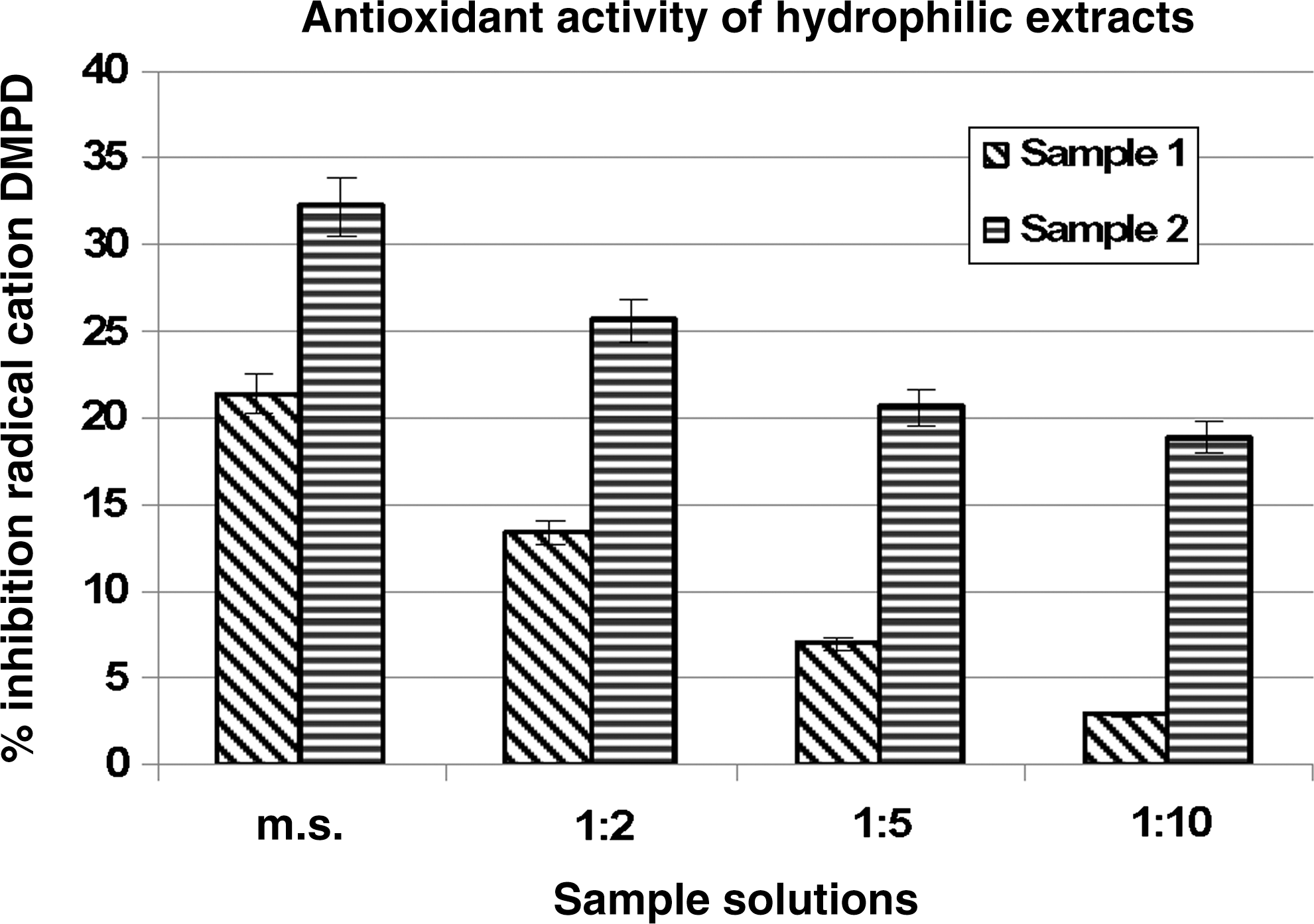
Antioxidant activity of hydrophilic extracts of tomato hybrid powders was measured using the DMPD method. The assay was carried out on supernatant (m.s.) and on its diluted solutions (1:2; 1:5; 1:10). Results are expressed as % inhibition of radical cation DMPD
As far as polyphenolic compounds are concerned, we performed the antioxidant assay on the extracts containing polyphenols and their content estimation by spectrophotometric methods. Results are reported in Figure 3. The radical-scavenging capacity of the extracts, expressed as a percentage of the inhibition of DPPH radical, was 25.78% and 19.05% for samples 1 and 2, respectively, at the maximum amounts tested (50 μL of a solution 20 mg/mL). These amounts were equivalent to 9.8 and 8.5 μg of polyphenolic compounds, which were calculated on the basis of the standard quercetin used in the assay (Fig. 3). We estimated a content of total polyphenols of 9.8 mg for Sample 1 and 8.5 mg for Sample 2, referred to 1 g of powder. There was no significant difference in the polyphenolic compound content and scavenging capacity of radical DPPH between both samples. In fact, even if Sample 1 was obtained by using a higher temperature than Sample 2, this difference in temperature did not seem to affect polyphenolic compounds.
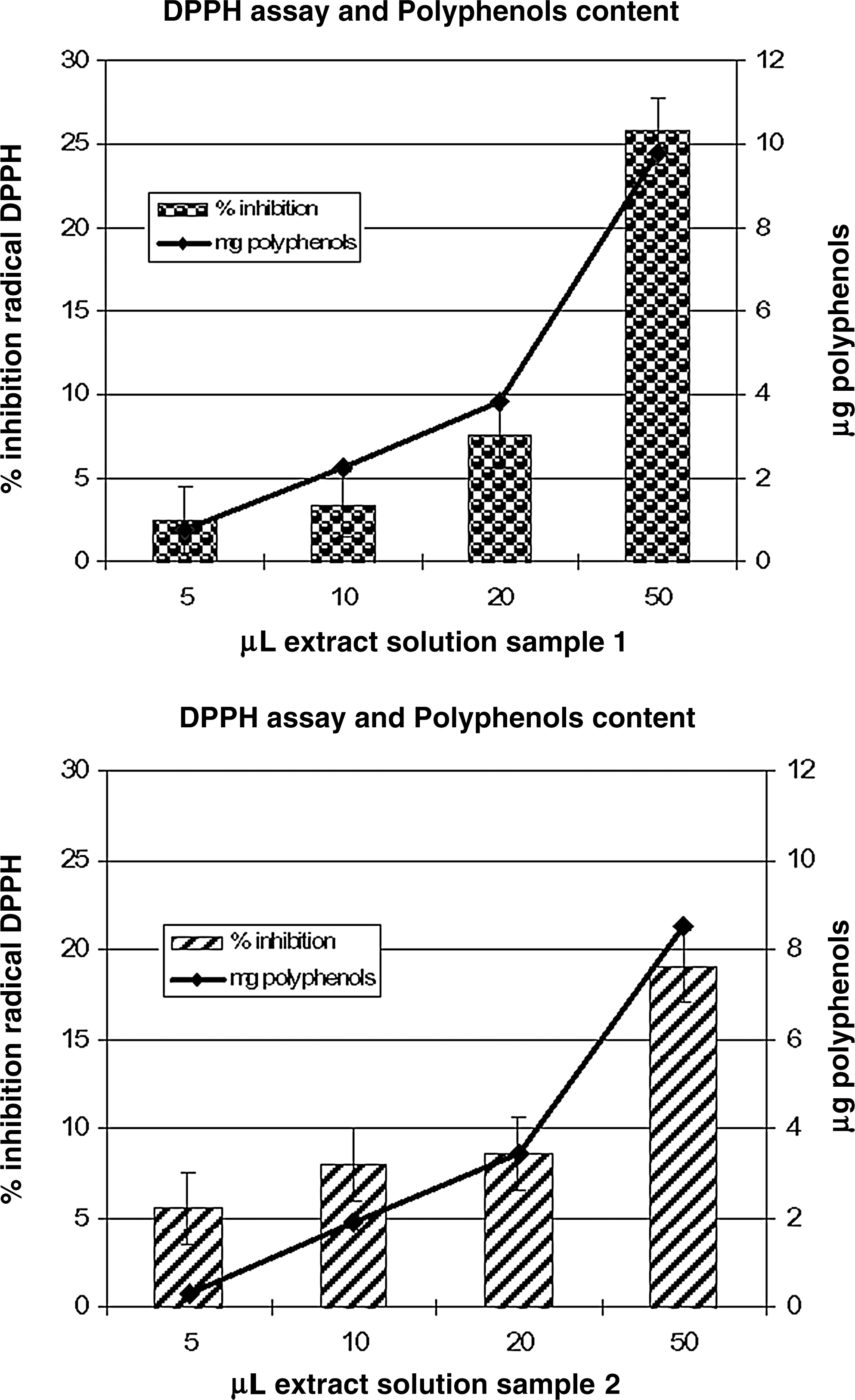
Free radical scavenging capacity and polyphenols content estimation of Samples 1 and 2 evaluated by DPPH and Folin-Ciocalteau methods, respectively. Antioxidant activity was expressed as % inhibition of radical DPPH
Moreover, the determination of the effect of anthocyanin content on tomato hybrid powders, according to the method reported by Lee et al., 19 was also performed. Results indicated that samples 1 and 2 contain traces of anthocyanins, showing, respectively, an amount of about 0.33 μg and 0.22 μg/100 g of powder.
The effect of cytotoxic activity on cancer cell T47D (human breast carcinoma) of lipophilic, polyphenolic, and anthocyanic extracts of tomato hybrid powders was also evaluated. As shown in Table 1, the lipophilic extract of Sample 2 exhibited a moderate cytoxicity (IC50=185.4 μg/mL) on T47D cells. The others extracts did not show a significant cytotoxicity.
Tomato hybrid powder extracts were tested at concentrations of 100, 10, and 1 μg/mL in dimethyl sulfoxide. After 24 h, mitochondrial respiration, an indicator of cell viability, was assessed according to the 3-(4,5-dimethylthiazol-2-yl)-2,5-phenyl-2H-tetrazolium bromide method. The cell mortality in response to treatment with test compounds was calculated as % cell mortality=100−[(OD treated/OD control)×100] and expressed as 50% inhibitory concentration (IC50; μg/mL). Results are expressed as the mean±SD of three experiments.
OD, optical density.
Discussion
The industrial processing of tomato to achieve different products (peeled tomato, juice, ketchup, sauces, etc.) involves several treatments that may affect the final profile of bioactive metabolites in the mentioned commercial product. 10,21 For this reason, it is important to understand the effect of industrial processes on health-associated compounds. Processing steps, undoubtedly, influence the composition of metabolites, with main attention to bioactive compounds present in tomato fruit.
In the present work, we presented results about two samples of tomato hybrid powder that were obtained by using the same industrial process, but at two different working temperatures (45°C and 60°C). As shown in figures, there was a significant difference between the antioxidant activity of hydrophilic and lipophilic extracts of samples. In particular, the extracts of Sample 1 obtained at a temperature higher than Sample 2 showed a less antioxidant capacity that was evaluated by using DMPD and ABTS assays for hydrophilic and lipophilic extracts, respectively. These results confirmed the effect of high temperature on bioactive metabolite (vitamins and carotenoids) composition of processed tomato. There was no significant difference between the two samples in polyphenol content, and its scavenging activity was evaluated by DPPH assay. A similar result was achieved with regard to the presence of anthocyanin compounds; in fact, both samples presented traces of anthocyanins (0.22 and 0.33 μg/100 g of powder).
Several studies are focused on the effect of industrial processing steps that involve washing, storage pasteurization, and canning on health-promoting compounds. 22 –25 The processes just mentioned provide a heat treatment that affects the nutritional value and metabolite profile of tomato. With regard to the effect of high temperature on lycopene content, several data presented in the literature show that the loss of this carotenoid was linked to the time of exposure at a high temperature. For example, heating tomato juice for 7 min at 90°C and 100°C resulted in a small (1.1% and 1.7%, respectively) decrease in lycopene content. 26 In other studies, a significant loss of lycopene (ranging from 28% to 32%) was observed when tomatoes were processed into paste. 27,28 On the other hand, there are contrasting results about the effect of heat treatments on other bioactive constituents (vitamins, polyphenols, and flavonoids) present in tomato. In some cases, an increase in total phenolic content as well as flavonoid content is reported; 29 in other cases, a decrease in these bioactive metabolites is observed. 30
In conclusion, on the basis of both antioxidant analyses and the estimation of bioactive compound content, we observed that high temperature affects mainly the composition of hydrophilic metabolites, such as vitamins, and other bioactive metabolites, such as carotenoids, present in the lipophilic fraction. The content of other health-beneficial compounds was not compromised a lot from the use of a high temperature, resulting in a processed product with interesting metabolite profile and a good total antioxidant capacity, and could be utilized as an additive in the food or cosmetic industry.
Footnotes
Acknowledgments
The authors thank Mr. Carmine Iodice and Mr. Valeria Calandrelli (technicians of the Institute of Biomolecular Chemistry) for their technical assistance. This work was supported by a dedicated grant from the Italian Ministry of Economy and Finance to the National Research Council for the project “Innovazione e Sviluppo del Mezzogiorno, Conoscenze Integrate per Sostenibilità ed Innovazione del Made in Italy Agroalimentare, Legge n. 191/2009.”
Author Disclosure Statement
No competing financial interests exist.