




Abstract
The polyphenolic compound resveratrol (RSV) has been studied for its protective effects on a variety of conditions, including cardiovascular disease (CVD), reduced exercise capacity, and bone disease. Individuals with chronic kidney disease suffer from a variety of these comorbid conditions, but the efficacy of RSV supplementation in this population is unknown. The objective of this study was to determine the efficacy of resveratrol feeding on factors related to CVD, aerobic capacity, and bone health in a mouse model of uremia. At 8 weeks of age, 28 female apolipoprotein E−/− mice underwent a two-step surgical procedure to induce uremia and were randomized to one of the two treatment groups for 16 weeks: 0.04% w/w resveratrol supplemented diet (group designated as RSV) (n=12) or control diet (group designated as CON) (n=16). Cardiovascular risk was determined by analysis of aortic atherosclerotic lesion area and aortic calcium, aerobic capacity was measured by maximal oxygen consumption/maximal aerobic capacity (VO2max) testing, and bone microarchitecture was assessed by microcomputed tomography. RSV animals had significantly fewer aortic atherosclerotic lesions at the site of the ascending aorta and lower aortic calcium at the branch of the coronary arteries compared with CON. Furthermore, there was a significant decline in VO2max from baseline to final testing in the CON group, but VO2max was preserved in the RSV group. Last, RSV had no significant effect on bone architecture. These data indicate that RSV supplementation improves vascular health and preserves aerobic capacity in a model of uremia, suggesting RSV supplementation could be examined as a therapeutic strategy for a critically ill population.
Introduction
R
Due to the high rate of cardiovascular and bone disease and low physical functioning reported in renal disease patients, this population represents a potential group for RSV supplementation. As many as 10% to 17% of adults in the US have moderate to severe declines in renal function, 6 which contributes to chronic fatigue, low physical functioning, and reduced maximal exercise capacity. These changes promote high rates of physical inactivity, leading to obesity, CVD, osteoporosis, and greatly increased mortality rates in this population. 7
CVD is the leading cause of death in individuals with chronic kidney disease (CKD), and elevated vascular calcification (VC) in this population 8 may contribute to this risk. The abnormal mineral metabolism is not confined to the vasculature, as CKD patients also have significantly elevated rates of bone disorders leading to increased fracture risk, mortality, and morbidity. 9 Several groups have demonstrated that apolipoprotein E null (ApoE−/−) mice subjected to partial nephrectomy become uremic and possess many of the metabolic and pathological disturbances associated with CKD. 10,11 This model of uremia has been used successfully to investigate the effect of several drug therapies on vascular disorders common in renal disease, 11,12 but has never been used to study the potential impact of resveratrol on other CKD comorbidities, including low aerobic capacity. The primary purpose of this study was to evaluate the effects of RSV supplementation on aortic atherosclerosis, aortic calcification, bone mineral density, and maximal oxygen uptake in a mouse model of uremia. We hypothesized that resveratrol supplementation would reduce atherosclerosis and VC and improve bone density and VO2 max in this model. Furthermore, we hypothesized that these effects would be associated with improvements in plasma urea levels and reductions in plasma cholesterol.
Methods
Animals
Female ApoE−/− mice (B6.129-Apoetm1Unc /J, #002052) (n=28) were obtained from the Jackson Laboratories (Bar Harbor, ME, USA). All experiments were approved by the Institutional Animal Care and Use Committee at the University of Illinois.
Surgical creation of uremia and study diet composition
At 8 weeks of age, after being anesthetized with oxygen and 1–3% isoflurane, the right kidney was approached through a 2 cm long lumbar incision and exposed by fine dissection. The anterior and posterior poles of the kidney were resected leaving the middle segment of the kidney intact. Following a 2-week recovery, a total nephrectomy of the left kidney was performed by ligation of the renal artery with a 5-0 silk suture and excision of the kidney. After an additional 2-week recovery, animals with urea levels >12 mM were randomized into one of the following two groups for the 16-week intervention: control casein diet (CON, n=16; TD.06650 Harlan Teklad, Madison, WI, USA) or casein diet supplemented with 0.04% w/w RSV (n=12). The dose of resveratrol used in the study represents ∼2 servings of red wine for a 70 kg adult.
Serum assays
Fasting blood samples were drawn from the retro-orbital vein before and after the dietary intervention. Plasma and serum were collected by centrifugation, aliquoted, and stored at −80°C until analyzed. Plasma urea (BioAssay Systems, Hayward, CA, USA) and total cholesterol (Infinity Incorporated, Melbourne, Australia) were measured enzymatically at both time points.
Quantification of aortic calcium and atherosclerotic lesions
After the 16-week intervention, the animals were sacrificed by carbon dioxide (CO2) asphyxiation; the basal portion of the heart and proximal aorta were rinsed in phosphate-buffered saline, placed in a freezing medium (OCT; Fischer Scientific, Pittsburg, PA, USA), and stored at −80°C until sectioning. Serial sections of heart tissue (measuring 8 μm) from the start of the aortic sinus to the ascending aorta were sliced, mounted on glass slides (Fischer Scientific), and frozen at −20°C, as described by Daugherty and Whitman. 13
Calcium in the cryosections was identified by Alizarin red at three specific anatomical regions of the proximal aorta that coincide with the start of the aortic valves (Region A), the orifices of the coronary arteries (Region B), and the ascending aorta (Region C). Quantification of calcium staining was graded on a scale of 0–4, as described. 14,15 Scores were determined by averaging the scores of four investigators blinded to the treatment groups.
Additional slides containing cryosections of the same regions of the proximal aorta were stained for neutral lipids using Oil Red O to detect and quantify intimal atherosclerotic lesions, as described. 16 The quantification was done using Microsoft Photoshop and expressed as the total aortic area covered with lipid-filled lesions and as the percent lesion area compared with the total aortic area.
Measurement of bone mineral density by microcomputed tomography
After sacrifice, the right femur was removed from each animal, cleaned, and stored in ethanol at −20°C. High-resolution images of the femur were acquired using a desktop microtomographic imaging system (μCT40; Scanco Medical AG, Basserdorf, Switzerland). Each tissue sample was scanned at 45 keV with an isotropic voxel size of 6 μm; scanning began in the mid-epiphysis and extended proximally for 3.6 mm (600 CT slices/specimen). The scans resulted in reconstructed three-dimensional (3D) data sets with the μCT Evaluation Program. The bone volume, trabecular volume, and composition were calculated by the program using nondestructive 3D reconstruction, as described. 17
Testing for maximal oxygen consumption
Animals were exercise tested at baseline and again 2 days before sacrifice (after the 16-week intervention) to measure maximal oxygen consumption/maximal aerobic capacity (VO2max) as an indicator of aerobic capacity. The open-circuit spirometry VO2max chamber was calibrated before each use with room air and bottled air (18% O2). The animals were tested at the same time of day for each measurement period after an overnight fast. During the testing, mice were placed into an airtight chamber on a motorized treadmill (Jog-a-Dog, Toledo, OH, USA). The mice were run at 6 m/min for 4 min, and the speed was increased by 6 m/min every 4 min and run at a 5° incline. The test was terminated when the mice were unwilling to run after gentle prodding. O2 and CO2 samples were taken every minute using O2 and CO2 sensors and were averaged for each stage, and VO2max was calculated using the following equation: [(O2min/100) – (room O2/100)]×air flow rate/body weight (kg).
Statistical analysis
All statistical tests were conducted using SPSS software with two-tailed significance set at α=0.05. Baseline and final testing values of the plasma variables and maximal oxygen consumption testing were analyzed using a general linear model repeated measures analysis of variance (ANOVA) with time (baseline or postintervention) as the within-subject factor and diet (RSV or CON) as the between-subject factor to detect any diet×time interaction effects. In addition, post hoc analysis between groups using one-way ANOVA was used to detect differences between groups. Atherosclerotic lesions and bone outcomes were assessed using independent samples t-tests. The ranked calcium scores were analyzed using the Mann–Whitney U test for nonparametric data. Correlation analysis was used to identify relationships between selected variables of interest using both the Pearson and Spearman correlation tests. Data are presented as the mean±standard error of the mean unless otherwise noted.
Results
Plasma variables
Plasma urea and plasma cholesterol values from RSV and CON animals are shown in Table 1. The baseline and final testing values for urea were not significantly different between the groups. Furthermore, there was no significant interaction or main effect of time or diet on changes in plasma urea values in either group. The baseline and final testing values for cholesterol were not significantly different between the groups. However, there was a significant interaction effect for plasma cholesterol levels (P=.013); both the RSV and CON groups showed a significant decrease in measured plasma cholesterol from baseline to final testing, with the decrease being significantly greater in CON animals (P<.05).
Data presented are mean±SEM. For the baseline and final measurements, a one-way ANOVA was used to measure differences between groups at each time point. For the delta values, general linear model repeated measures ANOVA was used to determine a diet×time interaction using the baseline and final values. Cholesterol and urea were measured enzymatically using commercially available kits. Both the RSV and CON animals had a significant decrease in plasma cholesterol from baseline to final testing.
Significant diet×time interaction.
ANOVA, analysis of variance; CON, control diet group; RSV, resveratrol supplemented diet group; SEM, standard error of the mean.
Aortic atherosclerotic lesion area and aortic calcium
RSV animals had a 44% reduction compared with the CON group in the atherosclerotic lesion area at the position in the aortic arch corresponding to the ascending aorta (Region C) (0.097±0.081 mm2 for RSV vs. 0.172±0.015 mm2 for CON, P<.01) (Fig. 1). However, there were no significant differences between the RSV and CON groups in the lesion area at the position in the aortic arch corresponding to the cusps of the aortic valves (Region A) (0.207±0.02 vs. 0.207±0.01 mm2, nonsignificant [NS]) or the branch point of the coronary arteries (Region B) (0.255±0.02 vs. 0.283±0.02 mm2, NS). Nonparametric analysis of aortic calcium scores revealed significantly lower calcium in the RSV group compared with the CON group at Region B (0.487±0.19 and 0.019±0.02, respectively; P=.025) (Fig. 2). Additionally, there was a trend for lower aortic calcium in the RSV animals at Region C (0.042±0.04 vs. 0.432±0.20 for RSV and CON, respectively; P=.087), although this difference was not significant.
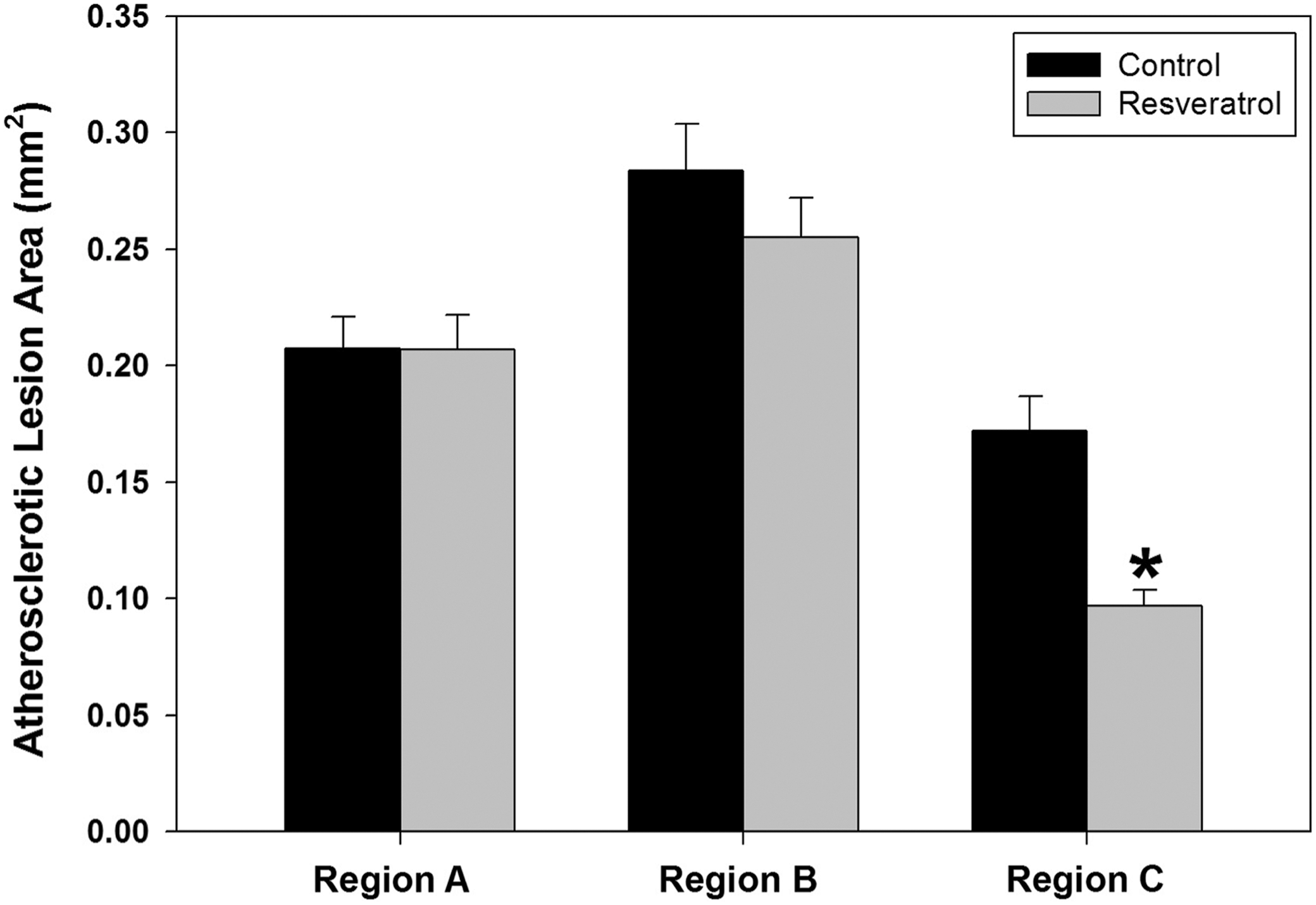
Atherosclerotic lesion area in aortic root sections corresponding to the cusp of the aortic valves (Region A), the branch of the coronary arteries (Region B), and the ascending aorta (Region C) in mm2. RSV animals (n=12) had a significantly lower lesion area at Region C (0.097±0.081 mm2) compared with CON (n=16) (0.172±0.015 mm2). Results are presented as the mean±SEM. *Indicates a significant difference in the RSV compared with CON animals (P<.01). CON, control diet group; RSV, resveratrol supplemented diet group; SEM, standard error of the mean.
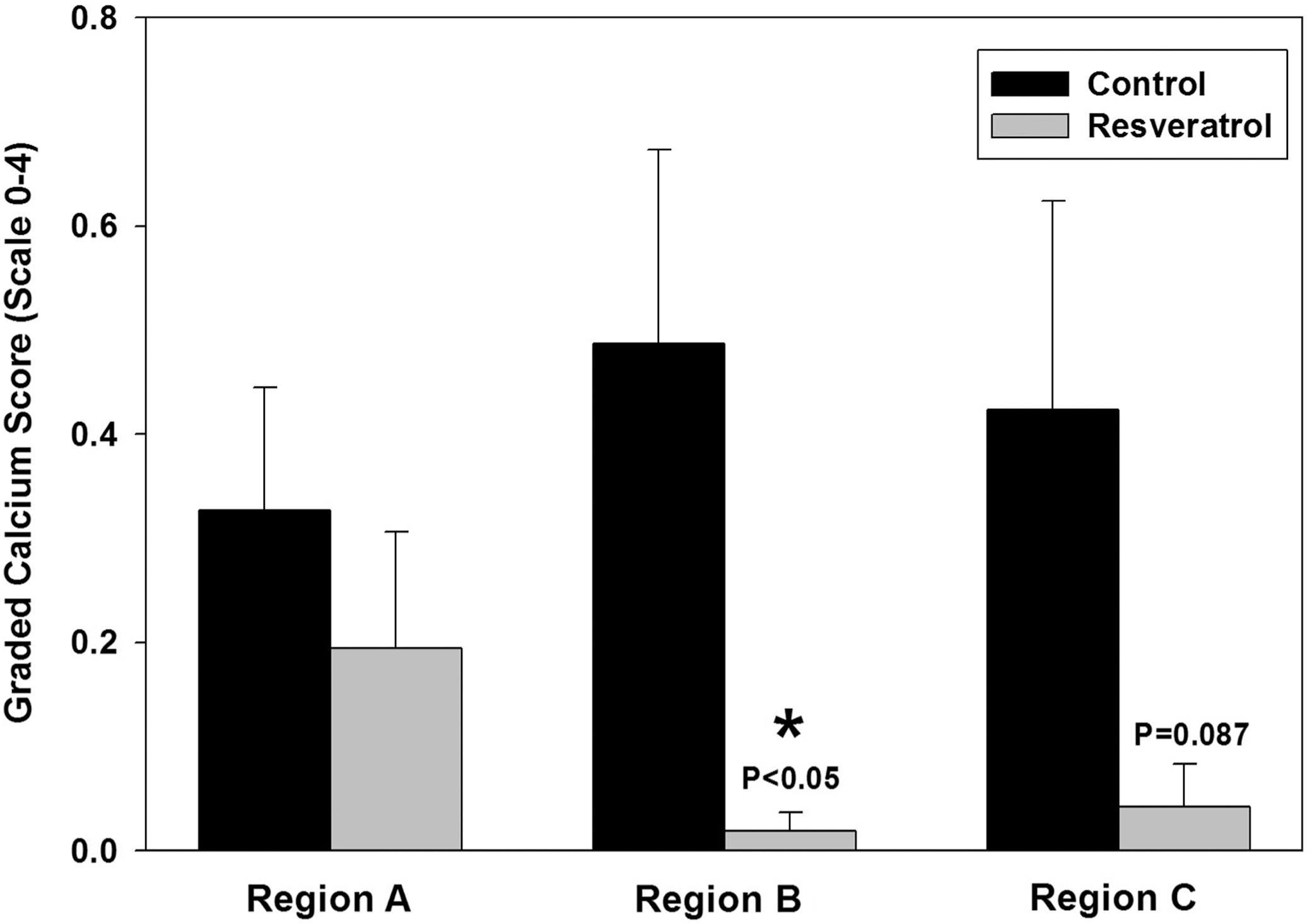
Aortic calcium in aortic root sections corresponding to the cusp of the aortic valves (Region A), the branch of the coronary arteries (Region B), and the ascending aorta (Region C) measured by a graded scale (0–4). RSV animals (n=12) had significantly lower aortic calcium than the CON animals in Region B (0.487±0.19 and 0.019±0.02, respectively; P=.025) (n=16). Additionally, there was a trend for lower aortic calcium in the RSV animals at Region C (0.042±0.04 vs. 0.432±0.20 for RSV and CON, respectively; P=.087), although this difference was not significant. Results are presented as the mean±SEM. *Indicates a significant difference in the RSV compared with CON animals (P<.05).
Bone microarchitecture
Parameters of bone microarchitecture are shown in Table 2. There were no significant differences between groups for total volume, bone volume, relative bone volume (total volume/bone volume), connective density, trabecular number, trabecular thickness, or trabecular separation. However, there was an NS trend toward higher TV (P=.08) and BV (P=.097), and consequently higher relative bone volume, in the RSV animals compared with the CON group.
Data presented are mean±SEM.
Maximal oxygen consumption
There was a significant interaction effect of time and diet on changes in maximal oxygen consumption (P<.05). Post hoc analysis showed a preservation of maximal oxygen consumption in the RSV animals (Δ−8.20±4.8 mL/min/kg, NS) compared with a significant decrease in the CON animals from baseline to final testing (Δ−26.9±7.7 mL/min/kg, P<.05) (Fig. 3).
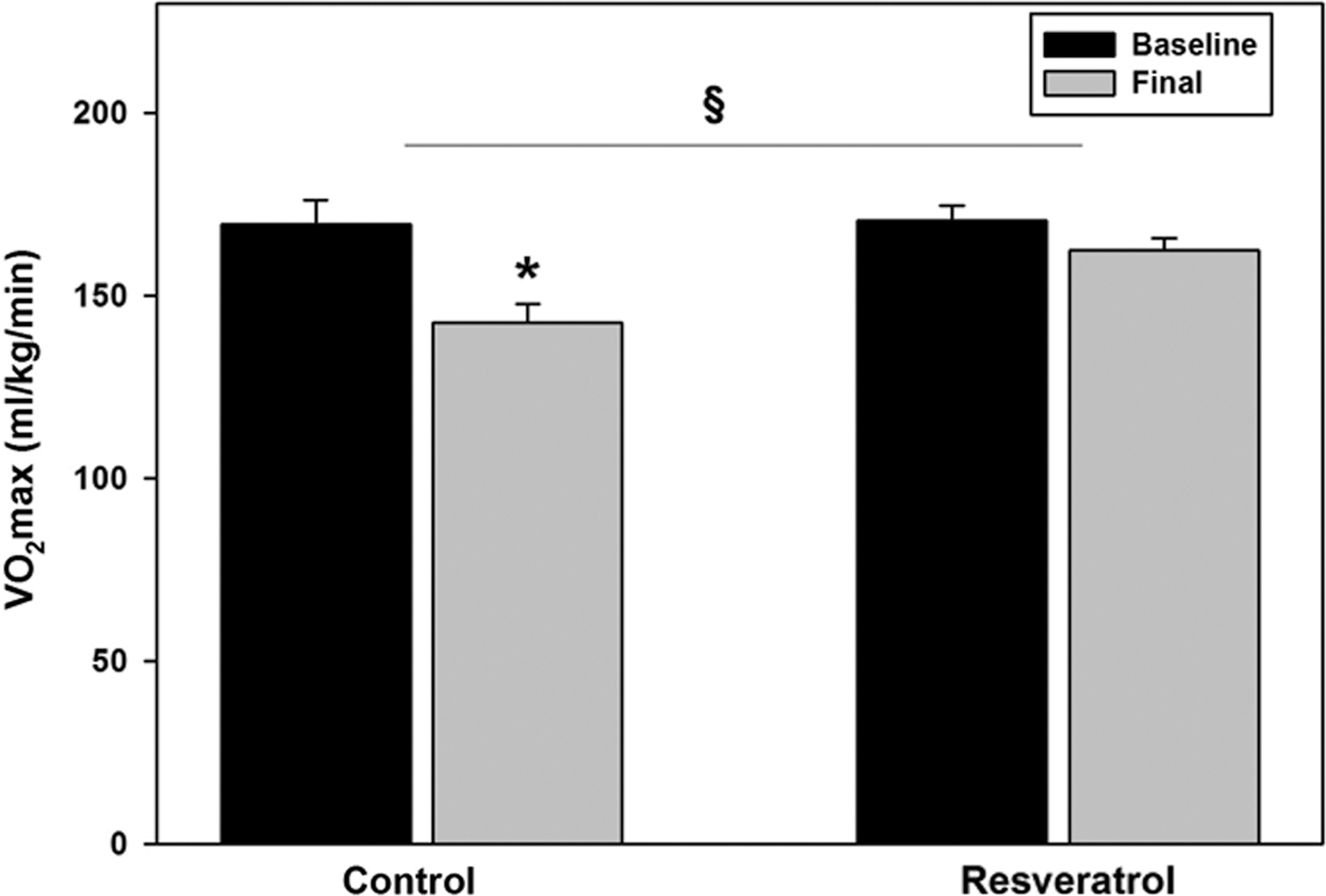
Maximal aerobic capacity measured by the VO2max test before and after a 16-week dietary intervention. There was a significant time × treatment interaction effect (§ P<.05). Post hoc analysis indicated that the RSV animals (n=12) showed a preservation of aerobic capacity (Δ−8.20±4.8 mL/min/kg, NS) compared with a significant decline in the CON group (Δ−26.9±7.7 mL/min/kg, *P<.05) (n=16). Results are presented as the mean±SEM. NS, nonsignificant; VO2max, maximal oxygen consumption/maximal aerobic capacity.
Correlation analysis
The correlations between plasma variables, VO2max, atherosclerotic lesion area, and bone variables at final testing are shown in Table 3. Plasma urea showed a negative association with bone volume (Pearson's r=−0.538, P<.05; Spearman's r=−0.548, P<.05) and relative bone volume (Pearson's r=−0.508, P<.05; Spearman's r=−0.540, P<.05). We also found an inverse relationship between VO2max and lesion area at the position corresponding to the branch point of the coronary arteries (Pearson's r=−0.674, P<.05; Spearman's r=−0.806, P<.01), while VO2max was positively correlated with the trabecular number (Pearson's r=0.755, P<.05; Spearman's r=0.433, P<.05). Postintervention cholesterol levels were negatively associated with the lesion area at the position corresponding to the ascending aorta (Spearman's r=−0.414, P<.05).
The Pearson correlation is listed first, followed by the Spearman correlation.
P<.05, ** P<.01.
Region A, aortic root region corresponding to the cusps of the aortic valves; region B, aortic root region corresponding to branch point of the coronary arteries; region C, aortic root region corresponding to the ascending aorta; VO2max, maximal oxygen consumption/maximal aerobic capacity.
Discussion
To our knowledge, this is the first study to investigate the effects of RSV supplementation on cardiovascular risk, bone outcomes, and exercise capacity in a mouse model of renal insufficiency. Animals in the 0.04% RSV-supplemented group displayed significantly fewer aortic atherosclerotic lesions at the site of the ascending aorta and lower aortic calcium at the branch of the coronary arteries compared with the CON animals after a 16-week dietary intervention. Furthermore, RSV animals demonstrated a preservation of VO2max compared with the decline in VO2max seen with the CON group, suggesting that RSV supplementation could represent a potential therapeutic target for CKD patients.
RSV and other phenolic compounds have been studied for their protective effects on atherosclerosis development. In this study, we found that 0.04% RSV reduced the aortic atherosclerotic lesion area by ∼44% at the site corresponding to the branch point of the coronary arteries. Fukao and colleagues demonstrated that high doses of RSV (9.6 and 96 mg/kg diet) reduced the lesion size in atherosclerosis-susceptible mice fed a high-fat diet, 18 and similar findings were reported in hamsters 19 and hypercholesterolemic rabbits 20 and by using structurally similar polyphenols. 21,22 We believe this is the first study to report the cardiovascular benefits of RSV in the context of CKD. We also documented a RSV-mediated reduction in aortic calcium; although the two processes can occur independently, VC directly correlates with atherosclerotic plaque burden and predicts CVD mortality.
ApoE−/− animals are characterized by elevated plasma cholesterol, and further increases in cholesterol after induction of uremia have been documented in this model. 11 We found a significant decrease in plasma cholesterol in our animals from baseline to postintervention testing for both the CON and RSV groups. We believe that the decrease shown in both groups reflects that the animals were maintained on a chow diet during weaning, surgery, and recovery before being switched to a purified diet for the intervention period, so we do not believe the decrease in plasma cholesterol was RSV induced. Additionally, we measured plasma urea as a marker of renal insufficiency and did not observe any group differences. Our data suggest that the effects of RSV are not related to uremic toxins or plasma cholesterol, but may be through other mechanisms not measured in this study, such as a reduction of superoxide generation, 23 a decrease in platelet aggregation, 24 or mitigation of inflammatory cytokines. 25
Impaired renal function constitutes increased risk for bone disorders in addition to VC, and RSV has been shown to modulate biomarkers of bone metabolism and markers of bone formation in vivo 3 and to prevent bone loss in an ovariectomized rat model, 4 suggesting potential for managing bone loss with progressive renal failure. RSV, structurally similar to diethylstilbestrol, may exert protective effects by binding to estrogen receptors on bone. We did not see any significant differences in bone parameters after 16 weeks of RSV supplementation, but this finding may be due, in part, to the dose of 0.04% w/w RSV we used (to represent an amount reasonably achievable by diet) compared with others who used much higher pharmacologic doses.
Accumulation of urea and other toxins promotes bone disorders in renal disease (reviewed in Barreto et al. 26 ); indeed, we found that plasma urea measured postintervention was negatively associated with bone volume and relative bone volume. Furthermore, we found a positive relationship between postintervention VO2max and trabecular number, suggesting that RSV supplementation was associated with greater exercise capacity and, possibly, positive measures of bone health.
Previous studies have shown that RSV increases lifespan through activating SIRT-1 pathways, including PGC-1α control of mitochondrial function. 27 Because of this, RSV has been studied for its effects on mitochondrial activity, muscle function, and overall physical functioning. Lagouge et al. 5 demonstrated an increased mitochondrial size, citrate synthase activity, and maximal oxygen consumption with RSV supplementation, and other studies have confirmed the RSV-mediated increase in VO2max. 28 Similarly, we found that RSV attenuated the decline in VO2 max observed in the control uremic animals. Because individuals with renal insufficiency suffer from significant and rapid declines in physical function, especially as the severity of renal disease increases, the attenuation of the decline in VO2 max found in this study could indeed be clinically significant in this population.
There were several limitations to this study. First, this surgical model was very severe, and due to a higher mortality rate in the male mice, only female mice were used for this study. Because of the potential estrogenic effects of RSV, it is unclear if the same results would be found in male animals. Furthermore, we do not know if these effects translate to humans, if this dosage of RSV can be safely cleared by individuals with renal impairment, or if the effects of this intervention persist in the context of diabetes or other comorbidities of CKD. The severity of the surgical model may also have prevented more robust reductions in atherosclerotic lesions. Furthermore, our sample size was small, and we are not able to explain the mechanisms responsible for the differences in atherosclerosis and functioning. Future research is needed to consider possible RSV-mediated changes in the SIRT-1 pathway in muscle tissue, or analysis of circulating inflammatory cytokines, markers of oxidative stress, or mineral regulatory proteins in this model.
In conclusion, we have shown that 16 weeks of a moderate dose of resveratrol (0.04% w/w) in the diet attenuates the development of aortic atherosclerotic lesion development and aortic calcium and the decline in maximal oxygen consumption in a mouse model of renal insufficiency. These findings indicate that RSV supplementation may be an appropriate strategy to prevent comorbidities associated with declining kidney function.
Footnotes
Author Disclosure Statement
No competing financial interests exist for any of the authors listed on this article. There are no disclosures to report.