




Abstract
Cornelian cherry (Cornus mas L.), apple (Malus domestica Borkh. cultivars Jonagold and Red Boskoop), pear (Pyrus communis cv. Conference), and plum (Prunus domestica L. cv. Common Plum) juices were assayed for their quality, organic acids, polyphenol content, and antioxidant activity (determined as a ferric-reducing antioxidant power [FRAP]). Cornelian cherry juice revealed the highest titratable acidity—2.58 g malic acid/100 g. The highest polyphenol content was also noted for Cornelian cherry—45.6 mg gallic acid (GA)/g. The medium level of polyphenols was proved for Jonagold apple (22.8 mg GA1/g). The lowest level was recorded for Common Plum (9.60 mg GA/g), followed by Conference pear and Red Boskoop apple (12.3 and 21.3 mg GA/g, respectively). The FRAP values were 1.97 mmol Fe/L for Common Plum juice, 2.37 mmol Fe/L for Conference pear juice, and 3.92 mmol Fe/L for both Red Boskoop and Jonagold apple juices. However, the obtained data indicated outstanding antioxidant properties for Cornelian cherry juice. In this case, FRAP reached 23.5 mmol Fe/L. The calculated correlation coefficient FRAP versus polyphenols indicates that the antioxidant status for Cornelian cherry is not only correlated with polyphenols but also with other biological compounds. The obtained results indicated that Cornelian cherry is a valuable source of substances with a high antioxidant activity.
Introduction
S
The genus Cornus (dogwood) belongs to the family Cornaceae, which consists of ∼50 species. 4 –6 The Cornus ssp. is widely distributed in the northern hemisphere, in different regions of Eurasia. 7 It grows in the temperate zone on calcareous, well-drained forest soils. The fruits of the Cornelian cherry are dark red, cherry red, pink, or yellow. 8 The majority of fruits have so far been harvested in the wild. The difficulties involved in making Cornelian cherry a profitable production are associated with the lack of valuable, highly productive, and high-quality fruit types. Therefore, in many countries, selection and breeding programs have recently being established. 3 For example, in Ukraine, more than 14 cultivars are registered. As the main criteria for selection, the yield, fruit size, fruit/seed ratio, and vitamin C content are used. Yields more than 10 kg per bush are considered satisfactory; however, it is possible to obtain 30–80 kg per tree. 9 The fruit weight of “wild types” does not exceed 2 g. Caucasian types may reach with this parameter 5–8 g. 3 Tree vigor is usually weak to moderate. 10 It is rarely attacked by pests and diseases, and it can be grown with the minimal use of pesticides, 11 making it suitable for organic orchards.
Cornelian cherry fruits have a sour and sweet tasting juice, and they contain a high vitamin C and E content. 8 According to Güleryüz et al., 12 fruits contained from 43.6 to 76.7 mg of vitamin C per 100 g; whereas for Greek types, the value reached 103 mg per 100 g of fruit. 13 This was the highest amount among all of the investigated small fruits. Cornelian cherries are a rich source of organic acids as well as macro- and microelements. 14 Demir and Kalyoncu 8 have reported that these values ranged from 2.2% to 4.7%. In our study, 15 Cornelian cherry juice contained high levels of Ca, reaching a level 10-fold higher (323 mg/L) than in the case of other juices (14–77 mg/L).
Cornelian cherries constitute an excellent source of carotenoids and a wealth of biologically active substances with curative effects such as phenolic acids, flavonoids, and anthocyanins. The dominant antioxidant components of the fruits are phenolic compounds. Pantelidis et al. 13 indicated 1592 mg gallic acid (GA)/100 g dry weight. Anthocyanins are the major bioactive compounds reported in Cornus species. 16,17 The total anthocyanin content of many Cornus species is 10–15 times higher than for other fruits that are used as sources of this compound. 2,18 Pantelidis et al. 13 reported the highest content of measured anthocyanins in Cornelian cherries (up to 223 mg/100 g fresh weight). The fruits are consumed not only fresh, but also dried and pickled similar to olives and they are used for producing jams, jelly, marmalade, dried fruits, soft drinks, and distillates. 8,19,20
The fruits, bark, and leaves were used for medicinal purposes already in Neolithic and ancient times. There are several reports of its use in traditional Chinese medicine, and it is known for its tonic, analgesic, and diuretic activities. 21 Modern pharmaceutical studies have indicated that Cornus not only exhibits anti-inflammatory and bacterial inhibitory effects, 22,23 but also has some therapeutic effects on diabetes, cancer, and shock. 24,25 It is reported that the contained oleanolic and ursolic acid bioactive components have a beneficial effect on anti-inflammation, anti-tumor protection, and antihyperlipidemia 26 and act against obesity and aid diabetics. 27 It also has radioprotective properties 28 and an antimicrobial activity. 29 Vareed et al. 18 proved the anti-tumor cell proliferation of extracts obtained from Cornus fruits. The cornelian cherries are also among the major constituents of several antidiabetic herbal preparations found in Asian countries. 27
The aim of the study was to investigate domestic dogwoods in comparison to other common grown species used as a material for juice processing. We focused on juices, as they are not only the most popular product of food processing, but also a source of nutritive organic compounds.
Materials and Methods
The investigated juices were obtained using a cold press juicer from fruits picked from trees planted in southern Poland. We compared juices from Cornelian cherries (seedlings), apples (cv. Jonagold and Red Boskoop), pears (cv. Conference), and plums (cv. Common Plum). The soluble solids concentration (SSC) of the juices was determined by a digital refractometer (Model PR-100; Atago) at 22°C. The titratable acidity (TA) was ascertained by titrating the juice with 0.1 M NaOH to pH 8.1 and expressed as % of malic acid. The total polyphenols content was evaluated by means of the Folin–Ciocalteu method, 30 with the data being calculated in mg/g of GA. In addition, the total antioxidant activity of the investigated juices was measured by ferric-reducing antioxidant power (FRAP) assay. 31
Determination of organic acids
The leading electrolyte was hydrochloric acid (10 mM), including 0.2% methylhydroxyethylcellulose adjusted with Beta–alanine to a pH of 3.5. The terminating electrolyte contained 5 mM of caproic acid and 5 mM of histidine. An isotachophoretic separation was performed using an Electrophoretic Analyzer EA 202M (Villa Labeco) with conductivity detection. The system was equipped with a sample valve of 30 μm fixed volume and two capillaries: the preseparation capillary (90 mm×0.9 mm internal diameter) and an analytical capillary (160 mm×0.3 mm internal diameter).
Statistical analysis
Statistical calculations of the obtained results were performed with the use of the ANOVA module of Statistica 9.0 (Statsoft, Inc.) for a confidence level of P=.95. The significance of variations was assessed with the help of variance analysis. Moreover, the Pearson product-moment correlation coefficient was calculated.
Results and Discussion
The highest soluble solids content was noted for Common Plum juice (14.5°Brix), whereas lower values were obtained for Cornelian cherry, Boskoop apple, and Jonagold apple juices (13.5, 13.1, and 13.0°Brix, respectively). The lowest SSC was measured for pear juice (12.2°Brix). The same applied to TA; pear juice reached only 0.20% of malic acid/100 g. Slightly higher values were obtained for Jonagold apples (0.53%). Juices with a high TA were produced from Red Boskoop apples and plums (0.90% and 0.91%, respectively). However, the highest value was noted for Cornelian cherry—2.58%. According to Demir and Kalyoncu, 8 the titrable acidity of the Cornelian cherry juice varied from 1.852% to 2.346%, while in another study, Krgovič 32 reported a range from 1.17% to 6.82%.
The isotachophoresis analyses revealed large differences in the organic acids content among the investigated cornelian cherry ecotypes (Fig. 1). The highest total acids content was recorded for the dogwood type DG 28 (20,442 mg/L), whereas the lowest for the DG 3 type (15,898 mg/L). Its fruits had the highest share of oxalic acid, and the reverse was true for DG 28. For the 10 investigated ecotypes, a low level (<100 mg/L) of tartaric acid was recorded. For the rest, the range was from 106.7 to 297.7 mg of tartaric acid/L. The highest amounts were contained by juices obtained from fruits of the DG 22 type. Since one of the potential uses of Cornelian cherry juices is the natural acidification of other sweet juices (e.g., apples with a high sugar/acid ratio), genotypes with high total acid content should be sought.
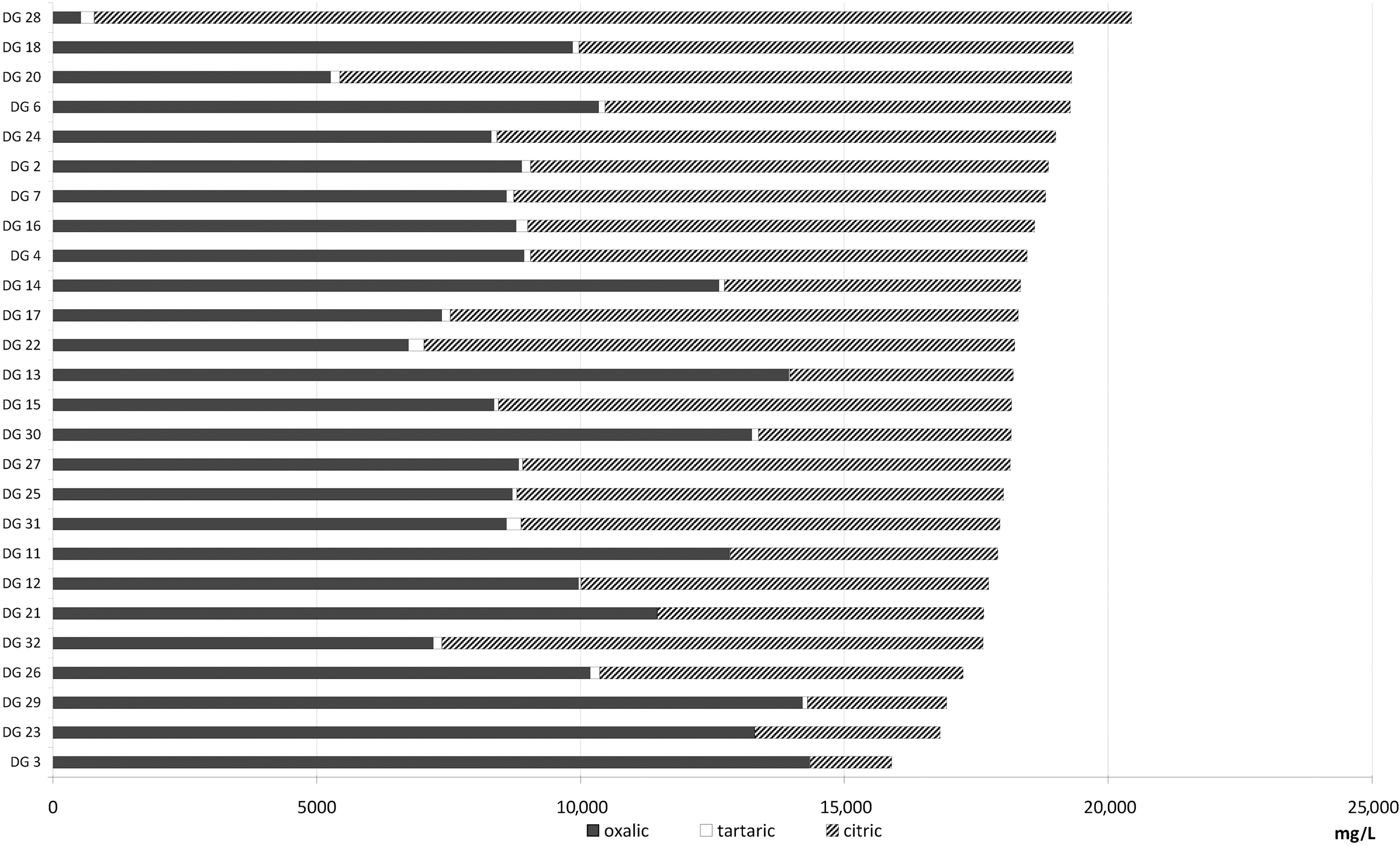
Oxalic, tartaric, and citric acid content in investigated wild types of Cornelian cherry juices (values expressed in mg/L).
The total polyphenols content in our study varied significantly (Fig. 2). The lowest level was recorded for Common Plum (9.60 mg GA/g), followed by Conference pear and Red Boskoop apple (12.3 and 21.3 mg GA/g, respectively). The medium level of polyphenols was proved for Jonagold apple (22.8 mg GA/g), while the highest was noted for Cornelian cherry (45.6 g GA/100 g). Rop et al. 33 reported within 12 of the investigated Central-East European cultivars a total phenolic content from 2.61 to 8.11 g GA/100 g. The highest values were measured for Russian genotypes. The polyphenol content measured for Greek Cornelian cherries was one of the highest among all of the investigated fruit species. This ranged from 657 to 2611 mg GA equivalents per 100 g of dry weight. 13 However, to assess the beneficial effect of abundant Cornelian cherry polyphenols, further investigations need to be carried out, as polyphenols may have a limited bioavailability and may also be extensively metabolized. 34
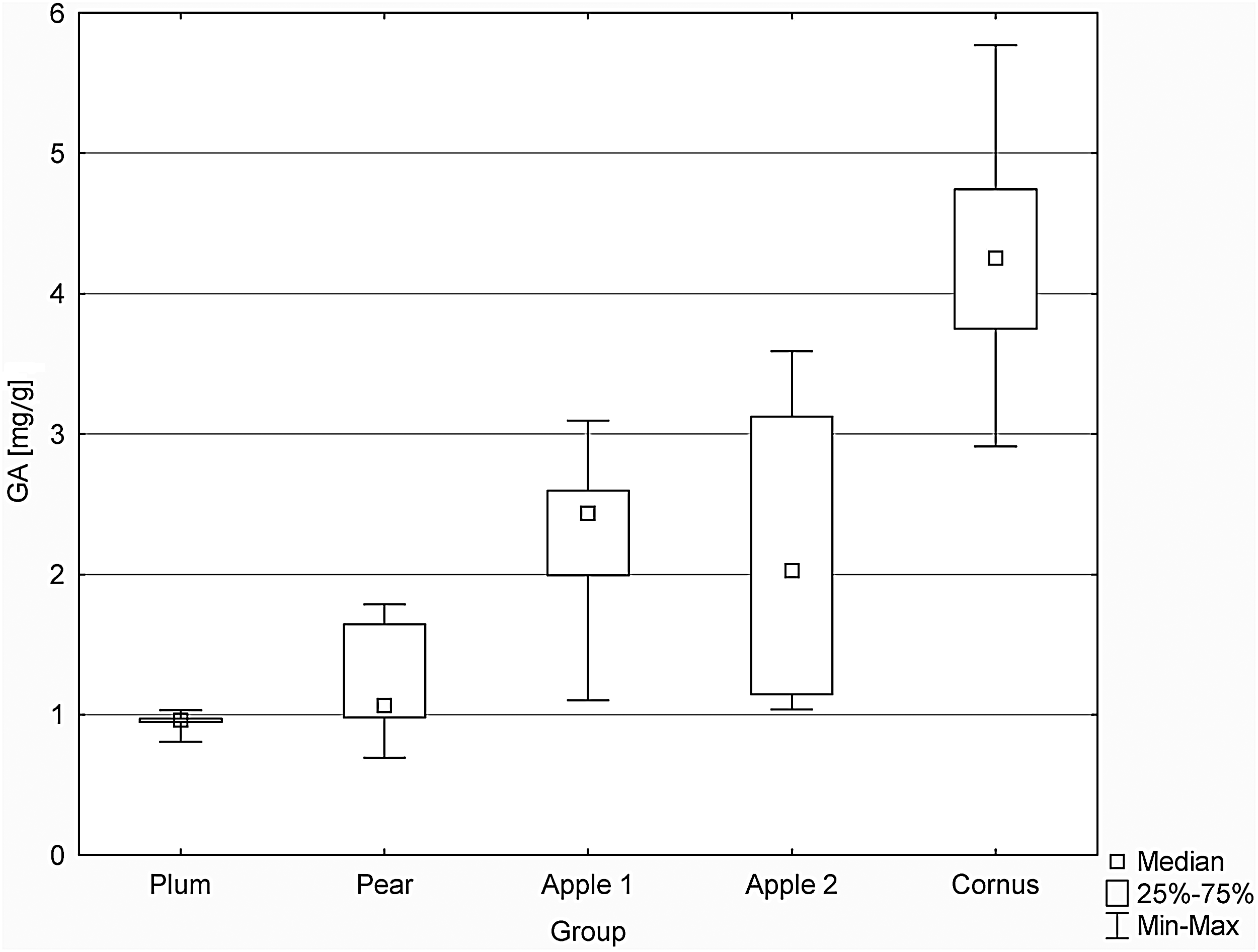
The total polyphenol content of the investigated juices. Plum; Prunus domestica cv. Common Plum; Pear: Pyrus communis cv. Conference; Apple 1: Malus domestica cv. Jonagold; Apple 2: Malus domestica cv. Red Boskoop; Cornus: Cornelian cherry (Cornus mas L.) seedling.
The analyses of FRAP revealed significant differences between the observed objects (Fig. 3). The values obtained for Common Plum juice (1.97 mmol Fe/L), Conference pear (2.37 mmol Fe/L), Red Boskoop apple (3.92 mmol Fe/L), and Jonagold apple juices were at roughly the same level. However, the obtained data indicated outstanding antioxidant properties for Cornelian cherry juices. In this case, FRAP reached 23.5 mmol Fe/L. The highest correlation coefficient calculated for FRAP versus polyphenols content was observed for Jonagold apples (0.95) and Conference pears (0.93), followed by plums (0.90) and Red Boskoop apples (0.87). However, the lowest correlation coefficient was proved for the Cornelian cherry (0.78). This indicates that the antioxidant status for the Cornelian cherry is correlated not only with polyphenols but also with other biological compounds. Some recent studies showed that cherries could be a valuable source of tryptophan, 35 which is an essential precursor for neurotransmitters such as serotonine or melatonine. 36 –38 In their clinical studies, Garrido et al. 39,40 and Howatson et al. 41 reported enhanced mood and sleep quality after a cherry-enriched diet. Moreover, a higher antioxidative status as measured in urine was proved. However, with regard to the Cornelian cherry, confirmation is required and further indepth investigations on whether the Cornelian cherry and other cherries are not closely related need to be carried out. The confirmation of high serotonin precursors content could be an additional advantage of consuming these little-known fruits. The second interesting problem is the correlation between the antioxidant compounds of the fruit content and the blood plasma antioxidant status. Nowadays, some interesting work is being performed on this; however, it is not concluded whether there are any direct correlations between these factors. Prior et al. 42 reported that in vitro measurements of the high antioxidant capacities of foodstuffs may not be an indication of their potential for altering the in vivo status.
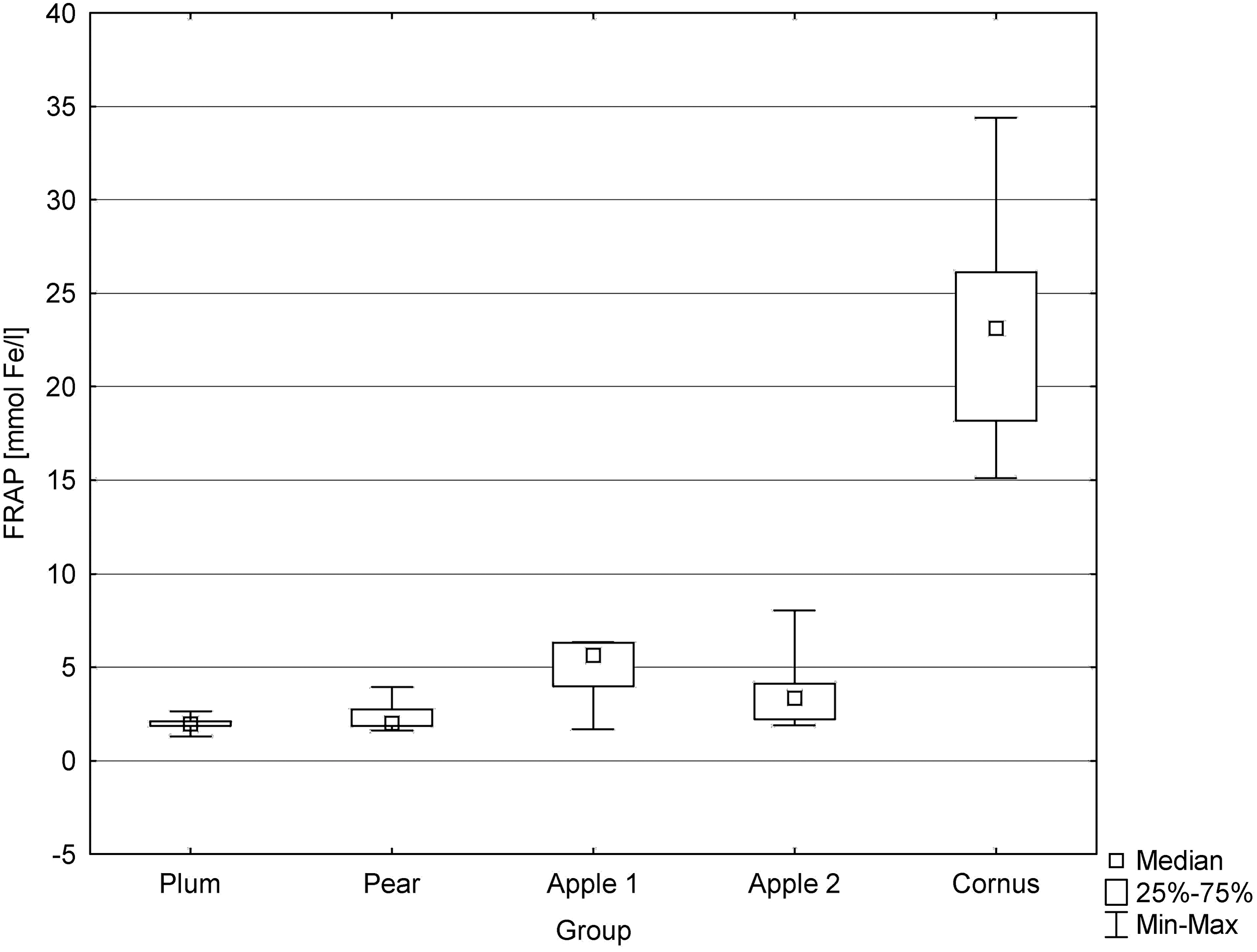
The total antioxidant activity of the investigated juices measured by ferric-reducing antioxidant power (FRAP) assay.
Conclusions
Among all of the investigated species, Cornelian cherry fruits revealed the highest content of organic acids and polyphenols. They could be seen as a valuable source of substances with high antioxidant activity. Nevertheless, further studies on Cornelian cherries phytonutrients absorption and their in vivo antioxidant status are required. With regard to the presence of the large variability of the Cornus genus (in terms of its organic acid content as well as antioxidant properties), further selection of the best specimens should be continued.
Footnotes
Acknowledgment
The study was supported by the statutory funds No. 3500/KSiP from the University of Agriculture in Kraków.
Author Disclosure Statement
None of the authors has a financial or proprietary interest in any of the materials mentioned.