




Abstract
Saskatoon berries (Amelanchier alnifolia Nutt.) have significantly higher levels of anthocyanins (ACY) among berries with potential health benefits. The pomace is a by-product of juice extracted from berries and is a potential source of inexpensive polyphenols. The objectives of this study were to extract the maximum amount of total phenolics from saskatoon pomace, to determine the antioxidant activity, and to identify individual phenolic components. Pomace extracts showed high content of total phenolics, total ACY, and total flavonoids of 43.3, 2.8, and 10.3 g/kg of dried weight (DW) of pomace. A high oxygen radical absorbing capacity value of 119.4 μmol Trolox equivalents/g DW and free radical scavenging activity of pomace extract (200 ppm, 86.8%) were observed. Five major ACY, two flavonols, and three chlorogenic acids were identified and quantified in pomace extracts. This study shows that saskatoon berries pomace rich in antioxidant phenolics could be extracted by “green” solvents (water and ethanol) and used as suitable food product applications.
Introduction
F
Phenolic phytochemicals (phenolic acids, flavones, flavonols, flavanones, flavanonol, isoflavones, and anthocyanidins) are widely distributed in fruits and vegetables. Among all fruits and vegetables, phenolic compounds in berries (blueberries, raspberries, strawberries, and cranberries) have been studied most extensively. Kähkönen et al. identified and quantified the phenolic contents of 26 different kinds of berries and found their phenolic composition, which includes biphenyls, flavonoids, phenolic acids, and other simple phenolics, such as caffeic, chlorogenic, ferulic, sinapic, and p-coumaric acids. 6 Flavonoids (flavonols, anthocyanins [ACY], proanthocyanins, and catechins) and phenolic acids are main constituents of phenolic composition found in fruits. 7 These phenolic phytochemicals present in berries have been reported to be natural antioxidants that have anti-inflammatory, anticancer, antiobesity, antineurodegeneration, antiallergy, and antihypertensive properties. 8 –12
Pomace is a dry residue obtained after the extraction of juice from fruits. Berry pomace is composed of skins, pulp, seeds, and stems. As a by-product of the berry processing industry, pomace is an underutilized co-product. 13 Recent studies have shown that large quantities of phenolic compounds (flavonols, ACY, and procyanidins) are present in pomace of berry fruits. 14 Several studies have reported that some berry pomaces contain large amount of phenolic compounds, with their extracts showing remarkable antioxidant activities. 14 –16
Saskatoon berry (Amelanchier alnifolia Nutt.) is native to North America and belongs to the family Rosaceae. Fresh whole saskatoon berries have been reported to contain high amounts of ACY, flavonols, and phenolic acids, and their phenolic extracts have shown high antioxidant activities. 17 –20 However, studies on saskatoon berries are limited to whole berry phenolic extract; there is not sufficient information available on the antioxidant activity and phenolic content of saskatoon berry pomace extract. The objectives of this study were to determine the phenolic contents in saskatoon pomace that are extracted using environmental friendly solvents (water and ethanol) and to evaluate their antioxidant activities for potential application as natural antioxidant.
Materials and Methods
High-performance liquid chromatography (HPLC) grade methanol, ethanol, water, acetonitrile, acetic acid, and formic acid were purchased from Sigma-Aldrich, Inc. (St. Louis, MO, USA). ACY standards (cyanidin-arabinoside, cyanidin-glucoside, cyanidin-galactoside, delphinidin-3-O-glucoside, and delphinidin-3-O-arabinoside) and flavonol standards (3-O-caffeoylquinic acid, 4-O-caffeoylquinic acid, 5-O-caffeoylquinic acid, quercetin-galactoside, and quercetin-arabinoglucoside) were purchased from Quality Phytochemicals, LLC (East Brunswick, NJ, USA). All other chemicals used for total phenolics determination and antioxidant activity were purchased from VWR International, Inc. (Suwanee, GA, USA) and Sigma-Aldrich, Inc. Dried saskatoon (A. alnifolia Nutt.) pomace was supplied by Select Ingredient (San Diego, CA, USA). The dried pomace was ground into a homogeneous powder using a universal mill (IKA WERKE model M20; Ika Works, Inc., Wilmington, NC, USA), passed through a 60-mesh sieve (W.S. Yyler, Inc., Wilmington, OH, USA), and stored in air-tight plastic bags at 4°C.
Preparation of extracts
For analytical purpose, the maximum amount of phenolic content in the extract was obtained by screening varying levels (60%, 70%, 80%, and 100%) of aqueous methanol (v/v), which has been proven to be the most efficient solvent for phenolic compounds extraction. 21 However, methanol is considered an environmental hazard and toxic extractant, which leads to safety concerns in food application. In the present study, we used “green” solvents (water and ethanol), which are generally recognized as safe (GRAS), for phenolic extraction and investigated their effectiveness to extract phenolics from saskatoon pomace with potential antioxidant activity by comparing the extracts that were prepared using methanol as solvent. The extraction of phenolics was performed using the method described by Khanal et al. with some modifications. 22 Twenty-five milliliters of aqueous methanol at various levels (60%, 70%, 80%, and 100%, v/v) was added to 5 g of the dried pomace powder. The dispersions were subjected to sonication for 10 min and vacuum filtered. The residues were re-extracted twice with the same solvents. This was followed by treatment with 0.15 N hydrochloric acid (25 mL) to fully extract the soluble phenolics. The extracts were combined in a round-bottom flask and evaporated under reduced pressure at 45°C by a rotary evaporator (Buchi Rotavapor Model 011; Brinkman, Wesbury, NY, USA). The dried extracts were obtained by freeze drying and stored in air-tight plastic bags at 4°C for further studies.
Total phenolics determination
The total phenolic contents of the extracts were determined by the Folin–Ciocalteu method described by Horax et al.
23
In a test tube, 1 mL of extract solution (1 g/L), 1 mL of 0.25 N Folin–Ciocalteu reagent, 1 mL of 1 N sodium carbonate, and 7 mL of water were added, vortexed, and incubated at ambient temperature for 2 h. The absorption of the solution was measured by a spectrophotometer at 726 nm. The milligrams of chlorogenic acid equivalent (CAE) per gram dry weight of pomace (mg CAE/g DW) was calculated using the following formula:
where A is the absorbance at 726 nm.
The determination of the total phenolics in the extracts was conducted in triplicate and calculated using a standard curve obtained with the chlorogenic acid standard.
Total ACY determination
The pH differential assay was used to determine the total ACY content of pomace extracts.
24
Extracts were prepared from 5 g dried pomace flour, and the final volume was made up to 6 mL using 70% methanol. The extract solutions (50 μL) were diluted 200 times with two buffers (pH 1.0: potassium chloride buffer, 0.025 M; pH 4.5: sodium acetate buffer, 0.4 M). Absorbance was measured using a spectrophotometer (Palo Alto, CA, USA) at 510 and 700 nm against water. The ACY concentrations in the extracts were calculated using the following formula:
where A=(A510−A700)pH1.0−(A510 − A700)pH4.5, MW is the molecular weight, DF is the dilute factor, ɛ is the molar absorptivity coefficient of cyanidin-3-glucoside, and MW=449.2, ɛ=26900, DF=200. Results were expressed as mg/g DW of pomace (cyanidin-3-glucoside equivalents).
Total flavonoids determination
The total flavonoids content in extracts were determined using a colorimetric method described by Heimler et al. 25 Pomace extract solutions were prepared from 5 g of dried pomace flour, and the total volume was made up to 6 mL. Then, the extract (0.25 mL) was mixed with 1.25 mL of distilled water in a test tube, followed by adding 75 μL of 5% NaNO2 solution. After 6 min, 150 μL of 10% AlCl3·6H2O solution was added and allowed for 5 min incubation before adding 0.5 mL of 1 M NaOH. The mixture was brought to 2.5 mL with 275 μL of distilled water and mixed well. The absorbance was measured immediately against the blank (the same mixture without the sample) at 510 nm using a UV-Visible Spectrophotometer (UA160; Shimadzu, Austin, TX, USA). The results were calculated and expressed as micrograms of (+)-catechin equivalents (mg of CE/g sample) using the calibration curve of (+)-catechin.
Oxygen radical absorbing capacity
The oxygen radical absorbing capacity (ORAC) of pomace extracts were evaluated using a modified method described by White et al. 14 The method was carried out using a Flx800 Fluorescence Microplate Reader (Winooski, VT, USA) and a 96-well black plate. Extracts were diluted suitable-fold with phosphate buffer (7 mM, pH 7.0). Diluted sample (25 μL) and blank solution (phosphate buffer) were added to each well, followed by 150 μL of fluorescein (4.19×10⁻³ mM). The plate was placed in an incubator for 10 min at 37°C, and the initial reads were taken after the incubation. Then, the 2,2-azobis-(2-amidinopropane) dihydrochloride (AAPH) (153 mM) was added to each well. Fluorescence was detected at 485 nm (excitation) and 520 nm (emission) after the addition of fluorescein and AAPH and every 3 min until 95% loss of fluorescence. The results were calculated on the basis of differences between the blank, sample, and standard Trolox curves (Trolox standards concentration: 12.5, 25, 50, and 100 μM). A standard curve was generated by plotting the concentrations of Trolox against the area under each curve. ORAC values were calculated using the regression equation obtained and expressed as μmol Trolox equivalents (TE)/g DW of pomace.
Free radical scavenging activity
The 2,2-diphenyl-1-picrylhydrazyl (DPPH) free radical scavenging assay described by Horax et al. was used to determine the antioxidant activity of pomace water extract (PWE) and pomace ethanol (70%, v/v) extract (PEE).
23
The PEE and PWE were prepared at various concentrations (0.2/0.4/0.6/0.8/0.1/1.5%, w/w) to test the scavenging ability against the DPPH. BHT (2 g/L) was used as positive control for comparison. In a test tube, 100 μL of extract solution and 3.9 mL of 6×10⁻⁵ mol/L of DPPH solution were added and vortexed. The blank solution was prepared with 100 μL methanol and 3.9 mL DPPH solution (6×10⁻⁵ mol/L). The absorbance of the solutions was measured at 515 nm in a spectrophotometer at 30 min interval up to 180 min. All tests were performed in triplicates. The antioxidant activity of pomace extracts was expressed as a percent of DPPH free radical scavenging activity and calculated using the following formula:
where SC% was the percentage of scavenged DPPH.
HPLC analysis of ACY
The HPLC analysis for ACY in the extracts was performed according to the method described by Monrad et al. with modification. 26 A Hewlett-Packard liquid chromatograph model 1050 equipped with a UV detector (Agilent Technologies, Inc., Palo Alto, CA, USA) was used to identify and quantify the ACY in the extracts. The extract solution (6.0 mL) was prepared from 5 g of dried pomace flour and diluted 10 times before passing through a 0.2-μm polyvinylidene fluoride (PVDF) syringe filter (Natl Scientific, Duluth, GA, USA). Purified extracts (10 μL) were loaded onto a Symmetry® C18 5 μm 100 Å (250mm×4.6 mm) column (Waters Corp., Milford, MA, USA). The gradient solvent system consisted of water:formic acid (95:5) as solvent A and 100% methanol as solvent B at a flow rate of 1 mL/min for a total run time of 65 min. The mobile phase had 2% of solvent B, which was increased linearly to 35% at 55 min followed by 5 min of column washing with 60% of solvent B. The detection wavelength was set at 520 nm. Individual ACY were identified and quantified by running the ACY standards.
HPLC analysis of flavones and chlorogenic acids
The identification and quantification of flavones and chlorogenic acids were performed using the liquid chromatography. The phenolic extracts using ethanol (70%, v/v) and water (100%, v/v) were prepared from 5 g dried pomace flour, and the final volume was made up to 6 mL. The extract solutions (10 μL) were diluted (×10), filtered through a 0.2-μm PVDF target syringe filter and loaded onto a Synergi™ Hydro-RP 80Å LC (250mm×3 mm, 4 μm) column (Phenomenex, Inc., Torrance, CA, USA). The mobile phases consisted of elution solvent A, water:acetic acid (98:2) and solvent B, acetic acid:water:acetonitrile (5:47.5:47.5). The total run time was set at 67 min at a flow rate of 0.6 mL/min. A linear gradient was used from 0% to 30% of solvent B from 0 to 15 min; followed by 30–90% of solvent B from 15 to 60 min, and finally 90–100% of solvent B from 60 to 62 min. This was terminated by a final isocratic flow of 100% A for 7 min. The wavelength of the UV detector was set at 320 nm for flavones and chlorogenic acids isolation. The amounts of individual compounds in the extracts were calculated using the standard curves of the phenolic standards.
Statistical analysis
All the experiments were conducted in triplicate, and the values are reported as means of three determinations. The effect of extract solvents on total phenolic, ACY, flavonoids contents, and the amounts of individual ACY, flavonols, and chlorogenic acids in pomace extracts were analyzed by analysis of variance using the Statistical Analysis System (SAS 9.2 2000; SAS Institute, Inc., Cary, NC, USA).The Fisher's protected least significant difference test was conducted to separate the means at P≤.05.
Results
Total phenolic, ACY, and flavonoid content
The total phenolic content, expressed as milligram of CAEs per gram of dried pomace (mg CAE/g DW), of extracts obtained by different levels of methanol and ethanol are given in Table 1. The extracted phenolics increased as the methanol concentration increased from 60% to 70% and declined from 80% to 100%. The extract obtained by 70% methanol (PME) showed the maximum amount of phenolic extraction (43.3 mg CAE/g DW). However, methanol is considered an environmentally hazard, toxic, and expensive extraction solvent. 26 Green solvents, such as ethanol at varying levels (60/70/80/100%, v/v) and water, extracted 29.5, 39.9, 32.4, 22.8, and 16.2 mg CAE/g DW of total phenolics, respectively. The phenolics extraction yields showed the same trend as methanolic extracts (Table 1). Significant differences (P<.05) in the total phenolic contents between methanol and ethanol extracts at various levels (60/70/80/100%, v/v) were observed. Also, significant differences in total phenolic content using only methanol, ethanol, and water were observed (28.8, 22.8, and 16.2 mg CAE/g DW, respectively).
Values are means±standard deviation of three determinations.
Values in the same column with the same letter are not significantly different (P>.05).
CAE, chlorogenic acid equivalents; ORAC, oxygen radical absorbing capacity; DW, dry weight; C3GE, cyanidin-3-glucoside equivalents; CE, (+)-catechin equivalents; TE, Trolox equivalents.
The total ACY contents in pomace extracts were expressed as cyanidin-3-glucoside equivalents (mg/g DW of pomace), and the results are presented in Table 1. The ACY of the extracts exhibited similar trend as total phenolic content, whereas methanolic solvents (ranged from 1.8 to 2.8 mg/g DW) showed higher ACY extraction yield than ethanol extracts (ranged from 0.9 to 2.6 mg/g DW). Significant differences (P<.05) in ACY between methanol and ethanol extracts at various levels (60/70/80/100% v/v) were observed. There is a significant correlation between total phenolic content of the extracts and their total ACY content (r=0.92). This indicated that ACY are considered one of the major groups of phenolic compounds in saskatoon berry pomace extracts (2.8±0.1 mg/g DW). In comparison to other varieties of berry pomaces, saskatoon berry pomace contains higher amount of ACY than cranberry, blackberry, raspberry, and strawberry pomace of 1.2, 1.5, 0.7, and 0.2 mg/g DW, respectively. 13,27
The total flavonoids content in the extracts were determined using a colorimetric assay, and the results are presented in Table 1. The highest flavonoids content was found in 80% methanol extract of 10.3 mg/g DW, followed by 70% ethanol extract of 8.4 mg/g DW, and the trend was in accordance with total phenolic content. A high positive correlation (r=0.91) was also observed between the total flavonoids content of the extracts and their total phenolic contents. Higher content of flavonoids in extracts using 70% methanol and 70% ethanol was observed in comparison to other berry pomaces (raspberry, strawberry, blackberry, and cranberry pomace of 5.9, 3.0, 2.5, and 3.6 mg/g DW, respectively). 13,27
ACY profile by HPLC
Since the previous studies on the ACY composition of saskatoon berry extracts was only limited on whole berries, the HPLC analysis of PME was conducted to isolate and identify the individual ACY compounds in its pomace. Profiles of PWE and PEE were also quantified to show their ACY recovery effectiveness in comparison to PME. Seven major peaks were detected in all extracts. Peaks 1–5 were identified as delphinidin-3-O-glucoside, cyanidin-galactoside, delphinidin-3-O-arabinoside, cyanidin-glucoside, and cyanidin-arabinoside, while peaks 6 and 7 were unidentified (Fig. 1a, b). Delphinidin-3-O-glucoside was accounted for the primary ACY in extracts, followed by cyanidin-glucoside, cyanidin-galactoside, delphinidin-3-O-arabinoside, and cyanidin-arabinoside (Table 2). Saskatoon berry pomace contains significantly higher amounts of delphinidin-3-O-glucoside and cyanidin-glucoside than cranberry pomace (cyanidin-glucoside: 13.2 mg/100 g DW). 14 These results (Table 2) indicate that saskatoon pomace could be considered a rich source of ACY compounds, especially delphinidin-3-O-glucoside (149.9 mg/100 g DW), cyanidin-glucoside (87.2 mg/100 g DW), and cyanidin-galactoside (64.2 mg/100 g DW).

High-performance liquid chromatography (HPLC) profiles of anthocyanins in PEE
Values are means±standard deviation of three determinations. The anthocyanin compounds in PWE and PEE were separated by Symmetry C18 column (250 mm×4.6 mm). The quantification studies of anthocyanins were achieved by comparing to the anthocyanin standards. The flavonols and chlorogenic acids in PWE and PEE were separated by Synergi™ 4 μm Hydro-RP 80 A LC column (250 mm×3 mm). The quantification studies were achieved by comparing to the phenolics standards.
Values with the same letter are not significantly different (P>.05).
HPLC, high-performance liquid chromatography; PME, pomace 70% methanol extract; PWE, pomace water extract; PEE, pomace 70% ethanol extract; RT, retention time.
In addition, PWE and PEE were analyzed for their ACY contents. Significant differences in amount of each ACY between PME (delphinidin-3-O-glucoside, cyanidin-glucoside, cyanidin-galactoside, and delphinidin-3-O-arabioside were 149.9, 87.2, 64.2, and 23.4 mg/100 g DW, respectively) and PWE (delphinidin-3-O-glucoside, cyanidin-glucoside, cyanidin-galactoside, and delphinidin-3-O-arabioside were 45.5, 33.5, 25.2, and 7.1 mg/100 g DW, respectively) were observed. However, no significant difference in the amount of each individual ACY between PME and PEE was observed, which indicated that PEE showed comparable ability on ACY extraction.
Flavones and chlorogenic acid profile by HPLC
A Synergi 4 μm Hydro-RP 80Å LC column (250mm×3 mm) was used to determine the flavonols and chlorogenic acid in the pomace. Similar separation pattern were shown in PME, PWE, and PEE (Fig. 2a, b). Two flavonol compounds (peak 4: quercetin-arabinoglucoside; peak 5: quercetin-galactoside) and three chlorogenic acids (peak 1: 5-caffeoylquinic acid; peak 2: 4-caffeoylquinic acid; peak 3: 3-caffeoylquinic acid) were identified. Quercetin-arabinoglucoside (163.0 mg/100 g DW) accounted for the most abundant flavones in the extract, followed by chlorogenic acids: 5-caffeoylquinic acid (66.1 mg/100 g DW), 4-caffeoylquinic acid (33.7 mg/100 g DW), and 3-caffeoylquinic acid (13.3 mg/100 g DW). No significant difference in the amounts of individual flavonols and chlorogenic acids among PME, PWE, and PEE (P<.05) was observed. The results showed that water and 70% ethanol have comparable flavonols and chlorogenic acids extraction rate compared to 70% methanol.
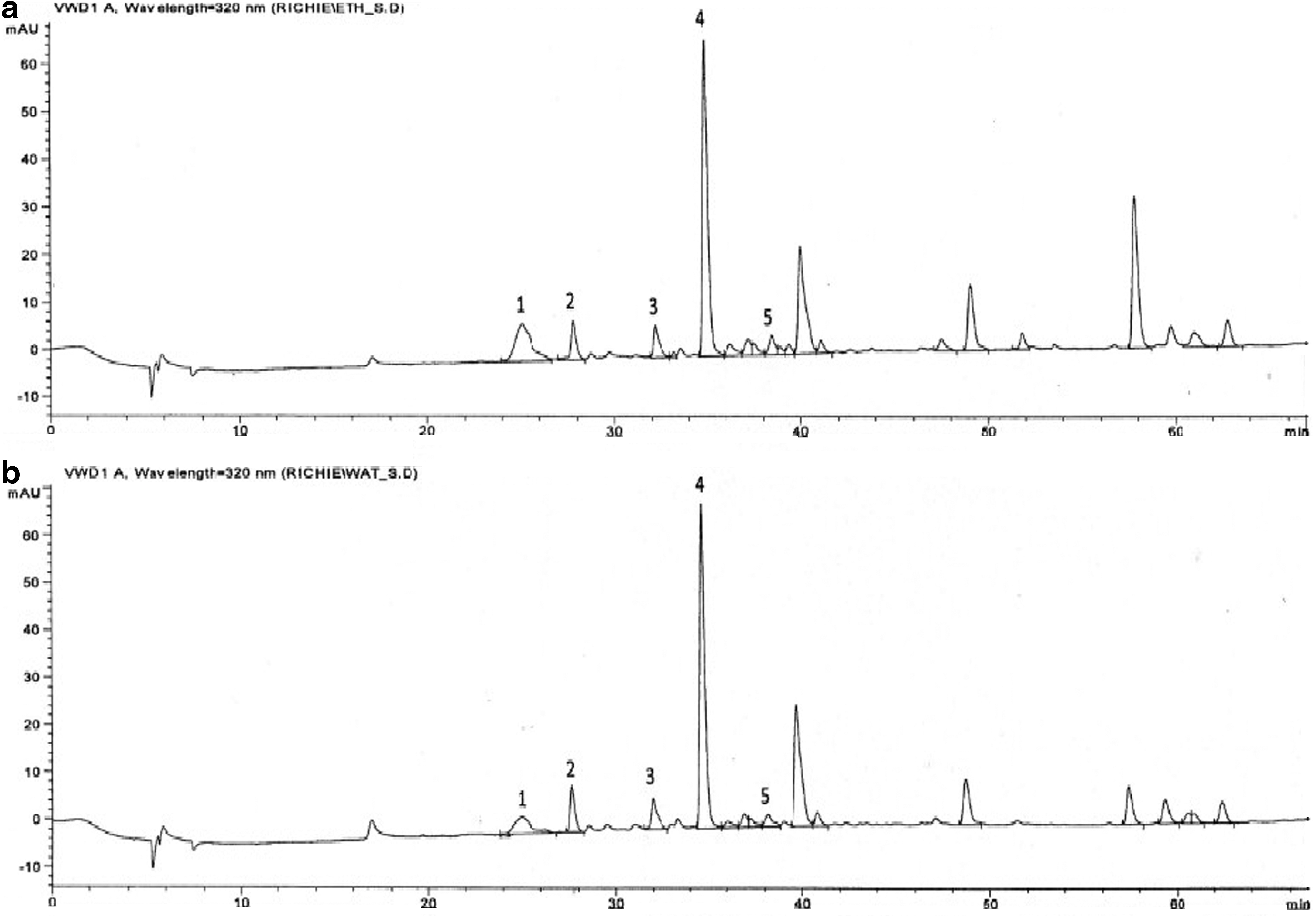
The HPLC profiles of flavonols and chlorogenic acids in PEE
Antioxidant activity of the pomace extracts
The ORAC and the DPPH free radical scavenging assay were used to evaluate the antioxidant activities of the pomace extracts. The ORAC values are presented in Table 1, where the values of methanol extracts ranged from 54.2 to 119.4 μmol TE/g DW of pomace and ethanol extracts from 53.4 to 103.1 μmol TE/g DW of pomace. The ORAC value of the extract was significantly (P<.05) affected by the extraction solvent, and a similar trend was showed as total phenolic, ACY, and flavonoids content. Those results suggested that 70% ethanol is the best proportion of a “GRAS” solvent to extract antioxidative phenolics. There was a good positive correlation between the ORAC and the total phenolic content (r=0.92). Also, good correlations were found between the ORAC and the contents of ACY (r=0.90) and flavonoids (r=0.87).
Based on the results of ORAC, pomace 70% ethanol extract (PEE) was selected to test the antioxidant activity because of its high phenolic content and yield during extraction. PWE was also selected since water is considered a cheap and safe extraction solvent. Both extracts at varying concentrations were tested by free radical scavenging method to investigate the potential application in the food products as antioxidants. The free radical scavenging activities of the extracts showed a concentration-dependent pattern (Fig. 3). The scavenging activities at relatively lower concentrations (0.2–1.0%, w/w) were not as effective as BHT (0.2% w/w). A comparable higher antioxidant activity of PWE (86.8%) and PEE (84.9%), compared to BHT (0.2% w/w, 94.5%), were observed at a concentration of 1.5% (w/w). PWE at each concentrations (0.2/0.4/0.6/0.8/1.0/1.5%, w/w) of dried extracts showed higher DPPH scavenging activities (86.21%) than PEE (84.9%), despite high total phenolic content of PEE (39.9 mg CAE/g of DW) in comparison to PWE (16.2 mg CAE/g of DW).

The 2,2-diphenyl-1-picrylhydrazyl (DPPH) scavenging activities of various concentrations (0.2/0.4/0.6/0.8/1.0/1.5%, w/w) of pomace ethanol (70% v/v) extract (PEE) and pomace water extract (PWE). Butylated hydroxytoluene (BHT, 0.2% w/w) was tested as comparsion and showed 94.5% scavenging activity. Values are means of three determinations. Standard derivation is shown by error bars.
Discussion
The discrepancies in the amount of phenolic content using different solvent systems may be due to the polarity of the extractants. 23 Studies have shown that polar solvents (polarities of methanol and ethanol are 5.1 and 5.2, respectively) were superior in comparison to less polar solvent (aqueous acetone) in extracting phenolic compounds from grapes and berries. 21 On the contrary, a study has shown that phenolic extract from mushroom by water showed higher total phenolic content than those extracts by methanol. 28 This may be explained by the differences in the phenolic compositions from different plant sources. 23 In general, Ju and Howard found the combination of organic solvents (methanol, ethanol) and water is more efficient in extracting fruits- and vegetables-derived polyphenolic compounds than pure organic solvents. 29
The early studies showed that cyanidin-galactoside accounted for the highest amount of ACY in saskatoon whole berries, followed by cyanidin-glucoside and cyanidin-arabinoside, whereas the present study showed that delphinidin-3-O-glucoside is the primary ACY in its pomace, followed by cyanidin-glucoside, cyanidin-galactoside, and delphinidin-3-O-arabinoside. 30,31 These differences might be explained by the stability and the presence of specific compounds, such as cyanidin-glucoside, which was also found to be the major ACY in cranberry and bayberry pomace. 14,16
The differences in ACY contents between PWE and PEE showed that water was much less effective than 70% ethanol in extracting ACY from saskatoon pomace. Frank et al. concluded that mixed solvent can increase the solubility of a compound. 32 Ethanol at concentration with a limited range can modify the physical properties (density, dynamic viscosity, polarity, and dielectric constant) of the solvent. 31 In the case of ACY extraction, the reduction of the solvent viscosity and surface tension leads to the increased efficiency of mass transfer and extraction. 33 On the other hand, the attraction between water molecules may result in lower ACY solubility. 31
Compared to other berry pomaces (cranberries, blackberries, and blueberries), the flavonol and chlorogenic acids compositions and distribution have shown significant differences in saskatoon berry. 14,23 Pervious study has shown that quercetin-glucoside accounted for the major flavonol in whole saskatoon berries, whereas quercetin-arabinoglucoside was identified as primary flavonol in its pomace in the present study (Table 2). The saskatoon pomace extracts showed higher amounts of quercetin-arabinoglucoside than its whole berries (ranged from 1.8 to 2.9 mg/100 g DW). 19 Three main flavonols (quercetin-glucoside, quercetin-arabinoside, and quercetin-rutinoside) present in saskatoon whole berries were absent in pomace. Additionally, 5-caffeoylquinic acid and 3-caffeoylquinic acid in pomace were in higher amounts than whole saskatoon berries (5-caffeoylquinic acid ranged from 43.5 to 58.4 mg/100g DW, 3-caffeoylquinic acid ranged from 10.0 to 10.7 mg/100 g DW). 18,19 Besides, 4-caffeoylquinic acid was first identified in pomace in the present study and has never been observed in whole saskatoon berry in previous research. In the case of saskatoon berries, some of the compounds (quercetin-galactoside, quercetin-glucoside, quercetin-arabinoside, quercetin-rutinoside) are more likely to be contained in the juice, whereas some compounds (quercetin-arabinoglucoside, 5-caffeoylquinic acid, 4-caffeoylquinic acid, and 3-caffeoylquinic acid) may remain only in the pomace.
For the evaluation of antioxidant activities of pomace extracts, the correlation between the ORAC values and the results of the total phenolics, ACY, and flavonoids indicated the importance of phenolic compounds in the peroxyl radical scavenging activities. Among those bioactivity compounds, ACY may be the major contributor to the measured antioxidant activity of pomace extracts. The high antioxidant activity of PWE may due to the high amount of phenolic compounds that have potential scavenging activity. It is possible that some of the individual phenolic compounds extracted in PEE have low antioxidant ability.
In conclusion, ACY, flavonols, and chlorogenic acids that are rich in saskatoon pomace extracts were obtained by green solvents—ethanol (70%) extraction. The maximum extraction amount of total phenolic content was 39.9 mg/g of dried pomace. The PWE at 1.5% (w/w) concentration showed high free radical scavenging activity, whereas PEE showed high ACY extraction yield compared with PWE. HPLC results showed that saskatoon pomace contains highest amount of delphinidin-3-O-glucosideand quercetin-arabinoglucoside among ACY and flavonol, respectively. Other phenolic acids, including 5-caffeoylquinic acid, 4-caffeoylquinic acid, and 3-caffeoylquinic acid, were also identified and quantified. Thus, those active phenolic compounds could be extracted effectively by green solvents (70% ethanol and water) and that have showed potential applications in scavenging free radicals and could be used in food formulations to extend the shelf-life of food products.
Footnotes
Author Disclosure Statement
No competing financial interests exist.