




Abstract
Health promoting cold pressed oils may improve human health and prevent certain diseases. It is hard to find any research concerning the composition and functional properties of cold pressed clove (Syzygium aromaticum) oil (CO). Cold pressed CO was evaluated for its lipid classes, fatty acid profiles, and tocol contents. In addition, antiradical and antimicrobial properties of CO were evaluated. The amounts of neutral lipids in CO was the highest (∼94.7% of total lipids), followed by glycolipids and phospholipids. The main fatty acids in CO were linoleic and oleic, which comprise together ∼80% of total fatty acids. Stearic and palmitic acids were the main saturated fatty acids. α- and γ-tocopherols and δ-tocotrienol were the main detected tocols. CO had higher antiradical action against DPPH• and galvinoxyl radicals than virgin olive oil. The results of antimicrobial properties revealed that CO inhibited the growth of all tested microorganisms. CO had a drastic effect on the biosynthesis of proteins and lipids in cells of Bacillus subtilis. In consideration of potential utilization, detailed knowledge on the composition and functional properties of CO is of major importance.
Introduction
O
Clove (Syzygium aromaticum L., family Myrtaceae) is the flower bud, wherein the tree is widely cultivated in tropical countries. 3 Cloves are used in the food industry because of their special aroma and their health beneficial properties. S. aromaticum essential oil is obtained by distillation of the flowers, stems, and leaves of the clove tree. 4,5 S. aromaticum bud essential oil has many biological impacts, such as antimicrobial, insecticidal, and antioxidant properties, and the oil is used traditionally as flavoring agents in foods. 6,7 S. aromaticum essential oil had an antilisteric activity in meat and cheese. 8,9 In addition, S. aromaticum oil is used in many nonfood applications such as an antimicrobial agent against oral bacteria associated with dental caries and periodontal disease 10 and as protective agents against tissue injuries in the lens and cardiac muscles. Moreover, clove treatment significantly reduced blood sugar increases and lipid peroxidation in streptozotocin-induced diabetic rats by restoring the levels of antioxidant enzymes. 11
S. aromaticum contain a wide variety of potentially bioactive compounds such as sesquiterpenes, tannins, and triterpenoids. The main aroma constituent of clove buds, eugenol (4-allyl-2-methoxyphenol), was reported to have an antifungal activity. 12,13 As a food additive, eugenol was classified by the U.S. Food and Drug Administration (FDA) to be a substance that is generally regarded as safe. 5 The high levels of eugenol found in clove essential oil give it strong biological and antimicrobial activities. Eugenol was reported to have an antifungal activity and inhibited malonaldehyde formation from cod liver oil and the formation of hexanal. 14 S. aromaticum oil has been listed as a “Generally Regarded As Safe” substance by the FDA when administered at levels not exceeding 1500 ppm in food categories. In addition, the World Health Organization (WHO) Expert Committee on Food Additives has established the acceptable daily human intake of S. aromaticum oil at 2.5 mg/kg body weight for humans. 15
Food scientists are continually searching for unique spice flavorings because of the rising global demand for authentic ethnic and cross-cultural cuisines. Consumers are also looking for natural foods and natural preservatives for healthier lifestyles. Thus, spices are being sought for their medicinal value as antioxidants and as antimicrobials. 16 A need for identifying alternative natural and safe sources of antioxidants has been created and notably increased in recent years. Recently, S. aromaticum essential oil exhibited antioxidant effects on retarding lipid oxidation of hazelnut and poppy oils. 17
Foodborne pathogens are responsible for millions of cases of foodborne illness, 325,000 hospitalizations and 5000 deaths in the United States annually. 18 The estimated annual cost related to the top five bacterial pathogens—Campylobacter, Salmonella (nontyphoidal serotypes only), Listeria monocytogenes, Escherichia coli 0157, and non-0157 STEC—is 6.9 billion USD. The antimicrobial activity of natural extracts is closely linked with their phenolic content. 19 Therefore, extracts rich in phenolics and other bioactive compounds may serve as potential natural antimicrobial agents. 14,18,20 Recently, S. aromaticum essential oil exhibited antimicrobial activity against the growth of Gram-negative and Gram-positive bacteria. 21
Over the last years, interest in cold pressed oils has been observed as these oils have high nutritive properties. The cold pressing procedure is becoming an interesting substitute for traditional practices because of the consumers' desire for natural products. 22 Cold pressing is a technique that involves no heat or chemical treatment. Cold pressing also involves no refining process and may contain a high level of lipidic phytochemicals, including natural antioxidants.
Different nontraditional oils have been recently introduced to the market, and therefore, data on their composition, antioxidant properties, and antimicrobial characteristics have not been reported. Such information is of importance for the evaluation of the nutritional and health impact of these functional products. To the best of our knowledge, it is hard to find any data in the literature on cold pressed clove oil (CO). As a continuation of the efforts in developing oils with health-beneficial characteristics, this study was carried out to (1) determine the lipid classes, fatty acids, and tocol profiles of cold pressed CO, (2) measure the phenolic content and in vitro antiradical power of CO, and (3) study the antimicrobial properties of CO. The results could be used to develop novel oil products rich in bioactive phytochemicals with a desirable shelf life.
Materials and Methods
Materials and oils
Different samples (n=3) of cold pressed CO and extra virgin olive oil were obtained from a local market in El-Zagazig (Egypt). The total phenolic content in olive oil as determined by the Folin–Ciocalteu was 3.4 mg/g as gallic acid equivalents. Neutral lipid (NL) standards were from Sigma (St. Louis, MO, USA). Standards used for glycolipid (GL) identification, monogalactosyldiacylglycerol (MGD), digalactosyldiacylglycerol (DGD), cerebrosides (CER), steryl glucoside (SG), and esterified steryl glucoside (ESG), were of plant origin (plant species unknown) and purchased from Biotrend Chemikalien GmbH (Köln, Germany). Standards used for phospholipids (PL), phosphatidylserine (PS), phosphatidylethanolamine (PE), and phosphatidylinositol (PI) from bovine liver and phosphatidylcholine (PC) from soybean, were purchased from Sigma. Standards used for tocols were purchased from Merck (Darmstadt, Germany).
Column chromatography and thin layer chromatography of lipid classes
Fractionation of lipid classes and subclasses
CO was separated into different classes by elution with different solvents over a glass column (20 mm diameter×30 cm) packed with a slurry of activated silicic acid (70–230 mesh; Merck, Darmstadt, Germany) in chloroform (1:5, g/mL). NL were eluted with 3 times the column volume of chloroform. 23 The major portion of GL was eluted with 5 times the column volume of acetone and that of PL with 4 times the column volume of methanol. The amount of the lipid classes obtained was determined by gravimetry. By means of thin layer chromatography (TLC) on Silica gel F254 plates (thickness=0.25 mm; Merck), a further characterization of the GL and PL subclasses was carried out with the following solvent system chloroform/methanol/25% ammonia solution (65:25:4, v/v/v). For the characterization of NL subclasses, TLC plates were developed in the solvent system n-hexane/diethyl ether/acetic acid (60:40:1, v/v/v). For the detection of the lipids, the TLC plates were sprayed with the following agents: for the marking of all lipids, sulfuric acid (40%), for the marking of GL, α-naphthol/sulfuric acid, and for the marking of PL, the molybdate-blue reagent. 23 Each spot was identified with lipid standards as well as their reported retention factor (R f ) values. Individual bands were visualized under ultraviolet light, scraped from the plate, and recovered by extraction with chloroform/methanol (2:1, v/v). The fatty acid composition of CO as well as NL, GL, and PL was determined by the GLC/flame ionization detector (FID) as described below.
Quantitative determination of lipid subclasses
For the quantitative determination of NL subclasses, individual bands were scraped from the plate and recovered by extraction with 10% methanol in diethyl ether, followed by diethyl ether. Data presented are the average of three gravimetrical determinations. For the quantitative estimation of GL subclasses, the acetone fraction obtained by column chromatography (CC) was separated by TLC in the above given solvent system. The silica gel regions with the corresponding GL subclasses were scraped out followed by hexose measurement photometrically at 485 nm using the phenol/sulfuric acid in acid-hydrolyzed lipids. 24 The percent distribution of each component was obtained from the hexose values. From the extinction values, the quantitative amount was determined and related to their portion of the GL fraction. The determined portion was set into relation with the amount of oil that had been separated by CC into the main lipid fractions. For the determination of the PL, the methanol fraction from CC was also separated by TLC in the above given solvent system and after scraping out of the individual PL subclasses, brought to reaction with the hydrazine sulfate/sodium molybdate reagent at 100°C for 10 min and photometrically analyzed at 650 nm. From the obtained extinction values using a calibration chart for phosphorus, the amount of PL was calculated. The individual values were put into relation to the PL fraction (methanol fraction from CC) and to the amount of oil.
Gas chromatography analysis of fatty acid methyl esters
Fatty acids of CO and lipid classes were transesterified into fatty acid methyl esters (FAME) using N-trimethylsulfoniumhydroxide (Macherey-Nagel, Düren, Germany) according to the procedure reported by Arens et al. 25 FAME were identified on a Shimadzu GC-14A equipped with FID and C-R4AX chromatopac integrator (Kyoto, Japan). The flow rate of the carrier gas helium was 0.6 mL/min and the split value with a ratio of 1:40. A sample of 1 μL was injected on a 30 m×0.25 mm×0.2-μm film thickness Supelco SPTM-2380 (Bellefonte, PA, USA) capillary column. The injector and FID temperature were set at 250°C. The initial column temperature was 100°C programmed by 5°C/min until 175°C and kept 10 min at 175°C, then 8°C/min until 220°C and kept 10 min at 220°C. A comparison between the retention times of the samples with those of an authentic standard mixture (Sigma, St. Louis, MO, USA; 99% purity specific for GLC), run on the same column under the same conditions, was made to facilitate identification.
HPLC analysis of tocols
For tocol analysis, a solution of 250 mg of oil in 25 mL n-heptane was directly used for the HPLC. The HPLC analysis was conducted using a Merck Hitachi low-pressure gradient system, fitted with an L-6000 pump, a Merck-Hitachi F-1000 Fluorescence Spectrophotometer (The detector wavelength was set at 295 nm for excitation, and at 330 nm for emission), and a D-2500 integration system; 20 μL of the samples was injected by a Merck 655-A40 Autosampler onto a Diol phase HPLC column 25 cm 9 4.6 mm ID (Merck) using a flow rate of 1.3 mL/min. The mobile phase used was n-heptane/tert-butyl methyl ether (99:1, v/v).
Extraction and quantification of phenolic compounds
Aliquots of cold pressed CO and extra virgin olive oil were dissolved in n-hexane (5 mL) and mixed with 10 mL of methanol–water (80:20, v/v) in a glass tube for 2 min in a vortex. After centrifugation at 1593 g for 10 min, the hydroalcoholic extracts were separated from the lipid phase by using a Pasteur pipette, and then combined and concentrated in vacuo at 30°C until a syrup consistency was reached. The lipidic residue was redissolved in 10 mL of methanol–water (80:20, v/v) and the extraction was repeated twice. Hydroalcoholic extracts were redissolved in acetonitrile (15 mL) and the mixture was washed three times with n-hexane (15 mL each). Purified phenols in acetonitrile were concentrated in vacuo at 30°C and then dissolved in methanol for further analysis. Aliquots of phenolic extracts were evaporated to dryness under nitrogen. The residue was redissolved in 0.2 mL water and diluted (1:30) Folin–Ciocalteu's phenol reagent (1 mL) was added. 26,27 After 3 min, 7.5% sodium carbonate (0.8 mL) was added. After 30 min, the absorbance was measured at 765 nm using a UV-260 visible recording spectrophotometer (Shimadzu). Gallic acid was used for the calibration and the results of triplicate analyses are expressed as parts per million of gallic acid.
Radical scavenging activity of CO and olive oil toward DPPH•
The radical scavenging activity (RSA) of CO and olive oil was assayed with DPPH• radical dissolved in toluene.
28
The toluenic solution of DPPH• radicals was freshly prepared at a concentration of 10−4 M. The radical, in the absence of antioxidant compounds, was stable for more than 2 h of normal kinetic assay. For evaluation, 10 mg of CO or extra virgin olive oil (in 100 μL toluene) was mixed with 390 μL of toluenic solution of DPPH• radicals and the mixture was vortexed for 20 sec at ambient temperature. Against a blank of pure toluene without DPPH•, the decrease in absorption at 515 nm was measured in 1-cm quartz cells after 1, 30, and 60 min of mixing using a UV-260 visible recording spectrophotometer (Shimadzu). The RSA toward DPPH• radicals was estimated from the differences in absorbance of toluenic DPPH• solution with or without a sample (control) and the inhibition percent was calculated from the following equation:
RSA of CO and olive oil toward galvinoxyl radical
A miniscope MS 100 ESR spectrometer (Magnettech GmbH, Berlin, Germany) was used in this analysis. 29 Experimental conditions were as follows: measurement at room temperature, microwave power 6 db, centerfield 3397 G, sweep width 83 G, receiver gain 10, and modulation amplitude 2000 mG. Ten mg of oil (in 100 μL toluene) was allowed to react with 100 μL of toluenic solution of galvioxyl (0.125 mM). The mixture was stirred on a vortex stirrer for 20 sec and then transferred into a 50-μL micropipette (Hirschmann Laborgeräte GmbH, Ederstadt, Germany) and the amount of galvinoxyl radical inhibited was measured exactly after total incubation time of 60 min after the addition of the galvinoxyl radical solution. The galvinoxyl signal intensities were evaluated by the peak height of signals against a control. A quantitative estimation of the radical concentration was obtained by evaluating the decrease of the ESR signals in arbitrary units after 60 min of incubation using the KinetikShow 1.06 Software program (Magnettech GmbH). The reproducibility of the measurements was 5% as usual for kinetic parameters.
Antimicrobial activity
The antimicrobial activities were carried out according to the conventional agar diffusion test using cultures of Bacillus subtilis NRRL B-94, E. coli NRRL B-3703, Pseudomonas aeruginosa NRRL, Staphylococcus aureus NRRL, Aspergillus niger NRRL313, Aspergillus flavus NRC, Saccharomyces cerevisiae NRC, and Candida albicans NRRL477. 30 The bacterial strains were cultured on a nutrient medium, while the fungi and yeast strains were cultured on a malt medium and yeast medium, respectively. The broth media included the same contents of nutrient medium except for agar. For bacteria and yeast, the broth media were incubated for 24 h. As for mold, the broth media were incubated for∼48 h, with subsequent filtering of the culture through a thin layer of sterile sintered Glass G2 to remove mycelia fragments before the solution containing the spores was used for inoculation. For plate preparation, 1.0 mL Tween 20 and 0.5 mL of inocula were added to 50 mL of agar media (50°C) and mixed by simple inversion. The agar was poured into 120-mm Petri dishes and allowed to cool to room temperature. Wells (4 mm in diameter) were cut in the agar plates using sterile paper tubes. Wells were filled to the surface of agar with the oils to be tested (50 μL/well). The microbial growth inhibition zones, clear microbial free inhibition zones, were measured after incubation at 30°C, beginning within 24 h for yeast, 24–48 h for bacteria, and 48–72 h for fungi. Antimicrobial activities were calculated as a mean of three repetitions.
Minimal inhibitory concentration
A concentration of 0.5% (v/v) Tween 20 was incorporated into the agar after autoclaving to enhance oil solubility. The culture medium (25 mL) was poured into Petri dishes (9 cm in diameter) and maintained at 45°C until the samples were incorporated into the agar. The samples were added as 15, 25, 50, 75, 100, 125, 150, 175, 200, and 250 μL/25 mL agar media using an automatic micropipette while constantly stirring to assure a uniform distribution. The different microbial strains were layered by using an automatic micropipette to place 30 μL over the surface of the solidified culture medium containing a sample. After the microorganisms were absorbed into the agar, the plates were incubated at 30°C for 24–48 h. The minimal inhibitory concentration (MIC) was determined as the lowest concentration of oil inhibiting the visible growth of each organism on the agar plate.
Mode of action
The effects of different concentrations of the cold-pressed CO on some biochemical activities were studied. Immediately after incubating flasks with B. subtilis, cells were harvested during the middle logarithmic growth phase and CO were applied in concentrations of 1/8, 1/4, and 1/2 MIC. Each test was repeated three times. Subsequently, the flasks were shaken using a rotary shaker of 3 g at 30°C. Samples were withdrawn at onset of the experiment and after incubation periods of 20, 40, 60, 80, 100, and 120 min. The bacterial cells were subjected to the following determinations of acid-soluble phosphorus compounds, total lipids, soluble proteins, and nucleic acids.
Extraction of intercellular components of bacterial cells
Acid-soluble phosphorous compounds
The cells were collected by centrifugation, washed twice with ice-cold saline, and extracted twice with 5% ice-cold trichloroacetic acid (TCA). The suspensions were finally centrifuged at 4424 g. The extract (1 mL) was added to a 4 mL reagent (40 mL of 6 normality [N] H2SO4, 80 mL distilled water, 40 mL ammonium molybdate solution, and 40 mL ascorbic acid), mixed, and incubated at 37°C for 2 h, then cooled at room temperature. The absorbance was measured at 680 nm.
Total lipid
The residue after removing the acid-soluble compounds was extracted three times with a mixture of chloroform–methanol (2:1, v/v). A volume of 0.1 mL of extract was added to 5 mL of concentrated H2SO4. The mixture was heated for 10 min in a boiling water bath, cooled, and a 0.4-mL aliquot was placed in a dry test tube. Six mL of phosphor-vanillin reagent (0.6 g vanillin dissolved in 10 mL ethanol before diluting to 100 mL with distilled water was mixed with 400 mL of concentrated orthophosphoric acid) was then added to each test tube. The mixture was set in the dark for 45 min and the absorbance was measured at 525 nm.
Soluble protein
The delipidated cells were solubilized in 1 N KOH at 37°C for 20 h. The protein in the extract was determined at 595 nm.
RNA extraction
The remaining portions of the sample after hydrolysis by 1 N KOH were subjected to extraction of RNA fractions. To each sample, 6N HCl was added, and then the solution was completed with the same volume of 10% TCA. After concentration, the residue was washed with 5% TCA. One milliliter of RNA fraction was added to 3 mL of reagent (135 mg of ferric ammonium sulfate and 0.2 g orcinol were dissolved in 15 mL of distilled water, then 85 mL of concentrated HCl was added), mixed, and heated for 20 min in a boiling water bath. The tubes were cooled at room temperature and measured at 670 nm.
DNA extraction
The residue after extraction of RNA was hydrolyzed by 5% TCA and the supernatants were heated at 90°C for 30 min, cooled, and centrifuged at 6371 g. The residue was washed once with least amount of 5% TCA. One milliliter of DNA extract was added to 2.5 mL of the diphenylamine reagent (1 g of diphenylamine was dissolved in 98 mL of glacial acetic acid, 2 mL of H2SO4 was then added), the mixture was heated for 5 min in a boiling water bath. The sample was cooled and absorbance was measured at 540 nm.
All work was carried out under subdued light conditions. All experimental procedures were performed in triplets if the variation was routinely <5% and the mean values (±standard deviation) were determined.
Results and Discussion
Levels of lipid classes and subclasses
The proportion of lipid classes and subclasses presented in CO as well as R f values of these subclasses are shown in Table 1 and Figure 1. The level of NL was the highest (∼94.7%), followed by GL (0.76%) and PL (0.39%). This data are in agreement with Suzuki et al. 31 who analyzed lipid classes of clove lipidic extract. Subclasses of NL contained triacylglycerol (TG), free fatty acids (FFA), diacylglycerol (DG), esterified sterols (STE), and monoacylglycerol (MG) in decreasing order. A significant amount of TG was found (∼96.6% of total NL) followed by a relatively low level of FFA (∼1.4% of total NL), while DG and STE were recovered in lower levels. Subclasses of GL found in CO were sulfoquinovosyldiacylglycerol (SQD), DGD, CER, SG, MGD, and ESG as presented in Table 1. The proportion of each component was estimated by the lipid carbohydrate determination. CER, SG, and ESG were the prevalent components and made up about 92% of the total GL. PL subclasses in CO were separated into four major fractions through TLC. TLC fractions of PL revealed that the predominant PL subclasses were PC followed by PE, PI, and PS, respectively (Table 1). About half of the total PL was in PC and a quarter was in PE, while PI and PS were isolated in smaller quantities.
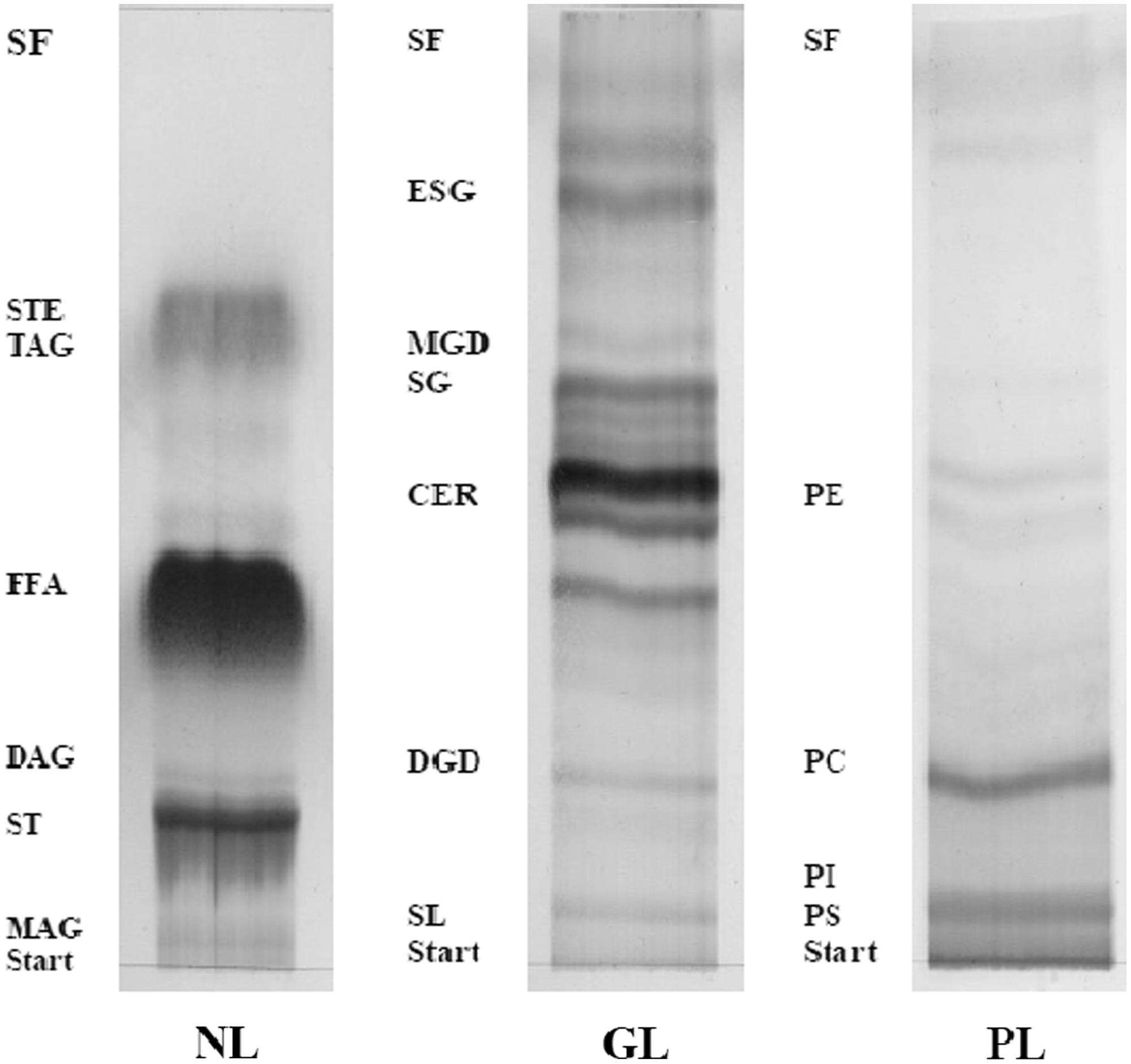
Thin layer chromatography profile of CO lipid classes. CO, clove oil; NL, neutral lipid; GL, glycolipids; PL, phospholipids; MAG, monoacylglycerols; ST, sterols; DAG, diacylglycerols; TAG, triacylglycerols; FFA, free fatty acids; STE, sterol esters; SQD, sulfoquinovosyldiacylglycerol; DGD, digalactosyldiacylglycerol; CER, cerebrosides; SG, steryl glucoside; MGD, monogalactosyldiacylglycerol; ESG, esterified steryl glucoside; PS, phosphatidylserine; PI, phosphatidylinositol; PC, phosphatidylcholine; PE, phosphatidylethanolamine; SF, solvent front.
Results are given as the average of triplicate determinations±standard deviation.
Solvent system used in TLC development: n-hexane/diethyl ether/acetic acid (60:40:1, v/v/v).
Solvent system used in TLC development: chloroform/methanol/ammonia solution 25% (65:25:4, v/v/v).
TLC, thin layer chromatography; R f , retention factor; TL, total lipids; MG, monoacylglycerols; DG, diacylglycerols; TG, triacylglycerols; FFA, free fatty acids; STE, sterol esters; SQD, sulfoquinovosyldiacylglycerol; DGD, digalactosyldiacylglycerol; CER, cerebrosides; SG, steryl glucoside; MGD, monogalactosyldiacylglycerol; ESG, esterified steryl glucoside; PS, phosphatidylserine; PI, phosphatidylinositol; PC, phosphatidylcholine; PE, phosphatidylethanolamine.
Fatty acid profile of cold pressed CO and lipid classes
Fatty acid profiles of CO and lipid classes (NL, GL, and PL) are presented in Table 2. According to the results, nine fatty acids were identified in CO. Linoleic and oleic acids were the main fatty acids in CO. Both fatty acids comprise together about 80% of the total FAME. Cold pressed CO contained significant levels of monounsaturated fatty acids (MUFA; 39.7 g/100 g total fatty acids), which is comparable to the cold pressed hemp, cranberry, blueberry, onion, and milk thistle seed oils, but much lower compared with 81% and 82% in the carrot and parsley cold pressed seed oils. 32,33 Cold pressed CO had a polyunsaturated fatty acid (PUFA) content of 42.1 g/100 g of total fatty acids (Table 2). This PUFA content was lower than that in the cranberry (67.6 g/100 g), onion (64–65 g/100 g), milk thistle (61 g/100 g), and blueberry (69 g/100 g) cold pressed seed oils. 34
Results are given as the average of triplicate determinations±standard deviations.
SFA, saturated fatty acids; MUFA, monounsaturated fatty acids; PUFA, polyunsaturated fatty acids.
Palmitic and stearic were the major saturated fatty acids (SFA), comprising together about 15% of total identified FAME. Cold pressed CO contained about 18 g of SFA per 100 g of total fatty acids, which is much lower compared with 30.8 g/100 g of total fatty acids in the cold pressed cardamom seed oil and comparable to that of 13.8 and 15.9 g/100 g of total fatty acids found in the cold pressed milk thistle and roasted pumpkin seed oils, respectively. 34 The SFA levels were higher than those of 7.4–9.7 g/100 g of total fatty acids in the cold pressed parsley, onion, hemp, mullein, and cranberry seed oils. 32
Fatty acids in NL and polar lipids did not differ significantly from each other, wherein linoleic and oleic acids were the main fatty acids. The ratio of unsaturated fatty acids to SFA, however, was not significantly higher in neutral fractions than in the corresponding polar fractions (GL and PL).
A striking feature of the CO was the relatively high level of MUFA and PUFA. γ-Linolenic acid (GLA, C18:3n-6) was also estimated in relatively lower amounts. From the health point of view, MUFA have been shown to lower bad LDL (low-density lipoproteins) cholesterol and retain good high-density lipoprotein cholesterol. This is, in fact, the major benefit of olive oil over the highly polyunsaturated oils, wherein PUFA reduce both the bad as well as the good serum cholesterol levels in our blood. 29 A rapidly growing literature illustrates the benefits of PUFA, in alleviating cardiovascular, inflammatory, heart diseases, atherosclerosis, autoimmune disorder, diabetes, and other diseases. The fatty acid profile of CO evinces the lipids as a good source of the nutritionally essential fatty acids. The fatty acid composition and high amounts of MUFA and PUFA make the CO a special component for nutritional applications.
Tocol composition
Cold pressed CO was characterized by high levels of unsaponifiables (25.3 g/kg). Levels of α-, β-, γ-, and δ-tocopherols in CO were 14,890, 56, 4184, and 186 mg/kg oil, respectively. In addition, amounts of α-, β-, γ-, and δ-tocotrienols were 1110, 55, 85, and 9498 mg/kg oil, respectively. All tocopherol isomers were present in cold pressed CO, wherein α-tocopherol constituted ∼49.5% of the total tocols followed by δ-tocotrienol (31.6% of the total tocols) and γ-tocopherol (13.9% of the total tocols). Other tocols were measured in lower levels. α- and γ-tocopherols proved to be the major tocopherols in vegetable oils and fats. γ-Tocopherol occurred in the highest concentrations in camelina, linseed, cold pressed rapeseed, and corn oil. 30 α-Tocopherol is the most efficient antioxidant of tocopherol isomers, while β-tocopherol has 25–50% of the antioxidative activity of α-tocopherol, and the γ- isomer has 10–35%. Levels of tocopherols detected in cold pressed CO may contribute to the stability of the oil toward oxidation.
RSA of CO in comparison with extra virgin olive oil
The model of scavenging stable free radicals is widely used to evaluate the antioxidant properties in a relatively short time, as compared to other methods. A simple experiment using toluene to dissolve fat or oil samples and the free radicals was developed. 35
The oxidative stability of oils and fats depends on the fatty acid composition, the presence of minor fat-soluble bioactives, and the initial amount of hydroperoxides. The RSA of antioxidants may be influenced by the radical system and other testing conditions. Two or more radical systems are needed to better study a selected antioxidant for its RSA. Antiradical properties of the cold pressed CO and extra virgin olive oil (as a standard crude oil with respective high levels of nutritive antioxidants and bioactives) were compared using stable DPPH• and galvinoxyl radicals. Figure 2 shows that CO had higher RSA than olive oil. After 60 min of incubation with DPPH• radicals, 70% of DPPH• radicals were quenched by CO, while olive oil was able to quench only 45% (Fig. 2A). ESR measurements showed also the same pattern, wherein CO quenched 57% of galvinoxyl radical and olive oil deactivated ∼38% after 1 h of reaction (Fig. 2B). Ramadan & Moersel 35 compared the antiradical performance of different edible oils against DPPH• radical. The order of effectiveness of oils in inhibiting free radicals was as follows: coriander>black cumin>cottonseed>peanut>sunflower>walnut>hemp>linseed>olive>niger.
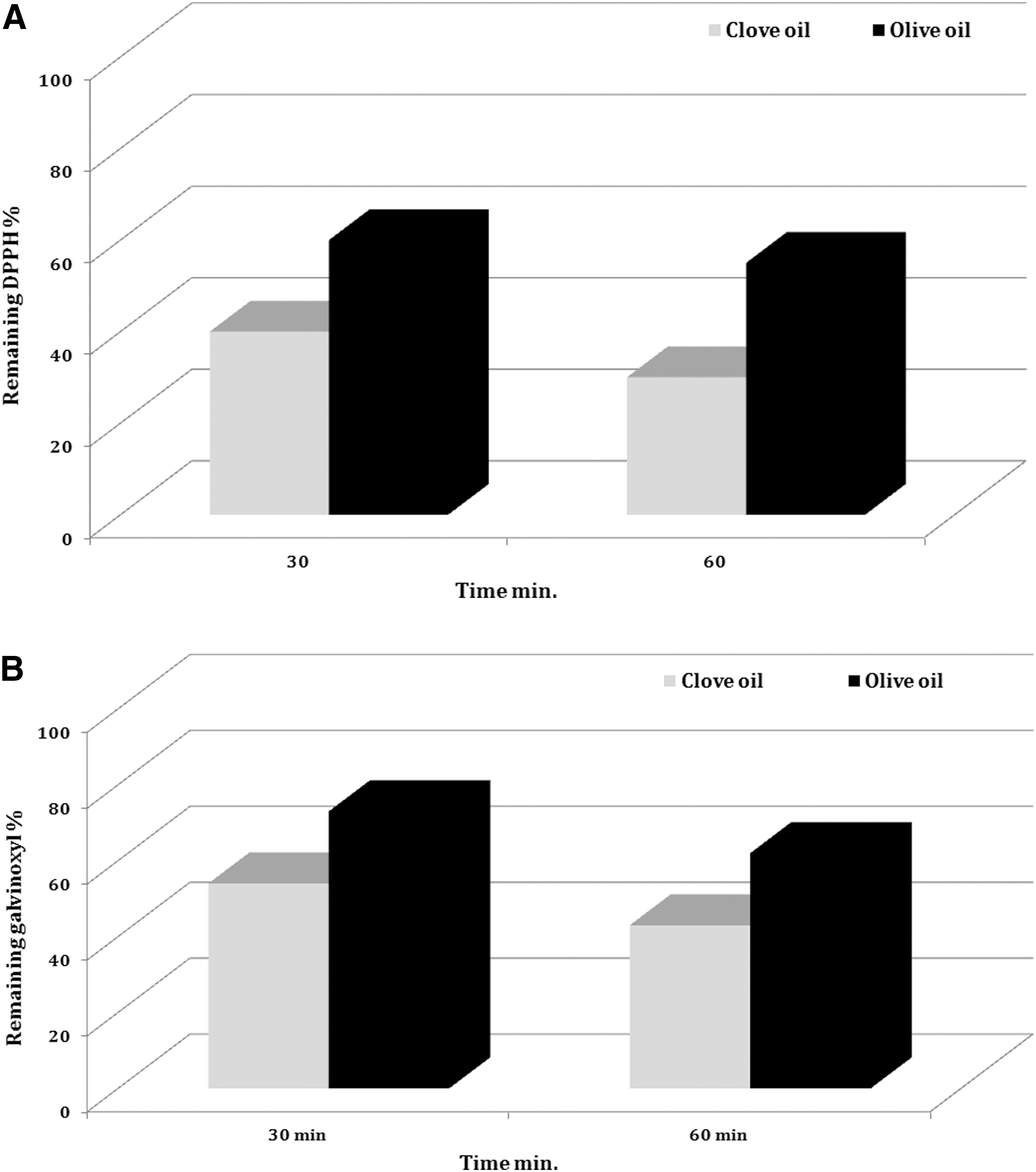
Scavenging effect at different incubation times of cold pressed CO and olive oil on
Regarding the composition of CO and olive oil, they have different patterns of fatty acid and lipid-soluble bioactives. Cold pressed CO was characterized by higher levels of phenolics (4.6 mg/g, respectively) than extra virgin olive oil (3.4 mg/g). Thus, CO examined may be used in different food applications to provide nutrition and health benefits. Phenolic compounds have been reported to be present in vegetable oils, which is very important for the oxidative stability of the PUFA of these oils. Additionally, edible oils rich in natural antioxidants may play a role in reducing the risk of chronic diseases. Phenolic compounds in the plant materials are closely associated with their antioxidant activity. 36 –38 The antioxidant effect of phenolic compounds is mainly due to their redox properties and is the result of various mechanisms: free-RSA, transition-metal-chelating activity, and/or singlet-oxygen-quenching capacity. 39 The total phenolic values of CO were higher compared with 1.73–2.0 mg GAE/g oil for the cold pressed red raspberry, blueberry, and boysenberry seed oils, and that of 1.8–3.4 mg GAE/g oil for the cold pressed parsley, onion, cardamom, mullein, and milk thistle seed oils. 32 –34 On the other hand, tocopherol levels in oils may have a great impact on their RSA. Increasing ring methyl substitution led to an increase of scavenging activity against the DPPH radical, and also to a decrease in oxygen radical absorbance capacity. 40
The stronger RSA of CO compared to olive oil may be due to (1) the differences in content and composition of unsaponifiable materials, (2) the diversity in structural characteristics of potential phenolic antioxidants present, (3) a synergism of phenolic antioxidants with other active components, and (4) different kinetic behaviors of potential antioxidants. From the results, we can suggest that cold pressed CO may serve as a dietary source of phenolic substances, which may act as antioxidants for disease prevention and/or general health promotion through improved nutrition.
Antimicrobial activity of CO
The exploration of naturally occurring antimicrobials for food preservation receives increasing attention due to consumer awareness of natural food products and a growing concern of microbial resistance toward conventional preservatives. 41 Antimicrobial properties of spices have been recognized since ancient times for food preservation. Biologically active molecules from food are of interest to prevent the deleterious effects of free radicals and also to prevent the deterioration of foods due to lipid oxidations and microbial spoilage. Spices are an integral part of human diet to impart flavor, taste, and color to the food. Foodborne illness caused by consumption of contaminated foods with pathogenic bacteria and/or their toxins has been of great concern to public health. Controlling pathogenic microorganisms would reduce foodborne outbreaks and assure consumers a continuing safe, wholesome, and nutritious food supply. Spices are generally applied to food, which is a nutrient-rich environment for most bacteria. Extracts from botanicals have shown the antimicrobial activity against various pathogenic microorganisms. 18,42
Different microbial species, including Gram-negative bacteria, Gram-positive bacteria, and mold (yeasts and fungi), were used to screen the possible antimicrobial activity of cold pressed CO. The examination of antimicrobial activity of the cold pressed CO by the agar diffusion method revealed that CO inhibited the growth of all microorganisms tested (Table 3). Cold pressed CO was very active against bacteria and yeasts and produced great zones of inhibition. The maximum inhibition zone obtained with CO was that against A. flavus, A. niger, and C. albicans (31, 29, and 27 mm, respectively). On the other hand, the CO led to the high inhibition of bacteria, wherein the inhibition zones were between 17 and 26 mm. Recently, the antimicrobial activity of the vapor generated by a combination of cinnamon and clove essential oils against the growth of four Gram-negative (E. coli, Yersinia enterocolitica, P. aeruoginosa, and Salmonella choleraesuis) and four Gram-positive bacteria (S. aureus, L. monocytogenes, Bacillus cereus, and Enterococcus faecalis) was assessed by means of the fractional inhibitory concentration index. 21
Each value represents mean of sample±SD for n=3. Diameter of inhibition zone was measured as the clear area centered on the agar well containing the sample.
MIC, minimal inhibitory concentration.
The MIC of CO toward Gram-negative bacteria, Gram-positive bacteria, yeasts, and fungi was examined and results are also summarized in Table 3. CO exhibited strong antimicrobial action against Gram-negative bacteria, Gram-positive bacteria, and mold. It has a broad-spectrum activity against Gram-negative bacteria, Gram-positive bacteria, and mold with MIC ranging from 0.6 to 1.0 mL/L. The variation in the effectiveness of CO against different strains may depend on the differences in the permeability of cells of those microbes. 43
The impact of different concentrations of CO on the biosynthesis of acid-soluble phosphorus compounds, total lipids, proteins, and nucleic acids (DNA and RNA) in the cells of B. subtilis was studied and the data are presented in Figure 3. It was found that CO had a drastic effect on the biosynthesis of protein and total lipids in cells of B. subtilis (Fig. 3A, B). This effect increased with increasing the concentration (1/8–1/2 MIC) and incubation period. On the other hand, CO had a slight impact on the biosynthesis of acid soluble phosphorus (Fig. 3C). The cold pressed CO had a drastic effect on nucleic acids (DNA and RNA) in the cells of B. subtilis (Fig. 3D, E). This effect increased with increasing the concentration (1/8–1/2 MIC) and incubation period. These results indicated that CO greatly affects the biosynthesis of proteins by inhibiting some steps in the complex process of translation. The most important antibiotics with the same action are the tetracyclines. On the other hand, some chemotherapeutic agents affect the synthesis of DNA or RNA, or can bind to DNA or RNA so that their messages cannot be read. The majority of these drugs are unselective and affects animal and bacterial cells alike; thus, these drugs have no therapeutic applications. 44 These data suggest that CO has potential applications as natural food preservatives to inhibit microbial growth.
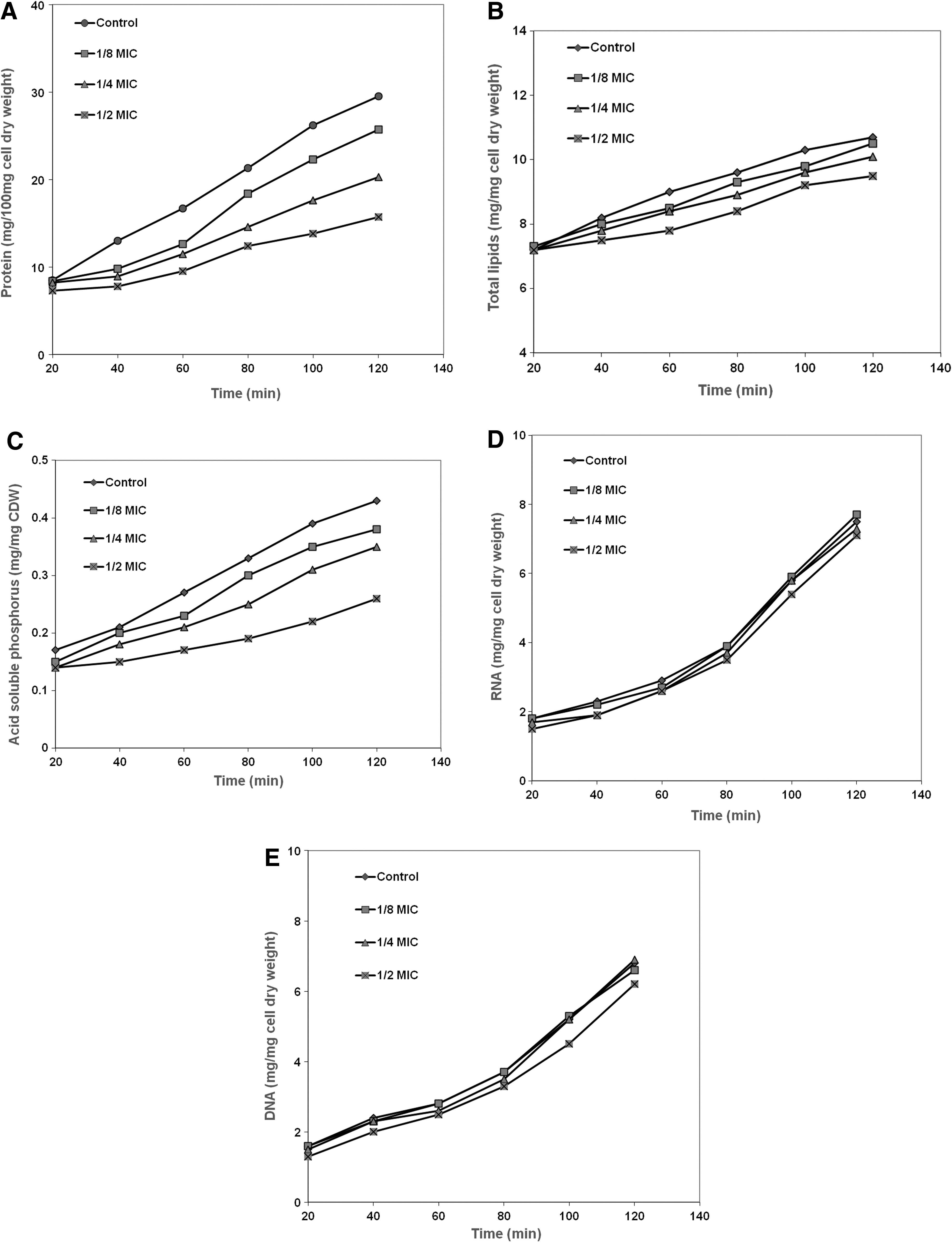
Effect of different concentrations of cold pressed CO on
In conclusion, characterization of the bioactive molecules in novel foods and agricultural products is required to improve the quality and nutritional value of the human diet. These are also important to improve the utilization of food and pharmaceutical products. The present study was designed to investigate the composition and functional properties of cold pressed CO. No such previous studies have yet been conducted on cold pressed CO. Knowledge on the composition and functional properties of cold pressed CO would assist in efforts for industrial, nutritional, and medical application of these plants. This report might serve as a milestone toward the development of healthy oils with high nutritional values. It could be concluded that the CO is a good source of essential fatty acids and lipid-soluble bioactives. The high linoleic and oleic content makes CO nutritionally valuable. The present study demonstrated that CO contained significant levels of natural antioxidants. Tocols and phenolics at the level estimated may be of nutritional importance as natural antioxidants and might directly react with and quench free radicals and prevent lipid peroxidation. Cold pressed CO could be nutritionally considered as a nonconventional supply for pharmaceutical industries, edible purposes, and provide health benefits to the consumers.
Footnotes
Author Disclosure Statement
No competing financial interests exist.