




Abstract
The present study aimed to evaluate the protective effect of maslinic acid (MA) on body weight, heart weight, lipids, lipoproteins, lipid peroxidation (LPO), cardiac marker enzymes, and paraoxonase (PON) in normal control and isoproterenol (ISO)-induced myocardial infarcted albino Wistar rats. After treatment with MA (15 mg/kg) for 7 days, myocardial infarction was induced by subcutaneous injection of ISO (85 mg/kg) for two consecutive days. ISO caused a considerable decrease in body weight and increased the heart weight. The concentrations of total cholesterol, triglycerides, very low-density lipoprotein-cholesterol, and low-density lipoprotein-cholesterol were higher, whereas that of high-density lipoprotein-cholesterol was lower, in the serum of ISO-administered rats. The activities of the cardiac marker enzymes creatine kinase, alanine transaminase, aspartate transaminase, and γ-glutamyl transferase and levels of malondialdehyde were elevated in the serum of ISO-treated rats. ISO-administered rats also exhibited a decline in the activity of PON. Pretreatment of rats with MA reduced the effects of ISO on all parameters tested. This is the first report of the protective effect of MA on ISO-induced cardiotoxicity and of an association between PON status and MA supplementation. The observed cardioprotective effects may be due to the antihyperlipidemic potential of MA, inhibition of LPO, and antioxidant activity.
Introduction
C
Isoproterenol (ISO) is a β-adrenergic agonist that causes severe stress on the myocardium, which causes infarcts like necrosis of the heart muscle. 3 MI induced by ISO shows many metabolic and morphologic aberrations on the myocardium of experimental animals similar to those observed in human MI. 4 ISO stimulates lipid peroxidation (LPO) by inducing free radical production, which may be a causative factor of irreversible damage of the myocardial membranes. 5 ISO-induced MI in rats causes cardiac injury that can be detected by quantifying cardiac marker enzymes such as creatine kinase (CK), alanine aminotransaminase (ALT), and aspartate aminotransaminase (AST). 6
Paraoxonase (PON) is synthesized in the liver and is bound to plasma high-density lipoprotein-cholesterol (HDL-C). 7 PON has been treated as a component of the plasma antioxidant system. This enzyme prevents the oxidation of low-density-lipoprotein cholesterol (LDL-C) and acts as a protective enzyme against atherogenesis. PON protects against atherosclerosis by curtailing HDL-C peroxidation and shielding plasma membranes from free radical injury. 8 Human serum PON has been shown to hydrolyze oxidized lipids 9 and thus to decrease oxidative stress on serum lipoproteins. 10 Low serum PON activity was shown to be associated with increased prevalence of CVD. 11
Even though many synthetic drugs or therapies are available in the market to treat CVD, long-term usage of the drugs or therapies may cause some adverse effects. 12 Thus, such therapies have narrow margins of therapeutic safety and can be associated with severe side effects and toxicities. Therefore, alternative therapies using natural phytochemicals are becoming increasingly popular as these natural compounds have few side effects.
The protective effects of plants can be due to the presence of triterpenoids. 13 Maslinic acid (MA) is a pentacyclic triterpenoid compound that exists widely in the leaves and fruits of medicinal plants like Olea europaea 14 and Terminalia pallida. 15 The compound has attracted much interest due to its proven pharmacological safety and its many biological activities such as antihyperlipidemic, 16 antioxidant, 14 anti-inflammatory, 17 anticancer, 18 antimalarial, 19 antihyperglycemic, antidiabetic, 20 antibacterial, and antiviral. 21 MA has a structure similar to that of oleanolic acid, which is known to exhibit potent cardioprotective efficacy against ISO-induced MI in rats. 22 However, an extensive literature survey has shown that there are no systematic scientific studies available on the effect of MA on CVD. Hence, the present investigation was undertaken to evaluate the cardioprotective effect of MA during ISO-induced cardiotoxicity in albino Wistar rats.
Materials and Methods
Animals
Adult male albino rats of the Wistar strain, weighing approximately 130–170 g, were housed in polypropylene cages under hygienic standardized conditions (12-h light/dark cycle). They all received standard pellet diet (National Institute of Nutrition, Hyderabad, AP, India) and water ad libitum. Rats were acclimatized to animal house conditions for 7 days. The experiment was carried out according to the guidelines of the Committee for the Purpose of Control and Supervision of Experiments on Animals (CPCSEA), New Delhi, India and approved by Institutional Animal Ethics Committee, Sri Krishnadevaraya University, Anantapur (Reg. No. 470/01/a/CPCSEA).
Drugs and chemicals
MA was obtained from Cayman Chemical Co. (Ann Arbor, MI, USA). ISO was purchased from Sigma Chemical Co. (St. Louis, MO, USA). Gallic acid (GA) was purchased from Sisco Research Laboratories Ltd. (Mumbai, India). All other chemicals used were of analytical grade.
Experimental design
To determine the dose-dependent effect of MA on ISO-treated rats, a pilot study was conducted with two different doses of MA (7.5 and 15 mg/kg) in ISO-treated rats and found that the higher dose (15 mg/kg) showed a significant effect after 7 days. MA pretreatment at the doses of 7.5 and 15 mg/kg significantly (P<.05) lowered the elevated levels of cardiac marker enzymes in the serum of ISO-induced rats. Therefore, we chose the highest dose (15 mg/kg) for our study. GA (15 mg/kg) was used as a cardioprotective positive control.
The rats were randomly divided into five groups with eight rats each: Group 1, normal control rats; Group 2, rats treated with MA (15 mg/kg); Group 3, rats administered ISO (85 mg/kg); Group 4, rats pretreated with MA (15 mg/kg) + ISO; and Group 5, rats pretreated with GA (15 mg/kg) + ISO.
The compound MA was completely dissolved in 0.5% sodium carboxymethyl cellulose solution, and GA was completely dissolved in saline and administered to rats orally using an intragastric tube for a period of 7 days. Normal control rats and ISO-control rats received 0.5% sodium carboxymethyl cellulose alone.
After 7 days of pretreatment, MI was induced for two consecutive days (on Days 8 and 9) by subcutaneous injection of ISO (85 mg/kg) dissolved in distilled water. Twelve hours after the second ISO injection (on Day 10), all the rats were sacrificed by cervical dislocation, and blood was collected from a heart puncture. Blood was collected without adding anticoagulant and allowed to clot for 30 min, and serum was separated by centrifugation at 1000 g for 10 min. For the analysis of various biochemical parameters, serum and tissue samples were separated under ice-cold conditions and preserved at −20°C.
Biochemical estimations
The levels of serum total cholesterol (TC) and triglycerides (TGs) were estimated using diagnostics kits from Erba Diagnostics (Mumbai), as described by Allian et al. 23 and McGowan et al., 24 respectively. Serum HDL-C was determined by using a diagnostics kit from Siemens (Mumbai), as described by Richmond. 25 The serum level of very low-density lipoprotein-cholesterol (VLDL-C) was calculated as VLDL-C=TG/5, and that of LDL-C was calculated as LDL-C=TC – (HDL-C + VLDL-C).
The activity of CK was assayed by using a diagnostics kit from Aspen Laboratories (New Delhi, India), as described by Rosalki. 26 The activities of ALT and AST were assayed by using diagnostics kits from Aspen Laboratories as described by Tietz. 27 The activity of serum γ-glutamyl transferase (GGT) was assayed by using a diagnostics kit from Robonik (Mahape, India), as described by Young. 28 LPO in serum was determined by measuring malondialdehyde (MDA) content by the method of Okhawa et al. 29 Protein was estimated by the method of Lowry et al. 30 The activity of PON was assayed by the method of Gan et al. 31
Statistical analysis
Statistical analysis was performed by one-way analysis of variance followed by Duncan's Multiple Range Test using SPSS software (SPSS, Inc., Chicago, IL, USA). Results were expressed as mean±SD values for eight rats in each group. Values of P<.05 were considered significant.
Results
Table 1 shows the effect of MA on serum lipid profiles such as TC, TGs, VLDL-C, LDL-C, and HDL-C in normal control and ISO-treated rats. ISO-administered rats showed a significant increase (P<.05) in the concentrations of serum TC, TGs, VLDL-C, and LDL-C and a significant decrease (P<.05) in the concentrations of serum HDL-C compared with those of normal rats. Pretreatment of ISO-treated rats with MA (15 mg/kg) and GA (15 mg/kg) significantly decreased (P<.05) the levels of TC, TGs, LDL-C, and VLDL-C and increased the levels of HDL-C in serum of ISO-induced myocardial infarcted rats compared with untreated ISO-induced myocardial infarcted rats. Treatment with MA (15 mg/kg) alone improved serum lipid profiles but not significantly (P<.05) compared with normal control rats.
Data are mean±SD values (n=8 rats).
Values that do not share a common superscript differ significantly from each other (P<.05, Duncan's Multiple Range Test).
GA, gallic acid; ISO, isoproterenol; HDL-C, high-density lipoprotein-cholesterol; LDL-C, low-density lipoprotein-cholesterol; MA, maslinic acid; TC, total cholesterol; TGs, triglycerides; VLDL-C, very low-density lipoprotein-cholesterol.
Table 2 depicts the effect of MA on cardiac marker enzymes such as CK, ALT, AST, and GGT in the serum of normal control and ISO-treated rats. ISO administration significantly increased the activities of the enzymes CK, ALT, AST, and GGT compared with those of the normal control group. Upon pretreatment with MA (15 mg/kg) and GA (15 mg/kg) the reversed condition was observed where the activities of these enzymes significantly (P<.05) decreased in serum of ISO-induced myocardial infarcted rats compared with ISO-control rats. MA (15 mg/kg) treatment alone did not showed any significant (P<.05) effect on these marker enzymes.
Data are mean±SD values (n=8 rats).
Values that do not share a common superscript differ significantly from each other (P<.05, Duncan's Multiple Range Test).
ALT, alanine aminotransaminase; AST, aspartate aminotransaminase; CK, creatine kinase; GGT, γ-glutamyl transferase.
Figure 1 shows the effect of MA on body and heart weights in normal control and ISO-treated rats. At the end of experimental period, the ISO-treated group's body weights were significantly (P<.05) lower and the heart weights were significantly (P<.05) higher compared with the control group. Treatment with MA (15 mg/kg) and GA (15 mg/kg) for 7 days significantly (P<.05) increased the body weight and significantly (P<.05) decreased the heart weight compared with the ISO-treated group. MA (15 mg/kg) treatment alone did not showed any significant (P<.05) effect on body weight and heart weight of rats.
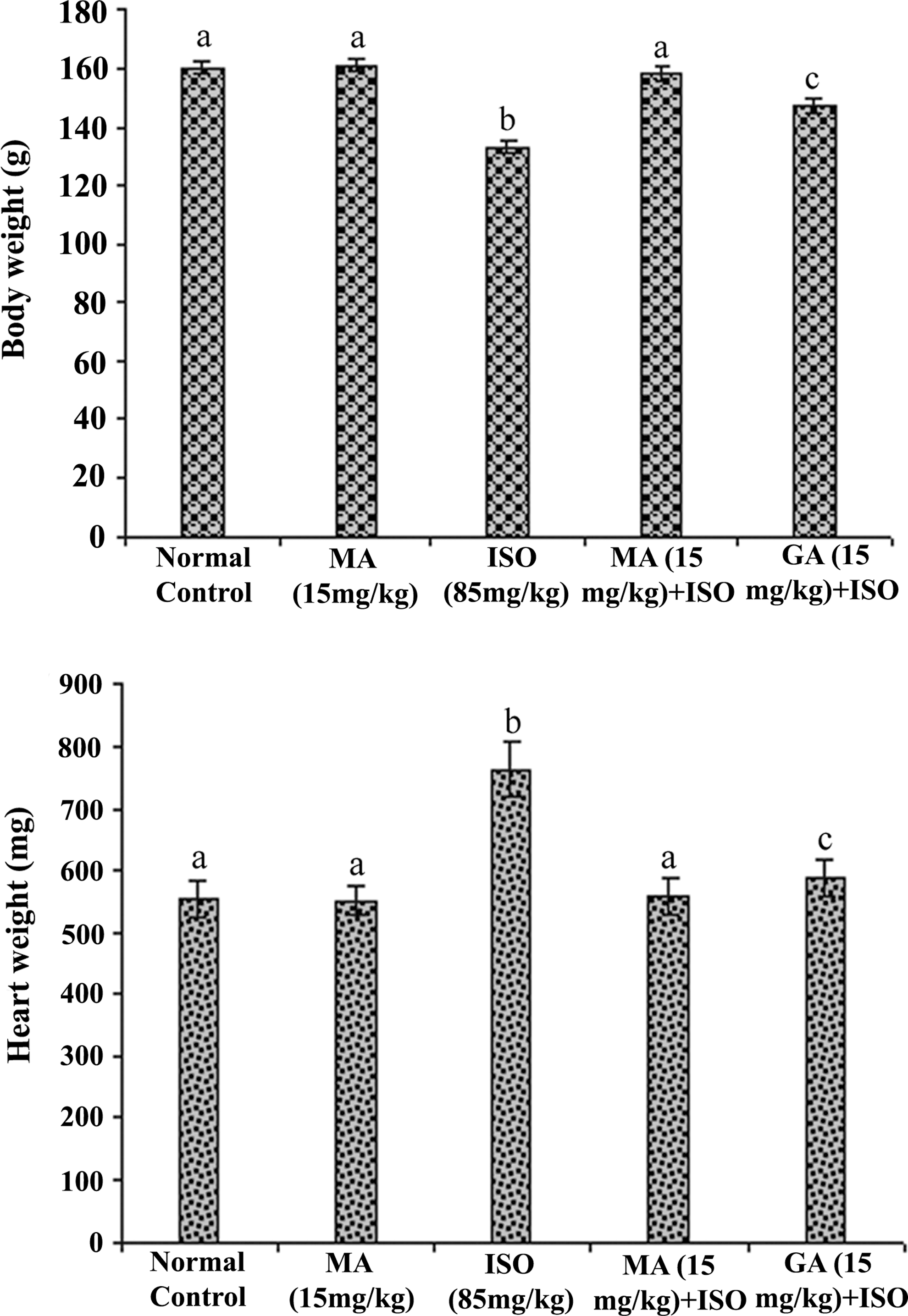
Effect of MA on body weight (in g) and heart weight (in mg) in normal control and ISO-induced myocardial infarcted rats. Data are mean±SD values (n=8 rats). abcValues that do not share a common superscript differ significantly from each other (P<.05, Duncan's Multiple Range Test).
Figure 2 summarizes the effect of MA on the levels of MDA and the activity of PON in the serum of normal control and ISO-administered rats. The level of MDA, the myocardial LPO marker, was significantly (P<.05) elevated, and the activity of the antioxidant enzyme PON was significantly (P<.05) decreased, in the ISO-administered group in comparison with the normal control group. Animals treated with MA (15 mg/kg) and GA (15 mg/kg), followed by ISO injection, showed a significant (P<.05) decrease in MDA levels and a significant (P<.05) increase in the activity of PON enzyme compared with ISO-administered rats. Treatment with MA (15 mg/kg) alone increased the activity of PON significantly (P<.05) compared with normal control rats.
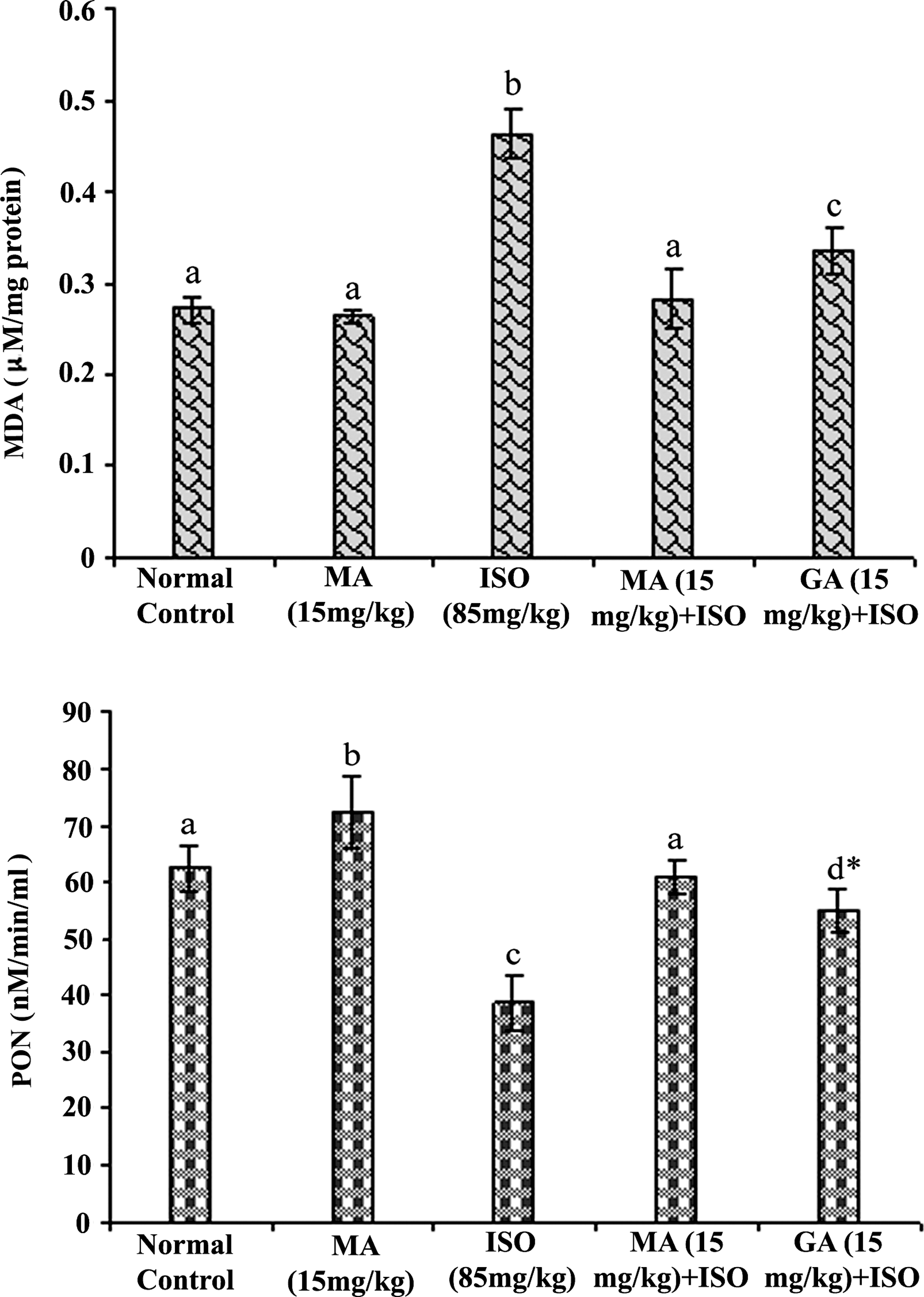
Effect of MA on levels of serum malondialdehyde (MDA) (in μM/mg of protein) and serum paraoxonase (PON) (nM of phenol produced/min/mL of serum) in normal control and ISO-induced myocardial infarcted rats. Data are mean±SD values (n=8 rats). abcdValues that do not share a common superscript differ significantly from each other (P<.05, Duncan's Multiple Range Test). *This group does not differ significantly from the MA + ISO group.
MA pretreatment of ISO-administered rats resulted in significant effects on all the biochemical parameters studied.
Discussion
Lipids play an important role in CVDs, not only through hyperlipidemia and the development of atherosclerosis, but also by modifying the composition, structure, and stability of cellular membranes. 32 MI is an important CVD event associated with altered lipid metabolism. In our study, the levels of TC and TGs increased in serum of ISO-induced myocardial infarcted rats. The levels of LDL-C and VLDL-C increased, whereas the level of HDL-C decreased, in serum of ISO-administered rats. These changes in lipids level are due to the enhanced lipid biosynthesis by cardiac cyclic AMP. 33 Studies have shown that high levels of LDL-C are positively correlated and high levels of HDL-C are negatively correlated with MI. 34 An inverse relationship exists between HDL-C and body cholesterol. HDL-C inhibits the uptake of LDL-C by the arterial wall and facilitates the transport of cholesterol from peripheral tissue to the liver, where it is catabolized and excreted from the body. 35 The observed increase in TGs may be due to a decrease in the activity of lipoprotein lipase resulting in decreased uptake of TGs from circulation. 36 Pretreatment with MA decreased the levels of TC, TGs, LDL-C, and VLDL-C and increased the levels of HDL-C in ISO-administered rats. These cardioprotective changes may be due to the antihyperlipidemic effects of MA. These findings are in agreement with the earlier report of Jun et al. 16
In the present study the levels of diagnostic cardiac marker enzymes like CK, ALT, AST, and GGT were increased in the serum of ISO-administered rats. The increased level of these marker enzymes indicates the severity of ISO-induced necrotic damage to the myocardium. 37 The cardiac marker enzymes are released from the heart into the blood during myocardial damage. Because of deficiency of oxygen or glucose, the cell membrane becomes permeable and may rupture, resulting in the leakage of enzymes. 38 MA pretreatment significantly normalized the levels of all serum marker enzymes, which may be due to the protective effect of MA on myocardium, which had decreased the extent of cardiac damage induced by ISO, thereby slowing the leakage of these enzymes from myocardium. Our results are consistent with the previous report of Priscilla and Prince. 39
In the present study, there was a considerable decrease in the body weight and an increase in heart weight. Increase in the heart weight might be due to the increased water content or edematous intramuscular space, 40 and the loss of body weight could be due to reduced food intake. MA maintained body and heart weights at nearly normal levels.
Increased levels of MDA indicate excessive formation of free radicals by autooxidation of ISO and activation of the lipid peroxidative process, resulting in irreversible damage to the heart in animals subjected to ISO stress. MA pretreatment significantly decreased the MDA levels by preventing formation of lipid peroxides from fatty acids. The inhibition of LPO may be due to the antioxidant property of MA. 17 Our results are in agreement with a previous report 39 demonstrating that MA has the ability to decrease LPO end products.
To date there are no reports available on the relationship between MA with an endogenous antioxidant and the cardioprotective enzyme, PON, as a coronary heart disease risk factor in ISO-induced myocardial infarcted rats. In this study we have observed decreased PON activity in ISO-administered rats. MA supplementation increased PON activity in normal control and myocardial infarcted rats. Low PON activity is suggested to play a role in the severity of coronary atherosclerosis, 41 and low concentrations and enzymatic activity of PON are thought to be independent predictors of cardiovascular events. 42 Therefore, the beneficial effect of MA on PON activity seems to be an important finding, and this effect may be due to the anti-atherosclerotic activity of MA and protection of LDL-C against oxidation by MA.
Conclusions
Our investigation clearly revealed the antihypercholesterolemic, antihyperlipidemic, and antioxidant activities and inhibition of LPO properties of MA, which could protect the heart from ISO-induced cardiotoxicity in myocardial infarcted rats. This is an important indication that MA could be used for treating cardiac-related diseases.
Footnotes
Acknowledgments
The authors are grateful to the Department of Biochemistry, Sri Krishnadevaraya University, Anantapur, AP, India for providing the facilities to carry out the present work. One of the authors, H.S.A. sincerely acknowledges the University Grants Commission (UGC), New Delhi, India, for providing financial assistance (UGC-Senior Research Fellowship).
Author Disclosure Statement
The authors have declared no competing financial interests exist.