




Abstract
The aim of the present study was to investigate the antihyperglycemic and protective potential of crocin, a pharmacologically active constituent of Crocus sativus L., in streptozotocin-induced diabetic rats. Rats were administered crocin intraperitoneally at doses of 15, 30, and 60 mg/kg of body weight for 6 weeks. The levels of thiobarbituric acid reactive substance (TBARS) and total thiol (SH) groups were measured in the liver and kidney at the end of 6 weeks. Under our experimental conditions, crocin at a dose of 60 mg/kg was found to significantly reduce the blood glucose level in diabetic animals. In addition, there was a significant increase in TBARS levels and decreased total thiol concentrations in the liver and kidney of diabetic animals. Crocin, at doses of 30 and 60 mg/kg, appears to exert an antioxidative activity demonstrated by a lowering of lipid peroxidation levels in these organs. In conclusion, our findings suggest that crocin has the hypoglycemic and antioxidative properties in streptozotocin-induced diabetes and it may be useful in the management of diabetic patients.
Introduction
D
Carotenoids, by acting as biological antioxidants, protect cells and tissues from the damaging effects of free radicals and singlet oxygen, and play a significant role in human health. 12 Crocus sativus L., commonly known as saffron, is a stemless herb of the Iridaceae family. The major bioactive compounds in saffron are crocins, safranal, and picrocrocin. Crocins, glycosyl esters of crocetin, are unusual water soluble carotenoids and are responsible for its characteristic color. 12
Numerous studies have shown crocins to be capable of a variety of pharmacological effects, such as protection against cardiovascular diseases, 13 –15 inhibition of tumor cell proliferation, 16 neuroprotection, 17,18 and protection of hepatocytes. 19 It also has been reported that crocins inhibited lipid peroxidation in renal 20 and skeletal muscle homogenates during ischemia-reperfusion-induced oxidative damage in rats. 21 The antioxidant and radical scavenging activity of crocins have also been shown in several in vitro models. 22 –24 A recent study in alloxan-diabetic rats showed its antihyperglycemic efficacy. 25 The present study was undertaken to investigate the antihyperglycemic and hepatorenal protective effects of crocin in streptozotocin-diabetic rats
Materials and Methods
Animals
Male Wistar rats, weighing 270–300 g were housed in an air-conditioned colony room at 23°C±2°C on a standard pellet diet and tap water ad libitum. The experiments were conducted in accordance with the Guide for the Care and Use of Laboratory Animals, and the study was approved by the Mashhad University of Medical Sciences.
Chemicals
2,2′-Dinitro-5,5′-dithiodibenzoic acid (DTNB), 2-thiobarbituric acid (TBA), trichloro acetic acid (TCA), Tris, Na2EDTA, potassium chloride, and hydrochloric acid were obtained from Merck. Crocin was purchased from Sigma. Streptozotocin was obtained from Enzo Life Sciences.
Induction of diabetes
The overnight fasted rats were rendered diabetic by a single intraperitoneal injection of 55 mg/kg streptozotocin freshly dissolved in cold distilled water. Animals were allowed to drink a 5% glucose solution overnight to overcome the drug-induced hypoglycemia. At 72 h post-streptozotocin injection, serum glucose levels were measured using a glucometer (Glucocard). Only those animals with serum glucose higher than 250 mg/dL were selected as diabetics for the following experiments. The day on which hyperglycemia was confirmed was designated as day 0. Diabetes was also confirmed by the presence of polyphagia, polydipsia, and polyuria during the experiment.
Experimental design
Rats were randomly allocated and similarly grouped into five groups, with seven rats in each group, as follows: normal saline-treated nondiabetic control, normal saline-treated diabetic, diabetics treated with crocin at doses of 15, 30, and 60 mg/kg. The animals received crocin or saline intraperitoneally since day 0 for 6 weeks. Changes in body weight, food consumption, and water intake were regularly recorded during the experimental period. For blood sampling, rats were fasted overnight and blood samples were obtained from retro orbital plexus before diabetes induction (week 0) and at the end of weeks 3 and 6. Serum was then separated for the estimation of the glucose level. At the end of the experiment, the animals were sacrificed and the liver and kidney were dissected out, washed immediately in ice-cold saline, and homogenized in the KCl solution by a homogenizer (Heidolph).
Biochemical assays
Serum glucose was assayed using commercial kits based on the glucose-oxidase method (Parsazmun).
The lipid peroxidation level of the liver and kidney was measured as malondialdehyde (MDA), which is the end product of lipid peroxidation, and reacts with TBA as a thiobarbituric acid reactive substance (TBARS) to produce a red colored complex that has a peak absorbance (A) at 535 nm. A mixture of TCA acid, TBA, and HCl were added to 1 mL of homogenate, and the mixture was heated for 45 min in a boiling water bath. After cooling and centrifugation at 1000 g for 10 min, the absorbance was measured at 535 nm. The level of TBARS was calculated by: C(M)=A/1.65×105. 26
Total sulfhydryl (SH) groups were measured using DTNB as the reagent. This reagent reacts with the SH groups to produce a yellow colored complex that has a peak absorbance at 412 nm. Briefly, 1 mL Tris-EDTA buffer (pH 8.6) was added to 50 μL homogenate in 2-mL cuvettes and the sample absorbance was read at 412 nm against the Tris- EDTA buffer alone (A1). Then, 20 μL of the DTNB reagent (10 mM in methanol) was added to the mixture and after 15 min, the sample absorbance was read again (A2). The absorbance of the DTNB reagent was also read as a blank (B). The total thiol concentration (mM) was calculated by: The total thiol concentration (mM)=(A2−A1−B)×1.07/0.05×13.6. 27
Statistical analysis
The data are expressed as mean±SEM. Statistical analysis was carried out using one-way analysis of variance followed by Tukey's post hoc test. A statistical P-value<.05 was considered significant.
Results
Serum glucose levels
At week 0 (before diabetes induction), there were no significant differences among animals in the experimental groups. Diabetic rats showed a significant increase in serum glucose compared with control rats at weeks 3 and 6 (Fig. 1). Treatment of diabetic rats for 3 weeks with crocin at doses of 15, 30, and 60 mg/kg did not change the serum glucose in comparison to untreated diabetic rats. At week 6, treatment of diabetic rats with crocin at a dose of 15 mg/kg had no effect on serum glucose. However, treatment with crocin at doses of 30 and 60 mg/kg decreased the serum glucose levels compared to diabetic rats, but only the 60 mg/kg dose was statistically significant (Fig. 1).

Serum glucose levels in the control, diabetic, and diabetic rats treated with crocin at doses of 15, 30, and 60 mg/kg at week 0 (before diabetes induction) and at the end of weeks 3 and 6. Data are mean±SEM for seven animals in each group. ***P<.001 vs. control group; # P<.05 vs. diabetic group.
Lipid peroxidation levels in liver and kidney
Changes in TBARS levels, an index of lipid peroxidation, in the liver and kidney of the control and experimental groups of rats are shown in Figure 2. A significant increase in the levels of TBARS in the liver and kidney of streptozotocin-induced diabetic rats was found. This was probably related to the hyperglycemia-related generation of free radicals, which caused the oxidative damage to the tissues. Treatment of diabetic rats with crocin at doses of 30 and 60 mg/kg significantly and dose-dependently decreased the TBARS level in the liver (P<.01) and kidney (P<.001) at week 6.
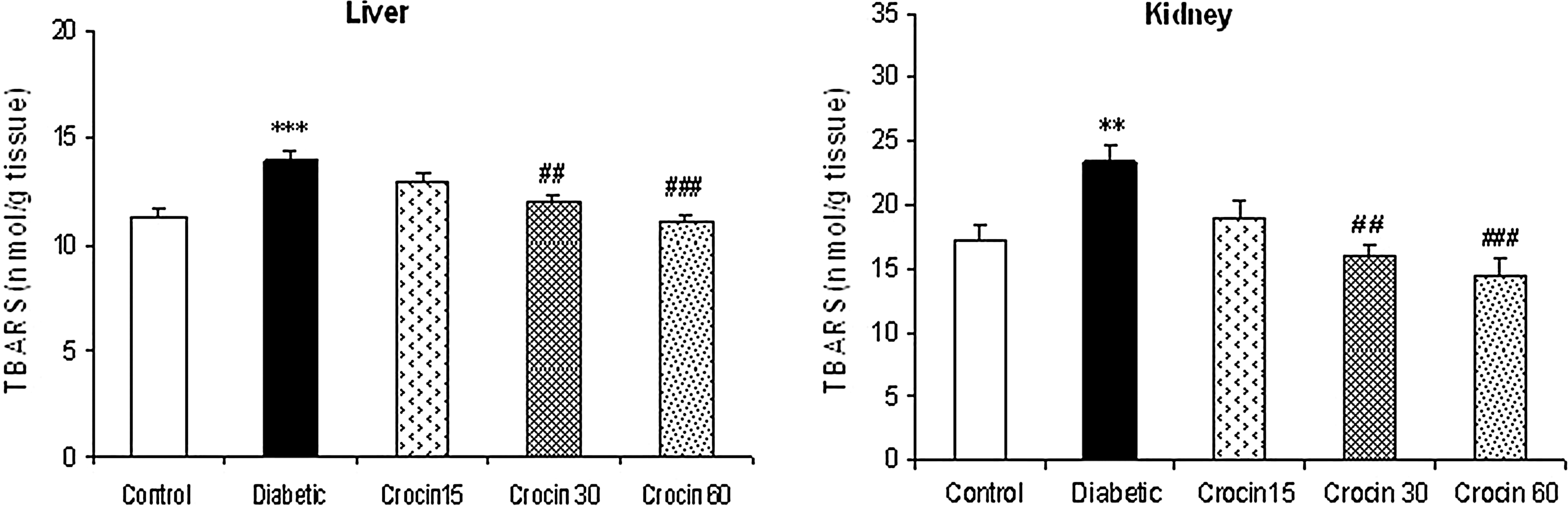
Lipid peroxidation levels (thiobarbituric acid reactive substance [TBARS]) in the liver and kidney of the control, diabetic, and diabetic rats treated with crocin at doses of 15, 30, and 60 mg/kg at week 6. Data are mean±SEM for seven animals in each group. **P<.01, ***P<.001 vs. control group; ## P<.01, ### P<.001 vs. diabetic group.
Total thiol concentration in liver and kidney
Figure 3 shows the total thiol concentration in the liver and kidney of the control and experimental groups. A significant decrease in the total thiol concentration in the liver of streptozotocin-induced diabetic rats was observed compared with control rats (P<.01). The administration of crocin at doses of 15, 30, and 60 mg/kg increased the total thiol concentration in the liver of diabetic rats, although the changes were not significant. Meanwhile, diabetes induction did not change total thiol concentrations in the kidney of diabetic rats compared with controls.
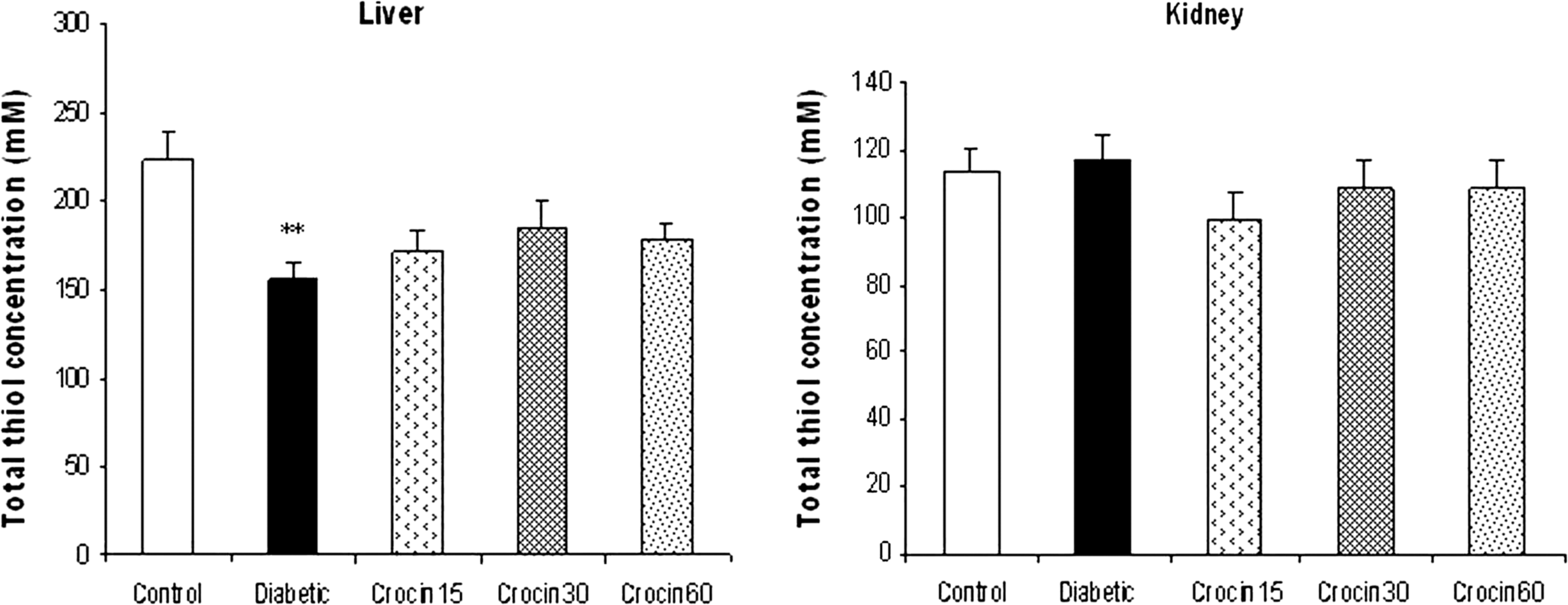
Total thiol concentrations in the liver and kidney of the control, diabetic, and diabetic rats treated with crocin at doses of 15, 30, and 60 mg/kg at week 6. Data are mean±SEM for seven animals in each group. **P<.01 vs. control group.
Discussion
Diabetes is a complex metabolic disorder characterized by hyperglycemia that leads to an increased production of ROS. The resulting oxidative stress (the imbalance between ROS production and the antioxidant defenses) can play a key role in diabetes pathogenesis. 28 Streptozotocin-induced diabetes is a well-known model that mimics diabetic conditions and is useful for evaluating the diabetes complications. In the present study, as expected, streptozotocin treatment induced a diabetic state characterized by hyperglycemia. It is suggested that the diabetogenic effects of streptozotocin is at least, in part, due to excess production of ROS leading to toxicity in pancreatic cells, which reduces the synthesis and the release of insulin. 29 In the present study, pretreatment with crocin intraperitoneally at the dose of 60 mg/kg significantly reduced the blood glucose level. The ability of crocin to reduce the blood glucose level could be attributed to a stimulation of Langerhans islets, an improvement of peripheral sensitivity to the remnant insulin, or to the strong antioxidant properties of crocin. From our results, we rather suggest that the effect of crocin is due to its ability to scavenge free radicals 30 and to prevent streptozotocin-induced oxidative stress, so that crocin protects β-cells resulting in an increased insulin secretion, 25 and decreases elevated blood glucose levels.
Liver is an important organ, which is an important regulator of various metabolic functions, such as regulation of the blood glucose level. Oxidative stress in diabetes leads to oxidative damage to many organs, including the liver. 1 ROS exert their cytotoxic effect by peroxidation of membrane phospholipids leading to a change in permeability and the loss of membrane integrity. 31 Oxidative damage to the liver may lead to inappropriate glucose conditions. Considering this hypothesis, it seems that using natural products, such as crocin with antioxidant effects, may ameliorate the cascade of events induced by diabetes. The results of the present study showed for the first time that crocin is probably a useful natural product that has a good potential for controlling the level of serum glucose in diabetic conditions, probably by inhibiting the oxidative damage to hepatic tissues. We assessed the effect of crocin by studying its effect on lipid peroxidation, which was measured in terms of TBARS. Studies with human and animal models using the TBARS assay generally report an increased lipid peroxidation in liver membranes in a diabetic state. 32 –35 In our experiments, we observed the significant increase of peroxidation in the liver. Clearly, the administration of the crocin intraperitoneally at doses of 30 and 60 mg/kg decreased the TBARS levels to a considerable extent in hepatic tissues of diabetic rats. To our knowledge, this is the first study reporting the protective effect of crocin on streptozotocin-induced oxidative damage in the liver.
In diabetic conditions, control of blood glucose is very important to prevent complications, including renal damage. The role of oxidative stress as a main cause of diabetic complications has been well documented. It is well known that the abnormal glucose metabolism in diabetes leads to an increased generation of ROS, 36 which affect many organs, such as the kidney. 37 A decreased antioxidant enzyme level and an enhanced lipid peroxidation have been well documented in streptozotocin-induced diabetes. 37 –39
In the present study, we also examined the effect of crocin on lipid peroxidation in the kidney. Administration of crocin intraperitoneally at doses of 30 and 60 mg/kg decreased the TBARS levels in renal tissues of diabetic rats, thereby confirming its protective effects against diabetic complications probably via its antioxidant properties.
The antioxidant effects of crocin, which has been previously examined in other models, may confirm this hypothesis. For example, Naghizadeh et al. reported that crocin attenuated cisplatin-induced renal oxidative stress as indicated by a significant decrease in MDA levels and an elevation in total thiol and glutathione peroxidase concentrations. 40 It has also been reported that crocins inhibited lipid peroxidation in renal 19 and skeletal muscle homogenates during ischemia-reperfusion–induced oxidative damage in rats. 20 Furthermore, Chen et al. found that treatment with crocin at doses of 18.7, 37.5, and 75 mg/kg for 6 weeks increased superoxide dismutase levels in the liver and kidney, glutathione peroxidase in the liver, and total antioxidant capacity in the kidney in mice. 41 The radical-scavenging activity of crocins has also been shown in several in vitro models. 22 –24 Collectively, it seems that the antioxidant activity of crocin is related to its radical-scavenging activity and its effect on elevating the levels of antioxidant enzymes in the tissues.
Sulfhydryl (SH) groups are known to be sensitive to oxidative damage and depleted following an oxidative insult; 42 therefore, we studied the effect of crocin on total thiol concentrations in hepatic and renal tissues during diabetes. Similarly, in our studies, thiol (SH) groups were decreased in the liver following streptozotocin injury. Treatment with crocin slightly increased SH contents following diabetes, indicating that crocin assisted in replenishing the total thiol pool. The effect of crocin on the total thiol concentration may be due to a direct antioxidant effect, enhanced biosynthesis of glutathione, or increased levels of other antioxidants, such as vitamins A and E. 43,44
In the present study, the reversal of peroxidative damage in tissues by crocin confirms its antioxidant and antiperoxidative properties and its potential role in defense against free radicals. Our results suggest that besides its effects on uptake or metabolism, crocin could probably act on blood glucose levels by protecting the liver against oxidative damage; however, the precise mechanism(s) needs to be further investigated. Crocin administration could therefore be considered as a valuable adjunct therapy for diabetic patients, especially for alleviating the hepatic and renal complications due to this disease.
In conclusion, the present study indicates that crocin possesses hypoglycemic and protective effects in streptozotocin-induced diabetes and it can be used with some profit in the treatment of diabetic complications.
Footnotes
Acknowledgments
The results presented in this work have been taken from a student's thesis. This study was supported by the Council of Research, Mashhad University of Medical Sciences.