




Abstract
The aim of this study was to evaluate the effects of the Zhizhu decoction on gastric emptying and gastric mucosal protection. The Zhizhu decoction is composed of Aurantii fructus and Atractylodes macrocephala Rhizoma. Results showed that oral administration of the Zhizhu decoction accelerated gastric emptying in mouse and protected gastric mucosa from ethanol-induced ulcers in rat. Our investigations demonstrated that the Zhizhu decoction accelerated gastric emptying, at least in part, by activating the muscarinic and 5-HT3 receptors. The gastroprotective effect is involved in its antioxidant effects and increased vascular endothelial growth factor expression.
Introduction
D
Gastric ulcer, also known as peptic ulcer, is a localized area of erosion in the stomach lining, resulting in abdominal pain, possible bleeding, and other gastrointestinal symptoms. The most common causes of gastric ulcer include stomach infection, alcohol, tobacco, and medications such as nonsteroidal anti-inflammatory drugs. 9
Traditional Chinese medicines (TCMs) have been used for the treatment of dyspepsia. 10,11 Notably, studies show that individual compounds are less or not effective for dyspepsia, suggesting that the biological activities of TCMs are most effective as synergistic actions of multiple components, a phenomenon supported by TCM and modern theories as reviewed by Lyseng-Williamson and Perry. 12 This finding is consistent with the multifactorial property of dyspepsia.
Zhizhu decoction, first recorded 1700 years ago in “Synopsis of Golden Chamber,” contains Aurantii fructus (Citrus aurantium L., Rutaceae) and Atractylodis macrocephalae Rhizoma (Atractylodes macrocephala Koidz, Compositae) in a ratio of 2:1. The Zhizhu decoction has been used in the treatment of functional dyspepsia and gastric ulcer caused by spleen deficiency and Qi-stagnation syndrome. Its effectiveness has been demonstrated by a randomized controlled trial conducted several years ago in China. 13
In this article, we discuss the regulation mechanism of the Zhizhu decoction in the treatment of dyspepsia and gastric ulcer.
Materials and Methods
Plant materials
A. fructus (C. aurantium L., Rutaceae) and A. macrocephala Koidz were obtained from Qixin Traditional Chinese Medicine Co., Ltd., and identified by Dr. Tianxiang Li, Tianjin University of Traditional Chinese Medicine (TUTCM). Voucher specimens were deposited at the Institute of TCM of TUTCM.
Sample preparation and analysis
Extraction
A. fructus (1 kg) was extracted with 5 L 70% EtOH under reflux for 2 h for two times. The extracts were collected and pooled together, and then were concentrated at 40°C to give a crude A. fructus extract (AF).
A. macrocephalae Rhizoma (1 kg) was extracted twice with 95% EtOH 5 L under reflux for 2 h. The extracts were combined and concentrated at 40°C to give a crude extract as an A. macrocephalae Rhizoma extract (AM).
Analysis
The AF was analyzed by high-performance liquid chromatography (HPLC; Waters 600E, Waters Corp.) under the following conditions: HPLC column, Kromasil2 C18 (4.6 mm×250 mm, 5 μm); detection, UV detector at 280 nm; column temperature, 30°C; mobile phase, CH3CN–10 mM phosphate buffer water solution (17:83, v/v); flow rate 1.0 mL/min. Narirutin, naringin, and neohesperidin obtained from the National Institutes for Food and Drug Control were used as comparison standards.
The AM was analyzed by HPLC (Waters 600E) under the following conditions: HPLC column, Kromasil2 C18 (4.6×250 mm, 5 μm); detection, UV detector at 276 nm; column temperature, 30°C; mobile phase, CH3OH–H2O (80:20, v/v); flow rate 1.0 mL/min. Atractylenolide II, obtained from the National Institutes for Food and Drug Control Center, was used as comparison standards.
Animals
All animals were maintained and used in accordance with the guidelines of the Institutional Animal Care and Use Committee of the TUTCM. Male Kunming mice (6 weeks old, body weight 20–30 g) and Sprague-Dawley rats (6 weeks old, body weight 180–200 g) were purchased from Shanchuanhong Laboratory Animal Co., Ltd. The animals were housed at a temperature of 23°C±2°C and were fed a standard laboratory chow (provided by The Institute of Laboratory Animal Science, Chinese Academy of Medical Sciences and Peking Union Medical College). The animals were fasted for 20–24 h before experiments with free access to tap water. The experimental protocol was approved by the Experimental Animal Research Committee at TUTCM.
Effect on gastric emptying in mice
Male Kunming mice were randomly assigned to four treatment groups: normal (untreated), AF 400 mg/kg, AM 200 mg/kg, and AF 400 mg/kg+AM 200 mg/kg. Test samples prepared in 5% acacia solution were intragastrically administered at the dose 0.1 mL/10 g bodyweight, while the normal group received 5% acacia water solution. Thirty minutes later, the marker solution 0.05% phenol red was given orally at 0.3 mL/mouse. Another 30 min later, the animals were sacrificed by cervical dislocation under ether anesthesia. The abdominal cavity was opened, and the gastroesophageal junction and pylorus were clamped; then, the stomach was removed, weighed, and placed in 0.1 M NaOH (50 mL) and homogenized. The suspension was allowed to settle for 1 h at room temperature, and 5 mL of the supernatant was added to 20% trichloroacetic acid (0.5 mL) and then centrifuged at 900 g (Centrifuge Sigma 3K15, SIGMA Laborzentrifugen, Germany) for 20 min. The supernatant (2 mL) was mixed with 0.5 M NaOH (2 mL), and the amount of phenol red was determined from the absorbance at 560 nm. Phenol red recovered from an animal scarified immediately after the administration of 5% acacia containing 0.05% phenol red was used as a standard (0% emptying). The gastric emptying (%) during the 30-min period was calculated by the following equation: Gastric emptying (%)=(1−amount of test sample/amount of standard)×100.
Gastric emptying in quinpirole-treated mice
Dopamine D2 receptor agonist, quinpirole hydrochloride, was dissolved in physiological saline. It was administered intraperitoneally at 1 mg/kg after oral administration of test samples, whereas the normal group was administered physiological saline at the same volume. The methods used for the measurement of gastric emptying and group design were the same as those described in the section Effect on gastric emptying in mice.
Gastric emptying in CuSO4-treated mice
CuSO4 was dissolved in physiological saline. It was administered orally 30 mg/kg at 30 min after oral administration of the test samples. The normal group was administered the same amount of distilled water. The methods used for the measurement of gastric emptying and group design were the same as those described in the section Effect on gastric emptying in mice.
Gastric emptying in atropine-treated mice
Thirty minutes after subcutaneously injecting of 0.1 mL/10 g atropine (0.8 mg/kg; normal group was administered same amount of distilled water), the samples were orally administered. The methods used for the measurement of gastric emptying and group design were the same as those described in the section Effect on gastric emptying in mice.
Ethanol-induced gastric mucosal lesions in rats
Acute gastric lesions were induced by oral administration of ethanol. 14 Briefly, rats were administered 99% ethanol using a metal orogastric tube. One hour later, the animals were killed by cervical dislocation under ether anesthesia. The stomach was removed and inflated by injection of 10 mL 1.5% formalin and then opened along the greater curvature. The lengths of gastric lesions were measured as previously described. Malondialdehyde (MDA) and vascular endothelial growth factor (VEGF) levels in gastric tissue were tested using commercial kits (Biosino Bio-Technology and Science, Inc.)
Reverse transcription–polymerase chain reaction measurement of RNA expression in gastric tissue
Total RNA was extracted using an RNAprep Pure Tissue kit [Tiangen Biotech (Beijing) Co., Ltd.] following the manufacturer's protocol. Samples (2.5 mg of RNA) were reverse-transcribed using a first-strand cDNA synthesis kit (High-capacity cDNA Reverse Transcription Kits; Applied Biosystems Co., Ltd.) according to the manufacturer's instructions. Synthesized cDNA was used in real-time reverse transcription polymerase chain reaction (RT-PCR; Bio-Rad Chromo 4 System) experiments using the iQ SYBR Green Supermix and analyzed with Opticon Monitor software according to the manufacturer's instructions. The total reaction volume was 20 μL with the reaction incubated as follows in PE-480 HYBAID (Perkin Elmer): 10 min at 25°C, 120 min at 37°C, 5 min at 85°C, and hold at 4°C.
Reactions of real-time PCR were performed on the Applied Biosystems 7500 Real-Time PCR System (Applied Biosystems) using the Power SYBR® Green PCR master mix (Applied Biosystems) following the manufacturer's instructions. Briefly, PCR was performed in a final volume of 20 μL, including 10 ng sample cDNA, 5 μM specific forward and reverse primers, and 10 μL Power SYBR green PCR Master Mix. PCRs consisted of an initial denaturating cycle at 95°C for 10 min, followed by 40 amplification cycles: 15 sec at 95°C and 1 min at 60°C. The primers used are shown in Table 1. The results were presented as the levels of expression relative to those of controls after normalization to GADPH using the 2−ΔΔCT method. 15 Analysis was carried out in triplicates.
Hsp70, heat shock protein 70; NOS, NO synthetase; VEGF, vascular endothelial growth factor.
Statistical analysis
The values are expressed as mean±standard deviation. All the grouped data were statistically analyzed with SPSS 11.0. Significant differences between means were evaluated by one-way analysis of variance followed by Tukey–Kramer post hoc analysis. P<.05 was considered to indicate statistical significance.
Results
Sample analysis
According to China Pharmacopeia, the contents of narirutin, naringin, and neohesperidin in AF 95% EtOH extract, determined by the HPLC method, were 1.90%, 18.22%, and 21.35%, respectively. Following a method reported in the literature, 16 the content of atractylenolide II in the AM was 0.85%. All of the analyses showed the correlation coefficient r>0.9995, intraday precision <4.0%, and the average recovery in the range of 95.0%–102.1% (relative standard deviation <2.0%, n=5).
Effect on gastric emptying in mice
As shown in Figure 1A, the groups treated with AF 400 mg/kg or with AM 200 mg/kg showed an increase in the gastric emptying rate in mice as compared with the control group (emptying rate: 51.6%±2.2%). The combination-treated group (AM:AF=1:2) showed similar effects, but there were no significant differences between the combination group and the single-ingredient–treated groups.
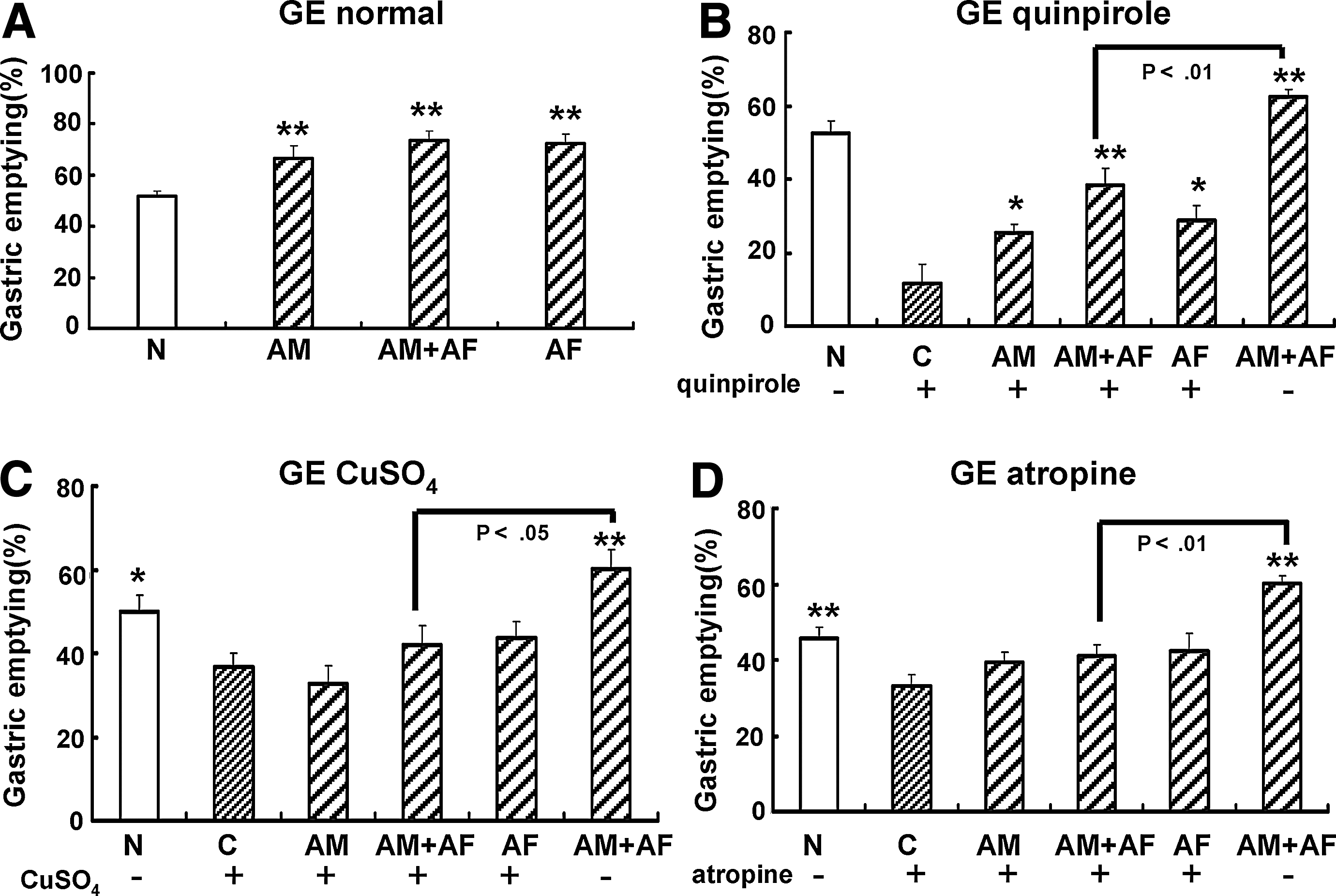
Effects of Atractylodes macrocephalae Rhizoma extract (AM), Aurantii fructus extract (AF), and their combination on gastric emptying in mice. After 18-h fasting, the animals (n=8–10 in each group) received oral administration of AM, AF, or combination at the indicated dosages. Gastric emptying in normal mouse
Gastric emptying in quinpirole-treated mice
As shown in Figure 1B, quinpirole (1 mg/kg) significantly delayed gastric emptying in mice as compared with the negative control group. Compared with AF and AM quinpirole-free mice (Figure 1A), the mice treated with quinpirole and either AF 400 mg/kg or AM 200 mg/kg had a decrease in gastric emptying of >50%, respectively. AF+AM–treated mice receiving quinpirole displayed ∼20% decrease in gastric emptying compared with AF+AM-alone group. On the other hand, compared with the quinpirole-treated control group, the AF, AM, and combination groups showed significant improvements in gastric emptying.
Gastric emptying in CuSO4-treated mice
As shown in Figure 1C, CuSO4 (30 mg/kg) significantly delayed gastric emptying in mice as compared with the negative control group. Compared with the CuSO4-treated control group, AF 400 mg/kg, AM 200 mg/kg, and the combination group had no significant effect on copper-induced delay of gastric emptying. Especially in the AF+AM combination group, a significant difference was found between the copper-treated and untreated mice.
Gastric emptying in atropine-treated mice
As shown in Figure 1D, atropine (0.8 mg/kg) significantly delayed gastric emptying in mice compared with the negative control group. Compared with mice free of atropine, the atropine-treated mice in the AF 400 mg/kg, AM 200 mg/kg, and AF+AM combination groups showed a tendency toward alleviation of atropine-delayed gastric emptying, but did not reach a significant difference compared with the positive control group. Within the AF+AM combination group, a significant difference was found between the atropine-treated and untreated mice.
Ethanol-induced gastric mucosal lesions in rats
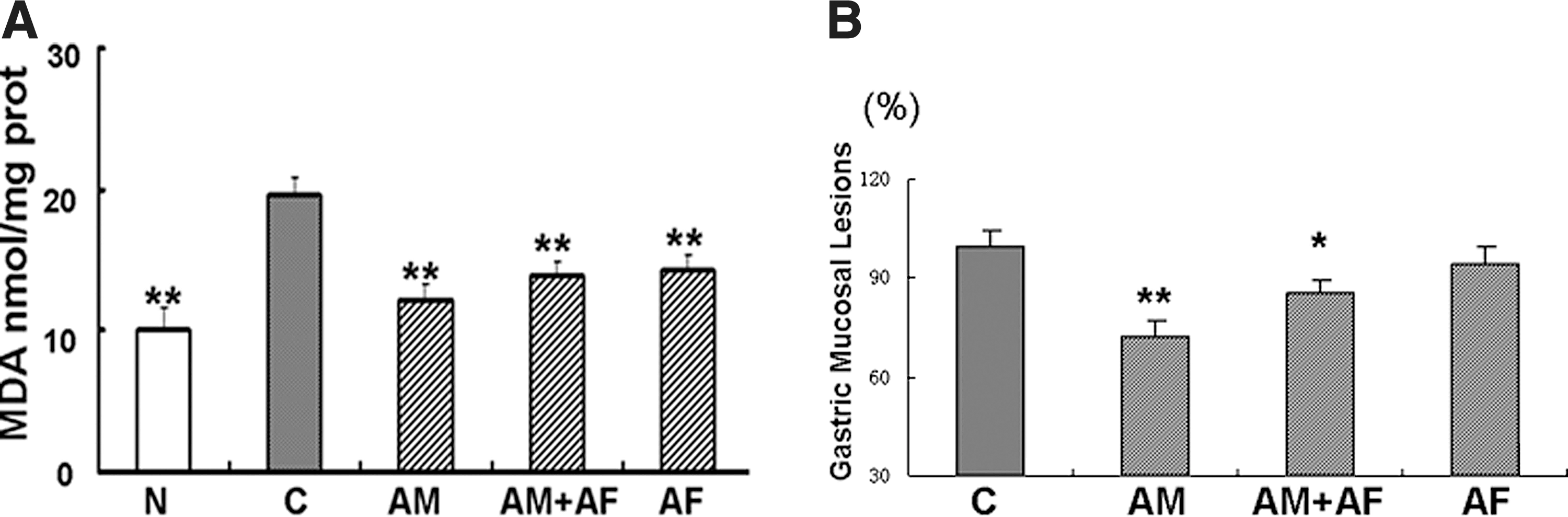
As shown in Figure 2, oral administration of 99% EtOH induced gastric mucosal lesions in rats, and it was inhibited by the AM extract at a dosage of 200 mg/kg (inhibition rate: 27.84%±4.82%). The AF extract did not show any effects on gastric lesions induced by EtOH at the dosage of 400mg/kg. The AF+AM combination group showed a significant gastroprotective effect compared to the control group. MDA levels in the AF, AM, and AF+AM combination groups were significantly lower compared with the positive control group.
RNA expression and VEGF level in gastric tissue
To investigate the protein and mRNA expression, the mRNA expression of heat shock protein 70 (Hsp70), NO synthetase (NOS), and VEGF in gastric tissue was determined. As shown in Figure 3, compared with the EtOH-untreated group, the expression of Hsp70 and NOS was significantly upregulated in the EtOH-treated group, and the expression of VEGF was significantly downregulated. For Hsp70, the AM-, AF-, and AM:AF 1:2–treated groups showed a downregulation tendency, but were not statistically significant. Compared with the positive control group, the AF- and combination-treated groups exhibited significant decreases in NOS mRNA expression induced by EtOH, while the AM group failed to show a significant difference. However, the AM-treated group had significantly increased VEGF mRNA expression, but the AF group did not. The combination of AM and AF downregulated the expression of NOS and upregulated the expression of VEGF compared with the positive control group. As shown in Figure 4, the VEGF protein content was detected by an enzyme-linked immunosorbent assay method. Compared with the positive control group, AM, AF, and the combination significantly increased protein expression of VEGF.

Effects of AM, AF, and their combination on heat shock protein 70 (Hsp70) mRNA, NO synthetase (NOS) mRNA, and vascular endothelial growth factor (VEGF) mRNA. After 18-h fasting, the animals (n=8–10 in each group) received oral administration of AM, AF, or AF+AM combination at the indicated dosages. Thirty minutes later, EtOH was orally administered to all mice except the normal (negative control) group; 30 min later, the stomachs were removed, and the reverse transcription polymerase chain reaction technique was used to measure the expression of relevant genes, such as NOS, VEGF, and Hsp70. Values are the mean±SEM of 6–7 experiments. *P<.05, **P<.01 versus control.
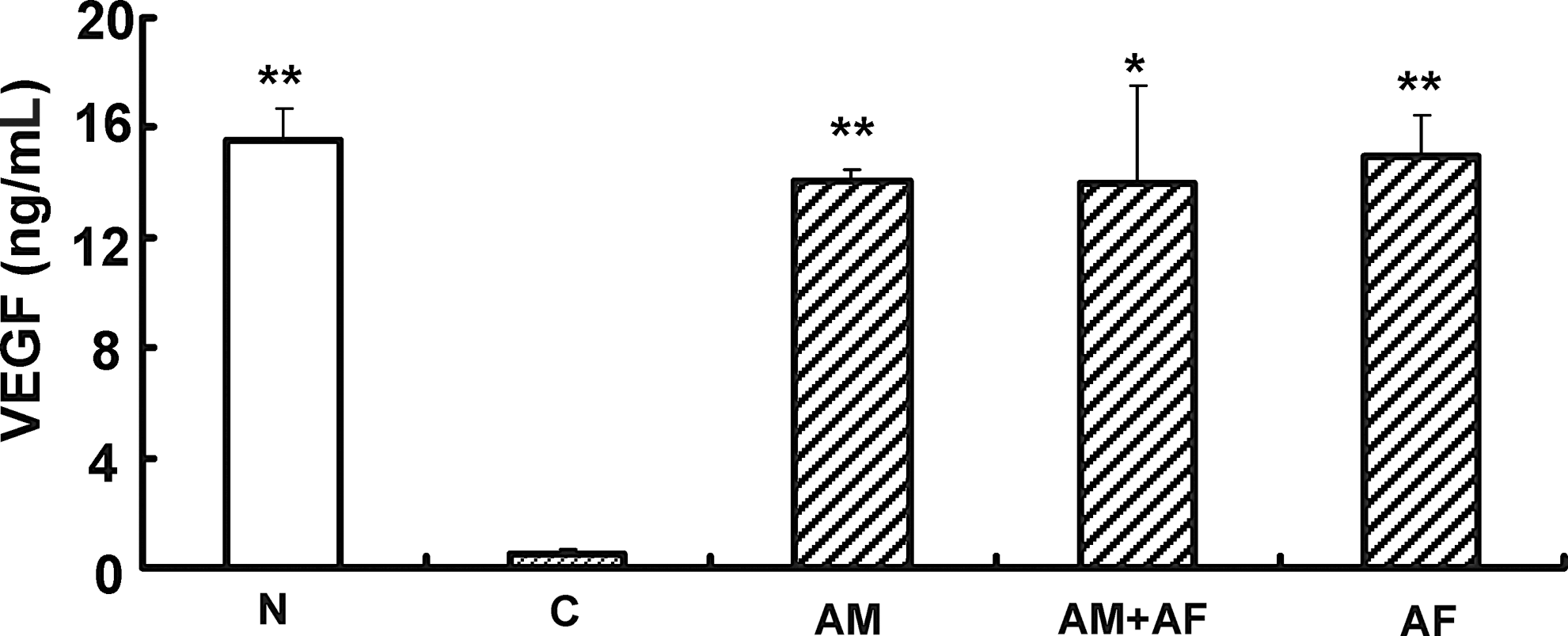
Effects of AM, AF, and their combination on VEGF protein, analyzed by an enzyme-linked immunosorbent assay (ELISA). After 18-h fasting, the animals (n=8–10 in each group) received oral administration of AM, AF, or AF+AM combination at the indicated dosages. Thirty minutes later, EtOH was orally administered except the normal group; 30 min later, the stomachs were removed, and the VEGF content was detected by the ELISA method. Values are the mean±SEM of 6–7 experiments. *P<.05, **P<.01 versus control.
Discussion
The Zhizhu decoction has been used in the treatment of functional dyspepsia and gastric ulcer caused by spleen deficiency and Qi-stagnation syndrome. However, the lack of a clear understanding of mechanisms of action has limited its applications.
In the present study, we investigated the effects of the Zhizhu decoction on gastric emptying to evaluate its effect on functional dyspepsia. Administration of the AF and AM extracts and the AF:AM 1:2 combination significantly increased gastric emptying. To clarify its mechanisms, we further tested the gastric-emptying effects on the gastric inhibitor-pretreated animals. It has been reported that quinpirole, a dopamine D2 receptor agonist, suppresses gastrointestinal transit. 17 Dopamine D2 receptor antagonists such as domperidone are used clinically as antidyspepsia agents for promoting the release of acetylcholine from vagal nerve endings by antagonizing the endogenous dopamine action at D2 receptors. 18 The effects of AF, AM, and their combination on promoting gastric emptying can be partly eliminated by quinpirole, which suggests that the Zhizhu decoction–enhanced gastrointestinal motor activity is related to dopamine D2 receptors.
Copper sulfate evokes vomiting via stimulation of the terminals of the visceral afferents innervating the stomach wall in humans, dogs, cats, and ferrets. It inhibited gastric emptying in mice, which is mediated by the 5-HT3 receptor. 19 CuSO4-induced gastric-emptying delay effects were completely eliminated by administration of AF, AM, and their combination, suggesting that the promotion of gastric emptying by the Zhizhu decoction is related to the 5-HT3 receptors.
Atropine, a muscarinic receptor antagonist, strongly inhibits gastrointestinal contractions by its effect on cholinergic neurons involved in gastrointestinal motor activity. 20,21 Pretreatment with atropine completely blocked the gastric-emptying effect of AF, AM, and their combination. Consequently, the combination of AF and AM also showed a gastric-motility stimulatory effect even lower than the atropine-untreated group, which suggested that the activity of the Zhizhu decoction is involved with muscarinic receptors.
We further investigated the gastroprotective effect of the Zhizhu decoction. The results showed that pretreatment with AM and the AF+AM combination significantly decreased the intensity of gastric mucosal damage induced by ethanol compared with the positive control group. It has been reported that ulcers caused by ethanol are the result of superficial damage to mucosal cells and their protective factors, such as the mucus barrier. 22 EtOH-induced ulcers also involve damage by reactive oxygen species apart from acid and pepsin-related factors. 23 Expression of MDA, a marker of the level of lipid oxidation, was significantly decreased by AF and AM. NOS, a key synthetase of the NO free radical, which is involved in the gastric mucosal defense and also in the pathogenesis of mucosal damage, 24 was downregulated by AF and the AF+AM combination. These results suggest that the antioxidant effect of the Zhizhu decoction may be related to its gastroprotective effects.
VEGF, a gastric growth factor, accelerates gastric ulcer healing by enhancement of cell proliferation at the gastric ulcer margin. 25 AM and the AF+AM combination, but not AF alone, significantly upregulated VEGF gene expression, but AM, AF and their combination all significantly increased VEFG protein expression.
In conclusion, our work partly revealed the mechanisms of the Zhizhu decoction on functional dyspepsia and gastric ulcer in a multitarget manner. AM, AF, and their combination can significantly increase gastric emptying in normal mice. These results suggest that the effects of the Zhizhu decoction on promoting gastric emptying may be mediated by activation of the M and 5-HT3 receptors. Furthermore, the Zhizhu decoction protects EtOH-induced gastric mucosal injures by its antioxidant effects and by increasing VEGF expression.
Footnotes
Acknowledgments
This research was supported by the Program for New Century Excellent Talents in University (NCET-10-0958); the Changjiang Scholars and Innovative Research Team in University (PCSIRT); the Tianjin Committee of Science and Technology, China (10SYSYJC28900); the MOST Important Drug Development, China (2011ZX09307-002-01); and the National Natural Science Foundation of China (81173524).
Author Disclosure Statement
No competing financial interests exist.