




Abstract
In the present research, the effect of clove essential oil (CO) and its major constituent, eugenol, formulated in water-based microemulsions, was studied on fatty liver and dyslipidemia in high-fructose-fed rats. Plasma and liver lipids, oxidative stress, inflammatory biomarker, and liver function were the assessed criteria. CO dispersed in water as conventional cloudy emulsion was also subjected to the same biological evaluations for comparison with the microemulsified form of this oil. Results showed that the particle size of CO microemulsion (COM) and eugenol microemulsion (EM) was 8.0 nm and 8.9 nm, respectively. Excess dilution and incubation of these microemulsions in 1.2 N HCl, that mimic stomach juice (without lipase), for 5 hours at 37°C lead to the establishment of second population of larger particles with average diameter>100.0 nm. Biological evaluation revealed that rats of high fructose control group exhibited significant dyslipidemia, high plasma tumor necrosis factor-α, and elevated malondialdehyde. The same group of rats showed significant high liver total fat, triglycerides and cholesterol, and liver dysfunction compared to control normal rats fed balanced diet. Daily oral administration of CO conventional emulsion, COM, and EM produced significant improvement of all studied parameters. No significant change in all biochemical parameters was noticed when the groups given the different formulations were compared with each other. The study concluded that administration of CO conventional emulsion, COM, or EM produced significant improvement in fatty liver and dyslipidemia with consequent expected protection from cardiovascular diseases and other complications of fatty liver. Formulation of CO in microemulsion having particle size ∼8.0 nm did not enhance the protective effect compared with the same dose of CO dispersed in water as conventional macroemulsion, probably due to the ease of absorption of these bioactives in their native states. However, formulation in microemulsion provides a delivery system for oral administration of CO or eugenol in homogeneous, water-based, and thermodynamically stable dosage form during storage.
Introduction
E
Eugenol (l-hydroxy-2-methoxy-4-allylbenzene) is a volatile phenolic compound that is widely used in some medicinal preparations, particularly in dentistry as an antiseptic and analgesic agent. It is also used as bioactive and aromatic ingredient in personal hygiene products like mouth rinses, fragrances, and also in food flavoring. On the pharmaceutical level, early investigations revealed that eugenol has an inhibitory activity on non-enzymatic lipid peroxidation in rat liver mitochondria. 7 It also possesses multiple health impacts towards lipid and carbohydrate metabolism and liver function. 8 Investigations on rats revealed that eugenol pretreatment prevented liver injury induced by thioacetamide by decreasing CYP2E1 activity and by improving the antioxidant status. 9 This could be due to the antioxidant activity of eugenol which was found to be about five-fold higher than that observed for α-tocopherol. 10
From these findings, it could be estimated that clove oil, as a rich source of eugenol, may have potential health benefit towards different metabolic syndrome components. Fatty liver is considered as the hepatic component of metabolic syndrome that is increasing in adults and is likely to be increasing in children. Nonalcoholic fatty liver disease (NAFLD) is one of the most common causes of chronic liver diseases. 11 A number of studies have identified a significant correlation between hepatic steatosis (fatty liver) and fibrosis. 12,13 NAFLD covers a progressive spectrum of liver pathologies from simple steatosis to nonalcoholic steatohepatitis (NASH), which is characterized by necroinflammation and fibrosis and subsequently by cirrhosis. 14 It is also speculated that NASH may progress to hepatocellular carcinoma. 15,16 It was reported that NASH has an intimate correlation with dyslipidemia which is another feature of metabolic syndrome that may both lead to cardiovascular diseases. 17,18
With the advent of nanotechnology, it was possible to fabricate bioactive compounds with unique biological properties in the form of nanoparticles (diameter r<100.0 nm). Pharmaceutical research took advantage of that technology in formulating targeted drugs delivery systems for cancer therapy. 19 Similarly, food and nutrition researches were recently focused on the preparation of functional dietary supplements, nutraceuticals, and bioactive compounds in the form of nanoparticles 20,21 aiming to enhance their therapeutic efficacy and bioavailability. 22 Nowadays, there are well-established techniques for the formulation of these bioactives as nanoparticles carried in water-based system. Microemulsion is one of these attractive delivery systems that is used to carry biologically active ingredients in the form of droplets having extremely small particle size (r<100 nm). This technique is economic feasible because microemulsions are formed spontaneously and require no costly machinery for fabrication. Recently, different phenolic-bearing essential oils including CO were formulated in different microemulsion systems. 23,24 However, their potential protective effect against some liver diseases is yet to be evaluated.
Based on the above mentioned, the authors aimed to study the protective effect of administration of CO formulated as conventional cloudy emulsion and also as COM on steatohepatitis and dyslipidemia as manifestation of metabolic syndrome. Pure eugenol formulated also in microemulsion (EM) was subjected to the same study. The protective effect will be accomplished through assessing dyslipidemia, oxidative stress, inflammatory biomarker, and liver fat and functions under each treatment in high-fructose-fed rats as a working model of metabolic syndrome.
Materials and Methods
Chemicals
Tween-20 (polyoxyethylene sorbitan momolaurate), and pure eugenol (98.0%) were obtained from Aldrich Chemical Co. (Saint Louis, MO, USA). Dried clove bud (Eugenia carryophylatta) was purchased from a local herbal retailer in Cairo, Egypt.
Extraction of CO
The dried clove buds were ground into fine powder using an electric grinder. Batches of 100 g of clove powder were mixed with 1 liter distilled water and subjected to hydro-distillation process for 3 hours. The condensed vapors were received in separating funnel, left until a distinctive two layers separated and the oil was collected from the bottom due to its high density. The oil was dried over anhydrous sodium sulfate and stored in dark glass bottles at −4.0°C for further experiments.
Gas chromatographic analysis
Twenty microliter of CO was diluted with 1 mL diethyl ether and 2.0 μL of this mixture was injected into Perkin Elmer XL gas chromatograph equipped with a flame ionization detector (FID) at a split ratio 10:1. A 60 m×0.32 mm ID fused silica capillary column coated with DB-Wax was used to separate the different volatile components. The oven temperature was programmed from 50°C to 230°C at a rate of 3°C/min. The injector and detector temperatures were 230°C and 250°C, respectively. Helium was used as a carrier gas at a flow rate of 1.0 mL/min. Components were identified by comparing their retention times with authentic samples. Values were reported as area percent of the mean of three analyses.
Preparation of the microemulsions for animal dosing
The oil titration method was used for the formulation of COM and EM. In details, 5.0% (w/w) micellar solution was prepared by dissolving the surfactant (Tween 20) in deionized water at room temperature (27°C±1) using a magnetic stirrer. Then, certain volume of CO and eugenol were titrated separately into two conical flasks containing the same weight of the micellar solution to give 0.9 wt% CO and 0.68 wt% eugenol (g/100 g micellar solution, respectively). The two emulsions were magnetically stirred for 5 minutes then left to equilibrate at room temperature (27.0°C±1) until transformed from cloudy emulsion into clear transparent microemulsion within ∼30.0 minutes.
Preparation of CO conventional cloudy emulsion for animal dosing
Beside formulation in microemulsion, the same concentration of CO (0.9 wt%) was also formulated in conventional cloudy emulsion vehicle by dispersing CO in water containing 0.5% Tween 20 using just magnetic bar stirring. This emulsion being administered to control rats fed on high fructose diet.
Verification of microemulsion formation
After complete equilibration of the microemulsions for an additional 48 hours at room temperature, samples were subjected to visual, microscopic, and particle size examinations to verify the existence of microemulsion. Evidence of microemulsion formation was based on the transparent appearance of the colloidal systems, the non-birefringent texture under polarized light microscope, and the small hydrodynamic particle size (r) which should not exceed 100.0 nm.
Particle size measurement
The particle size of microemulsions was measured using the dynamic light scattering Nano-S90 (Nanoseries, Malvern Instruments, Malvern, UK). The measurements are based on the Brownian motion of the hydrated particles. Thus, it provides information on the hydrodynamic radius of the microemulsion particles. Measurements were conducted at 27.0°C (unless otherwise stated) with a fixed angle of 90°. Sizes quoted are the z-average mean of the microemulsion hydrodynamic diameter (nm) obtained from 15 measurements (3 replicate×5 measurements each). Before measurement, the samples were filtered through 0.20 μm single use syringe filter unit (Minisart®, Sartoius stedim biotech GmbH, Goettingen, Germany) to remove impurities.
Stability of microemulsions against dilution in acidic environment
Each microemulsion (COM and EM) was diluted 100 times by addition of 100 μL (0.1 mL) of each corresponding miroemulsion into 10.0 g hydrochloric acid solution adjusted at pH 1.2 to simulate the gastric juice (without lipase). The samples were equilibrated for 5 hours at 37°C, then the particle size of each microemulsion was examined.
Animals
Male Sprague Dawley rats of body weight ranging from 150 to 170 g were used in the present study. Animals were obtained from animal house of National Research Centre, Cairo, Egypt. Animals were kept individually in stainless steel cages; water and food were given ad libitum. Animal experiment was carried out according to the Medical Research Ethics Committee, National Research Centre, Cairo, Egypt.
Diets
Experimental diets were prepared as in Table 1. A diet rich in fructose and supplemented with butter fat as saturated fat and high percentage of casein were used for induction of metabolic syndrome with steatohepatitis.
Biological evaluation
Thirty rats were divided into 5 groups with 6 rats in each. The first group was control normal group where rats received a balanced diet. The second group was control where rats were fed a high-fructose diet (for induction of metabolic syndrome with steatohepatitis) and given daily oral dose of the vehicle (water and Tween 20). Rats of group three, four, and five were fed a high-fructose diet and given an oral daily dose of the cloudy conventional emulsion containing 40 mg CO /kg rat body weight, COM containing 40 mg CO/kg rat body weight, and EM containing 31 mg eugenol/kg rat body weight.
The selection of these doses is justified in detail in the “Results and Discussion” section under “Biological Evaluation.” The experiment was continued for a month. During the experiment, body weights of rats were followed weekly. At the end of experiment, body weight gain was calculated and blood samples were collected from all rats after an overnight fast for the determination of plasma total cholesterol (T-Ch), 25 high-density lipoprotein cholesterol (HDL-Ch), 26 low density lipoprotein cholesterol (LDL-Ch), 27 and triglycerides (TG). 28 T-Ch/HDL-Ch ratio was calculated. Plasma malondialdehyde (MDA) was determined as indicator of lipid peroxidation. 29 Plasma tumor necrosis factor-α (TNF-α), an inflammatory biomarker, was assessed by ELISA. 30 The plasma activity of aspartate transaminase (AST) and alanine transaminase (ALT), 31 total bilirubin (T. bilirubin), and direct bilirubin (D. bilirubin) were estimated 32 as indicators of liver function. Livers were immediately removed, weighed, and stored at −20°C until analyzed. Total hepatic lipids were extracted and weighed according to the procedure of Folch 33 and Cequier-Sánchez. 34 Concentration of hepatic triglycerides and cholesterol was analyzed. 25,28
Statistical analysis
The results of animal experiments were expressed as the mean±SE and they were analyzed statistically using the one-way analysis of variance ANOVA followed by Duncan's test. In all cases, P<.05 was used as the criterion of statistical significance.
Results and Discussion
Chemical composition of CO and formation of microemulsions
Gas chromatographic study revealed that eugenol, which is the fragrant and bioactive constituent of CO, was the oil's major volatile compound (75.2%). This percentage is considered to be within the reported average values 5 but lower than an exceptional case in which eugenol content reached 96.0%. 6 The variation of eugenol composition in CO from one study to another is due to variation in extraction methods, environmental and genetic factors or agricultural practice. β-caryophyllene (14.2 %) and eugenyl acetate (5.2%) were also detected as two prominent volatile components constituting CO.
CO and eugenol were formulated in water-based microemulsions using Tween 20 as non-ionic surfactant. This surfactant is characterized by an acceptable daily intake (for humans) of 0-25.0 mg/kg b.wt. 35 and also approved by FDA for food applications. In addition, Tween 20 was previously found to be suitable for solubilizing CO 23 and eugenol 36 as particles in microemulsion having diameter<100 nm. The current investigation revealed that the particle size of COM and EM was 8.0 nm and 8.9 nm, respectively, with mono-modal size distribution (Fig. 1), which is a typical size for oil droplets in microemulsion.
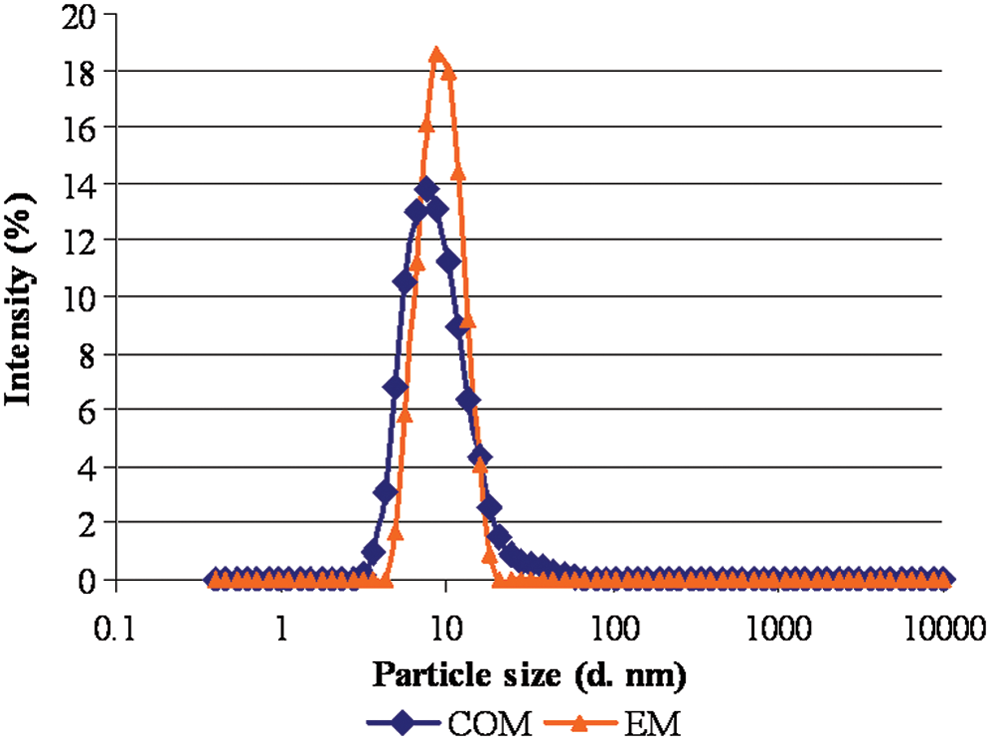
Particle size distribution of clove oil and eugenol microemulsions equilibrated for 1 week and measured at 27°C. Color images available online at
Stability of microemulsions
Micoremulsions administered orally are confronted by different challenges that may alter their microstructure. These challenges include stomach high acidity, dilution with stomach fluids and stomach temperature. Thus, it was important to assess the physical stability of COM and EM under these conditions. For this reason, each microemulsion was subjected to 100-times dilution in HCl solution (pH 1.2) which mimic the acidity of stomach juice (without lipase) followed by equilibration for 5.0 hours at 37°C.
Particle size measurements (at 37°C) after this treatment revealed that the average particles diameter increased to 19.55±0.3 nm (poly-dispersibility index 0.6) for COM and 13.04±0.3 nm (poly-dispersibility index 0.33) for EM, respectively (Fig. 2). From the same figure it is clear that a new population of particles having diameter>100.0 nm had appeared. The intensity % of this new population of large particles ranged from 53.0% to 28.0% of the total intensity % for COM and EM, respectively (Fig. 2). The relatively narrow poly-dispersibility index of EM (0.33) compared to COM (0.6) indicated that EM was more stable toward dilution in acidic medium than COM.
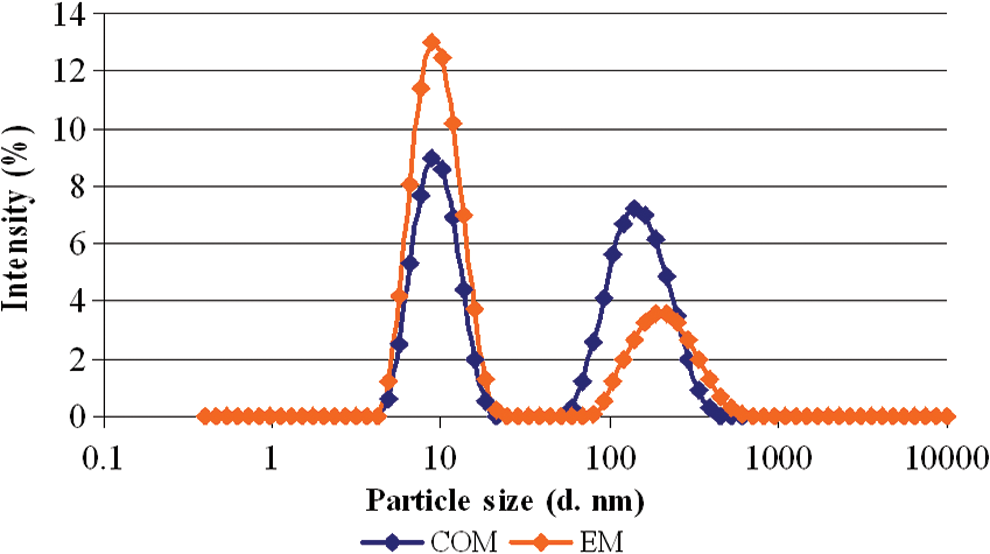
Particle size distribution of clove oil and eugenol microemulsions after 100-times dilution in hydrochloric acid aqueous solution (pH 1.2), equilibrated for 5.0 hours at 37°C and measured at the same temperature. Color images available online at
The potential reason for the change in particle size of the diluted emulsions and the formation of a second population of larger particles is due to the sensitivity of microemulsions in general toward dilution. This process may decrease the concentration of the surfactant below its critical micelle concentration (CMC) which is the minimum surfactant concentration required to form microemulsion. Practically, the 100-times diluted COM or EM still containing ∼5.0 mg surfactant after dilution (0.1 mL of the original 5.0% surfactant-containing microemulsion diluted in 10.0 g HCl solution). This value is 6.7 times higher than the CMC required for Tween 20 (∼0.06 milliMolar 37 ) that is equivalent to 0.736 mg surfactant in 10.0 g solution. This means that there is enough surfactant after dilution to keep CO and eugenol in the microemulsion structure.
Thus, the formation of a second population of larger particles could be due to another consequence of dilution. This process affects the number, shape, and size of the surfactant micelles which contribute ultimately to the particle size. Moreover, losing part of the surfactant efficiency due to the degrading action of HCl can affect its micellization characteristics and, hence, the particle size of oil droplets. From the above mentioned, one may speculate that COM and EM may exit the stomach (if not absorbed) in the form of nanoparticles (9.5 nm – 9.7 nm) as well as relatively larger particles (160.0 nm – 225.0 nm, Fig. 2). After that, both bioactives move to the duodenum which has less severe acidic environment (∼pH 6.7) where they may be absorbed totally, as discussed later.
Biological evaluations
COM, EM, and CO in conventional emulsion were evaluated for their activity in prevention of steatohepatitis and dyslipidemia in rats. CO in conventional emulsion was taken as a guide to study the potential enhancement of the protective or therapeutic efficacy of CO when formulated as nanoparticles in microemulsion versus conventional emulsion.
EM was also subjected to the same biological evaluation to investigate the efficiency of single, pure phenolic compound versus its multi-component parent oil (COM). The selected daily dose of eugenol in microemulsion in the present study (31 mg/kg rat body weight) was intermediate between the acceptable daily intake of this compound (0–2.5 mg/kg b.wt. human/day), 38 and the doses given orally to rats (5–200 mg/kg rat body weight) in previous literature. 39 –41 Similarly, the dose of CO in the conventional emulsion and in COM (40 mg/kg rat body weight) was selected based on the percentage of eugenol in CO which was previously determined in this study (75.2%, Table 1) using gas chromatographic analysis. One should keep in mind that absolute quantization of eugenol in CO may reveal slight differences from (75.2%) which is based on quantization using relative area percentage.
Experimental animals fed fructose-enriched diets are widely recognized as good models for metabolic syndrome. Fructose is a highly lipogenic sugar that has profound metabolic effects in the liver and has been associated with many of the components of the metabolic syndrome such as insulin resistance, elevated waist circumference, dyslipidemia, and hypertension. 42 The biochemical parameters of control and test groups were demonstrated in Table 2. It is evident that the levels of plasma T-Ch, LDL-Ch, TG, and T-Ch /HDL-Ch were significantly high in control rats fed on high fructose diet compared to control rats fed on balanced diet. Plasma HDL-Ch was significantly reduced in control rats fed on high fructose compared to those fed on balanced diet. This lipid profile indicated induction of dyslipidemia and cardiovascular risk on feeding high fructose diet supplemented by butter fat and relatively high protein percentage compared to balanced diet. Also, it was noticed that plasma MDA and TNF-α were significantly high indicating increased oxidative stress and inflammatory condition, respectively on feeding high fructose diet. The significant increase in plasma T-Ch /HDL-Ch along with increased oxidative stress and inflammation reflected an atherogenic effect. 43 Liver total fat, triglycerides, and cholesterol contents of high-fructose control rats were significantly higher than that of normal control in the current study, demonstrating an induction of fatty liver which, together with the increased inflammatory biomarker (TNF-α), reflected a condition of steatohepatitis. Significant elevation of plasma AST activity, ALT activity, total bilirubin, and direct bilirubin in the high-fructose control rats compared to control normal represented liver dysfunction which could be attributed to the induced steatohepatitis. Fructose stimulates hepatic de-novo lipogenesis and so increased hepatic fat leading to nonalcoholic fatty liver disease. 44 Recent evidence has shown fructose to alter gene expression patterns (such as peroxisome proliferator-activated receptor-γ coactivator-1α/β in the liver), alter satiety factors in the brain, and increase inflammation, reactive oxygen species, and portal endotoxin concentrations via Toll-like receptors, along with induction of leptin resistance. 42 Although several aspects in the pathogenesis of NASH remain unclear, it is now well established that accumulation of excess lipids in the liver results in toxic damage to the hepatocytes, or lipotoxicity, which triggers inflammation and fibrosis. 45,46 In this context, the generation of reactive oxygen intermediates has a pivotal role in the induction of damage to the cellular membranes and DNA. 47,48 It has been demonstrated that a fatty liver is insulin resistant, which results in an elevated glucose and very low-density lipoprotein production. 49 Insulin resistance is characterized by the presence of small, dense atherogenic LDL particles that may have an important role in development of atherogenic dyslipidemia and cardiovascular disease. Furthermore, cytokines released from the (visceral) adipose tissue, including interleukin-6 and tumor necrosis factor-alpha are associated with decreased hepatic insulin sensitivity that may further enhance fatty infiltration and decrease hepatocyte integrity. 17 From the biochemical changes observed above, the present study confirmed the induction of metabolic syndrome with steatohepatitis after feeding rats high fructose diet supplemented with butter fat.
In each column, same letter means non-significant difference; different letter means significance difference at 0.05 probabilities.
Administration of CO conventional emulsion, COM and EM in the present study produced significant improvement in all biochemical parameters but not to the extent of normalization. Eugenol and CO have been reported to reduce raised triglycerides and cholesterol levels and activities of AST and ALT in blood serum, 8 which agreed with the present results. Thereby, it is speculated that both eugenol and CO have cardioprotective, hypolipidemic, and hepatoprotective effect; activities that my lead to management of metabolic syndrome. In addition, the present study showed CO conventional emulsion, COM and EM to possess antioxidant, anti-inflammatory and lipid-lowering activity in both plasma and liver. Hence, they may have protective effect towards steatohepatitis, dyslipidemia, and cardiovascular diseases. Previous investigations indicated that eugenol possess antioxidant activity and reduce lipid peroxidation, 7,10 which met with the current results. This might be due to direct effect of eugenol or through inhibiting lipid accumulation in the liver as shown in the present study.
Reduction of hepatic lipid content by the different treatment in the present study would reduce hepatic production of VLDL-Ch and consequently LDL-Ch, thereby preventing dyslipidemia, which is one of the most causative factor for cardiovascular disease. Previously, methyl eugenol, which is a derivative from eugenol, was shown to inhibit the production of nitric oxide and decrease the protein expression of inducible nitric oxide synthase 50 which certainly leads to reduction in oxidative stress and inflammation, as seen in the present study. Methyl eugenol down-regulated the production of pro-inflammatory cytokines thereby it was speculated to be useful for the treatment of inflammation-related diseases such as steatohepatitis. 50 Eugenol was reported to improve the decrease in reduced glutathione observed with indomethacin in rat stomach, scavenge free radicals, and to prevent the deleterious rise in nitric oxide level. 41 These might be the mechanism by which CO, COM, and EM reduce lipid peroxidation and inflammation in the present study. Eugenol was reported to possess cardioprotective effect in rats through enhancing antioxidant defense mechanisms, decreasing lipid peroxidation, and attenuating the elevations in cytosolic Ca(2+) and nitric oxide levels in cardiac tissue. In addition, it reduced cardiac tissue damage induced by doxorubicin. 51 One may propose the same mechanisms whereby CO, COM, and EM could prevent progression of steatosis to steatohepatitis in the present study.
Though there was no notable significant change among all biochemical parameters of the test groups (CO conventional emulsion, COM, and EM) when compared with each other, COM showed the most promising effect (except for AST, T. bilirubin, and D bilirubin) monitored through the percentage improvement.
It was reported that eugenol was mainly and almost completely absorbed in the stomach and the proximal small intestine of piglets. 52 This may clarify, to some extent, the non-significant change of the activity of CO formulated in conventional emulsion and in microemulsion form, since it is completely absorbed in its crude (native) form without degradation. This may reflect no difference in bioavailability between both conventional and microemulsion forms. Nevertheless, formulation of eugenol and CO into microemulsion may give them some privileges over their crude or conventional emulsion forms as it provides them in micellar encapsulated form which may prevent direct contact of clove oil to gastrointestinal wall, suppressing their irritant side effects as reported previously. 53
The final body weights and body weight gain did not show any significant change among the different experimental groups (Table 3). This might mean that the main effect of fructose and the studied oils was focused on the liver fat rather than body weight.
In each column, same letter means non-significant difference; different letter means significance difference at .05 probabilities.
BW, body weight.
Conclusion
Administration of CO conventional emulsion, COM, or EM produced significant improvement on inflammatory fatty liver (steatohepatitis) and dyslipidemia with consequent prevention of cardiovascular disease and other complication of steatohepatitis. Formulation of CO in the nano-form via micro-emulsification did not enhance the protective effect compared with the same dose of CO in the conventional emulsion. However, the micro-emulsified forms secured a solvent-free and homogeneous bioactive particles in water-based delivery system that can be used as supplement having protective effect towards metabolic syndrome.
Footnotes
Author Disclosure Statement
We declare that there are no competing financial interests for any author of this article, whether actual or potential.