




Abstract
Chitosan (CH) is a polymer of glucosamine that is extracted from the shells of several sea fruits. It is well recognized as a nutritional supplement that is used to reduce body weight and blood lipid levels, but its clinical efficacy has not been clearly demonstrated. The true mechanism of action and physiological processes involved in these properties of CH are not yet understood or explained. The most accepted theories assume that CH reduces dietary fat absorption by trapping the fat in the gastric lumen. The very low pH of the gastric lumen induces CH jellification and, therefore, entrapment of the fats. This article describes the most plausible mechanism by which CH interferes with fat absorption in the first part of the enteric tract while interacting with cholic acids. We emphasize the weak points of the classic CH-containing formulations, which are unable to prove this theory. We also report preliminary experimental data of a new CH salt-containing formulation that is capable of effectively interfering with bile salt emulsification processes and, as a result, reducing dietary fat absorption.
Introduction
C

Structures of
Owing to the unique chemical features of CH and its high safety profile when consumed as an oral preparation, the pharmaceutical and functional foods industries have given it attention as a potential weight loss agent, and CH has been included in numerous nutritional supplements intended for this purpose. However, despite many articles and reviews reporting CH's capability to reduce fat absorption and blood lipid levels, the actual clinical efficacy of CH preparations has not been demonstrated, 7 –10 and the underlying mechanisms and physiological processes involved in CH's actions have not been explained.
One of the most plausible mechanisms supporting the weight loss and lipid-absorption properties of CH emphasizes its ability to trap dietary fats in the gastric lumen. This region of the gastroenteric tract contains parietal cells located in the stomach wall that secrete hydrochloric acid. This physiological phenomenon creates a very acidic medium in the gastric lumen (pH 1.5), and under these conditions, CH is completely protonated and becomes an ammonic polycation (Fig. 1d).
Protonated CH is water soluble and jellifies water. This phenomenon allows CH to partially emulsify fats contained in the gastric contents or to mechanically entrap them, which reduces their contact with gastric lipase. According to this theory, a reduced amount of dietary fats will be absorbed. This mechanism partially explains the weight loss action of oral CH. Another proposed mechanism is the inhibition of gastric and pancreatic lipases by CH. 11,12 This hypothetical mechanism could partially explain the higher content of triglycerides discovered in the feces of animals and humans treated daily with CH preparations during meals. 13 Nevertheless, an accurate investigation of human physiology regarding digestive processes emphasizes some inconsistencies in these theories. Once CH is consumed and reaches the stomach, it immediately becomes a polycation and, according to the hypotheses, traps fats, preventing them from coming in contact with gastric lipase. However, the peristaltic movements of the gastric wall that occur during digestive processes lead to the relative repositioning of CH–fat complexes into the duodenum portion of the intestines; the pH increases to more than 7 in this part of the enteric tract because of the secretion of bicarbonate ions. Under these conditions, CH–fat complexes break down since CH cannot maintain its polycationic structure, and its structure returns to that of a poly-amino sugar.
In the duodenum, bile salts trap dietary fats into micellar structures to facilitate contact with pancreatic lipase and further absorption into the circulating blood. This is the central mechanism that governs fat absorption. In other words, the primary means of reducing fat absorption is interference with bile salt emulsification processes. 14,15
Bile salts are steroid-based carboxylic acids produced in the liver cells and concentrated in the gallbladder. In the hepatocyte, cholic acids (CA) are further conjugated with L-glycine and L-taurine through amidic bonds, which leads to the formation of glycocholic acid (GCA) and taurocholic acid (TCA), respectively. These molecules are more hydrophilic than deconjugated CA, and this feature appears essential for the fat emulsification process that occurs in the first part of the enteric tract. In the gallbladder, GCA and TCA are mixed with phospholipids and mineral salts and the final dispersion is later concentrated to form bile. GCA and TCA exist as sodium salts because of the pseudo-neutral pH of the duodenum; these salts are amphiphilic molecules and work as emulsifying agents (Fig. 1b,c).
CH, owing to its chemical features, becomes a polycation in acidic medium and, in such a form, can potentially interact with bile salts and form complexes with them, which can dramatically alter the micellar structures that are necessary for fat absorption. In fact, GCA and TCA, as sodium salts, are anions and can, therefore, react with the poly-ammonic structure of CH and form an insoluble complex in the water medium of the duodenum (Fig. 2a). This theory provides a more reliable and robust scientific rationale to support the mechanism through which CH interferes with fat absorption. In addition to the precipitation of bile salts and the consequent partial impairment of enteric fat absorption, there is another important pharmacological implication of this action of CH. Partial removal of bile acids from enterohepatic reabsorption promotes a reflex conversion of native cholesterol to bile salts, in order to renew bile production and restore physiological digestive processes. This provides a further rationale for the use of CH to reduce blood low-density lipoprotein cholesterol. 16

Molecular representations of
Considering these theories, it is necessary to specify that under physiological conditions, CH cannot work according to this proposed mechanism because, at the pH level of the enteric environment, the cationic function of CH is not expressed. Most likely, this is the primary reason for the poor efficacy of CH after oral consumption that has been reported by many clinical trials conducted in recent decades. CH is a potentially interesting and safe molecule for reducing weight and blood lipid levels, but the primary challenge is to maintain it in the form of a polycation, even in the pseudo-neutral pH of the duodenum and the jejunum.
This article describes, for the first time, a new association between CH and DL-phosphoserine (PS) (Fig. 2b), a unique food-grade phospho-amino acid that is usually used in over-the-counter and nutritional supplements to improve brain performance. DL-PS creates a poly-ammonic salt of CH that is potentially capable of forming complexes with bile salts, even in the pseudo-neutral medium of the duodenum.
Materials and Methods
Materials
CH (MW=5000 D; degree of deacetylation=90%) was supplied by DKSH SRL (Milan, Italy), and DL-PS was supplied by Flamma SPA (Bergamo, Italy). Tauroursodeoxycholic acid (TUDCA) was provided by Metapharmaceutical (Barcelona, Spain). Caprylic/capric triglycerides (food-grade Delios V) were from Cognis (Eurotrading, Padua, Italy), and cholesterol (European Pharmacopoeia) was supplied by ACEF SPA (Milan, Italy). Sodium bicarbonate was obtained from Faravelli SPA (Milan, Italy), sunflower oil lecithin was supplied by Rigoni-Asiago (Vicenza, Italy) and physiologic solution (sterile 0.9% sodium chloride) was obtained from Freseius Kabii SRL (Isola della Scala, Verona, Italy).
Preparation of enteric fluid solution
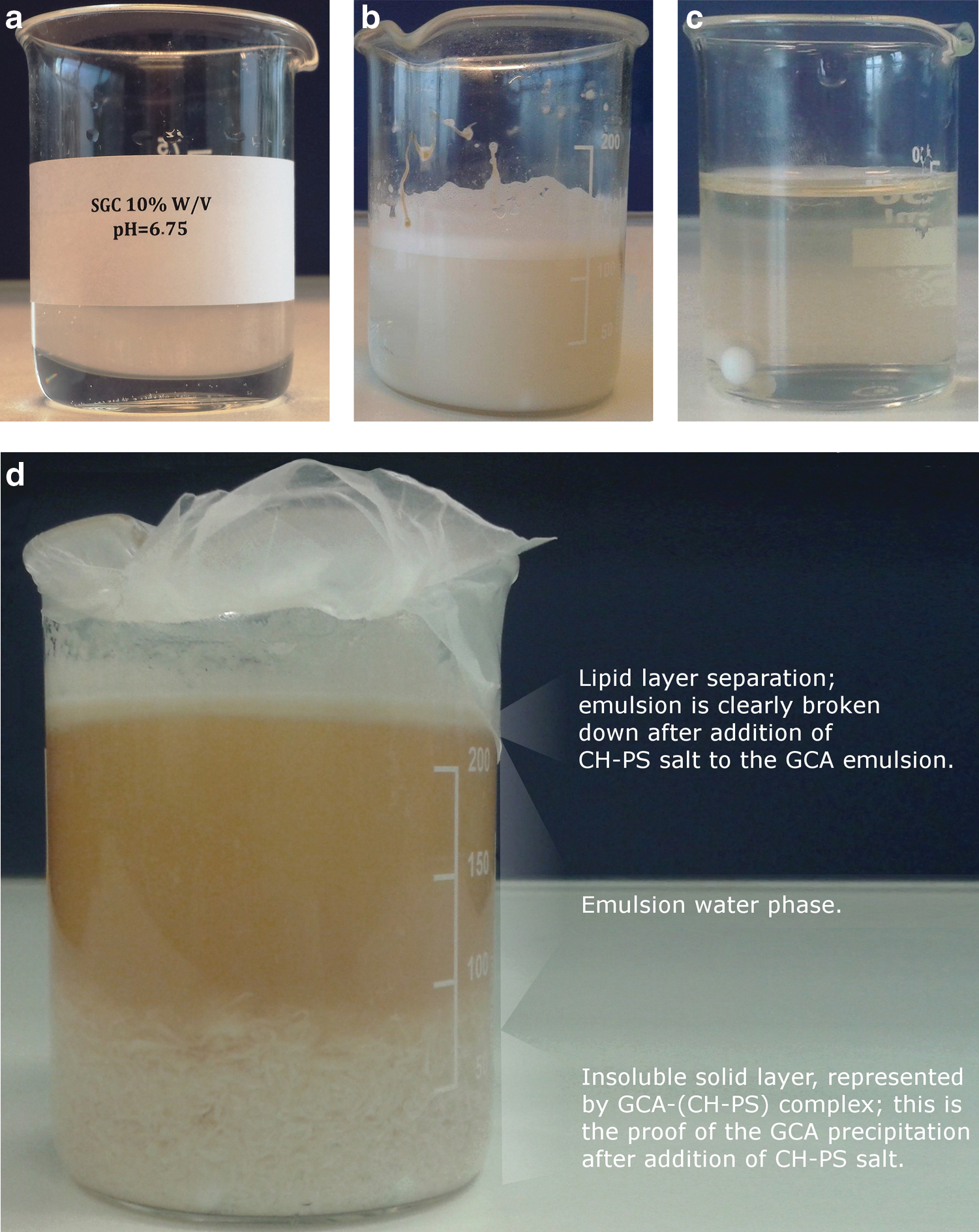
To mimic the fluid secretion and bile salt content in the first part of the enteric tract, a 10% w/v solution of sodium tauroursodesoxycholate (STUDC) was prepared by dispersing 10 g of TUDCA in a beaker containing 80 mL of physiologic solution. The mixture was maintained under moderate stirring (200 rpm; Velp DLS Stirrer) and at a temperature of 37°C with a thermostatic hot plate (Velp VTF, Velp ARE). A pH probe (Hanna Instruments 208, Padua, Italy) was introduced into the beaker to measure and record pH variations. Additionally, a solution of sodium bicarbonate 5% w/v was prepared and then the salification process of TUDCA dispersion was conducted. A solution of sodium bicarbonate was added drop by drop until a colorless solution was achieved (pH 7.75–8.00). Physiologic solution was added to achieve a total volume of 100 mL; the final pH was 6.75 (Fig. 3a).
Preparation of enteric dietary fat emulsion
To create a solution that mimicked the enteric dietary fat emulsion, 3 g of food-grade DELIOS V (caprylic/capric triglyceride) and 40 mg of cholesterol, which are the equivalent amounts of fats present in a 100 g cheeseburger, 17 were placed in a 100 mL glass beaker. Next, 1 g of sunflower oil lecithin was added and the mixture was stirred at 400 rpm for 10 min and maintained at 37°C with a thermostatic hot plate (Velp VTF, Velp ARE) until a uniform clear phase was achieved (phase A). At the same time, a mixture composed of 50 mL of the STUDC solution (equivalent to 5.0 g of STUDC) and 40 mL of physiologic solution was prepared and maintained at 37°C (phase B).
The emulsification process was completed by adding phase B to phase A at 37°C under 300 rpm stirring. When phase B was completely added to phase A, the emulsion was stirred for an additional 30 min under the same conditions to achieve a uniform system. Lastly, physiologic solution was added to the emulsion to achieve a total volume of 100 mL (Fig. 3b); the final pH was 6.9.
Preparation of CH-PS salt and pH assessment
To prepare the CH-PS salt, 1 g of CH was added to 1.25 g of DL-PS and the final powder mixture was dissolved in a glass beaker containing 50 mL of physiologic solution under 400 rpm stirring and maintained at 37°C, following the previously described method. A pH probe was introduced to the beaker. CH quickly solubilized and jellified, and the pH of the system was 3.7. The resulting solution was clear and slightly yellowish (Fig. 3c).
Interaction of enteric dietary fat emulsion with CH-PS powder
To investigate the interaction between the enteric dietary fat emulsion and CH-PS powder, 2 g of powder containing CH and PS (1 and 1.25 g, respectively) was added to the beaker containing the prepared emulsion model. The mixture was maintained at 37°C under 200 rpm stirring with a pH probe introduced. After a few seconds, the emulsion showed preliminary signs of phase reversion and a complete breaking of the emulsion occurred. At the same time, abundant material began to collect at the bottom of the beaker, which was clearly identified to be the precipitation of STUDC-CH complexes. A layer of fat separated to the surface of the beaker (Fig. 3d).
Significantly, we observed that the pH of the system decreased from approximately 7.0 (6.9) to 4.6 and finally reached a pH of 4.2. At this final pH, CH is, for the most part, protonated to form a polycation. This pH value supports the hypothesis that when CH is protonated to form an ammonic polycation in the first part of the enteric tract, a complete and effective formation of bile salt complexes and a dramatic disruption of the fat-containing micellar structures occur. This phenomenon reduces fat absorption in the duodenum and jejunum and, therefore, irreversibly alters the process that leads to dietary fat absorption. In order to create a new pharmaceutical form that contains the CH-PS salt, a gastro-resistant envelope must be created that enables the CH-PS salt to freely dissolve in the watery fluids of the first part of the enteric tract and that enables the interaction between the CH-PS polycation and bile salts, which promotes their precipitation.
Formation of GCA-PS complex
To demonstrate the hypothesis by which PS is capable of forming insoluble complexes with CH, we conducted a precipitation test of GCA with both PS and another acidic amino acid that did not have an ammonic group. A 5.0% w/v solution of GCA in physiologic solution was prepared according to the method described.
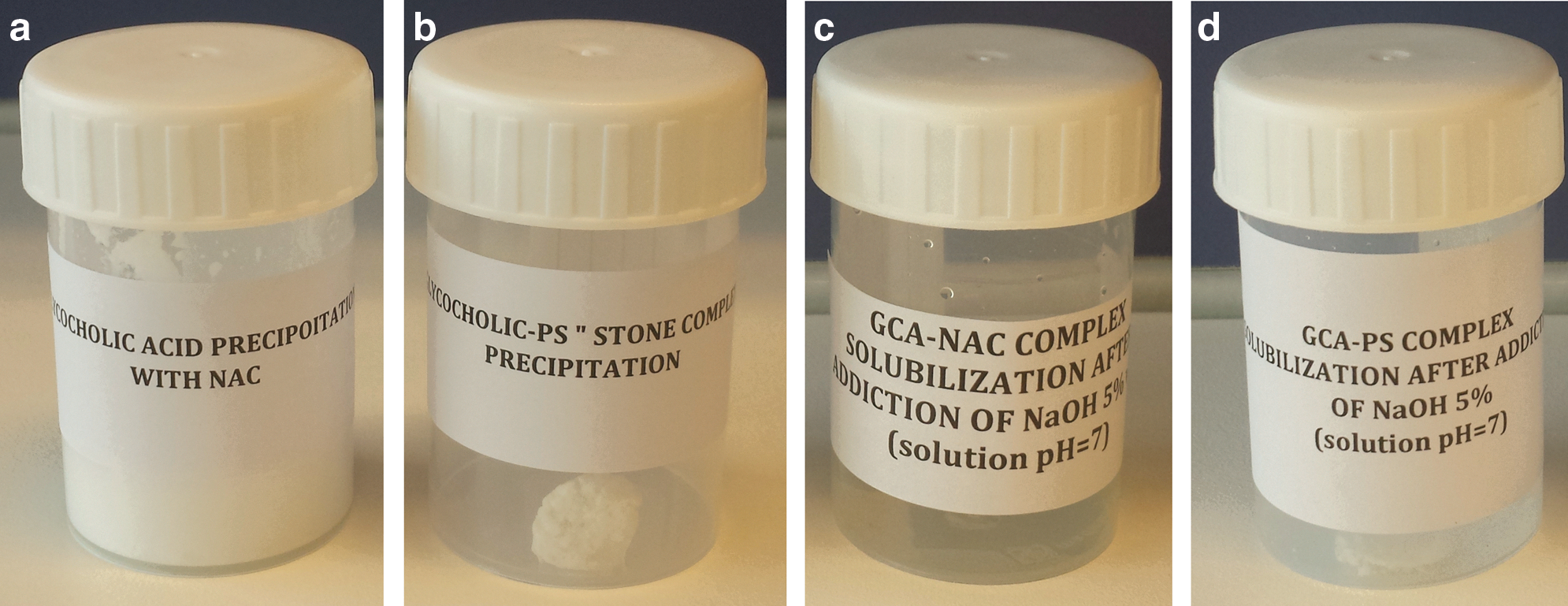
The solution was divided into two glass beakers. Aliquots of N-acetylcysteine (NAC; 500 mg) were added to one of the beakers. NAC is an acidic sulfurated amino acid in which an amine group is acetylated to prevent the formation of an ammonic group. A few seconds after the addition of NAC, a white structured precipitate began to form a uniform viscous bulk (Fig. 4a).
Formation of
Next, 500 mg of PS was added to the second beaker of GCA solution. Just a few seconds after the addition of PS, a white, solid, well-shaped “stone” formed at the bottom of the beaker. Some other small stones formed around the beaker. In each of the beakers, the final pH reached 5.0 (Fig. 4b).
To verify the formation of an insoluble complex between GCA and PS and the lack of formation of the same insoluble complex between GCA and NAC, a 5.0% w/v solution of sodium hydrate was added to both of the dispersions to force the preparation to return to the original pH of the initial enteric solution and to verify either the complete dissolution of the solid precipitate or its insolubility.
The addition of sodium hydrate 5.0% solution to the GCA-NAC solution produced a complete dissolution of the solid white bulk previously evident at pH 5 (Fig. 4c). The addition of sodium hydrate 5.0% solution to the GCA-PS solution did not produce a complete dissolution of the system and the white “stone” remained at the bottom of the beaker. In each of the dispersions, the final pH was 7.0 (Fig. 4d). The stone was separated from the surrounding solution and it appeared very hard with a leather-like texture. The formation of the stone clearly represents the result of the irreversible formation of a GCA-PS complex.
Results and Discussion
Our results show that CH, when existing in a polycationic form in the first part of the enteric lumen, is able to complex with bile salts and consequently displace them from the emulsion–micellar structures in which fats and cholesterol are trapped. This chemical mechanism is likely to occur when CH is consumed as an oral preparation in nutritional supplements, such as a capsule or a compressed tablet. With these methods of consumption, CH can exist in the gastric fluid as an ammonic polycation until it reaches the first part of the enteric tract in which the pH increases to more than 7 and the deprotonation of ammonic groups occurs. In this chemical form, CH is unable to interact with bile salts and displace them from the micellar structures. PS is an acidic phospho-amino acid that is very soluble in water with strong acidic behavior derived from the phosphoric group. This emphasizes the acidic character of the molecule and allows for three acidic functions and three relative pkAs. The first pkA has a value of 2.1, which indicates a strong acidic profile of the molecule in the water medium; it is useful for protonating CH amino groups and creating an ammonia polycation. Another interesting feature of this molecule is that it expresses an ammonic function itself. PS is an amino acid and its natural state is as a zwitterion with the amine group protonated and the carboxylic group in the form of carboxylate. The doubling of the formation of the poly-ammonic salt in the CH structure and the presence of ammonic function in the PS molecule support the rationale of a more effective and irreversible precipitation of bile salts compared to a simple CH salt, which is an acid that does not possess an ammonic cationic function.
Because of its good water solubility, once in contact with the enteric fluid secretions, PS readily dissolves and protonates CH. At the same time, PS reduces the pH of enteric fluids to 4, which ensures the most ideal conditions for the precipitation of bile salts.
These experiments provide preliminary evidence that this new salt of CH can effectively interact with bile salts in the duodenum and alter the micellar structures necessary for absorbing fats. The formation of an insoluble complex between GC and PS, which is not reversible once transferred to an alkaline medium, appears to prevent the displacement of the CH–bile salt complexes that form when a significant pH increase occurs. The medium in the duodenum is physiologically protected to buffer excess acid coming from the stomach. Therefore, the formation of an irreversible complex between bile salts and the CH-PS salt guarantees effective bile salt precipitation, regardless of the pH of the medium. This is the most important finding reported in this article, which was demonstrated by the chemical tests that simulated an accurate fat micellization model that involved the two major bile salts, TCA and GCA.
For these conditions to be feasible, a gastro-resistant pharmaceutical delivery system must be created, such as a tablet, capsule, or granulate with a gastro-resistant shell. Possibly, such a system could use a mixture of methacrylic polymers (Eudragit™), which are capable of protecting an inner core containing CH and PS from contact with gastric fluids. The delivery system could lead the core into the first part of the enteric tract where the gastro-resistant envelope would rapidly dissolve and CH and PS could work as previously described.
Another perspective that has been suggested is to explore the formation of a CH-PS salt through a chemical process, such as a spray-dry wet granulation technique, and introduce it directly into a capsule or compress the final powder into a tablet. This delivery system could accelerate the precipitation of bile salts in the duodenum and it would be less dependent on the chemical and physical interaction between CH and PS during the salification process that occurs in vivo.
Conclusions
The preliminary results and observations described here expose the landscape of new pharmaceutical forms in which both CH with a high degree of deacetylation and an organic acid with a strong acidic profile, hydro-solubility, and an ammonic group are introduced into the inner core of a gastro-resistant capsule, tablet, or granulate in order to promote the dissolution and protonation of CH in the first part of the enteric tract and consequent precipitation of bile salts. Both CH and PS should be introduced in a ratio that permits the acidification of the first part of the enteric tract in order to overcome the pseudo-neutral pH of this region. Despite the absence of solid analytical and quantitative determinations, the preliminary laboratory experiments conducted in this study prove the scientific sustainability of the chemical mechanism of action of CH and emphasize the pivotal role of the pH of the medium in which this activity must occur. Even though the formation of an acidic environment in the fluids of the first part of the enteric tract is brief, the condition allows for the complete protonation of CH and the precipitation of bile salts. Two features are necessary to improve the effectiveness of this new preparation: the complete water solubility of the acid chosen to protonate CH and its own capability to express ammonic groups. In the future, an assessment of the clinical efficacy of such a gastro-resistant pharmaceutical form containing CH-PS should be conducted to validate the theories presented here and to confirm the preliminary experimental evidence. Further, a contextual validation of the theoretical mechanisms of action proposed here, along with an analytical and instrumental determination of actual bile salt precipitation and a titration of fats in feces after oral consumption of this new formulation, should be conducted first in an animal model and then in humans. The final results should be collected and statistically analyzed.
The primary goal of this work was to offer preliminary proof of the feasibility of a new CH-salt-containing formulation capable of effectively interfering with the primary process of fat absorption in humans. We also attempted to provide a perspective for realizing a novel effective and safe product intended for human use.
Footnotes
Acknowledgments
We thank Labomar Research SRL for providing the main source of funding for this work. We thank BioMed Proofreading LLC for the valuable language editing service.
Author Disclosure Statement
The authors declare that they have no commercial interests that could potentially create a conflict of interest with the contents of this article.