




Abstract
The present study aimed to evaluate the toxicity of aqueous extract of Chenopodium ambrosioides leaves. To measure acute toxicity, rats were administered 0, 0.3, 1.0, or 3.0 g/kg of aqueous extract from C. ambrosioides leaves by gavage. To analyze sub-chronic toxicity, rats were treated by oral gavage for 15 consecutive days with 0, 0.3, or 1.0 g/kg of extract of C. ambrosioides leaves. No animals from either trial exhibited any signs of toxicity. In the acute study, the highest dose of the extract led to an increase in the serum activities of alanine transaminase (ALT) and aspartate transaminase (AST) and a decrease in the serum levels of urea. In the sub-chronic test, rats treated with 1.0 g/kg for 15 days exhibited increased serum ALT activity and creatinine levels and mild cytoplasmic vacuolation of hepatocytes. The results indicate that aqueous extract from C. ambrosioides leaves produce slight hepatotoxic lesions in rats.
Introduction
C
The essential oil of C. ambrosioides is an irritant to the mucous membranes of the gastrointestinal tract and promotes lesions in the kidneys and liver. Presumably at high doses, the essential oil of C. ambrosioides has been reported to cause human fatalities, especially in children. 16,20,28 –30 Furthermore, the exposure of human lymphocytes to C. ambrosioides extracts in vitro has been shown to increase the frequency of chromosomal aberrations and to reduce the mitotic index. 31 Furthermore, hepatocellular carcinomas were found in Egyptian toad (Bufo regularis) dosed with C. ambrosioides oil for 3 months. 32
Although C. ambrosioides exhibits anti-parasitic properties in both humans 2,3 and animals, 33 its use as an anti-parasitic agent has been limited by its toxicity, which is promoted primarily by ascaridole. However, infusions of the plant have been shown to retain its parasiticidal activity. 34 Thus, the present study aimed to determine the toxicity of aqueous extracts of C. ambrosioides.
Materials and Methods
Plant extract preparation
Fresh leaves of cultivated C. ambrosioides were obtained from the Medicinal and Toxic Plants Garden, Sector of Seedlings Production, Federal Rural University of Semi-Árido (UFERSA), in northeastern Brazil (5°11′15″S and 37°20′39″W) at an altitude of 16 m above sea level. The climate in the region is characterized as semi-arid. The mean annual temperature is 27.4°C, and the average annual rainfall and mean relative humidity are 674 mm and 68.9%, respectively. A reference specimen is deposited in the Dárdano de Andrade Lima Herbarium at UFERSA under number MOSS 13814.
Fresh leaves (50 g) were blended with distilled water (200 mL) and then filtered, resulting in an aqueous solution with a final concentration of 0.25 g leaves/mL. Aqueous solutions were prepared daily for administration to rats.
Animals
The Wistar male rats used in the present study were obtained from the Department of Animal Sciences, UFERSA. The average age of the rats was 5 weeks old (weighing ∼100±15 g). They were provided regular rodent chow (Labina, Purina, São Lourenço da Mata, PE, Brazil) ad libitum and given free access to tap water. During the entire study period, the animals were housed in cages under hygienic conditions in a controlled environment with a 12 h light/dark cycle that was maintained at 24±3°C. Ethical procedures were based on the Standards for Didactic and Scientific Practice of Animal Vivisection and Ethical Principles for Use of Experimental Animals from the Brazilian College of Animal Experimentation (COBEA), Brazil, which are in accordance with the European Convention for the Protection of Vertebrate Animals used for Experimental and Other Scientific Purposes (Strasbourg, March 18, 1986).
In vitro red blood cell lysis assay
The test was carried out as described earlier. 35 Erythrocytes were isolated from fresh horse blood, washed three times with a physiologic saline solution, and suspended in a physiologic solution at a hematocrit of 25%. C. ambrosioides leaves blended in physiologic solution were added to the suspended erythrocytes, and the suspension was diluted with physiologic solution to result in a final plant concentration of 0.5 g leaves/mL and a final hematocrit of 1%. The erythrocytes were then incubated for 20 min at room temperature. Non-lysed cells were removed by centrifugation at 3000 rpm for 5 min, and the hemoglobin in the supernatant was determined by its absorbance at 540 nm. Control samples exhibiting no lysis (with physiologic solution instead of plant solution) and 100% lysis (with distilled water instead of physiologic solution) were used in all experiments.
Acute toxicity trial
Twenty-four rats were randomly divided into four test groups of six animals each, which were treated by gavage with different concentrations of a C. ambrosioides extract corresponding to 0 (control), 0.3, 1.0, or 3.0 g of leaves/kg body weight. The rats were monitored closely for 24 h after dosing and then sacrificed under anesthesia (xylazine and ketamine). Anticoagulant-free blood samples were collected from all animals and were centrifuged at 2000 rpm for ten minutes to separate sera. The serum levels of total protein, urea, creatinine, glucose, triglycerides, and cholesterol and the activities of alanine aminotransferase (ALT) and aspartate aminotransferase (AST) were determined using specific commercially available kits (Katal, Belo Horizonte, MG, Brazil) and an SBA-2000 automatic analyzer (Celm, Barueri, São Paulo, Brazil).
After the rats were euthanized, tissue samples from liver and kidney were collected and fixed by immersion in 10% buffered formalin for 18 h at 4°C. Next, samples were dehydrated through a series of baths in increasing concentrations of ethanol, defatted in xylene, and, finally, embedded in paraffin (56°C). Paraffin blocks were cut on a rotary microtome and 5 μm thick sections were obtained. The sections were stretched in water bath at 40°C and placed on glass slides coated with Meyer's albumin. The sections were stained with hematoxylin and eosin (H&E) and the sections were examined using a light microscope.
Sub-chronic toxicity trial
Thirty rats were randomly divided into three test groups of ten animals each and were treated for 15 consecutive days by gavage with different concentrations of C. ambrosioides extract corresponding to 0 (control), 0.3, or 1.0 g of leaves/kg body weight. The rats were monitored closely twice a day throughout the experimental period. Twenty-four hours after the final dosing, the animals were sacrificed under anesthesia (xylazine and ketamine). Blood samples and tissue samples from liver and kidney were collected and handled as described at acute toxicity trial.
Statistical analyses
The results are expressed as the means±the standard error of the mean (SEM). Comparisons between groups were performed by ANOVA followed by Dunnett's multiple comparisons test. Data analysis employed Graphpad INSTAT software (version 2.0), and the level of statistical significance was P<.05.
Results
No hemolysis was observed in equine erythrocytes incubated with C. ambrosioides.
At the acute trial, rats from all groups did not show any clinical signs of toxicity. Serum ALT and AST activities were significantly increased in rats treated with 3.0 g/kg of C. ambrosioides leaves, and AST activity was significantly increased in rats treated with the 1.0 g/kg dose. The treatment with C. ambrosioides leaves did not cause any significant changes in total protein, creatinine, triglycerides, and cholesterol levels (Table 1). The serum levels of urea were significantly reduced in rats that were administered the 3.0 g/kg dose, and serum glucose levels were significantly reduced in the 1.0 g/kg group. No macroscopic lesions were observed in any animals from the acute trial. The sole microscopic finding was mild congestion in the medullar region of kidneys from rats that were treated with the 3.0 g/kg dose.
Statistically significant as compared with control (P<.05).
ALT, alanine aminotransferase; AST, aspartate aminotransferase.
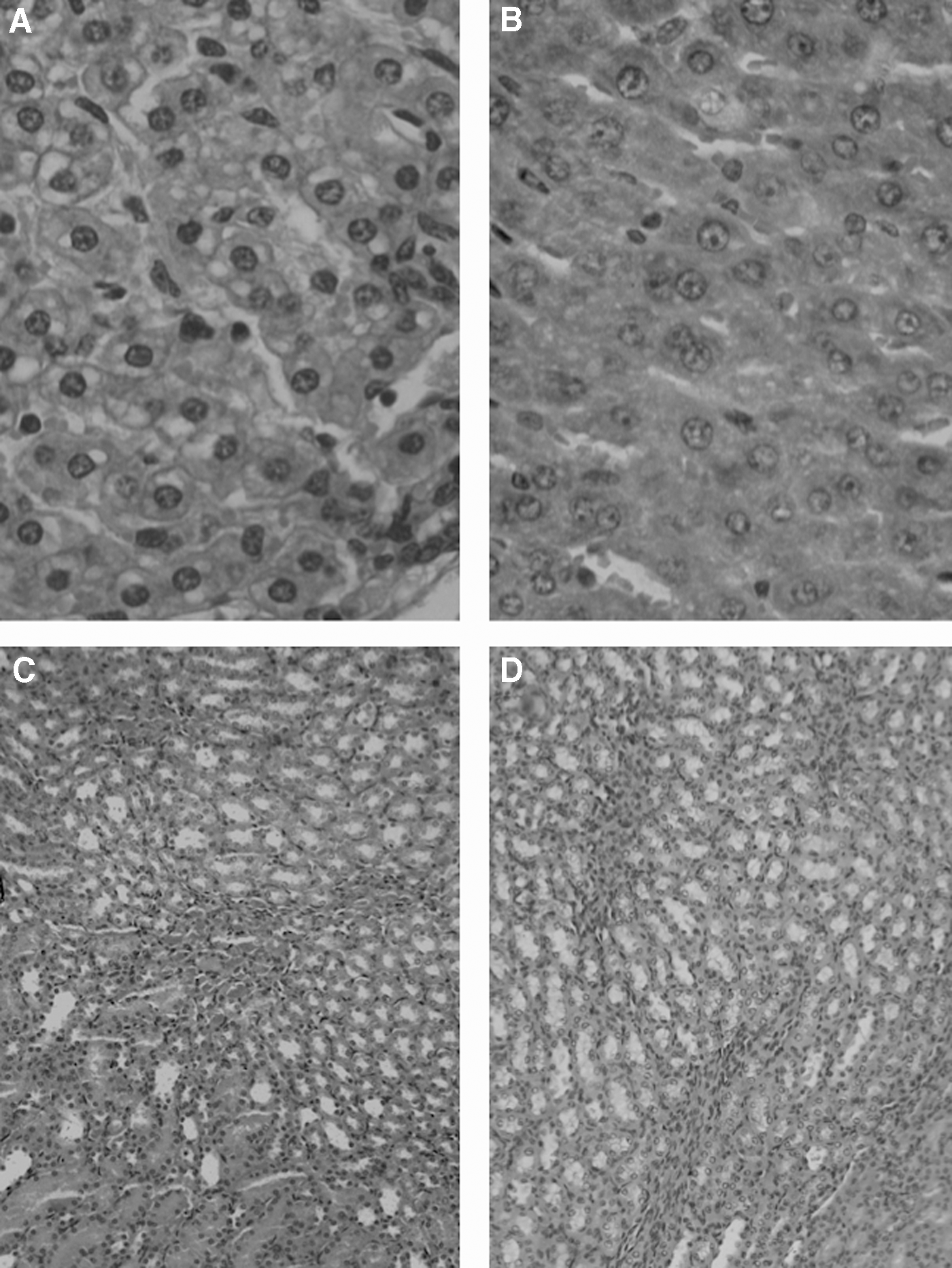
At the sub-chronic trial, none of the animals from all groups exhibited any signs of poisoning. The ALT activity and creatinine levels in the serum were significantly decreased in rats that were administered 1.0 g/kg of C. ambrosioides leaves for 15 days. The treatment with C. ambrosioides leaves did not cause any significant changes in total protein, AST, urea, glucose, triglycerides, and cholesterol values (Table 2). Necroscopic examinations showed no gross lesions in any animal. Histopathological analyses revealed mild cytoplasmic vacuolation of hepatocytes (Fig. 1A), mild hepatic congestion and moderate congestion in the medullar region of the kidneys (Fig. 1C) of rats treated with 1.0 g/kg of C. ambrosioides leaves for 15 days. Mild congestion in the medullar region of the kidneys was observed in rats that were administered the 0.3 g/kg dose.
Statistically significant as compared with control (P<.05).
Discussion
C. ambrosioides oil has been reported to be toxic because it is an irritant to the mucous membranes of the gastrointestinal tract and it promotes lesions in the kidneys and liver. Several human fatalities have been attributed to the use of high doses of C. ambrosioides oil. 16,20,28 –30 Carvacrol, caryophyllene oxide, and ascaridole, which are the major compounds of this plant, have been shown to inhibit the mitochondrial electron transport chain. Carvacrol and caryophyllene oxide have been reported to affect mitochondrial electron transport by directly inhibiting the electron-transferring complex I, whereas the effects of ascaridole have been shown to depend strongly on the availability of redox-active Fe2+. 36
The red blood cell lysis assay used in the present study is based on the fact that the short-term exposure of erythrocytes to cytotoxic agents results in hemoglobin release, which is measured as the endpoint of the assay. 35,37 In the present study, C. ambrosioides did not promote hemolysis in horse erythrocytes. These data suggest that this plant does not promote membrane disruption but are insufficient to conclude that it does not exhibit any cytotoxic effects.
It has been suggested that the use of C. ambrosioides infusions in traditional medicine, especially as vermifuge, is safer than the use of the essential oil. 34 Ascaridole has been shown to relax rat gastrointestinal tissue contracted by carbachol in vitro, but C. ambrosioides infusion at nematocidal concentrations was reported to have no effect at these contractions. 34 In our study, both the acute and chronic administration of an aqueous extract of C. ambrosioides leaves resulted in mild toxic effects in the liver and kidneys, which were associated with changes in serum biochemistry and histological abnormalities. These observed effects are far less toxic than those that have been reported with use of the essential oil. 30,38 Similarly, the administration of a hydroalcoholic extract from C. ambrosioides leaves to mice for 15 days led to reductions in the blood levels of albumin, VLDL cholesterol, and triglycerides, 39 effects that might result from disturbances in hepatocyte function. In our study, the observed lowered serum ALT activities in rats treated with 1.0 g/kg of C. ambrosioides leaves for 15 days might be attributed to an initial liver damage, that was histologically observed as cytoplasmic vacuolation of hepatocytes and mild hepatic congestion. In fact, previous studies showed reduced serum ALT activity associated to subchronic exposure to hepatotoxins. 40,41 In the same experimental group, the observed congestion in the medullar region of the kidneys might be produced by renal vasoconstriction, which could predispose to renal failure. 42,43 Increased cell numbers in the lymph node and bone marrow and reductions in the number of peritoneal cells were also reported in response to treatment with this hydroalcoholic extract. 39
It is possible that compounds found in C. ambrosioides interact with DNA. In vitro studies with human lymphocytes have shown that C. ambrosioides extracts increase the frequency of chromosomal aberrations and reduce the mitotic index. 31 Furthermore, the administration of this oil to the Egyptian toad, B. regularis, induced hepatocellular carcinomas after 3 months of treatment. 32 Thus, the potential oncogenic effects of C. ambrosioides should be evaluated in future studies.
Conclusions
The results of the present study indicate that aqueous solutions of C. ambrosioides leaves produce only slight hepatotoxic and nephrotoxic effects in rats. These low levels of toxicity may not be significant in healthy individuals, but they may exacerbate pre-existing hepatic and renal disturbances.
Footnotes
Author Disclosure Statement
No competing financial interests exist.