




Abstract
Berry fruits are a rich source of polyphenols, especially anthocyanins: well-known potent anti-oxidant phytochemicals. The purpose of this study was to evaluate beneficial effects of long-term consumption of polyphenol-rich organic chokeberry juice on different markers of antioxidant/pro-oxidant status in healthy female volunteers. Twenty-nine women, aged 25–49, were included in the study. Serological markers of oxidative stress and antioxidant defence, blood pressure, routine biochemical, and anthropometric parameters were analyzed at baseline and after twelve weeks of regular chokeberry juice consumption. Significant decrease in thiobarbituric acid-reactive substances level (TBARS; P<.001) and pro-oxidant-antioxidant balance (PAB; P<.05), as well as increase in paroxonase-1 activity toward diazoxon (P<.01) were found. Total oxidative status and sulphydryl groups levels were not significantly influenced by the intervention. Anthropometric, biochemical parameters, and blood pressure values were within the referent values for all subjects and were not influenced by the chokeberry juice consumption. However, we found positive correlation between age, body mass index, waist circumference, body fat percent, blood pressure, and analyzed marker of lipid peroxidation, which was influenced by the consumption. In conclusion, the fine modulation of several antioxidant/pro-oxidant status biomarkers observed in healthy subjects indicates putative prophylactic effects of polyphenol-rich chokeberry juice and supports its importance as part of an optimal diet.
Introduction
O
Traditional diet-related risk factors (e.g., obesity, dislipidemia, hyperglycemia, and hypertension) are often accompanied with the disturbed antioxidant/pro-oxidant status, contributing to the pathogenesis of chronic diseases. 1 The correlation between certain biochemical and anthropometric parameters, defined as risk factors, and oxidative stress markers has also been shown in healthy young subjects and is found to be gender-specific. 2,3
The putative role in the prevention of chronic diseases and improving overall health has directed attention to antioxidants and their use as dietary supplements. Polyphenols are one of the major contributors to antioxidant capacity of plant food. They act directly on reactive oxygen species by accepting electrons and forming relatively stable phenoxyl radicals, but they also show “indirect” effects mainly through the regulation of antioxidant enzymes status. 1 The mechanisms of beneficial effects on endogenous defense systems involves modulation of cell signalling pathways and gene expression. 4 Beside this, polyphenols could prevent oxidation of lipids in food before its consumption, which could decrease the amount of pro-oxidant intake. 5
It has been reported that chokeberry (Aronia melanocarpa L.) is one of the richest sources of dietary phenols, mainly proanthocyanins and anthocyanins present as mixture of different cyanidin glycosides. 6 According to the Phenol-Explorer database, the amount of proanthocyanidins and anthocyanins in chokeberry is 5000–10,000 mg/kg fresh weight. 7
The interest for chokeberry products and bioactives has recently increased mainly because of its health-promoting effects, especially in protecting from heart disease, maintaining a healthy urinary tract, fighting against bacteria and viruses, and strengthening memory. 6 In vitro studies revealed antioxidative potential of chokeberry extract in homocysteine-rich plasma based on total antioxidative capacity (TAC) level, and the reduction of superoxide radicals in platelets of healthy volunteers and breast cancer patients. 8,9 However, there are limited data on the effects of long-term consumption of chokeberry products on oxidative stress status in vivo. Stimulation of superoxide dismutase, catalase, and glutathione peroxidase activity of erythrocytes has been shown after the supplementation with chokeberry extract. 10
Oxidative stress, defined as imbalance between promoters and inhibitors of oxidation, is very complex and involves numerous biomolecules that can be assessed by various indices and methods. 11
Taking into account all these facts, the aim of our study was to investigate the effects of a 12-week consumption of polyphenol-rich organic chokeberry juice on antioxidant/pro-oxidant status in healthy female volunteers.
Materials and Methods
Subjects and study design
Twenty-nine female volunteers, aged 25–49 years, were recruited for the study. All subjects were apparently healthy and without any medication or supplementation of dietary antioxidants. The study was undertaken according to the Helsinki Declaration and approved by the Ethical Committee of Faculty of Pharmacy, University of Belgrade. All subjects gave written consent prior to the enrollment. They were instructed to consume 100 ml of polyphenol-rich organic chokeberry juice per day for twelve weeks. During this period, volunteers did not change their individual dietary habits and preferences according to the Food Frequency Questionnaire. Routine biochemical and anthropometric parameters, parameters of antioxidant/pro-oxidant status were determined at baseline and after twelve weeks of intervention.
Polyphenol-rich organic chokeberry juice
Polyphenol-rich organic chokeberry (Aronia melanocarpa) juice used in this study was donated from Conimex trade d.o.o., Belgrade, Serbia. Total phenolics and total anthocyanin content, determined according to the previously published method, 12 were 386 mg GAE/100 g of juice and 25 mg/100 g of juice, respectively.
Sample collection and analysis
Venous blood was collected between 8 and 10
Markers of antioxidant/pro-oxidant status
The following parameters of oxidative stress and antioxidant defence were measured: thiobarbituric acid-reactive substances (TBARS), total antioxidative capacity (TAC), total oxidative status (TOS), sulphydryl groups (-SH), paroxonase-1 activity (PON1), and pro-oxidant-antioxidant balance (PAB).
TBARS were measured using assay previously described by Girotti et al. 13 TAC was determined by automated method developed by Erel using an ILab 300 plus autoanalyser. 14 The results were expressed as Trolox equivalents, used as a standard. Serum TOS was measured according to Erel method. 15 The results were expressed as H2O2 equivalent which was used as a standard. The concentration of sulphydryl groups was determined using 5,5′-dithiobis(2-nitrobenzoicacid) assay described by Ellman, 16 based on quantification of highly-colored reaction product at 412 nm. PAB was determined using modified Alamdari method on Elisa reader. 17 The values were expressed in arbitrary units, as percentage of hydrogen peroxide in the standard solution. PON1 status was assessed by a two-substrate kinetic method according to Richter and Furlong. 18 PON1 activity toward paraoxon (POase) was determined using ILab 300+, while PON1 activity toward diazoxon (DZOase) was measured spectrophotometrically using a continuous spectrophotometer.
Statistical analysis
Data were tested for normality by performing the Kolmogorov-Smirnov test. Paired Student's t-test was used for comparisons and Spearman correlation coefficients were calculated for TBARS. Distribution for TOS values was skewed and logarithmic transformation of the values was performed before the comparison was made. Nonparametric Wilcoxon two related samples test was used for evaluation of POase activity due to the absence of normal distribution. Data are shown as mean values±standard deviation (SD), except for TOS and POase, which are shown in terms of geometric mean and median, respectively. Analyses were performed using the SPSS software (ver. 15.0; Chicago, IL) and P values<.05 were deemed to indicate statistical significance.
Results
Characteristics of the subjects
General characteristics of the study group at baseline and after twelve weeks are presented in Table 1. We included 29 women aged 25–49 years with average height of 168.7±6.2 cm and weight of 65.1±11.5 kg.
All values are presented as mean±SD.
BMI, body mass index; SBP, systolic blood pressure; DBP, diastolic blood pressure.
Effects on markers of antioxidant/pro-oxidant status
Effects of polyphenol-rich chokeberry juice on measured parameters are presented in Table 2. Chokeberry juice consumption significantly reduced levels of TBARS (P<.001). Similar findings were observed for pro-oxidant-antioxidant balance (PAB) in which the difference between two points of the study was statistically significant (P<.05). Decrease of TOS was noticed, although not statistically relevant. TAC was decreased significantly after 12 weeks of consumption (P<.05). On the other hand, there was no significant difference in the thiol groups level. DZOase activity showed statistically important increase after the supplementation (P<.01), while the POase activity was not significantly changed.
Values are presented as mean±SD, #median and 95% confidence interval, or ##geometric mean and 95% confidence interval derived from log-normal values.
TBARS, thiobarbituric acid reactive substances; PAB, pro-oxidant-antioxidant balance; TOS, total oxidative status; TAC, total antioxidative capacity; SH-groups, sulphydryl groups; POase, paraoxonase activity toward paraoxon; DZOase, paraoxonase activity toward diazoxon.
Effects on biochemical parameters
No statistically significant change in biochemical parameters was found (Table 3). However, all values remained in reference intervals, as they were at the beginning of the study. We observed increase in uric acid value, although this difference wasn't statistically relevant (P=.08).
All values are presented as mean±SD.
LDL, low-density lipoprotein; HDL, high-density lipoprotein; ALT, alanine aminotransferase; AST, aspartate aminotransferase.
Positive correlations between TBARS level and some anthropometric parameters are shown in Figure 1.
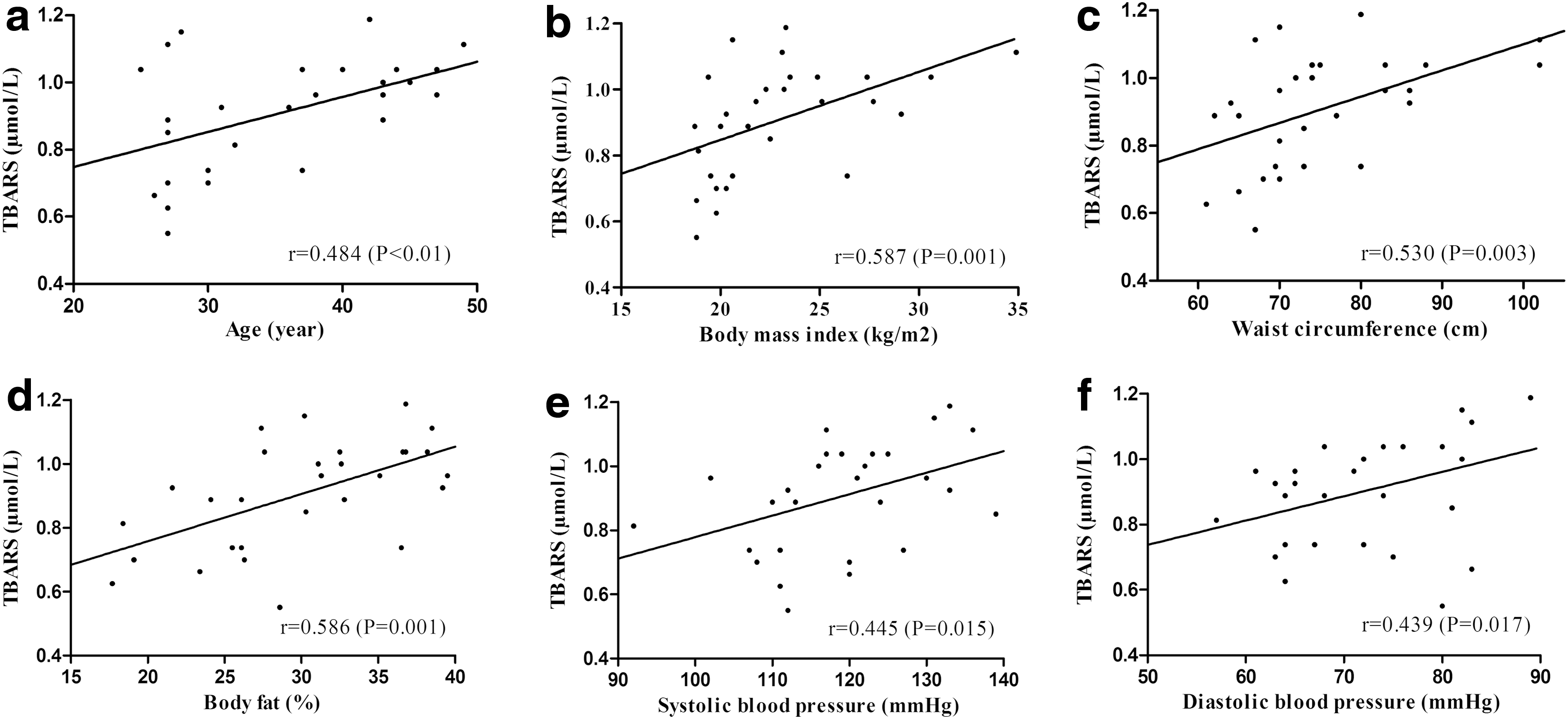
Thiobarbituric acid reactive substances (TBARS) correlation with anthropometric parameters and blood pressure.
Discussion
As a result of our study, statistically important decreases in TBARS, TOS, and PAB levels, as well as increase in DZOase activity and value of TAC, were shown.
Positive effects of chokeberry products on oxidative status in humans reported previously were mainly based on the reduction of TBARS level, as indicators of lipid peroxidation. Broncel et al. 10 showed significant decrease in TBARS production after an 8-week dietary intervention with chokeberry extract in a group of people with metabolic syndrome. The decreased level of TBARS was also shown in a study with rowers consuming chokeberry juice, before and after performing rowing ergometer test. 19 Our results were in accordance with these findings as we observed significant reduction of the TBARS level after 12 weeks of polyphenol-rich chokeberry juice supplementation, comparing to the baseline (P<.001). It has been reported that lipid peroxidation, evaluated as TBARS, is increased in many states related to enhanced risk for cardiovascular disease (CVD), such as chronic kidney disease, diabetes mellitus, and metabolic syndrome. 20 –22 We also found positive correlations between TBARS and age, body mass index (BMI), waist circumference, body fat, and blood pressure. Consequently, although apparently healthy, subjects with higher levels of these parameters are more likely to develop CVD.
According to authors' knowledge, there are no published data revealing the effect of dietary intervention with chokeberry or other berries on PAB. However, this parameter was included in the study as it enables estimation of both pro-oxidant burden and antioxidant capacity in one rapid, cost-effective, and simple assay. PAB decreased significantly in our study group after twelve weeks of intervention (P<.05).
Concentrations of different oxidant species in serum or plasma, produced endogenously or taken from the outer environment, could be measured in laboratories separately or as TOS due to additive nature of oxidant effects of different molecules. 15 Although we reported no significant change regarding this parameter, the value was lower at the end comparing to baseline.
TAC is an element of non-enzymatic part of the system protecting the body against ROS. 23 Malinowska et al. showed increase in TAC after in vitro treatment of plasma with chokeberry extract. 8 However, there are no published data showing effect of chokeberry on TAC in a human intervention study. Six-week long consumption of black currant extract induced at resting phase in rowers showed no statistically significant change in TAC compared to the control group. 24 We could only speculate reasons for decreased level of TAC in our study. Hypothetically, anthocyanins might exhibit a mild pro-oxidant activity in the environment of low concentration of reactive oxygen species, as suggested previously. 25
Total -SH groups contribute with 50% to the measured total antioxidant capacity in healthy subjects. 14 Although polyphenol-rich beverages posses great potential for increasing SH groups, 26 our study did not show any change in total -SH content of serum. Still, this is in accordance with the results of a recent study showing that neither one- nor two-month-long supplementation with chokeberry extract had statistically significant influence on thiol groups' levels in erythrocyte membranes. 27 In a recent in vitro study, chokeberry extract was also found to be ineffective in modulation of thiol levels in plasma obtained from healthy subjects. 28
Human paraoxonase (PON1) is polymorphic, high-density lipoprotein (HDL) associated esterase. 29 It has ability to protect against atherosclerosis by hydrolyzing specific derivatives of oxidized cholesterol and/or phospholipids in atherosclerotic lesions. 30 In our study, PON1 activity toward diazoxon showed statistically significant increase (P<.01), while the value of the activity toward paraoxon was not significantly changed. An increase in PON1 activity was reported for black currant, containing bioactives similar to chokeberry. 26 A similar increase in PON1 was found in patients with carotid artery stenosis after consumption of polyphenol-rich pomegranate juice, although in much longer dietary intervention. 31
Polyphenols are the most abundant dietary antioxidants 1 and they exert numerous beneficial effects on human health. 32 At the same time, their main characteristic is extensive metabolism and low bioavailability, which compromises the conclusions about direct effect of polyphenols on relevant targets. 33 Anthocyanins have the lowest bioavailability among polyphenols and it is suggested that their beneficial effects are mediated by their human metabolites, mainly phenolic acids. 34 However, data on precise mechanisms of anthocyanins' impact on different components of antioxidant defense are still lacking.
Some studies showed beneficial effect of Aronia melanocarpa on serum total cholesterol, LDL cholesterol, and triglyceridies. 10,27,35 Contrary to the reported studies involving subjects with mild hypercholesterolemia or metabolic syndrome, participants involved in our study were apparently healthy. The values of biochemical parameters, recognized as traditional risk factors for CVD, were in reference intervals at the beginning as well as at the end of the study. We considered noteworthy the increase in the level of uric acid, although it was not statistically significant (P=.08). Uric acid has been mentioned as an important plasma antioxidant in in vivo studies and one of the major contributors to the total antioxidant response. 36 Erel estimated that uric acid makes about 4% of TAC, and it is right behind total –SH groups and vitamin C. 37
Different pathologies may be associated with different types of oxidative stress, characterised by the prevalence of specific indices over others, and need to be evaluated by the use of different methods. Only under severe pathological conditions are all the indices of oxidative stress elevated with marked correlation with each other. 38 Although, greater efficiency of dietary antioxidants should be expected on those having some risk factors or some prevalent disease, their long-term consumption might also show beneficial effects on some stress-related biomarkers in healthy subjects. 39 In consistence with this, even in healthy subjects, we observed decrease in markers of oxidative damage (TBARS, TOS), improvement in pro-oxidant-antioxidant balance, as well as increase in DZOase activity. The effect on lipid peroxidation is of special importance, as the related biomarkers are the most common group of indices used to assess both the stress-related conditions and efficacy of antioxidants. 38 Furthermore, in the group of healthy subjects we found that lipid peroxidation products showed positive correlation with traditional CVD risk factor-related parameters.
In conclusion, obtained results indicate putative prophylactic effects of polyphenol-rich chokeberry juice mediated by the fine modulation of several antioxidant/pro-oxidant status biomarkers, and rationalize its use as an important part of optimal diet.
Footnotes
Acknowledgments
We appreciate financial support from the Ministry of Education and Science of Serbia, project number 46013. The authors are also grateful to Conimex trade d.o.o., Belgrade, Serbia.
Author Disclosure Statement
The authors declare that they do not have any actual or potential financial interests or any conflicts of interest in the findings from this manuscript.