




Abstract
Native plants are exceedingly valuable because they are sources of natural products with applications for the treatment of various diseases. Berrycactus fruit (Myrtillocactus geometrizans) has been consumed in Mexico since ancient times due to its sweetness. The hypoglycemic and antioxidant effects of this fruit were evaluated in streptozotocin-induced diabetic rats by replacing the drinking water with berrycactus juice (2 or 4 g/kg). After 4 weeks of treatment, the diabetic animals showed an improvement in their conditions, as reflected by diminished circulating glucose levels (up to 50%), diminished triglycerides (up to 67%), and diminished total cholesterol (up to 35%) compared with diabetic nontreated controls, and these effects were dose dependent. The dose of 4 g/kg produced the best results. The administration of the juice improved renal function and helped to restore normal levels of glutathione and glutathione S-transferase in the kidney. The expressions of two transcription factors that are relevant to normal functioning of the kidney changed due to the administration of the juice; compared to the diabetic nontreated controls, the level of nuclear factor kappa of B-cells diminished, and the total level of peroxisome proliferator-activated receptor gamma increased. The results of this study highlight the importance of the compounds that are present in berrycactus fruit as adjuvants in the treatment of diabetes and its renal complications.
Introduction
D
Mexico has many plants with great nutritional, functional, and economic potentials, but these fruits have been poorly explored. For example, the genus Myrtillocactus is a member of the Cactaceae family and comprised of four species. Its edible fruit is known as berrycactus and locally known as garambullo. The fruit is purplish or bluish in color, up to 2 cm long, and has very small seeds (up to 1 mm) that are similar to kiwi seeds. 5
Berrycactus fruit contains water-soluble pigments, such as betalains, that are not toxic at high doses. 6 Betalains from red-purple pitahaya (Hyloceresus sp) and prickly pear (Opuntia ficus indica) have high antioxidant capacities 7 or prevent oxidative modifications of low-density lipoprotein cholesterol (LDL), 8 whereas other betalains confer hepatocyte protection against carbon tetrachloride. 9 Additionally, Cactaceae fruits are rich in fiber from pectin and related compounds that are associated with the control of plasma glucose in diabetic individuals, 10,11 and their pulp decreases oxidative damage to lipids and increases the concentration of reduced GSH in red blood cells in healthy humans. 12 Due to its contents of betalain and other phenolic compounds, we evaluated the antidiabetic effects of berrycactus juice, and its effect on serum lipid profiles, antioxidant enzyme levels, and renal damage protection in rats with experimentally induced diabetes.
Materials and Methods
Plant material
Berrycactus (Myrtillocactus geometrizans) fruit was harvested in July of 2009 in the town of El Marquez, Querétaro (Mexico), freeze-dried, and stored at −15°C until analysis.
Juice preparation
The juice was extracted by grinding and chopping 10 g of fruit that had previously been defrosted with 100 mL of water (10% w/w). The mixture was centrifuged at 5000 g for 15 min, and the supernatant was recovered for further analysis. The juice was prepared every 2 days.
Animals and the protocol
Male Wistar rats (250–300 g; Rismart Laboratories, Mexico city, Mexico) were appropriately housed at a controlled standard temperature (20–25°C) on a 12-h light/12-h dark cycle. We followed the guidelines for the use of experimental animals of the National Research Council, and the protocol of this study was approved by the Bioethics Committee of the University of Querétaro.
Animals were fed ad libitum with Zeigler rat chow and water for 1 week and then diabetes was induced with a single intraperitoneal injection of streptozotocin (45 mg/kg body weight in 0.01 M sodium citrate buffer, pH 4.5). Five days later, blood glucose was measured under fasting conditions at the tail vein with a reflective glucometer (Glucose Accutrend; Roche, Mannheim, Germany). Group 1 was composed of healthy animals (n=7) that received water ad libitum. The diabetic animals were randomly divided into four groups (seven animals per group) as follows: group 2 received water ad libitum, group 3 received the berrycactus juice at 2 g fruit/kg of body weight per day, group 4 received the berrycactus juice (4 g), and group 5 was treated with rosiglitazone (thiazolidinedione, TZD) (1 mg/kg, Avandia; GlaxoSmithKline, Research Triangle Park, NC, USA). After 4 weeks, urine was collected for 12 h using individual metabolic cages. The next day, the animals were anesthetized, and blood samples were taken by cardiac puncture. The plasma was separated by centrifugation and stored at −80°C until analysis. The kidneys were immediately removed, thoroughly washed with ice-cold phosphate-buffered saline, frozen in liquid nitrogen, and stored at −80°C for further analysis.
Lipid profiles and renal function parameters
Total cholesterol (TC), LDL, high-density lipoprotein cholesterol (HDL), and triglycerides (TG) were determined from the serum samples under fasting conditions using commercial diagnostic strip kits (Randox Laboratories Ltd., Crumlin, United Kingdom). Urinary protein was measured using Multistix 10 SG reagent strips (Siemens, Erlangen, Germany), and microalbumin was measured using CLINITEK microalbumin reagent strips (Siemens). Sodium and potassium were quantified using a Perkin-Elmer Atomic Absorption Spectrometer (AA Analyst 100) at wavelengths of 589 nm for Na and 766 nm for K.
GST activity and reduced GSH content
Kidney tissues were homogenized in sucrose buffer (pH 7.0), centrifuged sequentially at 10,000 g for 20 min and at 105,000 g for 60 min at 4°C to obtain the cytosolic fractions. Total GST activity was measured in the cytosolic fractions in the presence of 0.1% (w/w) bovine serum albumin (BSA) using 1-chloro-2, 4-dinitrobenzene (CDNB) as a substrate 13 and is expressed as nM of CDNB–GSH conjugate per min per mg protein. GSH was determined using Ellman's method 14 and is expressed relative to the protein content as μM GSH per mg protein. The protein concentration was measured with a modified Bradford assay (Bio-Rad, Hercules, CA, USA) using BSA as the standard.
Preparation of protein extracts and western blot analysis
The kidney tissue was suspended and homogenized in a buffer containing 50 mM HEPES pH 7.5, 1% NP-40, 1 mM MgCl2, 1 mM CaCl, and 150 mM NaCl, and supplemented with protease inhibitors. After 30 min in ice, the homogenate was centrifuged at 10,000 g for 20 min at 4°C, and the supernatant was stored at −70°C until analysis.
Western blots were performed using 60 μg total protein mixed with sodium dodecyl sulfate (SDS) sample buffer. After boiling, the samples were electrophoresed on 10% SDS-polyacrylamide gels and transferred to polyvinylidene fluoride membranes (Transblot; Bio-Rad) in Tris-glycine buffer. The membranes were processed at room temperature and shaken as follows: (1) blocked for 1 h in TBS; (2) incubated for 3 h with the specific primary antibody (anti-nuclear factor kappa of B-cells (NFκB) (1:1000), anti-peroxisome proliferator-activated receptor gamma (PPARγ) (1:1000), or anti-β-actin (1:1000)); (3) washed five times for 5 min each with TBS-T buffer; (4) incubated with horseradish peroxidase-labeled secondary antibody (1:2000) for 45 min; (5) washed six times for 5 min each; (6) and detected using a chemiluminescence kit and autoradiography film. The signal was quantified by densitometry (Kodak ID Image Analysis), and β-actin was used as an internal control.
Statistical analyses
The data are represented as the mean values±the standard errors. The statistical significances of the differences (P<.05) of the mean values between the treatment groups were analyzed with Dunnett's tests and one-way analyses of variance using the JMP 5.0.1 statistical software.
Results and Discussion
Antidiabetic effect of berrycactus juice
Similar to other wild fruits, berrycactus fruit contains phenolic compounds that support the management of diabetes and its complications. The concentration of total phenols in berrycactus juice has been reported to be 142 mg of gallic acid equivalents/100 g, and phenolic compounds, such as caffeic acid, gallic acid, and vanillin, have been identified in fresh fruit. 5 The antioxidant compound content of berrycactus juice suggests that it may have a beneficial effect in the treatment of diabetes.
During the experimental period, the nondiabetic control rats gained an average of 85 g of body weight and exhibited normal growth (data not shown). The diabetic rats lost weight over the experimental period; they lost ∼30% of their average weight of 300 g at the beginning of the induction and weighed an average of 200 g at the end of the experiment (data not shown). The administration of berrycactus juice did not ameliorate the weight loss, but a slight trend toward an increase in weight (up to 27%) was observed in the treated groups compared with the diabetic control group (data not shown).
One week after the induction of diabetes, the levels of circulating glucose increased to 300 mg/dL (Fig. 1) and continued to increase in the subsequent 4 weeks, after which the levels in the diabetic nontreated animals reached nearly double their initial value (550 mg/dL). The inclusion of berrycactus juice in the diets of the diabetic animals diminished the levels of circulating glucose in a dose-dependent manner (Fig. 1). The reductions were 30% for the animals that were treated with the dose of 2 g/kg and nearly 50% for those treated with 4 g/kg. The 2-g/kg dose of fresh fruit corresponded to approximately one cup of juice for an adult weighing 70 kg. We included a diabetic group that was treated with TZD (rosiglitazone), which is widely used in the management of diabetes, and this group exhibited a decrease of ∼30% (Fig. 1). Via the inhibition of the activities of intestinal disaccharides, soluble fiber is one of the compounds that may explain the hypoglycemic effect of berrycactus juice. Soluble fiber prevents the elevation of blood glucose after oral sucrose ingestion and enhances peripheral insulin action. 11 The hypoglycemic effect may also be attributable to the betalain and phenolic contents of the juice. A variety of phenolic compounds have been shown to inhibit α-glucosidase and α-amylase activities in vitro and to inhibit the absorption of glucose from the intestine. 15 Additionally, other mechanisms related to the regulation of carbohydrate and lipid metabolism in the liver and adipose tissue 16 –18 or to the regulation of other pathways have been reported for these compounds. 19 –21

Circulating glucose concentrations at weeks 1 and 5 quantified from the sera obtained from control and streptozotocin (STZ)-induced diabetic rats that received water (diabetic), berrycactus juice (2 or 4 g/kg), or thiazolidinedione (TZD) for 5 weeks. The values are presented as the means±the standard errors (SEs) for seven animals per treatment. *Indicates a significant difference compared to the diabetic control group (which received water) (P<.05).
The diabetic animals exhibited increased levels of TG (62%) and TC (29%) compared to the nondiabetic controls (Table 1). Increases in LDL values are thought to increase the risk for cardiovascular diseases, whereas increases in HDL moiety levels confer cardioprotection. The diabetic nontreated animals exhibited slight increases in their LDL values, while their HDL concentrations were similar to those of the healthy group (Table 1). The diabetic groups that received berrycactus juice exhibited triglyceride levels that were similar to those of the healthy group, and represented reductions of 46% and 33% for the doses of 2 and 4 g/kg, respectively, compared to the nontreated diabetic group. A minor effect TC-lowering effect of the juice was observed and was reflected in changes in LDL and HDL levels (Table 1). The TZD-treated group exhibited an improvement in serum lipid profiles and had TG and LDL values that were lower than those of the healthy group (Table 1). In nondiabetic volunteers with hyperlipidemia, prickly pear pectin has been shown to produce decreases in blood glucose and TC and LDL levels while the HDL concentrations remain unchanged. 22 Berrycactus contains ∼2.2% fiber; therefore, its hypocholesterolemic effect may also be partly attributable to similar mechanisms. Furthermore, patients with hypercholesterolemia who are treated with 250 g broiled edible prickly pear pulp daily exhibit reduction in TC and LDL. 23
The values are presented as the means±the SEs for seven animals per treatment.
Indicates a significant difference compared to the diabetic control group (which received water) (P<.05).
SEs, standard errors; TZD, thiazolidinedione.
Evaluation of the effects of berrycactus juice on renal damage in diabetic animals
In Mexico, diabetic nephropathy is one of the leading causes of disability and mortality. During the development of the disease, gradual damage to the kidneys occurs, and they become less efficient in correct filtration. Kidney damage can be estimated by measuring the presence of protein in the urine (proteinuria), and these measurements are reported as microalbumin or total protein. The diabetic animals exhibited increases microalbumin and total protein that were 4- and 1.2-fold the levels of the healthy controls, respectively (Table 2). An increase in the excretion of sodium ions (2.4 times) and a decrease in potassium ions (0.8 times) were also detected (Table 2). Under normal conditions, the amount of protein in the urine should be low, and the excretion of sodium should be lower than that of potassium (i.e., the ratio of Na+/K+ should be less than 1). The inclusion of berrycactus juice in the diet improved these parameters, and microalbumin values similar to those of the healthy group were detected. Regarding total protein, the values were lower, and we did not detect protein in the urine of the group of animals that were treated with the dose of 4 g/kg probably because the amount of protein was under our detection limit (Table 2). The excretions of sodium and potassium ions also improved but to different extents. The group that received the 2-g/kg dose exhibited a greater than 32% reduction in the excretion of sodium, but the excretion of potassium did not change. The animals that received the 4-g/kg dose did not improve in terms of the excretion of sodium but exhibited better secretion of potassium (Table 2). The Na+/K+ ratios were 1.62 in the diabetic nontreated animals and ∼1 in the berrycactus-treated groups. The TZD group exhibited improved renal function as assessed by the levels of excreted protein, sodium, and potassium (the Na+/K+ ratio was 0.61) in the urine (Table 2).
The values are presented as the means±the SEs for seven animals per treatment.
Indicates a significant difference compared to the diabetic control group (which received water) (P<.05).
ND, not detected.
High glucose levels alter the ox-redox states of cells, which is ultimately responsible for cell damage. 1 The cells recover to their basal state following ox-redox stress primarily via two systems: the enzyme GST, and the cofactor reduced GSH. The diabetic control group presented with lower values of both GST and GSH; the GST and the cytoplasmic levels of GSH were ∼10% and 30%, respectively, less than those of the nondiabetic controls (Table 3). The inclusion of berrycactus juice in the diet increased GSH levels to produce values that were similar to those of the healthy controls (Table 3). Therefore, this juice may reverse the effects of diabetes. TZD rescued GST levels but was unable to recover GSH levels (Table 3). The effects of berrycactus are important because GSH is the most powerful intracellular antioxidant; it acts as a direct scavenger of free radicals, and it is involved in the prevention of oxidation and the cross-linking of protein thiol groups. 12,24 The cactus pear has a high antioxidant capacity, and its effects have been attributed to its high contents of phenolic compounds, ascorbic acid, betalains, and flavonoids 8,25,26 ; these compounds that have also been identified in berrycactus fruit. 5
Redox states were measured via reduced GSH level and the activity of GST. The values are presented as the means±the SEs for seven animals per treatment.
Indicates a significant difference compared to the diabetic control group (which received water) (P<.05).
GSH, glutathione; GST, glutathione S-transferase.
Diabetes involves a low-chronic inflammatory stage that is responsible for causing damage to certain tissues and for the increase in oxidative stress. 27 An early indicator of diabetic damage is the proinflammatory cytokine tumor necrosis factor-α (TNF-α), which is an important regulator of various physiological states and regulates the expression of several transcription factors. 28 The diabetic group exhibited a three-fold increase in the circulating level of this cytokine compared with the healthy controls (Fig. 2). The consumption of berrycactus juice effectively lowered these values in a dose-dependent manner; the low dose produced a reduction of 50% compared to the diabetic control group, and the high dose resulted in values that were similar to those of the healthy control group. TZD treatment also resulted in a 50% decrease in TNF-α values (Fig. 2).
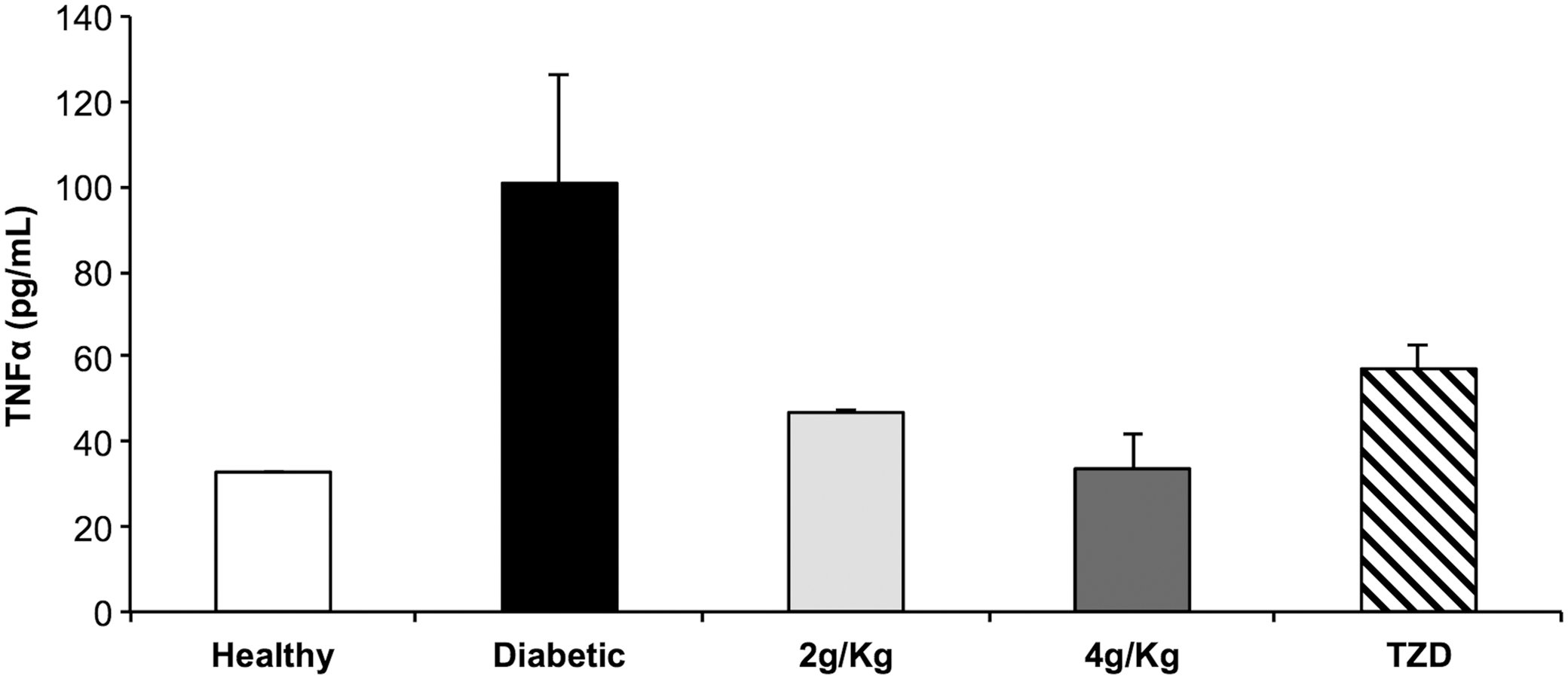
Circulating levels of tumor necrosis factor-α (TNF-α) quantified from the sera obtained from control and STZ-induced diabetic rats that received water (diabetic), berrycactus juice (2 or 4 g/kg), or TZD for 5 weeks. The values are presented as the means±the SEs for seven animals per treatment.
Due to their functions as regulators of cell metabolism and the damage that is induced by diabetes, two transcription factors were measured. The first was the NFκB. NFκB regulates the expression of different genes, and changes in the expression of NFκB lead to pathological states. 29 NFκB is present in the cytoplasm in an inactive form (bound to its inhibitor, IKβ) and in an active form inside the nuclei. Both forms were analyzed by western blot. In the healthy animals, the NFκB protein was primarily located in the cytoplasm; however, in the diabetic animals, greater amounts of the protein were found in the nuclei compared with the controls; this increase was ∼85% (Fig. 3). These nuclear proteins may have come from the cytoplasmic pool because a 34% decrease of this protein was observed in the cytoplasmic fraction of the diabetic animals. Treatment with berrycactus juice compensated for the change that was induced by the diabetes, and reductions in the amounts of active nuclear NFκB were observed for both juice concentrations; these reductions were 31% and 20% compared with the diabetic control group for the 2 and 4 g/kg concentrations, respectively. The treatment of the diabetic animals with TZD produced a 38% reduction in NFκB protein in the nuclear fraction (Fig. 3). Decreases in the amounts of NFκB in the nuclear fractions were always accompanied by proportional increases in the cytoplasmic fractions (Fig. 3).
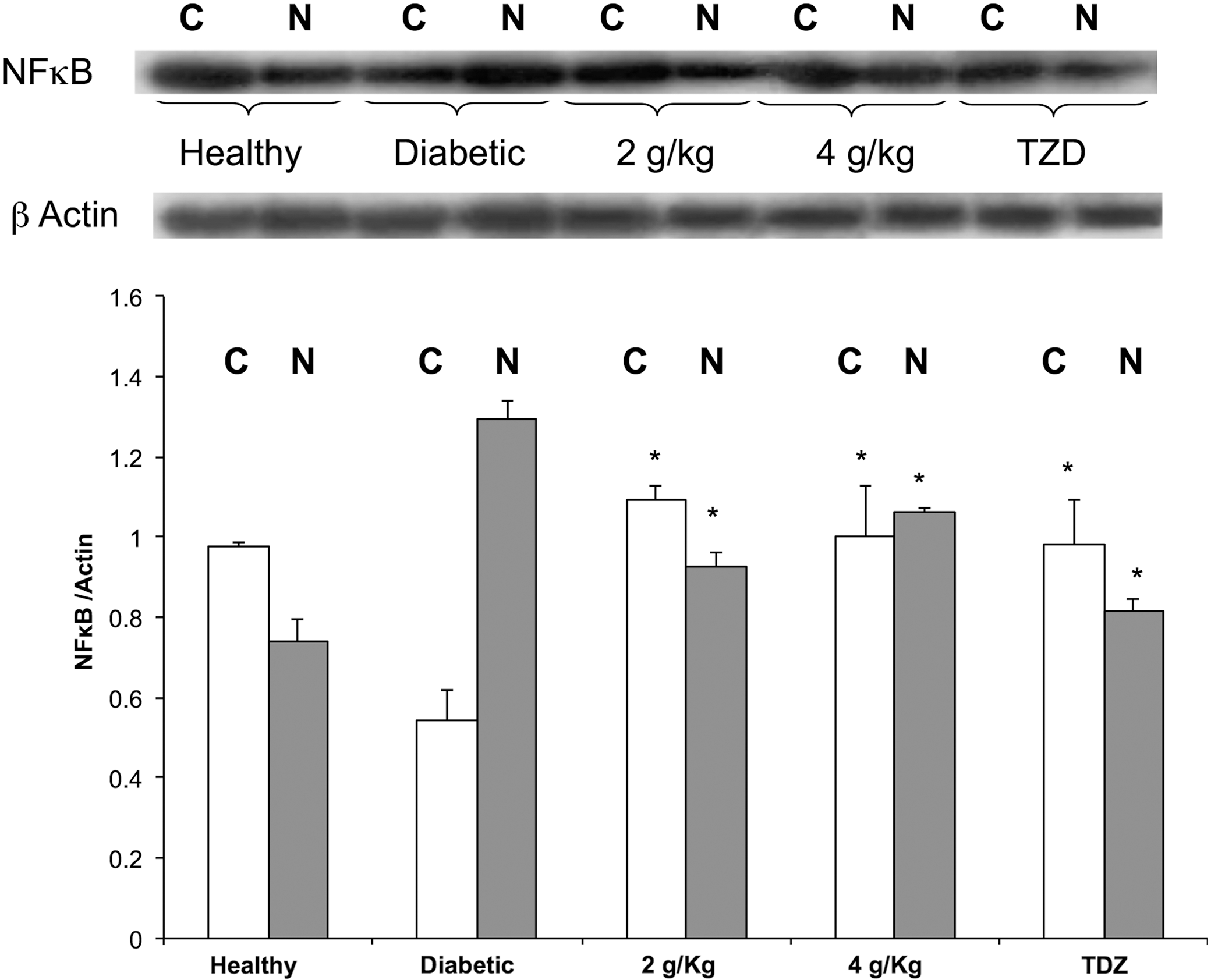
Nuclear factor kappa of the B-cells (NFκB) protein levels detected from the cytoplasmic (C) and nuclear (N) fractions of kidney cells from control (healthy) and STZ-induced diabetic rats that received water (diabetic), berrycactus juice (2 or 4 g/kg), or TZD for 5 weeks. The values are presented as the means±the SEs for seven animals per treatment. *Indicates a significant difference compared to the diabetic control group (which received water) (P<.05).
The transcription factor NFκB regulates different groups of genes, and most of these genes are related to the inflammatory response. 29 One of the main gene targets of NFκB is the gene that codes for the cytokine TNF-α. Dietary supplementation with berrycactus juice decreased the circulating levels of TNF-α (Fig. 2) and the transcription of TNF-α in kidney cells (data not shown). An interesting implication of these results is that the reductions in TNF-α levels may have been mediated by NFκB.
The other transcription factor that we analyzed was PPARγ. This family of nuclear receptor proteins regulates the expressions of genes that are involved in cellular differentiation, development, metabolism, and tumorigenesis. 30,31 These transcription factors are targets of the TZDs, which are compounds that improve insulin sensitivity. PPARγ has been implicated in the regulation of NFκB through the inhibition of the kinase IKβ. 32 PPARγ levels were reduced in the cell extracts from the diabetic animals; these levels were nearly 20% less than those of the nondiabetic group (Fig. 4). Dietary supplementation with 2 g/kg berrycactus juice prevented the damage caused by the diabetic condition, although the higher dose did not produce any change (Fig. 4). As expected, treatment of the diabetic animals with TZD improved transcription factor levels and resulted in levels that were greater than those of the nondiabetic group (Fig. 4). The increase in the transcription factor PPARγ in the treated animals may have been due to the phenolic content of the berrycactus juice. Previous studies have demonstrated the activating effects of phenols on PPARγ activity. 33

Peroxisome proliferator-activated receptor gamma type (PPARγ) protein levels detected from the kidney total protein extracts from the STZ-induced diabetic rats that received water (diabetic), berrycactus juice (2 or 4 g/kg), or TZD for 5 weeks. The values are presented as the means±the SEs for seven animals per treatment. *Indicates a significant difference compared to the diabetic control group (which received water) (P<.05).
Berrycactus is a rich source of phytochemicals, including phenolic compounds and betalains. These compounds may help to reduce glucose levels in diabetics and to reduce blood TC, LDL, and TG, which would have positive effects on the prevention of cardiovascular alterations. The increases in GSH levels and GST enzyme activities that were observed in the kidneys of the diabetic rats indicate that supplementation with berrycactus reduced oxidative damage. This effect on the redox state of the kidney was complemented by strong effects on important transcription factors that are necessary for the healthy kidney physiology. Therefore, the results of this study highlight the importance of the compound mixture that is present in berrycactus fruits as an adjuvant in the treatment of diabetes. The two concentrations we tested helped to improve hyperglycemia and other complications, but the best results were observed in the animals that were treated with the higher dose (4 g/kg).
Footnotes
Acknowledgments
We are grateful to the Sixth Framework Program of the Commission of the European Communities for its support of this research project (FP6-2003-INCO-DEV-2; Contract 015279).
Author Disclosure Statement
No competing financial interests exist for any of the authors.