




Abstract
We examined the antiobesity and antioxidant effects of supplementation with doenjang, a fermented soybean paste, in overweight Koreans with the PPAR-γ2 C1431T polymorphism. Sixty overweight subjects were randomly assigned to consume either 9.8 g/day of doenjang or placebo for 12 weeks. Before and after the intervention, anthropometric and metabolic parameters, along with abdominal fat distribution and PPAR-γ2 polymorphisms, were measured. Fifty-one subjects completed the study, doenjang (n=26) and placebo (n=25) groups. Relative frequencies of the PPAR-γ2 genotypes CC, TC, and TT were 70% (n=41), 25.9% (15), and 3.4% (2), whereas those of the PPAR-γ2 alleles C and T were 81.6% and 18.4%. Visceral fat area (VFA) was significantly decreased by doenjang supplementation in subjects with a mutant T allele of PPAR-γ2 compared to those with a C allele after adjusting for age, sex, and body mass index. Plasma free fatty acid, insulin, and homeostatic model assessment insulin resistance (HOMA-IR) levels were also significantly increased in the doenjang group. Doenjang pills significantly activated radical clearance capacity (ORAC and DNA tail length) in subjects with the C allele. The catalase (CAT) activity was increased twofold in the doenjang-treated group with the C allele, but this phenomenon was reversed in those with the T allele. Doenjang-treated subjects tended to have low dietary carbohydrate and sodium intakes compared with those given placebo. We found that doenjang supplementation decreased visceral fat accumulation and aging most effectively in subjects with PPAR-γ polymorphisms. This study suggests that doenjang has antiobesity and antioxidative effects in overweight individuals with mutant alleles of PPAR-γ2.
Introduction
O
Soybean, a species of legume native to East Asia, contains significant amounts of phytic acid, α-linolenic acid, isoflavone, daizein, polyphenols, and saponins, all of which have many biological functions, such as antioxidant, anticancer, immune strengthening, and antiobesity activity. 3,4 The U.S. Food and Drug Administration has approved a health claim stating that 25 g of soy protein per day protects against cardiovascular disease. 5 Park et al. reported that Koreans have consumed doenjang soup at least once a day for hundreds of years. 6 Soybean is popular for its functional ingredients and meat-like texture and flavor, despite a much lower energy density than meat. Traditional nonfermented food products made from soybean include soymilk, tofu, and yuba, whereas the common soy-based fermented foods include soy sauce, doenjang, tempeh, miso, and natto. Doenjang is a traditional Korean fermented soy bean paste similar to Japanese miso, which is fermented from meju using Bacillus and Aspergillus species of bacteria. 7,8 Fermentation of soybeans alters the profiles of isoflavonoids (genistein and daizein), small peptides (Glu-Tyr and Glu-Phe), and urea cycle intermediates (i.e., arginine as a NO precursor, citrulline, and ornithine). 9,10 Such alterations have important effects on the prevention of metabolic diseases, including obesity.
Although PPAR-γ is well known for its role in adipogenesis, it also plays a crucial role in maintaining normal physiology, including insulin sensitization. 11 Mutations in the PPAR-γ gene are associated with obesity and diabetes-related phenotypes. 12 The polymorphism C1431T, located in exon 6 of PPAR-γ, is associated with susceptibility to cardiovascular diseases, 13,14 leptin concentrations, 15 and body mass index (BMI). 16–17
PPAR-γ deficiency is associated with a greater risk of adipose tissue inflammation as well as increased susceptibility to diet-induced obesity. 18,19 Previous studies on isoflavones have shown their potential antiobesity effects, but the mechanisms related to PPAR-γ are thus far unclear. 20,21 A few studies have shown that doenjang cooked in any manner reduces body fat mass. However, a randomized clinical study using doenjang on subjects with C1431T polymorphism of the PPAR-γ2 gene has not yet been conducted.
The goal of this study was to investigate whether supplementation of fermented soybeans affects body fat distribution in overweight subjects based on the mechanisms of PPAR-γ in a 12-week randomized clinical trial (RCT).
Materials and Methods
Subjects and research design
The present 12-week, double-blind, placebo-controlled RCT followed the Korean FDA's General Clinical Practice Guidelines to evaluate the antiobesity and antioxidative effects of doenjang, a Korean traditional fermented soy paste. The Clinical Trial Center for Functional Food (CTCF2) at Chonbuk National University Hospital recruited 83 participants. Our inclusion criteria were as follows: adults older than 19 or younger than 65 years, body mass index (BMI) >23 kg/m2, and a waist/hip ratio (WHR) >0.90 for men and >0.85 for women. Exclusion criteria were the use of any type of medication, in particular, lipid-lowering and antidiabetic medications, the presence of familial cardiovascular-related diseases or gastrointestinal disorders, or the loss of >10% of their body weight within the last 3 months. After screening, 60 subjects (10 males and 50 females, 37.88±1.51 years, 69.69±1.23 kg) were randomly assigned to either a placebo (n=30) or doenjang group (n=30). Subjects assigned to the doenjang group took 9.8 g of freeze-dried doenjang supplement per day for 12 weeks, while subjects assigned to the placebo group took a placebo pill each day for 12 weeks. Subjects were asked to maintain their usual diet and level of physical activity and were prohibited from consuming functional foods or dietary supplements during the study. A physical and pathological questionnaire was administered and anthropometric measurements were made. In addition, all biochemical samples were collected in accordance with the Ethics Committees of the CTCF2. However, nine participants, four in the doenjang group and five in the placebo group, failed to complete the study. Seven participants were disqualified because of an inadequate intake of the prescribed supplements or not participating in other aspects of the study, while two participants voluntarily withdrew. Finally, 51 subjects (doenjang=26, placebo=25) completed the study after 12 weeks and statistical analysis was carried out for the final 51 subjects. This study was conducted according to the guidelines laid down in the Declaration of Helsinki, and all procedures involving human subjects were approved by the Chonbuk National University Ethical Board of Clinical Experiments. Informed and written consent was obtained from all subjects before starting the study.
Test and placebo food production
Doenjang (38.5–40 g; Soon-Chang, Korea) was freeze dried in 9.8 g/3 packs/day (Lymsil Medicine Co., Jeonju, Korea), which were consumed three separate times per day. Doenjang and placebo provided 63 and 61 kcal/day, respectively (Table 1). The actual nutrients per 100 kcal of doenjang were calculated based on the total recommended intake of about 2100–2600 kcal for adults. The doses were determined from previous animal studies using animal-to-human extrapolation and by using a dose equivalent to approximately three servings per day of doenjang soup, according to Korean FDA policy.
Doenjang was freeze dried in 9.8 g/3 packs/day, which were consumed three separate times per day. Doenjang and placebo provided 63 and 61 kcal/day, respectively.
Anthropometric measurements
The waist circumference (WC), blood pressure (BP), BMI, and WHR were measured and body fat distribution measured using Inbody 3.0 (Biospace Co., Ltd., Seoul, Korea) and computed tomography (CT). The visceral fat area (VFA) was quantified by measuring the intra-abdominal cavity at the internal aspect of the abdominal and oblique muscle walls surrounding the cavity and the posterior aspect of the vertebral body. The subcutaneous fat area (SFA) was calculated by subtracting the VFA from the total fat area.
Laboratory analysis
Blood was collected after overnight fasting. Whole blood samples were allocated, allowed to clot, and centrifuged at 1168 g for 15 min to obtain serum. Whole blood and serum were stored at −80°C for genetic and biochemical analysis. The following profiles were measured using a Hitachi-7600 analyzer (Hitachi Ltd., Tokyo, Japan): fasting blood sugar, total cholesterol (TC), triglycerides (TG), high-density lipoprotein cholesterol (HDL-C), low-density lipoprotein cholesterol (LDL-C), apoA-I, apo B-100, glucose, insulin, fructosamin, and hemoglobin A1C (HbA1C). Homeostatic model assessment–insulin resistance (HOMA-IR) was calculated using the following formula: fasting insulin (μU/mL)×fasting glucose (mM)/22.5. 22 Hematology parameters (WBC, RBC, Hb, and platelet) were measured using a Coulter LH 750 analyzer (Beckman Coulter, Inc., Fullerton, CA, USA). Aspartate aminotransferase (AST), alanine aminotransferase (ALT), albumin, blood urea nitrogen (BUN), creatine, and sodium excretion were measured using an autoanalyzer (Variant; Bio-Rad, Hercules, CA, USA). The BP was measured using an Omron T4 (Omron Corporation, Kyoto, Japan).
DNA degradation in lymphocytes was measured by the comet assay, and the plasma total radical-trapping antioxidant potential (TRAP) was measured by Rice-Evans and Miller's inhibition assay with a calibration curve for trolox. 23 Elimination of peroxyl radicals (ROO·) in plasma was verified by Guohua Cao's oxygen radical absorbance capacity (ORAC) method. 24 The activities of antioxidant enzymes in red blood cells, including CAT, GSH-Px, and SOD, were measured using an ultraviolet/visible light spectrometer. 25 –27 Polymorphisms of the PPAR-γ gene C1431T (exon 6, rs3856806) were conducted by polymerase chain reaction (PCR) restriction fragment length polymorphism with 5′-TAC CCT TCC TCC CCA CCT AT-3 and 5′-GTG GCT CAG GAC TCT CTG CT-3′ as the forward and reverse primers, respectively. 28 The extracted 100–200 ng of template DNA (LaboPass™ Blood Mini Kit; Cosmo Genetech, Seoul, Korea), 0.5 μM primers, Tris buffer (pH 8.3), 200 μM Taq DNA polymerase (Koma Biotech, Inc., Seoul, Korea), and distilled water were used to amplify the target template using a PCR machine (iCycler iQ PCR system; Bio-Rad). Restriction enzymes were added to the above complex and electrophoresis was performed in a 2% agarose gel. The results were confirmed with an ultraviolet transilluminator after staining with EtBr. H447H gene variants included CC (wild), CT (hetero), and TT (mutant).
Dietary intakes
At the initial visit and on the 4th and 12th weeks, nutrient intakes using a three-day food record (including two consecutive days and one weekend day) with a 24-h recall were analyzed using the CanPro3.0 software (The Korean Nutrition Society).
Statistical analysis
Statistical analyses were performed using SPSS 18.0 for Windows (SPSS, Inc., Chicago, IL, USA). Data are presented as the mean±standard error (SE). Mean differences before and after supplementation were tested by t-tests or analysis of variance. Pearson's correlation coefficients (r) were used to describe the linear association between variables. Values of P<.05 were considered statistically significant. Gene interactions and supplementation among the test and placebo groups were evaluated by χ2 tests, and relationships among the factors and genes were evaluated by paired t-test and analysis of variance after adjusting for age, sex, and BMI.
Results
Characteristics of the subjects
Table 2 shows the baseline characteristics of the subjects with the C and T alleles of the PPAR-γ polymorphism. The relative frequencies (RF) of PPAR-γ genotypes CC, TC, and TT in 58 subjects were 70% (n=41), 25.9% (15), and 3.4% (2), whereas those of PPAR-γ alleles C and T were 81.6% and 18.4%, respectively. RF of the PPAR-γ mutant T allele (0.16) was slightly lower than in Caucasians and even Chinese (RF=0.24). There were no significant differences in baseline characteristics (anthropometric, lipid profiles, glucose tolerance, hematology and antioxidant parameters) among the four groups, with one exception. Those subjects in the doenjang-supplemented group with the C allele had a significantly lower initial serum GSH-Px activity compared with the other three groups. Significantly higher VFA/SFA and Na/K ratios were shown in T allele subjects of the doenjang group compared with those in the others.
Values are presented as mean±SE, adjusted by age (19–65 years), sex [male (n=8), female (n=43)], and BMI. P-values indicate significant differences among the four groups.
Different superscript letters in the same row indicate statistically significant differences at P<.05.
Significant differences between the test and placebo groups are indicated with asterisks (* P<.05, ** P<.01, *** P<.001) in the T and C alleles.
BMI, body mass index; WC, waist circumference; WHR, waist-to-hip ratio; SBP, systolic blood pressure; DBP, diastolic blood pressure; VFA, visceral fat area; SFA, subcutaneous fat area; TC, total cholesterol; TG, triglycerides; HDL, high-density lipoprotein; LDL, low-density lipoprotein; FFA, free fatty acid; HOMA-IR, homeostatic model assessment insulin resistance; HbA1C, hemoglobin A1C; AST, aspartate aminotransferase; ALT, alanine aminotransferase; ORAC, oxygen radical absorbance capacity; TRAP, total radical-trapping antioxidant potential; NS, nonsignificance.
The correlation among the parameters
BMI was positively correlated only with the fat mass (P<.001) after age and sex were adjusted. Positive correlation between waist and WHR, BP and SFA, TC and apo B, HDL and apo A-I, LDL and apoB-100, TG/HDL and HbA1C, FFA and energy intake, insulin and HOMA-IR, and DNA tail length and CAT activity were significant (P<.01). On the other hand, negative correlations between TFA and TRAP, FFA and Na excretion, ORAC and carbohydrate intake, and fat and K intake were significant (P<.01; data not shown).
Differences on anthropometry in doenjang intervention according to PPAR-γ polymorphism
Doenjang supplementation significantly decreased VFA (P=.005) compared with the placebo treatment, even though the total fat mass content did not differ when age, sex, and BMI were adjusted (Table 3). Otherwise, VFA reduction was increased in those with the PPAR-γ T allele rather than the C allele. VFA was increased with increasing age, in particular, >40 years of age. We found that the PPAR-γ gene was positively correlated with VFA accumulation and aging, but mutant of PPAR-γ decreased SFA. (Fig. 1)
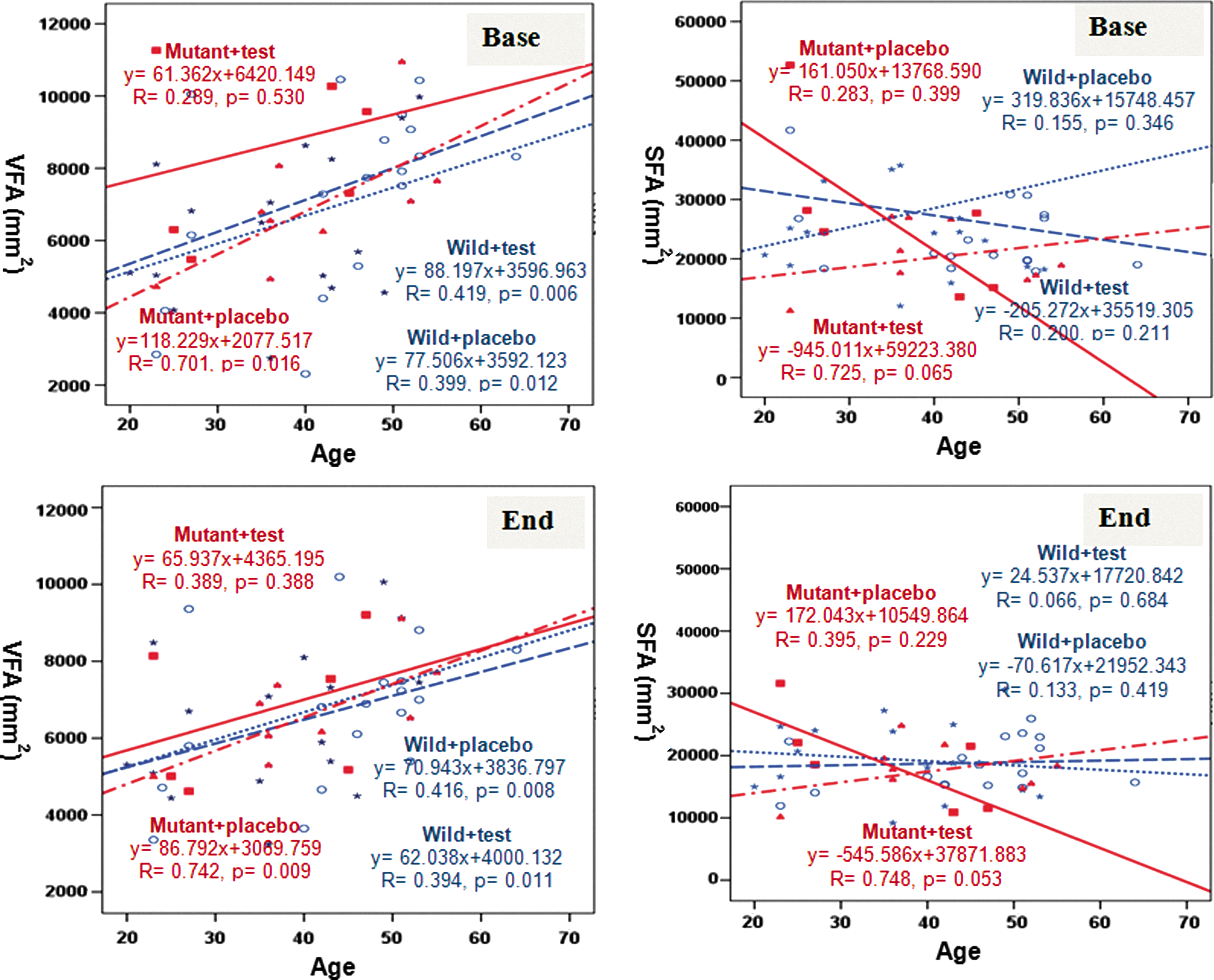
Presentation of visceral fat area and subcutaneous fat area regression according to increasing age in subjects having PPAR-γ polymorphisms such as C wild and T mutant allele. ○, wild+test (
Values are presented as mean±SE, adjusted by age (19–65 years), sex [male (n=8), female (n=43)], and BMI. P-values indicate significant differences among the four groups.
Different superscript letters in the same row indicate statistically significant differences at P<.05.
Significant differences between the test and placebo groups are indicated with asterisks (* P<.05, ** P<.01, and *** P<.001).
WBC, whole blood cell count; RBC, red blood cell count; Hb, hemoglobin; Hct, hematocrit; BUN, blood urea nitrogen.
Differences in blood chemistry in doenjang intervention according to PPAR-γ polymorphism
Plasma FFA, insulin, and HOMA-IR levels were significantly increased with increased catabolism of VFA upon doenjang treatment in those with both alleles compared with placebo. The Na excretion was higher in the placebo group compared with doenjang group, to a level corresponding to that of decreased systolic BP, and Na was excreted 30-fold higher in those with the T allele than the C allele. ORAC was increased in those with the wild-type allele, but was decreased in those with either the mutant allele or after doenjang pills were administered for 12 weeks. CAT activity was increased twofold in the doenjang-treated group with the C allele, but this phenomenon was reversed in those with the T allele. However, SOD was decreased by doenjang supplementation in the C allele group, but there was no significant difference observed in the T allele group. GSH did not differ after age, sex, and BMI were adjusted.
Differences in dietary intakes due to doenjang intervention according to PPAR-γ polymorphism
We observed an interaction between doenjang and PPAR-γ in dietary carbohydrate and Na intakes. The reason was that subjects with the mutant T allele who took doenjang consumed less dietary carbohydrates and sodium compared with the C allele, even though there was no difference in the dietary doenjang intake. However, dietary fat was slightly increased in the C allele group upon doenjang supplementation. The dietary sodium intake was significantly different when age, sex, and BMI were adjusted.
Discussion
To best of our knowledge, this is the first study to report antiobesity effects of long-term fermented soybean product, Korean doenjang, in subjects with PPAR-γ polymorphisms. Doenjang significantly decreased VFA, but not SFA, by increasing lipolysis in subjects with the mutant T allele. Since the food intake and physical activity were not controlled, those results of doenjang supplementation in overweight subjects were very important to be generalized for people following a regular diet and exercise regimen. Studies in rat adipocytes revealed that the soy isoflavonoids, genistein and daidzein, enhance basal lipolysis, with mechanisms possibly related to the regulation of fatty acid metabolism using the nuclear receptors, PPAR-α and PPAR-γ. 29,30 In an in vitro-based study, the authors demonstrated that soy isoflavones doubled PPAR-α–directed gene expression, whereas they increased PPAR-γ–directed gene expression by 200–400%, resulting in an improved lipid and glucose metabolism. 31
Fermentation of soybeans alters compounds such as isoflavonoids and small peptides. As a result, isoflavonoid aglycones, such as genistein and daidzein, which are more active compounds representing 50–55% and 40–45% of total isoflavones, respectively, are increased by more than 10- to 100-fold. 9 Urea cycle intermediates (i.e., arginine, an NO precursor, citrulline, and ornithine) are increased by 3.3- to 33-fold depending on the length of fermentation. 10 Small peptides, Glu-Tyr and Glu-Phe, which are related to the unique taste characteristics produced by soybean fermentation, are involved in the prevention of hypertension. 10 Isoflavones in foods and dietary supplements have both advocates and critics in the health industry. The latter are due to concerns about the estrogenic effects of isoflavones in certain species. In this study, the subjects took 40 g of doenjang a day, which is equivalent to 20–30 mg of isoflavones. This level produces plasma concentrations of isoflavones ranging around 200–300 nM, which is typical of many orally ingested therapeutics, but even daily doses of 1000 mg of soy isoflavones do not produce any significant adverse effects. 32 At low genistein levels, an estrogen-like effect was observed, whereas at micromolar levels, PPAR-γ activation predominated. 33 However, in a previous study, a high dose of 160 mg of isoflavones (20 g of soy protein) over 12 weeks did not improve inflammatory parameters in androgen-deprived men with prostate cancer. 34
Genistein inhibits the proliferation and differentiation of 3T3-L1 cells, a preadipocyte cell line, by increasing the CCAAT/enhancer-binding protein beta (C/EBP beta) activity and impacting PPAR-γ protein expression. 35 Soybean fermented for longer periods improves the insulin resistance. PPAR-γ acts as a central regulator of insulin sensitivity by increasing insulin-stimulated IRS2-mediated glucose uptake and TG accumulation. 36 In another study, genistein, daidzein, and small peptides (<3 kDa), which were produced by longer fermentation of soybeans, inhibited preadipocyte differentiation and body weight gains in vivo through PPAR-γ activation. 24 The mechanism of TG accumulation in adipocytes of animals and humans is also connected with PPAR-γ by the mechanism of insulin sensitivity. PPAR-γ agonists, such as thiazolidinediones, have a site-specific effect on the differentiation of human preadipocytes, in particular, subcutaneous fat, although preadipocytes from visceral fat are refractory to drugs like troglitazone. Visceral fat accumulation is closely associated with insulin-resistance syndromes, including impaired glucose tolerance, hyperlipidemia, hypertension, and cardiovascular disease. 37
We expected that the antioxidant effect of isoflavones in fermented doenjang would mediate their cytoprotective effects even at low levels. Like other polyphenols, many studies have shown that isoflavones can scavenge various reactive oxygen species that are formed endogenously during the innate immune response. 38 In our results, ORAC was increased in the C allele but was decreased in the T allele after doenjang pills were administered for 12 weeks. CAT activity was increased twofold in the doenjang-treated group with the C allele, but this phenomenon was reversed in those with the T allele. Contrary to the above results, SOD was increased by placebo. One of the reasons was that some ingredients in the placebo pills, such as cowpea, wheat, rice, cocoa, and chrysanthemum, may be antioxidants, which may influence the results. The decreased proinflammatory responses, antiatherosclerotic activities, and antioxidant effects were proposed as mechanisms underlying the beneficial effect of PPAR-γ activators. PPAR-γ promotes expression of numerous gene products whose profile of activity could be linked to oxidative stress suppression, proper mitochondrial function, or lipid and glucose metabolism and transport in non-neuronal tissues. 39 Moreover, isoflavones prevent atherosclerosis by inhibiting LDL oxidation and affecting signaling pathways, such as activation of estrogen receptor beta (ERβ) and PPARs. 40 For example, PPAR-γ ligands inhibit the cytokine-dependent expression of adhesion molecules in the endothelium. 41 We found one interesting result: doenjang-administered subjects with the mutant T allele consumed less sodium compared with the C allele, an interesting observation since soy improves the BP of spontaneously hypertensive rats on a high-salt diet. 42
The limitations of this study include the following: (1) the number of subjects was not sufficient to identify the interaction between the PPAR-γ gene (mutant T allele RF=0.18) and environment; therefore, we split the number of subjects with polymorphisms into two allele groups and not three genotypes; (2) nine subjects withdrew from the study—two did not submit consent forms, two voluntarily withdrew for personal reasons, and the remainder were excluded due to noncompliance with the study protocol. Even though our study results may not be generalized to the entire Korean population, our results on doenjang intervention can establish the basis for further functional food studies on obesity prevention. However, the antiobesity effect of VFA in overweight subjects with PPAR-γ polymorphisms should be confirmed in various populations, since genetic differences among ethnic groups may be present. In conclusion, this study suggests that doenjang has antiobesity and antioxidative effects in overweight individuals with mutant alleles of PPAR-γ.
Footnotes
Acknowledgments
This study was funded by the Seoul City R&BD program (10526) and the Ministry of Health & Welfare (A000385), Republic of Korea. All authors participated in this work with their substantive contributions. Y.-S.C. and S-.W.C. had the responsibility for conducting and performance of the RCT projects. M.L. and K.P. participated in the biochemical analysis and interpretation of data, and Y.K. and Y.P. carried out the statistics.
Author Disclosure Statement
No competing financial interests exist.