




Abstract
Bioassay-directed fractionation and purification were used to isolate 12 steroids (
Introduction
S
More than half of currently available drugs are natural compounds or related to them, and in the case of cancer, this proportion surpasses 60%. 4 Most of the anticancer drugs currently used in chemotherapy are cytotoxic to normal cells and cause immunotoxicity not only affecting tumor development but also impairing the patient's recovery. To find new medications, much attention has been focused on natural compounds in plants, marine organisms, and microorganisms. 5
Natural products have many pharmacological applications, especially with regard to their potential for use in cancer chemoprevention. Natural marine products have recently become the focus of increased research interest due to their potential pharmacological activities and lower toxicity. 6,7 Oxysterols, or oxygenated derivatives of cholesterol, are produced through autooxidation or in vivo enzymatic processes and have been identified in blood, mammalian tissues and cells, and processed foods. Oxysterols have emerged as intriguing substances with diverse biological activities. 8,9 For example, they suppress the expression of genes that are involved in the positive balance of cellular cholesterol. Furthermore, oxysterols are cytotoxic and inhibit cell growth. 10,11 Recently, it was shown that oxysterol-induced cell death shares many common features with apoptotic cell death, 12 which plays an important role in the balance between cell proliferation and cell death. A wide range of stimuli can trigger cell death, which is an irreversible process. 13,14
The sea urchin Diadema savignyi Michelin is an invertebrate in the family Diadematidae, order Diadematoida, class Echinoidea, and phylum Echinodermata. They are abundant in the Vietnamese sea and have been used as a health food. However, no reports on its chemical constituents and/or biological activities have been published.
In a continuation of our recent investigation of Vietnamese echinoderms,
15
–18
a CH2Cl2 extract of D. savignyi was found to exhibit significant cytotoxic effects. In this study, we demonstrate the promotive effects of this CH2Cl2 extract and of 12 steroids (
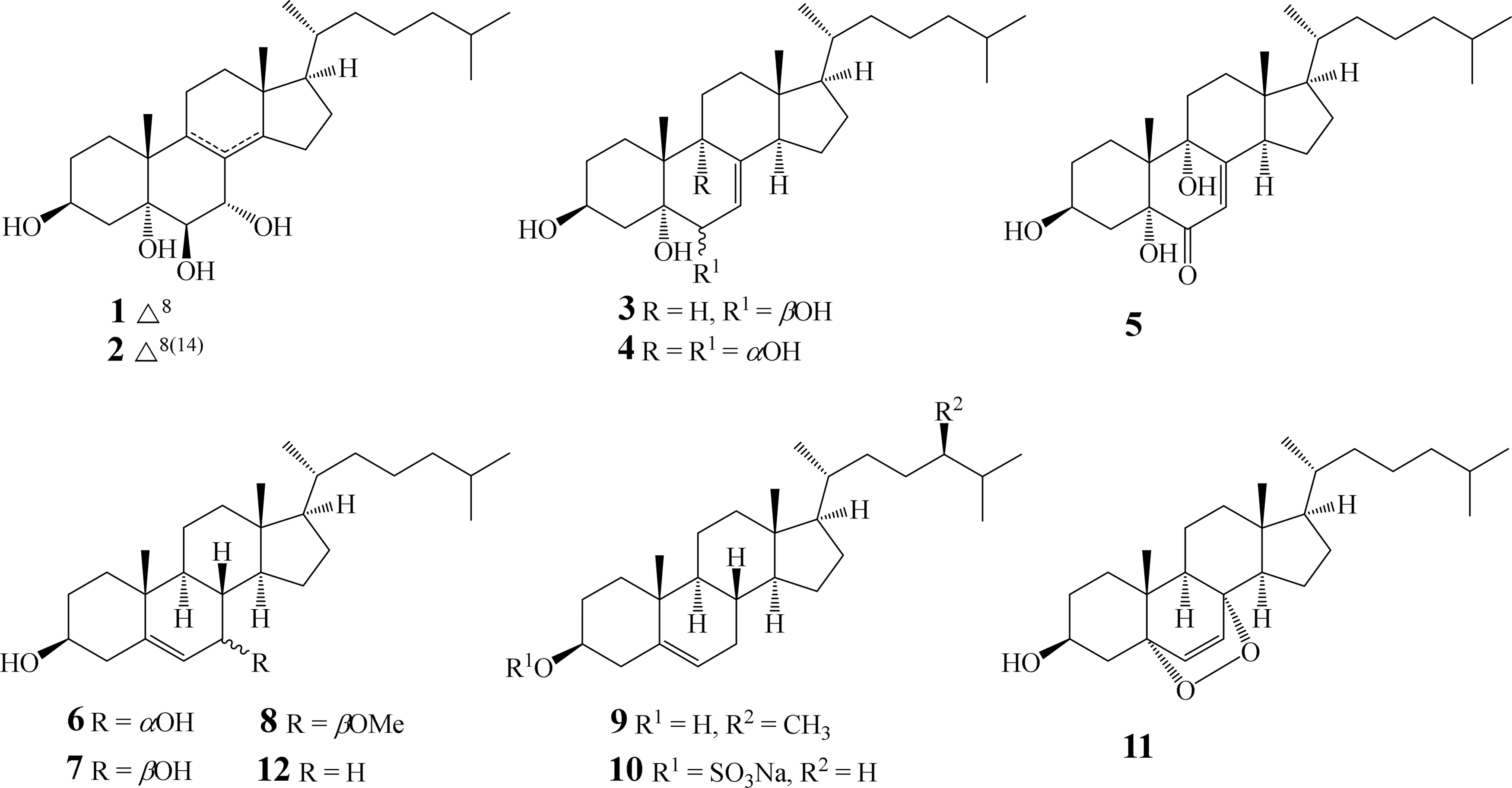
The chemical structures of steroids
Materials and Methods
Marine material
The samples of D. savignyi Michelin were collected in Nha Trang, Khanhhoa, Vietnam, in December 2011 and identified by MSc. Nguyen Thi My Ngan (Institute of Oceanography). Voucher specimens (No. DS-11-2011_01) were deposited at the Institute of Marine Biochemistry and Institute of Oceanography, VAST, Vietnam.
Compounds
From the CH2Cl2 extract of the edible Vietnamese sea urchin D. savignyi, 12 steroids
Cell culture and reagents
HL-60 (Human promyelocytic leukemia cells), PC-3 (Human prostate cancer cells), SNU-C5 (Human prostate cancer cells), and HEL-299 (Human embryonic lung cells) cell lines were obtained from the Korea Cell Line Bank (KCLB) and were grown in RPMI 1640 (Hyclone, Logan, UT, USA) medium that was supplemented with 10% fetal bovine serum and penicillin/streptomycin (100 U/mL and 100 mg/mL, respectively) at 37°C in a humidified 5% CO2 atmosphere (Gibco, Inc., Grand Island, NY, USA). The exponentially growing cells were used throughout the experiments.
Western blot analysis
HL-60 (3×10⁵ cells/mL), PC-3 (5×10⁴ cells/mL), and SNU-C5 (1×10⁵ cells/mL) cells were treated with the IC50 values of the CH2Cl2 extract and compounds
Statistical analysis
The results are expressed as the mean±standard deviation. All assays were performed in at least three independent experiments. Statistical significance was assessed by the analysis of variance using the paired Student's t-test (*P<.05, **P<.01, and ***P<.001).
Results
Chemistry analysis
Using various chromatographic experiments, 12 steroids (
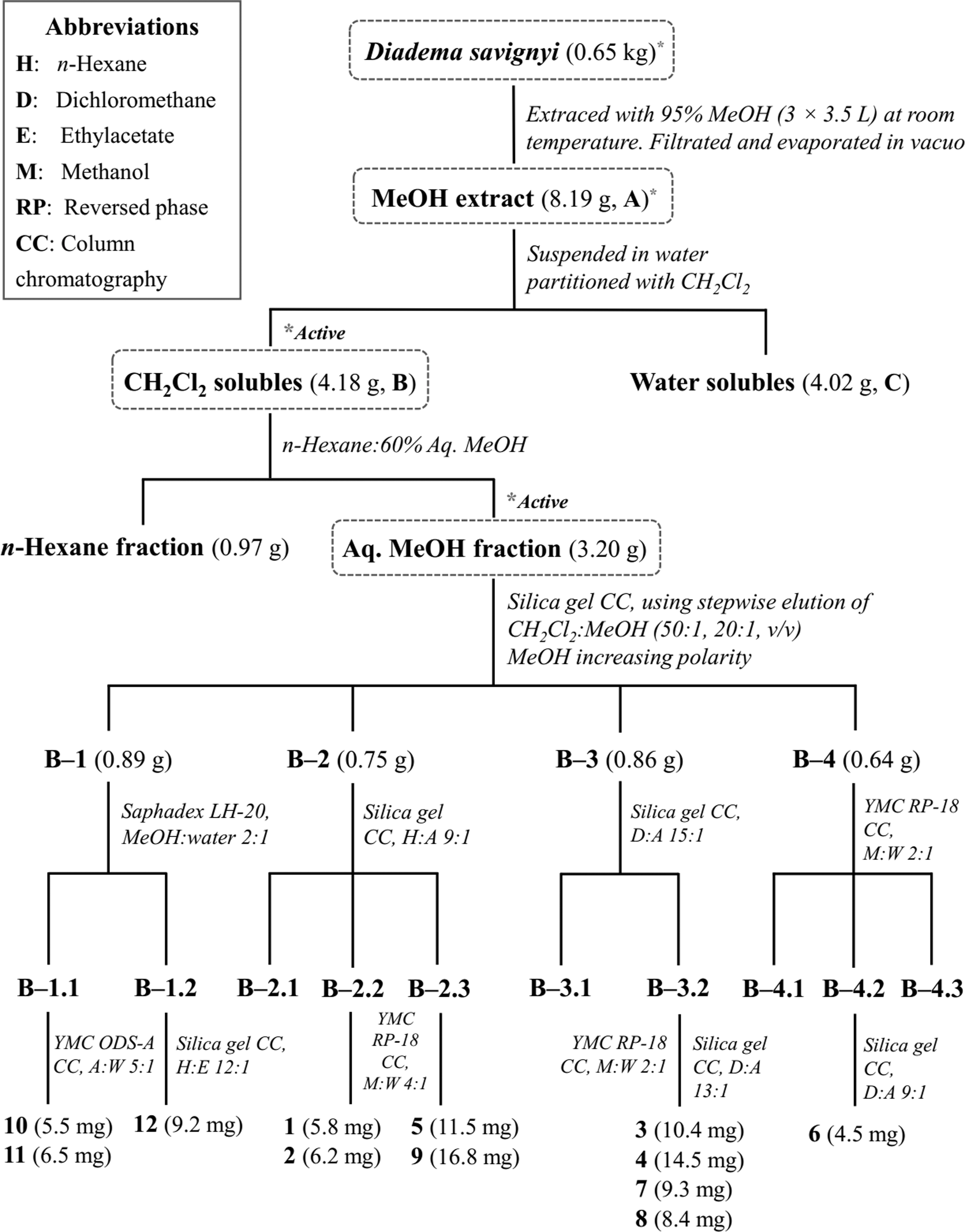
Extraction and isolation process of steroids
Biological activities
The cytotoxic effect of the CH2Cl2 extract of the sea urchin D. savignyi was examined against three human cancer cell lines (HL-60, PC-3, and SNU-C5) using the MTT assays. Treatment of these cell lines with the CH2Cl2 extract for 72 h yielded an inhibitory concentration of 50% (IC50) values of 1.37±0.15, 2.87±0.19, and 3.11±0.15 μg/mL, respectively. Subsequently, all of the isolated steroids (
Results are the means±SD of three independent experiments in triplicate. Mitoxantrone (an anticancer agent) was used as a positive control. Compounds/extract were tested at a maximum concentration of 100 μM and 100 μg/mL, respectively.
IC50, concentration that inhibits 50% of cell growth; NI, no inhibition (values<100 μM are considered active); SD, standard deviation.
Compounds
When HEL-299 cells (a normal cell line) were treated with the CH2Cl2 extract, cytotoxicity was observed, with an IC50 value of 9.62±0.66 μM (Table 2). However, when the extract was applied at a concentration equal to its IC50 for each human cancer cell line, HEL-299 cells showed greater viability than the three cancer cell lines (Table 3). Compounds
Results are the means±SD of three independent experiments in triplicate. Mitoxantrone was used as a positive control. NI, no inhibition.
Results are the means±SD of three independent experiments in triplicate.
Effect of CH2Cl2 extract and compounds 2 and 11 on the induction of apoptosis
The isolated steroids might induce cell death by inducing apoptosis. To determine whether the CH2Cl2 extract and compounds

The degree of apoptosis represented as the DNA content measured by flow cytometric analysis in HL-60
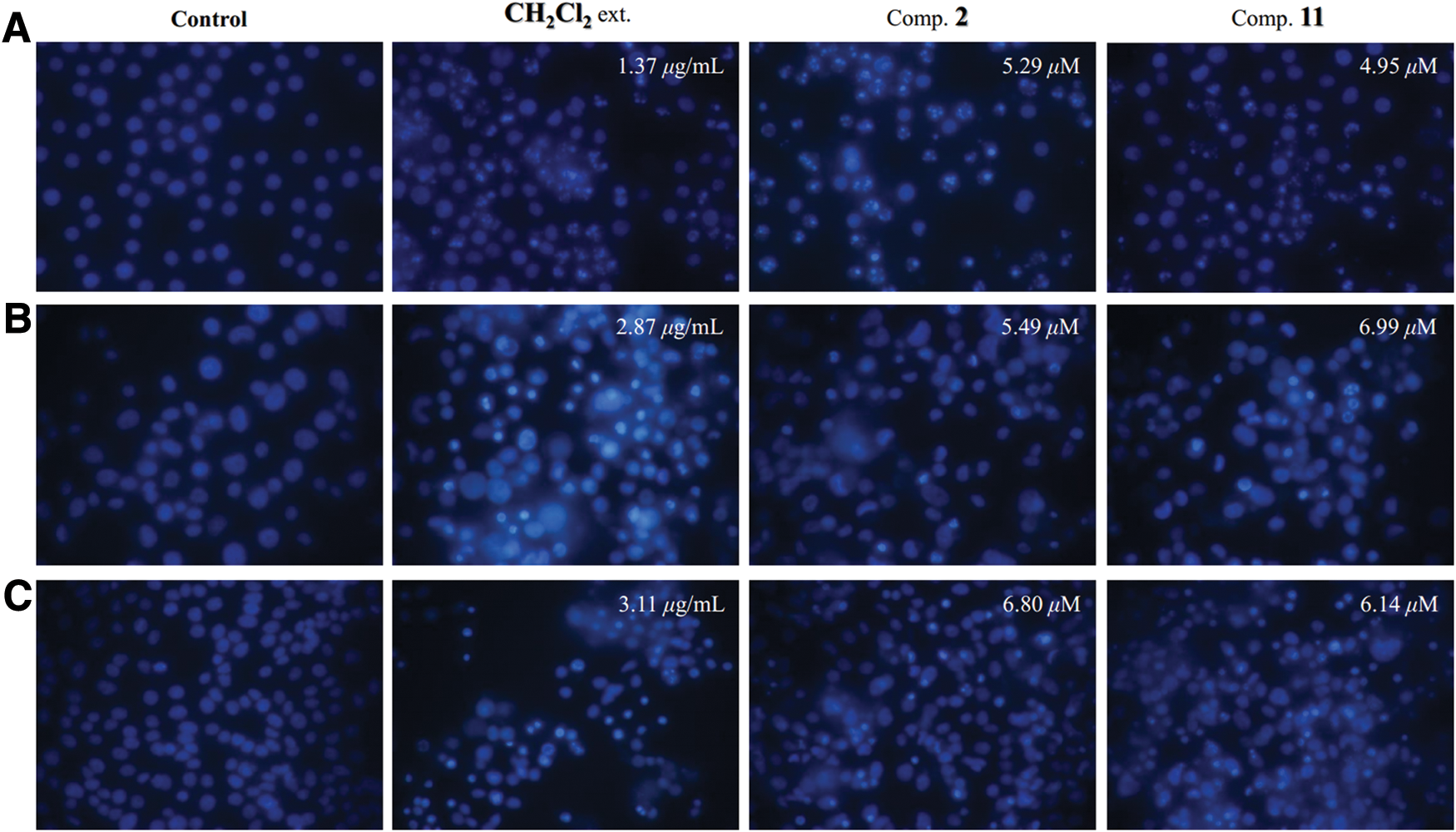
The degree of apoptosis represented as the fluorescent image of nuclei in HL-60
Effect of CH2Cl2 extract and compounds 2 and 11 on the regulation of apoptosis-related proteins
To investigate the possible mechanism underlying the induction of apoptosis by the CH2Cl2 extract and compounds

The effects of CH2Cl2 extract on the levels of Bcl-2, Bax, cleaved caspase-9, caspase-3, cleaved PARP, and on the activation of ERK1/2 mitogen-activated protein kinase (MAPK) and c-Myc in HL-60, PC-3, and SNU-C5 cells for 12, 24, and 48 h. Color images available online at

The effects of compound
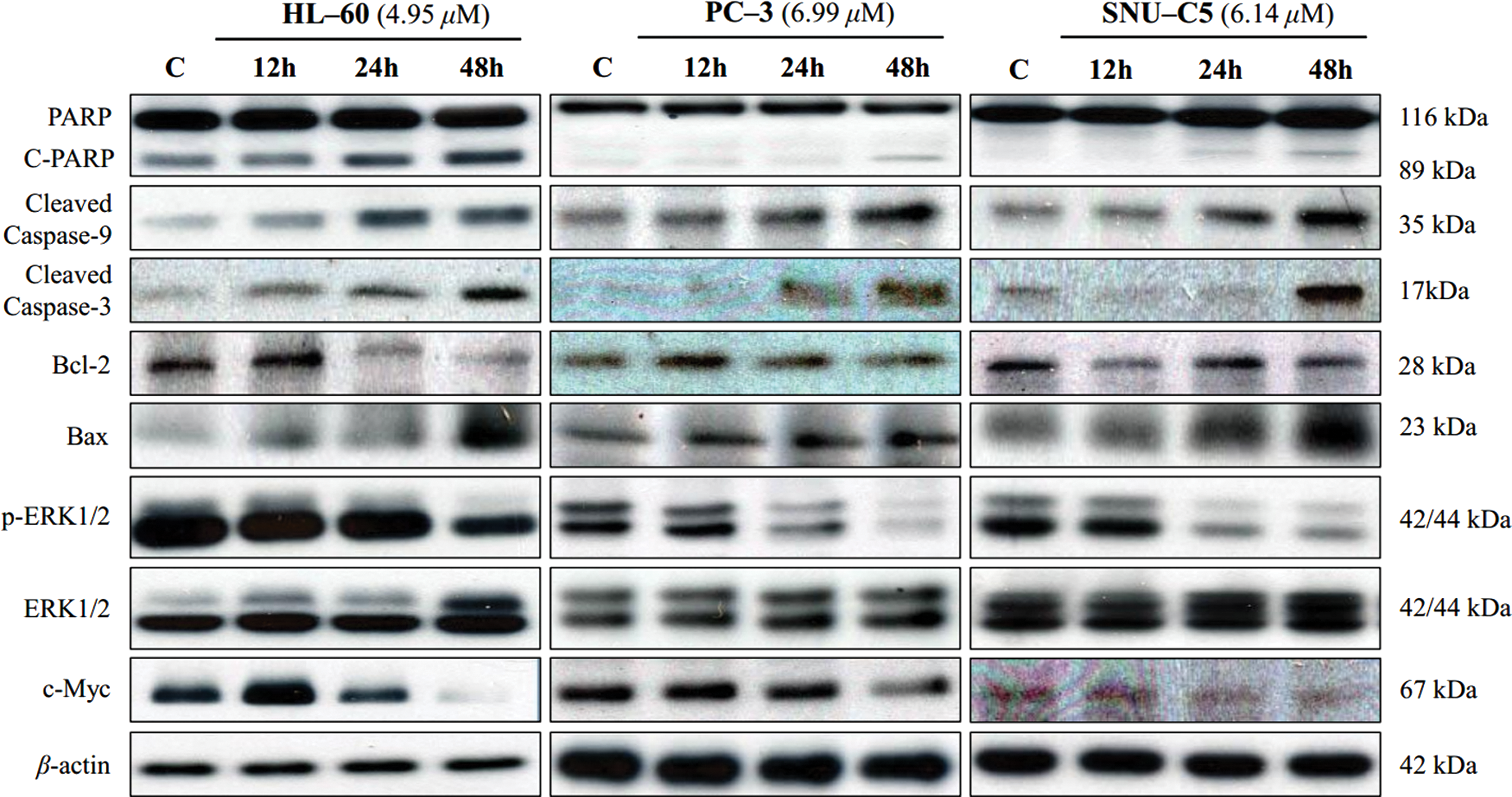
The effects of compound
Effect of CH2Cl2 extract and compounds 2 and 11 on the regulation of ERK1/2 MAPK and c-Myc
The members of the MAPK kinase family mediate a wide variety of cellular behaviors in response to extracellular stimuli. Three of the four main subgroups, ERK, JNK, and p38, serve as a nexus for signal transduction and play a vital role in cellular apoptosis.
23
Among MAPK proteins, ERK1/2 contributes to the stabilization of c-Myc, an oncoprotein. ERK1/2 is targeted to mitochondria, where it prevents the release of apoptogenic proteins, is involved in the response to oxidative insults, regulates cholesterol transport, and takes part in the disposal of damaged organelles. It also plays a major role in complex survival responses, leading to carcinogenesis by orchestrating transient signals and transcription modulation in different subcellular locations.
24
We further examined the effect of the CH2Cl2 extract and compounds
Discussion
During apoptosis, cells undergo morphological changes such as membrane blebbing, chromatin condensation, nuclear fragmentation, and the formation of apoptotic bodies, as well as biochemical changes, including the alteration of apoptosis-related protein levels. It has been demonstrated that the phosphorylation/dephosphorylation states of some regulatory proteins are crucial events along the pathways controlling cell growth and apoptosis. A well-established apoptotic signaling cascade is regulated by MAPK. 24,25 Two key molecular signaling pathways are implicated in the induction of apoptotic cell death. The first is the extrinsic pathway, which is activated by a death receptor from outside the cell; the second is the intrinsic pathway, which is activated by the Bcl-2 protein family and downstream mitochondrial signals from inside the cell. 26
Cancer chemotherapy has improved gradually with the development of novel antitumor drugs. 27,28 While the treatment of certain malignancies with chemotherapy has been both successful and encouraging, the efficacy of these approaches has frequently been limited by drug resistance in the tumors themselves and by side effects on normal tissues and cells. 29,30 Many reports have indicated that natural products and compounds have potential antitumor activity via the induction of apoptosis. 31,32 One of the more attractive strategies considered in current cancer chemotherapy is dietary or pharmaceutical manipulation to induce the death of malignant cells via apoptosis. 33 An accumulating body of evidence suggests that naturally occurring compounds and many chemotherapeutic agents with anticancer effects can trigger apoptosis in cancer cells. 2
Oxysterols are polyfunctional biological effectors that can prevent the growth of various cell types,
34
exerting differential cytotoxic effects on normal versus malignant cells.
35,36
The mechanism of oxysterol action involves effects on membrane formation and homeostasis by inhibiting endogenous cholesterol synthesis and insertion into phospholipid bilayers.
37
It is interesting to note that membrane-affecting chemicals influence the cell cycle. To elucidate the cytotoxic mechanism, we investigated whether the inhibitory effects of the CH2Cl2 extract and compounds
Bcl-2 proteins play important roles in regulating mitochondrial permeabilization and caspase activation. The apoptosis-inducing effect is more dependent on the balance of Bcl-2 and Bax than on the quantity of Bcl-2 alone. Typically, the ratio of Bcl-2 to Bax protein expression is used as an index of apoptosis.
39,40
Moreover, the pro-apoptotic members of the Bcl-2 family proteins induce apoptosis by stimulating the release of cytochrome c from mitochondria, resulting in the cleavage and activation of caspase-9. On activation, caspase-9 initiates a protease cascade leading to the rapid activation of caspase-3, an effector caspase in cells undergoing apoptosis.
41
–43
Therefore, to determine the possible mechanism underlying the induction of apoptosis, we monitored the expression of apoptosis-related proteins such as Bcl-2, Bax, cleaved-caspase-9, caspase-3, and PARP in HL-60, PC-3, and SNU-C5 cells. When treated with the IC50 values of the CH2Cl2 extract and compounds
The MAPK signaling pathways induce either cell proliferation or cell death depending on the cell type and stimulus.
25
To establish the MAPK-dependent mechanism of apoptosis induced by the CH2Cl2 extract and compounds
In summary, a CH2Cl2 extract and steroids isolated from the sea urchin D. savignyi exhibited potent in vitro cytotoxic activity against HL-60, PC-3, and SNU-C5 human cancer cells. Moreover, the extract and compounds
Footnotes
Acknowledgments
This study was supported by the Vietnam Ministry of Science and Technology (MOST), VAST (code: VAST.TĐ.ĐAB.03/13–15), and the Priority Research Center Program through the National Research Foundation of Korea (NRF) funded by the Ministry of Education, Science, and Technology (2009-0093815), Republic of Korea. The authors are grateful to the Institute of Chemistry, VAST, and KBSI for the provision of the spectroscopic instrument.
Author Disclosure Statement
No competing financial interests exist with this work for any of the authors who are involved in this study.
References
Supplementary Material
Please find the following supplemental material available below.
For Open Access articles published under a Creative Commons License, all supplemental material carries the same license as the article it is associated with.
For non-Open Access articles published, all supplemental material carries a non-exclusive license, and permission requests for re-use of supplemental material or any part of supplemental material shall be sent directly to the copyright owner as specified in the copyright notice associated with the article.
