




Abstract
Pomacea lineata is a fresh water shellfish that is utilized as food, medicinal portions, or licking remedies. The objective of this study was to evaluate the nutritional and microbiological aspects of P. lineata and spawning. The samples were collected in the Jaguaribe River (Paraíba, Brazil) during the rainy and dry seasons. The biochemical composition, mineral composition, total mesophilic bacteria (TMB), total coliforms (TC), fecal coliforms (FC), Salmonella sp., Staphylococcus aureus, and Vibrio presence were determined. Each 100 g of P. lineata presented 3.1 g of ashes; 9.4 g of proteins; 2.7 g of lipids; 0.6 g of carbohydrates; 1800.0 mg of calcium; 78.0 mg of phosphorus, and 58.4 mg of iron. Each 100 g of spawning presented 10.4 g of ashes; 4.5 g of proteins; 2.8 g of lipids; 1.3 g of carbohydrates; 3633.0 mg of calcium; 39.4 mg of phosphorus; and 4.6 mg of iron. Each 100 g of P. lineata provided 65.7 kcal and spawning 48.3 kcal. In the dry season P. lineata and spawning showed no TMB and TC, FC, S. aureus, Salmonella, or Vibrio. In the rainy season P. lineata and spawning presented increase in TMB and TC, FC, S. aureus, and Salmonella. The presence of Vibrio was not detected. P. lineata presented proteins, low lipid, and carbohydrate content, energy values close to those of lean meats, high contents of calcium and iron, and presented low contamination level with pathogenic bacteria. Since P. lineata substances may be useful in the treatment of respiratory and gastrointestinal diseases without presenting toxic or cytotoxic effects already described in the literature, it may be considered as a potential functional food.
Introduction
P
The unique pharmacological studies described in the literature demonstrated the spasmolytic effect of P. lineata shellfish and spawning in guinea pig (Cavia porcellus) trachea without effect on their spontaneous tone in addition to spasmolytic and antispasmodic effects in guinea pig ileum. These results validated their popular use in the treatment of respiratory diseases with bronchoconstriction without showing side effects and in the treatment of disorders characterized by gastrointestinal spasms. 7,8
The attainment of data regarding food composition is vital for several activities such as to evaluate the food supply and consumption of a given country, to verify the diet nutritional adequacy of individuals and populations, to evaluate the nutritional status to establish relations between diet and disease, to correlate food consumption with the appearance of diseases, besides being useful for the food industry. 9 The biochemical composition of shellfishes is influenced by factors such as species, sexual maturation level, temperature and water salinity, collection site and type of feeding, and making analyses at different sites and seasons necessary. 10
A number of works have reported the isolation of bacteria from shellfishes known for carrying viral and bacterial pathogenic agents. 11 –13 The most predominant genera are as follows: Acinetobacter, Aeromonas, Bacillus, Campylobacter, Clostridium, Pasteurella, Plesiomonas, Pseudomonas, Salmonella, Staphylococcus, Vibrio, and several members of Enterobacteriaceae. 11 –14 The isolation and characterization of bacteria associated to shellfishes is of great interest, since the presence of bacteria potentially pathogenic for human beings may compromise the use of shellfishes as food. The ingestion of shellfishes contaminated with Vibrio or Salmonella may contribute for the occurrence of hepatitis A, gastroenteritis, cholera, and salmonellosis outbreaks in human beings. 15 –17 The rainy season influences the increase of microbial contaminants in aquatic environments. The microbiological evaluation in dry and rainy seasons, indicate the safest way for the consumption of shellfish. 18 This association may yet make these shellfishes to act as natural reservoirs of opportunistic pathogenic agents both for themselves and for humans. 19
The aim of this study was to determine the biochemical and mineral composition of P. lineata and spawning and to investigate the presence of bacteria potentially pathogenic for human beings with the later objective of encouraging the safe use as food with medicinal properties.
Materials and Methods
Specimens of P. lineata from both genders, weighing on average 5 g and their spawning were collected from the Jaguaribe River within an area located at the Benjamim Maranhão Botanical Garden (João Pessoa, Paraíba, Brazil) (S7°11′52′′–S7°11′05,” W34°52′14′′–W34°51′01′′) during both dry and rainy seasons. The collection dates with their respective pluviometric indexes and temperature were as follows: April/2002 (175 mm3; 27.5°C), for the biochemical composition determination; February/2002 (97.7 mm3, 28°C) and July/2004 (439.9 mm3, 25.6°C) for the microbiological evaluation.
The shells were scrubbed under running water and dried on paper towels. The shellfishes were decapitated and separated from their shell. The shellfish and spawning were analyzed in natura up to 1 h after collection. The analytical unit was 25 g or 5 shellfishes.
The water content determination was performed by means of gravimetry in stove at 105°C until a constant weight is reached. The fixed mineral residue was obtained through gravimetry after incineration in muffle (QUIMIS) at 550°C for 12 h. The incinerated material was kept in a desiccator to reach room temperature and weighed on an analytical balance (GEHAKA) until a constant weight is reached. The total nitrogen content was determined by means of the micro-Kjeldahal standard method, using factor 6.25 for the attainment of the raw protein content. The lipid content was determined in a Soxhlet intermittent extractor (QUIMIS) using hexane P.A. The total carbohydrate content was indirectly measured by subtracting from 100 the sum of the humidity, proteins, lipids, and ashes average values. The total energy content given in kcal/100 g was obtained by the sum of the proteins, lipids, and carbohydrates average values multiplied by the energy factor provided for each one of them. 20 The calcium content was determined through the titration method using ethylenediaminetetracetic acid (EDTA) from the fixed mineral residue. The phosphorus from the ash solution was transformed into phosphomolybdic acid, which was reduced by the 1-amino-2-naphtol-4-sulfonic acid, and color intensity was colorimetrically measured in spectrophotometer (METERTEK–SP 810) in λ=660 nm. The iron content was determined in the samples through the conversion of the ferrous ion into ferric ion using oxidizing agents (potassium persulfate) and quantified in spectrophotometer in λ=480 nm. 21
The microbiological evaluation of P. lineata and spawning was performed using counting of total mesophilic bacteria (TMB) counting and total coliforms (TC) as indicators of bacterial contamination. The controls used were the parameters established by the RDC # 12 from 01/12/2001 from the National Sanitary Surveillance Agency–Ministry of Health (ANVISA–MS—Brazil) considered acceptable for human consumption in natura raw seafood such as fishes, crustaceans, and shellfishes presenting in 25 g up 102 most probable number determination (MPN)/g of fecal coliforms (FC), up to 103 colony-forming units (CFU)/g of Staphylococcus aureus and absence of Salmonella sp. and Vibrio. 22 The TMB counting was performed through the surface-plating method using Standard Agar and expressed as CFU/g of sample. 23 The counting of TC and FC was performed through the MPN/g of sample in multiple tubes. 24,25 The counting of S. aureus was performed through the surface-plating method using the Baird–Parker medium added of yolk in 0.85% NaCl solution (1:1), potassium tellurite solution (1%) and incubated at 35°C for 48 h. 23 Three typical and three atypical colonies were isolated from each sample and submitted to confirmation through the Gram staining technique and test that evidenced the presence of coagulase. 26 Salmonella detection was performed through the classic cultivation technique in selected mediums developed with the objective of assuring the detection even in situations extremely unfavorable. The Vibrio detection was performed based on the growth capacity of these organisms in alkaline conditions and in the presence of concentrations relatively high of biliary salts. 23
The results were expressed as average±standard deviation or average±standard error of the average and were statistically analyzed by means of the Student “t” test (unpaired), where differences between averages were considered as significant when P<.05. All data were analyzed through the GraphPad Prism program © version 5.01 (GraphPad Software, Inc.).
Results
Each 100 g of P. lineata presented 84.22 g of water content, 15.82 g of total solids, 3.11 g of ashes, 9.41 g of proteins, 2.70 g of lipids, and 0.56 g of carbohydrates and 100 g of spawn presented 81.10 g of water content, 18.90 g of total solids, 10.38 g of ashes, 4.47 g of proteins, 2.76 g of lipids, and 1.29 g of carbohydrates. Each 100 g of P. lineata provided 65.66 kcal and the same quantity of spawn provided 48.26 kcal (Table 1).
Values followed by different letters present significant differences, P<.05.
SD, standard deviation estimation; TEV, total energy content.
Each 100 g of P. lineata presented 1800 mg de calcium, 78 mg de phosphorus, and 58.4 mg of iron and 100 g of spawn presented 3633 mg of calcium, 39.4 mg of phosphorus, and 4.6 mg of iron (Table 1).
In the rainy season P. lineata showed an increase of 9.4% for TMB, 8.6% for TC, 23% for CF, and 40% for S. aureus and spawning presented an increase of 16.8% for TMB, 11.5% for TC, 10.8% for FC, and 36% for S. aureus when compared with the dry season (Figs. 1 –4).
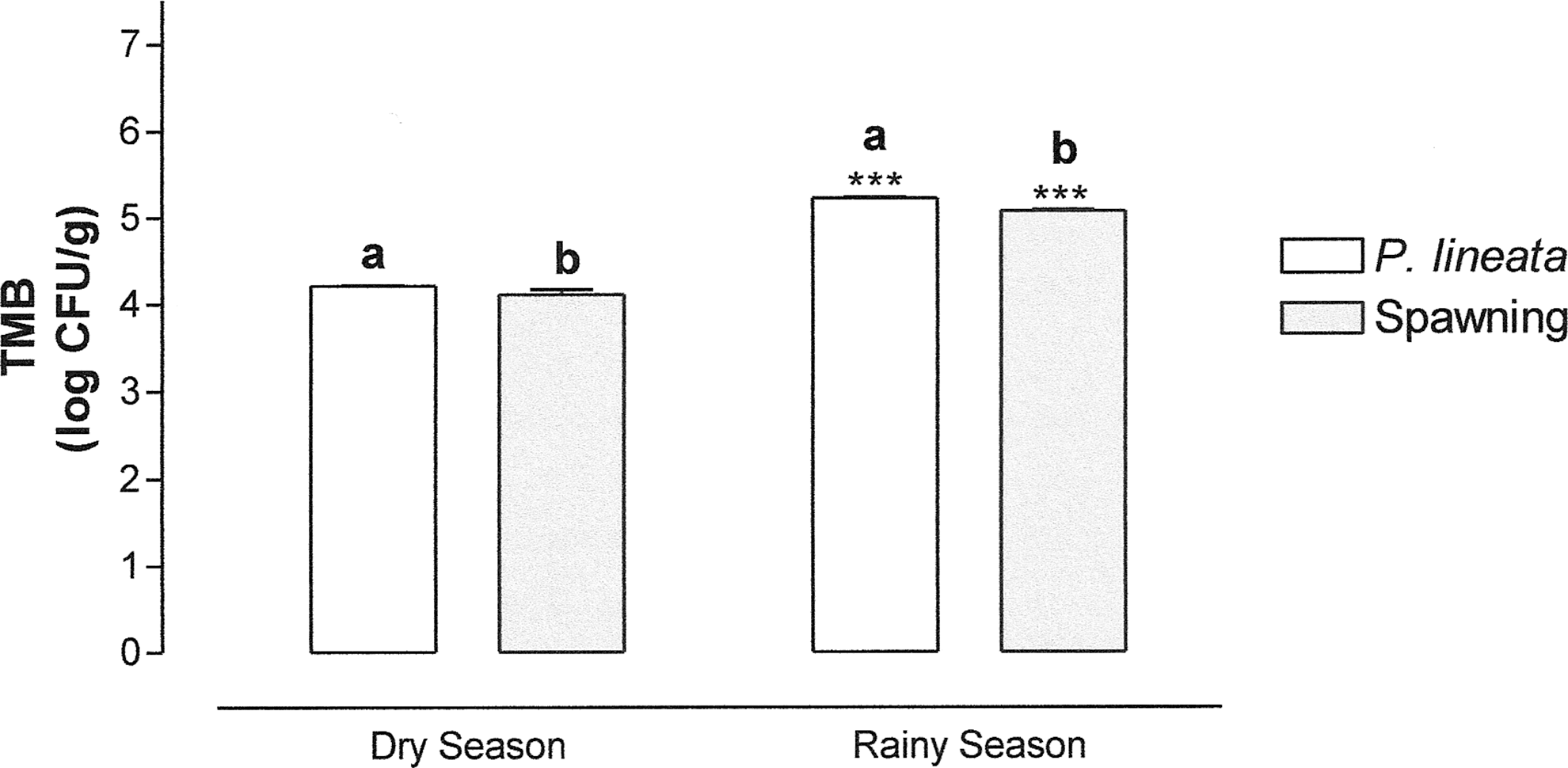
Total mesophilic bacteria (TMB) present in P. lineata shellfish and spawning in dry and rainy seasons (n=3). Student “t” test, ***P<.0001 (dry season×rainy season). Values signed with different letters in the same season present significant differences, P<.05 (P. lineata×spawning).
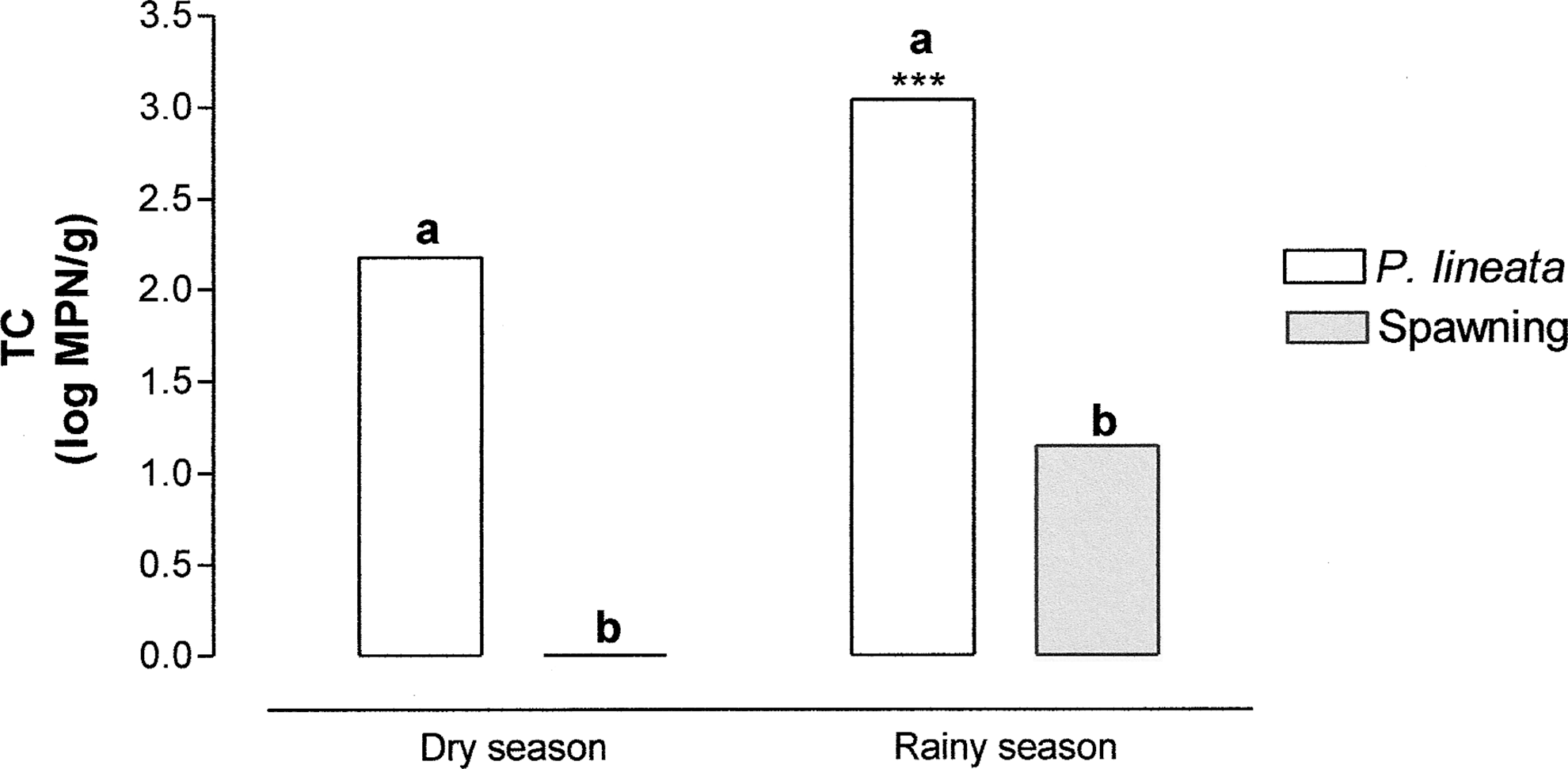
Total coliforms (TC) present in P. lineata shellfish and spawning in dry and rainy seasons (n=3). Student “t” test, ***P<.0001 (dry season×rainy season). Values signed with different letters in the same season present significant differences, P<.05 (P. lineata×spawning).
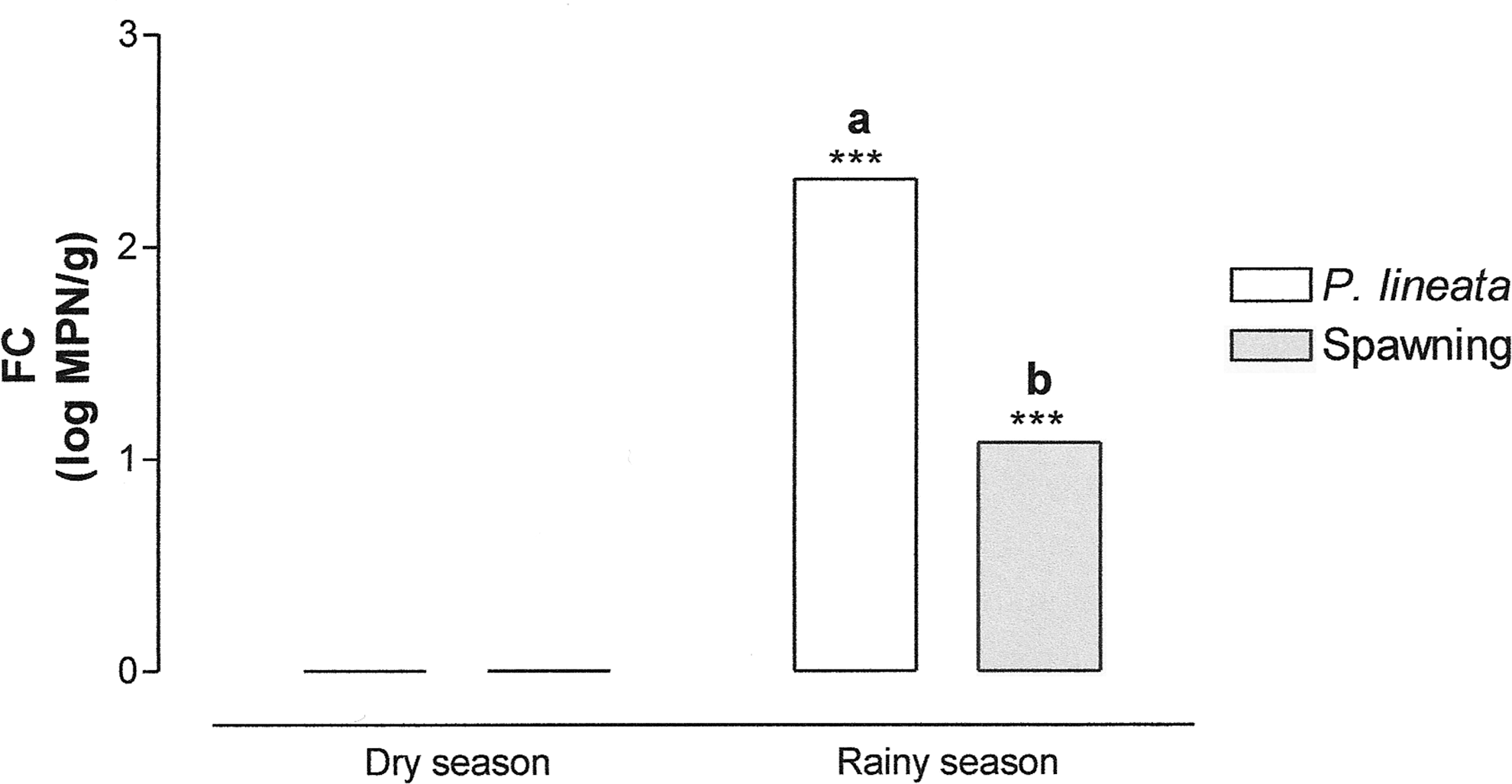
Fecal coliforms (FC) present in P. lineata shellfish and spawning in dry and rainy seasons (n=3). Student “t” test, ***P<.0001 (dry season×rainy season). Values signed with different letters in the same season present significant differences, P<.05 (P. lineata×spawning).

Counting of S. aureus present in P. lineata shellfish and spawning in dry and rainy seasons (n=3). Student “t” test, ***P<.0001 (dry season×rainy season). Values signed with different letters in the same season present significant differences, P<.05 (P. lineata×spawning).
When the TMB present in P. lineata and spawning in the dry and rainy seasons were compared, one observed that the difference between them was significant. On the other hand, the TMB in P. lineata and spawning in each season studied presented no significant differences (Fig. 1).
The difference between values of TC in P. lineata in both seasons was significant. When values of TC present in the two samples in the rainy season were compared, it was observed that the number of bacteria was significantly higher in P. lineata in relation to spawning (Fig. 2).
When values of FC in samples of P. lineata and spawning collected during the rainy season were compared, it was observed that the number of bacteria was higher in P. lineata, and the difference between them was significant (Fig. 3).
When the number of bacteria found in P. lineata and spawning of the rainy season was compared, it was observed that the difference between them is significant (Fig. 4).
The presence of Salmonella sp. was not observed in samples of P. lineata collected during the dry season but it was detected in samples collected during the rainy season. The presence of Salmonella sp. was not observed in samples of spawning both in the dry and in the rainy seasons.
The presence of Vibrio was not observed in samples of P. lineata and spawning collected both in the dry and in the rainy seasons.
In the rainy season, microbiological indicators (total mesophilic bacteria and total coliforms) and markers (fecal coliforms and S. aureus) presented in greater numbers demonstrating the influence of rainfall on the increase of microbial contaminants in aquatic environments.
Discussion
Fresh water shellfishes are consumed, especially by low-income populations from the Northern and Northeastern Brazil. 27 Thus, studying the biochemical composition of these shellfishes becomes vital for it to be consumed with safety.
Comparing the biochemical composition of marine shellfish species used as food such as Ostrea virginica (oyster) and Mytilus edulis (mussel) with P. lineata, it was observed that the protein content of P. lineata (9.4 g/100 g) and oyster (9.8 g) are similar; likewise, the lipid content of P. lineata (2.7 g) and mussel (2.3 g). Differences such as higher calcium (1800.0 mg) and iron (8.6 mg) contents and lower phosphorus content (118.0 mg) were observed in P. lineata in relation to other marine shellfishes consumed as food. 28 According to Food and Nutrition Board 29 the recommended daily requirement for an adult male is 11.43 mg/kg of calcium, 0.14 mg/kg of iron, and 11.43 mg/kg of phosphorus; then, 44, 95, and 114 g/day of P. lineata shellfish meets these needs of calcium, iron, and phosphorus respectively.
P. lineata presents ash content of 3.1 mg/100 g, which is higher than those presented by terrestrial shellfishes used as food such as Helix pomatia (1.8 mg) 30,31 and Helix lucorum (2.3 mg), 30 Helix aspersa (1.2 mg), 32 and Achatina sp. (2.1 mg), all called “escargot.” 33 The increased ash content may be a result of the high calcium and iron contents. The differences observed between the several shellfishes consumed as food are due to factors associated to the organisms themselves, which belong to different taxonomic groups and to environmental factors, since these shellfish populations live in habitats subject to the influence of photoperiod, temperature and soil nature, and supply and type of food available, which affect their development and chemical composition. 30
In 100 g of P. lineata there are 9.4 g of proteins, value similar to those described for other edible terrestrial shellfishes: 8.6 g in H. pomatia, 30 9.9 g in H. aspersa, 32 and Achatina sp. 33 P. lineata also presents 2.7 g of lipids, value higher than 0.5–0.7 g of H. pomatia, 32,33 1.1 g of H. lucorum, 30 1.4 g of H. aspersa, 32 2.1 g of Achatina sp., 33 and 1.5 g of Oreohelix strigosa. 34
The differences observed between values for the chemical composition of P. lineata found in this study (Table 1) and data obtained by other authors may be explained by the fact that although the shellfishes belong to the same genus 35 and even to the same species, they were collected at different sites and therefore submitted to seasonal, nutritional, and reproductive diversity in the collection period. 27
P. lineata can be used as a protein source just like other types of meat consumed by man. It was verified that shellfish is good food, once it is source of high nutritional quality protein, and as long as this protein is of animal origin, it presents better utilization by the organism in relation to most vegetal origin proteins. 36 It yet presents low lipid and carbohydrate contents and energy value (65.7 kcal/100 g), below other lean meat such as fish (96.5 kcal) and chicken (106.7 kcal), presents high calcium and iron contents, essential minerals with important physiological functions, which should be provided by foods. 37 Calcium is essential for growth and normal skeleton formation, vascular contraction and dilation, muscular contraction, neuron transmission, and glandular secretion. Several molecules such as hemoglobin, myoglobin, cytochromes, and enzymes contain iron to assure that the fuel used by the body is oxidized to provide the energy required to all physiological processes and movement. 38 Thus, P. lineata may be used as source of these minerals when consumed as food.
The large availability in natural environments makes P. lineata an alternative food for low-income populations from northern and northeastern Brazil, since they are not commercially exploited yet. On the other hand, due to its interesting nutritional characteristics, this shellfish presents potential for commercial production.
When P. lineata was compared to spawning it was observed that spawning presents lower amounts of proteins, lipids, phosphorus, and iron; a higher carbohydrate content; and large amount of ashes probably due to the high calcium content. This high calcium content in the spawning may be explained by the need of this ion for the construction of the shell even before the eclosion of the young forms. 37
Since P. lineata and spawning are consumed as food and with therapeutic purposes in the popular medicine for the treatment of respiratory and gastrointestinal diseases 3 without the knowledge of possible contamination with bacteria potentially pathogenic, a microbiological evaluation in the dry and rainy seasons was performed, once its consumption is observed in any season.
The RDC # 12, from 02/01/2001 (ANVISA–MS–Brazil), 22 considers in natura raw seafood such as fishes, crustaceans, and shellfishes presenting in 25 g up to 102 MPN/g of TC, up to 103 CFU/g of S. aureus, and absence of Salmonella sp. and Vibrio as acceptable for human consumption.
In this study, although P. lineata had presented 1.6×10⁴ CFU/g of TMB in the dry season, the presence of FC, S. aureus, Salmonella, or Vibrio was not detected. Thus, during this season, this shellfish is acceptable for human consumption. In the rainy season, however, the number of TMB and TC increased, and FC (2.1×10² MPN/g) and S. aureus (1×10⁴ CFU/g) were detected, and the presence of Salmonella, which makes the raw shellfish inadequate for human consumption (Figs. 1 –4). Since boiling water for 30 min is an effective way to destroy Salmonella and S. aureus as well as their enterotoxin, 39,40 the consumption of P. lineata only after cooking is strongly recommended.
In this study, the spawning presented 1.3×10⁴ CFU/g of TMB in the dry season, which may indicate the presence of pathogenic bacteria; however, the presence of TC, FC, S. aureus, Salmonella, and Vibrio was not detected, indicating that the product is adequate for human consumption. In the rainy season, the number of TMB and TC increased; FC (12 MPN/g) and S. aureus (4.5×10³ CFU/g) were observed, which makes the sanitary conditions of the spawning inadequate for human consumption (Figs. 1 –4).
Since the spawning is used in popular medicine under the form of medicinal portions or licking remedies, prepared boiling it with water and sugar, 6 the S. aureus cells and their toxins are probably destroyed.
Although the methodology recommended by agencies that determine microbiological standards for water and food both in Brazil and in the United States establish a direct correlation between the number of indicator bacteria and the presence of bacteria potentially pathogenic, it was observed in the samples analyzed in this study that this correlation is not always verified. Similar results were also observed in other regions for Staphylococcus, 41 Salmonella, 14 and Vibrio. 13,41
It was observed that P. lineata presented higher number of bacteria in all analyses performed and the presence of bacteria potentially pathogenic (Figs. 1 –4). Once water flows through shellfishes, they ingest and concentrate all particulate matter in the water, including pathogenic bacteria and viruses, 42 what makes their consumption recommended only after cooking.
Functional food, regulated by Resolution # 18 from 30/04/1999 from the National Sanitary Surveillance Agency–Ministry of Health (ANVISA–MS–Brazil), 43 are defined as products containing ingredients necessarily natural that, besides the known nutrients, present compounds with biological activity capable of causing medical or health benefits, including the prevention and treatment of disease. 44 Since P. lineata is a food that can be used as protein source, rich in mineral salts, presents low contamination levels due to bacteria potentially pathogenic for human beings and substances with biological activity that may be useful in the treatment of respiratory diseases and gastrointestinal disorders without presenting toxic or cytotoxic effects, 7,8 it may be considered as a potential functional food.
Footnotes
Acknowledgments
The authors would like to thank the management of the Benjamim Maranhão Botanical Garden (João Pessoa, Paraíba, Brazil) for permitting the collection of P. lineata and its spawning, Prof. Paulo Roberto de Oliveira Rosa (Environmental Geoprocessing Laboratory, UFPB) for the pluviometric and temperature data and for the determination of the geographic coordinates of the collection site, and Dr. Francisco José Pegado Abílio (Aquatic Toxicology Laboratory, UFPB) for identification of P. lineata specimens.
Author Disclosure Statement
No competing financial interests exist.