




Abstract
The stembarks of Harungana madagascariensis were analyzed for their content of chemical constituents, antinutrients, vitamin levels, and in vitro antioxidant properties in two solvent systems. Phytochemical screening revealed higher levels of alkaloids, saponins, and flavonoids in the methanolic (MHM) extract than in the dichloromethane (DCM) extract. The methanolic extract had higher contents of minerals, vitamins, and antinutrients except K, vitamin B1, and phytic acid, respectively. Antioxidant potentials of the stembark extracts were assessed by the 1, 1-diphenyl-2-picrylhydrazyl (DPPH) free radical scavenging activity, metal chelating activity, and ferric reducing power. The methanolic extract showed a better antioxidant activity (IC50=87.66±0.97 μg/mL) in the DPPH system. The metal chelating activity was higher in the methanolic extract (92.4% at 20 mg/mL), but lower than the control ethylenediaminetetraacetic acid (EDTA). The methanolic extract also showed greater ferric reducing power and was richer in phenolics (132.24±0.61 mgGAE/g) and flavonoids (259.05±2.85 mgQE/g). Antinutrient analysis of the extracts indicated low levels of phytic acid, oxalates, and hydrocyanides below the lethal doses. The LD50 (i.p. mice) of the extracts showed relatively low toxicity in the range 1000–1414 mg/kg. These results support the ethnomedicinal uses of this plant in the treatment of diseases related to oxidative stress and suggest that consumption of H. madagascariensis is not harmful nutritively.
Introduction
T
In the present study, we evaluated the contents of mineral elements, vitamins, antinutrients, LD50, and in vitro antioxidant properties of the stembark of H. madagascariensis from Nigeria using standard analytical methods.
Materials and Methods
Plant material
The stembark of H. madagascariensis was collected from a forest edge in Ikono Local Government Area of Akwa Ibom State, Nigeria, in the month of December 2010. Plant identification, authentication, and specimen referencing were done by Dr. Margaret Bassey, a plant taxonomist in the Department of Botany and Ecological Studies, University of Uyo, Nigeria. A voucher specimen has been deposited at the Herbarium of the Department of Botany and Ecological studies.
Sample preparation
The dried plant stembark (870.0 g) was ground into powder using a laboratory hammer mill and macerated first with dichloromethane (1.8 L) at room temperature for 24 h and later with methanol (1.8 L) at room temperature for 24 h. This was followed by filtration of the resulting solution and evaporation of the solvent in vacuo to obtain the crude dichloromethane (DCM) and methanol (MHM) extracts, respectively.
All reagents used were of analytical grade, and all experiments were done in triplicate.
Phytochemical analysis
Phytochemical tests to identify the constituents of the extracts were carried out using standard procedures outlined by Harborne 19 and Trease and Evans. 20 Precisely, screening of alkaloids was carried out with Mayer's and Dragendroff's reagents, saponins by Frothing and Fehling's tests. Cardiac glycosides were detected by the Liebermann's and Keller-Killiani's tests, tannins by the ferric chloride test, and phlobatannins by the hydrochloric acid test. Flavonoids were detected by the magnesium metal/hydrochloric acid test, triterpenes by the chloroform/acetic anhydride/sulfuric acid test, and anthraquinones by the benzene/ammonia solution test.
Quantitative determination of alkaloids was by the method of Harborne, 19 while saponin was by the method used by Obadoni and Ochuko. 21
Mineral analysis
Mineral digestion was done following the method of Egan et al. 22 The concentrations of magnesium, manganese, and iron were determined using an atomic absorption spectrophotometer (AAS Unicam 919) in conjunction with reference mineral standards from Unicam Limited, United Kingdom. The flame photometer was used for the determination of potassium concentration in the extracts, while phosphates were determined by the colorimetric method using the UV-visible spectrophotometer model DR 2010.
Antinutrient analysis
The composition of total and soluble oxalates was determined by the Dye method 23 and hydrocyanic acid by the method of AOAC. 24 Phytic acid was determined by the method of McCane and Widdowson, 25 while tannin determination was by Van-Burden and Robinson. 26
Animals
Albino Swiss mice (20–25 g) of either sex were obtained from the University of Uyo animal house. They were kept under standard conditions in the animal house and maintained on standard animal pellets and water ad libitum. The animals were handled in accordance with the National Institutes of Health (NIH) guidelines of the Care and Use of Laboratory animals. Permission and approval for animal studies were obtained from the College of Health Sciences Animal Ethics committee, University of Uyo.
Acute toxicity test
The median lethal dose (LD50) of the extract was estimated using albino mice by intraperitoneal (i.p.) route using the method of Lorke.
27
This involved the administration of different doses of the extract to groups of three mice each. The animals were observed for manifestation of physical signs of toxicity such as writhing, decreased motor activity, decreased body/limb tone, decreased respiration, and death. The number of deaths in each group within 24 h was recorded. The LD50 was calculated as the geometrical means of the maximum dose producing 0% mortality and the minimum dose producing 100% mortality. That is
Vitamin analysis
The composition of water soluble vitamins, thiamine, and riboflavin was determined by the method of Scalar. 28 Ascorbic acid content was obtained by the method of AOAC, 24 while the vitamin A content was determined by spectrophotometry at 620 nm.
In vitro antioxidant analysis
In vitro antioxidant potentials of the extracts were determined using the 1, 1-diphenyl-2-picrylhydrazyl (DPPH) assay, 29 and the metal chelating activity was determined according to the method of Decker and Welch, 30 while ferric reducing assay was by the method of Oyaizu. 31 In all the measurements of antioxidant potentials, butylated hydroxyanisole (BHA), ethylenediaminetetraacetic acid (EDTA), and ascorbic acid were used as standards. The IC50 value was obtained by interpolation from linear regression analysis. Total phenolic content of the extracts was determined using the Folin–Ciocalteu reagent 32 and expressed as mgGAE/g, while flavonoids were determined according to the method of Gulcin et al. 33 and expressed as mgQE/g.
DPPH assay
In the DPPH assay, 1 mL of varying concentration of sample solutions was mixed with 1 mL of 0.004% methanol solution of DPPH. The mixture was shaken vigorously and allowed to stand for 30 min at room temperature in the dark. The reduction of the DPPH radical was determined by measuring the absorption at 517 nm. The procedure was repeated for the blank and control. The radical scavenging activity was calculated using the following equation.
Extract concentration providing 50% inhibition (IC50) was calculated from the graph plotting inhibition percentage against extract concentration. BHA and ascorbic acid were used as positive controls.
Metal chelating activity
Metal chelating ability was determined according to the method of Decker and Welch,
30
with some modifications. Precisely, 0.5 mL of sample was mixed with 0.05 mL of 2 mM FeCl2 and 0.1 mL of 5 mM ferrozine. The total volume was diluted with 2 mL methanol. Then, the mixture was shaken vigorously and left standing at room temperature for 10 min. After the mixture had reached equilibrium, the absorbance of the solution was measured spectrophotometrically at 562 nm. The percentage of inhibition of ferrozine–Fe2+ complex formation was calculated using the following formula.
where Acontrol=absorbance of ferrrozine–Fe2+ complex and Asample=absorbance of sample. EDTA was used as a positive control.
Ferric reducing assay
The ferric reducing power was determined according to the method of Oyaizu. 31 Each sample (0.1–20 mg/mL) in ethanol (2.5 mL) was mixed with 2.5 mL of 200 mM sodium phosphate buffer (pH 6.60) and 2.5 mL of 1% potassium ferricyanide and the mixture was incubated at 50°C for 20 min. After 2.5 mL of 10% trichloroacetic acid (g/mL) was added, the mixture was centrifuged at 200 g for 19 min. The upper layer (5 mL) was mixed with 5 mL of deionized water and 1 mL of 0.1% ferric chloride and the absorbance was measured at 700 nm against a blank. A higher absorbance indicated a higher reducing power. BHA was used as positive controls.
Results and Discussion
Phytochemical screening
Phytochemical screening of the dichloromethane and methanol stembark extracts of H. madagascariensis showed the presence of alkaloids, anthraquinones, flavonoids, cardiac glycosides, saponins, tannins, and terpenes. Alkaloids were absent in the dichloromethane extract, while phlobatannin was absent from the stembark. These results are given in Table 1. The presence of these phytochemicals in the stembark of H. madagascariensis makes it beneficial to the consumer as these compounds have potent medicinal values, including analgesic, antiplasmodial, bactericidal, wound healing, hypoglycemic, anti-inflammatory, and antioxidant properties, among others. 34 –36
+, present; −, absent.
Quantitative determinations of alkaloids, flavonoids, and saponins showed that the methanol extract contained higher concentrations of these constituents than the dichloromethane extract (Table 2).
Alkaloids are efficient therapeutically significant plant substance. Pure, isolated, and synthetic derivatives are used as basic medicinal agents because of their analgesic, antiplasmodic, and bacterial properties. 34 Saponins have been shown to possess both beneficial (cholesterol-lowering and hypoglycemic effects) and deleterious (cytotoxic and permeabilization of the intestine) properties. 35 They also possess structure-dependent biological activities. 36 Another important action of saponins is their expectorant action through the stimulation of a reflex of the upper digestive tract. 37 A potent mix of flavonoids and alkaloids causes the production of more insulin in the body. Flavonoids are known for their anti-inflammatory and allergic effect coupled with their gastric mucus production. Flavonoids also possess some antibacterial and antifungal properties. 38 It is possible that these bioactive compounds found in the stembark could be responsible for the various pharmacological activities of the plant and support its widespread use in traditional medicine.
Antinutrient composition
Levels of hydrogen cyanide, oxalate, phytic acid, and tannins in the dichloromethane and methanol extracts of H. madagascariensis stembark are given in Table 3.
The content of hydrogen cyanide (0.75 mg/100 g) in the methanol extract was far below the lethal dose of 35 mg/100 g. 39 Also, the quantity of soluble oxalates in the methanol extract (3.03+0.02 mg/100 gDW) was below the toxic level of 2–5 mg/100 g. 40 Oxalates are known to bind to calcium to form calcium oxalate crystals, which are deposited as urinary calcium (stones) that are associated with blockage of renal tubules. 41 Based on our obtained values, it could be speculated that the danger of toxicity arising from hydrogen cyanide or oxalate in the plant under study is low. Contents of phytic acid and tannins were found to be low in both extracts. Generally, the methanol extracts had slightly higher contents of these antinutrients than the dichloromethane extracts.
Acute toxicity test
The acute toxicity test showed that the administration of the methanol crude stembark extract at doses of 3000 and 2000 mg/kg resulted in 100% mortality of the animals in the various groups tested, while no death was recorded in the group administered with 1000 and 500 mg/kg of the sample. The LD50 (i.p. mice) value of 1414±8.2 mg/kg for MHM extract and 1000±8.0 mg/kg for DCM extract obtained indicated slight toxicity. In general, the smaller the LD50 value, the more toxic the sample is and the larger the LD50 value, the lower the toxicity. It therefore means that a large quantity of the material will be required to cause a toxic response.
Mineral elements
Obtained results indicate H. madagascariensis stembark to be a source of magnesium, manganese, potassium, phosphate, and iron (Table 3). The dichloromethane extract had higher contents of potassium and phosphorus than the methanol extract. Iwalewa et al. 15 reported a higher value of 164 mg/g K for ethanol: water extract of H. madagascariensis. This variation may be attributed to the climate, soil structure, and extracting solvent. However, our values were lower than reports for potassium content in green vegetables (l32 mg/l00 g). 42 Minerals have been reported to play significant roles in many health-promoting systems within the body, 43,44 and thus, consumption of H. madagascariensis might play useful roles in optimizing their availability and utilization.
Vitamin composition
The vitamin content of H. madagascariensis stembark was higher in the methanol extract than the dichloromethane extract. Vitamins decreased in the following order: B1>B2>A>C. A trace amount of vitamin C was recorded (0.26+0.01 mg/100 gDW) in the methanol extract. Lee et al. 45 have reported that edible plants possess chemopreventive and chemoprotective activities and these activities have been attributed to dietary constituents such as vitamin E, vitamin C, and more recently, polyphenols. Also, the wound healing of ascorbic acid has been reported, 46 but the extremely low values obtained in this study do not entirely support its usage for wound healing, rather a reasonable justification could be deduced from a possible synergistic effect with tannins.
Antioxidant activity
In vitro antioxidant activity of methanol and dichloromethane stembark extracts of H. madagascariensis was determined using DPPH scavenging assay, metal chelating ability, and ferric reducing assay.
The DPPH assay as given in Figure 1 increased in a dose-dependent manner. The methanol extract exhibited a better radical scavenging ability (IC50=87.66+0.97 μg/mL) than the dichloromethane extract, even though the ability was lower than that observed for the standard BHA and ascorbic acid. The radical scavenging activity is extremely important due to the deleterious role of free radicals in living systems. Lower IC50 values indicate a higher radical scavenging activity. 47 Our results are in agreement with reports from the purified water extracts of Kandelia candel and other medicinal plants of the Hypericaceae. 48,49

DPPH activity of H. madagascariensis stembark extracts.
The metal chelating activity of the extracts is given in Figure 2. Result indicated a significant chelating ability, which increased with an increase in concentration. However, it was lower than that of the standard EDTA. The metal chelating activity indicates antioxidant and antiradical properties. Observed result indicated that the methanol extract is a better metal chelator than the dichloromethane extract.
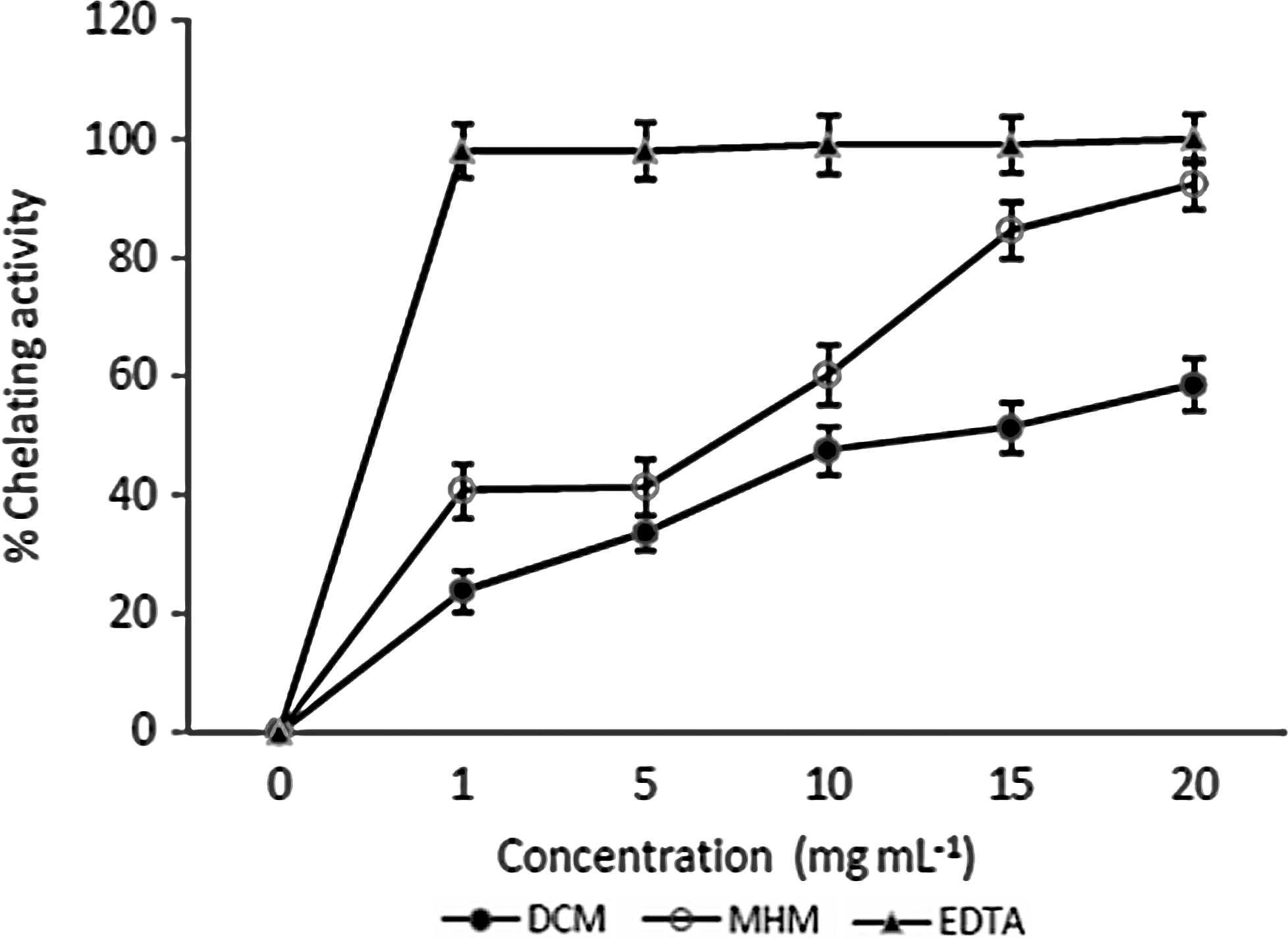
Metal chelating activity of H. madagascariensis extracts.
Reducing power of extract was determined by the ferric ion (Fe2+) reducing method (Fig. 3). The reducing ability of both extracts varied with varying concentrations. Generally, a higher absorbance indicates a greater reducing power. Obtained results indicated a higher reducing power in the methanol extract than the dichloromethane extract.
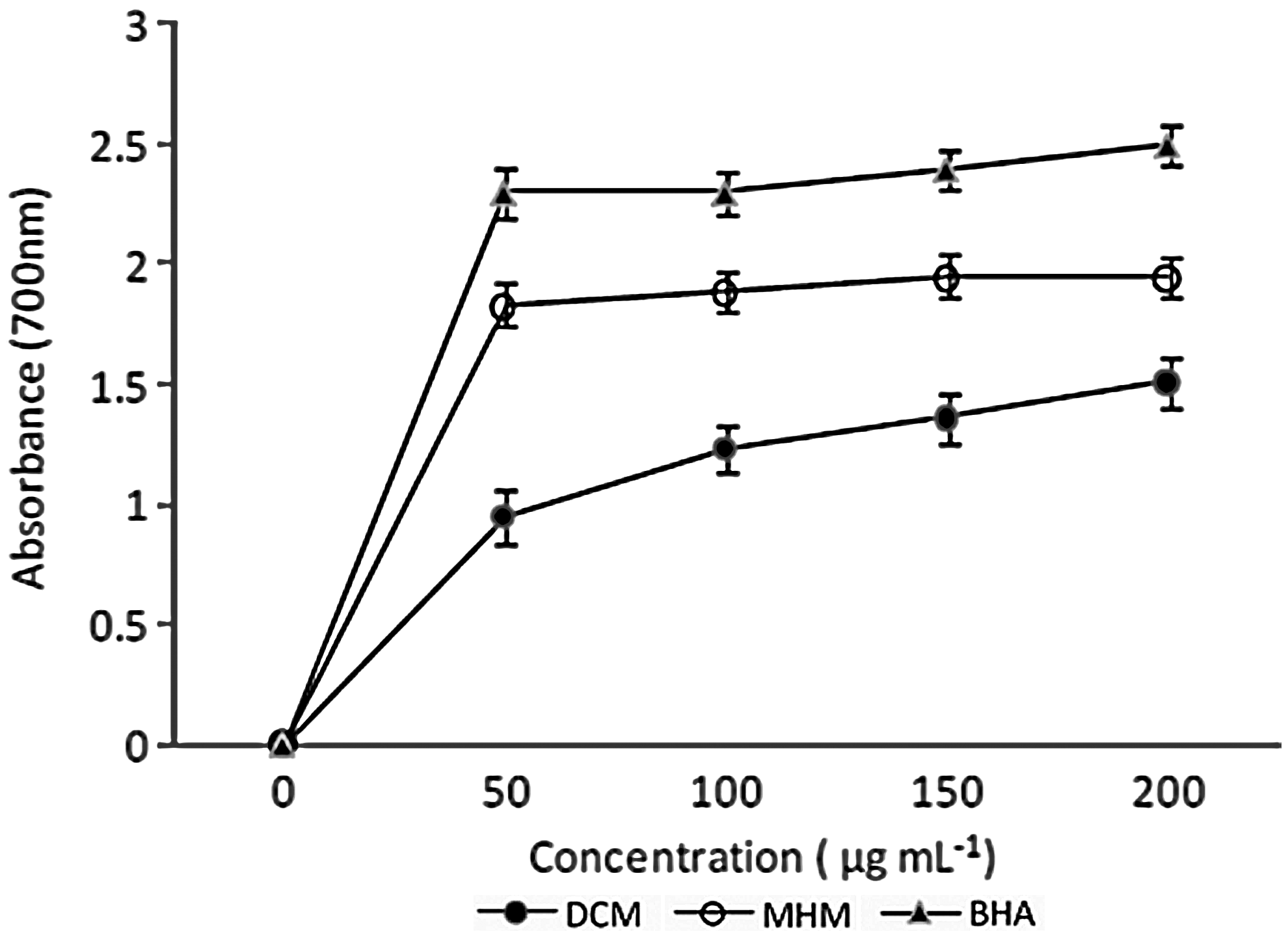
Reducing power of H. madagascariensis stembark extracts.
Flavonoid and phenolic contents of the extracts varied with solvent (Table 4). The methanol extract had higher contents of flavonoids (295.05±2.05 mgQE/g) and total phenolics (132.24±0.61 mgGAE/g) than the dichloromethane extract.
Phenolic compounds are secondary metabolites and are mostly represented by flavonoids and phenolic acids. Many studies have shown that phenolic compounds in plants show an antioxidant activity. These antioxidant compounds donate an electron to a free radical and convert it into an innocuous molecule. 50 Flavonoids are polyphenolic compounds that have antioxidant properties and have been associated with protection against cancer and heart disease. Our result compared favorably with previous studies on extracts of family Hypericaceae and showed an equivalent or higher content of flavonoids and phenolics. 49 Thus, the presence of significant amount of flavonoids and phenolics in the methanol extract may, in part, explain its antioxidant activity and metal chelating potential. This together with its content of minerals, vitamins, and phytochemicals lends credence to its various uses in ethnomedicine.
In conclusion, these analyses of H. madagascariensis methanol and dichloromethane stembark extracts showed that the plant contains some antioxidants and low levels of antinutrients—phytic acids, oxalates, and hydrocyanides. The plant, therefore, may play some contributory role in the prevention of diseases related to oxidative stress, in areas where it is widely consumed as herbs without any nutritive harm.
Footnotes
Author Disclosure Statement
No competing financial interests exist.