




Abstract
The antioxidant capacity and the polyphenolic profile of fresh and processed cherry tomatoes were analyzed with the aim of investigating the effect of industrial processes on the nutritional qualities of fruits. The results exhibited a decrease of antioxidant activity mainly in the lipophilic fraction of processed tomatoes compared with fresh products. No great difference in the antioxidant capacity was detected in the hydrophilic and methanolic extracts of fresh tomatoes and processed tomato juices. Moreover, a decrease of polyphenolic content, estimated by means of high-performance liquid chromatography analysis and Folin–Ciocalteu method, was observed in all tomato juices. The overall polyphenolic profile of both fresh and processed tomatoes did not change significantly and, among all juices, a higher polyphenolic content was detected in juice containing peels and seeds in comparison to those without. From our data on antioxidant power and the bioactive metabolite content, tomato juice could be used as a valid and easily available source of antioxidants in everyday diet to preserve human health.
Introduction
P
Several studies have shown the correlation between the intake of polyphenols and the prevention of cancer diseases. 6 –8 Furthermore, additional studies showed that there is a positive correlation between high polyphenol intake and decreased risk of coronary heart disease. 9,10
In plants, polyphenols vary in relation to the developmental stage, environmental conditions, and stress factors. They can differ among plant species and have various roles, which include protection against UV-B radiation and defense against pathogenic organisms. 11 –14
The tomato (Solanum lycopersicum), a major component of Mediterranean diet, is consumed both in fresh and processed products such as tomato juice, paste, puree, ketchup, and sauce. It has been reported that a diet rich in tomatoes can promote health by preventing chronic degenerative diseases and some types of cancer. 15 –17 The protective effects of tomato are due to the presence in this fruit of several bioactive compounds such as carotenoids and vitamins having known antioxidant activity. Tomatoes also contain phenolic compounds, which also display remarkable antioxidant and free radical scavenging properties. Since the tomato is mostly consumed as an industrially processed product, it is important to investigate how the industrial processes could influence the nutritional profile of the fruit to improve industrial food processing techniques. Some phases of the industrial process, in fact, may represent critical steps; for example, temperature values, time of heat treatment, oxidation, and the presence of metals can affect the levels and stability of certain bioactive compounds. It is well known, in fact, that ascorbic acid is heat sensitive and therefore a decrease of vitamins has been observed in tomato-processed products. For the relatively temperature-stable carotenoids, prolonged cooking can cause some losses and cis/trans bond isomerization. 18
The aim of the present work was to evaluate the nutritional profile, in terms of antioxidant power, of cherry tomato samples, both as fresh products and processing products (tomato juices) to assess nutritional modifications made by the process of transformation, in terms of functional compounds.
The study has been also focused on the evaluation of the polyphenolic profile of the samples before and after industrial processing to assess the variation of the polyphenolic content due to the industrial processing.
Materials and Methods
Sampling
Tomato samples, both in fresh and processed products (juice), were supplied and certified by a local farm. Two different methods were carried out to obtain juices with and without peels and seeds. One thousand five hundred grams of fresh product was boiled for few minutes and then passed in a common mill to remove the skin and seeds, thus obtaining 1130 g of juice without peels and seeds. Then, the juice was transferred into 200-mL glass bottles and sterilized (15–20 min at 100–110°C). In the other case, 1000 g of fresh product was homogenized in a mixer to obtain a juice containing skin and seeds that was transferred into 200-mL glass bottles and then sterilized (15–20 min at 100–110°C).
Extraction
Fresh tomatoes were homogenized in a blender and next centrifuged at 13,848 g for 20 min to obtain a supernatant (hydrophilic fraction) and a solid part (the pellet), while the juices were directly centrifuged at 13,848 g for 40 min. For all samples (fresh and juices), a supernatant (hydrophilic fraction) and a solid part (the pellet) were obtained. These different fractions were collected separately and kept at 4°C for further analysis.
Pellets were extracted with diethyl ether (1:2 g/mL) and stirred in the dark overnight. Lipophilic extracts were filtered, concentrated in a rotary evaporator under vacuum (temperature <35°C), and dried under N2.
In separate experiments, samples (fresh tomatoes and juices) were extracted with methanol for 30 min under magnetic stirring; the extractive process was repeated thrice. The extracts were filtered, concentrated in a rotary evaporator under vacuum, and dried under N2.
DMPD assay for hydrophilic fraction
The antioxidant activity of hydrophilic fraction of all samples was evaluated by the DMPD method. 19 Briefly, the reaction mixture contained 1 mM DMPD and 0.1 mM ferric chloride in 0.1 M acetate buffer (pH 5.25) in a total volume of 1 mL. Then, 5 μL of hydrophilic fraction was added to the reaction mixture and the absorbance was determined after 20 min at room temperature at λ=505 nm. The antioxidant activity of hydrophilic fraction was carried out in triplicate and expressed as % of inhibition of radical cation DMPD•+.
ABTS assay for lipophilic fraction
Evaluation of antioxidant activity of lipophilic fraction of all samples was performed according to the ABTS method. 20 The reaction mixture contained 56 mM ABTS and 24.5 mM K2S2O8 in ethanol (dilution 1:100) in a total volume of 1 mL. Five microliters of lipophilic fraction was added to the reaction mixture and the absorbance was determined at λ=734 nm after 5 min at room temperature. The antioxidant activity of lipophilic fraction was carried out in triplicate on each sample, dissolved at a main concentration of 20 mg/mL, and on its dilutions 1:2, 1:5, and 1:10. The antioxidant activity was reported as IC50, namely the concentration of samples at which 50% of inhibition of radical cation ABTS•+ is observed.
Free radical scavenging activity: DPPH assay
Solutions of methanolic extracts of all samples, at a concentration of 20 mg/mL in MeOH, were prepared for the DPPH test. 21 Fifty microliters of these solutions was added to 0.7 mL of 0.1 mM DPPH and adjusted to 2 mL final volume with MeOH. The absorbance at λ=517 nm was determined after 30 min at room temperature, and the antioxidant activity of samples was estimated as IC50, that is, the concentration value able to inhibit 50% of the radical DPPH•.
Hydrogen peroxide scavenging activity
The hydrogen peroxide scavenging assay was performed according to the method reported in Ruch et al. 22 A solution of 40 mM H2O2 was prepared in 0.1 M phosphate buffer pH 7.4. Different concentrations of methanolic extracts (50, 100, 200, and 500 μg/mL) were mixed to 0.6 mL of H2O2 solution and phosphate buffer was added up to a final volume of 4 mL. A blank solution containing the phosphate buffer without H2O2 was also prepared and the absorbance of all samples was measured after 10 min. All measurements were carried out in triplicate and results were reported as IC50.
Ferric reducing antioxidant power assay
The ferric reducing antioxidant power (FRAP) assay was used to estimate the reducing capacity of fruit extracts according to the method of Benzie and Strain. 23 The FRAP reagent contained 2.5 mL of a 10 mM TPTZ [2,4,6-Tris(2-pyridyl)-s-triazine] solution in 40 mM HCl, 2.5 mL of 20 mM FeCl3·6H2O, and 25 mL of 300 mM acetate buffer (pH 3.6). It was freshly prepared and warmed at 37°C. Nine hundred microliters of FRAP reagent was mixed with 90 μL of water and 30 μL of the extract. The reaction mixture was incubated at 37°C for 30 min and the absorbance was measured at 593 nm. All measurements were carried out in triplicate and results were reported as mgeq−1 Fe2(SO4)3.
Polyphenol content: Folin–Ciocalteu assay
Total polyphenol content was estimated by using the Folin–Ciocalteu colorimetric method. 24 Different amounts of samples (from 10 to 50 μL), diluted at a concentration of 20 mg/mL, were added to a reagent solution (800 μL of deionized water, 50 μL of Folin–Ciocalteu phenol reagent, 100 μL of 20% sodium carbonate solution) and mixed. Deionized water was then added up to a volume of 1 mL. The total phenol content was estimated at a spectrophotometer at λ=765 nm after a 2-h incubation at room temperature. Quantification was based on the standard curve generated with quercetin. All determinations were carried out in triplicate.
Polyphenolic profile-HPLC analysis
Methanolic extract from each sample was analyzed by reversed-phase high-performance liquid chromatography (HPLC) to determine the polyphenols profile and their quantitative composition. The system was a Shimadzu LC 6A with a Kromasil 100A C18 column, 5 μm, 250×10 mm (Phenomenex) with UV-VIS detector SPD 10A VP, CR 3A recorder, system controller SCL 10A VP, and Chemstation integration software Class–VP 5.0. Immediately before injection, the methanolic extracts were dissolved in 2 mL of methanol HPLC grade and filtered with a 0.22-μm PTFE syringe filter. For every HPLC chromatographic run, 50 μL was injected.
HPLC analysis was performed by using the following chromatographic conditions: gradient elution, 90:10 to 70:30, v/v, A/B (A was 0.3% of trifluoroacetic acid in water and B was acetonitrile), linear gradient changed over a period of 10 min and return to starting condition in 10 min before next injection; flow rate, 4 mL/min; the run time was 50 min, UV detector 450 nm, sensitivity adjusted to 0.04 AUFS; room temperature.
Results and Discussion
Nutritional quality, in terms of antioxidant capacity and polyphenolic content, was evaluated in fresh cherry tomatoes and their processed product as juice with and without peels and seeds. Results on the antioxidant activity linked to hydrophilic, lipophilic, and methanolic extracts of fresh and processed cherry tomatoes are reported in Table 1. As concerning the lipophilic and methanolic extracts of fresh products the Red cherry tomato showed the best results, in ABTS and DPPH assays, with IC50 values of 10.41 and 22.22 mg/mL, respectively. The others samples showed IC50 antioxidant activity values less than Red cherry tomato, which were 11.49 and 15.80 mg/mL in ABTS assay and 27.03 and 22.73 mg/mL in DPPH assay for Yellow and Black cherry tomatoes, respectively. On the contrary, hydrophilic fractions of Yellow and Black cherry tomatoes exhibited the best inhibition of cation radical DMPD•+ with 69% and 66% values, respectively, while Red cherry tomato showed 38% of DMPD•+ inhibition.
Results are referred to 100 g of fresh tomatoes or 100 mL of tomato juices.
FRAP, ferric reducing antioxidant power.
Among processed cherry tomatoes, hydrophilic fractions of Red and Black cherry tomato juices displayed an interesting antioxidant capacity in a range of 60–65% of DMPD•+ inhibition.
As regards lipophilic and methanolic extracts of cherry tomato juices, the antioxidant capacity differed from that of fresh samples, in particular, for lipophilic fractions. As expected, IC50 values calculated in the ABTS assay were higher than those registered for fresh cherry tomatoes resulting in a loss of antioxidant activity. We also found a difference between juices with and without peels and seeds except for Black cherry tomatoes in which IC50 values were similar. In contrast, in Red and Yellow cherry tomatoes, IC50 values of juices with peels and seeds were 18.55 and 95.24 mg/mL, respectively, while juices without peels and seeds showed 30.12 mg/mL (Red cherry tomato) and 156.25 mg/mL (Yellow cherry tomato) IC50 values.
It is known that the total antioxidant activity of tomatoes changes significantly depending upon the ripening stage, genotypic factors, and pedoclimatic conditions. 25 Because tomatoes are usually consumed as processed products (paste, peeled tomatoes, juice, etc.), the study on the preservation of their antioxidant properties after processing has gained the attention of several researchers. 26 –29 Although several articles described an increase of lipophilic antioxidants (i.e., carotenoids) in processed tomato products, 30,31 the partial loss of antioxidant activity in lipophilic fractions of cherry tomato juice here described could be due to the high temperature used in the sterilization step.
The methanolic extracts also were assayed for their antioxidant properties by means of DPPH, hydrogen peroxide scavenging, and FRAP assays. As regards the DPPH scavenging activity, there were no great differences between all tested extracts; namely, all extracts showed an antioxidant capacity in an IC50 value range of 15–22 mg/mL. On the contrary, hydrogen peroxide scavenging and FRAP assays showed that, among fresh tomatoes, the Red cherry and Black cherry tomatoes were the most interesting samples [7.20 and 11.11 mgeq−1 Fe2(SO4)3 in FRAP assay, respectively, and IC50 values of 0.05 and 0.10 mg/mL in hydrogen peroxide scavenging assay, respectively]. There was a significant difference in the polyphenolic content evaluated by the Folin–Ciocalteu method. Fresh cherry tomatoes, in particular, Red and Yellow cherry tomatoes, exhibited an estimated polyphenol content of 89.70 and 49.20 mmol/100 g, respectively. Among tomato juices, Red cherry tomato with peels and seeds showed the best result (18.70 mmol/100 g). This result was in accordance with its antioxidant activity evaluated by means of FRAP and hydrogen peroxide scavenging assays. Indeed, the Red cherry tomato juice, with and without peels and seeds, exhibited the best antioxidant effect [12.17 and 8.15 mgeq−1 Fe2(SO4)3 in FRAP assay, respectively, and IC50 values of 0.05 and 0.10 mg/mL in hydrogen peroxide scavenging assay, respectively].
On the basis of the above-mentioned results, a qualitative analysis by the HPLC method was performed on methanolic extracts of fresh products and juices with peels and seeds to evaluate their polyphenolic profile. All extracts were dissolved in methanol at a concentration of 20 mg/mL and injections of 50 μL (1 mg of extract) were carried out. Six standards (chlorogenic acid, ferulic acid, caffeic acid, coumaric acid, naringenin, esperetin) were dissolved in methanol at a concentration of 2 mg/mL and injections of 50 μL (100 μg) were performed. Polyphenols were identified by comparing them with standards at the HPLC condition described in the Materials and Methods section. The chromatograms are showed in Figure 1.
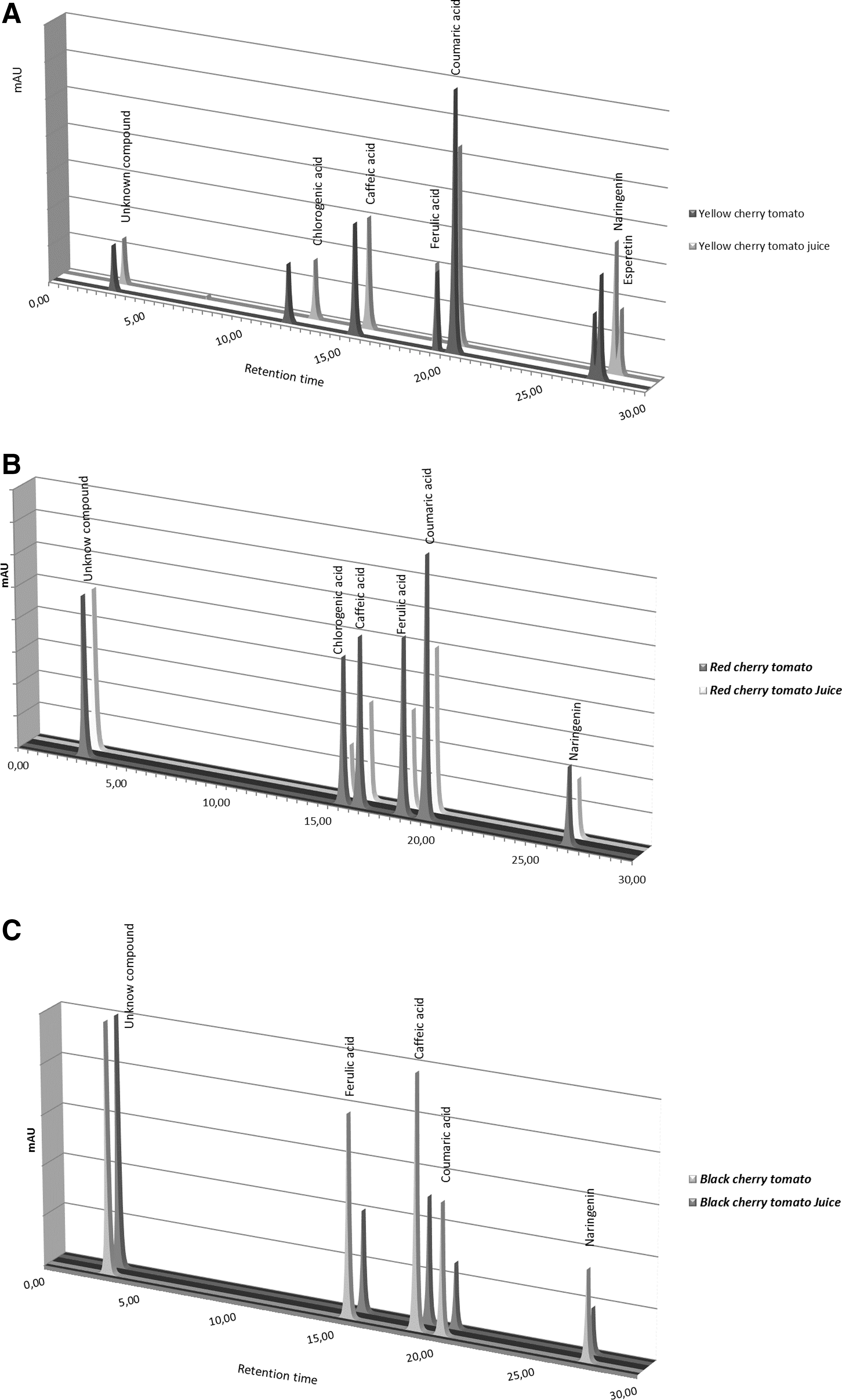
High-performance liquid chromatography polyphenolic profile of fresh and processed (juice with peels and seeds) cherry tomatoes.
Among all analyzed samples, only Yellow cherry tomato, both as fresh and juice product, showed the presence of all standards, and even if in a processed product, a decrease of coumaric acid and naringenin was observed. On the contrary, there was a little increase of esperetin. As regards Red cherry tomato, the chromatograms of the fresh tomato and juice exhibited the presence of almost all standards, except esperetin. Moreover, in the juice, a significant decrease of all polyphenols was detected. As concerns Black cherry tomato, only four polyphenols were detected and identified as ferulic acid, caffeic acid, coumaric acid, and naringenin. In this sample also, a marked decrease in polyphenolic content was observed. The above-described results were in accordance with the estimated polyphenolic content evaluated by the Folin–Ciocalteu method (89.70 mmol/100 g in fresh tomato vs. 11.40 and 18.70 mmol/100 g in Red cherry tomato juice 49.20 mmol/100 g in fresh tomato vs. 6.45 and 10.80 mmol/100 g in Yellow cherry tomato juice 7.30 mmol/100 g in fresh tomato vs. 4.72 and 6.36 mmol/100 g in Black cherry tomato juice). Our results showed that the juices with peels and seeds contained more polyphenolic compounds, in accordance with data reported in literature. Indeed, because 98% of total flavonols occurred in the skin, the cherry tomato juices with peels showed a higher content of these compounds. 32
Tomatoes are also a rich source of phenolic compounds due to their marked antioxidant activity and other potential health benefits. 6,33,34 It is known that environmental conditions and type of cultivars are the major factors contributing to the total content of phenolics in tomatoes. 32
In summary, our results showed that all analyzed samples, both as fresh and processed products (juices with peels and seeds), exhibited an interesting polyphenol profile. In all samples, ferulic acid, caffeic acid, coumaric acid, and naringenin were detected, while chlorogenic acid and esperetin were noticed only in Yellow cherry tomatoes (for both) and Red cherry tomatoes (for chlorogenic acid). The polyphenolic analysis performed in HPLC revealed the same profile in both fresh tomatoes and in juices for the same variety. However, there was a difference in specific polyphenols in some samples after processing. These results showed that the industrial processes also effected the polyphenol profile of tomatoes, even if tomato flavonols are able to resist industrial processes, and then they were detected in a variety of processed tomato products. 32
In conclusion, our study was carried out to estimate the overall antioxidant activity and the polyphenolic profile of fresh and processed cherry tomatoes. Our results indicated that the genotypic factor had an effect on the bioactive metabolite content and on the antioxidant capacity of tomatoes. Furthermore, the industrial processes also effected the content of carotenoids and polyphenols, although the analyzed juices preserved an interesting total antioxidant activity in all kinds of tested extracts, and a considerable polyphenolic profile and content. Accordingly, tomato juices could represent an effective contribution to the daily antioxidant intake to reduce the risk to some health diseases (i.e., cancer and cardiovascular pathologies).
Footnotes
Acknowledgment
This work was supported by a dedicated grant from the Italian Ministry of Economy and Finance to the National Research Council for the project “Innovazione e Sviluppo del Mezzogiorno, Conoscenze Integrate per Sostenibilita’ ed Innovazione del Made in Italy Agroalimentare, Legge No. 191/2009.”
Author Disclosure Statement
No competing financial interests exist.