




Abstract
Plant essential oils (EOs) can potentially replace synthetic fungicides in the management of postharvest fruit and vegetable diseases. The aim of this study was to evaluate in vitro and in vivo effectiveness of thymol, carvacrol, linalool, and trans-caryophyllene, single constituents of the EO of Origanum vulgare L. ssp. hirtum against Monilinia laxa, M. fructigena, and M. fructicola, which are important phytopathogens and causal agents of brown rot of pome and stone fruits in pre- and postharvest. Moreover, the possible phytotoxic activity of these constituents was assessed and their minimum inhibitory concentration (MIC) was determined. In vitro experiment indicated that thymol and carvacrol possess the highest antifungal activity. Results of in vivo trials confirmed the strong efficacy of thymol and carvacrol against brown rot of peach fruits. The thymol MIC resulted to be 0.16 μg/μL against M. laxa and M. fructigena and 0.12 μg/μL against M. fructicola, whereas for carvacrol they were 0.02 μg/μL against the first two Monilinia species and 0.03 μg/μL against the third. Results of this study indicated that thymol and carvacrol could be used after suitable formulation for controlling postharvest fruit diseases caused by the three studied Monilinia species.
Introduction
F
Over several decades, different control measurements have been accomplished to prevent or eradicate plant diseases, and several novel synthetic fungicides were found particularly effective. 3 Nevertheless, their continued applications sometimes disrupt the equilibrium of environmental ecosystems and induce development of new fungal pathogen races resistant to them. Therefore, the development of natural antimicrobials and biopesticides would help in decreasing the harmful impact of synthetic pesticides and their accumulation in ecosystems.
Significant losses were recorded in fruit crops all over the world due to the brown rot disease caused by Monilinia spp. such as M. laxa (Aderhold and Ruhland), M. fructicola (Winter) Honey, and M. fructigena (Aderhold and Ruhland). 4,5 In particular, M. fructicola has been enclosed in the A2 list for quarantine organisms in Europe. 5,6 Further spread in Europe would lead to increased control costs and perhaps the appearance of resistance to fungicides of its new races. 7
In France and Italy, synthetic fungicides are prohibited in postharvest applications. 8 Dicarboximide-resistant strains of M. fructicola found in New Zealand orchards were an example of resistance as a result of the frequent applications of these active substances. 9 Coupled resistance of M. fructicola to benomyl and iprodione has been documented around the world. 10,11 M. fructicola has also been reported to develop multiple resistance to benzimidazole, dicarboximide, and demethylation inhibiting chemical compounds. 12,13 Most strains of fungi, which became tolerant to benomyl, also showed cross-tolerance to thiabendazole. Due to their resistance phenomenon in Australia, carbendazim has been withdrawn from the list of registered fungicides, and benomyl is no longer widely used in stone fruit orchards. 11
Recently, Mancini et al. 14 reported the chemical composition of essential oils (EOs) of Origanum vulgare L. ssp. hirtum, collected from three different localities in the Southern Apennines, and the possible antifungal activity against the three above-mentioned fruits postharvest pathogens (M. laxa, M. fructigena, and M. fructicola). The results showed that the phenolic compounds thymol and carvacrol (65.3–84.7%) were the major constituents of EOs, followed by linalool (0.1–2.6%) and trans-caryophyllene (1.5–3.2%). 14 The three O. vulgare EOs exhibited a high inhibitory activity against the three tested Monilinia species, especially when used at the highest tested dose of 1000 ppm. 14 It, therefore, seemed opportune to evaluate the in vitro and in vivo antifungal activity of the above-mentioned constituents against the same Monilinia species. Moreover, the possible phytotoxic activity of the same constituents was assessed and their minimum inhibitory concentration (MIC) was determined.
Materials and Methods
Chemicals
Thymol, carvacrol, linalool, and trans-caryophyllene were purchased from Sigma Aldrich Co. (Milan, Italy) and kept at −20°C.
Fungal isolates
The isolates of Monilinia species used in this study were derived from a pure culture-maintained collection of the School of Agricultural, Forestry, Food and Environmental Sciences, University of Basilicata (Potenza, Italy), kept on a potato dextrose agar (PDA) at 4°C. In particular, M. laxa (isolate 1517 from pear), M. fructicola (isolate 1561 from plum), and M. fructigena (isolate 1521 from apple) were used. The morphological identification was attempted using a light microscope (Axioskop; ZEISS, Germany) and molecular tools. For the molecular identification, total DNA was extracted using a DNeasy Plant mini kit (QIAGEN, Hilden, Germany) from the anamorph of each tested species of Monilinia and amplified with primer ITS4/ITS5. 15 The obtained amplicons were directly sequenced and the resulting sequences were compared with those available in the GenBank using BLAST software. 16
Bioassays
In vitro test
PDA was used for the fungal culture media. The possible fungicidal activity of the four standards (thymol, carvacrol, linalool, and trans-caryophyllene) was determined according to the method of Soylu et al. 17 Three-millimeter-thick and 5-mm diameter PDA plugs, axenically taken from the peripheral portion of basic colonies, were inoculated onto the central part of Petri dishes, 90 mm in diameter, previously filled with PDA containing 0.2% Tween-20 and 50, 150, or 250 ppm of each studied constituent. All plates were incubated at 22°C for 96 h under darkness. Negative controls were constituted by PDA plates without the standards and other ones only added 0.2% of Tween 20. The antifungal activity was expressed in terms of diameter of mycelium growth in millimeters. 18
In vivo test
The components, which exhibited the highest efficiency in vitro, were evaluated in vivo against brown rot of peach fruits caused by the three Monilinia species using the method of Hong et al. 19 Different series of peach fruits cv. Springcrest, each composed of 18 specimens not subjected to any pre- and postharvest chemical treatment, were superficially sterilized by a 10-min immersion in a 2% sodium hypochlorite solution, repeatedly washed with sterile distilled water, and then dried on sterile filter paper before being artificially inoculated with one of the above-mentioned three Monilinia species. The challenge of the studied pathogens were performed at room temperature by puncturing with a sterile needle each fruit in three points a part 25 mm each from the other and putting on each wound 10 μL of the single broth cultures containing 106 spore form U/mL. Broth fungal cultures were prepared by adding two loopful of fresh fungal mycelium taken from 4-day-old PDA colony-grown cultures in a 90-mm-diameter Petri dish to a 150 mL sterilized potato dextrose broth medium and then incubated at 22°C for 7–9 days. One day after inoculation, the single fruit series composed of 18 fruits were sprayed with an emulsion containing sterile distilled water, 0.2% Tween 20, and 150 or 500 ppm of the single components. Each experiment was carried out in triplicate. Three groups of fruits were sprayed only with sterile distilled water and used as a negative control. Three groups of fruits were inoculated only with the single Monilinia isolates as a positive control. All the fruit series were kept in a moist chamber for 3–5 days at room temperature (16–24°C) before being observed for the appearance of eventual symptoms.
Severity of symptoms induced by infection of the single Monilinia isolates was determined by measuring the diameter of brown rot lesions in millimeter. The presence of inoculated Monilinia species was verified by morphological and molecular techniques after reisolation from the edge of lesions. Results were statistically processed and subjected to analysis of variance (ANOVA). Significantly different means were separated by Duncan and Tukey tests using the SPSS software program.
Determination of MIC (agar dilution method)
The MIC of the highest two effective bioactive substances, in vitro and in vivo, was evaluated against the same tested Monilinia species by incorporating different concentrations into the PDA medium. Petri dishes were centrally inoculated after that with a 5-mm-diameter fungal disk. In particular, the two selected substances have been tested at two different concentration series ranging from 0.001 to 0.05 μg/μL and from 0.08 to 0.1 μg/μL corresponding to the obtained results of in vitro and in vivo tests. The above concentrations were prepared by dissolving each single EO constituent at 50°C in a sterilized PDA medium containing 0.2% Tween 20. The MIC was considered as the lowest concentration of each oregano EO component determining no visible mycelium growth after an incubation time of 72–96 h compared to positive fungal growth control. 20
Phytotoxicity test
Two series of peach fruits of the above cultivar were subjected to one single application of each component, which has been selected for an in vivo test previously diluted at 150 and 500 ppm. All treated fruits were then kept in a moist chamber for 3–5 days at room temperature before being observed for possible phytotoxicity symptom appearance. A series of peach fruit sprayed only with sterile tap water was used as a negative control. 20
Statistical analysis
The experimental data were statistically analyzed using the one-way ANOVA system. The Duncan and Tukey post hoc tests were followed for showing any significant differences among the studied treatments employing the SPSS statistical software, Version 13.0 (2004).
Results
Fungal isolates
The sequences of DNA extract obtained from the anamorphs of each tested species of Monilinia, compared with those present in GenBank, confirmed the morphological identification by the microscopic technique. One sequence of each species of Monilinia tested was deposited in GenBank with accession code HF678387 (M. laxa), HF678388 (M. fructicola), and HF678389 (M. fructigena).
In vitro test
In vitro carvacrol and thymol exhibited the highest activity against all tested Monilinia species; linalool and trans-caryophyllene showed a weak antifungal activity, independently on the target Monilinia species (Fig. 1A–C). More in detail, thymol showed a clear fungitoxic activity, whereas carvacrol displayed a more fungistatic activity. In fact, the utilized fungal disc started again to develop mycelium 4 days after being recultured on the new untreated PDA. In contrast, thymol treatments completely inhibited mycelial growth from the utilized fungal discs.
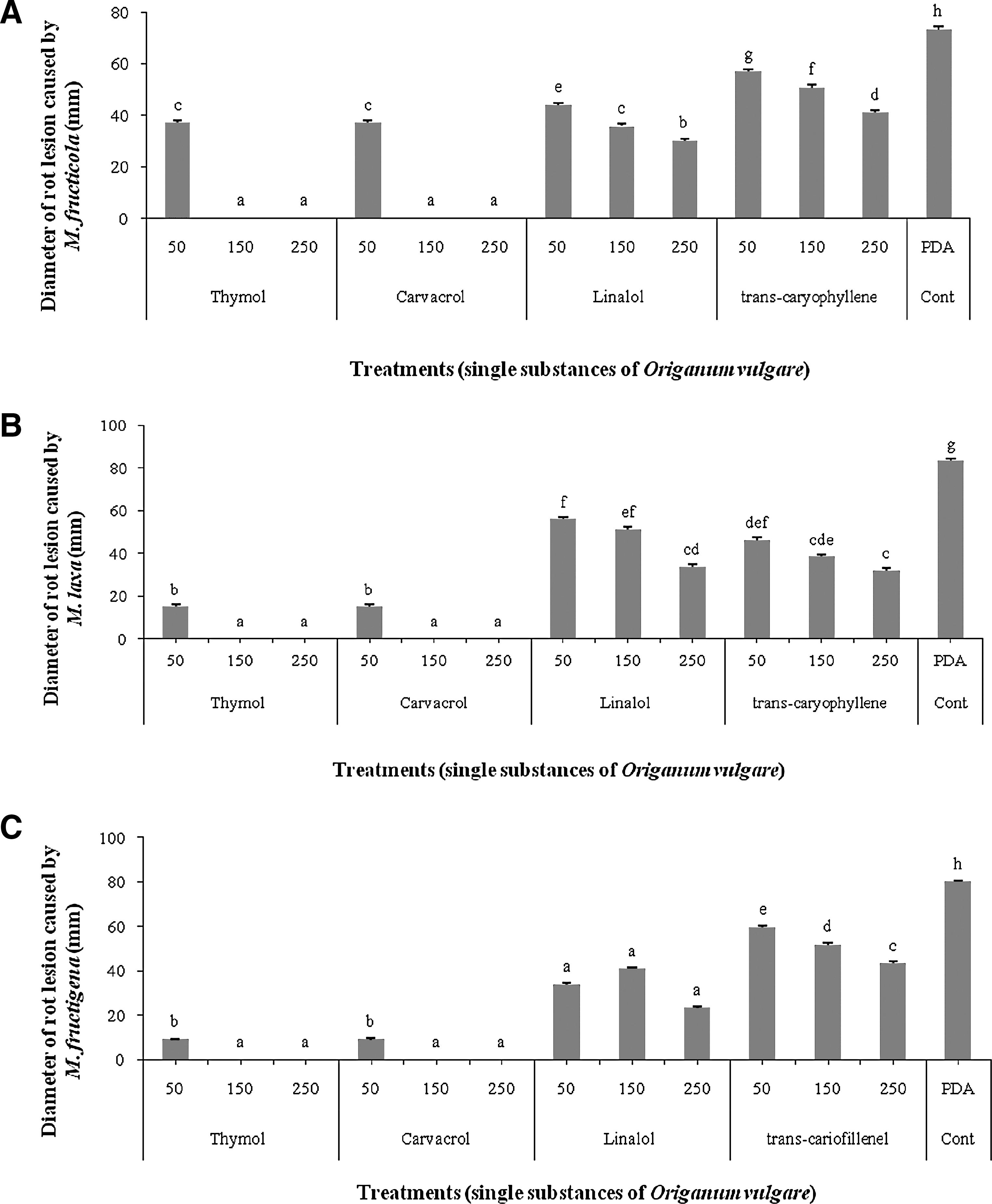
In vitro antifungal activity of the four standards against Monilinia fructicola
In vivo test
At the dose of 500 ppm, carvacrol and thymol exhibited a high inhibitory activity against the three target Monilinia species. In particular, carvacrol showed the highest significant antifungal activity against M. fructicola (Fig. 2). The same species of inoculated Monilinia were always reisolated from the necrotic lesions on peach fruits.
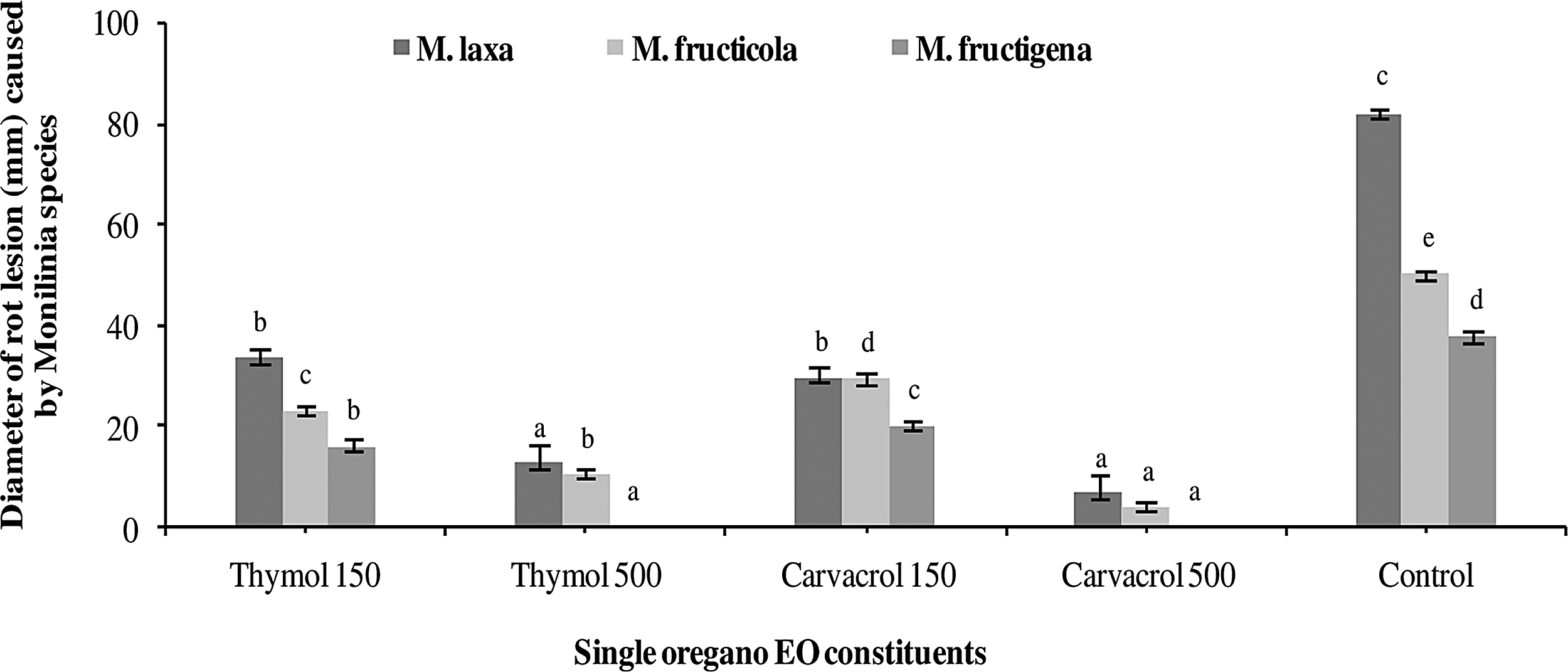
In vivo antifungal activity of thymol and carvacrol against brown rot disease of peach fruit caused by M. laxa, M. fructicola and M. fructigena. Bars with different letters for each pathogen indicate mean values significantly different (P<.05) according to the Duncan test. Data are expressed as mean of three replicates±SE, where 150 and 500 are the concentrations of each substance in ppm.
Minimum inhibitory concentration
The MICs of thymol against M. laxa, M. fructigena, and M. fructigena were 0.16 μg/μL for the first two species and 0.12 μg/μL for the third one. Whereas the MICs of carvacrol resulted in 0.02 μg/μL against M. laxa and M. fructigena and 0.03 μg/μL against M. fructicola (Fig. 3A, B).
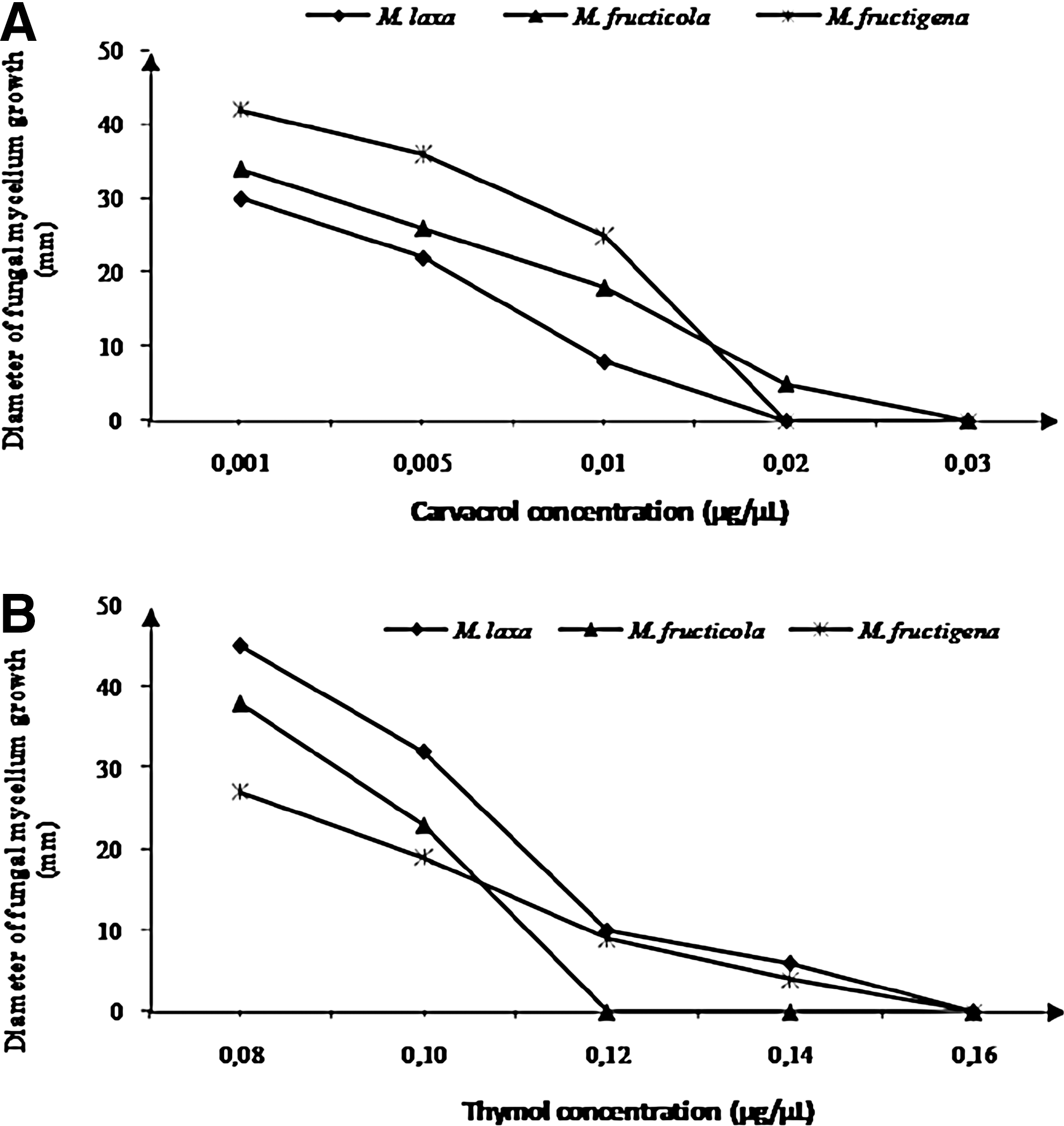
Minimum inhibitory concentrations of carvacrol and thymol against the three Monilinia species.
Phytotoxicity test
The two tested constituents, carvacrol and thymol, did not show any phytotoxic effect to peach fruits. These results showed the possibility of using these components in Agropharmacy.
Discussion
The results showed that carvacrol and thymol explicate the highest in vitro and in vivo antifungal activity against the three Monilinia species studied. The antifungal activity can be explained by the chemical structure of these compounds. In particular, carvacrol and thymol are phenolic compounds with similar structures (carvacrol: 5-isopropyl-2-methylphenol; thymol: 2-isopropyl-5-methylphenol), isolated from several aromatic plants. The antifungal activity of phenolic compounds, such as thymol and carvacrol, on apricot, plum, sweet cherry, and table grape, was investigated some years ago and the potential in reducing fruit fungal decay was confirmed. 21 These compounds were reported to have a lipophilic character, acting in cell wall and interfering with membrane-catalyzed enzymes and with enzymes responsible for energy and protein production, causing as a result the cell death. 21 Moreover, the presence of an aromatic nucleus and one hydroxyl group is important for their antimicrobial activity. In fact, it has been found that these chemical groups cause alterations in the hyphal morphology and aggregates, resulting in reduced diameters and lyses of the hyphal wall, as these interact with the cell membrane of microbial pathogens. 22
The antimicrobial activity of EO from thyme, clove, and oregano was assigned to thymol, eugenol, and carvacrol, respectively. 14,23 –26 Lambert et al. 25 studied the antibacterial activity of oregano EO and reported that it can induce the permeability of the microorganism membranes such as Pseudomonas aeruginosa and Staphylococcus aureus with a consequent leakage of protons, phosphates, and potassium. In particular, the antibacterial activity of carvacrol is attributed to bacterial plasma membrane disruption. 27 –29
Various studies have verified the antifungal activity of carvacrol against several strains of pathogenic fungi such as Fusarium moniliforme, Rhizoctonia solani, Sclerotinia sclerotiorum, and Phytophthora capisci. 27 The phenolic nature of carvacrol could explain its interactions with the cell membrane of microorganisms, which is correlated with its hydrophobicity. 30 –33 Thymol has strong antimicrobial properties. Several studies showed that its biocide nature ranges from inducing antibiotic susceptibility to promote antioxidant effects, which lead to growth inhibition and lactate production. 34,35 On the other hand, thymol and carvacrol showed an effective fungicidal effect against Candida albicans. 36 Chu et al. 37 found that thymol is able to reduce the postharvest brown rot and blue mold rot of sweet cherries. In addition, Falcone et al. 38 suggested that thymol can be successfully used as an alternative antimicrobial substance to increase the lag time as well as to decrease the maximum value of the stationary growth phase in some serious hygiene-indicating and controlling pathogenic bacteria. In addition, the thymol lipophilic nature allows it to interact with the cell membrane of fungus cells and hence changing its permeability. 39 Several studies demonstrated the powerful effect of the synergic action of both thymol and carvacrol to increase antibiotic susceptibility of drug-resistant bacteria such as Salmonella typhimurium spp., Streptococcus pyogenes, and Staphylococcus aureus. 40 In addition, the studied constituents did not show any phytotoxic effect on peach fruits in accordance with Camele et al., 41 who reported that O. vulgare could be used as possible source of ecofriendly botanical fungicides for controlling important postharvest fungal pathogens without apparent phytotoxicity problems.
Results of this study showed that thymol and carvacrol could be used, properly formulated, for controlling the postharvest fruit brown rot diseases. The MICs registered for thymol and carvacrol showed their strong powerful antifungal effect and push to judge their possible future employ in postharvest brown rot fruit disease control as alternative to fungicides. It appears of importance that these compounds showed no toxicity on treated fruits.
Footnotes
Author Disclosure Statement
No competing financial interests exist.