




Abstract
Oligonol is a low-molecular-weight polyphenol that possesses antioxidant and anti-inflammatory properties. This study investigated the effects of Oligonol supplementation on sweating response, plasma volume (PV), and osmolality (Osm) after heat load in human volunteers. We conducted a placebo-controlled crossover trial. Participants took a daily dose of 200 mg Oligonol or placebo for 1 week. After a 2-week washout period, the subjects were switched to the other study arm. As a heat load, half-body immersion into hot water (42°C±0.5°C for 30 min) was performed in an automated climate chamber. Tympanic and mean body temperature (Tty, mTb) and whole-body sweat loss volume (WBSLV) were measured. Changes in PV, Osm, and serum levels of aldosterone and sodium were analyzed. Oligonol intake attenuated increases in Tty, mTb, and WBSLV after heat load compared with the placebo (P<.01, P<.05, and P<.01, respectively). In addition, serum aldosterone was maintained at a relatively low degree and serum sodium was maintained at a relatively high degree with Oligonol compared to the placebo (P<.01 and P<.05, respectively). However, PV decreased and Osm increased significantly with Oligonol compared to the placebo (P<.05 and P<.05, respectively). This study demonstrates that Oligonol supplementation for 1 week can attenuate elevation of body temperature and excessive sweating under heat load in healthy humans, but interpretation of the results requires caution due to the potent diuretic effect of Oligonol.
Introduction
E
Sweating is a physiological reaction to high internal or external temperatures and is produced by sweat glands located across the entire surface of the body. Sweating is primarily controlled neutrally through the integration of internal and skin temperatures, although a variety of other nonthermal factors (i.e., exercise and fluid status) can modify the sweating response. 1 In addition, supplementing nutrients such as carbohydrates, electrolytes, proteins, and glycerol can modify the sweating response before and after heat stress. 2 –5
In our preliminary studies, supplementation of Oligonol, a natural bioactive material with antioxidant properties, attenuated increases in body temperature and fever-related peptides under passive heating. 6 –10 This led us to hypothesize that Oligonol ingestion affects the sweat rate because sweat rate varies according to body temperature. We also hypothesized that Oligonol ingestion affects plasma volume (PV) and osmolality (Osm), and related factors, including aldosterone and sodium, because these factors are modified by the sweat rate.
To test the hypotheses, we measured the sweat rate, PV, Osm, serum levels of aldosterone and sodium before and after heat load, as well as before and after 1 week of Oligonol or placebo supplementation in human volunteers. The heat load was half-body immersion of the volunteers in hot water. Passive hyperthermia (rise in core temperature) is the consequence of heat gain that exceeds the body's ability to dissipate heat and is observed under environmental heat load such as hot water immersion.
Materials and Methods
Subjects were given Oligonol (200 mg/day) or a placebo for 1 week in this placebo-controlled crossover study. The two periods were separated by a 2-week washout period. As a heat load, half-body immersion in hot water was conducted at the end of each period.
Subjects
The experimental protocol was approved by the University of Soonchunhyang Research Committee, and written informed consent was obtained from each subject after the purpose of the study and experimental procedures as well as any potential risks were thoroughly discussed. Nineteen healthy male college students (age 23.7±2.3 years; height 174.5±4.1 cm; weight 68.9±5.2 kg; body–mass index 19.8±3.0; body fat 16.4%±3.2%; VO2max 52.1±4.3 mL/kg/min) were enrolled. The protocol complied with the Helsinki Declaration of 1975. Subjects refrained from consumption of alcohol and caffeine, smoking, medication, and vigorous physical activity during the testing period.
Supplements
Oligonol is produced by oligomerization of polyphenols abundantly found in the lychee fruit. The typical constituents of Oligonol are 15–20% monomers, 8–12% dimers, and 5–10% trimers. The Oligonol used in this study was supplied by the Amino Up Chemical Company (Sapporo, Japan). The safe repeated dose of Oligonol was previously determined less than or equal to 200 mg/day, 11 so 200 mg/day was used in this study. Empty placebo capsules with the same size and color were used.
Heat load
All experiments were conducted in a thermoneutral climate chamber (26°C±0.5°C, 60%±3% relative humidity, and an air velocity <1 m/sec) between 2 PM and 5 PM at the 6th and 27th day of May. On arriving at the climate chamber, the subjects wore short pants and sat in a chair in a relaxed posture for 60 min to become conditioned to the chamber climate before the commencement of the experiments. After 60 min of rest, heat load was applied to each subject through half-body immersion up to waist level in hot water bath maintained at 42°C±0.5°C for 30 min. Due to the uncomfortably hot water temperature, subjects were allowed to take breaks as short as 1 min at 5-, 10-, and 20-min check points during the 30-min immersion. Participants did not consume caffeine, smoke, or consume alcohol 48 h before the test and refrained from intense physical activities 24 h before the test. Drinking water during the immersion experiments was not permitted.
Tympanic temperature measurement
Tympanic temperature (Tty) was assessed continuously (10-sec interval for 30 min) in the left ear through the insertion of a thermistor probe (TSK7+1; Songkitopia, Incheon, Korea) with a small spring into the ear canal (Takara, Instrument Co. Ltd., Yokohama, Japan) connected to a personal computer (model CF-T1; Panasonic, Tokyo, Japan), which was also connected to a model K-720 data logger (Technol Seven, Yokohama, Japan). 10,12 As the thermistor probe contacted the tympanic membrane, the subject felt slight discomfort and could hear a scratching noise. The inner pinna was then filled with small cotton balls to fix the position of the probe. 10,12
Mean body temperature and mean skin temperature measurements
Skin temperatures were measured at the 60-sec break, after 5 min, 10 min, 20 min, and at the end of bathing out of the water. Skin temperatures on the chest (T 1), upper arm (T 2), thigh (T 3), and leg (T 4) were measured using thermistor thermometers (PXK-67; Technol Seven) that were connected to a data logger (K-720; Technol Seven). 13 Mean skin temperature (mTs) was calculated using the Ramanathan equation 13 : mTs=0.3×(T 1+T 2)+0.2×(T 3+T 4). Mean body temperature (mTb) was calculated from the Tty and mTs using the following equation: mTb=0.9×Tty+0.1×mTs. 12
Whole-body sweat loss volume
Body weight loss after half-body immersion can be caused by sweating. Body weight was therefore measured before and after immersion with a precision instrument (IW2, Sartorius, Germany) to determine the whole-body sweat loss volume (WBSLV).
Blood sampling and analyses
Two aliquots of blood were taken from each subject at each draw. Blood drawn into a heparinized syringe (2 mL) was immediately tested for hematocrit, hemoglobin, and Osm values using a blood gas analyzer (GEM Premier 3000; Instrumentation Laboratories, Lexington, MA, USA). Hematocrit and hemoglobin values were used to calculate the change in relative PV using the method described by Dill and Costill. 14 A second sample (5 mL) was drawn into a nonheparinized vacutainer and immediately centrifuged at 4°C and 1500 g for 10 min. Aliquots of serum were assayed for concentrations of aldosterone (ELISA; Alpha Diagnostics Intl, San Antonio, TX, USA) and sodium (Fiske 2400, Norwood, MA, USA).
Statistical analysis
Descriptive statistics were expressed as the mean±standard deviation using SPSS for Windows, version 12.0 (SPSS, Chicago, IL, USA). T-tests were performed to analyze differences in WBSLV and PV changes in placebo versus Oligonol groups. Repeated two-way ANOVAs were performed to compare changes over time in Tty and mTb, serum sodium and aldosterone concentrations, and Osm between two groups. The level of significance was set at P<.05.
Results
Tty and mTb
Tty and mTb of both groups increased significantly from resting levels immediately after immersion. However, Tty and mTb of the Oligonol group were lower compared with the placebo group (P<.01, P<.05, respectively) (Fig. 1).

Tty and mTb in the two groups before and after heat load (at 42°C±0.5°C for 30 min). Values are mean±SD. Significant difference between groups at #
P<.05, ##
P<.01, and within each group at ***P<.001, respectively. mTb, mean body temperature; O, Oligonol; P, placebo; SD, standard deviation; Tty, local tympanic temperature. Color images available online at
Whole-body sweat loss volume
WBSLV was significantly higher in the placebo group after heat load than in the Oligonol group (P<.01) (Fig. 2).
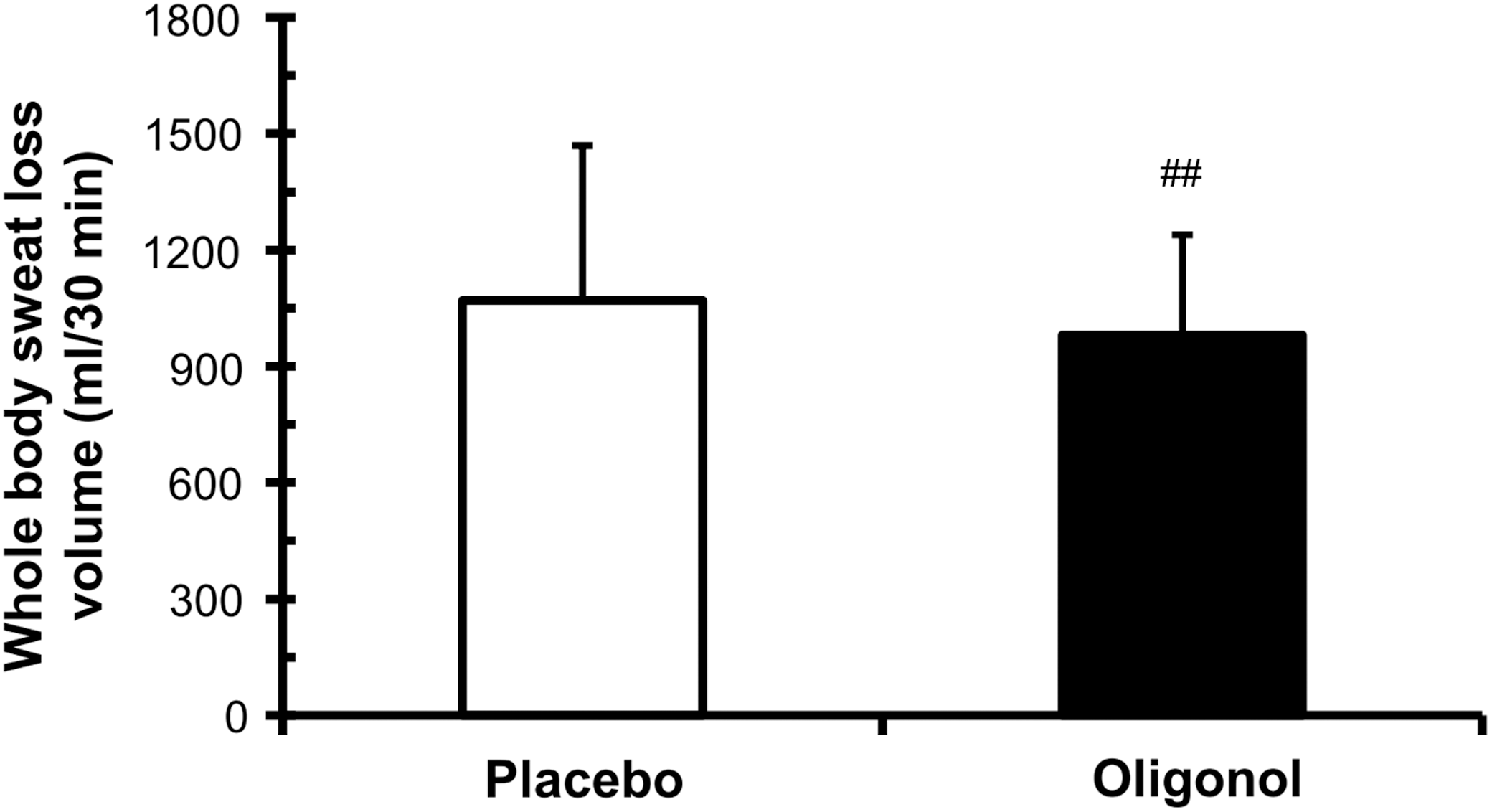
Whole-body sweat loss volumes in the two groups after heat load (at 42°C±0.5°C for 30 min). Values are mean±SD. Significant difference between groups at ## P<.01.
Blood parameters
Hemoglobin and hematocrit increased in both groups, but a much greater elevation was seen in the Oligonol group than the placebo group (hemoglobin; a 5.2% change vs. a 3.0% change, P<.01, hematocrit; a 3.5% change vs. a 2.6% change, P<.05).
PV decreased after half-body immersion for all groups. However, there was a significant difference in the PV change between the Oligonol and placebo groups after immersion (P<.05) (Fig. 3).

Plasma volume changes in the two groups after heat load (at 42°C±0.5°C for 30 min).Values are mean±SD. Significant difference between groups at # P<.05.
Blood sodium in the two groups was similar before immersion and was significantly lower after immersion for both groups. However, blood sodium remained higher for the Oligonol group compared to the placebo group (P<.05) (Fig. 4).

Sodium concentration in the two groups before and after heat load (at 42°C±0.5°C for 30 min). Values are mean±SD. Significant difference between groups at # P<.05 and within each group at ***P<.001, respectively.
Serum aldosterone was similar before immersion and at the 5-min check point. Although the pattern of change in aldosterone was similar for the two groups during immersion, aldosterone was significantly lower after immersion (at 30 min) for the Oligonol group compared to the placebo group (P<.01) (Fig. 5).

Serum aldosterone levels in the two groups during heat load (at 42°C±0.5°C for 30 min).Values are mean±SD. Significant difference between groups at ## P<.01, and within each group at ***P<.001, respectively.
Osm increased after immersion only in the Oligonol group (P<.01) (Fig. 6).
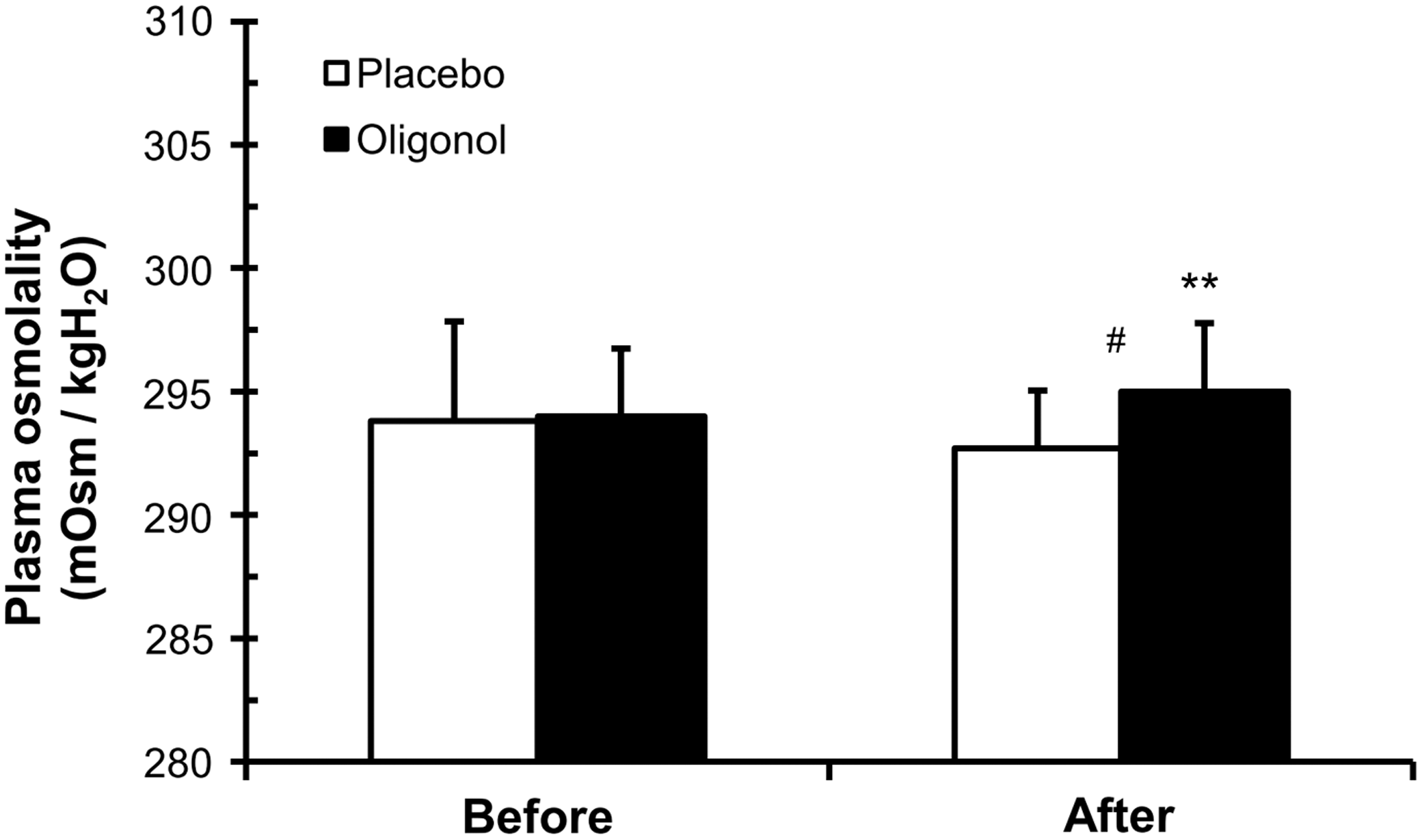
Plasma osmolality levels in the two groups before and after heat load (at 42°C±0.5°C for 30 min).Values are mean±SD. Significant difference between groups at # P<.05, and within each group at **P<.01.
Discussion
In this study, the impact of Oligonol on sweating, PV, and Osm in response to heat load was evaluated. Our novel finding was that Oligonol supplementation attenuated the elevation of body temperature, sweating, serum aldosterone concentration, and the decrease in blood sodium compared with a placebo control. However, PV was much lower and Osm was much higher with Oligonol supplementation than with the placebo. These results suggest that Oligonol can be used as a natural substitute to help attenuate the elevation of body temperature and sweat loss under heat load. On the other hand, caution should be exercised with Oligonol supplementation to limit excessive loss of PV. To our knowledge, this is the first study to demonstrate the modulation of sweating, PV, and Osm by Oligonol supplementation.
Thermal stress can challenge the function of the human cardiovascular system, and temperature regulation, body fluid balance, and exercise performance. 15 Prolonged exposure to hyperthermic conditions can induce water deficits due to large amounts of sweating and can eventually lead to dehydration. 16 The state of body hydration has a greater effect on thermoregulation during heat stress; therefore, delayed heat dissipation due to dehydration or hypohydration can further elevate body temperature. 17 Our results demonstrate that Oligonol intake attenuates the heat-induced elevation of Tty and mTb after heat load, consistent with our previous studies showing attenuation of body temperature increase under passive heating with Oligonol supplementation. 6 –8 A reduced elevation of body temperature with Oligonol appears to contribute to reduced sweat loss.
We evaluated the sweating response to heat load. The sweating activity can change after exposure to heat or pharmacological agents (e.g., caffeine). 2,3,18 Our results showed that Oligonol supplementation reduced whole-body water loss (i.e., sweat rate) after half-body immersion compared with placebo. The decreased sweat rate with Oligonol could also be due to a lower activated sweat gland density and sweat gland output or a combination of both factors even though the underlying mechanism is unclear in the present study and needs further study to clarify.
Water makes up about 45–70% of the body mass in an average adult. 19 Water balance is determined primarily by the rate of skin evaporative water loss (or sweat rate), the rate of urinary water loss, and water intake. With controlled water supplementation and urination in the present study, Oligonol intake appears to affect PV and Osm because there was a much greater decrease in PV and an elevation of Osm with Oligonol than with placebo, despite the lower WBSLV.
In various animal studies, acute heat exposure has been shown to produce an increase in blood volume. 20,21 This change may be due to the influence of changes in skin circulation on the distribution of body fluids. Elevated skin temperature produces a significant increase in skin blood flow and volume and subsequently in PV. 22 Increased skin temperature results in venodilation and a decrease in capillary pressure, which favors net reabsorption in the cutaneous capillary beds and leads to hemodilation. 23 However, increased skin blood flow (cutaneous vasodilation) results in an increase in capillary pressure, resulting in net filtration and hemoconcentration. 24,25 In the present study, we observed increased hemoconcentration (hemoglobin and hematocrit values increased), a greater decrease in PV, and elevation of plasma Osm with Oligonol than with placebo, despite the lower WBSLV. This suggests that Oligonol intake may affect the migration of water from the plasma.
Up to now, it is unclear whether Oligonol is a diuretic or not. Oligonol is a compound produced from the oligomerization of polyphenols, which possesses antioxidant and anti-inflammatory activities. The health-promoting properties reported for some plants can mostly be attributed to the presence of several phenolics known to possess antioxidant, diuretic, and anti-inflammatory properties. 26 –28 We, therefore, doubted whether Oligonol qualified as a diuretic and investigated the interference effect of Oligonol supplementation on PV, Osm, and related factors such as aldosterone and sodium response to heat loading. Consequently, we observed that Oligonol may have some diuretic activity.
Diuretics enhance the renal excretion of water with or without sodium due to a direct action at different tubular sites of the nephron where solute reabsorption occurs. Diuretics act primarily to decrease extracellular fluid volume, both PV and interstitial fluid volume, which result in an elevation in plasma Osm and a moderate hypohydration. Clinically, they have been widely prescribed in the treatment of hypertension and various edematous states. In the current study, Oligonol appears to have the potential to act as a diuretic. However, further excretion of sodium did not occur by Oligonol intake.
Serum levels of aldosterone are increased during heat stress in humans. 29 The magnitude of the increase was found to be related to the degree of sodium loss as well as the level of thermal stress. Acute heat stress elevates plasma renin activity, and presumably angiotensin two levels, contributing to a rise in plasma levels of aldosterone. 30 In the present study, aldosterone levels increased after heat loading in both groups, but the increase was smaller with Oligonol than placebo. The smaller aldosterone increase and a lower sodium decrease seem to be consistent with lower WBSLV. We speculated that about 1 kg of WBSLV affect greatly serum levels of aldosterone and sodium than change of PV because reabsorption of water and sodium is not happening in sweating.
It is generally accepted that natural bioactive substances can be used as an alternative to synthetic drugs that can cause multiple unwanted effects. These natural products can be considered as potential candidates due to bioactivity of antipyretic, analgesic, and anti-inflammatory agents against fever, algesia, and inflammation associated with several pathological conditions. 31 –33 As with these prior studies, the current study also aimed to evaluate the potential applications of a natural substance, Oligonol. The results validate Oligonol in this regard.
In conclusion, the present study demonstrates that Oligonol supplementation for 1 week can attenuate the elevation of body temperature and excessive sweating under heat load in healthy humans, but interpretation of the results requires caution due to the potent diuretic effect of Oligonol.
Footnotes
Acknowledgments
The authors extend their thanks to the subjects whose participation made this study possible. This work was supported by the Soonchunhyang University Research Fund.
Author Disclosure Statement
No competing financial interests exist.