




Abstract
Obesity is a common cause of hyperlipidemia, which is a major coronary risk factor. Previous studies have shown red yeast rice (RYR) effectiveness in lowering low-density lipoprotein cholesterol. The aim of this study was to investigate the effects of RYR on obesity and hyperlipidemia. Mice were randomly separated into five groups: the control group with a normal diet, the high-fat diet (HFD) group fed a HFD without any treatment, and HFD-fed groups supplemented with RYR (1 g/kg/day for 8 weeks, 1 g/kg/day for 12 weeks, and 2.5 g/kg/day for 8 weeks). Body weight was recorded twice and food intake thrice weekly. Liver and fat pads were surgically removed and weighed. The levels of lipid parameters, liver enzymes, and leptin levels were measured. The HFD feeding resulted in obesity, which was associated with increases in body weight, liver weight, fat pad weight, liver enzymes, and plasma leptin levels with the development of hyperlipidemia. RYR prevented weight gain and fat pad weight in mice fed a HFD. RYR alleviated blood lipid parameters, liver enzymes, and leptin levels, and improved atherogenic index. These findings suggest that RYR has therapeutic potential in treating obesity and hyperlipidemia.
Introduction
O
Statins (3-hydroxy-3-methylglutaryl coenzyme A [HMG-CoA] reductase inhibitors) are the most effective and widely used lipid-lowering medications. 8 –10 Although statins are generally safe and well tolerated some patients develop adverse effects. 11 Among adverse effects of statins, myopathy and hepatotoxicity are of particular concern. Statin-associated myalgias are dose dependent and usually occur without myositis. 12 Because of statin-associated myalgias, patients may seek alternative therapies to manage their hypercholesterolemia, including red yeast rice (RYR), Monascus purpureus. 13
RYR is a dietary supplement made by fermenting the yeast over rice. RYR possesses a family of substances called monacolins, which inhibit the enzyme HMG-CoA reductase, all capable of lowering cholesterol. 14 –16 Previous studies have shown its effectiveness in lowering low-density lipoprotein cholesterol (LDL-C), by being through inhibition of the HMG-CoA reductase enzyme in the liver. 13 RYR has been used to lower LDL-C cholesterol levels in patients who have had to discontinue the use of statin medication due to muscle pains. 17 Furthermore, RYR provided beneficial effects in hyperlipidemia and might have also positively affected cardiac outcomes. 18 These studies suggested that hyperlipidemic patients may have chance to seek alternative cholesterol-lowering therapies in place of more conventional statin therapies. 19
In this study, the hyperlipidemic mouse model was employed, and the parameters of hyperlipidemia, body weight, food intake, liver weight, fat pad weight, liver enzymes, and plasma leptin levels were also estimated. The aim of this study was to assess the effects of RYR on obesity, hyperlipidemia, and NAFLD in mice fed a high-fat diet (HFD).
Methods and Materials
Chemicals and animals
All reagents were purchased from Sigma-Aldrich (St. Louis, MO, USA) unless otherwise noted. RYR powders were prepared from I-Woo agricultural company and were suspended in distilled water as 1:10 ratio. Previous study reported that powdered RYR mainly contains monacolin K, 20 which is regarded as potent chemicals of RYR in antihyperlipidemic effects. 14
Specific pathogen-free 4-week-old male C57BL/6J mice purchased from Nara biotechnology company (Seoul, Korea) were allowed to acclimate for 1 week before use. Mice were allowed access to food and water ad libitum. The animal room was maintained at a temperature of 20°C±2°C, a humidity of 45%±10% and a 12-h light/dark cycle.
Induction of obesity by HFD feeding and RYR treatment
Mice were randomly separated into five groups. Control mice were fed a normal diet (D12450B; Research Diets, Inc., New Brunswick, NJ, USA) and other mice were fed HFD (D12492; Research Diets, Inc.) for 4 weeks before sample treatment. The composition of each diet is listed in Table 1. Control or HFD group were administered saline daily by oral gavage for about 8 weeks. Mice fed a HFD without any treatments served as HFD group. RYR (1 or 2.5 g/kg) was administered daily by oral gavage for 8 weeks. RYR (1 g/kg) was administered daily by oral gavage for 12 weeks at the HFD feed starting.
CD, control diet; HFD, high-fat diet.
Body weight was recorded twice a week and food intake thrice a week, respectively. At the end of the experiment, blood collected from posterior vena cava and plasma was prepared for biochemical analysis and leptin enzyme-linked immunosorbant assay (ELISA). Liver, epididymal fat pad, mesenteric fat pad, inguinal subcutaneous fat were removed surgically, weighed, and immediately frozen in liquid nitrogen. The protocol for this experiment was approved by the Animal Care and Ethical Use Committee at Chung-Ang University, Korea.
Biochemical analysis and leptin ELISA
The levels of triglyceride (TG), total cholesterol (TC), high-density lipoprotein cholesterol (HDL-C), LDL-C, aspartate aminotransferase (AST), and alanine aminotransferase (ALT) in plasma were measured using Beckman Coulter AU5421 (Beckman Coulter, Fullerton, CA, USA). Plasma leptin levels were assayed using mouse leptin ELISA kit (Boster Biological Technology Co., Ltd., Pleasanton, CA, USA) according to manufacturer's instructions.
RNA extraction and reverse transcriptase polymerase chain reaction
Total RNA was extracted from frozen tissue using an RNeasy Mini kit (Qiagen, Valencia, CA, USA) and then reverse-transcribed into cDNA with M-MLV (Moloney murine leukemia virus) reverse transcriptase (Promega, Madison, WI, USA). The β-actin gene (ACTB) was amplified first as an internal control, and its quantified expression level was normalized using Alpha-EaseFC (Alpha Innotech, Inc., Santa Clara, CA, USA). Peroxisome proliferator-activated receptor gamma (PPARγ, NM_011146.3) gene was amplified by polymerase chain reaction (PCR). The PCR products were electrophoresed, and their intensity was automatically determined using AlphaEaseFC software.
Histopathology
Ten lumen-thick liver sections were prepared from frozen liver. To detect lipid deposition, frozen liver sections were stained with Oil Red O as described previously. 21 Hematoxylin and eosin-stained 4 nm-thick sections of adipose tissue were observed under identity occultation and adipocyte measurement was performed as described previously. 22 All adipocytes were made at a final magnification of 200×.
Statistical analysis
The data are expressed as mean±SEM. Statistical differences between means were analyzed by the Student's t-test or Tukey's multiple comparison after analysis of variance. Differences were considered significant at error probabilities smaller than 0.05.
Results
Effects of RYR on body weight and food intake
After 12 weeks of study, the weight of the HFD group significantly increased from starting weight compared with the control group (Fig. 1A, B). All dosage regimens of RYR (1 g/kg/day for 8 weeks, 1 g/kg/day for 12 weeks, and 2.5 g/kg/day for 8 weeks) prevented weight gain in mice fed a HFD. No significant differences were observed in daily food intake among all the groups fed a HFD during the whole experimental period (Fig. 1C).
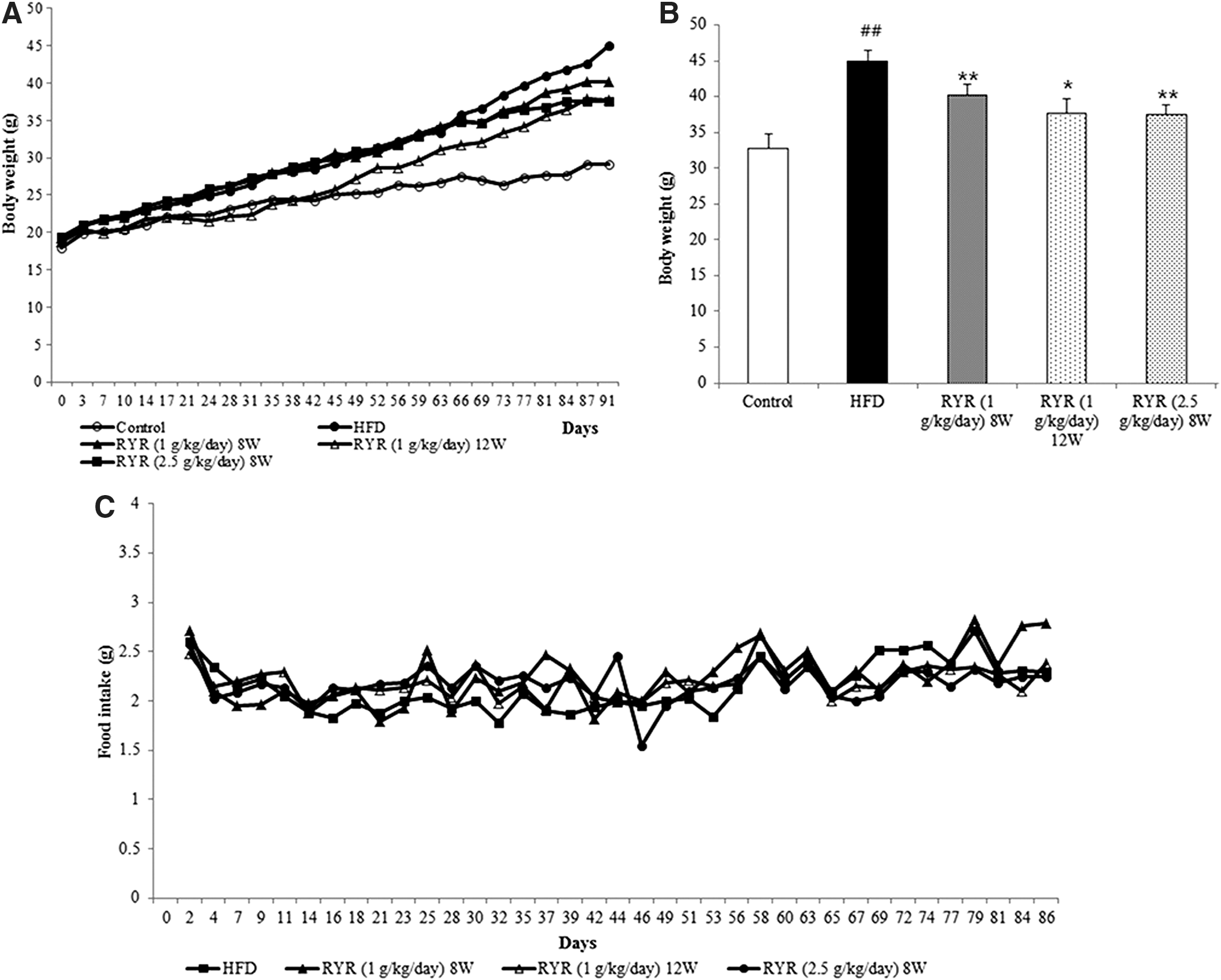
Effects of red yeast rice (RYR) on body weight of mice during experiment period
Effects of RYR on fat pad weight and liver weight
The weight of the fat pads of mice in the HFD group significantly increased compared with that of mice in the control group in 12 weeks (Table 2). All RYR treatments also significantly reduced the mesenteric fat pad weight compared with the HFD group, except RYR 1 g/kg/day 8 weeks group. Epididymal fat pad weight decreased by treatment of RYR 2.5 g/kg/day for 8 weeks compared with the HFD group, but no significance. Compared with the control group of mice, the liver weight significantly increased in the HFD group of mice fed a HFD for 12 weeks (Table 2), while the liver weight significantly declined in groups administered RYR 1 g/kg/day and RYR 2.5 g/kg/day for 12 weeks, compared with that of HFD group.
Mesenteric fat pad weights and liver weight/BW were decreased in rats administered RYR compared with HFD group. Data represent mean±SEM.
P<.01 compared to control group.
P<.05 compared to HFD group.
P<.01 compared to HFD group.
BW, body weight; RYR, red yeast rice.
Effects of RYR on plasma lipid parameters
As can be seen in Table 3, the serum levels of TC, TG, HDL-C, and LDL-C significantly increased in mice fed a HFD for 12 weeks when compared with those in the control group of mice fed a basic diet. After 8 weeks of RYR treatment (1 g/kg/day), the level of plasma TC and TG significantly decreased compared with the HFD group. Treatments of RYR 1 g/kg/day for 12 weeks or 2.5 g/kg/day for 8 weeks significantly decreased the level of plasma TG and TC, and increased the level of plasma HDL-C compared with the HFD group. The atherogenic and coronary artery indices were also calculated and presented in Table 3.
TG level and TC level were significantly decreased in RYR treatment groups. HDL level was increased in RYR treatment groups compared with HFD group. Atherogenic index: TG/HDL-C, Coronary arteric index: LDL-C/HDL-C. The atherogenic index was significantly decreased in RYR treatment groups. Data represent mean±SEM.
P<.01 compared to control group.
P<.05 compared to HFD group.
P<.01 compared to HFD group.
HDL-C, high-density lipoprotein cholesterol; LDL-C, low-density lipoprotein cholesterol; RYR, red yeast rice; TC, total cholesterol; TG, triglyceride.
Effects of RYR on biochemical and morphological changes in subcutaneous adipocytes
The plasma leptin levels of the HFD group significantly increased in 12 weeks compared with the control group (Fig. 2A). All dosage regimens of RYR (1 g/kg/day for 8 weeks, 1 g/kg/day for 12 weeks, and 2.5 g/kg/day for 8 weeks) significantly decreased plasma leptin levels in mice fed a HFD relative to the HFD group. HFD elevated gene expression of the lipogenic marker, PPARγ. Treatment with RYR attenuated the HFD-induced gene expression of PPARγ. Therefore, RYR treatment affected HFD-induced lipogenesis in adipose tissue (Fig. 2B). The HFD mice showed considerable lipid accumulation in subcutaneous adipocytes compared with that in the control group (Fig. 2C). RYR treatment lowered the size of mesenteric adipocytes compared with the HFD group.
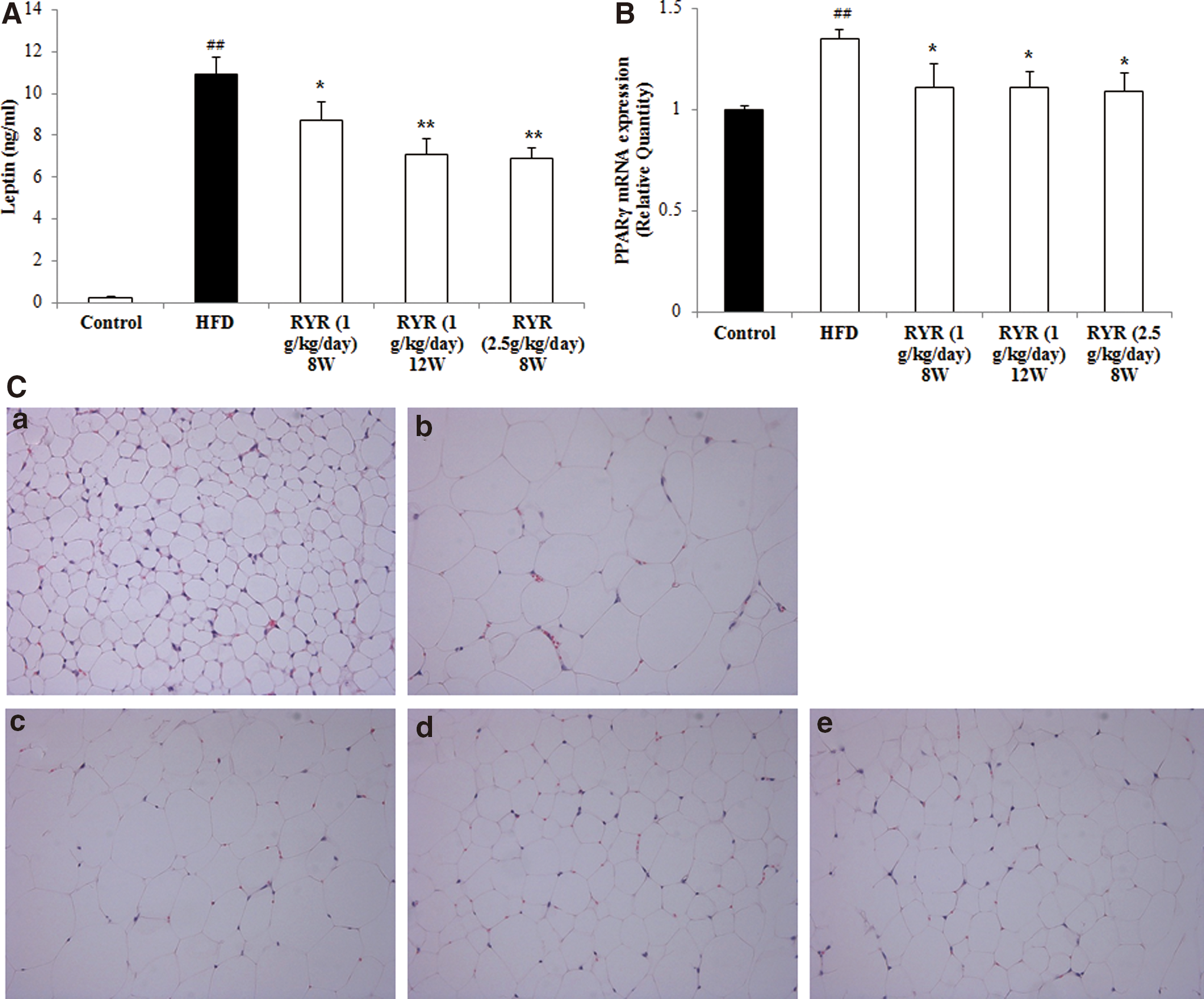
Leptin levels in RYR-treated mice were significantly decreased compared with the HFD group
Effects of RYR on liver enzymes and morphological changes in hepatocytes
AST and ALT levels were significantly increased in HFD group when compared with those in the control group of mice (Fig. 3A). RYR treatments significantly decreased the level of the liver enzymes compared with the HFD group. The HFD fed mice showed considerable hepatic lipid droplet accumulation compared with that in the control group (Fig. 3B). The administration of RYR groups significantly lowered the accumulation of hepatic lipid droplets.
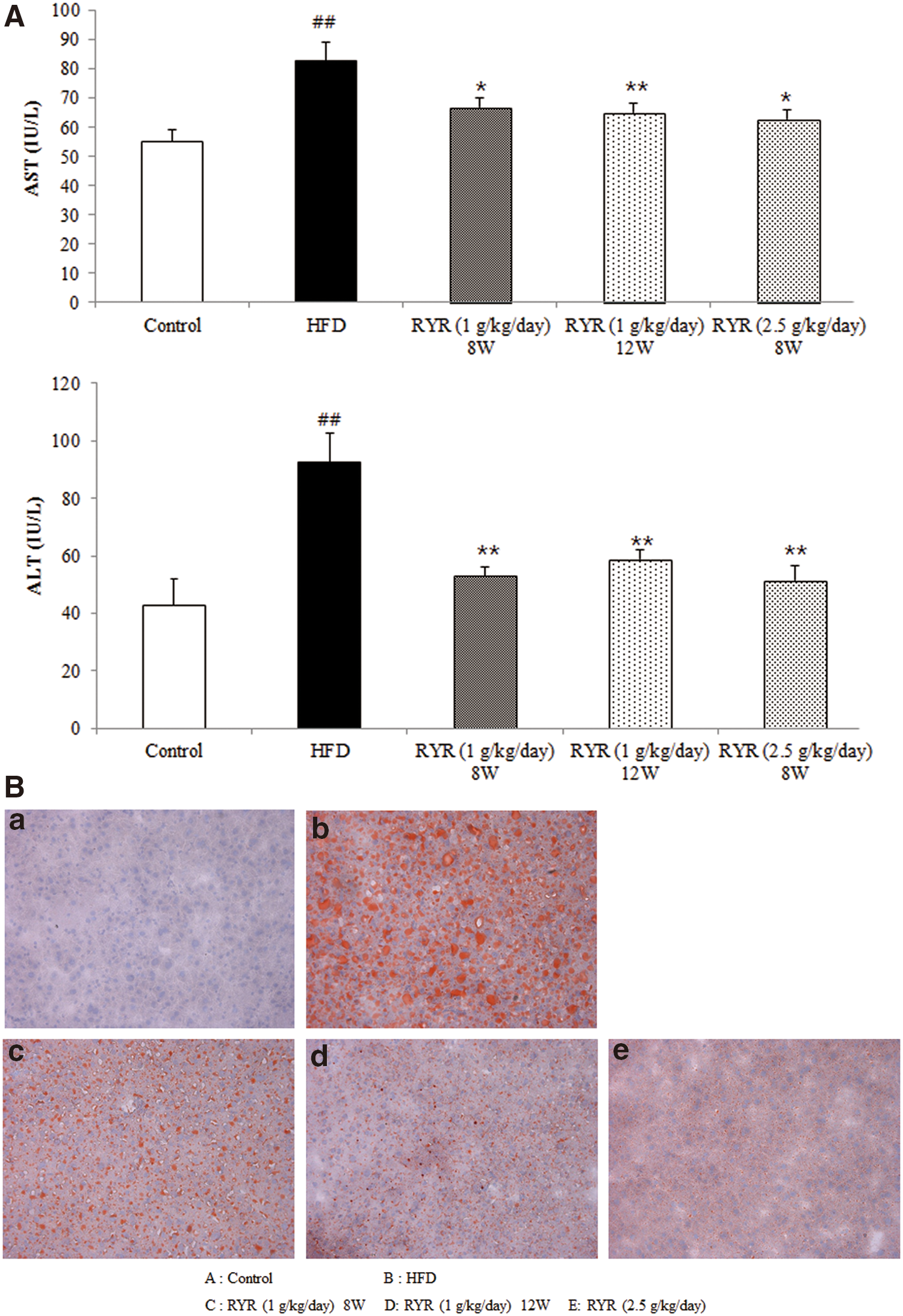
The aspartate aminotransferase (AST) and alanine aminotransferase (ALT) levels were significantly decreased in RYR-treated mice
Discussion
Obesity is known to increase the risk of cardiovascular disease, a major cause of death worldwide. 23 Although several factors contribute to increased risk, the adverse effect of obesity on plasma lipoprotein levels is a major determinant. According to the results of this study, HFD feeding increased body weight, liver weight, fat pad weight, liver enzymes, and plasma leptin levels, but these were inhibited by RYR. Mice fed a HFD also showed significant increases in plasma TC, TG, and LDL-C levels. The administration of RYR significantly lowered plasma TC and TG levels in mice with HFD.
This study found that all dosage regimens of RYR (1 g/kg/day for 8 weeks, 1 g/kg/day for 12 weeks, and 2.5 g/kg/day for 8 weeks) significantly inhibited the increase in body weight in mice fed a HFD. This inhibition was not associated with decreased food intake because there was no significant difference in daily food intake among all groups. Furthermore, this decrease in body weight was accompanied by loss of stored body fat because treatment with RYR also significantly decreased the fat pad weight compared with the HFD group. Excessive growth of adipose tissue results in obesity, which includes hyperplastic and hypertrophic growth mechanisms. 24 Excess glucose can be converted to triacylglycerol and stored in adipose tissue via lipogenesis, which is driven by PPARγ. 25 The histological appearance of mesenteric adipocytes in the HFD mice supplemented with RYR was more regular and showed adipocyte size similar to that of the HFD group. RYR treatment also reduced the gene expression of the lipogenesis marker, PPARγ. These results suggest that RYR suppresses HFD-induced adipose tissue mass and body weight gain and inhibits lipid accumulation in adipose tissue.
Obesity is associated with hyperlipidemia characterized by increasing TG and decreasing HDL-C concentrations. 26 Increased levels of TG are considered as an important risk factor for cardiovascular disease. 27 TG induces the ectopic accumulation of lipids in the liver and is involved in several diseases such as type 2-diabetes and metabolic syndrome. TC is a measure of the total amount of all cholesterol in blood, and LDL-C induces fat deposits in the arteries, causing decreased blood flow and heart attack. High levels of TC increase the risk of developing coronary heart disease and high LDL-C levels are also a risk factor for coronary heart disease. HDL-C levels are inversely related to this risk because HDL-C removes excess cholesterol from arteries and transports it to the liver for elimination in the bile. 28,29 Therefore, extensive interventions are recommended when treating obesity and hyperlipidemia, including life style modifications such as diet control and exercise, and pharmacological therapy. However, many patients need efficacious alternatives or additive therapy to the current pharmacological interventions due to their adverse effects or insufficient efficacy. Previous analytical research using high-performance liquid chromatography reported that powdered RYR mainly contained monacolin K, 20 which was effective for the maintenance of normal blood LDL-C levels. 14
The effect of RYR treatment on the atherogenic and coronary artery risk indices was remarkable. The ratio of TG to HDL‐C (known as the atherogenic index) and the ratio of LDL-C to HDL-C (known as coronary artery index) are important and reliable markers to evaluate whether cholesterol is accumulated into tissues or metabolized and excreted. 30,31 These ratios are strong prognostic indicators for cardiovascular disease. 32,33 In this study, the administration of RYR induced profound reductions in the atherogenic index in hyperlipidemic mice and strongly suggests that RYR has therapeutic potential in the management of obesity, hyperlipidemia, and in the prevention of atherogenic cardiovascular diseases.
Plasma leptin levels were measured in this study because leptin is a hormone produced by adipose tissue and leptin deficiency has been associated with development of obesity. 34,35 However, most obese humans have increased plasma leptin levels, likely reflecting leptin-resistance rather than leptin-deficiency. 36,37 Leptin is associated with increased insulin resistance, which can cause hyperlipidemia. 38 Leptin may induce endothelial dysfunction and atherosclerosis by promoting proinflammatory signaling in hyperleptinemic-states. 39 The expression levels of the inflammatory transcription factors, tumor necrosis factor-α and interleukin-6, were shown to be reduced in the RYR group when compared with the hyperlipidemia group. 40 A positive relationship between serum leptin level and body fat mass in HFD has been reported. 41 In our study, HFD induced an increase in serum leptin, whole body fat mass marker, which were significantly decreased in mice consuming a diet containing RYR. Subcutaneous adipocyte size of RYR treatment group was smaller than HFD group. According to these result of RYR treatment, we suggested that its treatment can alleviate the whole body obese state and adipokine-related inflammation.
In this study, the liver weight was also evaluated. NAFLD caused by hyperlipidemia is a disorder in fat metabolism, which is detrimental to the liver and a main cause of obesity-associated morbidity and mortality. Several materials having hypolipidemic activities also possessed hepatoprotective effects. 42 –44 In this study, the liver weight significantly increased in the HFD group of mice fed HFD for 12 weeks, but profound decline was found in all groups of mice given RYR. These results showed that RYR was characterized by an ameliorating effect on NAFLD. Elevated liver enzyme levels are one of the main adverse effects observed in patients on statins, which are highly effective and widely used lipid-lowering medications. In this study, all dosage regimens of RYR induced significant decrease in liver enzyme levels compared with the HFD group.
We demonstrated that dietary RYR alleviated HFD-induced obese status and dyslipidemic changes in mice by reducing body weight, adipocyte size, and normalizing lipid parameters in serum. RYR treatment might be useful and beneficial for HFD-induced obesity-related complications, such as dyslipidemic changes that induce cardiovascular disease. However, further investigations are required to assess the possible toxicity of RYR.
Footnotes
Acknowledgment
The authors appreciate the I-Woo agricultural company (Seoul, Korea) for financial support.
Author Disclosure Statement
The authors have declared that there are no conflicts of interest.